TL;DR
- Porcelain countertops run $55, $120 per square foot installed, depending on slab thickness and edge complexity.
- They're harder than granite, nearly impossible to stain, and can handle heat straight from a pan.
- The tradeoff is brittleness at edges and a limited fabricator pool.
- Quartz costs roughly the same but is heavier, easier to chip-repair, and widely available from any stone shop.
What are porcelain countertops, exactly?
Porcelain countertops are slabs made from refined clay, feldspar, and silica fired at extremely high temperatures, typically above 1200°C. The result is a dense, non-porous surface with very low water absorption, usually below 0.5%, which is what tile standards define as vitreous or impervious porcelain [1]. These are not ceramic tile glued to a substrate. Modern porcelain countertop slabs come in large formats, most commonly 126" × 63" or 128" × 64", and in thicknesses of 6mm, 12mm, and 20mm.
The 12mm thickness is the most common for countertops. The 6mm slabs are used almost exclusively as overlays laminated on top of existing counters. The 20mm slabs behave more like natural stone and are used for heavy-duty applications or waterfall islands where visible edge thickness matters aesthetically.
Manufacturers fire a high-resolution inkjet image of stone, wood, concrete, or abstract pattern directly into the body of the slab, more than a surface coating. That matters because scratches don't expose a different color underneath the way a painted or laminated surface would. The pattern runs several millimeters deep, though not through the full thickness of the slab.
How much do porcelain countertops cost?
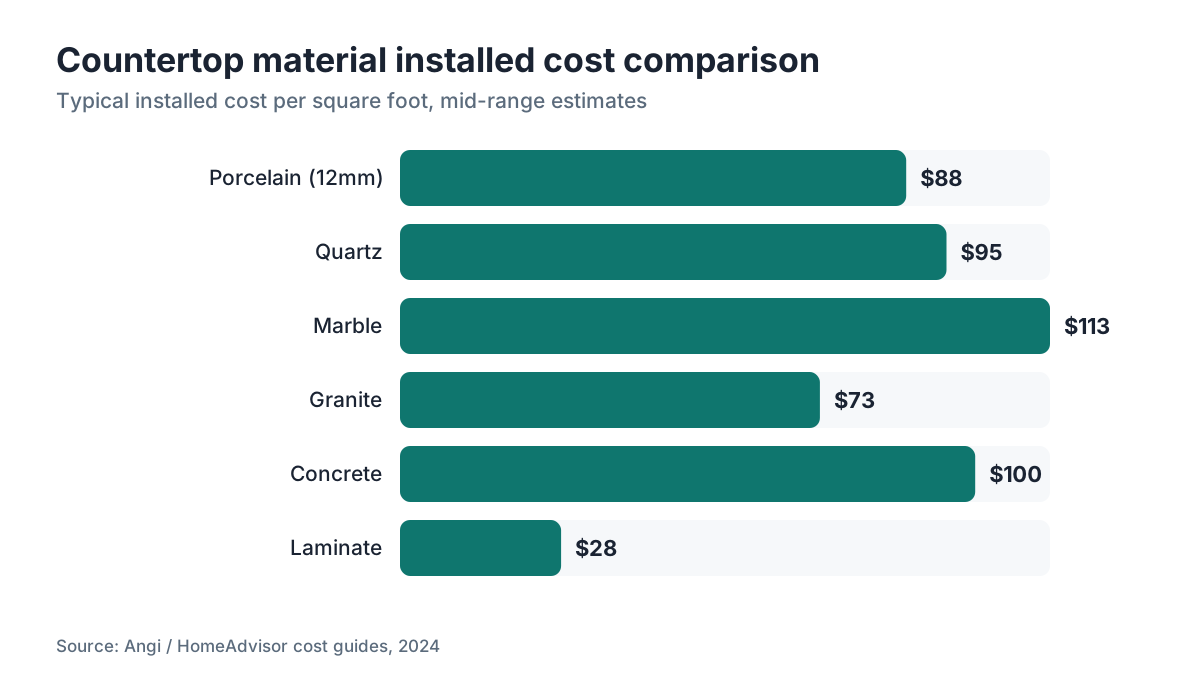
Installed porcelain countertops typically cost $55 to $120 per square foot, with the wide range driven by slab thickness, pattern complexity, edge profiles, and local labor rates [2]. Material-only prices for 12mm slabs run roughly $28 to $65 per square foot at distributor pricing. Fabrication and installation add another $30 to $55 per square foot depending on the shop.
Here's what pushes costs up: 20mm slabs cost 20 to 40% more than 12mm slabs at the material level. Mitered waterfall edges on a porcelain island are labor-intensive and some shops charge a premium of $80 to $150 per linear foot just for the miter. Cutouts for undermount sinks and cooktops require specialized diamond blades and take longer than cutting quartz, so expect a higher cutout fee, often $150 to $250 per cutout.
Compared to quartz countertops, the installed price ranges overlap almost entirely. Quartz runs roughly $60 to $130 per square foot installed [3]. Porcelain is not cheaper than quartz in most markets. It can be more expensive if your fabricator has limited experience with it, because inexperienced cutting produces chip-out and wasted material.
Granite sits a bit lower, typically $45 to $100 installed [4], though premium granites with exotic patterns push past $150. If budget is your primary driver, laminate countertops or formica countertops are the honest comparison, not porcelain.
| Material | Installed cost range (per sq ft) | Typical warranty |
|---|---|---|
| Porcelain (12mm) | $55, $120 | Manufacturer: 10 to 25 yr; install: varies |
| Quartz | $60, $130 | Manufacturer: 10 to 15 yr lifetime |
| Granite | $45, $100 | No manufacturer warranty |
| Marble | $75, $150 | No manufacturer warranty |
| Laminate | $15, $40 | Varies by brand |
| Concrete | $65, $135 | Fabricator-dependent |
How durable is porcelain compared to other countertop materials?
Porcelain is extremely hard. The Mohs hardness of dense-sintered porcelain is typically 6 to 8, which puts it above most granite countertops (6 to 7) and significantly above quartz (5 to 7 depending on the engineered binder content) [5]. You can drag a cast iron pan across it without scratching. Your kitchen knife will dull before the counter marks.
Heat resistance is genuine. Porcelain slabs are fired at temperatures far exceeding anything a residential oven or pan produces. Setting a 500°F Dutch oven directly on a 12mm porcelain slab will not scorch, discolor, or crack it under normal conditions. Quartz, by contrast, uses polymer resins that can discolor or warp above 300°F, which is why quartz manufacturers universally warn against hot pots without trivets [6].
The weakness is edge chipping. The same brittleness that makes porcelain hard makes it vulnerable to sharp impacts at the edge. Drop a cast iron pan on the corner of a porcelain counter and you may chip or crack it in a way that's very difficult to repair invisibly. Quartz edges chip too, but the polymer content makes repairs with color-matched epoxy reasonably clean. Porcelain chip repairs are often visible.
For outdoor kitchens, porcelain is genuinely better than quartz. It's frost-resistant at 20mm thickness (check the manufacturer's frost resistance rating), UV-stable so the color doesn't shift in sunlight, and the non-porous surface doesn't harbor mold or mildew the way porous stone can.
Porcelain is also non-porous enough that it never needs sealing. That's a real maintenance advantage over granite, quartzite, and marble.
Porcelain countertops vs quartz: which should you actually choose?
This is the question most homeowners are really asking, and the honest answer depends on four things: how you cook, what your fabricator knows, what look you want, and how you feel about risk.
If you cook seriously and put hot pans directly on counters without thinking about it, porcelain is the better call. Heat damage to quartz is a real and common warranty dispute. Most quartz warranties explicitly exclude heat damage because the resins are thermoplastic [6].
If you want a large-format slab that mimics Calacatta marble or bookmatched stone, both materials now offer good options. Porcelain slabs from brands like Dekton (Cosentino) and Neolith come in convincing stone looks. Quartz brands like Cambria and Caesarstone have improved their veining dramatically. Personal preference rules here.
If you're working with a smaller regional shop or a fabricator you found through a local referral, ask them specifically how many porcelain jobs they've done. Porcelain requires different tooling (higher-quality diamond blades, slower cutting speeds, water cooling) and more careful handling. An experienced porcelain fabricator will show you finished work. An inexperienced one will chip your edges and the fight over responsibility is unpleasant.
Quartz is more forgiving to fabricate. That means more shops can do it well, lead times are shorter, and you're less dependent on finding a specialist. For a standard kitchen with a rectangular layout, no waterfall, and an undermount sink, quartz is the lower-risk material choice.
Porcelain wins for: outdoor kitchens, heavy heat users, anyone who genuinely never wants to seal, very large format slab looks, and some contemporary or minimalist aesthetics where the ultra-thin edge profile is a design choice.
Quartz wins for: most residential kitchens, buyers who want a wide selection of fabricators, anyone repairing a chip someday without calling it a loss, and buyers prioritizing impact resistance over heat resistance.
For a full breakdown of quartz specifically, see our guide to quartz countertops.
What thicknesses are available, and which one do you need?
The three standard porcelain slab thicknesses are 6mm, 12mm, and 20mm. Each is suited to a different use case.
6mm slabs are overlay material. They're almost never installed as a freestanding countertop on their own. Instead, they're adhered directly on top of existing counters, plywood substrates, or even old tile. The advantage is minimal weight and the ability to skip full demolition. The tradeoff is that the counter surface is only as flat as what's underneath, and edge treatments are limited. Overlay porcelain makes sense in a bathroom reface or a rental renovation where you're controlling cost.
12mm is the workhorse residential thickness. It's stiff enough to span a cabinet opening without flexing, takes a bullnose or eased edge cleanly, and is light enough that a two-person crew can handle full slabs. Most kitchen countertop projects use 12mm.
20mm slabs behave like natural stone. They're heavy, require full support, and have the visual edge weight that looks proportional on a large island. For waterfall edges where the slab wraps floor to ceiling on an island side, 20mm is what looks right without laminating two thinner pieces together. It's also the spec most manufacturers recommend for outdoor applications where freeze-thaw cycles create stress.
One common fabrication trick for getting the look of 20mm at lower cost is to laminate two 12mm pieces together at the visible edge only. It's a legitimate technique that most homeowners can't spot once the counter is installed. Ask your fabricator whether they're quoting solid 20mm or a laminated edge buildup.
Can porcelain countertops crack or chip, and what can you do about it?
Yes, they can. Porcelain is brittle in the way all ceramic materials are brittle. That brittleness is not a defect; it's a physical property of a material with very low elasticity. Drop something heavy enough on the edge or apply a point load to an unsupported span and you can crack or chip it.
The most vulnerable spots are: unsupported overhangs beyond about 8 to 12 inches (depending on thickness and the slab's modulus of rupture), cutout corners for sinks and cooktops, and exterior edges. Sharp 90° corners inside a cutout are stress concentrators. Good fabricators relieve interior corners with a small radius drill relief, which distributes stress and significantly reduces crack propagation risk.
Repair is the real issue. A chipped quartz corner can be filled with color-matched polyester or epoxy filler and polished flush in a way that's often barely visible. A chipped porcelain edge shows the body of the slab (usually white or gray) under the surface pattern, and the repair is almost always visible on close inspection. This is not a dealbreaker for everyone, but it's honest information you should have before you choose the material.
Cracks across the field of a well-supported slab are rare. Most cracks trace back to: installation on a cabinet that wasn't level (creating a high spot that gets point-loaded), an unsupported cutout edge, or an impact during delivery or installation. Ask your installer how they verify cabinet flatness before setting the slab.
How do you clean and maintain porcelain countertops?
Maintenance is genuinely simple. Because porcelain is non-porous (water absorption below 0.5% by ASTM C373 standards [1]), it never needs sealing. Stains from coffee, red wine, oil, and most kitchen acids sit on the surface rather than penetrating it.
For daily cleaning, a damp cloth or mild dish soap and water is enough. For dried food or grease, a non-abrasive nylon scrubber works without scratching. For stubborn stains, a diluted solution of isopropyl alcohol (around 70%) or a pH-neutral stone cleaner removes most residue.
What to avoid: abrasive powders (Comet, Bar Keepers Friend with scrubbing), steel wool, and high-alkaline or high-acid cleaners used repeatedly at full strength. A single accidental exposure to bleach or vinegar won't damage the surface, but regular use of strongly acidic or caustic cleaners can dull the surface finish over time on some polished porcelain products.
Unlike granite or quartzite, you won't spend money or time on annual sealing. See our general guide on how to clean stone countertops for context on what non-porous versus porous surfaces mean for your cleaning routine.
Grout lines are not a maintenance concern with countertop slabs because they're installed as continuous slabs. Don't confuse porcelain countertop slabs with tiled countertops, which do have grout lines and all the maintenance that implies.
What are the best porcelain countertop brands?
A few manufacturers dominate the large-format porcelain slab market and most fabricators know their material.
Dekton (by Cosentino) is an ultra-compact sintered surface that combines silica, quartz, and glass. Technically it's not pure porcelain but it uses the same sintering technology and competes directly in the same category. Cosentino describes it as "an ultra-compact surface with exclusive TSP technology" and warranties it for 10 years for interior residential use [7]. Dekton is available in hundreds of finishes including outdoor-rated options.
Neolith (by TheSize) is a true sintered porcelain. Available in thicknesses from 6mm to 20mm, and widely specified for both residential and commercial kitchens. Their Classtone series mimics natural stone with bookmatched options.
Laminam is an Italian manufacturer producing some of the largest porcelain slabs available, up to 126" × 60" at thicknesses from 5mm to 20mm. Architects specify Laminam frequently for its scale and consistency.
Italian brands like Atlas Plan (part of Atlas Concorde) and Fiandre are also well-established in the North American market through distribution networks.
For U.S. buyers, availability depends heavily on your regional stone distributor. Ask your fabricator which brands they can source locally; shipping a fragile large-format slab across the country is expensive and introduces breakage risk.
Shops running quoting software like SlabWise can attach slab material specs and price per square foot directly to a quote, which makes it easier to compare porcelain and quartz options side by side before you commit to a material.
Is porcelain safe for food contact, and does it have any health concerns?
Porcelain is food-safe. The firing process drives off any organic compounds, and the dense, non-porous surface does not harbor bacteria in the way wood or unsealed stone can. The U.S. Food and Drug Administration regulates food-contact surface safety under 21 CFR Part 177 for polymers and related materials, but fired ceramic and porcelain surfaces are generally not subject to those restrictions because they do not leach materials into food under normal use conditions [8].
There's one health angle worth knowing about: porcelain contains silica in crystalline form as a raw material, and cutting or grinding porcelain produces respirable crystalline silica (RCS) dust. OSHA's silica standard for construction (29 CFR 1926.1153) sets a permissible exposure limit (PEL) of 50 micrograms per cubic meter as an 8-hour TWA and requires dust controls (water suppression, vacuum extraction, or enclosed cutting) for silica-generating operations [9]. This is a fabricator concern, not a homeowner concern. Installed and intact porcelain poses zero silica hazard. But if you're specifying porcelain for a commercial kitchen renovation and care about your contractor's safety practices, it's a fair question to ask.
The silica exposure concern applies to quartz fabrication as well, perhaps more acutely. Engineered quartz slabs are 90 to 95% crystalline silica by weight. The CDC and OSHA have flagged engineered stone fabrication as a significant occupational silica risk [11]. Porcelain typically has lower total silica content than engineered quartz.
How does porcelain perform for bathroom and outdoor countertops?
Porcelain is genuinely well-suited to both applications, probably better suited than quartz for outdoor use specifically.
For bathroom vanities, the non-porous surface means soap scum and toothpaste don't stain or etch the way they can on marble or limestone. The thin 12mm profile looks clean and contemporary on floating vanities. The weight is lower than 3cm natural stone, which matters if your cabinet structure is lightweight. One practical note: bathroom vanities tend to have smaller dimensions and more cutouts (for undermount sinks) relative to the total slab area, which can raise the per-square-foot installed cost because cutout labor is spread across less material.
For outdoor kitchens, porcelain at 20mm is one of the best-performing countertop materials available. It's UV-stable (colors don't fade), frost-resistant at proper thickness (verify the manufacturer's freeze-thaw test rating, usually expressed as number of cycles per ASTM C1026 or similar [12]), and genuinely impervious to rain, humidity, and temperature swings. Quartz manufacturers typically void warranties for outdoor installations because resin binders can degrade with UV and freeze-thaw cycling [6]. Porcelain manufacturers generally do not have that restriction for properly specified 20mm slabs.
One installation consideration for outdoor counters: ensure your substrate and support structure is designed for the weight of a 20mm porcelain slab (roughly 12 to 14 lbs per square foot) and that the support allows for any thermal expansion at the perimeter. Your fabricator should spec appropriate silicone joint widths rather than rigidly gluing edges.
What should homeowners ask a fabricator before buying porcelain countertops?
A few questions will tell you quickly whether a shop can actually do the job well.
First: how many porcelain jobs have you completed in the last year, and can I see photos or a finished installation? Experience with porcelain is not universal. Shops that primarily cut granite or quartz may not have the right blade specs, the right cutting speed protocols, or the handling equipment to move a fragile large-format slab without incident.
Second: what blade and cutting method do you use for porcelain? The right answer involves continuous-rim diamond blades rated for porcelain or ultra-hard ceramic, water cooling, and specific feed rates. A shop that's vague about this or that says they use the same setup as quartz is telling you something.
Third: how do you handle sink cutouts? Porcelain cutouts for undermount sinks require a plunge cut with router relief at corners. The interior corners must be radiused. A square interior corner is a stress crack waiting to happen.
Fourth: what does your warranty cover? Manufacturer warranties cover material defects. Fabricator warranties cover installation workmanship. Understand both, because a chip from a drop during installation is a workmanship issue, not a manufacturer defect.
Fifth: are you buying from a local distributor or drop-shipping from elsewhere? Local slab sourcing means you can inspect the slab before fabrication. A slab arriving by freight from a distant warehouse has much higher breakage risk during transit, and a broken slab delays your project by weeks.
Fabricators quoting porcelain jobs should track their waste factors carefully. Porcelain has higher breakage rates during cutting than quartz, and nesting software that accounts for grain direction and pattern matching saves real material cost. Tools like SlabWise help shops run accurate nesting and quoting for materials where waste factors vary by slab thickness and pattern type.
Are porcelain countertops a good investment for resale value?
Nobody has clean apples-to-apples data on this. The closest you can get is the Remodeling Magazine Cost vs. Value report, which tracks kitchen remodel ROI but doesn't break down countertop material choices at that granularity [10]. What the industry generally agrees on is that buyers respond to countertop quality and appearance, and that premium countertops return somewhere in the range of 60 to 80% of their cost in resale value depending on your market and home price tier.
Porcelain countertops are not yet as well-known among general homebuyers as quartz or granite. A buyer who knows what they're looking at may appreciate the heat resistance and durability. A buyer who doesn't recognize the material may not assign it the same perceived value as a quartz countertop from a brand they've heard of.
For most homeowners in the $400,000, $800,000 home price range, quartz is probably the safer resale choice simply because buyers recognize and expect it. For higher-end homes where buyers expect something less common and are likely to do more research, porcelain or Dekton can be a genuine differentiator.
If you're renovating to sell in under two years, the material choice matters less than the overall quality of the installation and the visual harmony with the rest of the kitchen. A beautifully installed porcelain counter will photograph better and show better than a poorly installed quartz counter every time.
For comparison shopping across other kitchen countertop materials, our kitchen countertops guide covers the full landscape, and the marble countertops and concrete countertops articles cover the other premium alternatives.
Frequently asked questions
How long do porcelain countertops last?
A well-installed porcelain countertop can last decades without any measurable degradation in the surface. The material itself doesn't age, stain, or require refinishing. The practical lifespan is limited mostly by style preferences or edge chip damage from impacts. Manufacturer warranties typically run 10 to 25 years covering material defects, though the slab itself can outlast the warranty period easily.
Can you cut directly on a porcelain countertop?
Technically yes, the surface won't scratch from a kitchen knife. But you shouldn't, for the same reason you shouldn't cut directly on any hard countertop: it destroys your knife edge. Porcelain is harder than most knife steel, so your blades dull almost immediately on contact. Use a cutting board. The counter will be fine; your knives won't.
Do porcelain countertops need to be sealed?
No. Porcelain has a water absorption rate below 0.5% by ASTM standards, which makes it impervious to staining without any sealer. This is one of its genuine advantages over natural stone. No annual sealing costs, no risk of forgetting to reseal after a few years, and no need to worry about the sealer's chemical compatibility with your cleaning products.
What is the difference between porcelain and quartz countertops?
Porcelain is fired clay and mineral sintered at high heat, fully non-porous, and heat-resistant enough to handle hot pans directly. Quartz is crushed quartz stone bound with polymer resins, slightly softer, and vulnerable to heat above roughly 300°F. Both are non-porous and stain-resistant. Quartz is easier to chip-repair and more widely available from fabricators. Porcelain is better for outdoor use and high-heat cooking.
How much does a typical porcelain countertop kitchen cost in total?
A standard kitchen with roughly 50 square feet of countertop surface in 12mm porcelain runs $2,750 to $6,000 installed based on the $55 to $120 per square foot range. Add $150 to $250 per cutout for sinks and cooktops, and more if you're doing waterfall edges or complex miters. A full kitchen with an island can easily reach $8,000 to $12,000 for premium slabs with complex details.
Is porcelain or quartz better for a kitchen with kids?
Quartz edges generally hold up better to the accidental impacts that come with busy family kitchens, and chips are easier to repair when they do happen. Porcelain's edge brittleness is a real consideration if your counters take regular abuse. Both are stain-resistant and easy to clean. If you cook with heavy cast iron frequently and put hot pans down without thinking, porcelain's heat resistance is a meaningful advantage.
Can porcelain countertops be used outdoors?
Yes, and this is one of the strongest use cases for porcelain. At 20mm thickness, porcelain is frost-resistant, UV-stable, and doesn't require sealing in outdoor conditions. Quartz manufacturers typically void warranties for outdoor installations because the resin binders degrade with UV exposure and freeze-thaw cycling. Verify the specific manufacturer's frost resistance rating before spec-ing any outdoor porcelain installation.
What edge profiles work with porcelain countertops?
Standard profiles like eased, beveled, and bullnose work well and are common. Ogee and cove profiles are possible but require more skill and carry higher chip risk during fabrication. A straight eased edge (1 to 2mm relief) is actually one of the best choices for porcelain because it reduces the sharpness of the edge without creating a complex profile that's hard to execute cleanly. Mitered waterfall edges work beautifully but require an experienced fabricator.
Is porcelain heavy? Will my cabinets support it?
A 12mm porcelain slab weighs roughly 7 to 8 lbs per square foot, compared to about 18 to 20 lbs per square foot for a 3cm granite or quartz slab. Standard residential cabinets designed for stone countertops can handle porcelain easily. The 20mm thickness runs about 12 to 14 lbs per square foot, still lighter than full-thickness natural stone. Cabinet support is rarely a limiting factor for porcelain in a standard kitchen.
What's the difference between porcelain and ceramic countertops?
Porcelain is a subset of ceramic fired at higher temperatures with denser, less porous results. ANSI standards define porcelain tile as having water absorption below 0.5%, while ceramic tile can absorb up to 7%. For countertops, this matters because countertop-grade porcelain is specifically large-format, high-density sintered material. Ceramic tile countertops still exist but they have grout lines that require maintenance; porcelain countertop slabs are single continuous pieces with no grout.
Can you use porcelain over existing countertops?
Yes, with 6mm overlay slabs. The existing surface must be flat, stable, and properly bonded to the cabinets. Any high spots create point loads on the thin slab. The existing counter can't have significant dips or waves. Overlay installation avoids demolition costs but limits your sink and edge options. Most fabricators will inspect the substrate before committing to an overlay job.
How do porcelain countertops compare to marble or quartzite?
Marble and quartzite are natural stone with genuine variation and aging character that porcelain can't fully replicate. Marble etches with acids (lemon juice, wine) and requires sealing. Quartzite is harder and more durable than marble but also needs sealing and can still etch depending on the specific stone. Porcelain beats both on maintenance simplicity. Marble and quartzite beat porcelain on authentic natural appearance and tactile feel for buyers who care about those things.
How do I find a fabricator experienced with porcelain?
Ask the slab distributor, more than Google. Stone and tile distributors who carry large-format porcelain brands like Dekton, Neolith, or Laminam usually maintain a list of certified or experienced fabricators in your area. Those certifications exist because porcelain fabrication genuinely requires different tooling and training. A brand-certified shop has demonstrated they can cut and install the material without damaging it.
Sources
- ASTM International, ASTM C373 Standard Test Method for Water Absorption, Bulk Density: Porcelain is defined by water absorption below 0.5% per ASTM C373; impervious tile is below 0.5%
- HomeAdvisor (Angi), Porcelain Countertop Cost Guide: Porcelain countertop installed costs range approximately $55, $120 per square foot
- HomeAdvisor (Angi), Quartz Countertop Cost Guide: Quartz countertops installed cost roughly $60, $130 per square foot
- HomeAdvisor (Angi), Granite Countertop Cost Guide: Granite countertops installed typically cost $45, $100 per square foot
- U.S. Geological Survey, Mohs Hardness Scale reference: Mohs hardness of dense-sintered porcelain runs 6 to 8, above most granite (6 to 7) and engineered quartz (5 to 7)
- Cambria quartz, Warranty terms and care guide: Quartz manufacturers warn against hot pots without trivets and typically void warranties for outdoor use due to resin binder limitations
- Cosentino, Dekton product and warranty information: Cosentino describes Dekton as 'an ultra-compact surface with exclusive TSP technology' and warrants it 10 years for interior residential use
- U.S. Food and Drug Administration, 21 CFR Part 177 Indirect Food Additives: Polymers: FDA regulates food-contact surface safety under 21 CFR Part 177 for polymers; fired ceramic and porcelain surfaces are not subject to those restrictions under normal use
- OSHA, Respirable Crystalline Silica Standard for Construction (29 CFR 1926.1153): OSHA's silica standard sets a PEL of 50 micrograms per cubic meter (8-hr TWA) and requires dust controls for silica-generating operations including cutting porcelain and engineered stone
- Remodeling Magazine, Cost vs. Value Report: Kitchen remodel ROI data; premium countertops generally return 60 to 80% of cost in resale value depending on market and home price tier
- CDC / NIOSH, Engineered Stone Silica Exposure Hazard: CDC and OSHA have flagged engineered stone fabrication as a significant occupational silica risk; engineered quartz is 90 to 95% crystalline silica by weight
- ASTM International, ASTM C1026 Standard Test Method for Measuring the Resistance of Ceramic Tile to Freeze-Thaw Cycling: Frost resistance for porcelain tile and slabs is evaluated per ASTM C1026 freeze-thaw cycle testing
Last updated 2026-07-09