TL;DR
- Stone countertop fabrication in Palo Alto and nearby Los Altos runs $55 to $175 per square foot installed, set mostly by material and edge work.
- The Peninsula has a handful of real fabricators and a bunch of resellers who ship your slab out to be cut.
- Knowing which one you hired, understanding the timeline, and asking five specific questions before you sign saves real money.
What does stone fabrication actually mean, and why does it matter where you get it done?
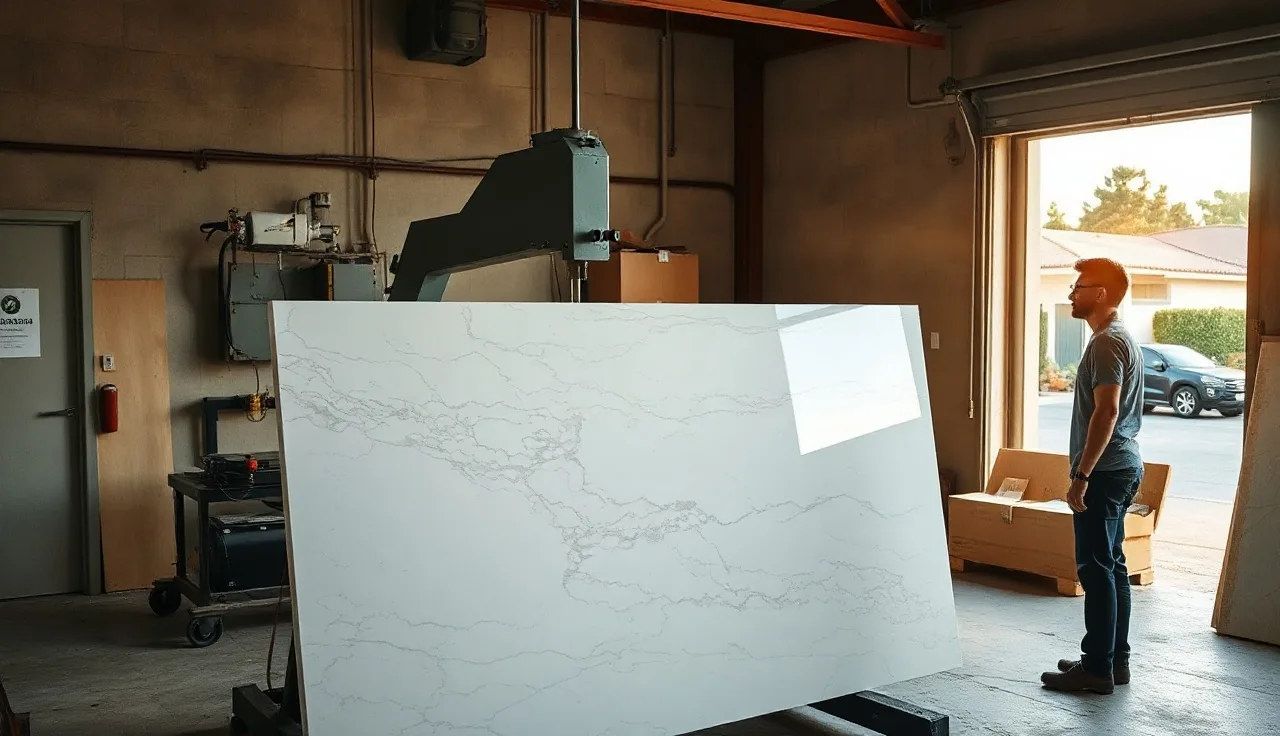
Stone fabrication is the whole process of turning a raw slab into a finished countertop: cutting it to your kitchen or bathroom dimensions, shaping the edges, cutting sink and cooktop openings, polishing every exposed surface, then setting it level on your cabinets. That entire chain, from the slab you pick to the counter you wipe down the first time, is what a full-service fabricator handles.
Where you get it done matters because the equipment, the skill, and the accountability swing wildly across shops on the Peninsula. A well-equipped shop runs a CNC or bridge saw with digital templating, so your cutouts land within a millimeter and your seams pull tight. A reseller takes your order, ships it to a bigger facility in San Jose or Hayward, and adds a margin. That model is fine in principle. You just have less visibility into who is cutting your stone and less recourse when something goes sideways.
On a $4,000 to $12,000 project, which is a normal Palo Alto kitchen, the fabricator's skill is the highest-leverage call you make. A bad cut on a quartzite waterfall is not fixable. A seam in the wrong spot is a permanent reminder of a conversation nobody had before the template.
One more thing. Stone fabrication is not tile installation. If someone quotes you by the tile, they are doing a different job. True slab fabrication is priced by the finished square foot, and that number covers material, cutting, edges, cutouts, and usually installation.
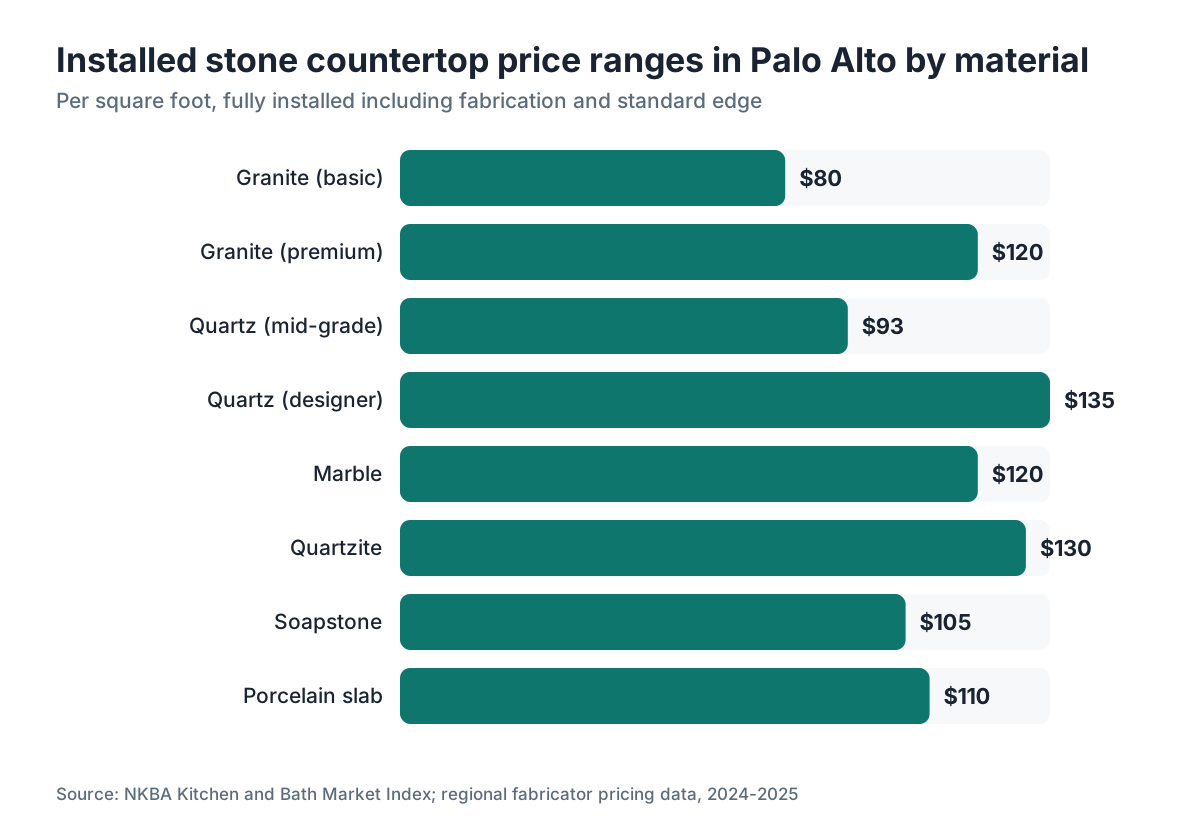
What does stone fabrication cost in Palo Alto and Los Altos?
Peninsula prices run above national averages, and there are plain reasons: California labor, Bay Area lease rates, and a customer base that reaches for premium materials. The national installed average for granite sits around $40 to $60 per square foot in NKBA and HomeAdvisor data, but that range gets dragged down hard by cheaper markets in the Southeast and Midwest [1][2].
In Palo Alto and Los Altos, plan for these ranges instead:
| Material | Installed price range (per sq ft) | Notes |
|---|---|---|
| Granite (basic colors) | $65, $95 | Commodity slabs like Santa Cecilia, Uba Tuba |
| Granite (premium/exotic) | $95, $145 | Brazilian exotics, book-matched pieces |
| Quartz (mid-grade) | $75, $110 | Caesarstone, Silestone, MSI |
| Quartz (designer) | $110, $160 | Cambria, Dekton, ultra-compact surfaces |
| Marble | $90, $150 | Carrara is on the low end; Calacatta and Statuario push higher |
| Quartzite | $95, $165 | True quartzite, not the mislabeled marble |
| Soapstone | $80, $130 | Limited color range, but holds its price |
| Porcelain slab | $80, $140 | Thin, light, but requires precise support |
Those ranges assume a standard eased or beveled edge. Mitered edges, waterfall returns, and ogee profiles add $15 to $40 per linear foot. Each sink or cooktop cutout runs $80 to $200 depending on complexity.
Demo of an old countertop, if you need it, adds $200 to $500 depending on how the top is set. Tile glued to drywall is the ugly case. Pulling it can tear up the drywall underneath, which becomes its own repair line.
After material choice, square footage is the biggest lever on your bill. Measure carefully. Width times length in inches, divided by 144, gives you square feet. Most shops quote by the slab square footage used, not your counter's footprint, because offcuts still eat slab. A good shop shows you a layout (the nest) of how your pieces come off the slab, so you can see what you are paying for.
How do you find a reputable stone fabricator near Palo Alto?
Start with one question: do you cut in-house, or do you subcontract? Everything else flows from that. The South Bay and Peninsula have dozens of shops, from one-person operations in industrial parks to mid-size facilities with showrooms in Mountain View, Sunnyvale, and Redwood City. Box-store programs (Home Depot and IKEA both subcontract fabrication) serve Palo Alto too, usually with tighter material menus and longer lead times.
Here are the questions that sort the good shops from the rest:
- Do you cut in-house, or do you subcontract fabrication? Outsourcing is not automatically bad. You should just know.
- Can I see the facility? Any real fabricator says yes. The shop should smell like stone dust and coolant, not like a furniture floor.
- What templating method do you use? Digital templating (an LT55 laser system or similar) beats hand-measuring with sticks. It matters.
- Who installs it? Some shops run their own crews, some subcontract. If it is subcontracted, ask who owns the problem when something breaks on install day.
- What is your seam policy? Ask to see where seams will fall before fabrication starts. Good shops show you on paper or on-screen before they cut.
Google reviews help, with a caveat. The useful ones describe a specific problem and how the shop handled it. A shop at 4.6 stars across 200 reviews that answered a few bad ones honestly tells you more than a 5-star shop with 12 reviews.
The Natural Stone Institute (formed when the Marble Institute of America merged with the Building Stone Institute) keeps a member directory [3]. Membership is not a quality guarantee. It signals a shop takes the trade seriously enough to pay dues and send people to training.
For kitchen countertops specifically, ask whether the shop has handled your cabinet brand before, especially European frameless cabinets where leveling tolerances are tighter.
What is the full timeline from quote to installed countertop?
Plan on 3 to 6 weeks from first quote to installed counter. That surprises homeowners who assume stone takes a week. Here is how it actually breaks down in the Palo Alto market:
Day 1: You visit a showroom or request a quote. The estimate is usually good for 30 to 60 days because slab prices move.
Day 2 to 7: You visit a slab yard (or the shop's own inventory) to pick your exact slab. For natural stone, pick the specific slab, more than a sample. Every slab is its own thing.
Day 8 to 14: Template appointment. The shop sends a crew, or runs a laser scan if they template digitally, after your cabinets are fully installed and level. This is non-negotiable. You cannot template before cabinets are set.
Day 14 to 21 (or longer): Fabrication. The shop cuts, edges, and finishes your stone. Most shops here carry 7 to 14 business days of backlog. Spring and fall remodeling surges can push that to 3 to 4 weeks.
Installation day: Usually 2 to 6 hours for a typical kitchen, longer for big or complex layouts. Have your sink, faucet, and any undermount accessories on hand before this day.
Total from first quote to installed counter: 3 to 6 weeks is normal. 8 to 10 weeks happens when your slab has to be ordered or the shop is buried. Build your remodel schedule around that, not the best case.
One piece people forget: the plumber reconnects the sink within 24 to 48 hours after install, and that is a separate appointment. Book it early.
What materials are most popular for stone countertops in Palo Alto kitchens?
Quartz (engineered stone) has led this market by volume for most of the past decade. It is non-porous, never needs sealing, and comes in consistent colors that photograph well for listings. Cambria countertops and Caesarstone are both widely stocked by shops serving the area.
Natural quartzite is the fastest climber here over the past three or four years. White and light-gray quartzite (Fantasy Brown, Super White, White Macaubas) photographs like marble but runs much harder and less porous. The catch: mislabeling is everywhere. Plenty of slabs sold as quartzite are actually marble or dolomitic marble. The Natural Stone Institute flags this directly and points buyers to scratch and acid testing as verification [9]. If durability matters to you, ask for a knife scratch test and a lemon-juice acid test on a corner before you commit. True quartzite scratches the knife, not the other way around.
Granite countertops stay strong for buyers who want natural-stone character without the price of exotic quartzite or marble. Commodity granite colors have dropped as Brazilian supply grew, so a very good-looking granite often lands at $65 to $80 per square foot installed.
Marble countertops show up in bathrooms and in kitchens where the owner accepts the upkeep. Marble etches from acid (citrus, wine, vinegar) and stains without steady sealing. That is not a reason to skip it if you love the look. Go in with clear eyes.
For laundry rooms, butler pantries, and other second-string surfaces, laminate countertops have had a quiet comeback. The new high-pressure laminates look far better than the Formica of 30 years ago and make sense when the real budget lives elsewhere.
How does the quoting process work, and what should your quote include?
A real quote should list, at minimum: square footage being charged, material cost per square foot, fabrication and edge work, any cutout fees (sink, cooktop, faucet holes), delivery and installation, and any demo or disposal. A one-line quote that reads "countertops installed, $4,800" gives you nothing to hold the shop to.
Some shops break out material and labor. Others bundle it all. Neither is better. You just need to know what you are comparing across bids. An apples-to-apples read requires the same square footage estimate, the same edge profile, and the same cutout count.
Ask this straight: is the square footage based on actual slab used (offcuts included), or on my finished counter footprint? Most shops charge for slab used, which runs 15 to 30 percent over your measured counter area because of layout waste. That is normal. You just need to know which number is on the page.
Quoting software has gotten better for shop owners. SlabWise, for one, handles the nesting layout (how pieces come off a slab) right next to the price math, so the quote reflects real material use instead of a guess. If your fabricator can show a cut layout alongside the quote, that is a good sign the math is right.
Get at least two quotes on any project over $3,000. The spread between shops here runs 20 to 35 percent for identical material and scope. That gap usually comes from overhead, slab sourcing relationships, and how hard a shop is pricing to fill its schedule.
What should you know about slab selection and slab yards near Palo Alto?
Most Palo Alto fabricators do not stock every slab in their own warehouse. They keep distributor relationships, and the big slab distributors serving this region cluster in Hayward, San Jose, and South San Francisco. MSI Stone, Arizona Tile, and Dal-Tile are three of the larger wholesalers with Bay Area locations [4][5].
Your fabricator can usually set up a yard visit so you pick your stone in person. Do it. For natural stone especially, the showroom sample and the actual slab are two different objects. The sample shows you a color family and pattern type. The slab is what ends up in your kitchen.
When you go, mark the slab with chalk or a sticky note once you choose it, photograph it, and confirm with the distributor that it is reserved under your name. Slabs sit on consignment and can be sold out from under you if the hold is not documented.
Engineered quartz gives you more slack, because it is made to consistent standards and you can trust the samples. Even so, looking at a full quartz slab in natural light before committing is worth the trip. Veining and texture read differently at slab scale than on a 12-inch chip.
If you are already thinking about how to clean quartzite countertops or how to clean stone countertops after install, ask the yard which sealer the manufacturer recommends. Get it in writing. It matters for warranty claims.
What permits or regulations apply to countertop replacement in Palo Alto?
A straightforward countertop swap in an existing Palo Alto home usually needs no building permit. The City of Palo Alto Building Division treats like-for-like replacements of fixtures and finishes that do not touch the structure, plumbing rough-in locations, or electrical circuits as no-permit work [6].
The exceptions that flip you into permit territory: moving a sink (that changes drain and supply lines and needs a plumbing permit), adding a new gas cooktop location, or countertop work riding along inside a larger remodel that already has permits pulled for other trades. In a full kitchen remodel, the contractor's general permit usually covers the counter work as part of the scope.
California law requires a valid CSLB (Contractors State License Board) license for any work above $500 in combined labor and materials [7]. A fabricator installing stone in your home should hold a C-54 (tile) or D-12 (synthetic products) license, or work under a general contractor's license. You can verify any California license at the CSLB site [7].
Here is why it matters. If an unlicensed installer cracks your counter or dents your cabinets, your recourse shrinks. Licensed California contractors have to carry workers' compensation insurance, and bonding gives you a thin layer of consumer protection you lose entirely with an unlicensed crew.
How do edge profiles affect cost and what looks best in Palo Alto kitchens?
Edges are one of the most underrated calls in a countertop project, and one of the easiest places to pile on cost without noticing. Here is the practical version.
A standard eased edge (a softened 90-degree corner) or a bevel comes included in most quotes. Both run fast on a CNC and add nothing.
An ogee or dupont profile (a curved S-shape) adds $10 to $25 per linear foot. It fights a little with modern cabinetry but looks right in traditional and transitional kitchens.
A mitered edge, where two pieces join at 45 degrees to fake a much thicker slab, is the current favorite in premium Palo Alto kitchens. A 3 cm slab mitered to read 6 cm is genuinely striking. It adds $40 to $80 per linear foot and demands precise cutting. Do not let a shop without CNC mitering try this by hand.
A waterfall edge, where the material runs continuously down the side of an island to the floor, is a real production commitment. You are adding a full vertical panel, usually 36 to 42 inches tall, and the veining has to wrap continuously, which means book-matching from the same slab. Budget an extra $800 to $2,500 for a waterfall on one side of an island, depending on material and slab availability.
For the minimalist modern kitchens common here, the trend runs toward thicker slabs (3 cm is now standard, some designers spec 4 cm or 5 cm in custom work) with simple eased edges. Clean lines beat decorative profiles in most of the new Palo Alto builds and gut remodels.
What are the most common mistakes homeowners make when hiring a stone fabricator?
The biggest mistake is picking a fabricator on material price alone and ignoring fabrication quality. A $5-per-square-foot material difference means nothing if the seam work is sloppy or the crew skips checking for level before setting the stone.
Second: skipping the template appointment. The template is where seam placement, overhang amounts, and how to handle crooked cabinets all get decided. Not there? You may end up with a seam right in your main prep zone because that was the easy default.
Third: not asking about the sealer schedule upfront. Natural stone (granite, marble, quartzite, soapstone) needs sealing at install and then on a schedule tied to porosity and how hard you use it. Some shops include the first sealer application, some do not. Know which.
Fourth: ordering before cabinets are fully set and level. Any template taken over cabinets still being shimmed produces a counter that does not fit. Do not let a shop pressure you into early templating to hold a slot.
Fifth: forgetting the plumber. The sink cannot go back until the counter is in, and plumbers usually want 24 to 48 hours of notice. Good Peninsula plumbers book out a week or more. Line them up before your install date is locked, not after.
For countertop installation generally, these apply across every material. The stone-specific twist on the plumber problem: undermount sink adhesive needs cure time (usually 24 hours before you run water), so that has to fit inside the plumber's window too.
How do you compare stone fabrication quotes fairly in the Bay Area?
Two or three quotes only mean something once you have confirmed all of this lines up across them:
- Same material (same brand and line for engineered stone, same source country and color for natural stone)
- Same slab thickness (2 cm vs 3 cm is a real gap in weight, durability, and cost)
- Same edge profile on every edge
- Same number and type of cutouts
- Demo included or excluded across all quotes
- Installation included or excluded
- Same seam count and placement
A quote that comes in 20 percent low might just be skipping demo, using a thinner slab, or pricing only your counter footprint instead of the slab actually used.
The honest move is to take the lowest bid and call them to confirm it covers everything the higher bids do. Most legit shops will walk a line-by-line comparison with you over the phone if you ask.
Check payment terms too. Under California Business and Professions Code Section 7159, a contractor can request a deposit of no more than 10 percent of the contract price or $1,000, whichever is less, before starting residential home improvement work [8]. Plenty of Bay Area stone shops ask for 50 percent down to cover slab purchase costs. That is common practice and not a red flag by itself, but it exceeds the statutory default, so know what the law actually allows before you hand over a check.
What should fabricators in Palo Alto know about running a profitable shop?
This market hands shop owners real advantages: high average project values, customers who pay for quality, and a steady pipeline from custom homes and high-end remodels. The pressures are just as real: California labor, Santa Clara County lease rates, and volume shops in San Jose and Fremont that can undercut on price [11].
The shops that win here specialize. A shop known for exotic quartzite and waterfall islands builds a referral network with the designers and architects who spec that work. A shop that prices sharp on commodity granite for flips serves a different buyer and wins on throughput. Trying to be both usually means being neither.
Digital templating is table stakes now. Still running stick templates in Palo Alto in 2025? You are losing jobs to shops that offer a cleaner process and a faster turn.
Quoting accuracy sets your margin. Shops that guess at slab yield bleed money on complex layouts and overcharge on simple ones. Software that runs nesting inside the quote, instead of as a separate production step, closes that gap. SlabWise is built around that exact workflow, tying the quote to the cut layout so there is no daylight between what you priced and what you cut.
Lead time is the other big lever. In a market where customers are juggling a whole remodel calendar, a shop that hits its promised install dates earns referrals. A shop that misses by a week costs the customer money in delayed plumber visits and extra days without a kitchen. That reputation follows you.
Frequently asked questions
How long does stone countertop fabrication take in Palo Alto?
The full timeline runs 3 to 6 weeks from first quote to installed countertop. After you choose your slab, the shop schedules a template appointment once your cabinets are in place (usually 1 to 2 weeks out), then fabrication takes another 7 to 14 business days in most Palo Alto-area shops. Busy seasons in spring and fall can stretch fabrication to 3 to 4 weeks.
Do I need a permit to replace countertops in Palo Alto?
For a like-for-like countertop replacement in an existing home, the City of Palo Alto generally does not require a building permit. Exceptions include moving the sink location (requires a plumbing permit) or work that is part of a larger permitted remodel. Always confirm with the Palo Alto Building Division for your specific project, especially if any plumbing locations are changing.
What is the cheapest stone countertop option in the Palo Alto area?
Commodity granite in colors like Uba Tuba or Santa Cecilia typically runs $65 to $80 per square foot installed in this market, making it the lowest-cost natural stone option. Engineered quartz starts around $75. If budget is the primary concern, high-pressure laminate from a local shop is a legitimate option at $25 to $45 per square foot installed and looks considerably better than it did a decade ago.
Is quartzite better than marble for a kitchen countertop?
True quartzite is harder and less porous than marble, which means it resists etching from acidic foods and is less prone to staining. For a kitchen that sees heavy daily use, quartzite is a more practical choice. The problem is that mislabeling is widespread; always ask for a scratch test and an acid test on the actual slab before purchasing. Marble is beautiful and fine for bathrooms or low-traffic kitchens.
How do I verify that a stone fabricator in Palo Alto is licensed?
Check the California Contractors State License Board public license lookup at cslb.ca.gov. Search by company name or license number. A fabricator performing in-home installation in California should hold an active license (C-54 tile contractor or work under a general B license). California law requires licensing for any work over $500 in combined labor and materials on residential property.
What is a waterfall edge on a countertop and how much does it cost?
A waterfall edge runs the countertop material continuously down the side of an island or peninsula to the floor, creating a solid panel of stone rather than an exposed cabinet face. It requires book-matched slabs so the veining wraps continuously. In the Palo Alto market, a single-side waterfall adds roughly $800 to $2,500 to the project cost depending on material and slab availability.
What deposit can a stone fabricator legally request in California?
Under California Business and Professions Code Section 7159, contractors doing residential home improvement work can request a deposit of no more than 10 percent of the contract price or $1,000, whichever is less, before starting work. Many stone shops ask for 50 percent down to cover slab purchase costs, which is common industry practice, but it technically exceeds the statutory limit for general contractors.
Should I go to the slab yard to pick my own stone?
Yes, absolutely, for any natural stone. Granite, quartzite, marble, and soapstone slabs vary significantly from one piece to the next even within the same color family. A showroom sample tells you the general pattern; it does not tell you about the specific movement, shading, or character of the actual slab going into your kitchen. Book an appointment at the distributor's yard and mark your slab with chalk when you find the one you want.
Can a stone countertop be repaired if it chips or cracks?
Minor chips on granite and engineered quartz can usually be filled with a color-matched epoxy resin, with results that are barely visible from a normal distance. Cracks are more serious and harder to fix invisibly. Marble and quartzite can sometimes be professionally repaired, but deep cracks in high-stress areas near sink cutouts may recur. Prevention (proper cabinet support, avoiding impact near edges) is far better than repair.
What is the difference between a fabricator and a countertop reseller?
A fabricator owns the equipment (bridge saw, CNC machine, edge polisher) and cuts and finishes your stone in-house. A reseller takes your order and subcontracts the cutting to a production facility, usually a larger shop in San Jose or the East Bay. Resellers can be fine, but you have less visibility into quality control. Always ask whether fabrication is done on-site or subcontracted.
How often does granite need to be sealed in the Bay Area climate?
Most granite should be sealed every 1 to 3 years depending on porosity. The Bay Area's relatively dry indoor climate means spills are the main staining risk rather than humidity. A simple test: drop water on the stone surface. If it beads up within 5 minutes, the sealer is working. If it darkens the stone, it is time to reseal. Your fabricator should seal the countertop at installation; maintenance is your responsibility after that.
What is the best stone countertop for a bathroom vanity in a Palo Alto home?
Marble is a popular choice for bathroom vanities because the acid-etching risk from citrus or vinegar is much lower in a bathroom than a kitchen, and the elegance is hard to match. Quartzite and quartz are also strong choices. For a guest bath that sees light use, almost any stone works well. For a primary bath with daily heavy use, avoid marble if you are not prepared for routine sealing and occasional etching.
How are seams placed and can I request where they go?
Yes, you can and should discuss seam placement before fabrication. Good fabricators show you a cut layout that indicates where seams will fall. Standard practice is to avoid seams at sink cutouts or near high-stress points. For visual reasons, seams placed along a cabinet break or away from the main prep area are less noticeable. Get the seam plan in writing or on a drawing before you sign off.
Does the Los Altos stone fabrication market differ from Palo Alto?
Not meaningfully in terms of material prices or shop quality, since the same regional distributors and many of the same fabricators serve both cities. Los Altos projects tend to be in larger homes with bigger kitchen footprints, so average project values are slightly higher. Lead times, material selection, and the permitting environment (City of Los Altos vs. City of Palo Alto) are the main practical differences.
Sources
- NKBA, Kitchen and Bath Market Index: National average installed granite countertop costs cited in NKBA member shop data range from approximately $40 to $60 per square foot
- HomeAdvisor (Angi), Cost to Install Stone Countertops: National installed stone countertop price ranges used as baseline comparison for Bay Area pricing
- Natural Stone Institute, Member Directory: Natural Stone Institute (formed from the Marble Institute of America and Building Stone Institute merger) maintains a searchable member directory of fabricators
- MSI Stone, Locations: MSI Stone is one of the major wholesale slab distributors with Bay Area locations serving fabricators in the Palo Alto and Los Altos market
- Arizona Tile, Locations: Arizona Tile operates Bay Area distributor locations serving stone fabricators on the San Francisco Peninsula
- City of Palo Alto, Building Division: Like-for-like replacements of finishes that do not alter structure, plumbing rough-in, or electrical circuits typically do not require a building permit in Palo Alto
- California Contractors State License Board, License Verification: California law requires contractors performing work over $500 in combined labor and materials to hold a valid CSLB license; license status is publicly searchable
- California Business and Professions Code Section 7159 (via California Legislative Information): California BPC 7159 limits the advance deposit a contractor may request on a residential home improvement contract to 10 percent of the total price or $1,000, whichever is less
- Natural Stone Institute, technical resources on quartzite: Mislabeling of quartzite as marble is a recognized industry problem; scratch and acid tests are recommended consumer verification methods
- UC Davis, Continuing and Professional Education: California residential contractor licensing and consumer protection requirements under CSLB are reviewed in professional education materials
- Santa Clara County Assessor, Property Data: Santa Clara County commercial real estate and labor cost environment context for fabricator overhead in the Palo Alto and Los Altos market
Last updated 2026-07-09