TL;DR
- You can paint kitchen countertops, laminate included, with the right prep and product.
- A DIY kit costs $50 to $200 and lasts 3 to 5 years if you seal it well.
- Two-part epoxy kits beat latex or chalk paint by a mile.
- Prep decides everything: skip the degreasing and sanding, and the paint peels within months.
- Treat it as a budget fix, not forever.
Can you paint kitchen countertops?
Yes. You can paint laminate, tile, wood, concrete, and even cultured marble. How well it holds up depends on the material and how carefully you prep the surface.
Here's the honest durability read. Painted counters do fine in a kitchen that gets light use and fall apart fast in a house that cooks hard every night. Two-part epoxy paints (the kind in DIY countertop kits) are the toughest thing a homeowner can buy. Latex and chalk paint soften under heat and moisture, so keep them off your counters.
What you can't paint well, or at least not to a standard most people would accept: natural stone like granite or marble. Paint doesn't bond to polished stone, and you'd be hiding a surface worth $40 to $150 per square foot installed. Painting stone is almost never the right move. If you're weighing stone, read about kitchen countertops and granite countertops first.
Laminate is the best candidate. It's cheap to replace anyway, so a failed paint job costs you a weekend, not a slab. The Rust-Oleum and Giani Countertop Paint kits were built with laminate in mind [1].
How long does painted countertop finish last?
Two to five years is the real window, and that range comes with a lot of asterisks. Light-use kitchens land near the top. Households that cook every night land near the bottom, sometimes lower.
Rust-Oleum's own product documentation says results depend on surface prep and how the counter gets used. User reports on contractor forums like JohnBridge.com and ContractorTalk cluster around 2 to 3 years before visible wear in busy kitchens and 4 to 5 years in lighter spaces.
A few things kill a painted finish faster than anything else:
- Setting a hot pan directly on the surface. Most countertop paints are rated only to about 150°F [1].
- Cutting on the surface. One deep knife scratch breaks the seal.
- Water pooled around the sink for hours at a time.
- Abrasive cleaners and scrub pads.
Don't expect the durability of a fresh laminate sheet or a quartz slab. You won't get it. But for a rental, a house you're staging, or a remodel you can't fully fund yet, three good-looking years for under $200 is a fair trade.
For fabricators quoting these jobs: homeowners who ask about painting are usually just sticker-shocked at replacement cost. Show them a clear breakdown of what new laminate countertops run versus a paint kit, and many pick replacement. SlabWise's instant quote tool builds that breakdown in under two minutes, which is worth putting in front of someone while they're still deciding.
What kind of paint works on kitchen countertops?
Three categories are worth your money. Everything else is a bad idea.
1. Epoxy countertop paint kits These are two-part epoxy coatings that cure chemically instead of just drying. Rust-Oleum Countertop Coating, Giani Countertop Paint, and Daich SpreadStone are the ones you'll find easily. They bond harder than latex and shrug off water and mild heat better than anything else in the DIY aisle. Kits run $35 to $100 and cover 35 to 50 square feet each [1][2].
2. Chalk paint with a topcoat sealer Some DIYers reach for chalk paint (Annie Sloan, Rust-Oleum Chalked) because it grips almost anything without primer. The paint itself is too soft and porous for a kitchen. You need at least two coats of hard wax or water-based polyurethane over it, and even then it's weaker than epoxy. I'd only go this route for a heavily distressed farmhouse look, and only if I was fine refinishing every year or two.
3. Oil-based alkyd paint plus conversion varnish This is what cabinet refinishers use on painted kitchen surfaces. More durable than latex, but also more work, slower to dry, and heavier on VOCs. If you can handle the ventilation, a good alkyd enamel under a conversion varnish makes a solid countertop finish. It's fussier to apply than the kits, though.
What doesn't work: standard interior latex, craft paint, or any water-based paint without a hard topcoat. It looks fine for a few weeks, then softens wherever it gets wet. Skip it.
How to paint kitchen countertops: step-by-step
The prep takes longer than the painting. Rush the prep and the paint peels. That's the whole story in one sentence.
Step 1: Clear and clean the countertop Remove everything. Scrub with a TSP substitute (trisodium phosphate) or a degreaser like Krud Kutter. Grease residue is the number-one reason paint won't bond. Rinse completely and let it dry at least 24 hours.
Step 2: Sand lightly Scuff the whole surface with 220-grit sandpaper. You're not stripping the finish, just giving the paint something to grab. Wipe with a tack cloth after.
Step 3: Protect what you're not painting Tape off the backsplash, walls, and sink edges. If the sink stays in place, tape its perimeter carefully.
Step 4: Apply primer if required Some kits include a primer step, some skip it. For bare laminate or any slick surface, a bonding primer (Zinsser Bulls Eye 1-2-3 or similar) helps adhesion a lot [3]. On a surface that already has a dull, scuffed finish, you can sometimes skip primer with epoxy kits.
Step 5: Apply the paint or base coat Follow the kit instructions exactly. Most epoxy kits use a foam roller for the base coat and a small brush for edges. Work in sections. Don't over-roll, or you'll trap bubbles.
Step 6: Apply decorative layers if you want them Giani and similar kits include mineral powder and veining sponges to fake a stone look. Optional, and it takes practice. Your first attempt won't match the photos on the box.
Step 7: Apply the topcoat sealer This is the step people rush, and it matters most. Lay down two to three thin coats of the included topcoat (or a separate water-based polyurethane if the kit calls for one), letting each coat dry fully. Full cure usually takes 48 to 72 hours before normal use and 7 days before the surface reaches full hardness [1].
Step 8: Curing period Go easy the first week. No hot pans, no heavy pots dragged across the top. The coating is still hardening.
How to paint laminate countertops specifically
Laminate (Formica and its cousins) is the most common thing people paint, because it's the cheapest surface and shows its age fastest. The process matches the general guide above, with a few tweaks.
The hard part with laminate is the slick melamine surface. A bonding primer isn't optional here. It's the whole reason the paint sticks. Zinsser Bulls Eye 1-2-3 is water-based and works well [3]. Some painters prefer a shellac-based primer like Zinsser BIN for extra grip on high-gloss laminate.
Watch the front edge, especially a post-form edge (that rounded or square plastic lip). It takes the most abuse and it's where paint fails first. Sand it carefully and add an extra coat of primer there.
If the laminate has chips or deep scratches, fill them with a laminate repair paste before priming. Paint doesn't hide texture. It follows it.
One honest note. If your laminate has real delamination, bubbling, or water damage under the surface, paint won't save it. The substrate is shot and no coating fixes that. At that point you're looking at countertop installation of new material, and it might be cheaper than you think for a standard kitchen. Read about formica countertops to see what new laminate actually costs.
The search phrase "installing laminate kitchen countertops" shows up a lot right next to DIY painting content, which tells you homeowners are comparison-shopping paint against replacement. Fair enough. New post-form laminate typically runs $10 to $40 per linear foot installed [4], so an average 30-linear-foot kitchen lands around $300 to $1,200. A paint kit is $50 to $200. The math favors painting if you have 2 to 3 years of patience.
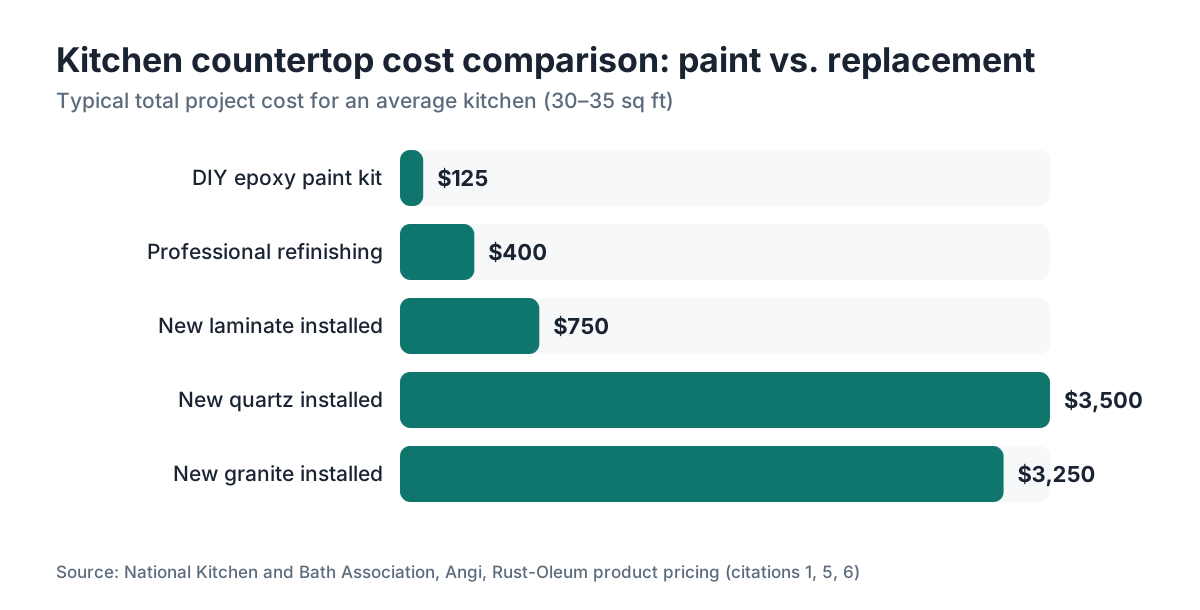
What does it cost to paint kitchen countertops vs. replace them?
Here's a straight cost comparison to frame the decision.
| Option | DIY Cost | Professional Cost | Expected Lifespan |
|---|---|---|---|
| Epoxy countertop paint kit (DIY) | $50 to $200 | N/A | 2 to 5 years |
| Professional countertop refinishing | N/A | $200 to $600 | 4 to 7 years |
| New laminate (post-form) installed | $300 to $1,200 | $300 to $1,200 | 10 to 20 years |
| New quartz installed | $1,500 to $5,500 | $1,500 to $5,500 | 25+ years |
| New granite installed | $1,500 to $5,000 | $1,500 to $5,000 | Lifetime |
Sources: Rust-Oleum product pricing [1]; National Kitchen and Bath Association cost benchmarks [5]; Angi national average data [6].
Professional refinishing deserves a mention. A handful of companies (Miracle Method is the biggest national chain) spray or roll a commercial-grade epoxy or acrylic coating over your existing counters. It looks better than DIY and lasts a bit longer, but it hits the same durability ceiling. Spend $500 or more on refinishing and you're within reach of new laminate, so you might as well replace.
For fabricators tracking leads: a homeowner calling to ask whether to paint or replace is a warm lead. They've already decided the current counter has to change. The only question left is how. A fast, itemized quote helps them answer it.
What surfaces can and can't you paint in the kitchen?
Paint compatibility swings hard by material. This is where people make expensive mistakes.
Laminate (Formica, Wilsonart, store-brand post-form): Best candidate. Bonds well with a bonding primer, holds topcoat reliably. More at laminate countertops.
Ceramic or porcelain tile: Paintable with an epoxy or tile-specific kit. Grout is the problem. It soaks up paint unevenly and stays darker. Looks decent from across the room, rough up close.
Cultured marble: Paintable with proper prep, though the gel coat is slick and needs heavy sanding. Common in 1980s bathrooms, occasionally in kitchens.
Wood (butcher block): You can paint it, but why? Butcher block countertops do better sanded and re-oiled or sealed with polyurethane. Painting over wood hides the grain you paid for.
Concrete: Takes paint well. It's porous, so run a penetrating sealer before painting and a topcoat after.
Quartz (engineered stone): Poor candidate. Surfaces like Cambria are non-porous and highly polished, so adhesion is bad. If you dislike your quartz, read about Cambria countertops or look at professional refinishing before you try paint.
Natural granite or marble: Avoid. The polished surface won't hold paint, the stone is valuable, and you'd be hiding natural variation you can't get back. See marble countertops.
Corian and solid surface: Corian is genuinely refinishable by a pro (DuPont runs an authorized refinisher network). DIY painting is possible but tricky. Better to check Corian countertops for refinishing options.
Is painting countertops safe? VOCs and ventilation
This is a real concern most DIY guides breeze past. Epoxy paints and topcoat sealers give off volatile organic compounds (VOCs) during application and curing.
The EPA treats VOCs as a serious indoor air quality issue. Its guidance states that concentrations of many VOCs are "2 to 5 times higher indoors than outdoors" and can run "up to 1,000 times" that level during and for hours after activities like painting [7].
The specific hazard: two-part epoxies, especially those with isocyanate hardeners, can cause respiratory sensitization. Once someone is sensitized, even tiny exposures can trigger a reaction. That's mostly an occupational risk for people doing this over and over, but it's worth respecting on a one-time DIY job too.
Steps that actually matter:
- Open windows and run a box fan to push air out of the kitchen, more than stir it around.
- Wear an N95 respirator at minimum. For two-part epoxy topcoats, a half-face respirator with organic vapor cartridges (3M 6001 or equivalent) is better [9].
- Keep kids and pets out during application and for at least 24 hours after.
- The California Air Resources Board sets VOC limits for architectural coatings. Look for CARB-compliant products if you're in California or just want a lower-VOC option [8].
Many countertop kits (Giani, Rust-Oleum Countertop Coating) use water-based topcoats specifically to cut VOC exposure versus solvent-based products. That's a real advantage, not marketing.
How do you maintain and clean painted countertops?
Painted counters need a gentle hand. The rules are simple, but you have to actually follow them.
Use a soft cloth or non-scratch sponge with mild dish soap and warm water. That's the whole routine. Skip bleach, ammonia, and abrasives, which all wear down the topcoat over time. Skip the Magic Eraser too (melamine foam is a micro-abrasive that dulls the finish).
For daily wipe-downs, a microfiber cloth dampened with water is plenty. For grease or sticky spots, a few drops of dish soap in water handles it.
Stay away from Windex, all-purpose sprays like 409 or Lysol, and vinegar-based cleaners. Vinegar is acidic enough to slowly etch some topcoats with repeated use.
One smart maintenance move: keep a small bottle of the same topcoat sealer around. After the first year, lightly sand the high-wear spots (around the sink, near the stove) with 400-grit and brush on one fresh coat of sealer. That buys you another year or two without redoing the whole counter.
Want to see how sealing and upkeep work on real stone by comparison? How to clean stone countertops is a good reference.
Common mistakes that ruin painted countertops
Most painted countertop failures trace back to one of five mistakes.
Skipping the degreasing step. Kitchen surfaces hold cooking oils you can't see. Paint over a greasy surface peels in sheets within weeks. Use a TSP substitute or a real degreaser, more than dish soap.
Not sanding between coats. Scuff every coat of paint and topcoat with 400-grit before the next goes on. That mechanical bite improves adhesion between layers a lot.
Laying coats too thick. Thick coats trap solvents and cause bubbling or a soft, fish-eye finish. Two thin coats beat one thick coat every time.
Using the counter too soon. Full cure for epoxy topcoats usually takes 7 days [1]. Cooking on it after 24 hours is tempting, and it noticeably shortens the life of the finish.
Painting over a bad substrate. Chips, peeling laminate, or soft water-damaged wood will telegraph through the paint or fail early around the damage. Fix the substrate first, or replace the counter.
Shops quoting replacements run into these homeowners all the time: painted first, hated the result, now want real countertops. If you're pricing replacement jobs with a quoting tool, SlabWise builds a quote that accounts for existing surface conditions and tearout, which moves the final number more than people expect.
When is painting a countertop not worth it?
Painting makes sense in a narrow set of cases. It's often the wrong call.
Don't paint if the countertop is structurally damaged: delaminated, water-swollen, or cracked through. Don't paint if you're selling within 12 to 18 months and buyers in your market expect updated counters. Painted counters can actually drag down resale value, because buyers know exactly what they're looking at.
Don't paint over granite, quartz, or any stone in decent shape. The material value is already sitting there, and you'd just be covering it up.
Don't paint if you cook hard and lean on the counter every single day. The finish looks worn inside a year, and you'll spend more time babying it than it's worth.
Painting earns its keep when you're renting and can't replace, you're in a temporary place, you're staging for a quick sale in a market where buyers just want clean surfaces, or you genuinely can't fund replacement yet and want 2 to 3 years of a better-looking kitchen.
Frequently asked questions
Can you paint kitchen countertops without removing them?
Yes. Every countertop painting kit is built for in-place work. You tape off the sink, walls, and backsplash, then paint the surface as-is. Removal isn't required. The main hassle is keeping the kitchen out of use for 48 to 72 hours while the topcoat cures, plus the full 7-day cure period before heavy use.
How to paint laminate countertops without it peeling?
Peeling almost always comes from skipping a bonding primer or not degreasing well. Clean with a TSP substitute, dry 24 hours, sand with 220-grit, apply a bonding primer (Zinsser Bulls Eye 1-2-3 works reliably), then apply epoxy countertop paint in thin coats. Finish with two to three coats of topcoat sealer. Let it cure 7 days before normal use.
What kind of paint is best for kitchen countertops?
Two-part epoxy countertop kits are the best DIY option. Rust-Oleum Countertop Coating and Giani Countertop Paint are the two you'll find most easily. Both cure harder than latex and resist water and mild heat. Standard latex or chalk paint without a hard topcoat won't hold up on a kitchen surface and will soften and peel quickly.
How much does it cost to paint kitchen countertops?
A DIY kit costs $50 to $200 depending on brand and coverage. Most kits cover 35 to 50 square feet, so a standard kitchen with 30 to 35 square feet usually needs one kit. Professional refinishing runs $200 to $600 for the whole kitchen. Both beat new countertops, which run $300 to $1,200 for laminate and $1,500 to $5,500 for quartz or granite.
Can you paint over laminate countertops that are already painted?
Yes, with the right prep. Sand the existing painted surface with 220-grit to scuff it, clean off the dust, and apply a bonding primer before the new coats. If the old paint is peeling or bubbling, remove it first with a chemical stripper or by sanding down to bare laminate. Painting over failing paint just moves the failure to the new coat.
How long does it take to paint kitchen countertops?
Active working time is 3 to 6 hours spread over 2 to 3 days: one day to clean and prime, one for paint coats, one for topcoat. Then you need 48 to 72 hours of drying before light use and 7 days for full cure before normal cooking. Plan on roughly a week without a fully working kitchen.
Can you paint tile countertops in the kitchen?
Yes. An epoxy countertop kit bonds reasonably well to ceramic and porcelain tile. Grout lines are the weak point, since they absorb paint unevenly and tend to peel over time. Sand the tile well, apply a bonding primer, and expect slightly shorter durability than laminate. Two-part epoxy kits clearly outperform regular paint here.
Is painted countertop finish heat resistant?
Only partly. Most epoxy countertop coatings handle brief contact with warm items but are rated to about 150°F. A pan just off the stove easily beats that. Always use trivets or heat pads on a painted counter. Direct contact with a hot skillet or pot softens the coating and leaves a permanent mark you can't fix without refinishing the whole surface.
Can you paint granite or marble countertops?
Technically possible, almost never a good idea. Polished stone gives most coatings very poor adhesion without aggressive sanding, which permanently damages the stone. Granite and marble are both worth keeping. If surface condition is the issue, professional honing or repolishing beats paint. Painting covers irreplaceable natural stone with a finish that will fail in a few years.
What is the best topcoat for painted countertops?
The topcoat in your epoxy kit is formulated to match that base, so use it. If you're going without a kit (chalk paint or a DIY approach), a water-based polyurethane like Varathane or Minwax Polycrylic, in at least two to three coats, is the most accessible hard-wearing option. Apply thin coats, sand lightly between them with 400-grit, and allow full cure time before use.
Does painting kitchen countertops affect home resale value?
It can hurt more than help. Most buyers and agents spot painted countertops as a temporary fix. In competitive markets, buyers discount homes with visibly cosmetic repairs. If you're painting before a sale, make the finish look genuinely good, not like a cover-up. In lower-price brackets or investor flips, clean painted counters are probably neutral rather than a negative.
How to paint butcher block countertops?
You can paint butcher block, but most countertop pros would tell you not to. It's better maintained by sanding and applying food-safe mineral oil or a hard-wax oil finish. If the wood is stained beyond saving, a solid-color alkyd paint plus polyurethane topcoat works, but you're covering the grain for good. Refinishing or replacing the block usually beats painting it.
Are countertop paint fumes dangerous?
Epoxy paints and topcoat sealers produce VOCs that are harmful in enclosed spaces. The EPA notes indoor VOC levels can run 2 to 5 times higher than outdoors, and far higher during painting. Use cross-ventilation, wear an organic vapor respirator (more than a dust mask), keep kids and pets out, and follow the manufacturer's safety data sheet. Water-based kit topcoats generally produce fewer VOCs than solvent-based alternatives.
Sources
- Rust-Oleum, Countertop Coating Product Page: Epoxy countertop paint kits cover 35 to 50 sq ft, are rated to approximately 150°F, and require 7 days for full cure before normal use
- Giani Inc., Giani Countertop Paint Kit Product Information: Giani countertop paint kits include mineral powder and veining tools and cover approximately 35 square feet per kit; retail pricing $50, $100
- Rust-Oleum, Zinsser Bulls Eye 1-2-3 Primer Technical Data: Zinsser Bulls Eye 1-2-3 is a water-based bonding primer recommended for slick surfaces including laminate prior to topcoat application
- National Association of Home Builders, Remodeling Cost Data: New post-form laminate countertops typically cost $10, $40 per linear foot installed
- National Kitchen and Bath Association, Cost vs. Value Kitchen Remodeling Data: Countertop replacement benchmarks: laminate $300, $1,200, quartz $1,500, $5,500, granite $1,500, $5,000 for an average kitchen
- Angi (formerly HomeAdvisor), Countertop Refinishing Cost Guide: Professional countertop refinishing nationally averages $200, $600 for a standard kitchen
- U.S. EPA, Volatile Organic Compounds' Impact on Indoor Air Quality: The EPA states that concentrations of many VOCs are 2 to 5 times higher indoors than outdoors and can be up to 1,000 times higher during and for several hours after activities such as painting
- California Air Resources Board, Architectural Coatings Regulation: CARB sets VOC limits for architectural coatings sold in California; CARB-compliant products are available in lower-VOC formulations
- U.S. EPA, Indoor Air Quality: An Introduction for Health Professionals: VOC exposure during painting is a recognized indoor air quality concern; N95 or organic vapor respirator recommended for painting in enclosed spaces
- Miracle Method Surface Refinishing, Countertop Refinishing Services: Miracle Method is a national countertop and surface refinishing franchise applying commercial-grade epoxy coatings with expected lifespan of 4 to 7 years
Last updated 2026-07-09