TL;DR
- The best outdoor countertops are granite, porcelain tile, concrete, and stainless steel.
- Each survives UV, moisture, and temperature swings differently.
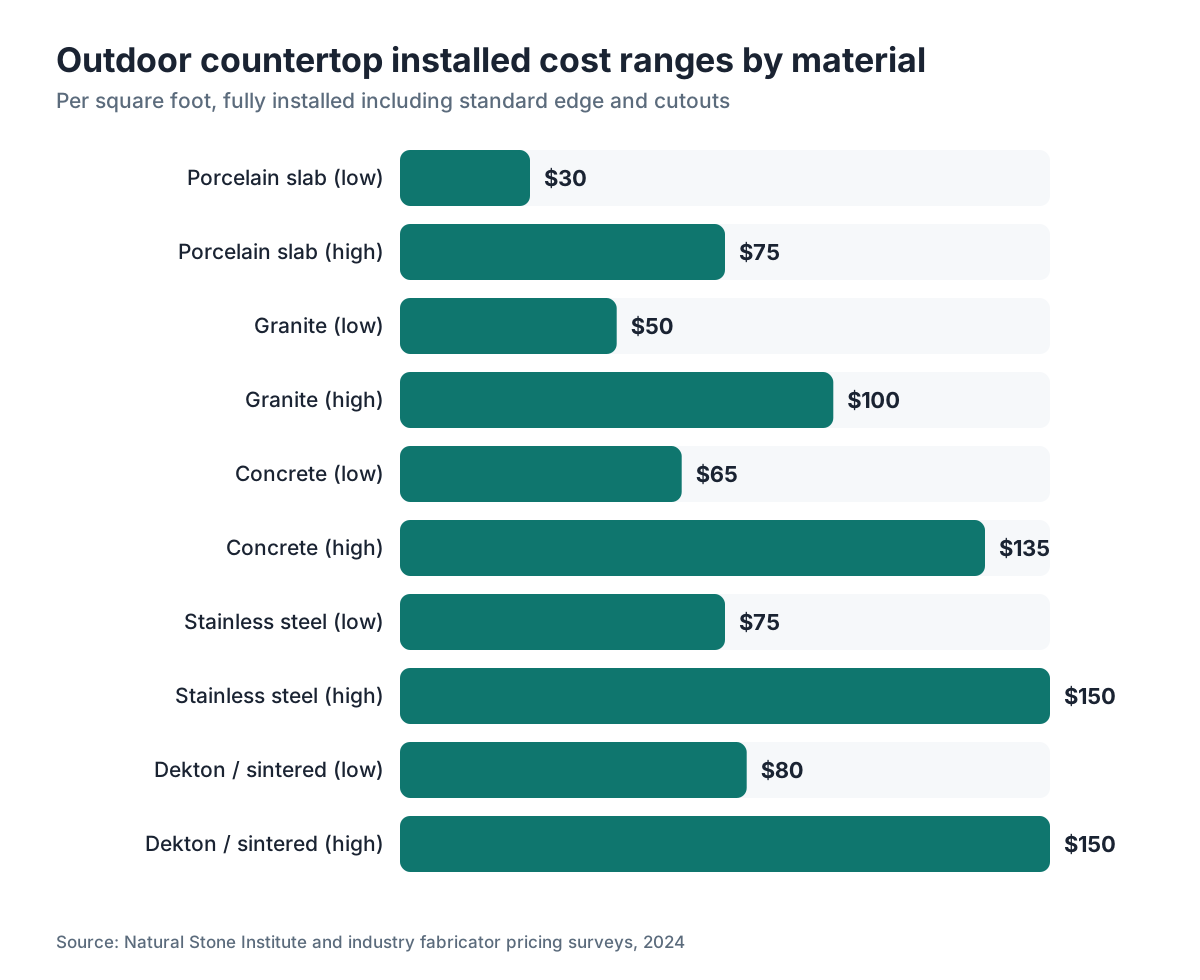
- Granite costs $50-$100 per square foot installed, porcelain runs $30-$75, and concrete $65-$135.
- Avoid quartz outdoors: resin binders yellow and crack under UV.
- Match the material to your climate, maintenance tolerance, and budget.
Why outdoor countertops fail faster than indoor ones
Indoor countertops live a sheltered life. Outdoor ones do not. They take direct UV radiation, freeze-thaw cycles, rain, humidity swings from 20% to 95%, airborne grease off the grill, and the occasional dropped cast-iron skillet. A material that stays perfect in your kitchen for 20 years can crack, fade, or delaminate outside in three.
The physics is the reason. Stone and ceramic expand and contract with temperature. A 50-degree Fahrenheit swing, which is an ordinary spring afternoon on a patio, puts measurable stress across a 4-foot slab. Materials with different expansion rates, like an epoxy coating bonded to concrete, separate at the joint. Resin-based materials, engineered quartz included, absorb UV at the polymer level, and the pigments break down no matter what sealer you put on top.
Then there is water. A porous surface with no roof over it soaks up rain, freezes, and spalls. Unsealed granite in a hard-winter climate can pit within five years. This is not hypothetical. The USDA Forest Products Laboratory has documented freeze-thaw damage in stone and composite materials used outdoors.
Choose wrong and you are buying a replacement in five years instead of twenty. Choose right and the counter outlasts the grill, the deck, and probably the designer who sold it to you.
Which materials actually work outdoors?
Here is an honest ranking. Not a sales pitch. Just what survives.
Granite. The default choice, and for good reason. Natural granite is UV-stable, heat-resistant, and handles freeze-thaw reasonably well once it is sealed. A sealed surface repels water, shrugs off grease, and does not fade. The cost is upkeep. You reseal every one to three years depending on porosity, and a hairline crack from impact or thermal stress is hard to fix invisibly. The market is big enough that fabricators stock exterior-grade pieces with tighter grain and lower porosity for outdoor use.
Porcelain and ceramic tile. Through-body porcelain (PEI rating 4 or 5, water absorption under 0.5%) is one of the toughest outdoor surfaces you can buy. It does not absorb water, never needs sealing, and modern large-format slabs (24x48 or 48x96) cut the grout lines way down. The weak point is those grout joints. They need to be epoxy outdoors, and even then you inspect them now and then. A cracked tile pops out and gets replaced without redoing the whole counter.
Concrete. Poured-in-place or precast concrete is genuinely good outside when the mix design is right. Integral fiber reinforcement plus a penetrating sealer takes real abuse. The risk is DIY or under-spec mixes that crack, and skipped resealing every one to two years. Our concrete countertops guide covers mix and sealer details.
Stainless steel. The stuff restaurants put on outdoor prep lines. Nonporous, heat-proof, zero maintenance past wiping. Grade 304 is fine inland. Coastal jobs need grade 316 (marine grade) to fight salt corrosion. Stainless scratches, shows fingerprints, and gets hot in full sun, but it never fades, never needs sealing, and never cracks.
Quartzite. Not quartz, quartzite. This is a natural metamorphic rock, denser and harder than granite. It is UV-stable and handles the outdoors well, though it needs sealing like granite does. Worth a look if you want more drama than granite gives you. Our notes on how to clean quartzite countertops apply outdoors too.
Dekton and ultra-compact surfaces. Dekton, Neolith, and other sintered stone products are technically ceramics made under extreme heat and pressure. Near-zero water absorption, UV resistance the makers verify, and no trouble with grill heat. They cost $80-$150 per square foot installed and chip at the edges if the substrate is not dead flat, but if budget is not the constraint, they are arguably the best single outdoor material.
What to skip. Quartz (engineered stone) is a hard no for full sun. The polyester or epoxy resin binder, 5-10% of the material by volume, degrades under UV. Cambria and Silestone both exclude outdoor use from their warranties in writing. Laminate and wood, butcher block included, are poor picks for wet, sunny spots, though a covered and shaded kitchen changes the math for wood. See butcher block countertops if you have a well-shaded, covered setup.
How much do outdoor countertops cost?
Material prices vary a lot. Install prices vary even more, because outdoor kitchens often mean longer template runs, nonstandard substrate prep, and sometimes crane or forklift access to the backyard. The numbers below are installed: slab plus labor, basic edge, and standard cutouts.
| Material | Installed cost per sq ft | Resealing frequency | UV stability |
|---|---|---|---|
| Granite | $50-$100 | Every 1-3 years | Excellent |
| Porcelain slab | $30-$75 | None (no sealing) | Excellent |
| Concrete | $65-$135 | Every 1-2 years | Good with sealer |
| Stainless steel | $75-$150 | None | Excellent |
| Dekton / sintered | $80-$150 | None | Excellent |
| Quartzite | $60-$120 | Every 1-3 years | Excellent |
| Quartz (not recommended) | $55-$100 | Not applicable | Poor |
Prefab outdoor kitchen inserts, including the NewAge modular units, typically use a 32-inch deep countertop format. A standard 10-foot run at 32-inch depth is roughly 26-27 square feet. At granite pricing that is $1,300-$2,700 for the countertops alone. Add a sink cutout, a grill cutout, and a side burner opening and you land around $1,600-$3,200 all-in for granite on a modest kitchen.
Shops usually charge a cutout fee of $75-$150 per opening. Outdoor jobs sometimes carry a travel or access surcharge of $100-$300 depending on how far the stone has to travel from truck to site. Get that itemized before you sign.
One more line item: substrate. Outdoor counters almost always sit on metal stud framing with cement board, not wood. If your contractor built the base out of plywood, a good fabricator will flag it. Plywood swells outdoors and cracks stone at the seams. Cement board or Hardie backer is the standard, and swapping a bad substrate adds $200-$500 before the stone even shows up.
What is the best outdoor countertop for a hot climate?
Heat is a different problem than UV, though the two usually arrive together in places like Arizona, Texas, and Florida. A Phoenix patio can hit 150 degrees Fahrenheit of surface temperature on dark stone in July. That is past hot-to-touch. It stresses sealers and adhesives.
In very hot, sunny climates, lighter-colored stones help because they soak up less radiant heat. But the material matters more than the color. Granite, porcelain, Dekton, and stainless steel all take high surface temperatures without structural damage. Concrete can develop hairline cracks if the cure was rushed or the mix was weak, and heat speeds that up.
Grills are the other heat source. Set a 500-degree cast iron skillet on sealed granite and the stone will not crack, but the sealer at that spot may scorch or break down. Porcelain and Dekton forgive direct heat better. If you cook hard and your pots land straight on the counter, sintered stone or stainless beats granite on practical heat resistance.
In a place like Florida, humidity is the bigger enemy than heat. Grout joints in tile, porous sealers on granite, and any wood substrate soak up moisture. In humid climates, lean toward materials that need no sealing at all: porcelain, Dekton, or stainless.
What is the best outdoor countertop for a cold climate?
Freeze-thaw is the killer up north. Water seeps into a porous surface, freezes, expands, and physically breaks the material apart. That is spalling, and it hits granite left unsealed or sealed with a product that never penetrated deep enough.
For climates that freeze regularly, the priority list shifts. Porcelain with water absorption under 0.5% is genuinely freeze-thaw proof by the ASTM C1026 test for unglazed ceramic tile. Through-body porcelain does not hold enough water to spall. Granite works with a penetrating impregnating sealer (silane or siloxane) and a reseal schedule of every one to two years in a harsh climate instead of three. Concrete with a good penetrating sealer behaves the same way.
A fully covered and heated space eases all of this. But if the counter sits exposed through a Minnesota winter, porcelain or sintered stone are the safest bets. The National Park Service Preservation Briefs document freeze-thaw damage to masonry and stone in exterior work, and the physics applies straight to countertops.
One practical tip: outdoor granite in cold climates should have every edge eased or bullnosed, never left sharp. Sharp edges are the first place freeze-thaw chipping shows up.
Does quartz work outdoors at all?
No. Or more precisely: not in direct sun.
Engineered quartz is roughly 90-95% ground quartz bound with polyester or epoxy resin. The quartz itself is UV-stable. The resin is not. UV yellows the resin, and because the pigments are suspended in that resin, the colors shift with it. White quartz goes cream or yellow. Gray develops a brown cast. This is not a stain you scrub off. It is chemical degradation.
Cambria's warranty document states it does not cover "outdoor use or exposure to direct sunlight." Silestone and Caesarstone carry similar exclusions. Some fabricators will still sell and install quartz outdoors, arguing that a covered patio differs from full sun. That is a gray area, but even under a pergola that catches indirect UV, I would not risk it.
The only outdoor spot where quartz makes any sense is a covered patio with zero direct sun, in a temperate climate with mild winters. Even then it is a compromise. Better materials exist. The quartz countertops article has the indoor specs and performance data.
If a contractor is pushing quartz for your outdoor kitchen, ask to see the manufacturer's outdoor warranty in writing. You will not find one.
How do you seal and maintain outdoor stone countertops?
Sealing outdoors is not the same as sealing indoors. You need more product, and you need to do it more often.
For granite and quartzite, use a penetrating impregnating sealer with silane or siloxane chemistry. These molecules are small enough to sink into the stone pores instead of sitting on top. Topical sealers (polyurethane or epoxy coatings) can look sharp on day one, then peel outdoors within a year. Penetrating sealers last longer and reapply without stripping. StoneTech, Aqua Mix, and Tenax all make outdoor-grade versions. How to clean stone countertops covers sealer chemistry in more depth.
The process: clean the stone well, let it dry fully (at least 24 hours after rain), apply sealer with a foam applicator, let it sit 10-15 minutes per the label, then wipe the excess before it hazes. One coat usually does granite. Two coats suit porous limestone or concrete.
Test it with water. Pour a tablespoon on the surface. If it beads and holds for several minutes, the sealer is working. If it darkens the stone inside 30 seconds, reseal. Run that test every six months outdoors. In harsh climates you may end up resealing every year.
For cleaning during cooking season, warm water and a little dish soap cuts grease fine. Skip bleach on granite or marble; it strips sealers. Citrus-based degreasers are hard on stone sealers too. After a cook, wipe the surface while it is still warm, before grease polymerizes onto the stone.
Stainless steel and porcelain are genuinely low-maintenance. A weekly wipe with a damp cloth and an occasional spray of non-abrasive cleaner is plenty. Coastal stainless benefits from a periodic fresh-water rinse to wash off salt.
What thickness and edge profile should outdoor countertops be?
Indoor countertops usually run 3/4 inch to 1.25 inches (2 cm to 3 cm). Outdoors, go thicker.
For granite and natural stone outside, 3 cm (about 1.25 inches) is the standard, not the upgrade. It resists cracking under thermal stress much better, and it holds up under the flexural load when your grill sits on an overhang. Some fabricators push 4 cm or 2-inch mitered edges for outdoor bars with long spans.
For porcelain slabs, 20mm (about 3/4 inch) is typical, and some makers offer 30mm outdoor-rated slabs. Thinner porcelain (12mm) is more of an indoor thing. Thicker porcelain forgives minor substrate irregularities.
On edge profiles, keep it simple outdoors. Eased, half-bullnose, and full bullnose hold up better than ogee or fussy carved profiles. Complex profiles have small sharp ridges that catch water, freeze, and chip. An ogee edge on a Minneapolis patio is asking for spalling by year three. Ogee is a fine indoor edge. It does not belong in a climate that freezes.
Keep overhangs conservative. The standard residential indoor overhang is 12 inches before you need corbel support. Outside, with more thermal cycling and less controlled install conditions, most fabricators want corbel support at 10 inches or more. Ask your fabricator what they recommend for your exact slab material.
How do outdoor kitchen countertops differ from indoor ones structurally?
The substrate under the stone is where outdoor and indoor kitchens split hardest.
Indoor counters usually rest on plywood decking over wood cabinet boxes. Outside, you see a few common build types: metal stud framing with cement board, concrete block with cement board, or prefab stainless steel frames. Wood, again, is a poor outdoor substrate in most climates. It expands, contracts, rots in the wet, and those dimensional changes crack stone at the seams.
Cement board (Hardie backer or similar) over metal studs is the most common and generally best approach. It is dimensionally stable, moisture-resistant, and gives a solid setting bed for adhesive. Setting stone on cement board outdoors, fabricators typically use a high-quality construction adhesive (often silicone-modified) instead of the plain silicone bead they use in kitchens. The outdoor thermal cycle wants a more flexible adhesive system.
Prefab outdoor kitchen systems, like the modular units from NewAge Products and others with stone tops, run a simplified version of this. The 32-inch depth format shows up because 32 inches fits most standard grill widths while leaving front workspace. Prefab tops are cut to the modular unit dimensions rather than custom-templated.
For a custom kitchen, a fabricator templates the space the same way they template indoors, with a physical or digital laser template. The difference is that outdoor templates account for expansion joints at seams. A long granite run outdoors (over about 8 feet) should carry a small silicone joint at the seam instead of a tight butt joint, because thermal expansion over that length can displace the seam. Fabricators skip this indoors sometimes. Outdoors it matters.
For shops quoting and templating complex outdoor jobs, management tools like SlabWise track the extra cutouts, access charges, and material selections that make outdoor quotes harder to standardize than indoor work.
What are the best countertop options for a covered outdoor kitchen?
A covered kitchen changes the math a lot. A solid roof (more than a pergola full of gaps) kills direct UV exposure and cuts rain contact way down. That opens the door to materials that would fail in the open.
Under a solid roof, quartz becomes possible in mild climates, though I still would not use it where it freezes hard. Concrete gets easier to maintain because rain is not stripping the sealer. Even marble, a terrible pick in full exposure, becomes reasonable under a well-protected covered patio in a mild, dry climate.
The variables that decide it under cover: how much UV sneaks in from the sides, how close the cooking equipment sits to the surface, and whether the space seals up in winter or stays open to the cold. A screened lanai in South Carolina with solid roof coverage is close to indoor conditions. An open-sided pergola in Colorado with gaps in the lattice still hits countertops with plenty of UV and hard freeze cycles.
For a truly covered space in a mild climate, the material choice looks a lot like an indoor kitchen. The kitchen countertops guide has the full indoor comparison. The differences that stay: substrate (cement board over metal frame, not plywood over wood) and penetrating sealers on any natural stone.
What do fabricators need to know before templating an outdoor kitchen?
Outdoor kitchens have a few gotchas that trip up fabricators who mostly do indoor work.
First, site access. Slabs are heavy, and the path from truck to back patio often runs through a gate, around a pool, or across a lawn. Get eyes on the site before you template. Know whether you carry slabs by hand, run a dolly, or whether a boom truck can reach. Access problems add real labor cost, and the only way to price them right is to see them.
Second, the substrate inspection. Push on the counter base. If it flexes, there is a problem. Stone does not flex. A wobbly base cracks countertops. Some fabricators refuse to set stone on a substrate they do not trust, and that is the right call.
Third, cutout complexity. Outdoor kitchens pack more cutouts per linear foot than most indoor kitchens. A typical build might have a grill cutout, a side burner, a sink, a beverage refrigerator door, and a power burner. Each cutout gets priced separately, adds template complexity, and raises miscut risk. Price each one in the quote and verify measurements against the appliance installation manuals, not the homeowner's memory.
Fourth, seam placement. Keep seams away from cutouts and away from corners. That is always good practice, but outdoor thermal cycling makes a bad seam fail faster. Digital templating software that optimizes seam placement and nesting earns its keep on complex outdoor jobs. Same goes for material yield, because an oddly shaped counter with multiple cutouts wastes a lot of stone if the nesting is not planned. SlabWise's quoting and nesting tools handle this geometry well for shops that do regular outdoor work.
Fifth, adhesive and install day. Do not set stone outdoors when rain is forecast within 24 hours, or when temperatures will drop below 40 degrees Fahrenheit on install day. Both conditions wreck adhesive cure.
What are some materials that look good but fail outdoors?
Marble gets people in trouble outdoors. It photographs beautifully. On a patio it etches from any acidic food or drink that lands on it (citrus, tomato, wine), and in humid climates it stains hard. Marble is high-maintenance even indoors. Outdoors it is a genuine mistake in almost every climate. Read marble countertops if you are set on the look. Indoors, sealed and cared for, marble is lovely. Outdoors it is the wrong call.
Laminate is a non-starter. The substrate is particleboard or MDF, both of which swell and fail the moment they get wet. Even with perfectly sealed edges, UV yellows and warps the surface fast. The full story is in laminate countertops and Formica countertops for indoor use, but outdoors the answer is just no.
Corian and solid surface land in a gray area. DuPont and others market some solid surface products for outdoor use, but those need UV-stabilized formulations built for exterior exposure. Standard Corian is not rated for outdoor installation. More at Corian countertops for indoor uses.
Soapstone is interesting. It is naturally UV-stable, dense, and non-porous enough to skip sealing. It runs naturally matte and heat-resistant. In mild climates with covered kitchens, soapstone works well. In harsh freeze-thaw climates, its softness (Mohs 1-2) leaves it open to edge chipping. The notes at how to clean soapstone countertops apply outdoors, just more often.
Frequently asked questions
Can you use quartz countertops outdoors?
No, not in direct sunlight. The resin binder in engineered quartz degrades under UV, causing yellowing and color shift. Cambria, Silestone, and Caesarstone all exclude outdoor use from their warranties. In a fully covered, shaded patio in a mild climate, quartz is a gray area, but there are better materials for every outdoor scenario.
What is the most durable outdoor countertop material?
Sintered stone (Dekton, Neolith) and through-body porcelain are the most durable outdoor countertop materials by most measures. Both have near-zero water absorption, are UV-stable, need no sealing, and handle extreme heat. The tradeoff is cost ($80-$150 per square foot installed for sintered stone) and brittleness at edges if the substrate is not perfectly flat.
How much do outdoor kitchen countertops cost per square foot?
Installed costs run $30-$75 per square foot for porcelain, $50-$100 for granite, $65-$135 for concrete, $75-$150 for stainless steel, and $80-$150 for sintered stone like Dekton. A standard 10-foot outdoor kitchen with 32-inch depth covers roughly 27 square feet. Add $75-$150 per cutout for grill, sink, and burner openings.
Does granite hold up outdoors?
Yes, when properly sealed. Granite is UV-stable, heat-resistant, and handles freeze-thaw well with a penetrating silane or siloxane sealer. The maintenance commitment is real: reseal every one to three years, or annually in harsh climates. Test by pouring water on the surface. If it darkens in under 30 seconds, the sealer needs refreshing.
What countertop works best around a pool or in a coastal environment?
For poolside use, choose non-porous, slip-resistant surfaces: through-body porcelain rated PEI 4 or 5, Dekton, or stainless steel grade 316 (marine grade). Coastal environments add salt air, which corrodes standard 304 stainless. Granite works near a pool but needs consistent sealing. Avoid any grout-heavy tile near a pool; the chlorine degrades standard cement grout.
How often do outdoor stone countertops need to be resealed?
Every one to three years for granite and quartzite in typical climates, and annually in harsh freeze-thaw or very sunny climates. Concrete may need resealing every one to two years outdoors. Do a water bead test every six months: if water soaks in within 30 seconds instead of beading, it is time to reseal. Porcelain and sintered stone need no sealing at all.
What is the best edge profile for outdoor countertops?
Eased, half-bullnose, and full bullnose edges perform best outdoors. Complex profiles like ogee or dupont have small ridges that trap water, freeze, and chip in cold climates. In any climate that sees freezing temperatures, keep edge profiles simple. Thick eased edges (3 cm stone) on outdoor bars also look proportionally better than thin indoor-style edges.
What substrate should outdoor countertops sit on?
Cement board (Hardie backer or similar) over metal stud framing is the standard outdoor substrate. Avoid plywood or wood-based decking outdoors because they absorb moisture, swell, and crack stone at the seams. The base should be rigid with no flex when pressed. A wobbly base leads to cracked countertops regardless of how good the stone or tile is.
Is concrete a good outdoor countertop material?
Yes, if the mix is right and the sealing is maintained. Properly made concrete with integral fiber reinforcement and a penetrating sealer handles outdoor conditions well. The risks are underpowered mixes that crack and sealer maintenance that gets skipped. In very hot climates, ensure the concrete was cured slowly; rushed curing leads to shrinkage cracks that worsen outdoors.
What is the outdoor kitchen granite countertop 32-inch depth format?
The 32-inch depth is the standard in prefab modular outdoor kitchen systems. It accommodates most standard grill widths (typically 30 inches) while leaving a couple of inches of workspace at the front. Prefab outdoor kitchen brands like NewAge cut their granite or stone tops to match their modular frame dimensions. Custom-built outdoor kitchens can use any depth, though 24-36 inches is the most common range.
Can you use marble or soapstone outdoors?
Marble is a poor outdoor choice in most climates. It etches from acidic food and drink, stains in humid conditions, and chips at edges in freeze-thaw climates. Soapstone is more viable outdoors, especially under a covered patio in a mild climate. It needs no sealing, is UV-stable, and is heat-resistant. Its softness (Mohs 1-2) makes edge chipping a risk in harsh climates.
How do I clean outdoor kitchen countertops during grilling season?
Warm water and a small amount of dish soap handles most outdoor kitchen grease. Wipe the surface while it is still warm from cooking before grease polymerizes. Avoid bleach-based cleaners on granite or marble since they degrade sealers. For stainless steel, a damp cloth and occasional non-abrasive cleaner is enough. Rinse coastal stainless with fresh water periodically to remove salt residue.
Do outdoor countertops need expansion joints at seams?
Yes, for long stone runs. A granite or natural stone countertop run over about 8 feet outdoors should have a silicone joint rather than a tight butt joint at seams. Thermal expansion over a long run in outdoor temperature swings can displace tight seams over time. Fabricators sometimes skip this step indoors but it matters outdoors, particularly in climates with wide temperature ranges.
What outdoor countertop material requires the least maintenance?
Stainless steel (grade 304 inland, grade 316 coastal) and through-body porcelain require the least maintenance. Neither needs sealing, neither fades, and both clean up with a damp cloth. Sintered stone like Dekton is also seal-free and low maintenance. If you want natural stone with minimal upkeep, choose a dense, low-porosity granite and commit to annual sealing.
Sources
- USDA Forest Products Laboratory, Wood Handbook: Wood as an Engineering Material: Freeze-thaw damage mechanisms in stone and composite materials used in exterior applications
- Natural Stone Institute (formerly Marble Institute of America), Dimension Stone Design Manual: Granite porosity variation and suitability for exterior applications including outdoor kitchen countertops
- Cosentino Group, Dekton Technical Data Sheet: Dekton sintered stone has near-zero water absorption and verified UV resistance, suitable for outdoor use
- Cambria Surfaces, Warranty Terms and Conditions: Cambria warranty excludes outdoor use or exposure to direct sunlight
- ASTM International, ASTM C1026 Standard Test Method for Measuring the Resistance of Ceramic Tile to Freeze-Thaw Cycling: ASTM C1026 establishes freeze-thaw resistance standards for ceramic tile; through-body porcelain with absorption under 0.5% passes
- Natural Stone Institute, Exterior Stone Applications Technical Bulletin: Penetrating silane/siloxane sealers recommended for exterior stone; topical sealers peel in outdoor conditions
- Portland Cement Association, Concrete Countertops Guide: Fiber-reinforced concrete with penetrating sealer suitable for exterior countertop applications
- Tile Council of North America, TCNA Handbook for Ceramic, Glass, and Stone Tile Installation: Epoxy grout recommended for outdoor tile installations; cement grout degrades in wet outdoor conditions
- American Iron and Steel Institute, Design Guidelines for Stainless Steel: Grade 316 stainless steel recommended for marine and coastal environments due to molybdenum content providing corrosion resistance
- U.S. Consumer Product Safety Commission, Outdoor Cooking Safety: Heat-resistant and non-combustible materials recommended for surfaces near outdoor grills and cooking equipment
- National Institute of Standards and Technology, Building Materials Durability Research: Penetrating impregnating sealers outperform topical sealers for durability in exterior masonry and stone applications
Last updated 2026-07-09