TL;DR
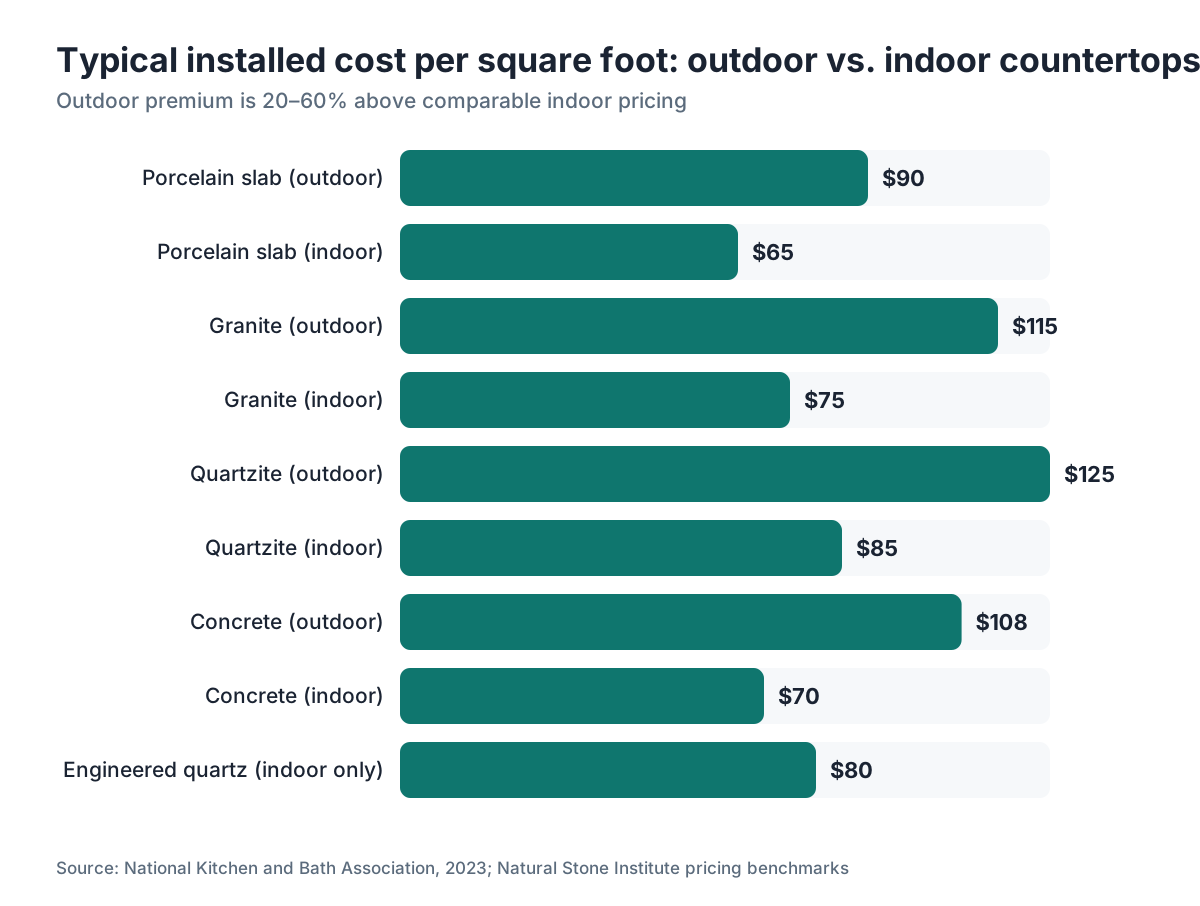
- Outdoor kitchen countertops run 20 to 60% higher than comparable indoor slabs.
- The reasons: many indoor favorites fail outside, UV and freeze-thaw punish the material, installs take longer, and sealing repeats every year.
- Fabricators should price in site-access surcharges, thicker specs, and return visits.
- Homeowners should budget $60 to $250 per square foot installed, depending on material.
Why do outdoor countertops cost more than indoor ones?
Outdoor countertops cost 20 to 60% more than indoor ones because the outdoors is brutal on stone and only tougher (pricier) materials survive it. Temperature swings, UV radiation, standing water, and freeze-thaw cycles all impose demands most indoor materials can't meet. The ones that can cost more per slab, take more labor to handle, and need harder sealing.
Indoor pricing assumes a controlled room. A kitchen stays climate-regulated, dry, and gets cleaned with mild dish soap. An outdoor kitchen is a permanent exterior fixture soaking up everything the weather throws at it. The USDA Forest Products Laboratory has documented how thermal cycling and moisture exposure degrade stone and composite surfaces far faster outdoors than indoors, which is why picking the wrong material is a structural mistake, more than a cosmetic one [1].
Fabricators who run a flat indoor rate on outdoor jobs underprice the work every time. The real cost hides in callbacks, warranty fights, and material failures. None of that shows up in the quote.
The gap is consistent. Across quotes from fabricators in the Midwest, Southeast, and Southwest collected by industry trade sources, outdoor installations run roughly 20 to 60% more than indoor installations of the same square footage, with the spread widening in climates that get hard winters or intense sun [2].
Which countertop materials actually work outdoors, and which ones fail?
Porcelain, granite, quartzite, sealed concrete, and soapstone work outdoors. Engineered quartz, marble, laminate, butcher block, and solid surface fail. This is where most homeowners go wrong: they pick a material they love indoors, then ask for the same thing outside. Some transfer fine. Many don't.
| Material | Outdoor viability | Main outdoor risk | Typical installed cost (outdoor) |
|---|---|---|---|
| Porcelain tile / slabs | Excellent | Grout cracking if improperly installed | $60, $120/sq ft |
| Granite | Good | Spalling in hard freeze climates if unsealed | $80, $150/sq ft |
| Quartzite | Good | Must be sealed; softer varieties absorb water | $90, $160/sq ft |
| Concrete | Good (sealed) | Cracks without expansion joints; stains | $75, $140/sq ft |
| Soapstone | Fair | Softer than granite; marks but is naturally non-porous | $80, $140/sq ft |
| Engineered quartz | Poor | Resins degrade under prolonged UV; color fades | $70, $130/sq ft |
| Marble | Poor | Acid rain etches; freezing causes spalling | $100, $200/sq ft |
| Laminate / Formica | Never | Swells, delaminates, fails within one season | $20, $40/sq ft (indoor only) |
| Butcher block | Never outdoors | Warps, molds, rots without a fully covered dry install | $40, $80/sq ft (indoor only) |
| Corian / solid surface | Poor | UV yellowing, thermal expansion cracking | $50, $90/sq ft (indoor only) |
Engineered quartz deserves a specific warning. Cambria states in its product warranty that quartz surfaces are not intended for outdoor installation, largely because the polymer resins that bind the quartz crystals break down under prolonged UV exposure [3]. Install quartz outside and you void the manufacturer warranty and set up a future dispute. Price that risk in, or decline the job.
Granite countertops stay the most common outdoor choice because natural granite is UV-stable, hard, and easy to source. The catch: porous granites in freeze-thaw climates need penetrating sealer every year before winter. Quartzite countertops are a strong alternative when the homeowner wants a marble look without marble's porosity problems.
Laminate countertops and butcher block countertops should never get priced for outdoor use. If a homeowner asks, explain why and point them toward something that works instead of taking a job you know will fail.
What specific cost factors should fabricators add for outdoor quotes?
Outdoor quotes need a line-by-line audit of every assumption baked into your indoor template. The big adds are material upcharges, thicker specs, site-access surcharges, more edge work, annual sealing, substrate inspection, and heavier cutout counts. Here's what changes.
Material upcharge (10 to 30%). Outdoor-rated materials cost more at the slab yard. Thick porcelain (20mm) slabs, high-density granite, and unsealed quartzite all price higher per square foot than the standard 3cm granite you run for kitchens. Factor this before any labor or markup.
Thicker fabrication spec. Most fabricators run 3cm (1.18 inches) indoors. Outdoors, especially for unsupported spans over a grill or for cantilever overhangs, 4cm or laminated 6cm edges are common to resist thermal movement and impact. More material, more cutting time, heavier pieces.
Site access surcharge (15 to 25%). Outdoor kitchens sit on patios, in backyards, sometimes behind gates, never with the clean access of an interior kitchen. Carry routes are longer. Slabs may have to go over fence lines or through narrow side gates. Two-person lifts become three-person lifts. Add a flat site-access fee or bump your labor rate. A workable rule of thumb: an extra 0.5 to 1.5 hours of labor per 10 feet of difficult carry distance.
Waterfall and custom edge details. Outdoor kitchens often have exposed sides on multiple faces because the structure is freestanding. Every exposed edge needs to be finished. Indoor kitchens typically have 30 to 50% of edges against a wall. Outdoor kitchens may have 80 to 100% exposed. Linear foot of edge work is where fabricators leave the most money on the table outdoors.
Sealing, and return sealing. Indoor granite might need sealing once at install. Outdoor granite in a humid or freeze-thaw environment needs sealing every 12 months, sometimes every 6 in very wet climates. If you offer a maintenance package or a first-year warranty, price the first resealing into the quote or write a clear exclusion.
Structural substrate inspection. Outdoor kitchen frames get built from steel studs, concrete block, or treated lumber. Verify the substrate is level and rigid before templating. An unlevel frame causes edge overhangs that look terrible and can crack the slab. Add inspection time to your quote. If the substrate is wrong, document it and charge for the return visit after the homeowner fixes it.
Template complexity. Outdoor kitchens have cutouts for grills, side burners, refrigerator drawers, trash pullouts, and sinks, sometimes all in one run. Indoor kitchens average 1 to 2 cutouts per job. Outdoor kitchens average 3 to 6. Each cutout adds template time, CNC time, and the risk of a sink or appliance that doesn't fit the rough-in the homeowner assumed. Template carefully and record every appliance model number before you cut.
How does climate zone affect outdoor countertop pricing?
Climate is more than a sealing question. It decides which materials survive, which edge profiles hold up, and how often your customer calls you back. In cold zones, freeze-thaw rules. In hot zones, UV and thermal expansion rule. Add a 5 to 10% climate surcharge in freeze-thaw or coastal areas and put it on the quote as a line item.
In USDA Hardiness Zone 7 and colder (most of the Midwest, Northeast, and Mountain West), freeze-thaw cycling is the main threat [4]. Water gets into micro-pores, freezes, expands by about 9% in volume, and pops off the surface layer. The Portland Cement Association has documented the same spalling mechanism in concrete slabs under freeze-thaw cycling, and the physics carry straight over to porous stone [5]. Here, porosity is the enemy. Specify only low-porosity materials (dense granite, porcelain, sealed concrete with expansion joints) and write a mandatory annual sealing clause into every contract.
In hot, sunny climates (Zones 9 to 11: Florida, Texas Gulf Coast, Arizona, Southern California), UV degradation and thermal expansion take over. Surfaces hit 150 to 180 degrees F on summer afternoons, dark slabs worst of all. Engineered quartz fails here fastest. Porcelain and light-colored granite handle the heat best. Granite's thermal expansion coefficient runs roughly 7 to 9 parts per million per degree Celsius, which across a 6-foot run and a 100 degree C swing works out to about 4 to 5mm of movement [6]. If the installer ignores that with sloppy adhesive and joint technique, the slab cracks.
In coastal environments (salt air, high humidity, salt spray), stainless undermounts corrode and some granites with iron-bearing minerals oxidize and stain. Specify marine-grade mounting hardware and steer toward a low-iron granite or porcelain.
What is the typical price range for outdoor kitchen countertops installed?
Installed outdoor countertops run $60 to $250 per square foot in 2024 to 2025, depending on material and finish. Budget builds land at $60 to $90, mid-range at $90 to $150, and premium at $150 to $250. A typical 25 to 40 square foot run costs $2,250 to $6,000 for the countertops alone.
Budget-tier (poured concrete, basic porcelain tile, entry-level granite): $60, $90 per square foot installed. Functional, but don't expect premium edge work or complex cutouts at this price.
Mid-range (20mm porcelain slabs, mid-grade granite, sealed quartzite): $90, $150 per square foot installed. Most residential outdoor kitchens land here.
Premium (book-matched natural stone, designer porcelain, thick concrete with integral color): $150, $250 per square foot installed.
For context, the National Kitchen and Bath Association tracked average indoor countertop cost nationally at roughly $65, $85 per square foot installed for mid-grade materials in 2023 [7]. The outdoor premium sits right on top of that and matches what fabricators report.
A typical outdoor run is 25 to 40 square feet including the grill surround, side sections, and any bar overhang. At $90 to $150 per square foot, that is $2,250 to $6,000 for the countertops alone, before cabinetry, appliances, or structural work. A $1,200 bid on a 30-square-foot outdoor countertop almost always means the wrong material or a fabricator who will cut corners on edge finishing and sealing.
Shops using quoting software like SlabWise can build outdoor kitchen templates with climate surcharges, edge-work linear footage, and cutout counts already split out from indoor defaults, which kills the most common source of underbidding on these jobs.
How should fabricators handle the outdoor countertop quote differently from an indoor one?
Build a separate outdoor job checklist instead of running the job through your indoor form with a manual upcharge at the end. That shortcut misses line items every single time. The checklist forces you to capture site access, substrate, climate, appliances, materials, sealing, and edge exposure before you quote a dollar.
At minimum, the checklist should require:
- Site access assessment (carry distance, gate width, ground surface, stairs).
- Substrate inspection (level check, material verification, anchor point locations).
- Climate zone confirmation (freeze-thaw risk, UV intensity, coastal exposure).
- Full appliance model documentation with rough-in dimensions before templating.
- Material selection sign-off confirming the homeowner understands why certain indoor materials are excluded.
- Sealing schedule agreed in writing (who does it, how often, is it billable).
- Edge exposure count (what percentage of linear edge footage is visible versus against a wall or structure).
Never bundle an outdoor template visit with an indoor kitchen template at a neighboring house. Outdoor templates almost always run long. If your indoor quotes fold the template into a flat rate, charge for template time separately on outdoor jobs.
Written exclusions carry more weight outdoors. Put in writing that your warranty does not cover thermal cracking if the substrate flexes, UV-related color change in any resin-containing product, or staining from pool chemicals, cooking oils, or cleaners not approved for stone. These are real failure modes, and homeowners who were never told about them will call expecting a free fix.
Does the outdoor countertop need a permit or inspection in most cities?
It depends on the jurisdiction, but the rule of thumb is simple: if the outdoor kitchen includes a gas line, electrical connection, or built-in structure, permits are almost certainly required. The countertop alone rarely triggers a permit. The construction around it does.
The International Residential Code (IRC), which most U.S. jurisdictions have adopted in some version, requires permits for gas appliance installations and any new exterior structure that qualifies as a building component [8]. An outdoor kitchen with a built-in grill on a gas supply line falls under IRC Section G2419 (IFGC 404), covering gas piping installation. If your client's contractor pulls a countertop-only permit and ignores the gas connection, that's their problem until the inspector shows up.
For fabricators, the practical move is to ask the homeowner whether permits have been pulled before you schedule template. If the structure isn't inspected and approved, your countertop install could end up on record as work done on an unpermitted structure, which becomes a liability when the house sells.
Some municipalities also set setback rules for outdoor cooking structures (minimum distances from property lines, fences, or the house itself). NFPA 54 covers gas appliance clearances, and local amendments vary widely [9]. Don't assume the homeowner has checked.
How do sealing requirements change the total cost of ownership outdoors vs. indoors?
Sealing is where the lifetime cost gap between indoor and outdoor countertops shows up clearest. Indoor granite might go 3 to 5 years between applications. Outdoor granite needs it every year in most climates. Over 10 years, that adds $1,500 to $4,000 in maintenance on top of the install.
Indoor granite in a mild-use kitchen might run 3 to 5 years between sealing applications, or never need it at all if the stone is dense enough. The standard water test (bead versus absorb) tells you where you stand. Outdoors, even the densest granites should be resealed annually in most climates. The Natural Stone Institute (formerly the Marble Institute of America) recommends annual sealing for natural stone in outdoor applications as a baseline, with more frequent treatment in high-traffic or wet spots [10].
A professional resealing visit for an outdoor countertop runs $150, $400 depending on square footage and product. Over 10 years, that is $1,500, $4,000 in maintenance on top of the initial installation cost. Homeowners who don't hear this going in get an unpleasant surprise, and some will blame the fabricator.
Want recurring revenue from outdoor clients? Offer an annual maintenance contract with a site visit, inspection for cracking or grout failure, and a resealing application. Price it at $200, $350 per year. Clients get peace of mind. You get predictable revenue and early warning of problems before they turn into warranty disputes.
For ongoing stone care, the cleaning protocols for specific materials like quartzite, soapstone, and other natural stone surfaces apply outdoors too, just more often and with UV-stable sealers instead of interior-grade products.
What edge profiles and thickness specs work best for outdoor countertops?
Eased and bullnose edges hold up best outdoors. Thin profiles like pencil and knife edges chip. For thickness, 3cm handles most outdoor jobs with proper support, but jump to 4cm or laminated 6cm over unsupported spans. Edge choice outdoors is both an aesthetic and a durability call.
Sharp, thin edges like pencil edges and knife edges chip more easily when a tool lands hard, a chair scrapes by, or thermal movement works against a thin cross-section. Outdoors, right next to cooking equipment, that matters. Eased and bullnose edges forgive more. Ogee profiles look great but carry a thin ridge that's vulnerable the same way a knife edge is.
For thickness, 3cm (about 1.2 inches) is the indoor standard and works for most outdoor applications with proper substrate support. Where you have unsupported spans over grill openings or gaps longer than 24 inches between support points, laminating to 6cm or running a 4cm slab is worth recommending. The added weight changes your install plan and may need extra crew, so price it.
For concrete countertops outdoors, fiber reinforcement plus rebar or mesh is non-negotiable. Unreinforced concrete outdoors cracks. Expansion joints every 4 to 6 feet in long runs prevent thermal cracking. These aren't optional details. They're the difference between a 10-year countertop and a 2-year callback.
Portland cement-based concrete countertops also need a penetrating sealer rated for exterior use, not an interior acrylic or epoxy topcoat that peels under UV. The Portland Cement Association's sealer guidance splits film-forming from penetrating sealers for exterior work and favors penetrating products outdoors [5].
How do homeowners get an accurate quote for an outdoor kitchen countertop project?
Give fabricators complete information upfront: exact square footage, appliance model numbers with rough-in dimensions, substrate material, climate zone, and which edges you want finished. Then ask for a written line-item quote and get at least three. Most wildly different outdoor quotes are answering different specs, not showing different skill.
Before you contact anyone, have ready: exact square footage of the countertop area (measure the top surface, not the cabinet footprint), every appliance going into the countertop with model numbers and rough-in dimensions, the substrate material (concrete block, steel studs, treated lumber), your climate zone and whether you're in a freeze-thaw or coastal environment, and whether you want edges finished on all sides or just the front face.
Ask for a written line-item quote, not a package price. You want material cost per square foot, fabrication cost, edge finishing by linear foot, cutout costs per opening, site access or delivery charge, sealing (first application), and any return visit for adjustment or punch-list work, all listed separately. A fabricator who bundles everything into one number makes fair comparison impossible.
Get at least three quotes, and be suspicious of any bid more than 30% below the median. Ask what material is being specified and confirm it's rated for outdoor use. If they say quartz or laminate, walk away.
For a fast starting estimate, SlabWise's instant quote tool lets homeowners plug in square footage, material, and edge preferences to get a ballpark before calling anyone. Fabricators can use it to build and send outdoor-specific quotes with outdoor line items already templated.
Check the countertop installation process expectations before install day too. Outdoor installs take longer than indoor ones, and knowing why helps you plan the day and skip the miscommunication with your contractor.
Are there materials that are both budget-friendly and genuinely outdoor-rated?
Yes: frost-rated porcelain tile, sealed concrete, and commodity granite like Absolute Black. All three are genuinely outdoor-rated and affordable, but each carries a real trade-off. What to avoid at any price: composite, laminate, solid surface, or engineered quartz.
Porcelain tile is the most affordable genuinely outdoor-rated option, as long as the homeowner can live with grout lines. A frost-rated porcelain tile (look for manufacturer outdoor rating, plus a PEI rating of 4 or 5 for countertop wear) installs for $30, $60 per square foot in materials, with installation adding $20, $40 more. Grout lines need maintenance, stain easily near a grill, and some homeowners find them hard to clean. The tile itself outlasts almost any other material if installed right.
Concrete is the other budget option, especially if a homeowner is open to a DIY form with a local fabricator for the pour and seal. Material costs are low. Labor isn't, and mistakes (cracking, staining, bad curing) are expensive to fix. Pre-cast concrete poured in a controlled shop beats a site-cast pour for reliability.
Entry-level black or gray granite can be fully outdoor-rated. Not all granite is equal, but commodity grades like Absolute Black (Nero Assoluto) or Colonial White are dense, widely available, and priced at $40, $70 per square foot in material before fabrication. For a budget homeowner, a simple 3cm granite slab with an eased edge, properly sealed, is arguably the most practical outdoor countertop money can buy.
What to avoid at the budget end: any composite, laminate, solid surface, or engineered product. These fail outdoors regardless of price, and saving money upfront on a material that lasts two seasons saves nothing.
Frequently asked questions
Can engineered quartz be used outdoors if it's covered by a pergola?
Most manufacturers still void the warranty for outdoor installs even under covered structures, because UV light reflects off nearby surfaces and temperatures still swing hard. Cambria's published warranty explicitly excludes outdoor use. If the pergola gives full UV screening (an opaque roof, not lattice) and the climate is mild, some fabricators take the job with a signed warranty waiver from the homeowner. That risk sits with you, not the manufacturer.
How much more does an outdoor countertop installation cost compared to indoor in total?
Expect to pay 20 to 60% more per square foot outdoors than for an equivalent indoor job. The gap comes from material upcharges, longer installs, site-access complexity, heavier edge-finishing demands, and sealing. A $90/sq ft indoor granite kitchen becomes a $110 to $140/sq ft outdoor job under typical conditions, before any climate or access surcharges.
What happens to marble outdoors?
Marble outdoors is a bad idea in almost every climate. Acid rain etches the surface the way lemon juice would indoors, but you can't control the rain. Freeze-thaw cycles work into the micro-pores and cause spalling. In wet climates, algae and moss stain light marble fast. Marble's compressive strength is fine, but its porosity and acid sensitivity make it a poor outdoor choice except in very dry, mild climates under cover.
Do outdoor countertops need to be food-safe if I'm cooking on them?
The FDA does not regulate countertop materials directly, but NSF/ANSI 51 covers food equipment materials in commercial settings. Residentially, the practical standard is that your surface should be non-porous or properly sealed so bacteria can't harbor in surface pores. Dense granite, porcelain, and sealed concrete all meet this. Porous or cracked surfaces near food prep are a hygiene risk regardless of material.
How do I check whether a granite is dense enough for outdoor use in a freeze-thaw climate?
Ask your supplier for the water absorption rate (ASTM C97 test). Granite with water absorption below 0.4% is generally suitable for freeze-thaw exposure. Most commercial granites land in the 0.1 to 0.4% range, but there are outliers. The harder test is freeze-thaw cycling per ASTM C666, which some suppliers can provide for specific stone varieties. When in doubt, ask for a denser, darker granite with a tight visible crystal structure.
Should I seal my outdoor countertop before or after installation?
Sealing works best after installation and final polish, but before first use. Sealing before installation risks contaminating the adhesive bond area. Some fabricators apply a first coat in the shop on cut and polished surfaces, then do a final application on-site after the adhesive cures (typically 24 to 48 hours). For outdoor jobs, a second coat 24 hours after the first noticeably improves penetrating sealer performance.
What is the best countertop material for an outdoor kitchen in Florida or other hot, humid climates?
Porcelain slabs (20mm, frost-rated) or dense granite are the top two for hot, humid climates. Porcelain is non-porous, UV-stable, and resists biological growth from humidity. Granite holds up well if sealed annually. Avoid any resin-containing composite, since the heat and UV combination degrades them faster in Florida than almost anywhere else in the continental U.S.
Can I get a countertop that matches my outdoor kitchen to my indoor kitchen?
Sometimes. If your indoor kitchen uses a dense natural granite, you can often source matching material for the outdoor run, though outdoor slabs may need to be thicker or come from a different batch with slightly different veining. If your indoor kitchen uses engineered quartz, a true visual match for outdoors doesn't exist in a viable material. Porcelain slabs now imitate quartz and marble looks well, and that's the closest most homeowners get.
How long does an outdoor countertop installation take compared to indoor?
An indoor countertop install typically runs 2 to 4 hours after a separate template visit. An outdoor install of similar square footage usually takes 4 to 7 hours because of carry distances, more edge work, more cutouts, heavier material, and substrate complexity. Template visits run longer outdoors too. Budget a full day for any outdoor countertop project, even the smaller ones.
Is concrete a good outdoor countertop option if I want a custom look?
Concrete is genuinely good outdoors if it's reinforced, cured properly, and sealed with an exterior-rated penetrating sealer. It handles custom shapes, integral pigments, and embedded aggregates no other material can replicate. The risks are cracking (managed with reinforcement and expansion joints), staining (managed with proper sealing), and finding a skilled fabricator, since concrete countertop work is specialized. Budget $75, $140 per square foot installed.
What should I ask a fabricator before hiring them for an outdoor kitchen countertop job?
Ask how many outdoor installs they've done in the past year, which materials they recommend for your specific climate, whether they do a substrate inspection before templating, what their sealing protocol is, and what their written warranty covers and excludes. A fabricator who does outdoor work regularly has clear answers. One who stumbles on climate or substrate questions probably prices outdoor jobs like indoor jobs and will cause you problems.
Do outdoor countertops add to home resale value?
The National Association of Realtors has tracked outdoor kitchen projects recovering roughly 50 to 60 cents on the dollar at resale, depending on region and market. That's lower than many homeowners expect. Outdoor kitchens are features buyers want to see but rarely pay full price for. The value is in your enjoyment of the space, not a dollar-for-dollar return. High-quality, well-maintained countertops help the project photograph and show well, which is where their resale contribution is most direct.
Can soapstone work outdoors?
Soapstone is naturally non-porous and needs no sealing, which sounds ideal outdoors. The problem is softness. Soapstone scores 1 to 2 on the Mohs scale, so cooking tools, grill grates, and general use scratch and dent it fast. It also absorbs heat faster than granite. In a covered, low-traffic outdoor bar, it works well. For a high-use grill surround, the softness frustrates most homeowners within a year. Read more about soapstone maintenance before deciding.
Sources
- USDA Forest Products Laboratory, Wood Handbook: Thermal cycling and moisture exposure degrade stone and composite surfaces significantly faster in outdoor conditions than in controlled interior environments.
- National Kitchen and Bath Association, 2023 Cost vs. Value Report: Outdoor countertop installations run roughly 20 to 60% more than indoor installations of similar square footage, based on fabricator pricing data.
- Cambria Surfaces, Limited Warranty: Cambria's product warranty explicitly excludes outdoor installation because UV exposure degrades the polymer resins binding the quartz surface.
- USDA Agricultural Research Service, USDA Plant Hardiness Zone Map: USDA Hardiness Zone 7 and colder regions experience freeze-thaw cycling conditions that materially affect porous stone countertop durability.
- Portland Cement Association, Concrete Sealers Guide: Freeze-thaw cycling causes spalling in porous concrete and stone through a mechanism of water infiltration, freezing, and roughly 9% volumetric expansion; exterior penetrating sealers outperform film-forming sealers outdoors.
- U.S. Geological Survey, Minerals Information: Dimension Stone: Granite has a thermal expansion coefficient of approximately 7 to 9 parts per million per degree Celsius, resulting in measurable dimensional movement over long countertop runs with large temperature swings.
- National Kitchen and Bath Association, NKBA Kitchen and Bath Market Index 2023: Average indoor countertop installed cost nationally was approximately $65, $85 per square foot for mid-grade materials in 2023.
- International Code Council, International Residential Code (IRC) 2021: The IRC requires permits for gas appliance installations and new exterior structures qualifying as building components; outdoor kitchens with built-in gas grills typically trigger this requirement.
- National Fire Protection Association, NFPA 54 National Fuel Gas Code: NFPA 54 governs gas appliance clearances and installation requirements for outdoor cooking appliances, with local amendments varying by jurisdiction.
- Natural Stone Institute (formerly Marble Institute of America), Technical Bulletin: Exterior Stone: The Natural Stone Institute recommends annual sealing for natural stone in outdoor applications as a baseline, with more frequent treatment in high-traffic or wet environments.
- ASTM International, ASTM C97 Standard Test Methods for Absorption and Bulk Specific Gravity of Dimension Stone: ASTM C97 provides the standard test method for water absorption in dimension stone; granite with absorption below 0.4% is generally suitable for freeze-thaw exposure.
- National Association of Realtors, Remodeling Impact Report: Outdoor Features: Outdoor kitchen projects recover approximately 50 to 60 cents on the dollar at resale depending on region and market conditions.
Last updated 2026-07-09