TL;DR
- Flame finishing granite means running an oxy-propane or oxy-acetylene torch across the slab at roughly 1,800 to 2,200°F.
- The heat pops feldspar crystals and micro-pits the surface, leaving a rough, matte texture that grips when wet, hides weathering, and survives freeze-thaw cycles.
- Fabricators charge $8 to $20 per square foot for this on top of the raw slab, depending on stone thickness and burner setup.
What is flame finishing and what does it do to granite?
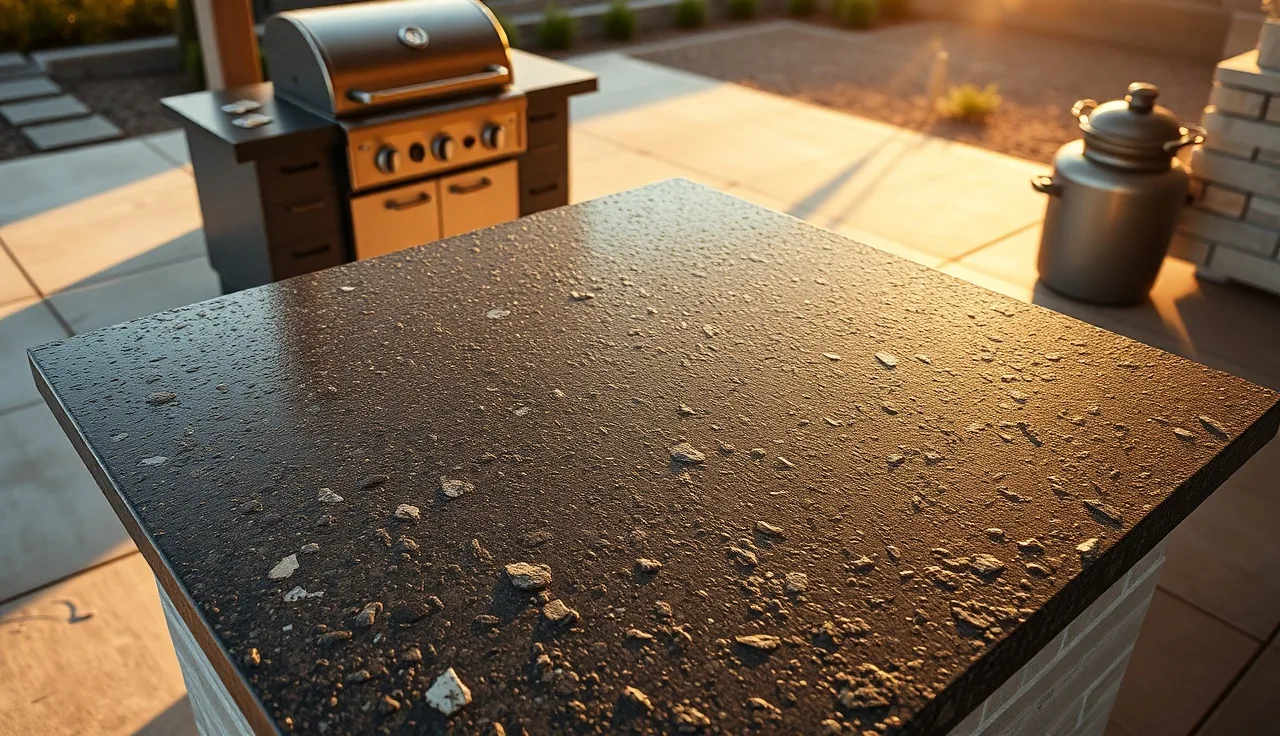
Flame finishing, also called thermal finishing or flaming, is a surface treatment where fabricators run an open flame across a polished or sawn granite slab. The heat, typically 1,800 to 2,200°F at the burner tip, makes the different minerals inside granite expand at different rates. Feldspar and quartz crystals near the surface pop off, leaving a micro-rough, pitted face. Mica flakes scorch and flake away too.
The result looks nothing like polished granite. It's matte, slightly grey-toned, and rough enough to catch your fingernail. That roughness is the whole point outdoors, where polished stone turns dangerously slick when wet.
Flaming doesn't change the stone's chemistry or its structural durability. You're removing a thin layer, maybe 1 to 2 mm at most. The stone underneath stays intact. What you lose is the reflective sheen and some of the color depth that polishing pulls out. What you gain is a surface that looks natural, ages well outside, and needs almost no maintenance to stay safe underfoot.
This finish has been standard on exterior architectural granite for decades. Walked across a plaza or climbed the steps outside a bank and noticed the stone felt grippy? That was almost certainly flame-finished granite [1].
Why choose flame finish for outdoor countertops specifically?
Outdoor countertops take abuse that indoor surfaces never see: direct sun, rain, pooling water, hard frost, and constant thermal cycling. Polished granite is beautiful. Outdoors it becomes a liability.
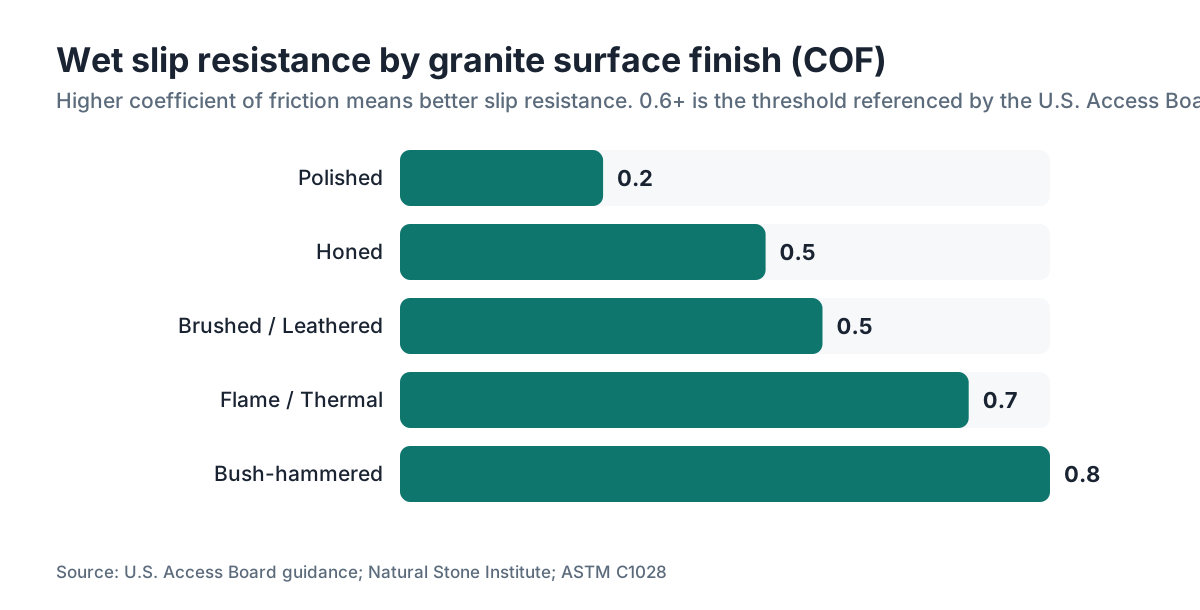
Slip resistance is the clearest reason to flame finish. Polished granite, wet, has a coefficient of friction (COF) around 0.2 to 0.3, which most safety guidelines call unacceptable for a walking surface. Flaming raises the COF to 0.6 or above, inside the range the U.S. Access Board references as a baseline for accessible pedestrian surfaces [2]. A countertop isn't a floor, but that friction still matters every time you set down a wet dish or lean on the edge.
Frost resistance is the second reason. Water works its way into the micro-pores of any stone surface. When it freezes, it expands about 9% by volume, and repeated freeze-thaw cycles cause spalling and surface cracking over time. Flaming opens the surface structure. That sounds backwards, but the larger surface pores drain and dry faster than the tight, sealed pores of a polished finish. European standard EN 1341 recognizes thermal finishing as a surface treatment for stone used in freeze-thaw paving environments [3].
Maintenance is the third reason. A polished outdoor countertop shows every water spot, every smear of sunscreen, every bird dropping in high contrast. The matte, textured surface hides all of it. You still clean it with soap and water. You're just not chasing a mirror finish that the weather dulls anyway.
Comparing stone for an outdoor kitchen? Granite countertops give you more mineral hardness than most alternatives, which is exactly what thermal finishing needs to work. Softer stones like marble and soapstone can't take the process without cracking.
One honest caveat: flaming is not a magic sealer. The stone still benefits from a penetrating impregnating sealer applied afterward, especially if you'll prep food on it or the counter sits under a roof where rain never rinses it.
What equipment do fabricators use to flame finish granite?
Commercial shops use purpose-built flaming machines that mount a row of torch heads on a carriage. The carriage rides a track down the length of the slab. The burner array runs oxy-propane (most common in the US) or oxy-acetylene. Propane is cheaper to run. Acetylene burns hotter and works slightly faster, but it costs more per cubic foot of gas and carries heavier storage and handling rules.
The carriage travels at a controlled speed, typically 1 to 3 feet per minute depending on granite thickness and how deep you want the texture. Too fast, you get uneven pitting. Too slow, you risk cracking the slab, especially thin 2 cm material. Most production shops run one flame pass, then follow immediately with a cold-water quench. The thermal shock from the water speeds up the crystal-popping and clears loose material. The result is cleaner and more consistent than dry flaming alone.
Smaller shops and on-site work use hand torches. A standard oxy-propane hand torch with a wide-angle heating tip gives you control but demands consistency. You move the torch in overlapping passes, tip 2 to 4 inches off the surface, and the results ride entirely on your pace and distance. Hand-flaming one square foot takes roughly 3 to 5 minutes of torch time. A 25-square-foot section runs about 90 minutes of active work, and fatigue turns into hot spots.
After flaming, the surface gets a wire brushing or a pass with an angle grinder and diamond cup wheel to knock off loose spalls. Then a water wash. Some shops follow with light hand sanding using 60 to 80 grit diamond abrasive to soften sharp high points that snag dish towels, then seal.
The main safety concerns are UV radiation from the flame (wear face protection with shade 5 or higher lenses per OSHA 1910.133), compressed gas cylinder handling, and the stone fragments that fly during quenching. A stone shield or splash guard around the quench zone is standard [4].
Which granites are best suited for flame finishing?
Not all granite responds the same way, and the differences matter a lot outdoors.
Granites with high feldspar content and a coarse to medium crystal structure flame beautifully. The large feldspar crystals pop clean and build the rough texture you want without deep irregular pitting. Good examples: Absolute Black (a South African gabbro sold commercially as granite, which flames to a dramatic charcoal grey), Baltic Brown, Impala, and most Brazilian granites with their coarse, visible grain.
Granites with very fine crystal structure, often sold as "black granite," are frequently not true granites at all but diabase or gabbro. They flame, but the texture comes out finer and less pronounced. That can be a plus on a countertop, where a smoother but still matte surface may read better.
Don't flame stone with significant natural fissures or veining until you've tested a sample. Rapid heating and quenching can drive existing fractures wide open. Skip thin-cut slabs too: 2 cm material is marginal for outdoor countertops in cold climates regardless of finish, and flaming piles on thermal stress. For outdoor countertops in freeze-thaw zones, 3 cm is the minimum thickness.
Quartzites get sold alongside granite but behave differently under the torch because their mineralogy is nearly all quartz. Some can be thermally finished, but the texture stays subtle. Marble, limestone, and travertine should never be flamed. The heat wrecks calcium carbonate and the results are poor.
Weighing granite against other surfaces for an outdoor kitchen? Marble countertops are a bad outdoor choice for exactly these reasons. Granite's silicate mineral structure is what makes it thermally finishable in the first place.
What does flame finishing cost, and what affects the price?
Flame finishing stacks on top of the slab cost and any other fabrication. A shop doing it in-house with a flame machine typically adds $8 to $15 per square foot. Hand-torch work by a fabricator without dedicated equipment runs $12 to $20 per square foot because of the labor time. High-demand markets charge more.
Here's what moves the price:
Stone thickness. 3 cm slabs take more heat and time to flame evenly than 2 cm. Thicker slabs also crack less, so part of what you pay for is a safer process.
Slab size and shape. Simple rectangles fly through a flame machine. L-shapes, curves, and tight cutouts around sinks force hand work and torch repositioning. Labor climbs fast.
Texture depth. Some clients want aggressive, heavily pitted texture. Others want a light flame with minimal roughness. The heavier pass takes longer.
Shop equipment. A shop with a dedicated flame machine produces consistent results faster than one working by hand. Their per-square-foot cost is lower, and your quote should reflect that.
Sealing. An impregnating sealer applied after flaming adds $1 to $3 per square foot depending on the product and coverage.
For full outdoor kitchen countertops, material plus fabrication plus flame finish commonly lands homeowners in the $100 to $180 per square foot installed range, depending on granite, region, and edge profiles. Edges on flamed counters usually stay rough or get a simple eased edge, since bullnose and ogee profiles need the polished surface most clients then want flamed away. Many installers leave edges either rough-chiseled for a rustic look or lightly honed to smooth them without a full polish.
Fabricators quoting flame-finish jobs live or die on accurate square-footage takeoffs. SlabWise includes nesting and quoting tools that let shops price thermal finishing as a per-square-foot line item, which keeps margins honest when material and labor costs swing by stone type.
How does the flame finishing process work step by step?
Here's the actual sequence, whether you're running a flame machine or working by hand.
1. Prepare the slab. The stone should be fully cut and edged before flaming. You can flame after cutting to shape, but do all major sawing first. Clamp or position the slab securely on a flat surface that can take heat. Wet the surrounding work area to cut fire risk.
2. Set gas pressures. For oxy-propane, typical starting pressures are oxygen at 40 to 60 PSI and propane at 20 to 30 PSI. Exact ratios vary by burner design, so read your equipment manual. The flame should be a sharp, blue oxidizing flame, not a fluffy yellow one.
3. Run the flame. Move the torch across the surface in slow, even passes, overlapping each pass by about 50%. Keep the tip 2 to 4 inches from the stone. You'll see feldspar crystals whiten and pop right away. The surface smokes as mica burns off.
4. Quench immediately. Follow the flame with a continuous water flow from a hose or the machine's quench bar. This clears loose material and cools the stone fast, which sharpens the texture.
5. Wire brush and wash. Once the stone cools, brush the surface with a stiff wire brush or a diamond cup wheel to clear all loose particles. Rinse thoroughly.
6. Inspect in raking light. Uneven areas show up as shinier patches where the crystal pop didn't finish. Those spots get a second torch pass.
7. Final finish and seal. For outdoor counters, apply a penetrating impregnating sealer rated for exterior use. Let it cure fully before installation. Most sealers specify a 24-hour minimum cure before water contact.
Total time for a 25-square-foot countertop on a flame machine with an experienced operator: roughly 1 to 2 hours including setup, flaming, brushing, and sealing. By hand with a single torch: 3 to 5 hours.
How does flame finish compare to other textured granite finishes?
Granite sells in several surface finishes, and it helps to know where flaming sits against the alternatives.
| Finish | Surface texture | Slip resistance (wet COF) | Outdoor durability | Typical cost premium over raw |
|---|---|---|---|---|
| Polished | Mirror-smooth | 0.2 to 0.3 (poor) | Fair (weathers, stains show) | $0 (baseline) |
| Honed | Matte, smooth | 0.4 to 0.5 (moderate) | Good | +$2, $5/sq ft |
| Brushed/Leathered | Slight texture, matte | 0.4 to 0.6 (moderate-good) | Good | +$3, $8/sq ft |
| Flame/Thermal | Rough, heavily pitted | 0.6 to 0.8 (excellent) | Excellent | +$8, $20/sq ft |
| Bush-hammered | Very rough, dimpled | 0.7 to 0.9 (excellent) | Excellent | +$10, $25/sq ft |
Flaming is the common pick for outdoor countertops where safety and looks both matter. Bush-hammering grips even harder but takes longer to produce and looks aggressive, more at home on paving than a counter. Leathered granite, made with flexible diamond brushes instead of heat, has caught on for indoor-outdoor kitchens because it keeps more color depth while staying matte [5].
For a true outdoor kitchen counter that sees rain, heat, and regular use, flamed or bush-hammered granite beats honed every time on slip resistance. Honed is fine for a covered outdoor kitchen in a mild climate where the surface rarely gets truly wet.
One thing that surprises homeowners: flaming makes color look lighter and more uniform. If you fell for the rich dark tones of a polished Absolute Black slab in the showroom, know that the flamed version reads grey and matte. Ask for a flamed sample before you commit. Good fabricators keep small flamed samples of common granites, or they'll flame a corner of a test piece for you.
Is flame-finished granite safe for food prep surfaces outdoors?
This comes up a lot, and the answer is yes, with one condition: seal it.
Flaming creates a rougher, more porous surface than polishing. Those micro-pits can harbor bacteria if food juices work in and the stone isn't sealed. The same is true of honed granite indoors, which is why most fabricators seal honed kitchen counters.
An impregnating sealer (also called a penetrating sealer) fills the pores at the surface without coating the top, so the rough texture and slip resistance stay intact. It blocks liquids from soaking in while leaving the surface safe for food contact after curing. Look for sealers that state they're food-safe when cured. Most major brands (StoneTech, Tenax, Miracle Sealants, and others) carry that designation and meet NSF/ANSI 51 criteria for incidental food contact, though coverage rates and reapplication schedules vary by product.
Outdoors, UV and weather speed up sealer breakdown. Plan to reseal a flamed outdoor granite counter every 1 to 2 years, against every 3 to 5 years for a polished indoor surface. A water bead test tells you when: drip water on the surface, and if it soaks in within a minute instead of beading, reseal.
For general stone care that carries straight over to your outdoor granite, how to clean stone countertops covers what to use and what to skip.
Can homeowners flame finish granite themselves, or is this a professional-only job?
Honest answer: a skilled DIYer can do it, but the risks are real enough that most people should hand it to a shop.
The physical hazards are the biggest wall. Running oxy-propane at flaming pressures means handling compressed gas cylinders correctly, using the right regulators and fittings, and wearing face protection rated for torch work. OSHA 29 CFR 1910.101 covers compressed gas cylinder storage and handling, and ignoring those requirements even at home puts you at serious risk [6]. The stone fragments flying off during the quench are a genuine eye hazard.
Beyond safety, getting a consistent result across a whole slab by hand takes practice. An experienced fabricator has flamed hundreds of square feet and reads the surface response as they go. A first attempt almost always leaves hot spots and uneven texture you can see in the finished piece.
That said, if you're a fabricator or experienced stoneworker who already runs oxy-fuel gear, hand-flaming is learnable. Practice on scrap of the same granite species until you get a feel for travel speed and distance. Build up to full slabs once your results hold steady on 12-inch square test pieces.
For a homeowner who bought a flame-finished slab that needs touch-up, or who wants to rough the edges of a polished slab, a rented propane weed burner (no oxygen boost) is the more practical option. It won't get hot enough for a true thermal finish, but it can lighten and roughen the surface marginally on small areas. Results are inconsistent and not comparable to real flaming. Save it for a minor texture blend on an already-flamed slab.
How do you maintain and clean flame-finished granite outdoors?
Maintenance is simpler than most homeowners expect, which is one of the best things about this finish.
Routine cleaning takes warm water and a pH-neutral stone-safe cleaner. Dish soap works in a pinch, but it leaves residue in the pits over time. Skip acidic cleaners (vinegar, citrus-based products) since they etch stone. The rules that apply to any stone counter apply here, outdoors included.
In outdoor kitchens, grease is the main enemy. It gets into the texture and hardens once grill heat carbonizes it. A degreasing stone cleaner and a stiff nylon brush (not metal, which leaves rust marks) handles most buildup. For heavy carbon deposits, a paste of baking soda and water left 15 minutes before scrubbing works without damaging the stone.
Power washing is fine at low to moderate pressure (under 1,500 PSI). Higher pressure won't hurt the stone but strips sealer faster.
Winter care in cold climates: keep deicing salts (sodium chloride, calcium chloride) off and away from the counter. They speed up surface deterioration in stone, and the open texture of flamed granite gives salt more surface area to attack. Use sand for traction on surrounding areas, and rinse the counter well before winter if you're near a salt-spray road.
Resealing schedule: once a year is a good habit for true outdoor exposure. Twice a year if the counter gets heavy rain and direct sun. The water bead test is your best diagnostic, not the calendar.
For closely related stone care chemistry that applies to granite too, how to clean quartzite countertops is worth a read.
What building codes or standards apply to flame-finished granite outdoors?
For countertops specifically, no federal building code mandates flame finishing. Finish choice is a design and safety decision, not a code requirement, unless the counter is part of an ADA-accessible outdoor kitchen or commercial space.
For accessible design, the 2010 ADA Standards for Accessible Design (Section 302) require accessible floor and ground surfaces to be stable, firm, and slip-resistant, and consultants apply similar principles to accessible counter and work surfaces in public accommodations [7]. The ADA itself doesn't put a number on "slip-resistant," but the U.S. Access Board has referenced wet COF values of 0.6 or above as consistent with slip-resistance goals [2].
In jurisdictions that adopted the International Building Code for commercial outdoor kitchen work, IBC Section 1003.4 addresses slip resistance for walking surfaces [9]. That applies most directly to floors, but a fabricator building commercial outdoor kitchen counters in an accessible space should know the intent.
For residential homeowners, local building departments rarely inspect countertop surface finishes. The code items that actually touch you are the outdoor kitchen structure (gas line permits, electrical) rather than the granite finish.
European projects have clearer standards. EN 1341:2012 covers natural stone slabs for external paving and includes slip resistance testing, which many specifiers reference even for countertop work [3].
If your project is commercial or you're a fabricator quoting an accessible outdoor space, do this: specify and document a slip-resistance test result (a pendulum test per BS 7976, or static COF per ASTM C1028) for the flamed granite you're using [8]. A wet COF above 0.6 gives you documented justification. Some granite suppliers provide test certificates for common flamed products.
How does flame-finished granite hold up long-term outdoors?
This is where granite earns its reputation. Properly flame-finished granite on exterior work has service lives measured in decades, not years. Look at the flamed granite paving on public buildings installed in the 1980s and 1990s: most is still in service, still gripping, still presentable with almost no maintenance.
The finish doesn't wear smooth quickly. The surface flaming leaves is the result of crystal fracture and removal. There's no coating to wear off. What you lose slowly, over many years of foot traffic on flooring or abrasive use on a counter, is the finest edge roughness of the pits. A counter used mostly for placing dishes and prepping food sees far less abrasive wear than a floor, so the texture lasts longer.
Freeze-thaw cycling is granite's real long-term test. Research in stone and geomaterials literature shows that igneous rocks like granite, with their interlocking crystal structure, resist freeze-thaw damage far better than sedimentary stones [1]. The flamed surface's open structure dries faster than a polished one and gives freeze-expanding water less pressure to build.
Color shifts over time. Flame-finished granite outdoors lightens and greys slightly over many years, mostly from UV-driven surface oxidation and lichen. It's slow and largely invisible year to year. Regular sealing slows it further. Most clients treat the natural weathering as an asset, since the stone reads more authentically aged.
The weak points are the same as any stone: chips on edges from hard impacts (the lighter, more brittle edges of a flamed piece are the usual victims), staining if you neglect the sealer, and cracking from substrate movement. All three are preventable with good installation and basic maintenance, not from anything specific to the flame finish.
For fabricators pricing countertop installation jobs with thermal finishing, accurate square-footage measurement matters most, because both stone cost and finishing labor scale directly with surface area. SlabWise lets shops build custom line-item pricing for specialty finishes and send professional quotes without manual math errors.
Frequently asked questions
How hot does the torch need to be to flame finish granite?
The stone surface needs to hit roughly 1,800 to 2,200°F to make feldspar crystals pop and spall. An oxy-propane burner at standard shop pressures (40 to 60 PSI oxygen, 20 to 30 PSI propane) reaches this range easily. The burner tip runs hotter still. The variable that actually controls the texture is how long any given spot on the stone stays exposed, which comes down to travel speed.
Does flame finishing weaken the granite slab?
Not meaningfully for properly selected material. You're removing 1 to 2 mm of surface crystal, not touching the structural depth of the slab. For 3 cm exterior counters, the loss is negligible. Thinner 2 cm slabs are more at risk from the thermal shock of the quench. Slabs with pre-existing fissures or voids can crack under flaming, which is why test pieces and careful slab selection matter before you commit.
Can flame-finished granite be polished again later?
Yes. You can regrind and re-polish flamed granite, though you'll remove more than just the flamed layer. It starts with coarse diamond abrasives (36 to 60 grit) to take out the rough texture, then works progressively finer to a polish. It's slow and practical mainly for a shop with polishing equipment. A homeowner wanting to restore a finish would need a fabricator to do it in the shop or bring portable equipment on-site.
What's the difference between flame finish and leathered granite?
Leathered granite uses rotating diamond brushes, not heat, to tighten the pores slightly while building a consistent, subtle texture. The surface is less rough than flame finish, keeps more color depth, and feels smoother. Flame finish uses thermal shock for a more pronounced, irregular pit pattern that's rougher and lighter in color. Outdoors in wet or cold climates, flame finish grips better. Leathered is popular for covered outdoor kitchens where the look matters more than maximum traction.
How long does it take a fabrication shop to flame finish a countertop?
On a production flame machine, a straightforward 25-square-foot section takes 1 to 2 hours including setup, the flame pass, quench, brushing, and sealing. Hand-torch work on the same piece takes 3 to 5 hours. Complex shapes, tight curves around sinks, or heavily detailed edges add time, since those areas need hand work whether or not the main surface runs through a machine.
Will flame-finished granite countertops be too rough to clean easily?
Rougher than polished, but not impractical. Food residue gets into the texture more than on polished stone, which is why sealing matters. Routine cleaning with a stiff nylon brush and a stone-safe degreaser handles daily cooking mess. The texture that catches food also hides water spots and fingerprints, so in practice the upkeep feels a lot like honed stone. Most outdoor kitchen owners find cleaning easier than they expected once the sealer is on.
Do I need to seal flame-finished granite before or after installation?
Before, if you can. Sealing in the shop or garage before the slab goes in gives you easy access to every face, including the bottom edge and surfaces you can't reach once the counter is set. Apply one or two coats of a penetrating exterior-rated stone sealer, let it cure fully (24 to 48 hours depending on the product), then install. Apply a final coat after installation to cover anything disturbed during setting and grouting.
Is flame-finished granite more expensive than polished granite for outdoor use?
Yes, typically by $8 to $20 per square foot in fabrication cost alone, on top of the same raw slab price. The slab cost for a given species is identical whether you flame it or polish it. The premium pays for the extra labor and gas of the flaming step. For full outdoor kitchen counters, budget $100 to $180 per square foot installed, depending on species, region, and edge treatment. Polished granite for the same project usually runs $70 to $140 installed.
Which granite colors look best with a flame finish?
Dark granites (Absolute Black, Impala, Baltic Brown, Black Galaxy) flame to a dramatic charcoal or dark grey that designers love for outdoor kitchens. Medium tones like Tan Brown or Blue Pearl keep some character but come out muted. Light granites go very pale, almost white-grey, which can wash out the natural pattern. Always look at a flamed sample of the specific stone before ordering. The color shift is significant.
Can flame finish be applied to just part of a granite countertop slab?
Technically yes, but the transition between flamed and polished sections of the same slab is jarring and rarely looks intentional. Some designers use a deliberate combo, a polished top with a flamed edge or apron, but the transition line has to be sharp and purposeful. If you're after a split-finish piece, have the fabricator mock up a sample first. Random partial flaming to patch or match an existing finish almost never looks right.
How does outdoor temperature and climate affect flame-finished granite performance?
Cold climates with freeze-thaw cycling are where flame finish shines most against polished. The open texture drains and dries faster, cutting ice formation in the pits. In hot, dry climates, the main concern is sealer degradation from UV, so high-UV spots (Southwest US, high altitudes) need resealing roughly every 12 months. In humid, tropical climates, watch for mold and algae colonizing the rough surface, which calls for periodic treatment with a dilute bleach or specialty biocide.
Are there granite types that should not be flame finished?
Yes. Granites with significant natural fissures, voids, or inclusions can crack under thermal shock. Very fine-grained true granites often never develop useful texture. Engineered stone, quartzite (in most cases), marble, limestone, travertine, soapstone, and anything that isn't a true igneous stone with substantial feldspar content should not be thermally finished. When in doubt, the fabricator should test a scrap piece from the same slab before committing the full countertop.
What edge profiles work with flame-finished granite countertops?
Simple edges work best: straight (eased), beveled, or a rough chiseled edge (called a natural or antiqued edge) that matches the flamed surface. Polished profiles like ogee, bullnose, or triple pencil are almost never used on flamed counters because the sheen fights the matte surface. Some fabricators offer a honed version of standard profiles on flamed pieces, which looks clean and consistent without the contrast of a full polish. Decide the edge profile before flaming.
How do fabricators price flame finishing as a line item on quotes?
Most shops price it as a per-square-foot add-on to the base fabrication price, typically $8 to $20 per square foot depending on equipment, stone type, and complexity. Some add a fixed setup charge ($50 to $150) for jobs that need machine configuration or repositioning. Edge flaming, when requested, is often priced separately per linear foot since it takes hand work regardless of shop equipment. Always break this out as a visible line item so clients see what they're paying for versus the raw stone cost.
Sources
- Indiana Geological and Water Survey, Indiana University: Igneous rocks like granite, with interlocking crystal structures, are highly durable in exterior use, and flame-finished granite has been standard for exterior architectural paving and facades for decades.
- U.S. Access Board: The Access Board references a wet coefficient of friction of 0.6 or above as consistent with slip-resistant surfaces for accessible pedestrian use; flame-finished granite typically achieves COF 0.6 to 0.8 wet.
- European Committee for Standardization: EN 1341:2012, Slabs of natural stone for external paving: EN 1341:2012 covers requirements for natural stone slabs used in external paving, including slip resistance and freeze-thaw durability; thermal (flame) finishing is a recognized surface treatment.
- U.S. Occupational Safety and Health Administration: OSHA Standard 1910.133, Eye and Face Protection: OSHA 1910.133 requires appropriate eye and face protection (shade 5 or higher lenses) when working with torches that produce UV radiation, including oxy-fuel equipment used in stone flaming.
- Natural Stone Institute: Dimension Stone Design Manual: Leathered or brushed finishes on granite are produced with flexible diamond brushes, giving a matte, slightly textured surface that differs from the thermally-induced pit structure of flame finishing.
- U.S. Occupational Safety and Health Administration: OSHA Standard 29 CFR 1910.101, Compressed Gases: OSHA 29 CFR 1910.101 sets requirements for compressed gas cylinder storage, handling, and use, applicable to oxy-propane and oxy-acetylene equipment used in granite flaming.
- U.S. Department of Justice: 2010 ADA Standards for Accessible Design, Section 302: 2010 ADA Standards Section 302 requires accessible floor and ground surfaces to be stable, firm, and slip-resistant, a principle applied by accessibility consultants to outdoor kitchen surfaces in public accommodations.
- ASTM International: ASTM C1028, Standard Test Method for Static Coefficient of Friction: ASTM C1028 provides the standard method for measuring static coefficient of friction on stone and tile surfaces, used to document slip resistance of flame-finished granite for specification.
- International Code Council: 2021 International Building Code, Section 1003.4 Slip-Resistant Surface: IBC Section 1003.4 requires walking surfaces in accessible means of egress to be slip-resistant; the same principles are referenced for commercial outdoor kitchen surfaces in accessible-design specifications.
- NSF International: NSF/ANSI 51, Food Equipment Materials: NSF/ANSI 51 sets criteria for food equipment materials including stone sealers; many penetrating stone sealers are formulated to meet incidental food contact safety requirements after full cure.
Last updated 2026-07-11