TL;DR
- Stone fabricators in the Pacific Northwest cut, edge, and install countertops from raw slabs of granite, quartz, quartzite, marble, and more.
- Most Pacific Northwest homeowners pay $55 to $130 per square foot installed for natural stone, though rates and slab prices swing by market.
- Shop size, equipment, and turnaround differ a lot across the region.
- Get two or three quotes.
What does a stone fabricator actually do?
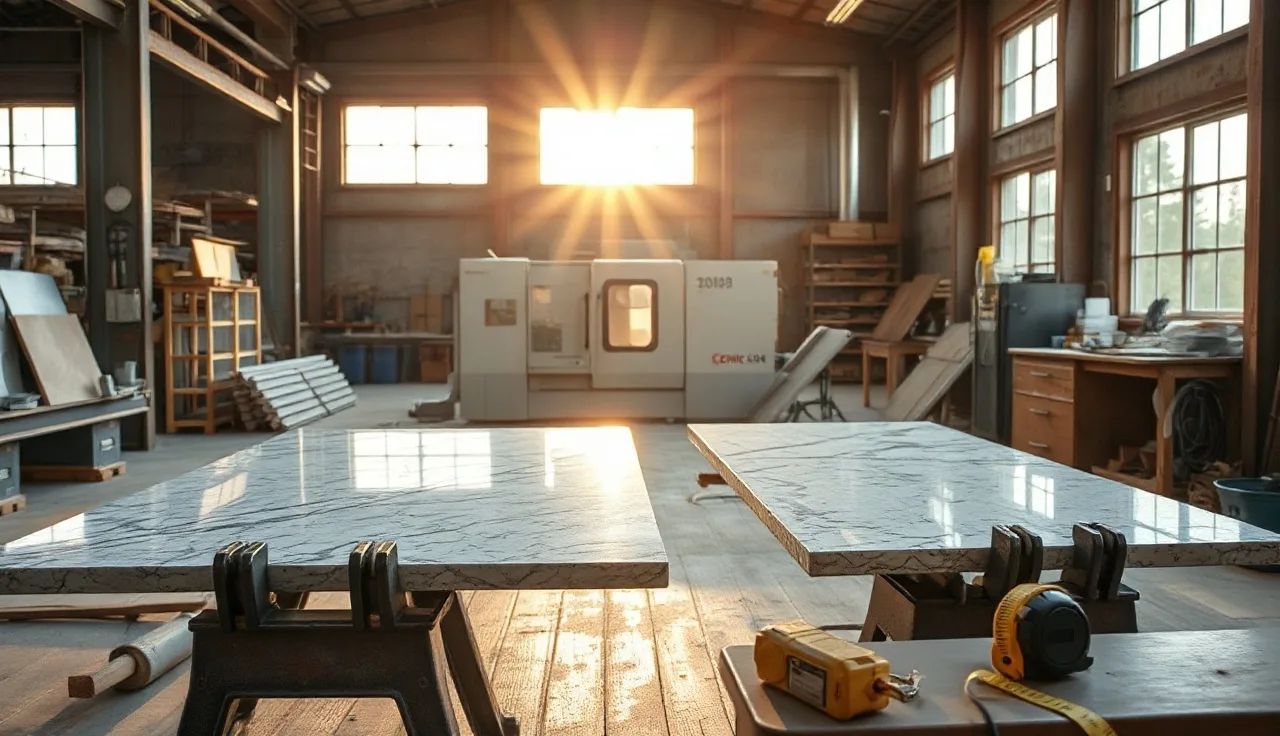
A stone fabricator takes a raw slab, usually 55 to 65 square feet of material, and turns it into finished countertops cut to your kitchen's exact dimensions. That means templating the space (either with a laser system or old-school sticks and cardboard), programming cuts on a CNC waterjet or bridge saw, profiling the edges, polishing, and installing the finished pieces in your home.
Fabrication is a manufacturing job as much as a trade skill. A good shop runs CAD-to-CNC software that nests your cut pieces onto the slab to cut down waste. A weak shop eyeballs the layout and you pay for the extra scrap. That gap matters, because the slab itself is usually the biggest line item on the invoice.
The Pacific Northwest has a dense cluster of fabricators. The region has strong new construction, high remodel activity, and several large slab importers anchored near Seattle, Portland, and Tacoma. Shops range from one-person operations with a circular saw and a grinder to full CNC facilities turning out 40 or 50 jobs a week.
How much do countertops cost from NW stone fabricators?
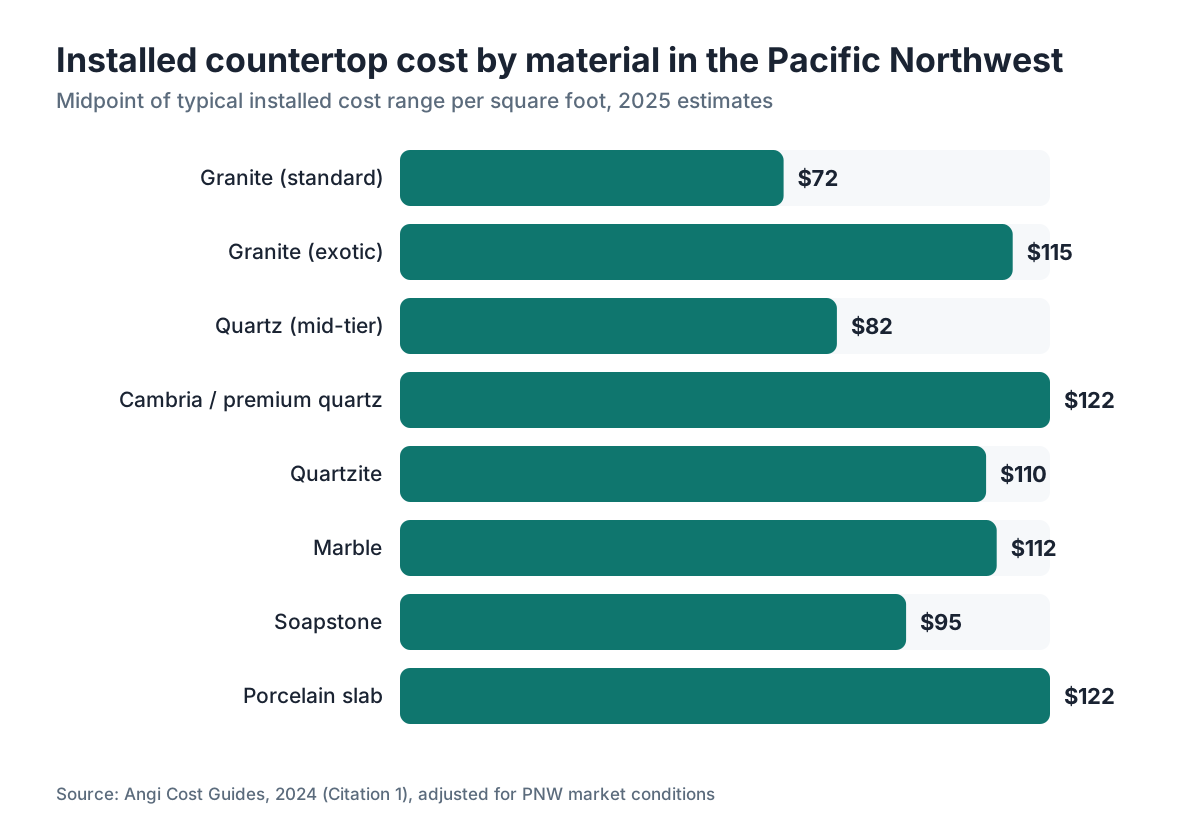
Price depends on material, edge profile, cutouts, and the shop's overhead. Here is a realistic range for the Pacific Northwest market as of 2025 [1]:
| Material | Installed cost per sq ft (PNW est.) |
|---|---|
| Granite (standard colors) | $55 - $90 |
| Granite (exotic/movement) | $90 - $140 |
| Quartz (mid-tier brands) | $65 - $100 |
| Quartz (Cambria, premium) | $95 - $150 |
| Quartzite | $80 - $140 |
| Marble | $75 - $150 |
| Soapstone | $70 - $120 |
| Porcelain slab | $85 - $160 |
These are all-in estimates covering material, fabrication labor, and a standard install. They do not include demolition of your existing countertops, which usually adds $150 to $400 depending on how much material and how many sinks are involved [2].
Seattle-area shops generally run 10 to 20 percent higher than shops in the Willamette Valley or eastern Washington, reflecting higher real estate, labor, and overhead. That gap is real, but chasing it across the region rarely pays off. A countertop damaged in transport becomes your problem the second it leaves the shop.
Edge profiles add cost. A simple eased or beveled edge is usually included. Ogee, waterfall, or mitered edges can add $15 to $30 per linear foot. Farmhouse apron fronts add more. Ask specifically. Shops quote these differently, and the line items are easy to miss on a rough estimate.
What stone materials do Pacific Northwest fabricators typically carry?
Most NW shops pull from the same slab distributors, so the menu looks broadly similar shop to shop. What differs is which distributors a shop has accounts with, how large the on-site inventory is, and whether they let you walk the yard.
Granite is still the workhorse. It is hard, heat-resistant, and the price range is huge, from commodity Baltic Brown to Brazilian quartzites sold under the granite umbrella. If you are pricing granite countertops, ask the fabricator to pull the actual country-of-origin certificate. Origin matters for durability and for consistency across remnants.
Quartz engineered stone (Silestone, Caesarstone, Cambria countertops, MSI, and others) now accounts for roughly 30 to 35 percent of residential countertop sales in the US, per National Kitchen and Bath Association trend reporting [3]. It is consistent, non-porous, and relatively easy to fabricate, which is part of why shops like working with it.
Quartzite and marble stay popular in the Pacific Northwest luxury remodel market. Both need sealing and some care, but quartzite (the real metamorphic rock, not the sandstone lookalike) is genuinely tough. Learn how to clean quartzite countertops before you commit to the material.
Soapstone is a regional favorite, partly because it fits the muted, natural Northwest look. It is softer than granite, scratches with use, and ages into a patina that either drives you crazy or grows on you. Read how to clean soapstone countertops before you decide.
Portland, Oregon has a busy natural stone community, with several specialty importers who deal in reclaimed and unusual stone you will not find in a big warehouse.
How do you find reputable stone fabricators in the Pacific Northwest?
Start with the Marble Institute of America (MIA+BSI) member directory [4]. Members have agreed to a code of ethics, and many have completed the Certified Fabricator or Accredited Stone Installer training programs. That does not guarantee quality, but it narrows the field faster than a generic Google search.
The Natural Stone Institute runs an accreditation program for fabrication shops [5]. Roughly 200 shops across North America hold it. Accreditation requires a facility inspection, documented quality processes, and proof of trained staff. It is the closest thing the industry has to a third-party quality audit.
Once you have a short list, here is what to check:
- Ask to walk the shop floor. A shop that will not show you its equipment and workflow has something to hide, or at least nothing to brag about.
- Ask what CAD/CAM software they run and whether they nest jobs to minimize waste. Shops that nest properly on software like SlabWise, Moraware, or Slabsmith pass savings on and are less likely to run short on a dramatic slab.
- Ask for three references from jobs finished in the last six months, not the last five years. Materials and staff turn over.
- Check the Better Business Bureau [6] and the Washington Department of Labor and Industries (or the Oregon CCB) license lookup [7] to confirm the license is current and there are no unresolved complaints.
Word of mouth from a general contractor or kitchen designer who has run multiple jobs with a shop is still the most reliable signal. A fabricator who installs sloppy counters does not keep GC referrals for long.
What licenses and insurance should a Pacific Northwest fabricator carry?
In Washington, any company installing countertops for pay must be registered with the Department of Labor and Industries as a general contractor [7]. The registration number should appear on every contract. Verify it at the L&I contractor lookup page. Hire an unregistered contractor and you lose your recourse through the state complaint process if something goes wrong.
In Oregon, contractors must register with the Construction Contractors Board (CCB) [8]. CCB registration requires proof of insurance, a bond, and passing a business and law exam. The CCB database is public and easy to search. Fabrication-only shops that do no installation sometimes operate without a CCB license, which is legal if they subcontract the install to a licensed party. Confirm who holds the license before you sign anything.
For insurance, ask for a certificate of liability naming your property as additionally insured during installation. A $1 million general liability policy is standard. Workers' compensation coverage for the install crew is non-negotiable. If a crew member gets hurt on your property and the company has no workers' comp, that claim can land on you.
Washington's contractor bond requirement is $12,000 for general contractors as of 2024 [7]. That sounds like plenty until a $25,000 countertop job goes sideways. It is a backstop, not a guarantee.
How long does fabrication and installation take in the Pacific Northwest?
A standard residential kitchen with one or two slab lots usually takes two to four weeks from signed contract to installed countertops. The timeline breaks down roughly like this:
- Template: within one to three business days after cabinet installation is complete
- Fabrication: five to ten business days after template, depending on shop backlog
- Install: a half-day to full-day job once your slot is scheduled
Spring and summer are the busy seasons. Planning a late-spring kitchen remodel in Seattle or Portland? Call fabricators in January or February. Some shops are booked six to eight weeks out by April.
Complicated jobs run longer. A kitchen with a waterfall island, multiple cutouts, and a custom edge might need an extra week of fabrication. Porcelain slab is slower to work than granite, because it is brittle and unforgiving with tooling.
If a shop promises countertops in five days on a big job, ask exactly how. Fast is not always better. Rushing a large seam or skipping cure time on epoxy causes problems you will notice for years.
What should a countertop contract from a fabricator include?
A proper contract protects both parties. Before you sign, confirm these items are in writing:
- The specific slab lot you approved (with slab ID, quarry, and thickness, usually 2cm or 3cm)
- Total square footage being fabricated
- Edge profile name, and whether it is included in the price or itemized
- Number of cutouts (sink, cooktop) and their type (undermount, drop-in, farmhouse)
- Seam locations, agreed in writing or shown on a shop drawing
- Lead time from template to install
- Payment schedule (a 50 percent deposit at signing and the balance at install is typical)
- What happens if the slab breaks during fabrication
The slab breakage clause matters more than people expect. Natural stone can crack during cutting, especially along fissures in quartzite or marble. A good shop carries the cost of a replacement slab and the extra fabrication time when its process caused the break. Get that in writing.
For countertop installation, confirm whether the installer reconnects plumbing or just does the stone work and stops. Many fabricators stop at the stone and expect a plumber to reconnect the sink. That costs extra and belongs in your project plan.
How do NW fabricators price jobs, and how can you compare quotes accurately?
Most shops quote by the square foot of finished installed area, measured from the template. Some quote by the job, which makes comparison harder. When quotes compete, always ask what each one includes on a line-item basis.
Common places where quotes diverge:
- Tearout and haul-away of existing countertops
- Undermount sink cutout (some include one, some charge $150 to $250 each)
- Undermount sink grinding and polishing
- Edge profile upgrades
- Sealer application (some shops seal as standard, some charge extra, some skip it)
- Backsplash from the same material (priced per linear foot, not per square foot, at most shops)
The cheapest quote is almost never the best deal. A shop charging $10 less per square foot but billing a $300 tearout fee and $200 per cutout can end up the more expensive option on a real kitchen.
Fabricators running CNC-based nesting software can sometimes offer better material use, which matters if you pay for the full slab rather than the cut area alone. Ask whether the quote is based on cut area or on gross slab area purchased. The answer tells you a lot about how transparent the shop is.
Shops using software like SlabWise can generate itemized digital quotes that show exactly how your pieces lay out on the slab, which makes it easier to compare bids honestly.
What questions should you ask a fabricator before signing a contract?
Here is a short list worth asking every shop you are considering:
- Who templates and who installs? Some shops template with one crew and install with another. Ask if the person measuring is also the person installing.
- Do you fabricate in-house or send work to a partner shop? Outsourced fabrication is not automatically bad, but you should know.
- What thickness slab do you recommend for my application, and why? (3cm is generally preferred for most applications because it needs no plywood substrate, but 2cm can be right for vertical surfaces.)
- How do you handle seams, and can I approve the seam location before fabrication starts?
- What warranty do you offer on fabrication and installation? One year on labor is common; some shops offer two.
- Will you send a written itemized quote, or just a total number?
- Have you worked with my specific material before? Porcelain slab, for one, needs different tooling and technique than granite.
Do not be shy about direct questions. A shop that gets defensive when you ask about licensing, insurance, or process is telling you something.
How do Pacific Northwest stone fabricators compare to big-box store countertop programs?
Home Depot and Lowe's both run countertop programs that outsource fabrication to regional shops, often the same ones you could hire directly. The big-box route has one advantage: a large corporate entity backstops disputes. It has several disadvantages.
Big-box pricing typically runs 15 to 30 percent higher for comparable material and work, because the retailer takes a margin on top of the fabricator's price [1]. Material selection is limited to whatever the program's distribution deal covers. And your actual fabricator, the shop cutting and installing your counters, has little local accountability to you, since your contract is with the retailer.
For kitchen countertops, a direct relationship with a local fabricator usually buys you better slab selection, the ability to walk the yard and pick your actual slab, and someone with a local reputation on the line.
Big-box programs make more sense for simple, budget-conscious projects using stock materials, or for homeowners who find sourcing overwhelming and want a single point of contact. If you are comfortable doing basic homework, the direct route almost always wins on cost and outcome.
What alternatives to stone should NW homeowners know about?
Stone is not right for everyone. A few alternatives are worth understanding before you commit.
Butcher block countertops are a Pacific Northwest staple, and they fit craftsman and farmhouse kitchens naturally. They are warm, workable, and renewable through sanding. They need regular oiling and do not belong near a constantly wet sink without careful sealing.
Laminate countertops have improved a lot. Modern laminate (including Formica countertops) can credibly mimic stone at a fraction of the cost. It is a legitimate choice for rentals or budget remodels, not a compromise you should feel bad about.
Corian countertops and similar solid surface materials are still widely used, especially in bathrooms and utility spaces. They are non-porous, repairable, and quieter underfoot than stone, which matters if you stand in the kitchen for hours.
For any natural stone you choose, understanding how to clean stone countertops before installation saves you from damage that voids warranties. And marble countertops deserve a clear-eyed talk with your fabricator about etching and stain risk before you fall in love with a sample.
What trends are shaping Pacific Northwest stone fabricators right now?
A few things are genuinely changing the Northwest market.
Waterfall edges are everywhere. The full slab running down the side of an island needs a mitered corner and careful grain matching, especially on veined material. It is a real test of a shop's skill. Sloppy grain matching on a waterfall edge in a shop's portfolio tells you something.
Large-format porcelain slab, sometimes called sintered stone or sold under brand names like Dekton and Lapitec, is growing fast. It is lighter than granite, comes in very large sizes, and in theory needs less sealing. It is also harder to cut without chipping, so fabrication skill matters more, and shops new to it have a learning curve.
Laser templating has largely replaced stick templating in larger shops, and the improvement in fit and seam quality is real. Getting quotes? Ask whether the shop uses laser templating. It is not a dealbreaker if they do not, but it is a fair quality signal.
Rising labor costs in Washington and Oregon are pushing shops to automate or raise prices. Seattle's minimum wage was $19.97 per hour in 2024 [9], and Oregon's statewide minimum was $14.70 with higher rates in the Portland metro [10]. Shops that bought CNC bridge saws and waterjet cutters in the last five years hold prices better than shops relying on hand-cutting.
Supply chains have mostly normalized since the 2022 disruptions, and slab availability is back near normal. Some exotic quarries in Brazil and Italy permanently cut output, though, so certain materials stay harder to source consistently.
Frequently asked questions
How do I find licensed stone fabricators in Washington state?
Search the Washington Department of Labor and Industries contractor lookup at lni.wa.gov. Every company that installs countertops for compensation must be registered. Search by company name or contractor ID. Confirm the registration is active, the bond is current, and there are no unresolved violations before signing a contract.
How do I find licensed stone fabricators in Oregon?
Search the Oregon Construction Contractors Board (CCB) license lookup at oregon.gov/ccb. Installation contractors must be CCB-registered, bonded, and insured. Fabrication-only shops sometimes operate without a CCB license if a licensed party handles installation, but confirm who holds the license before any work begins.
What is the average cost of granite countertops in the Pacific Northwest?
Installed granite in the Pacific Northwest typically runs $55 to $90 per square foot for standard colors and $90 to $140 per square foot for exotic or heavily figured slabs. Seattle-area shops usually sit at the higher end due to higher overhead. Always get an itemized quote that separates material from fabrication and installation labor.
How long does countertop fabrication take in the Pacific Northwest?
Most residential kitchen jobs take two to four weeks from signed contract to installed countertops: one to three days to template after cabinets are done, five to ten business days of shop fabrication, and a half-day to full-day install. Spring and summer backlogs can push that to six to eight weeks at busy shops, so plan ahead if your project lands in the busy season.
Can I pick my own slab at a Pacific Northwest stone yard?
Yes, and you should. Most fabricators have accounts with one or more local distributors and will take you to the yard to pick your specific slab before fabrication starts. This matters most for natural stone with strong movement or veining, where two slabs from the same quarry can look completely different. Do not skip this on marble, quartzite, or heavily figured granite.
What is the difference between a stone fabricator and a stone supplier?
A supplier (or distributor) imports, inventories, and sells raw slabs. A fabricator cuts, edges, polishes, and installs them. Some operations do both. Many fabricators buy from independent distributors and pass the slab cost through to you. If your fabricator keeps a small on-site inventory, ask which distributor they use so you can visit the full yard for a better material selection.
Do Pacific Northwest fabricators offer remnants for small projects?
Most shops sell remnants from larger jobs at a discount. A bathroom vanity, laundry room top, or bar section often fits on a remnant slab, and the savings can be real. Ask any fabricator you contact whether they keep a remnant yard. Prices vary widely but usually run 30 to 60 percent less than full slab pricing for comparable material.
Should I use a big-box store or a local fabricator for my countertops?
Local fabricators almost always offer better material selection, more direct accountability, and lower prices than big-box countertop programs, which typically add 15 to 30 percent margin on top of the underlying fabricator's cost. Big-box programs make more sense if you want a single corporate point of contact for disputes, or if you are doing a simple project with commodity materials and minimal customization.
What is the Natural Stone Institute accreditation and does it matter?
The Natural Stone Institute runs a shop accreditation program that requires a facility inspection, documented quality processes, and trained staff. Roughly 200 North American shops hold it. It is the closest thing to a third-party quality audit in the fabrication industry. It is not the only signal of a good shop, but an accredited fabricator has cleared a real bar.
What thickness slab should I get, 2cm or 3cm?
3cm (about 1.25 inches) is standard for most residential countertops because it supports itself without a plywood substrate and is less prone to cracking during installation. 2cm (about 0.75 inches) costs a little less and works for vertical applications or areas with very strong cabinet support. Most Pacific Northwest fabricators default to 3cm for kitchens and recommend 2cm only for specific situations.
Do fabricators in the Pacific Northwest seal countertops after installation?
Practice varies. Some shops seal as a standard part of installation, others offer it as an add-on for $50 to $150, and a few skip it and leave sealing to the homeowner. Engineered quartz does not need sealing. Natural stone generally does, though the frequency depends on porosity. Confirm whether sealing is in your quote and what product they use.
What happens if my slab cracks during fabrication?
A reputable shop absorbs the cost of a replacement slab and re-fabrication if the crack came from its process. Get this in writing before fabrication starts. Natural stone has inherent fissures, and a slab occasionally breaks along one during cutting. The contract should say who pays for replacement material and labor in that scenario.
Are there stone fabricators in smaller Pacific Northwest cities like Spokane, Bend, or Bellingham?
Yes, though fewer. Spokane has several established shops serving eastern Washington and northern Idaho. Bend has grown in remodel activity and now has local fabrication options. Bellingham serves the northern Puget Sound area. For very specialized materials or complex jobs in smaller markets, some homeowners work with a larger shop in Seattle or Portland and have countertops transported, though shipping stone carries real risk.
Sources
- HomeAdvisor (Angi) - Countertop Installation Cost Guide: Installed stone countertop cost ranges by material type for US residential projects
- HomeAdvisor (Angi) - Countertop Removal Cost Guide: Countertop demolition and haul-away typically costs $150 to $400 depending on material and sink count
- National Kitchen and Bath Association (NKBA) - Design Trends Report: Quartz engineered stone accounts for roughly 30 to 35 percent of residential countertop sales in the US
- Marble Institute of America (MIA+BSI) - Member Directory: MIA+BSI maintains a member directory of fabricators who have agreed to a code of ethics and completed training programs
- Natural Stone Institute - Accreditation Program: Natural Stone Institute accreditation requires facility inspection, quality process documentation, and trained staff; approximately 200 North American shops hold accreditation
- Better Business Bureau - Contractor Search: BBB profiles include complaint history and resolution records for fabrication and installation contractors
- Washington State Department of Labor and Industries - Contractor Registration: Washington state requires all countertop installation contractors to be registered with L&I; the bond requirement for general contractors is $12,000 as of 2024
- Oregon Construction Contractors Board - License Lookup: Oregon CCB registration requires proof of insurance, a surety bond, and passing a business and law examination for installation contractors
- Seattle Office of Labor Standards - Minimum Wage: Seattle's minimum wage was $19.97 per hour in 2024, contributing to higher fabrication labor costs in the Seattle market
- Oregon Bureau of Labor and Industries - Minimum Wage: Oregon's statewide minimum wage was $14.70 per hour in 2024, with higher rates in the Portland metro area
Last updated 2026-07-09