TL;DR
- Stone countertop fabricators in and around Redmond, WA cut, edge, and install granite, quartz, and marble slabs for kitchens and baths.
- Installed prices typically run $50 to $150 per square foot depending on material.
- This guide covers what fabricators do, how to compare shops, what the process looks like, and what Eastside homeowners and contractors actually pay.
What does a stone fabricator actually do?
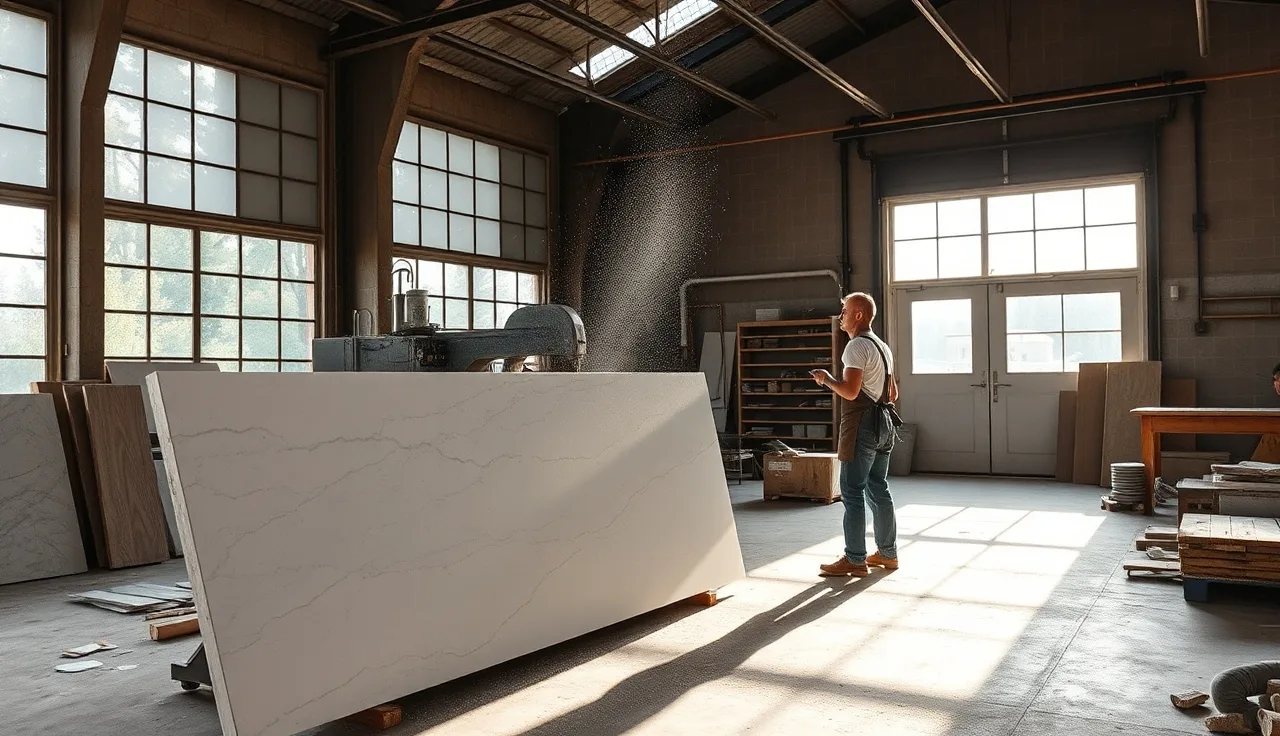
A stone fabricator is the shop that turns a raw slab into your finished countertop. They buy slabs from distributors (or let you pick your own), cut the pieces to your template, shape the edges, cut sink and cooktop openings, and then show up at your house to install everything.
Templating, cutting, and installation are usually bundled into one quoted price. What they don't do: plumbing reconnects, electrical, or cabinet work. That's on you to coordinate separately.
The fabrication process for a typical 40-square-foot kitchen usually runs 7 to 14 days from template to install [1]. Rush timelines exist but cost more. Some shops have CNC machines that can turn a template around in 3 to 5 days if their schedule allows.
Redmond and the broader Eastside market (Kirkland, Bellevue, Sammamish, Issaquah) have a handful of dedicated stone shops plus several large-format operations that also serve Seattle. The density of custom home builders and high-end remodels in this corridor means local fabricators see a lot of premium materials: thick quartzite, book-matched marble, and large-format porcelain slabs show up regularly in this market.
What materials do Redmond-area fabricators work with?
Most shops in the Eastside area work in granite, quartz (engineered stone), marble, quartzite, soapstone, and increasingly large-format sintered stone (Dekton, Neolith). A smaller number do concrete, butcher block, or laminate, but stone shops often send those jobs to specialty suppliers.
Granite countertops are still the most fabricated material by volume in the region, according to fabricators who have publicly discussed their mix. Marble countertops run second in the premium residential segment. Quartz (think Cambria countertops, Silestone, Caesarstone) has grown substantially and now rivals granite for market share in kitchen remodels nationally [2].
Quartzite has become a meaningful part of the mix in Eastside projects because buyers want the look of marble with better durability. If you go that route, learn how to clean quartzite countertops before you commit, because maintenance expectations often surprise people.
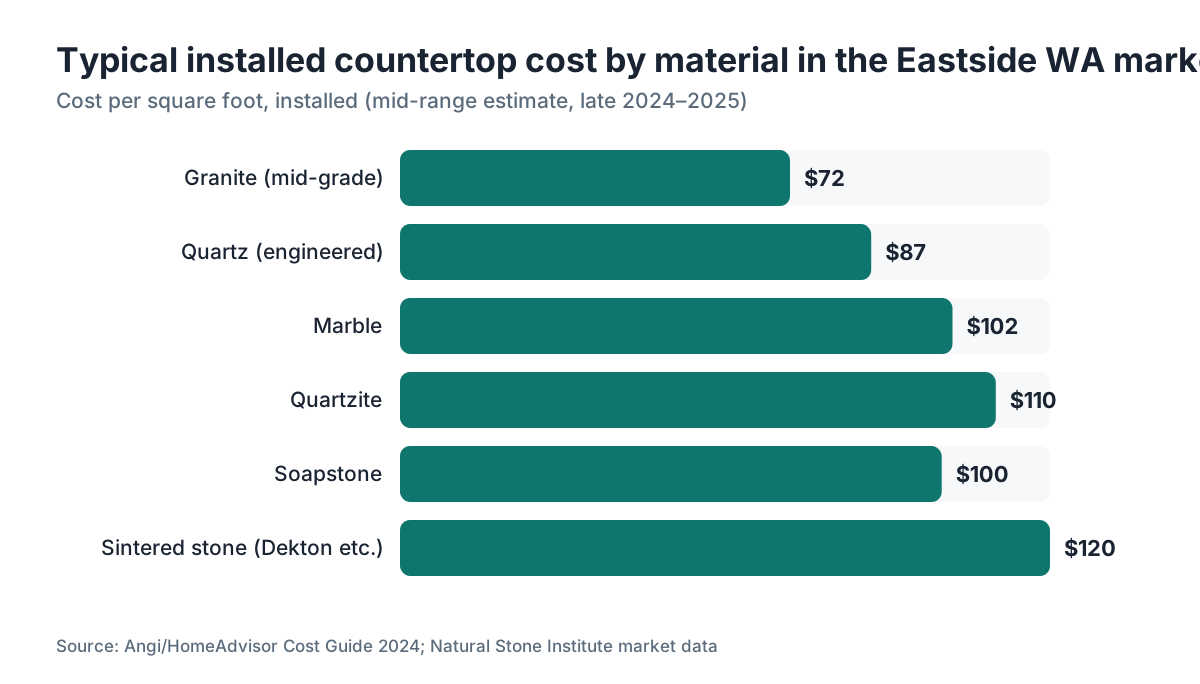
Here's a quick material comparison based on typical Eastside installed pricing:
| Material | Typical installed cost/sq ft | Notes |
|---|---|---|
| Granite (mid-grade) | $55 to $90 | Most widely available; lots of slab choice |
| Quartz (engineered) | $65 to $110 | Consistent color, no sealing needed |
| Marble | $75 to $130 | Etches; high maintenance |
| Quartzite | $80 to $140 | Hard; must be sealed; often confused with marble |
| Soapstone | $80 to $120 | Very durable; needs oiling |
| Sintered stone (Dekton, etc.) | $90 to $150+ | Heat and scratch resistant; tricky to cut |
Prices reflect late 2024 to mid-2025 market conditions for the Seattle metro area [3]. They will shift with slab import costs, which are sensitive to tariff policy on goods from Brazil, India, and Italy [4].
How much does stone countertop fabrication cost near Redmond?
Installed granite or quartz in a typical Redmond kitchen runs $2,500 to $6,500 for 35 to 55 square feet of countertop. The wide range comes from material grade, edge profile complexity, number of cutouts, and whether you're doing an island with waterfall sides.
Breaking the cost down helps you comparison-shop intelligently.
Material cost is the biggest variable. A Level 1 granite slab (basic pattern, thin selection) might run $25 to $40 per square foot for the raw stone. An exotic quartzite or book-matched marble could be $80 to $200+ per square foot for the slab alone.
Fabrication and installation labor in the Puget Sound area typically adds $30 to $55 per square foot on top of material [3]. That covers templating, cutting, edge work, and install. Specialty edges (ogee, dupont, mitered waterfall) add $15 to $45 per linear foot above a standard eased edge.
Cutouts for undermount sinks run $100 to $200 each. Cooktop cutouts are similar. Faucet holes are usually $25 to $50 each.
Removal of old countertops costs $150 to $400 for a typical kitchen, depending on what's coming out.
Washington state sales tax applies to fabricated stone countertops. The combined state and local rate in Redmond is currently 10.2% [5]. On a $5,000 project that's $510 you may not have budgeted for.
Get at least three quotes. In my experience talking to Eastside fabricators and homeowners, quotes on the same job can vary by 25 to 40 percent, driven mostly by overhead differences and how much a shop wants that particular job that week. Always ask for line-item quotes so you're comparing the same scope.
What is the fabrication and installation process step by step?
Understanding the sequence helps you avoid expensive mistakes and unrealistic timelines.
Step 1: Slab selection. You (or your designer) go to a slab warehouse and pick your material. Redmond-area shops have relationships with distributors in Kent, Tukwila, and Woodinville. Some shops let you pick from their own inventory; others walk you to a third-party yard. Mark the slab with chalk or tape to claim the section you want.
Step 2: Template. After your cabinets are set, shimmed, and level, the fabricator sends a tech to measure. Most shops now use digital templating (Proliner or similar laser devices) instead of cardboard, which cuts measuring errors significantly. Don't schedule the template until cabinets are fully done and appliances are in position. Moving anything after templating usually means a change order.
Step 3: Fabrication. The shop programs the CNC waterjet or bridge saw, cuts your pieces, shapes edges, and finishes the surface. This is the 5 to 14 day window where nothing is happening at your house.
Step 4: Install. A two-person crew shows up, usually in the morning, and sets the stone. A standard kitchen takes 2 to 4 hours. They use silicone to adhere the stone to cabinets and epoxy-fill seams. Seams are colored to match the stone. The sink gets undermount clips or epoxy, and the crew does a final wipe-down.
Step 5: Post-install. Wait 24 hours before using the sink. For natural stone, many fabricators apply one coat of sealer at install; plan to reseal every 1 to 3 years depending on stone porosity [6]. Check out how to clean stone countertops to set up a maintenance routine from day one.
The most common homeowner mistake at this stage: scheduling the plumber before the stone is in. Plumbers can't reconnect an undermount sink until the stone is set and cured, so sequence matters.
How do you compare and choose a stone fabricator in the Redmond area?
More fabricators serve the Eastside than most homeowners realize. Some are dedicated stone shops with their own CNC equipment and showrooms. Others are smaller operations that outsource cutting to a larger mill and handle templating and install themselves. Both models can produce great work. The difference usually shows up in lead times and how they handle problems.
Here's what I'd actually look at when comparing shops:
Licensing and bonding. Washington State requires construction contractors, including those doing installation work, to register with the Department of Labor and Industries [7]. Ask for the contractor registration number and verify it at L&I's online lookup. An unregistered contractor creates real liability for you if someone gets hurt on your property.
Washington UBI number. Any business collecting sales tax in Washington needs a Unified Business Identifier through the Department of Revenue [8]. This is basic accountability. If a shop can't produce this, walk away.
References from similar projects. Ask specifically for references from jobs with the same material you're using. Cutting a standard granite kitchen is different from executing a book-matched quartzite island with a waterfall edge. You want a fabricator whose portfolio actually includes your scope.
Lead times. In the Seattle metro, reputable shops have been running 2 to 4 week lead times from template to install for much of 2024 and 2025. If a shop quotes you 6+ weeks and you have a hard deadline, that's a problem. If they quote you 3 days, ask what they're skipping.
Seam placement policy. Ask to see the seam layout before fabrication starts. Seam placement is partly technical (slab size constraints) and partly aesthetic. A good fabricator will show you the plan and explain why seams go where they do. One who won't discuss it before signing is a yellow flag.
Warranty. Most reputable fabricators offer a 1-year warranty on labor (workmanship defects, loose undermount sinks, seam separation). Material warranties depend on the manufacturer for engineered stone. Natural stone has no material warranty because it's a natural product. Get the labor warranty in writing.
What are the Washington state contractor licensing requirements for stone installers?
This matters more than most homeowners think. Washington requires any contractor who installs countertops to be registered with the Department of Labor and Industries as a general contractor or specialty contractor [7]. Registration requires proof of general liability insurance and either a surety bond or assignment of savings.
The bond requirement for a general contractor in Washington is currently $12,000, and the liability insurance minimum is $200,000 per occurrence [7]. These numbers protect you if a crew member damages your cabinets, drops a slab through your floor, or the business closes before they finish your job.
You can verify any contractor's registration status at verify.lni.wa.gov. It's a 30-second check and it filters out a surprising number of low-quality operators.
Washington's Consumer Protection Act (RCW 19.86) also gives homeowners remedies if a contractor engages in deceptive practices [9]. Retaining paperwork, written quotes, and all communications matters if a dispute arises. The Washington State Attorney General's Office handles consumer complaint intake for construction disputes [10].
For stone shops that sell material and fabricate on-site (as opposed to install-only operations), they're also subject to Washington Department of Revenue retail sales tax collection requirements [8]. Fabricated countertops are taxable at the point of sale in Washington.
What questions should you ask a Redmond stone fabricator before signing?
These are the questions that actually separate good shops from marginal ones. The answers tell you what you need to know.
-
Do you have your own CNC equipment, or do you outsource cutting? (Outsourcing isn't automatically bad, but you want to know who's accountable for precision.)
-
Who does the template, and who does the install? Is it the same crew? (Disconnects between the measuring tech and the install crew cause the most errors.)
-
Can I see the seam layout before you cut?
-
What edge profiles do you cut in-house, and which ones add cost?
-
What does your warranty cover, and for how long?
-
Are you licensed with Washington L&I? What's your contractor registration number?
-
How do you handle damaged stone discovered after install? (Hairline cracks sometimes appear after shipping or setting. A good shop stands behind their install.)
-
What's your current lead time from template to install?
-
Do you apply sealer at install, and what product do you use?
-
What's your policy if I need to make a change after templating but before cutting?
The last question matters because people change their minds about sinks or appliances after the template. Most shops charge $150 to $400 for a re-template, which is fair. Some shops charge more or get difficult about it. Better to know upfront.
What does countertop installation look like in the Eastside WA market specifically?
The Eastside market (Redmond, Kirkland, Bellevue, Issaquah, Sammamish) has some characteristics that affect the countertop buying experience.
Home values here are high and remodel scopes tend to be ambitious. A lot of jobs include large islands, waterfall edges, or multiple bathrooms in the same scope. That means fabricators in this market see more complex work and tend to be set up for it better than shops in lower-cost markets.
The density of tech-industry homeowners also means buyers who have done their research and want detailed quotes. Shops that give vague ballpark estimates often lose jobs here because buyers are comparing specific line items across multiple quotes.
Traffic matters. Slab delivery from Kent or Tukwila distribution yards to Redmond involves I-405 and SR-520, both of which are genuinely unpredictable. Good fabricators build scheduling buffer for this. A shop that consistently overpromises on timelines and then blames traffic is telling you something about how they operate.
The King County permitting environment is worth mentioning for full-kitchen remodels. If your countertop project is part of a larger renovation that requires a building permit, the stone installation typically doesn't need its own separate permit, but the countertop can't be installed until inspections are passed on upstream trades. Work with your GC on sequencing [11].
For fabricators running shops in this market, the operational load of multiple concurrent large-scale projects makes quoting accuracy and production scheduling genuinely hard. Tools like SlabWise help shops quote and nest jobs more accurately, which is why some Eastside operations use fabrication software to reduce material waste and catch pricing errors before they cut stone.
What are common mistakes homeowners make when hiring a stone fabricator?
Most of the things that go wrong on countertop projects are predictable and avoidable.
Scheduling cabinets and stone concurrently. Stone cannot be templated until cabinets are done. Done means shimmed, leveled, and screwed to the wall. Not "mostly done." Shops that template on unfinished cabinets have come back to do re-templates and charge for it.
Not visiting the slab yard. Picking stone from a 4x6 inch sample at a showroom and then being surprised when the slab looks different installed is the single most common complaint in this category. Natural stone has enormous variation within a color name. Go to the yard. Mark your slab.
Ignoring seam placement. Seams in dark stone are nearly invisible. Seams in white marble or light quartz with strong veining are not. On a long run or a veined material, talk through seam placement before you sign.
Not accounting for overage. Fabricators typically quote to the nearest square foot with some buffer for cuts and waste. Don't order the exact square footage of your countertop and expect it to work. Standard practice is to add 10 to 15% for waste [12]. Your fabricator should account for this in their quote, but verify.
Forgetting about the backsplash. Stone backsplashes are a separate scope from countertops. If you want a 4-inch stone backsplash or a full-height slab backsplash, that needs to be in the quote. Many homeowners price the countertop and then add the backsplash later as a surprise cost.
For bathroom applications, see countertop installation for what to expect in vanity installations, which have their own sequencing quirks around plumbing access.
How do online or national countertop services compare to local Redmond fabricators?
Several national services now offer countertop quoting online and then connect you with a local installer. The model varies. Some own regional fabrication facilities; others are essentially lead-generation networks that route jobs to local shops.
The pitch is convenience: get a price online without calling shops. For simple jobs with common materials (Level 1 granite, entry-level quartz), the pricing can be competitive. For anything complex, the online quoting models tend to break down because they can't account for your specific layout, seam requirements, or material selection at the detail level that a local fabricator can.
Local Redmond-area shops generally offer better accountability when something goes wrong. You can drive to their shop. They care about local reputation. Warranty enforcement is straightforward. With a national network model, you may find the local installer is a small one-person operation with limited recourse if there's a problem.
If you want a sense of what a job should cost before you call shops, an online estimator is a reasonable starting point. Just treat the number as a rough floor, not a final quote. Complex jobs often come in 20 to 40 percent higher than online estimates once your actual layout is measured.
For budget materials like formica countertops or corian countertops, big-box stores (Home Depot, Lowe's) have in-house fabrication programs that can be cost-competitive for simple layouts. For natural stone and premium quartz, an independent local shop almost always produces better work at the quality level this market expects.
Shoppers evaluating kitchen countertops broadly should read up on all the material options before committing to stone, since the price and maintenance gap between stone and non-stone surfaces is significant.
What warranties and recourse do Washington homeowners have after installation?
If something goes wrong after your countertops are installed, here's what you actually have available.
Washington's contractor registration system means you can file a complaint against a registered contractor with L&I if they do substandard work and don't make it right [7]. L&I can investigate and, in some cases, require a contractor to make repairs or pay damages from their bond.
For engineered stone products (quartz brands like Cambria, Silestone, Caesarstone), the manufacturer warranty covers material defects. These warranties are typically 10 to 25 years and are transferable to new homeowners in many cases. Check the specific brand's warranty documentation because the terms vary meaningfully [2].
Natural stone (granite, marble, quartzite, soapstone) carries no manufacturer warranty because it's a naturally occurring material. Your recourse for natural stone problems is the fabricator's labor warranty.
Washington's three-year statute of limitations on written contracts means you have time to pursue a claim if a fabricator refuses to honor their written warranty [9]. Document everything: photos at install, the written quote, any emails about defects.
For significant disputes, Washington's Attorney General Office has a consumer protection complaint process [10]. For smaller amounts, King County District Court small claims handles up to $10,000 without an attorney.
The best protection is preventive: hire a licensed, bonded contractor, get the warranty in writing, and don't make final payment until you've inspected the install and confirmed the sink is secure and seams are acceptable. Once you've signed off and paid, your bargaining power shifts to the fabricator.
How does material choice affect your fabricator selection?
Not all fabricators are equally good at every material. This matters more for natural stone than for quartz.
Quartz is consistent and dimensionally predictable. Most competent fabricators produce good quartz work because the material behaves consistently and the dominant brands (Cambria, Silestone, Caesarstone) have strong technical support and installation guides. If you want Cambria countertops, almost any established local shop can handle the job.
Granite varies more. The skill required to match grain across a seam in a busy granite like Blue Bahia or Azul Aran is meaningfully higher than matching a simpler material. Ask to see photos of past granite jobs in busy patterns specifically.
Marble is unforgiving. Seams in white marble with dramatic veining (Calacatta, Statuario) are obvious if the shop doesn't put in the effort to mirror-match the veining. Ask specifically how the shop handles vein matching. The answer should include walking the slab and marking the cut lines by hand, more than programming coordinates.
Soapstone is rare enough that many shops have limited experience with it. If you want soapstone, ask how many soapstone jobs they've done in the last year. How to clean soapstone countertops covers what owners need to know post-install, but your fabricator should understand the material's thermal properties and cutting behavior before they touch your slab.
Sintered stone (Dekton, Neolith, Lapitec) requires diamond tooling and slower cutting speeds than granite. Cracking during fabrication is a real risk with inexperienced shops. These materials are genuinely hard to work with and the finished product is beautiful, but make sure your fabricator has specific experience with sintered stone before you commit.
For shops managing multiple material types across concurrent jobs, accurate quoting by material is essential. Fabrication software that tracks yield and material cost by stone type helps shops price these jobs correctly instead of losing money on complex materials. SlabWise is built for exactly this kind of mixed-material shop environment, and fabricators running Eastside operations can request a demo to see how it fits their workflow.
Frequently asked questions
Are there stone fabricators in Redmond WA specifically, or do I need to go to Bellevue or Seattle?
The Eastside has several stone shops operating in or very near Redmond, and more in Kirkland, Bellevue, and Woodinville within 10 to 15 minutes. Most fabricators serve the entire Eastside from a single location because they deliver and install countertops. Your installer's location matters less than their responsiveness, licensing, and fabrication quality. Expect fabricators from Kent and Tukwila (where large slab yards cluster) to also serve Redmond regularly.
How long does countertop fabrication take in the Seattle area?
From the day of template to install day, most reputable shops in the Puget Sound area currently quote 7 to 14 business days. Scheduling factors include the shop's backlog, slab availability at the distributor, and the complexity of your job. Rush services exist at a premium. The full project timeline from when you choose your material to when your countertops are in is often 3 to 6 weeks, factoring in slab selection and templating scheduling.
What is the average cost of granite countertops installed in Redmond WA?
Installed granite in Redmond typically runs $55 to $90 per square foot for mid-grade material, meaning a 40-square-foot kitchen runs roughly $2,200 to $3,600 before tax. Washington state plus local Redmond sales tax is 10.2%, which adds $220 to $360 to that estimate. Premium granites with complex patterns or exotic origins run higher, and edge profiles beyond a standard eased edge add $15 to $45 per linear foot.
Do I need a permit to install stone countertops in King County?
Countertop replacement by itself generally does not require a separate building permit in King County. If your countertop project is part of a larger kitchen remodel that includes moving plumbing, electrical, or structural work, a permit is required for those trades and countertop installation happens downstream. Check with King County's Department of Local Services, Permitting Division, if you're unsure about your specific scope.
How do I verify a stone fabricator is licensed in Washington state?
Go to verify.lni.wa.gov and search by the contractor's business name or registration number. Washington requires all installation contractors to register with the Department of Labor and Industries, maintain general liability insurance (minimum $200,000), and carry a surety bond (minimum $12,000 for general contractors). Unlicensed contractors create personal liability exposure for homeowners if an injury or property damage occurs.
Is quartz or granite better for a Redmond kitchen remodel?
Both work well in Pacific Northwest kitchens. Quartz requires no sealing and resists staining better, which suits busy households. Granite is a natural stone with more variation and character, needs sealing every 1 to 3 years, and is slightly more vulnerable to acidic spills. Quartz generally costs $10 to $20 per square foot more than comparable granite. If low maintenance is the priority, quartz wins. If you want natural stone's uniqueness and will maintain it, granite is a solid choice.
What is slab templating and why does it have to happen after cabinets are done?
Templating is the precise measurement of your counter space, used to program the CNC cutter at the fabrication shop. It must happen after cabinets are fully set, leveled, and secured because any movement or adjustment afterward changes the dimensions. Templates taken over partially installed or unleveled cabinets produce countertops that don't fit correctly, requiring costly re-fabrication. Most shops use digital laser templating devices (like a Proliner) for accuracy within 1mm.
Can I pick my own slab at a yard near Redmond?
Yes, and you should. Major stone distributors operate in Kent, Tukwila, and Woodinville, all within 20 to 35 minutes of Redmond. Many fabricators will bring you to the distributor they use, or you can visit independently. Bring your kitchen dimensions and any cabinet or flooring samples. Mark the section of the slab you want with chalk or tape and confirm with your fabricator before they purchase. Online samples don't capture the scale and variation of full slabs.
What are the most common stone countertop problems after installation?
Seam visibility is the most common complaint, particularly in light or heavily veined materials. Undermount sink separation is the second most common issue, usually caused by inadequate epoxy application or clips. Hairline cracks sometimes appear near cutout corners, which can result from shipping stress or installation. Etching on marble and unsealed quartzite is a maintenance issue, not a fabrication defect. A reputable fabricator addresses seam and sink problems under their labor warranty.
What does Washington sales tax mean for my countertop budget?
Fabricated stone countertops are taxable retail sales in Washington. The combined state and local rate in Redmond is currently 10.2%, per the Washington Department of Revenue. On a $5,000 installed countertop job, that's $510 in tax. Some homeowners overlook this in their remodel budget. Confirm with your fabricator that tax is shown as a line item on the quote, not buried in the total, so you can plan accurately.
How should I care for natural stone countertops after installation in a rainy Pacific Northwest home?
Indoor humidity variation in the Pacific Northwest is relatively mild compared to freeze-thaw climates, so cracking from humidity isn't a major concern. The real maintenance task is sealing. Most granite and quartzite needs sealer applied every 1 to 3 years depending on porosity. Test by dropping water on the surface: if it beads, you're fine; if it absorbs, reseal. Soapstone needs periodic oiling. Marble needs acid protection. Avoid bleach and vinegar-based cleaners on any natural stone.
What is a reasonable warranty for stone countertop fabrication and installation?
A one-year labor warranty is the standard in the industry, covering workmanship defects like seam separation, loose undermount sinks, or visible grinding errors. Some shops extend to two years. Engineered stone brands (quartz) offer separate manufacturer warranties on the material itself, ranging from 10 years to lifetime. Natural stone carries no material warranty. Get the labor warranty in writing before you sign, and ask specifically what the claims process looks like if something goes wrong.
How do I get an accurate quote for stone countertops without a contractor measurement?
Measure your countertop area yourself by sketching each run (length times depth in inches) and converting to square feet. Add 10 to 15 percent for waste. Note the number of sink cutouts, cooktop cutouts, and faucet holes, plus the total linear feet of edges that need profiling. With those numbers, most local fabricators can give you a ballpark range over the phone. The final quote will change after they template, but a sketch-based estimate gets you close enough to compare shops.
Sources
- Marble Institute of America (now Natural Stone Institute), Fabrication & Installation Guidelines: Typical stone countertop fabrication timeline runs 7 to 14 days from template to installation
- Freedonia Group, Countertop Market Report (via Natural Stone Institute industry data summaries): Engineered quartz has grown to rival granite in U.S. kitchen countertop market share
- HomeAdvisor (Angi), Countertop Installation Cost Guide, 2024: Installed countertop labor in the Pacific Northwest adds roughly $30, $55 per sq ft above material cost
- U.S. International Trade Commission, HTS Chapter 68 (Stone Articles), tariff schedule: Stone slab import costs are sensitive to U.S. tariff policy on goods from Brazil, India, and Italy
- Washington State Department of Revenue, Local Sales and Use Tax Rates, Redmond (King County): Combined state and local sales tax rate in Redmond WA is currently 10.2%
- Natural Stone Institute, Care & Maintenance of Natural Stone: Natural stone countertops should be resealed every 1 to 3 years depending on stone porosity
- Washington State Department of Labor & Industries, Contractor Registration Requirements: Washington requires countertop installation contractors to register with L&I, carry a $12,000 bond, and hold $200,000 general liability insurance
- Washington State Department of Revenue, Business Licensing and UBI: Businesses collecting retail sales tax in Washington are required to have a Unified Business Identifier (UBI) number
- Washington State Legislature, RCW 19.86 Consumer Protection Act: Washington Consumer Protection Act provides homeowners remedies against deceptive contractor practices; three-year statute of limitations applies to written contracts
- Washington State Attorney General, Consumer Protection Complaint Intake: Washington AG handles consumer complaint intake for construction and contractor disputes
- King County Department of Local Services, Permitting Division, Residential Permit Requirements: Countertop replacement alone generally does not require a separate building permit in King County; permits required for plumbing, electrical, or structural scope
- Natural Stone Institute, Estimating Stone Quantities (Technical Bulletin): Standard industry practice is to add 10 to 15% to measured square footage for fabrication waste when ordering stone
Last updated 2026-07-09