TL;DR
- New kitchen countertops cost roughly $40 to $200 per square foot installed, depending on the material.
- Quartz and granite are the most popular picks.
- Laminate is the budget option.
- Natural stone like marble or quartzite costs the most.
- The average kitchen uses 30 to 45 square feet of surface, which puts most projects between $1,500 and $9,000 all-in.
What do new kitchen countertops actually cost?
Costs vary so much by material that any single number lies to you. Most homeowners in the U.S. pay between $2,000 and $5,000 for a full kitchen countertop replacement in mid-range materials like quartz or granite, installed. Laminate can come in under $1,500. Exotic quartzite or leathered marble with a waterfall edge can clear $10,000 on a modest kitchen.
The industry prices countertops per square foot of finished surface, and that number almost always covers the slab, fabrication (cutting, edging, polishing), and installation. What it often leaves out: sink cutouts, cooktop cutouts, removal of the old top, and haul-away. Those add-ons typically run $75 to $200 per cutout and $150 to $400 for demo and disposal. Ask your fabricator to spell those out before you sign anything.
The National Kitchen and Bath Association pegs the average U.S. kitchen remodel at $24,000 for a minor project and $77,000 for a major one, with countertops usually accounting for 10 to 15 percent of the total budget [1]. Run the math on a real kitchen: 35 square feet of granite at $75 per square foot installed is $2,625 before cutouts. Most fabricators set a minimum charge of $500 to $1,000 regardless of size, so small kitchens don't always save proportionally.
Labor and material markups swing by region. Fabricators in metros like New York or San Francisco charge 20 to 40 percent more than shops in smaller markets, partly for rent and labor, partly because customers there pay it. Get three quotes if you can. The spread between the low and high bid is usually bigger than people expect.
Which countertop material is right for your kitchen?
There's no universal answer, but there's a right answer for your household. The material should match how you actually cook, how much upkeep you'll tolerate, and how long you plan to stay. Here's a real comparison across the common options.
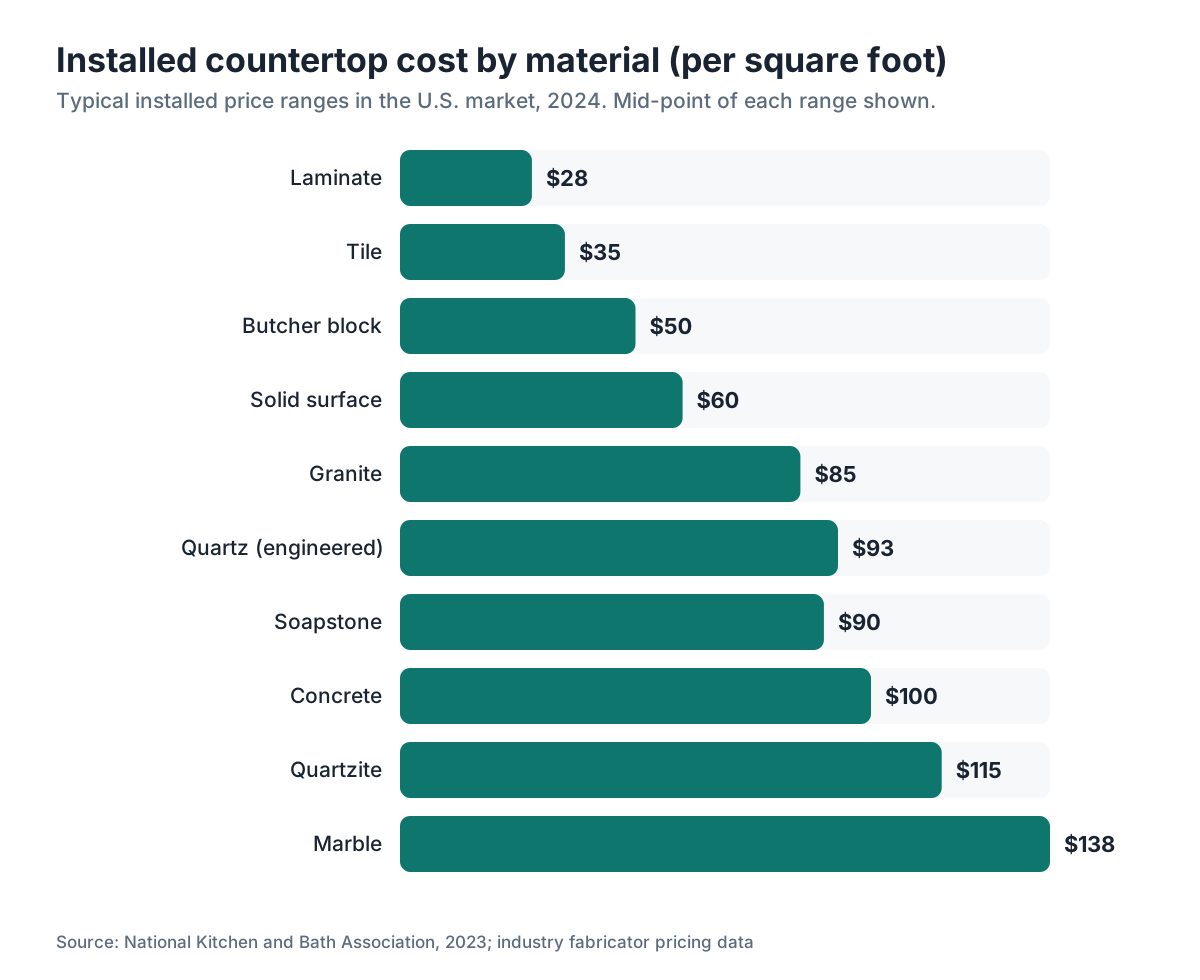
| Material | Installed cost ($/sq ft) | Hardness | Heat resistance | Stain resistance | Maintenance |
|---|---|---|---|---|---|
| Laminate | $15, $40 | Low | Poor | Good (surface) | Very low |
| Tile (ceramic/porcelain) | $20, $50 | High | Excellent | Good (tile); Poor (grout) | Moderate |
| Butcher block | $30, $70 | Medium | Poor | Poor | High |
| Solid surface (Corian) | $40, $80 | Low-medium | Poor | Good | Low |
| Granite | $50, $120 | Very high | Excellent | Good (sealed) | Low-moderate |
| Quartz (engineered) | $55, $130 | Very high | Moderate | Excellent | Very low |
| Concrete | $65, $135 | High | Good | Poor (unsealed) | High |
| Soapstone | $60, $120 | Medium | Excellent | Good | Moderate |
| Quartzite | $70, $160 | Very high | Excellent | Good (sealed) | Moderate |
| Marble | $75, $200 | Medium | Good | Poor | High |
Quartz (engineered stone) is the best all-around pick for most households. It's non-porous, resists stains without sealing, and comes in hundreds of colors. Brands like Cambria, Silestone, and Caesarstone back their products with 10- to 25-year warranties [6][7]. You can read more about one well-known brand in our Cambria countertops guide.
Granite is the natural-stone classic. It's harder than quartz, handles heat better, and every slab is unique. The tradeoff: it's porous and needs sealing once a year or so. For most kitchens that's no burden. Our full granite countertops guide covers grades, finishes, and what to look for in a slab.
Laminate gets a bad reputation it hasn't earned. Modern laminate from Formica or Wilsonart looks far better than the stuff from 30 years ago, costs a fraction of stone, and is DIY-friendly. Flipping a house or working a tight budget? Don't dismiss it. See our laminate countertops and Formica countertops articles for specifics.
Marble is beautiful and a genuinely bad idea for most kitchens. It etches from acidic foods (lemon juice, vinegar, tomato sauce), scratches, and stains. Bakers love it because it stays cool for dough work. If you're not a baker, there are better options. Quartzite gets confused with marble but is far harder and more durable. Our how to clean quartzite countertops guide walks through the care differences.
Butcher block adds warmth no stone can match. It's forgiving to knife edges too. The downsides are real: it stains, it can harbor bacteria if neglected, and water damage at the sink is a constant fight. Some designers run butcher block on the island and stone on the perimeter. That's a smart compromise. Learn more in our butcher block countertops guide.
How many square feet of countertop does a typical kitchen need?
Most U.S. kitchens have 25 to 50 square feet of countertop, with the average around 30 to 35 square feet. An L-shaped kitchen runs toward the low end. A U-shaped kitchen or one with an island often clears 50.
Fabricators measure in square feet but price by the square foot of stone actually used, not surface area alone. Edges, slab thickness, and grain direction all change how much raw material your job eats. A 3-centimeter (1.25-inch) slab is standard. Some high-end jobs use 2-centimeter tops with a laminated edge to fake 4-cm thickness, and that lamination adds cost.
Here's a fast way to estimate. Measure each run of cabinets in inches (length times depth, usually 25 inches deep for a standard overhang). Divide by 144 to get square feet. Add the runs together. Don't subtract for the sink; most shops charge for the full rectangle and add a cutout fee. Tack on 10 percent for waste. That number times your per-square-foot quote gives a ballpark material-and-fab cost before extras.
Measure islands carefully. A 4-by-8-foot island is 32 square feet, often cut from a single large slab. Large slabs cost more per square foot and are harder to move, which is why oversized islands sometimes carry a premium. Waterfall edges, where the stone drops vertically down the side, add square footage and complexity.
What is the process for getting new countertops installed?
Four steps: selection, templating, fabrication, installation. Each has its own timeline and its own way of going wrong.
Selection happens at the supplier or stone yard. For engineered stone like quartz, you pick from samples or slab displays at the fabricator's showroom. For natural stone, visit a stone yard and pick the exact slab you want, because two slabs from the same quarry can look nothing alike. Mark your slab with chalk and ask to put your name on it. Don't pick from a chip.
Templating is the measuring step. A templater comes to your home after your cabinets are set and level, takes precise measurements (physical templates or a digital laser tool), and captures every detail: sink size, cooktop location, wall irregularities, corner angles. This usually happens one to two weeks before installation. Do not rush it. Every error caught here saves money; errors caught during installation cost a fortune.
Fabrication takes one to three weeks depending on shop backlog and material availability. Your slab gets cut on a CNC waterjet or bridge saw, edges get profiled and polished, and cutouts get made. Some shops let you visit during fabrication, which is worth doing on complex jobs.
Installation usually takes one day for a standard kitchen. Two installers carry the finished pieces in, set them on the cabinets with silicone adhesive, and seam pieces together where needed. Seams are unavoidable on most kitchens; ask to have them placed away from sinks and high-traffic zones. An undermount sink goes in the same day or shortly after. Total time from contract to finished counters runs three to six weeks. Our full countertop installation guide covers everything that happens on install day.
Our kitchen countertops guide also has good background on how fabricators price jobs if you want to understand what drives your quote.
How do you choose the right edge profile?
Edge profiles seem like a minor detail until you see them in person and realize they set the whole look of the counter. Fabricators offer a range from simple (eased, slightly rounded) to elaborate (ogee, dupont, chiseled). The basic profiles usually come in the per-square-foot price. Decorative ones add $5 to $20 per linear foot.
For most kitchens, an eased edge or a simple pencil round is the right call. It looks clean, doesn't date the kitchen the way an ogee does, and cleans easier because there are fewer grooves to trap grime. Beveled edges work well on thicker stone. Mitered edges (two pieces joined at 45 degrees to look like a solid thick slab) are popular on islands and cost noticeably more in labor.
The edge affects safety too. Sharp right-angle corners at hip height in a busy kitchen are a bad idea for households with kids. A 1/8-inch easing or pencil round handles that without changing the look much.
Laminate has fewer edge options. Post-form laminate comes with a pre-molded rounded front edge. Custom laminate jobs can use wood edge banding or aluminum trim for a more finished look.
What should you check before signing a countertop quote?
A countertop quote can look clean and still hide several expensive surprises. Check these things before you sign.
First, confirm what the square footage count includes. Shops measure differently, and some charge for the full rectangle of a sink cutout while others deduct it. Neither is wrong, but you need to know which one you're getting.
Second, ask about seam placement. Where do they plan to put seams? Can you approve or negotiate placement before fabrication starts?
Third, ask who does the installation. Some fabricators subcontract it to a third party, which creates accountability gaps when something goes wrong. Prefer shops that install with their own crew.
Fourth, clarify the warranty. What does the fabricator warrant? Most cover their own work (seams, polish, cutout quality) for one year. Material warranties come separately from the manufacturer on engineered stone, or don't exist at all on natural stone slabs.
Fifth, ask about the backsplash gap. Countertops leave a small gap at the wall, filled with caulk. If tile meets the counter, how do they handle that transition? This gets left vague and causes friction at the end.
Fabrication software like SlabWise helps shops build quotes that itemize all of this, so there's less ambiguity on both sides. If your fabricator's quote is a single line-item total with no breakdown, ask for detail.
Sixth, check how old-countertop removal gets handled. Is it included? What's the extra cost if not? Will they disconnect and reconnect your plumbing, or do you need a plumber on site?
How do you maintain new kitchen countertops?
Care requirements swing hard by material, and getting it wrong early can ruin a surface for good.
For natural stone (granite, marble, quartzite, soapstone), sealing is the main job. A penetrating sealer soaks into the pores and slows stain absorption. Most granite needs sealing every one to three years; denser granites need it less. Test yours by dripping a few drops of water on the surface. If it beads, the sealer still works. If it soaks in within 10 minutes, reseal. Our guide on how to clean stone countertops covers this in detail.
For soapstone, the traditional care is rubbing mineral oil into the surface every few weeks at first, then less often as the stone darkens evenly. See how to clean soapstone countertops for the specifics.
For quartz (engineered stone), daily care is genuinely easy: wipe with a damp cloth and mild dish soap. Skip harsh chemicals like bleach, which break down the resin binders over time. Quartz is not heat-proof despite feeling like stone. A hot pan straight off the burner can crack or discolor the resin. Always use trivets.
For butcher block, oil it monthly with food-safe mineral oil for the first year, then quarterly. Keep it dry around the sink. A badly water-damaged butcher block can sometimes be sanded and refinished, which is a real edge over stone.
For solid surface (Corian and similar), you can buff out minor scratches with a fine Scotch-Brite pad. No stone lets you do that. The Corian countertops guide has more on repair.
For laminate, water at the seams is the enemy. Keep seams caulked. Don't let water pool at edges or sit on the surface. Skip abrasive cleaners, which dull the finish. See our marble countertops guide if you're weighing marble against another material on care burden.
Do new countertops add resale value to a home?
Yes, but probably less than you'd guess. The 2024 Cost vs. Value Report from Remodeling Magazine found that a minor kitchen remodel (which includes countertop replacement) returned about 96 percent of costs at resale on average [2]. A major upscale kitchen remodel returned only around 38 percent. Going all-in on luxury countertops purely for resale is a poor bet. Keeping counters updated to a reasonable standard just protects value.
Appraisers don't assign specific dollar values to countertop materials in most residential appraisals. They use comparable sales. If every other kitchen on your street has granite and yours has Formica, that gap probably hurts you. Drop $12,000 of marble into a $200,000 house and you won't get it back.
For resale, a clean mid-range stone (granite or quartz at $50 to $80 per square foot installed) is the right call. It reads well in listing photos, buyers expect it in most markets, and it doesn't spook appraisers with over-improvement.
What are the most common mistakes people make when buying new countertops?
Ordering before cabinets are installed is the big one. Templating has to happen after cabinets are set, level, and shimmed. Template too early, the cabinets shift during install, and your counters won't fit. Some contractors push homeowners to rush this. Don't.
Picking a material for looks alone is the second most common error. Marble in a kitchen with a home cook who makes pasta and tomato sauce will look terrible within a year from etching and stains. Be honest about how you cook.
Not visiting the actual slab before buying is a frequent regret. Stone varies. The showroom sample is one small chip from one slab. Your slab might have more movement, different veining, or a color that reads differently at full size. For anything over $100 per square foot, go to the yard.
Ignoring seam placement until it's too late. Ask about seams early, while the shop still has room to plan around them. A seam through the middle of a sink run is hard to dodge on wide kitchens, but there's usually some flexibility in where it lands.
Skimping on the edge profile and regretting it. The edge is what you touch every day and what people notice at counter height. Paying the extra $5 to $10 per linear foot for the right profile is worth it.
Forgetting the lead time. Stone counters take three to six weeks from contract to install in most shops. Got a hard deadline (a holiday, a rental turnover)? Order early. Late changes to cabinet layout or sink size after templating can push the timeline by weeks.
Are there eco-friendly countertop options worth considering?
A few, though this space has more marketing than substance.
Recycled glass countertops embed post-consumer glass in concrete or resin binders. They're genuinely made from recycled content, look interesting, and cost $50 to $100 per square foot installed. The tradeoffs are fragility (glass chips) and inconsistent quality between makers.
Paper composite (brands like Richlite and PaperStone) presses recycled paper and resins under high pressure. The result is dense, warm to the touch, and repairable like solid surface. Costs run $50 to $80 per square foot. Some carry Forest Stewardship Council certification for responsible fiber sourcing [3] and hold real recycled content.
Concrete counters can take recycled aggregate and carry a low-embodied-energy story if poured locally. The practical headaches (sealing, cracking, heavy weight) stay the same whether or not the mix is green.
Natural stone has a complicated footprint. Quarrying and shipping heavy slabs across oceans burns a lot of fuel. Locally quarried stone, where you can get it, has a smaller footprint. The U.S. runs active granite quarries in several states, including Vermont and Georgia.
Engineered quartz is around 90 to 93 percent natural quartz by weight, but the polymer resin binders are petroleum-based. Resin-based building materials can off-gas VOCs, which the EPA tracks under indoor air quality [8]. Some makers have cut resin content or moved to bio-based resins, but independent verification is thin. If this matters to you, ask for an Environmental Product Declaration from the manufacturer.
How do fabricators quote and price countertop jobs?
Knowing how shops price jobs helps you read a quote critically and negotiate better.
Most shops start with material cost: what they paid for the slab, usually bought wholesale from a stone distributor. They mark that up 30 to 60 percent. Then they add fabrication: machine time, edge labor, cutouts, polish. Then delivery and installation. Each of those carries labor and overhead.
The shape and complexity of your kitchen matters a lot. Straight runs with simple edges cut and finish fast. Radius corners, odd angles, multiple cutouts, and decorative edges all pile on CNC and polishing time. A job that looks like a minor size difference on paper can be twice the work.
Digital quoting tools have changed how accurate estimates get built. Modern shops use software to draw the layout, plan where slabs get cut (called nesting), and calculate material use and labor automatically. That cuts waste and produces steadier pricing. SlabWise is one such platform, built for countertop fabricators to quote faster and nest slabs more efficiently. If your fabricator still quotes by hand or can't show you the layout, note that.
Slab waste is real. Depending on kitchen shape and slab size, 20 to 40 percent of a slab can be left over after cutting. Efficient nesting shrinks that but rarely kills it. Some shops pass the savings from tight nesting on to customers; others don't. It's fair to ask how they handle remnants from your job.
Frequently asked questions
How long does it take to get new kitchen countertops installed?
From signing to finished install, expect three to six weeks at most shops. That breaks down as one to two weeks to schedule templating, one to three weeks of fabrication, then installation in a single day. Shops vary by backlog. During busy spring and fall remodel seasons, timelines can stretch to eight weeks. Rush fees sometimes exist but don't always help.
What is the cheapest countertop material for a kitchen?
Laminate is the least expensive, typically $15 to $40 per square foot installed. Tile is comparable in cost and more heat-resistant, but the grout lines are harder to keep clean. Solid surface like Corian runs around $40 to $80 installed. For context, the next tier up (granite, quartz) starts around $50 to $55 per square foot installed in most U.S. markets.
Can I install kitchen countertops myself?
Laminate post-form countertops and tile are DIY-friendly. Natural stone and engineered quartz are not, for most homeowners. Stone slabs are heavy (3-cm granite weighs roughly 18 to 20 pounds per square foot), need specialized cutting gear, and seams require professional polishing to look acceptable. A bad DIY stone install is expensive to fix. Professional installation (typically $10 to $30 per square foot) is worth it for stone.
How often do kitchen countertops need to be replaced?
Stone countertops (granite, quartz, quartzite) can last the life of the house with basic care. Laminate typically lasts 10 to 20 years before it looks dated or gets damaged. Butcher block can last decades with proper oiling and drying, but a neglected sink area often fails in five to ten years. Solid surface is durable and repairable but can yellow with age.
What countertop color is best for resale value?
Neutral tones do best at resale: whites, light grays, soft beiges, and black or dark charcoal for contrast. Bold colors and busy movement can win over some buyers and turn off others. For resale, a clean neutral quartz or granite at a mid-range price is the safest bet. The 2024 Cost vs. Value Report found mid-range kitchen remodels return more proportionally than upscale ones.
Does quartz or granite last longer?
Both last essentially forever in normal kitchen conditions. Granite is harder (Mohs 6 to 7 vs. quartz composite around 7), but quartz's non-porous resin surface resists staining better without sealing. Granite handles heat better. Either material outlasts most ownership periods if installed and maintained correctly. The durability difference is small; the care difference is real.
What thickness of countertop should I choose?
Three centimeters (about 1.25 inches) is the standard for stone in the U.S. and what most fabricators quote by default. It's strong, spans most runs without support, and looks proportional. Two-centimeter stone was more common in the past and now shows up mostly on tile backers or budget jobs. Some styles use 5 cm or stacked edges for a bold look, but that's a premium add-on.
Do I need a permit to replace kitchen countertops?
In almost all U.S. jurisdictions, replacing countertops alone does not require a building permit. Permits usually kick in when you change structural elements, move plumbing, or modify electrical. If your countertop swap is part of a larger remodel that moves a sink or adds circuits, check with your local building department. Requirements vary by city and county [11].
What is the difference between quartz and quartzite countertops?
Quartz (engineered stone) is about 90 to 93 percent ground natural quartz bound with polymer resins, made in a factory. Quartzite is a natural metamorphic rock quarried from the earth. Quartzite is harder and more heat-resistant than engineered quartz. Quartzite needs sealing and has natural variation; engineered quartz needs no sealing and stays consistent in color. Quartzite costs more, typically $70 to $160 per square foot installed.
How do I clean new kitchen countertops without damaging them?
For most stone, warm water and a few drops of dish soap on a microfiber cloth handles daily cleaning. Avoid vinegar, lemon juice, or anything acidic on marble or limestone (it etches). Avoid bleach on quartz (it degrades resin). Skip abrasive pads on polished surfaces. For natural stone, a dedicated neutral-pH stone cleaner beats dish soap long-term, since soap can slowly degrade sealers.
What is a countertop seam and where should it be placed?
A seam is where two pieces of countertop meet, joined with epoxy adhesive and polished to look continuous. Seams are necessary in most kitchens because standard slabs (roughly 55 by 120 inches or 55 by 130 inches) can't span long runs. Good placement keeps seams away from the center of sinks, cooktops, and high-traffic prep areas [9]. Always confirm seam placement before fabrication begins.
Can you put hot pans directly on quartz countertops?
No. Despite looking and feeling like stone, engineered quartz contains polymer resins that can discolor, crack, or delaminate under sustained high heat. Most manufacturers explicitly exclude thermal shock damage from their warranties. Always use a trivet or hot pad. Granite and quartzite handle heat much better; a brief pan placement usually isn't an issue, though trivets are still a good habit.
What questions should I ask a fabricator before hiring them?
Ask: Who does your installation, and are they your employees? How do you handle seam placement? Can I visit the yard to pick my specific slab? What's included in the per-square-foot price? Are cutouts, removal, and haul-away extra? What does your warranty cover, and for how long? What's your current lead time? Clear answers to all of these before signing spare you most common surprises.
Is marble worth it for a kitchen countertop?
Rarely, for most households. Marble etches from any acidic substance (citrus, wine, vinegar, tomato), scratches, and stains. It's genuinely beautiful, but in an active kitchen it shows wear fast. A dedicated baking station is the exception, since marble stays cool for dough work. For everything else, quartzite gives a similar look with far better durability. The cost is comparable, so the tradeoff tilts toward quartzite for most cooks.
Sources
- National Kitchen and Bath Association, 2023 Kitchen Design Trends Report: Average U.S. kitchen remodel costs $24,000 for minor and $77,000 for major; countertops typically 10 to 15% of total budget
- Remodeling Magazine, 2024 Cost vs. Value Report: Minor kitchen remodel returns approximately 96% of costs at resale; major upscale kitchen remodel returns approximately 38%
- Forest Stewardship Council, FSC Certification Overview: Some paper composite countertop products (Richlite, PaperStone) carry FSC certification for recycled/responsible content
- U.S. Bureau of Labor Statistics, Consumer Expenditure Survey, Housing: Background data on household spending on home improvement and maintenance in the U.S.
- Cambria, Product Warranty Documentation: Cambria offers a limited lifetime warranty on its engineered quartz products
- Cosentino / Silestone, Product Warranty: Silestone engineered quartz carries a 25-year limited warranty
- U.S. Environmental Protection Agency, Indoor Air Quality, Building Materials: Background on VOC emissions and indoor air quality considerations from resin-based building materials
- Natural Stone Institute (formerly Marble Institute of America), Natural Stone Standards: Industry standards for natural stone slab dimensions, thickness tolerances, and finish classifications
- National Association of Home Builders, Remodeling Market Index: Data on remodeling activity including kitchen projects; lead times and regional cost variation
- International Code Council, Residential Construction Permits, IRC Overview: Permit requirements for residential remodeling; countertop-only replacement generally does not require a permit under the IRC
- NSF International, NSF/ANSI 51 Food Equipment Materials Standard: Standards for food-safe surface materials including butcher block and solid surface countertops
Last updated 2026-07-09