TL;DR
- A natural stone fabrication company cuts, shapes, polishes, and installs countertops from raw granite, marble, quartzite, and similar materials.
- The work runs from templating your kitchen to the last silicone bead on install day.
- Most residential jobs cost $40 to $200 per square foot installed, depending on the stone and edge complexity.
- Picking the right shop matters as much as picking the right stone.
What does a natural stone fabrication company actually do?
A stone fabrication shop takes a raw slab, usually 9 to 10 feet long and 5 to 6 feet wide, and turns it into the finished countertop sitting in your kitchen. Sounds simple. The actual work involves templating, CNC programming, waterjet or bridge-saw cutting, CNC edge profiling, hand polishing at the sink cutout, dry-fitting, and installation with epoxy seams and silicone perimeter beads.
Most shops handle granite, marble, quartzite, travertine, limestone, and soapstone. Some also work with engineered quartz (like Silestone or Caesarstone), porcelain slabs, and ultra-compact surfaces, though those materials cut and polish differently than true natural stone.
Fabrication is a trade, not a commodity. Two shops can start with the same Calacatta marble slab and produce results that look nothing alike, depending on equipment calibration, how the template technician measured, and whether anyone spent real time hand-finishing the sink edge. [1]
For homeowners, the fabricator is the most important vendor in the whole project. The stone yard sells you the slab. The fabricator decides whether it ends up beautiful or a mess of crooked seams and uneven overhangs.
What is the step-by-step fabrication process from template to install?
The sequence at a serious shop looks like this.
Template: A technician visits your home (or job site) and captures your exact cabinet layout, usually with a digital laser templating system or, in smaller shops, physical rods and plywood. This is the most error-sensitive step. A 1/8-inch mistake here shows up in every step that follows. [2]
Slab selection and layout: Either before or after templating, you (or your designer) choose the specific slab. The fabricator then lays your template pieces digitally or physically on the slab to plan cuts, match veins across a seam, and keep waste down. Shops using nesting software at this stage get more usable material from every slab, which matters if you are paying by the slab.
Cutting: A bridge saw or CNC waterjet does the rough cuts. Bridge saws are faster for straight lines. Waterjet adds precision for complex shapes or curved aprons. A good CNC machine holds tolerances of plus or minus 0.005 inches. [3]
Edge profiling: A CNC router with diamond tooling shapes the edge, whether that is a simple eased edge or a multi-step ogee. Edges that need more tool passes cost more.
Sink cutout and hand finishing: The sink hole is cut by CNC, then the inside radius and underside are hand-polished. This step separates the good shops from the rest. Rush it and you leave scratches that are visible once the sink drops in.
Dry fit and seam check: Before install, good shops dry-fit large jobs, check seam alignment, and confirm scribes will work at the walls.
Installation: Slabs travel on a truck with padded A-frames, come in on suction cups, set on adhesive or support brackets, and get seamed with color-matched epoxy. Silicone beads seal the perimeter at the walls. The whole install for an average kitchen runs two to four hours. [4]
How much does natural stone fabrication cost?
Pricing is the question everyone asks first, and it is genuinely hard to answer cleanly because fabricators price differently. Some quote per square foot installed (materials plus labor). Others charge separately for the slab, the fabrication (cut and polish), and the installation.
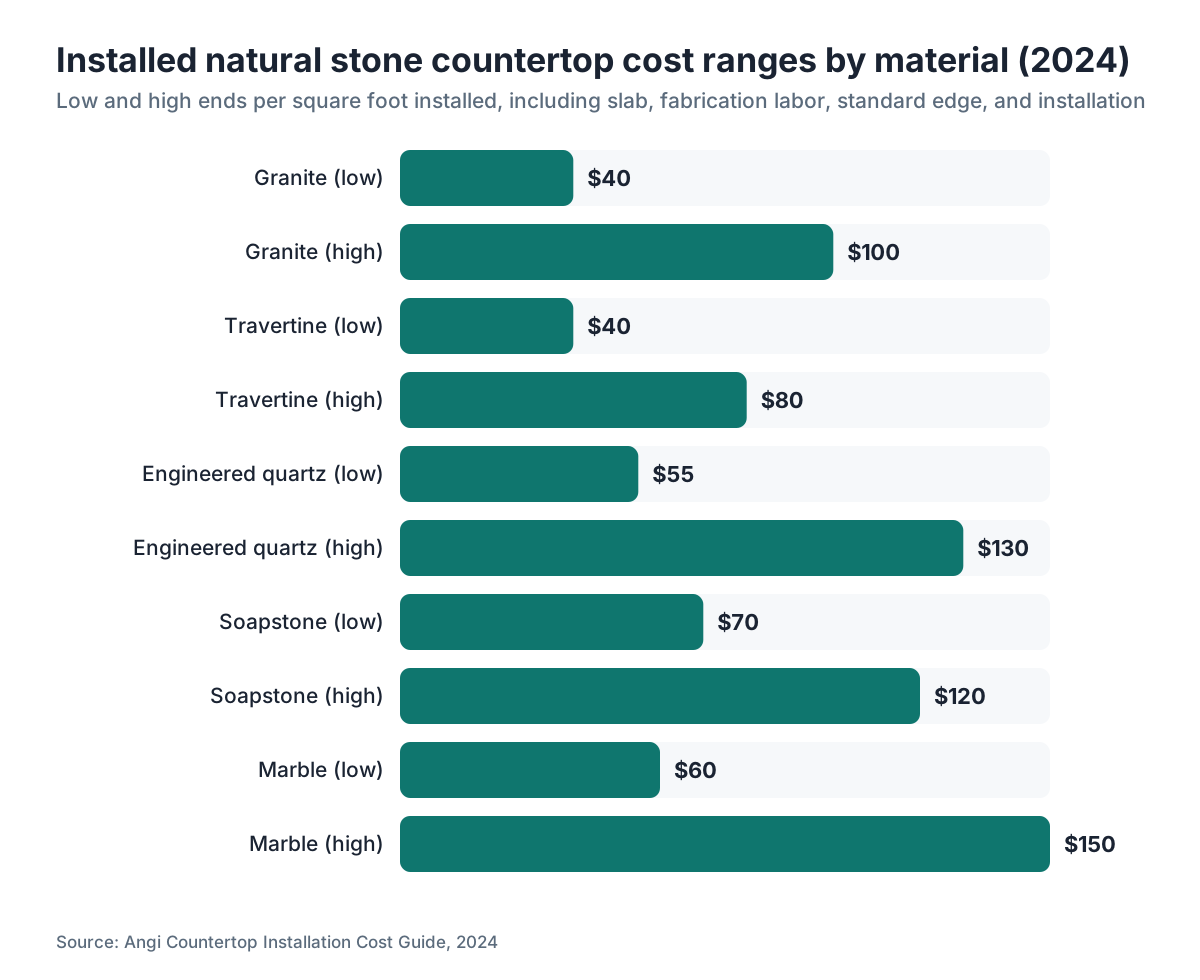
Here are realistic ranges for installed countertops in the United States as of 2024 to 2025. These include slab cost, fabrication labor, a standard edge profile, and basic installation. Complex jobs, unusual materials, or premium markets (coastal cities, resort areas) run higher.
| Material | Low end ($/sq ft installed) | High end ($/sq ft installed) |
|---|---|---|
| Granite | $40 | $100 |
| Marble | $60 | $150 |
| Quartzite | $70 | $200 |
| Soapstone | $70 | $120 |
| Travertine | $40 | $80 |
| Engineered quartz | $55 | $130 |
These ranges come from aggregated national cost data reported by Angi surveys. [5] Regional variation is real: a slab that costs $12 per square foot at a wholesale yard in Dallas might run $22 at the same tier in San Francisco.
Extra costs that catch homeowners off guard: ogee or waterfall edge profiles (often $25 to $60 per linear foot extra), full-height backsplash (priced by the linear foot), waterfall island ends, seam placement fees, and removal and disposal of your old countertops ($3 to $6 per square foot in most markets).
For granite countertops specifically, the fabrication labor alone typically runs $15 to $35 per square foot depending on complexity, separate from the slab cost. Marble countertops need more careful handling and slower polishing speeds, which adds to that labor number.
What equipment does a professional stone fabrication shop use?
Equipment is a reliable proxy for shop quality, even if it is not the whole picture.
The bridge saw is the core machine. It is a wet saw with a diamond blade suspended on a gantry that travels over a fixed table. Entry-level shops run a single manually operated bridge saw. Larger shops run CNC bridge saws, where the cut path is programmed and the machine executes it without an operator guiding it by hand. CNC cuts are more consistent and faster. [3]
A CNC router handles edge profiling and sink cutouts. It holds a spinning diamond router bit that follows a programmed path around the slab edge. Swap the bit profiles and you get different edge shapes.
Waterjet machines cut stone with a high-pressure stream of water mixed with garnet abrasive. The pressure runs 60,000 to 90,000 PSI. They shine on complex curved cuts, inlays, and any job where blade heat could cause micro-fracturing.
Polishing equipment ranges from hand-held angle grinders with diamond pads to automated flat-bed polishers. Hand polishing at seams and sink cutouts stays common even in fully automated shops, because those areas have geometry a flat-bed handles poorly.
Lifting and transport gear matters too. A vacuum lifter handles slabs that can weigh 500 to 800 pounds for a full slab of 3cm granite, and a properly padded truck A-frame keeps slabs from cracking in transit.
Stone cutting is also a serious dust hazard. OSHA guidance on countertop fabrication states that dry cutting and grinding of stone "can generate high levels of respirable crystalline silica," which is why serious shops run wet saws, ventilation, and respiratory protection. [9]
Shops investing in digital templating tools (Proliner, LT2D3D, or similar laser systems) produce templates accurate to 1 to 2 millimeters, against 3 to 5 millimeters for a skilled hand templater on a good day. [2]
How do you choose a good stone fabrication company?
Start with portfolio photos specific to the material you want. A shop that does beautiful granite work may struggle with quartzite, which is harder and more brittle. Ask to see recent jobs in your material.
Visit the shop floor if you can. You learn a lot in twenty minutes. Is it organized and clean, or are offcuts piled everywhere? Is the equipment maintained? Dusty, standing water around machines that should be running wet suggests poor maintenance habits, and that tends to show up in the finished product too.
Read reviews, but read the negative ones carefully. One-star reviews about scheduling delays matter less than one-star reviews about seam quality, crooked edges, or calls that never get returned after install.
Ask specifically how seam placement gets decided. A good fabricator places seams on structural logic and visual impact (away from high-traffic corners, matched to vein direction where possible). A shop that answers "we put them wherever is easiest to cut" is being honest, but it is not the answer you want.
Get at least three quotes. If one comes in dramatically lower, ask what is different. It may be a thinner slab (2cm vs 3cm), a lesser edge profile, or a shop that skips the silicone step. Sometimes it is genuinely just a leaner operation. You cannot tell without asking.
Verify licensing and insurance. Most states require contractors to carry general liability insurance, and some require specific licenses for stone installation work. In California, the Contractors State License Board requires a license for any construction work where the combined labor and material cost is $500 or more. [6]
For countertop installation generally, the fabricator and the installer are often the same firm. Confirm that before you sign anything.
What questions should you ask a fabrication company before hiring them?
These are the questions that actually surface useful information, more than a yes to whatever sounds like the right answer.
Who does the templating? Some shops send a dedicated template technician. Others send whoever is free. The template tech's skill is a major quality variable.
Where will my seams be? Ask them to mark seam locations on a rough sketch. If they cannot answer until after templating, that is normal. If they refuse to commit before install, that is a problem.
What is included in the quoted price? Confirm edge profile, sink cutout, removal of old tops, and whether delivery or installation labor is separate.
What slab thickness do you use? 3cm (about 1.2 inches) is the residential standard for granite and marble. 2cm material exists and costs less, but it needs a built-up edge or plywood substrate for overhangs.
How do you handle warranty claims? Seams can fail, sealers get applied wrong, and chips happen on install. Ask how a problem gets resolved and who pays.
How far out is your schedule? Reputable shops in busy markets often run 3 to 6 weeks out. A shop that can start tomorrow in a busy market is worth a closer look.
Do you seal the stone, and what product do you use? Many shops seal as part of install. The type of sealer matters for certain stones: how to clean quartzite countertops and how to clean soapstone countertops both depend partly on what, if anything, went on at installation.
How do fabrication shops price and quote jobs internally?
This section is for fabricators and shop owners, though homeowners will find it useful for understanding what goes into a quote.
Most shops build a price from five cost buckets: material (slab cost plus waste factor), fabrication labor (time on machine plus finishing), installation labor, overhead allocation, and margin. A slab that costs a shop $400 wholesale might carry a 15 to 25 percent waste factor, because not all of the raw slab ends up in the kitchen.
Labor costing is where many shops lose money. A square-foot rate that made sense in 2019 may not cover the same job in 2025 after wages climbed. The Bureau of Labor Statistics tracks pay for tile and stone setters (SOC 47-2044), and median wages were $24.36 per hour nationally as of May 2023, up from $21.17 in 2019, roughly a 15 percent jump over four years. [7] Fabrication-specific labor (machine operators, edge finishers) follows a similar path.
Shops quoting by hand on paper or in spreadsheets often underprice complex jobs because edge lineal footage, sink cutouts, and material upgrades are easy to miss. Software that handles slab layout, nesting, and quote generation in one place cuts those errors. SlabWise is one tool built for this workflow: it handles quoting and nesting together so shops are not pricing from gut feel on complex jobs. [8]
Margin targets vary widely. Specialty fabricators in premium markets target 45 to 55 percent gross margin. Volume shops doing builder work aim for 30 to 40 percent. Neither is wrong. The business model is different.
One note for builders and GCs. Net-30 terms are common in the trade, but many fabricators now require a deposit (often 50 percent) at order and the balance before or on install day, because custom-cut stone has zero resale value if a project falls through.
What materials can a stone fabrication company work with?
The short list of true natural stones: granite, marble, quartzite, soapstone, travertine, limestone, onyx, and slate. These all come from the earth as-is, cut from the quarry, sized into slabs, and shipped to fabricators.
Granite is the most common material in most U.S. shops and has been the dominant countertop stone since the late 1990s, according to USGS dimension stone data. [10] Granite countertops range from cheap commodity stones like Uba Tuba to rare slabs of Blue Bahia that hit $300 per square foot at the yard.
Marble is softer and etches from acid, which matters in kitchens. Marble countertops stay popular for baths and pastry counters where etching is less likely. Fabrication is similar to granite, but polishing runs slower.
Quartzite is harder than granite and often more brittle, which makes cutting and edge work more demanding. Shops with older or poorly maintained equipment tend to chip quartzite edges. It is not the same material as engineered quartz.
Soapstone is dense and non-porous but soft enough to scratch. How to clean soapstone countertops comes up a lot because the material darkens with mineral oil and some owners get caught off guard.
Engineered quartz (Silestone, Caesarstone, Cambria) is technically not natural stone, but most stone fabricators work with it. Cutting and polishing are similar but need different diamond tooling, because the resin binder responds differently than solid stone. Cambria countertops in particular sell through certified fabricator networks, so not every shop can install them.
For context on alternatives, kitchen countertops covers the full landscape including laminate countertops and formica countertops, which are shop-fabricated differently and by different trades entirely.
How long does stone fabrication and installation take?
The timeline most homeowners underestimate breaks down like this.
Template appointment: scheduled 1 to 3 days after cabinets are fully set and the plumbing rough-in is done. The template itself takes 30 to 90 minutes on site.
Fabrication lead time: typically 5 to 15 business days from template approval, depending on shop backlog and material availability. Exotic or custom-ordered slabs that ship from a regional yard add another 3 to 10 business days. Shops in high-demand markets (major metros, peak renovation season from March to September) often run at the longer end.
Installation: for an average kitchen of 50 to 70 square feet, install takes 2 to 4 hours. Large jobs, awkward access, or complex waterfall features can stretch to a full day.
Total from template to finished install: 10 to 25 business days is realistic for most standard jobs in a reasonably scheduled shop. Rushing is possible but usually costs more and raises the odds of errors.
One thing worth knowing. The template cannot be taken until the base cabinets are level, plumb, and permanently attached. If your cabinets are still floating or being adjusted, reschedule the template. A template taken off unsettled cabinets is a shop's most common source of fit problems.
How does stone fabrication differ from other countertop materials?
Stone fabrication is physically different from working with solid surface, laminate, or wood, in ways that change cost, lead time, and which companies can even do it.
Solid surface like Corian countertops gets cut and routed with woodworking equipment and seams invisibly with matching adhesive. The material is forgiving. Stone is not. A bad cut is a $400 slab of granite you cannot undo.
Laminate (laminate countertops or formica countertops) is fabricated by cabinet shops and countertop houses using post-form machinery or custom laminating setups. It does not need a waterjet, diamond tooling, or CNC stone routers. The trades barely overlap.
Butcher block countertops are wood products fabricated by woodworkers, not stone shops. Edge grain, end grain, and face grain blocks all involve woodworking joinery and finishing. A stone shop has no equipment for this.
Here is the practical takeaway. If you want a mixed-material kitchen with granite perimeter tops, a butcher-block island, and laminate in the laundry room, you likely need three different subcontractors or a general contractor who manages all three. Some full-service kitchen renovation firms have relationships with all of them, but you rarely find one company doing all of it in-house.
Natural stone fabricators often work with engineered stone products too, and some handle porcelain slab (Neolith, Dekton) with specialized blade and drill setups, since ultra-compact surfaces need different diamond tooling than natural stone.
What do fabrication shops need to run efficiently (a view from the shop floor)?
For fabricators reading this: the bottlenecks that hurt most shops are not the machines. They are quoting accuracy, template-to-cut communication, and inventory management.
A shop that quotes wrong loses money before the first saw cut. The common quoting errors are miscount of edge lineal footage, missed sink cutout fees, and no accounting for seam work on bookmatched slabs. If you are still quoting in Excel or on paper, you already know how often these slip through on complex jobs.
Template-to-machine communication is the next failure point. A paper template or a scan that does not translate cleanly into your CNC software means a technician re-entering dimensions by hand, which reintroduces measurement error. Shops that digitized this handoff, from digital template through DXF into the CNC, cut error rates and material waste meaningfully. [3]
Slab inventory and remnant tracking is the third issue. Every shop has remnant pieces stacking up in the yard, and those pieces are real dollars. A remnant management system, even a simple one, can recover 10 to 20 percent of material value that would otherwise get sold at a loss or tossed. [8]
Labor scheduling is underrated. A misscheduled install where the countertops arrive but the plumber has not disconnected the sink means you send a two-person crew home empty-handed and come back tomorrow at full cost. Coordinating with GCs and homeowners on install-day readiness is worth putting in writing on every job.
For shops treating how to clean stone countertops as a customer service angle: send a care card at installation with product-specific guidance. It reduces warranty callbacks and improves your review profile. Ten minutes to print, costs nothing.
Frequently asked questions
How do I find a reputable natural stone fabrication company near me?
Start with referrals from kitchen designers, cabinet shops, and general contractors in your area. They see the finished work and hear the complaints. Online review platforms can supplement that, but read reviews about seam quality and post-install service more than friendliness. Visit the shop floor before you commit. An organized, well-maintained shop usually produces better work than one that looks like a demolition site.
What is the difference between a stone fabricator and a stone yard?
A stone yard (or slab yard) sells raw slabs. They do not cut or install anything. They are the wholesale or retail source for the material. A fabricator cuts, shapes, polishes, and installs. Some large operations do both under one roof, and some yards have relationships with preferred fabricators. When you buy a slab at a yard and hire a fabricator, you are working with two separate businesses.
Can a fabrication company work from my existing template or measurements?
Most reputable fabricators insist on doing their own template, for good reason: if the template is wrong, they own the result. A few will work from a licensed template service (like a digital Proliner file), but they typically require the file to meet their software's specs. Bringing a hand-drawn sketch or tape-measure drawing is useful context but will not replace a proper template.
Is 2cm or 3cm stone better for countertops?
3cm (about 1.2 inches thick) is the U.S. standard for kitchen countertops because it is rigid enough for most overhangs without a plywood substrate. 2cm material costs less per square foot but needs a plywood backer for overhangs and can look thinner at the edge. Most fabricators prefer 3cm because it is easier to work and reduces warranty issues from cracking at overhangs.
What happens if the stone cracks during fabrication or installation?
Natural stone can crack from saw blade vibration, a flaw in the slab (a resin-filled crack that opens during cutting), or mishandling. What happens next depends on the shop. A reputable fabricator absorbs the cost of a crack caused by their process and either repairs it or replaces the section. A flaw in the original slab is sometimes a gray area. Ask about this policy before you sign, and get the answer in writing.
How much do fabricators charge for unusual edge profiles like ogee or waterfall?
Eased or beveled edges often come included in base pricing. Ogee profiles typically add $20 to $60 per linear foot over a standard flat polish, depending on the shop and market. Waterfall edges (where stone wraps vertically down the side of an island) are priced per miter and per linear foot of vertical panel and can add $500 to $2,000 or more to a single island job, depending on slab thickness and vein matching.
Do stone fabricators also do repairs and restorations on existing countertops?
Some do, many do not. Fabrication shops are set up for new work. Chip fills, crack repairs, and re-polishing get offered sometimes, but not universally. Dedicated stone restoration contractors use different equipment (portable honing and polishing machines with progressively finer grits) and are often a better choice for repairs on installed stone. Search specifically for stone restoration or stone polishing contractors in your area.
How do fabricators price remnant pieces for small projects?
Remnants are leftover pieces from previous jobs, often sold at a discount from regular slab pricing. A good remnant works perfectly for a bathroom vanity, a laundry room, or a small bar. Pricing varies widely: some shops sell remnants by the piece at a flat rate, others charge per square foot at a 20 to 40 percent discount from full slab price. It pays to ask what remnants are available before buying a full slab for a small job.
What is the lead time for fabricating stone countertops?
Most shops run 5 to 15 business days from template approval to installation, assuming the slab is in stock. If the slab needs sourcing or shipping from another yard, add 3 to 10 business days. Peak renovation season (spring and early fall) and busy metro markets push toward the longer end. If a shop promises a turnaround under five business days on a complex job, ask specifically how they plan to meet that timeline.
Are stone fabrication companies licensed and insured?
Requirements vary by state. In California, any contractor performing construction work of $500 or more in combined labor and materials must hold a license from the Contractors State License Board. Many other states have similar thresholds. At minimum, any fabricator working in your home should carry general liability insurance and workers compensation for their crew. Always ask for proof of insurance before the crew shows up. A legitimate shop will not hesitate to provide it.
How do I know if a stone shop is using good equipment?
Ask directly what CNC equipment they run and when it was last serviced. Look for a bridge saw that runs wet (constant water flow cools the blade and controls dust) and a CNC router for edge work. Shops still doing all edge work by hand are not necessarily bad, but they are slower and less consistent on complex profiles. Digital templating tools (Proliner, LT2D3D) are a good sign that the shop is investing in accuracy.
What should I do to prepare my kitchen before the stone installer arrives?
Cabinets must be level, plumb, and permanently fastened before the template. On install day, the sink and faucet need to be on hand (the fabricator uses them to confirm cutout fit), old countertops should be removed unless the fabricator is doing that as part of scope, and a clear path from the truck to the kitchen is necessary since slabs are heavy and fragile. Protect floors along the route.
Can I buy my own slab and bring it to a fabricator?
Yes, and many homeowners do. Buying the slab directly from a yard lets you hand-pick your specific piece, which matters for highly veined stones. The fabricator charges for fabrication and installation separately. Make sure the slab is a size the fabricator can work with, and confirm transportation logistics: some shops require slabs delivered, others will pick them up. Get the slab origin and lot number for warranty purposes.
Why is crystalline silica dust a concern in stone fabrication?
Cutting, grinding, and polishing stone releases respirable crystalline silica, which causes silicosis and other lung disease with long exposure. OSHA guidance on countertop fabrication warns that dry processing can generate high dust levels, so responsible shops cut wet, ventilate, and use respiratory protection. This mostly affects shop workers, not homeowners, but it is a fair sign of a well-run operation when you tour a floor.
Sources
- Natural Stone Institute, Technical Resources: Stone fabrication involves sequential processes including templating, sawing, edge profiling, and polishing before installation.
- Natural Stone Institute, Fabrication Reference Materials: Digital laser templating systems achieve accuracies of 1 to 2 millimeters; hand templating typically achieves 3 to 5 millimeters under skilled operators.
- OSHA, Stone and Countertop Fabrication Safety Resources: CNC bridge saws and waterjet machines are primary cutting equipment in stone fabrication shops; waterjet systems operate at 60,000 to 90,000 PSI.
- Natural Stone Institute, Dimension Stone Design Manual: Stone countertop installation involves setting slabs with adhesive or support, color-matched epoxy seams, and silicone perimeter sealing.
- Angi, Countertop Installation Cost Guide: Installed natural stone countertop costs range from $40 to $200 per square foot depending on material, with granite at $40 to $100 and marble at $60 to $150.
- California Contractors State License Board: In California, contractors performing construction work of $500 or more in combined labor and materials are required to hold a valid CSLB license.
- U.S. Bureau of Labor Statistics, Occupational Employment and Wage Statistics (Tile and Stone Setters, SOC 47-2044): Median hourly wage for tile and stone setters (SOC 47-2044) was $24.36 nationally in May 2023, up from $21.17 in 2019.
- SlabWise, Countertop Fabrication Software: Software combining quoting and nesting for stone fabrication shops reduces pricing errors and recovers material value from remnant tracking.
- OSHA, Crystalline Silica in Stone Countertop Fabrication: OSHA guidance states that dry cutting and grinding of stone can generate high levels of respirable crystalline silica, requiring wet methods, ventilation, or respiratory protection.
- U.S. Geological Survey, National Minerals Information Center (Dimension Stone): Granite has been a dominant dimension stone used for countertops in the United States since the late 1990s.
- Natural Stone Institute, Accreditation Program: The Natural Stone Institute operates a fabricator accreditation program evaluating shops on equipment, processes, and quality standards.
Last updated 2026-07-09