TL;DR
- Natural stone countertop fabrication covers slab selection, templating, CNC cutting, edge profiling, and installation.
- Most residential jobs run $50, $200 per square foot installed, depending on stone type and complexity.
- The process takes 1 to 3 weeks from template to install.
- Granite and quartzite are the most forgiving; marble and soapstone need more maintenance planning upfront.
What is natural stone countertop fabrication and what does the process involve?
Natural stone countertop fabrication is the full chain of work that turns a raw slab, quarried from the ground, cut into slabs at the quarry or block yard, into a finished countertop that fits your kitchen or bath precisely. It is more than cutting stone. It includes measuring, digital templating, CNC waterjet or bridge-saw cutting, edge profiling, sink cutouts, seaming, and final installation.
The typical residential fabrication sequence looks like this: you (or your fabricator) pick a slab at a stone yard, the fabricator sends a crew to do a digital template of your existing cabinets, the template data goes into the shop's CAD software, pieces are nested onto the slab to minimize waste and match veining, then the stone is cut, edges are profiled on a CNC router, surfaces are polished, and the finished pieces are installed on your cabinets.
Each stage has real tolerances. A digital Faro arm or Proliner template holds accuracy to about ±1/16 inch. CNC bridge saws can cut to ±1/32 inch. Those numbers matter because stone does not flex, if a piece comes out 1/4 inch long, it either chips when forced or leaves a visible gap.
The whole process from template to install typically runs 5 to 14 business days for a standard residential kitchen, though complex projects with waterfall edges, thick mitered edges, or rare stone can push to 3 to 4 weeks. [1]
What types of natural stone are used for countertops, and how do they differ in fabrication?
The main residential natural stones are granite, marble, quartzite, soapstone, slate, travertine, and onyx. Each has different hardness, porosity, and fabrication behavior.
Granite is the shop workhorse. Mohs hardness runs 6 to 7, it cuts cleanly, holds sharp edges well, and is relatively forgiving of aggressive polishing. Most fabrication shops have their processes dialed for granite because it dominated the market from roughly 2000 to 2015. [2]
Marble (and marble-look stones like Calacatta) runs Mohs 3 to 4. It cuts easily but scratches and etches easily too. Acid from lemon juice or vinegar leaves dull spots in seconds, those are chemical etch marks, not scratches, and they happen during fabrication too if a coolant is even slightly acidic. Fabricators need to be careful about what touches polished marble surfaces in the shop. You can read more about living with marble in our guide to marble countertops.
Quartzite is harder than granite in many varieties, hitting Mohs 7+. It is dense, low-porosity, and visually resembles marble, making it a popular choice for people who want marble looks without marble maintenance. The trade-off is tooling wear: quartzite is hard on saw blades and router bits, which raises shop labor costs slightly. For care specifics post-install, the how to clean quartzite countertops guide is a good resource.
Soapstone sits at Mohs 1 to 2, which sounds fragile but is actually very workable. It does not etch from acids, it does not need sealing, and it machines quickly. The downside is that it scratches from metal (though those scratches can be sanded out). See the how to clean soapstone countertops guide for maintenance detail.
The table below shows a quick comparison of fabrication-relevant properties:
| Stone | Mohs Hardness | Porosity | Sealing Needed | Typical Installed Cost ($/sq ft) |
|---|---|---|---|---|
| Granite | 6 to 7 | Low, Medium | Yes (1 to 2x/year) | $50, $100 |
| Marble | 3 to 4 | Medium, High | Yes (often) | $75, $150 |
| Quartzite | 7+ | Low | Sometimes | $80, $150 |
| Soapstone | 1 to 2 | Very Low | No | $70, $130 |
| Travertine | 3 to 4 | High | Yes | $50, $100 |
| Onyx | 6 to 7 | Medium | Yes | $100, $200+ |
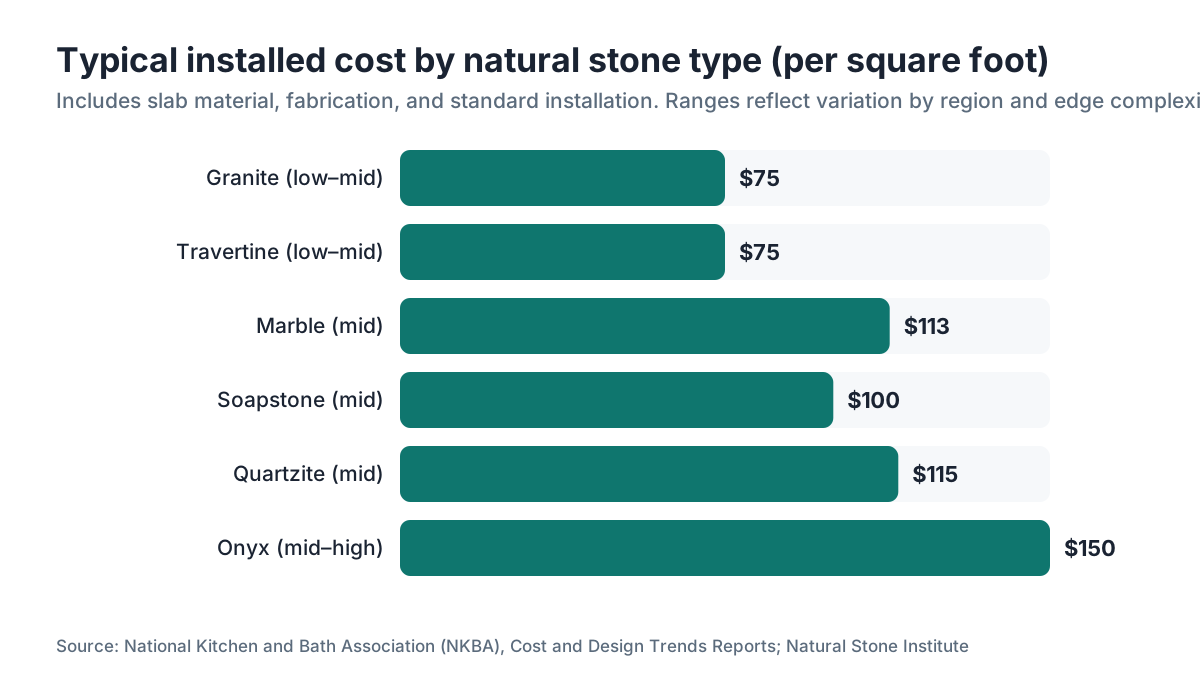
Prices reflect installed cost ranges reported by multiple trade sources and the NKBA; actual pricing varies significantly by region, thickness, and edge complexity. [3]
How much does natural stone countertop fabrication cost?
The honest answer is that cost ranges are wide and depend on four variables: stone material, square footage, edge profile, and local labor market.
For a typical residential kitchen of 40 to 60 square feet of countertop, total installed costs (slab + fabrication + installation) commonly run $2,500, $8,000. Entry-level granite in a mid-size market might land at $55, $65 per square foot installed. Premium marble or exotic quartzite in a high-cost metro can hit $180, $220 per square foot once you add a waterfall island or book-matched slabs. [3]
Fabrication labor alone (separate from slab material cost) typically runs $25, $60 per square foot, depending on job complexity and regional shop rates. A standard eased or beveled edge is usually included in a shop's base rate. Specialty edges, ogee, waterfall miter, laminated thick edge, add $15, $50 per linear foot. Sink cutouts run $100, $250 each depending on shape; a farmhouse apron cutout is at the high end. Cooktop cutouts are similar.
Slab material costs range from about $5, $15 per square foot for commodity granite at a local distributor to $40, $80 per square foot (or more) for rare stones like Patagonia granite, Blue Bahia, or translucent onyx. Book-matched slabs effectively double your slab cost because you are buying a matched pair and the shop has to align them precisely.
One cost that surprises many homeowners is overage. You almost always buy more slab than your finished square footage because of cuts, seams, and breakage allowance. A 45-square-foot kitchen typically needs 55 to 65 square feet of slab purchased. Shops and distributors sell slabs by the full slab or by the square foot depending on the relationship; homeowners buying retail usually pay for the full slab regardless of how much is used. [4]
What happens during the templating stage and why does it matter?
Templating is the measurement step that captures the exact geometry of your cabinets and walls before any stone is cut. A bad template means stone that does not fit. And stone, unlike wood, cannot be shimmed or planed on-site without major consequences.
Old-school shops used luan plywood strips or cardboard to trace cabinet outlines. Most modern shops now use digital systems: Prodim Proliner, Faro 3D arm, or laser-based tools. Digital templates export directly to the shop's CAD or nesting software, eliminating transcription errors. The Prodim Proliner, one of the most widely used, claims point accuracy to ±0.5 mm under field conditions. [5]
Templating typically happens after cabinets are fully installed and level. If you template before cabinets are set and cabinets shift or settle, every piece may be off. Most fabricators will not template until cabinets pass their own inspection.
During the template visit, the technician also identifies: where seams will fall (usually in lower-traffic visual areas or dictated by slab size limits), how to handle backsplash returns, appliance openings, and any walls that are out of square. Most residential walls are at least slightly out of square, and the fabricator scribes the stone to the wall rather than assuming 90-degree corners.
For homeowners, the templating visit is your last real chance to confirm seam placement, edge profiles, and overhang dimensions before stone is cut. If you want to move a seam or change an edge profile after templating, it can be done but may cost rescheduling time and possibly material.
How are stone countertops cut and shaped in the fabrication shop?
Two main machines do the cutting: a bridge saw (also called a wet saw) and a CNC router with a waterjet option at larger shops.
A bridge saw holds a large diamond blade and cuts straight lines through the slab at controlled depths. Most slabs are 3/4 inch (2 cm) or 1-1/4 inch (3 cm) thick for residential use; 3 cm is the current residential standard and does not need lamination for most overhangs. Bridge saws handle the main rough cuts: cutting the slab down to pieces, rough-sizing each countertop section.
CNC routers then profile the edges, drill faucet holes, and make curved or angled cuts that a straight saw blade cannot do. High-end shops use 5-axis CNC machines that can tilt the spindle to cut mitered edges in a single pass rather than gluing two pieces together. Waterjet cutters use a high-pressure water-abrasive stream (typically around 60,000 PSI) to cut detailed shapes, curved islands, medallion inlays, undermount sink templates, with no heat, which is important for fragile stones. [6]
After cutting, edges are profiled with diamond router bits in a series of progressively finer grits, then polished on a line polisher or by hand. A full polish on a 1-3/4-inch ogee profile might go through 6 to 8 grit stages from 50-grit diamond to a 3,000-grit resin pad.
Seams are one of the trickier fabrication decisions. Natural stone seams are filled with color-matched epoxy. A good fabricator matches the epoxy to the stone, gets the two pieces co-planar, and clamps them under controlled pressure while the epoxy cures. A bad seam is visible, proud (one side higher than the other), or has gaps. Seam quality is a real differentiator between shops, look at seam samples when interviewing fabricators.
What edge profiles are available and which are most popular for natural stone?
Edge profiles are one of the highest-impact aesthetic choices and one of the most significant cost variables. There are roughly a dozen standard profiles, plus custom work.
Eased (slightly softened square edge) is the current residential favorite for modern and transitional kitchens. It is clean, contemporary, and the lowest-cost option because a CNC router does it fast. Beveled edges (a flat angled cut at 45 degrees or less) are similarly affordable and slightly more forgiving of chips at the corner.
Ogee (an S-curve profile) was dominant in the 2000s and still appears in traditional kitchens. It requires more tooling time and looks dated to some eyes, but it is genuinely durable because the curves distribute impact stress better than sharp corners.
Waterfall edges are not a profile per se but a fabrication technique: the countertop surface material continues vertically down the side of a cabinet or island to the floor, creating a continuous plane of stone. This requires precise mitered joints at the corners, usually at 45 degrees, and typically 3 cm stone is the minimum thickness that works without lamination. Waterfall edges are labor-intensive and material-intensive, they look striking but add $500, $2,000 or more to a project depending on cabinet height and run length.
For islands, thick mitered edges (a 4 cm or 6 cm look achieved by laminating a second strip of stone at the front edge) give a high-end furniture appearance. This is done by cutting a strip from a remnant or second slab and gluing it at the underside front edge; the seam is usually hidden at the bottom. Most residential work uses 3 cm stone and laminated edges when a thicker look is desired rather than purchasing 5 cm stock, which is expensive and rare.
The choice of profile should account for the stone. Marble is prone to chipping at sharp corners; a slightly eased or pencil-rounded edge reduces that risk. Quartzite holds sharper profiles better. Any stone with natural fissures (common in some granites and quartzites) should be checked at the template stage, fissures near an edge can create a weak point that chips during profiling.
How do fabricators handle seams, and can they be made invisible?
Seams are a fact of life in stone countertop fabrication. Most residential slabs are 9 to 10 feet long and 5 to 6 feet wide. Many kitchen layouts exceed those dimensions, so seams happen. The fabricator's job is to plan them well and execute them cleanly.
Seam placement is a negotiation between structural need (where the slab breaks cleanly), visual impact (seams are less visible away from eye level and traffic zones), and veining match (on book-matched or patterned stone, aligning the seam so veining flows across it). On a busy granite, seams nearly disappear. On a marble with strong linear veining, a seam across a vein line will always be visible to some degree.
The Marble Institute of America's fabrication standards (ANSI MIA 4.2.1) state that seams on polished stone should be filled with color-matched adhesive and should be flat (flush within 1/32 inch) between the two pieces. [7] A slightly proud seam, even 1/64 inch, catches fingernails and looks worse over time as the surrounding stone polishes naturally from use.
Epoxy used for seams is typically a two-part system (resin plus hardener), tinted with stone colorants to match. The pot life is short, often 5 to 7 minutes for fast epoxies, so the fabricator has to work quickly once it is mixed. Some shops use UV-cure epoxies that give more working time and cure under a lamp in under a minute.
The honest truth is that no seam in natural stone is completely invisible under all lighting conditions. A flashlight raked across a polished slab will reveal any seam. What a good fabricator achieves is a seam that is visually unobtrusive under normal lighting, structurally tight, and not a nuisance to clean.
Does natural stone need to be sealed, and how does that work in fabrication?
Most natural stones used for countertops benefit from sealing, though the necessity and frequency varies by stone type and porosity. Granite typically gets one coat of penetrating sealer applied at the shop before delivery, or on-site immediately after installation. [8]
Penetrating sealers (also called impregnating sealers) work by filling the microscopic pores of the stone with a fluoropolymer or silicone compound that repels water and oil-based liquids. They do not change the stone's appearance when applied correctly. Surface sealers, less common in residential countertop work, sit on top of the stone and create a film, they can change sheen and wear unevenly.
The porosity test is simple: put a quarter-sized drop of water on the stone surface and time how long before it darkens the stone (absorbs). Under 4 minutes suggests the stone is quite porous and benefits from sealing; 5 to 15 minutes is moderate; over 15 minutes and the stone may not need sealing at all. Quartzite and some granites are dense enough that sealer adds little protection. Marble, travertine, and limestone are usually porous enough that sealing makes a real practical difference. [9]
Soapstone, notably, does not benefit from penetrating sealers because its pores are too small for the sealer molecules to enter. Soapstone owners typically treat the surface with mineral oil periodically, this darkens and enriches the color rather than sealing against stains.
For general maintenance guidance after installation, the how to clean stone countertops article covers the full routine.
What should homeowners look for when choosing a stone fabricator?
The fabricator matters as much as the material. A great slab ruined by a poor seam or a sloppy sink cutout is worse than a modest slab done well.
Start with physical shop visits. Ask to see in-progress work and finished seam samples. Look for: CNC equipment (manual cutting is not inherently bad but CNC is more precise and repeatable), digital templating capability, and a dedicated polishing area. Shops that cut, profile, and polish in the same facility have better quality control than those who outsource profiling.
Ask about their experience with your specific stone. A shop that does 80% granite and you want a particularly fissured quartzite, ask them to show you a finished quartzite job. Not all stones machine the same way.
Get a written quote with line items: slab cost (or a note that you supply the slab), fabrication per square foot, edge profile per linear foot, sink cutout, faucet holes, sealer, delivery, and installation. Vague quotes that lump everything together make it hard to compare shops or understand what you are actually buying.
Shops that use modern quoting and job management tools tend to produce fewer surprises on invoicing. Software like SlabWise gives fabricators the ability to generate precise, itemized quotes directly from the template data, which means fewer "we forgot to include the backsplash" surprises after the fact. If your fabricator cannot give you a clear written breakdown, that is a flag.
Check licensing and insurance. Stone installation involves heavy lifting, cutting adjacent to finished cabinets, and potential liability for damage. A fabricator should carry general liability insurance and workers' compensation. In most states, a contractor installing countertops does not need a specialty license (countertop installation is generally considered finish carpentry or general contracting in most jurisdictions), but they should be a registered business with proper insurance. Verify with your state's contractor licensing board. [10]
Finally, ask about warranty. Most shops warranty fabrication defects (seam quality, chip damage they caused) for 1 year. Material defects in natural stone are essentially unwarrantable because variation is inherent, but a reputable shop will work with you if a fissure opens or a seam fails shortly after install.
How long does the natural stone countertop fabrication process take?
Timeline is one of the most common friction points in kitchen renovations because countertop installation is often the critical path: you cannot finish the backsplash, hook up the plumbing, or call for a final inspection until counters are in.
Here is a realistic breakdown of typical residential lead times:
| Stage | Typical Duration |
|---|---|
| Slab selection and purchase | 1 to 7 days |
| Cabinet installation (prerequisite) | Already complete |
| Template appointment (scheduling) | 2 to 7 days after cabinet sign-off |
| Fabrication (shop time after template) | 5 to 10 business days |
| Installation appointment | 1 to 3 days after fabrication complete |
| Total from template to install | 8 to 20 business days |
These are ranges, not guarantees. Busy seasons (spring kitchen remodel peak, late fall before holidays) stretch shop queues. A complex job with book-matching, waterfall edges, or special stone may add another week. Shops that have good workflow software and CNC capacity can hit the short end of these ranges consistently; smaller shops doing everything manually often sit at the long end.
If you are on a hard timeline (short-term rental, contractor schedule, appliance delivery), tell your fabricator at the first conversation. Some shops offer rush fees (typically $200, $500 or a percentage of the job total) to jump the queue or add a Saturday install crew.
How does natural stone compare to engineered quartz and other countertop materials for fabrication?
The fabrication process for natural stone and engineered quartz (brands like Cambria, Silestone, Caesarstone) is similar at the machine level, same bridge saws, same CNC routers, but the materials behave differently.
Engineered quartz is more dimensionally consistent than natural stone because it is manufactured to tight tolerances. This makes nesting and cutting slightly more predictable. Natural stone has fissures, voids, inclusions, and thickness variations across a slab, requiring the fabricator to inspect, plan around, and occasionally reject sections of a slab. Some granites have hidden cracks that only appear when the saw blade reaches them.
Natural stone is heavier per square foot than most quartz products on a slab-for-slab basis, though quartz has similar density. The real weight difference tends to be in slab size: natural stone slabs can be 10+ feet long and require more careful handling. [2]
From a maintenance standpoint after fabrication, engineered quartz does not need sealing and is non-porous, while most natural stones require periodic sealing. This is a genuine practical advantage for quartz in high-use kitchens.
For context on the material diversity available, the kitchen countertops overview covers quartz, laminate, solid surface, and wood alongside stone options. If you are comparing engineered stone specifically, Cambria countertops is worth a look for that brand's fabrication specifics.
The bottom line comparison on total cost: engineered quartz typically runs $60, $120 per square foot installed, overlapping significantly with natural stone. You are not necessarily saving money by choosing quartz over granite, you are trading material character (unique natural variation vs. consistent engineered pattern) and maintenance requirements.
What are the most common fabrication mistakes and how do you avoid them?
The failures that generate callbacks and refund disputes tend to cluster around a handful of avoidable mistakes.
The most common is out-of-flat installations. Stone countertops need continuous support across their span. If cabinet tops are not level and co-planar, the stone may rock, crack along a seam, or crack across a sink cutout. A good installer shims cabinets before setting stone and checks with a long level. The standard for residential is a flat surface within 1/8 inch across 10 feet.
Poor seam execution is the second most common complaint. Causes include: epoxy mixed incorrectly (wrong ratio, wrong color, not fully blended), rushing the clamp time, or not sanding the seam area flush after cure. Once epoxy cures, you cannot re-polish stone at a seam without a professional re-polish service.
Insufficient support at overhangs causes cracking. The Marble Institute of America's standard recommends that unsupported overhangs in 3 cm stone not exceed 12 inches without additional support (corbels, steel brackets, or supports). For 2 cm stone, the limit is shorter. Countertop cracks at unsupported peninsulas are almost always a support failure, not a material defect. [7]
Fissures in the stone that were present but not identified at slab selection are sometimes blamed on fabrication. True fissures (natural, in the stone before cutting) are different from cracks (breaks that happen during fabrication). A fabricator should walk you through any fissures visible at slab selection and note them on the contract. If a fissure opens during fabrication, a reputable shop will fill it with epoxy and disclose it rather than quietly patch it and hope you do not notice.
Finally, not protecting adjacent surfaces during installation causes cosmetic damage. Diamond saw blades create fine silica dust and water slurry that can stain cabinet faces, damage flooring, and etch wood if it sits. Good installers use drop cloths, tape off cabinets, and clean up slurry promptly. If your installer does not prep the work area carefully before cutting, that is a sign of sloppy practice.
What are the health and safety considerations during stone fabrication?
Silica dust is the serious occupational hazard in stone fabrication. Crystalline silica is present in granite, engineered quartz (at very high concentrations), and most natural stones. Dry cutting or dry grinding generates respirable silica particles that cause silicosis, a progressive, irreversible lung disease, with prolonged occupational exposure.
OSHA's final rule on occupational exposure to respirable crystalline silica (29 CFR 1910.1053 for general industry, which covers fabrication shops) set the permissible exposure limit (PEL) at 50 micrograms per cubic meter of air as an 8-hour time-weighted average, effective June 23, 2018 for general industry employers. The rule requires engineering controls (wet cutting is the primary one), respiratory protection where controls are insufficient, and medical surveillance for workers with significant silica exposure. [11]
For fabrication shops, wet cutting (keeping the blade or router bit wet with water during cutting) is the standard engineering control. It suppresses dust at the source. Shops doing any dry cutting or grinding without proper ventilation and respiratory protection are violating OSHA standards.
For homeowners, the silica risk during countertop installation is low because the cutting happens in the shop, not your home (most of it, anyway). On-site modifications, trimming a piece to fit, cutting sink knockouts on-site, should always be done wet if possible, and the space should be ventilated. Ask your installer if on-site cutting will happen and what controls they use.
The National Institute for Occupational Safety and Health (NIOSH) has issued hazard alerts specifically about artificial stone (engineered quartz) fabrication noting higher silica content than natural stone, but natural stone fabrication carries real risk too and requires the same controls. [12]
Frequently asked questions
How much does it cost to fabricate and install natural stone countertops?
Total installed cost (slab plus fabrication plus installation) typically runs $50, $200 per square foot depending on stone type, edge complexity, and your region. A standard 50-square-foot granite kitchen commonly lands between $3,000, $5,000. Marble, exotic quartzite, or premium edge work pushes costs higher. Get at least three itemized quotes: slab cost, fabrication per square foot, edge linear footage, and cutout fees should all be listed separately.
How long does it take to get natural stone countertops after templating?
Most residential fabrication shops complete cutting, profiling, and polishing within 5 to 10 business days after the template appointment. Add 2 to 7 days for scheduling the template visit after cabinets are installed, and 1 to 3 days to schedule install after fabrication is done. Total time from template to installed countertops is typically 8 to 20 business days. Busy seasons or complex jobs (book-matching, waterfall edges) can add another week.
What is the difference between 2 cm and 3 cm stone thickness?
2 cm (about 3/4 inch) stone is thinner, lighter, and less expensive, but requires a plywood substrate to support it and has stricter limits on unsupported overhangs. 3 cm (about 1-1/4 inch) stone is the current residential standard, it is self-supporting for standard overhangs up to about 12 inches and does not require a substrate. Most shops and distributors stock primarily 3 cm material for residential countertops today.
Can natural stone countertops be repaired if they crack or chip?
Yes, both chips and cracks can be repaired, though results vary. Small chips at edges or corners are filled with color-matched epoxy, shaped, and polished, results are usually good but rarely invisible under raking light. Larger cracks that run through the slab are more difficult and may require a seam repair approach. A professional stone restoration company can re-polish, fill, and hone most damage. Prevention through proper support and careful use is far better than repair.
Do I need to seal my natural stone countertops, and how often?
Most natural stones benefit from a penetrating sealer, but frequency depends on porosity. Test by placing a water drop on the surface: if it absorbs and darkens the stone in under 4 minutes, resealing is due. Granite typically needs sealing every 1 to 3 years. Marble may need it annually or more in heavy-use kitchens. Quartzite and soapstone often need little or no sealing. Your fabricator should apply an initial coat before or at installation.
What is book-matching in stone fabrication?
Book-matching means opening two consecutive slabs cut from the same block like the pages of a book and placing them side by side so their veining mirrors across the seam. The effect is a symmetrical, dramatic pattern often used on large islands or wall applications. It requires purchasing a matched slab pair, precise seam alignment during installation, and generally costs significantly more than using a single slab because you are committing to two slabs and very exacting fabrication.
How do fabricators handle irregularly shaped kitchens and walls that are out of square?
Digital templating captures the exact geometry of your space, including out-of-square walls. The fabricator scribes the stone to match the wall angle rather than assuming 90-degree corners. CAD software allows the template data to be laid out on the slab digitally, adjusting angles to fit. This is one key advantage of digital templating over paper templates: small angular errors get caught in software before any stone is cut.
What causes countertop seams to fail or become visible over time?
Seam failure usually comes from one of three causes: poor epoxy mixing or application during fabrication, inadequate clamping during cure, or cabinet settling that creates differential movement across the seam. Once a seam opens, water can infiltrate and weaken the bond further. Visible seams (proud or recessed) are almost always a fabrication quality issue. Matching your stone's color and movement pattern carefully at the seam, and choosing a fabricator who shows you their seam samples, is the best prevention.
What is silica dust and should homeowners worry about it during countertop installation?
Crystalline silica in stone generates hazardous respirable dust when cut dry. OSHA sets the permissible exposure limit at 50 micrograms per cubic meter (8-hour average) for workers. The risk for homeowners during installation is low because most cutting happens in the shop with wet-cut equipment. If on-site cutting occurs, ensure the installer uses wet methods and ventilates the space. The bigger concern is ongoing occupational safety for shop workers.
Is granite still a good choice for countertops, or is it outdated?
Granite is genuinely excellent material, hard, heat-resistant, low-maintenance with basic sealing, and available in enormous variety from subtle to dramatic patterns. Whether it reads as dated depends entirely on the slab, not the material category. Busy "tropical" granites from the mid-2000s look dated; clean, linear granites and leathered-finish options look current. The granite countertops guide covers selection in detail. Material quality has not declined; trend cycles just make some patterns feel of their era.
What is a leathered or honed finish versus a polished finish?
Polished stone has a reflective, glassy surface produced by progressively finer abrasives up to 3,000 grit or beyond. Honed stone is sanded to a smooth matte with no reflectivity, typically stopping around 400 to 800 grit. Leathered finishes use a diamond brush process that opens the stone's texture slightly, giving a soft, tactile surface that hides fingerprints and minor scratches well. Leathered and honed surfaces are generally more porous than polished and may need sealing more frequently.
Can I supply my own slab and just pay for fabrication?
Many fabricators will work with customer-supplied slabs, but terms vary. Some charge a higher fabrication rate when they do not supply the material (they lose their slab margin). Others decline because they cannot warranty a slab they did not inspect or source. If you find a slab at a stone yard yourself, confirm with your fabricator before purchasing that they will accept it, and ask whether you need to arrange delivery to their shop or if they will pick it up.
What is the difference between natural quartzite and engineered quartz?
Natural quartzite is a metamorphic rock quarried from the earth, primarily composed of quartz sandstone that recrystallized under heat and pressure. It is fully natural, needs sealing, and has unique variation in each slab. Engineered quartz (brands like Cambria or Silestone) is a manufactured product: roughly 90 to 95% ground quartz bound with polymer resin. Engineered quartz is non-porous, never needs sealing, and has consistent patterning. They look similar but behave very differently in use and fabrication.
How do I compare quotes from multiple stone fabricators?
Ask every shop to quote the same scope in writing: material cost per square foot, fabrication per square foot, edge profile (type and linear footage), number and type of cutouts, delivery, installation, and sealer. Watch for quotes that bundle everything into one price with no breakdown, those are hard to compare and easy to dispute. Confirm what happens if your slab has a defect or if the installed piece needs an on-site adjustment. The lowest number is not always the best value.
Sources
- National Kitchen and Bath Association (NKBA), Kitchen and Bath Market Index: Typical residential countertop fabrication timeline from template to install runs approximately 5 to 14 business days for standard projects.
- U.S. Geological Survey, Mineral Commodity Summaries: Stone (Dimension): Granite has dominated the dimension stone countertop market and has Mohs hardness of 6 to 7; quartzite is commonly harder at 7+.
- National Kitchen and Bath Association (NKBA), Cost vs. Value and Design Trends Reports: Natural stone countertop installed costs commonly range from $50 to $200+ per square foot depending on stone type, complexity, and region.
- Marble Institute of America, Dimension Stone Design Manual: Fabricators typically account for 20 to 30% material overage when purchasing slab to accommodate cuts, seams, and breakage allowance.
- Flow International Corporation, Waterjet Cutting Technical Reference: Waterjet cutters used in stone fabrication operate at approximately 60,000 PSI, cutting without heat generation, which is critical for fragile or heat-sensitive stones.
- Marble Institute of America, ANSI MIA 4.2.1 Dimension Stone Fabrication and Installation Standards: MIA standards specify seams on polished stone should be flush within 1/32 inch and that unsupported overhangs in 3 cm stone should not exceed 12 inches without additional support.
- Natural Stone Institute, Technical Bulletins: Sealers for Natural Stone: Most granite countertops benefit from one application of penetrating sealer at or before installation, with reapplication every 1 to 3 years depending on use.
- Natural Stone Institute, Technical Bulletins: Testing Stone Porosity: The water absorption test (time for a water drop to darken the stone) is the standard field method for determining whether a stone surface needs sealing; under 4 minutes indicates high porosity.
- U.S. Small Business Administration, State Contractor Licensing Requirements: Contractor licensing requirements for countertop installation vary by state; homeowners should verify fabricator business registration and insurance with their state licensing board.
- U.S. Occupational Safety and Health Administration, Silica Rule 29 CFR 1910.1053: OSHA's final rule on crystalline silica sets the permissible exposure limit at 50 micrograms per cubic meter (8-hour TWA) for general industry, effective June 23, 2018.
- National Institute for Occupational Safety and Health (NIOSH), Hazard Alert: Worker Exposure to Silica during Countertop Manufacturing, Finishing, and Installation: NIOSH issued a hazard alert noting high crystalline silica content in engineered stone and the silica exposure risks in natural stone fabrication, requiring wet cutting and engineering controls.
- Remodeling Magazine / Zonda, Cost vs. Value Report: Engineered quartz countertops installed typically cost $60, $120 per square foot, overlapping significantly with natural stone pricing in most markets.
Last updated 2026-07-09