TL;DR
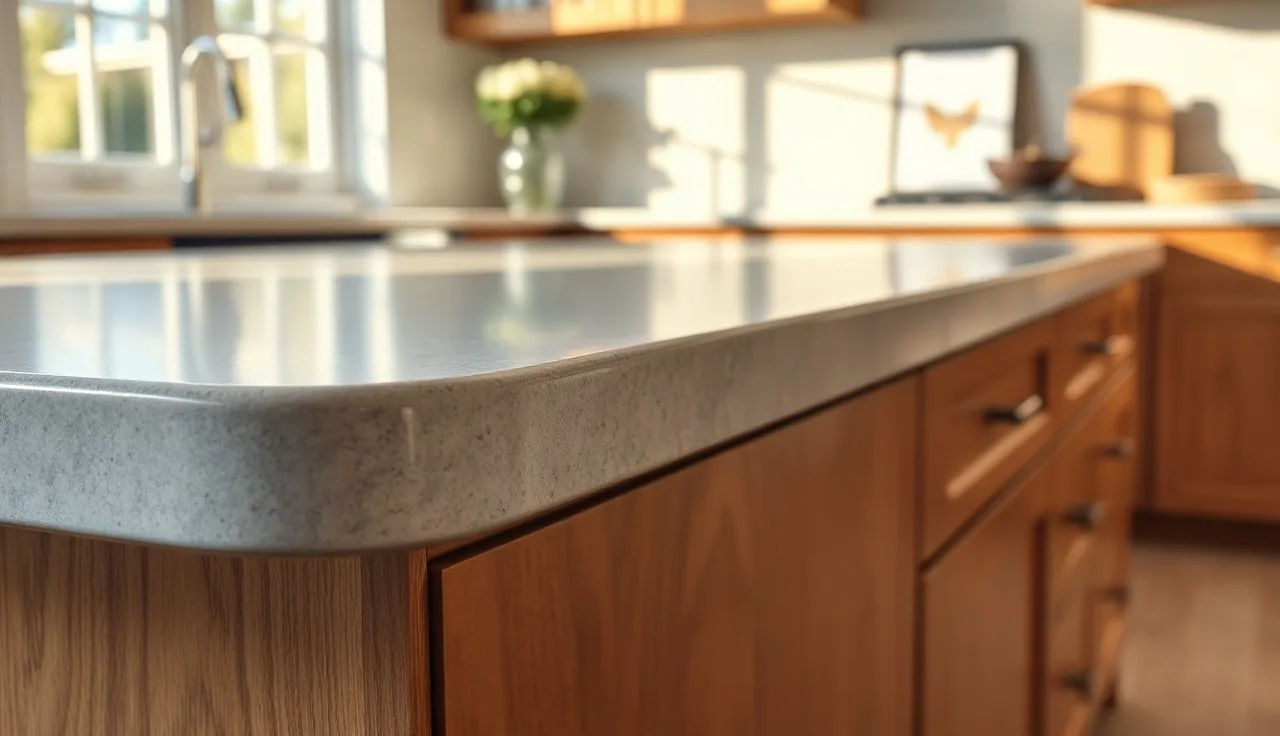
- A countertop edge profile is the shape cut into the exposed front and side edges of a slab.
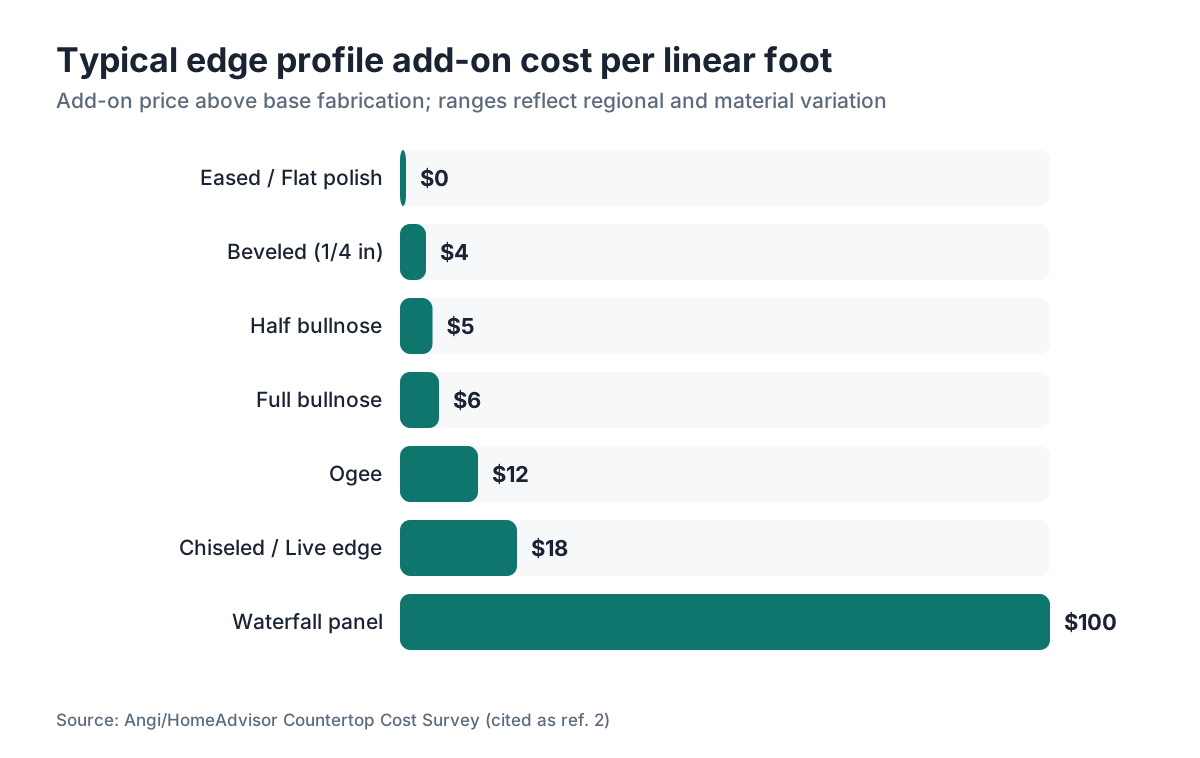
- Basic profiles like eased or beveled cost $0 to $5 per linear foot above slab price.
- Decorative profiles like ogee or waterfall can add $15 to $35 or more.
- The right choice depends on stone type, cabinet style, safety needs, and budget.
- Most kitchens do best with a simple eased or 1/4-inch radius edge.
What is a countertop edge profile and why does it matter?
An edge profile is the cross-sectional shape a fabricator cuts, grinds, and polishes onto every exposed edge of your countertop slab. It sounds like a minor detail. It is not.
The profile changes how a counter looks, how it feels against your hip, how fast you can wipe it clean, and how safely it takes a hit from a running toddler. A square edge on granite looks sharp and modern but chips faster than a rounded one. An ogee on a laminate top looks fussy and dates the whole kitchen. The profile also changes the visible thickness at the edge, which is why a 3/4-inch slab can read as 1.5 inches once you add a mitered or stacked buildup.
Shops cut profiles with CNC routers, wet polishers, or hand tools, depending on their equipment and the stone. Harder stones like quartzite take longer than softer ones like soapstone. That labor gap is where most of the price spread comes from. More complex profile, more passes, higher add-on per linear foot.
Every exposed edge gets the profile you pick. Island ends, peninsula edges, return walls, all of it. A typical kitchen has 20 to 30 linear feet of exposed edge, so even a $5-per-foot upgrade adds $100 to $150 to the job.
What are the most popular countertop edge profiles available today?
Most shops offer somewhere between eight and fifteen standard profiles. Here are the ones you will actually see on a quote sheet, grouped by complexity.
Eased edge (also called flat polish or straight edge) A square corner with the top arris lightly softened so it does not cut your hand. This is the default on most slabs and costs nothing extra. It looks clean, pairs with any cabinet style, and cleans in a single wipe because there are no grooves. Unsure what to pick? Pick this.
Beveled edge A flat angled cut, usually 45 degrees, along the top corner. Common sizes are 1/8 inch, 1/4 inch, and 3/8 inch. The bevel catches light and adds a little interest. It chips less easily than a true square corner because the angled surface has more mass behind it. Add-on cost runs $2 to $6 per linear foot [2].
Bullnose (full bullnose) The entire edge rounds into a half-circle. It feels soft and safe, which is why it shows up on bathroom vanities and in homes with young kids. The tradeoffs: the rounded surface makes the slab look thinner than it is, and water tends to roll off toward the cabinet faces. Costs $3 to $8 per linear foot above the base slab price [2].
Half bullnose (demi bullnose) Only the top edge rounds; the bottom stays flat or square. You get the soft look of a bullnose while still seeing the slab's real thickness. It was everywhere on granite and marble kitchens from the 2000s through the mid 2010s.
Ogee An S-shaped curve, one concave arc flowing into one convex arc. The classic European look. It was on nearly every granite kitchen from about 1998 to 2012. It is far less common in new kitchens now that clean lines rule, but it still works in a traditional or ornate room. Those grooves collect crumbs and need more attention when you clean. Cost is $8 to $15 per linear foot [2].
Double ogee Two ogee curves stacked into a bigger wave. Rare in contemporary kitchens. Cost runs $10 to $20 per linear foot.
Waterfall edge The material runs vertically down the cabinet side all the way to the floor. Not a traditional profile, but it is how designers and homeowners talk about it. The effect is dramatic on book-matched or heavily veined slabs. Cost is steep because it needs a separate slab cut, a precise 90-degree miter, and careful seaming. Budget $50 to $150 per linear foot or more for the panel itself, separate from edge labor [3].
Chiseled or quarry edge (also called live edge or rough edge) The edge is split or chiseled to expose the raw interior of the stone, leaving a jagged, natural face. It suits thick slabs (3 cm or 4 cm) and rustic or industrial rooms. It looks dramatic, cleans badly, and can leave sharp points. You see it mostly on granite and quartzite. Cost swings with how much hand work is involved, roughly $10 to $25 per linear foot [2].
Miter or stacked edge Two pieces of stone (or one piece routed at 45 degrees on both halves) are joined at a 45-degree miter to fake a very thick slab from thinner material. A 3/4-inch slab with a 4-inch miter skirt reads as a 4-inch-thick counter. It is a common pick for kitchen countertops that want heft without the price of a full thick slab. Labor is higher because the joint has to be tight and well supported.
Triple pencil, dupont, and compound profiles These are shop-specific names for layered or combined profiles. A dupont has a flat top, a small step, then a rounded lower edge. Triple pencil stacks three small rounded details. Most are holdovers from high-end traditional kitchens of the 1990s and 2000s. Still available, rarely spec'd on new builds.
| Edge Profile | Typical Add-On Cost (per LF) | Cleanability | Best Stone Fit | Style Fit |
|---|---|---|---|---|
| Eased / Flat | $0 | Excellent | Any | Any |
| Beveled | $2 to $6 | Excellent | Any | Modern, transitional |
| Half bullnose | $3 to $7 | Good | Granite, marble | Traditional, transitional |
| Full bullnose | $3 to $8 | Good | Granite, marble | Traditional, family |
| Ogee | $8 to $15 | Fair | Granite, marble | Traditional, ornate |
| Chiseled / Live edge | $10 to $25 | Poor to fair | Granite, quartzite | Rustic, industrial |
| Waterfall panel | $50 to $150+ | Good | Quartz, marble | Contemporary, bold |
Price ranges are industry estimates from fabricator pricing surveys [2] and shift with region, stone hardness, and shop equipment.
How much do different edge profiles cost, and what drives the price?
Edge profile pricing almost always runs as a per-linear-foot add-on above the base slab and fabrication cost. Most shops already include one standard profile (usually eased or beveled) in the base fabrication charge. Anything past that is an upgrade.
The main cost driver is labor time. A CNC machine runs a beveled edge in seconds per foot. A complex ogee on hard quartzite needs several passes with different wheels, slower feed rates, and often hand-finishing. Some shops price by complexity tier (simple, medium, premium). Others price each profile on its own. Neither system is more honest than the other. The numbers are what matter.
A typical kitchen has 20 to 30 linear feet of exposed edge [1]. At $10 per linear foot for an ogee, that adds $200 to $300 to the job. At $25 per linear foot for a chiseled live edge, you are looking at $500 to $750. That is real money. Ask about it before you fall for a specific look.
Material hardness matters too. Granite countertops and quartzite sit at Mohs 6 to 7 and wear profiling wheels faster than limestone or soapstone at Mohs 3 to 5 [5]. Some shops add a hardness surcharge. Others fold it into granite pricing. Ask which.
Thickness adds cost. A 3 cm slab (about 1.25 inch) has more material to grind away for a full bullnose than a 2 cm slab. Step up to a 4 cm or 6 cm slab for a dramatic edge and profiling labor climbs right along with it [7].
Region moves the price more than most people expect. Shops in New York, San Francisco, and Seattle often charge $5 to $15 more per linear foot for the same profile than shops in smaller markets. Three quotes is your only real protection against overpaying.
Which edge profile is best for granite countertops?
Granite takes almost any profile well because it is hard and holds a strong polish. Some choices still work better than others.
For contemporary kitchens, an eased or beveled edge is the top pick. It shows granite's polish without visual noise. For transitional or traditional rooms, a half bullnose or full bullnose is a safe bet. They have run on granite for thirty years for one good reason: the rounded surface hides the small edge chips that eventually happen on a mineral with cleavage planes.
The ogee owned granite from roughly 1998 to 2014. If your kitchen already has raised-panel cabinets and decorative hardware, an ogee still belongs. Put it in a kitchen with flat-front or shaker doors and it looks lost.
Chiseled or live edges are almost exclusively a granite and quartzite move. Softer stones will not chip cleanly enough to make an attractive rough face. On a thick granite slab with visible crystal structure, the effect can be genuinely impressive. It is a poor pick for a working kitchen you wipe down every day.
For more on how stone type shapes finish choices, see how to clean stone countertops.
What edge profile works best for quartz and engineered stone?
Eased, beveled, and miter/waterfall are the profiles that suit quartz best. Engineered stone like Cambria countertops is made with a uniform internal structure and no natural cleavage planes, so it behaves differently under a profiling wheel than natural stone.
The good news: quartz profiles cleanly and consistently every time. The catch: a chiseled or rough quarry edge does not work on quartz at all. The material does not split the way stone does. Try to chisel it and you get a crack, not a clean fracture.
The miter edge is a favorite on quartz islands. Quartz slabs usually run 3/4 inch thick (or 1.25 inch in the thicker option), and a miter skirt builds up the visible edge into something that reads much more substantial.
Quartz makers generally do not void warranties over profile choice, but they do require a licensed fabricator and warn against aggressive profiles on thin slabs [8]. Check your specific brand's fabrication guidelines before you spec anything unusual on a 2 cm slab.
Are some edge profiles safer for children and high-traffic kitchens?
Yes. Full bullnose is the safest profile because there are no corners at all, just a smooth curve. Half bullnose is a close second. Both are strong choices in homes with toddlers or any kitchen where people keep clipping the island edge.
Sharp 90-degree corners are a real injury risk for small children. The Consumer Product Safety Commission tracks sharp corners and edges in the home as a source of laceration and blunt-force injuries, with risk highest for children under five [4]. The profile you choose can lower that risk.
Beveled edges at 45 degrees are meaningfully safer than a true square eased edge. The bevel breaks the 90-degree corner into two 45-degree surfaces, so there is no pure right-angle point to hit.
Ogee and waterfall profiles do nothing for corner safety at the height where kids hit counters. The ogee's grooves can even add a secondary catch point.
For a family kitchen, the best mix is a half or full bullnose on any island edge or peninsula end that sticks into the traffic lane, with a simpler eased profile on the counters running along walls where nobody is walking straight into a corner. The CDC flags the same pattern: interior corners and edges cause the most injuries where children move fast and low [10].
Can you get a natural or live edge on non-stone countertops?
Some non-stone materials can approximate the live edge look, and wood does it for real. Butcher block countertops can carry a true live edge when the slab is cut from a natural plank that keeps its bark or outer contour. Woodworkers and some countertop shops offer it as a custom option. That is a genuine natural edge, not a machined imitation. Cost swings hard with species and slab size, but University of Minnesota Extension notes premium live-edge slabs often retail at $150 to $300 per linear foot or more [9].
Laminate countertops and Formica countertops cannot fake a live stone edge because the substrate is particleboard or MDF. Post-form laminate comes with rounded or beveled edges built in at the factory. High-pressure laminate over custom substrates can manage a square eased edge or a slight bevel, but the material will not take hand-chiseling or rough profiles. Want a live edge? Laminate is the wrong material.
Corian countertops and other solid-surface materials profile a lot like quartz. They take clean machined edges well. You can approximate a rough edge with sanding and grinding, but it never really looks like split stone.
Soapstone is soft (Mohs around 2 to 3) and takes a chiseled edge reasonably well, though it dents and damages from impact more than harder stones. See how to clean soapstone countertops for its surface care.
Marble countertops take every standard profile cleanly and suit the classic ogee or dupont look. Marble chips more easily than granite along profile edges, so a full or half bullnose is usually the more durable call in a working kitchen.
How do edge profiles affect countertop seams and installation?
Profile choice changes how seams look, how installation goes, and sometimes whether a seam is even possible in a given spot.
Eased and beveled edges are the easiest to seam consistently. The seam line is a straight vertical cut, and epoxy filler matches the profile cleanly. Complex profiles like ogee create a shaped edge at the seam that has to match exactly on both pieces. If the two pieces come from slightly different areas of the slab, or the profiling wheel wore a hair between cuts, the seam shows.
Waterfall edges at island ends need a 90-degree miter joint where the horizontal counter meets the vertical panel. That joint has to be structurally supported and cut to within a fraction of a millimeter, or the gap is visible. Most experienced shops run a CNC bridge saw for this cut. For what professional installation involves, see countertop installation.
Live or chiseled edges create a real seaming problem. There is no clean straight face to mate two pieces against. Most shops keep seams well away from any live-edge section. If your layout forces a seam there, a chiseled edge might push you toward a slab upgrade or a layout change to kill that seam.
Fabrication software helps shops plan profile and seam placement before cutting. At SlabWise, the quoting and nesting tools let fabricators flag profile requirements per edge segment during job setup, so seam locations and profile transitions are settled before the saw starts. That heads off the most common field surprise: a mitered edge at a return corner that nobody accounted for in the original quote.
How does edge profile affect cleaning and maintenance?
This is underrated. The profile you pick decides how much time you spend cleaning that edge for the whole life of the counter.
Eased and beveled edges have no grooves. One wipe clears them. That matters every single day.
Ogee and double ogee profiles have concave grooves that trap crumbs, grease, and dried liquid. Cleaning them takes a soft brush or a pointed corner of a cloth to reach into the channel. Over years, the buildup in those grooves gets stubborn. An ogee edge next to a cooktop? Plan on scrubbing those grooves weekly.
Chiseled or rough edges have irregular texture that catches everything: crumbs, oils, dried water spots. The rough surface is also harder to sanitize than a polished one. If kitchen hygiene is high on your list, a rough edge in a food-prep zone is a poor practical choice.
Bullnose edges have no grooves, and the rounded surface pushes liquid toward the front rather than the back wall. Small cleaning advantage, but a real one.
For natural stone, the profile does not change sealing requirements. You seal the whole surface and every edge together. The edge just has different porosity than the face depending on how the stone was cut relative to its mineral grain. See how to clean quartzite countertops for how cutting direction affects porosity.
What edge profiles are trending now versus what is dated?
Edge trends track broad kitchen design cycles, and those cycles move slowly compared to cabinet color or hardware.
Popular now (2025 to 2026): eased or flat polish on every stone type in modern and contemporary kitchens, miter/waterfall edges on thick-look islands, and a quiet revival of simple beveled edges in transitional rooms. The clean, minimal look that has run kitchen design since around 2016 still favors straight or lightly softened edges.
Fading: the full ogee and double ogee are clearly on the way out except in traditional formal kitchens. The half bullnose still works fine, but it reads as early 2000s granite kitchen to most designers now.
Steady no matter the trend: full bullnose on bathroom vanities and on any counter that takes heavy daily use from kids. Safety beats style in family bathrooms and mudrooms.
Worth watching: very thick slabs (4 cm and 6 cm) with a flat eased edge. The thickness itself is the statement, and the profile stays as plain as possible. It costs more (thick slabs are pricier) but the look is clean and ages well.
Renovating to sell? A safe eased or beveled edge will not hurt you with any buyer. An ornate ogee appeals to some and turns off others. The simpler profile is almost always the safer commercial choice.
How do you choose the right edge profile for your specific countertop project?
The decision usually comes down to four things: cabinet style, stone type, household use, and budget.
Start with cabinet style. Flat-front and shaker cabinets pair best with eased or beveled edges. Raised-panel traditional cabinets carry a half bullnose, full bullnose, or an ogee. Highly ornate cabinets with carved or turned details can handle more elaborate profiles. Match a minimal edge to very ornate cabinets, or the reverse, and it almost always looks wrong.
Then the stone. If you have dramatic veining (bold marble or quartzite), the profile is nearly irrelevant because nobody is looking at it. A plain eased edge lets the slab be the statement. A more uniform stone with less movement puts more of the design work on the edge.
Household use is the next filter. Kids in the house? Lean bullnose or half bullnose on exposed island and peninsula edges. Cooking constantly? Skip the ogee grooves. Bathroom vanity that is mostly decorative? More room for complex profiles.
Then budget. Get the per-linear-foot add-on for any profile you are considering, multiply by your footage, and decide if the premium earns the look. In most cases a free or low-cost eased or beveled edge wins the practical checklist and ages the best. Spend the profile budget on better stone instead.
Ask your fabricator for a sample cut in the actual stone you are buying, not photos or catalog images. The same ogee looks different in black granite than in white Carrara. Marble Institute standards call for profile type to be specified at templating [6], so lock it in early. A real cut sample in your stone before you commit saves regret.
Frequently asked questions
What is the most popular countertop edge profile right now?
The eased edge (also called flat polish or straight edge) is the most commonly specified profile in contemporary and modern kitchens as of 2024 to 2026. It costs nothing extra, cleans in one wipe, and works with every stone and cabinet style. The beveled edge is next, followed by the half bullnose in transitional kitchens.
How much does it cost to add an ogee edge to granite countertops?
An ogee edge on granite typically adds $8 to $15 per linear foot above base fabrication. A standard kitchen has 20 to 30 linear feet of exposed edge, so budget $160 to $450 extra for an ogee. Exact pricing depends on your region, shop equipment, and how hard your specific granite is, since harder stones take longer to profile.
Is a waterfall countertop edge more expensive?
Yes, significantly. A waterfall edge needs a separate vertical slab panel running floor to counter, mitered precisely at 90 degrees, and carefully seamed. The panel alone typically costs $50 to $150 per linear foot or more depending on slab material and matching, separate from normal edge profiling labor. On book-matched stone, costs run higher still.
What is a live edge or natural edge on a countertop?
A live edge or chiseled edge on a stone countertop is a rough, irregular edge that mimics the natural fracture surface of the stone rather than a machined profile. It is created by hand-chiseling or controlled splitting of the slab edge. It works best on thick granite or quartzite with visible crystal structure. Striking, but harder to clean than any polished profile.
Which edge profile is easiest to clean?
Eased and beveled edges are the easiest because they have no grooves or recesses. One pass with a damp cloth clears them. Bullnose edges are also easy. Ogee and double ogee profiles have concave grooves that trap crumbs and grease and need a brush or pointed cloth to clean thoroughly. Chiseled rough edges are the hardest by a wide margin.
Can you change the edge profile on an existing countertop?
In most cases, no. Changing a profile on an installed stone counter is hard because it needs a wet grinder and profiling wheels run against the edge in place, which is messy and risks cracking the slab. Some shops can make minor changes (like flattening an ogee into a bevel) but the work is risky and usually costs more than it adds. Choose your profile before fabrication.
Does edge profile affect how often you need to seal granite or natural stone?
No. Sealing frequency depends on stone porosity, sealer type, and use, not on which profile you chose. You do need to seal the edge faces along with the surface, and rough or chiseled edges may drink sealer faster than a polished surface because of their greater exposed area. Otherwise the schedule is the same regardless of profile.
What edge profile should I use on a bathroom vanity countertop?
Full bullnose or half bullnose are the most common choices for bathroom vanities. They look elegant, are safe, and hold up well in a lower-traffic room. For a contemporary master bath, an eased or beveled edge works. Ornate profiles like ogee stay popular on traditional vanities. Lower daily use means grooved profiles are less of a cleaning burden than they are in kitchens.
Does edge profile matter for laminate or Formica countertops?
Yes, but options are limited. Post-form laminate comes with a factory-rounded front edge built into the substrate shape. Custom-built laminate counters with high-pressure laminate take eased or beveled edges. Complex profiles like ogee are not practical because the particleboard or MDF substrate cannot support them and the laminate layer is too thin for the profile depth. For laminate, eased or post-form rounded edges are standard.
How do I tell a fabricator which edge profile I want?
Ask to see a physical sample board, which most shops have showing profiles cut in stone. No board? Ask for photos of completed work with each profile you are considering. Name the profile by its standard name (eased, beveled, half bullnose, ogee) and confirm it is on your written quote by name, with the per-linear-foot price and the total footage that price applies to. Do not leave it unspecified.
What edge profile works best for a kitchen island?
For a contemporary island, a miter edge (to fake a thick slab) or a clean eased edge on a genuinely thick slab are the most popular picks. For family kitchens, a full or half bullnose on the exposed sides cuts corner injury risk. Waterfall edges look dramatic and work well if the slab has strong veining worth showing. Ogee is functional but trending out of contemporary island design.
Are there edge profiles that void countertop warranties?
For engineered quartz, manufacturers generally do not void warranties over profile choice, but they require profiles to be cut by a certified or licensed fabricator following their technical guidelines. Some brands specify minimum corner radii or prohibit aggressive profiles on thin slabs. Check the warranty documentation for your specific product before specifying a non-standard profile, especially on thinner 2 cm slabs.
How does edge profile interact with undermount sink installation?
The front-edge profile does not directly interact with an undermount sink. The interior edge of the sink cutout does get profiled, usually with a small radius polish or a polished eased edge, and that cutout profile is normally included in the fabrication price. Complex profiles on the exterior edge have no effect on how the sink mounts underneath.
Sources
- National Kitchen and Bath Association (NKBA), Kitchen and Bath Market Index: Typical kitchen countertop installations have 20 to 30 linear feet of exposed edge requiring profiling.
- Angi (formerly HomeAdvisor), Countertop Installation Cost Guide: Edge profile add-on costs range from $0 for eased to $25+ per linear foot for complex profiles like chiseled or ogee; figures represent industry survey averages from fabricator pricing data.
- Architectural Digest, Waterfall Countertop Design Guide: Waterfall countertop edge panels typically cost $50 to $150 per linear foot or more depending on slab material and mitering complexity.
- U.S. Consumer Product Safety Commission (CPSC), Home Safety guidance: The CPSC tracks sharp interior corners and edges in the home as a source of laceration and blunt-force injuries, with risk highest for children under five.
- U.S. Geological Survey (USGS), National Minerals Information Center: Dimension Stone: Granite has a Mohs hardness of 6 to 7, making it one of the harder countertop stone materials and increasing profiling labor versus softer stones.
- Natural Stone Institute (formerly Marble Institute of America), fabrication standards: Standard fabrication practice for natural stone includes profiling all exposed edges; profile type is specified at the time of templating.
- National Stone, Sand and Gravel Association (NSSGA), dimension stone technical materials: Stone profiling wheel wear rate varies by stone hardness; harder stones including quartzite and granite require more passes and wear profiling tooling faster than softer stones.
- Cambria, Fabrication and Installation Guide (manufacturer technical document): Cambria and similar engineered quartz manufacturers require profiles to be cut by a licensed fabricator and specify that certain aggressive profiles are not recommended on 2 cm slab thicknesses.
- University of Minnesota Extension, wood countertop and slab care guidance: Live-edge wood countertop slabs cut from natural planks retaining the outer contour can be finished with a true natural edge; premium species live-edge slabs often retail at $150 to $300 per linear foot or more.
- U.S. Centers for Disease Control and Prevention (CDC), Home and Recreational Safety: Sharp interior corners and edges in the home are a documented source of laceration and blunt-force injuries, with risk highest for children under five.
Last updated 2026-07-09