TL;DR
- A broken edge profile is any countertop edge that takes off the factory-sharp 90-degree corner without fully rounding it.
- The three common types are the eased edge (a slight softening), the bevel (an angled cut, usually 45 degrees), and the chiseled or hand-chipped edge (a rough, natural-looking break).
- Prices run roughly $10 to $50 per linear foot depending on profile complexity and stone type.
What is a broken edge profile on a countertop?
A broken edge profile is any edge treatment that takes off the hard, square corner left by a raw slab cut, without rounding it into a full curve. The trade uses the term two ways, and the difference matters if you're quoting or shopping.
The broad meaning covers any edge that breaks the sharp 90-degree geometry: eased edges, bevels, and chiseled or quarry-faced edges all belong here. The narrow meaning, used especially with natural stone and leathered finishes, points to a hand-chipped or mechanically distressed edge that mimics how stone breaks naturally along its cleavage planes.
Neither definition is wrong. Context tells you which one a fabricator means. If a stone yard says "broken edge," they almost always mean the chiseled, rustic look. If a countertop salesperson says "broken edge," they may mean any non-bullnose, non-square option.
The practical result is a countertop edge that looks intentional and finished but has visible facets, flat planes, or rough texture rather than a smooth curve. It's a different look from the classic bullnose countertop edge profile, which sweeps the edge into a full half-round with no flat face visible from above.
What are the main types of broken edge profiles?
Five profiles reasonably fall under the broken-edge umbrella. They share the absence of a full round curve, but they look nothing alike.
Eased edge (also called a pencil eased or slightly eased edge) The fabricator runs the grinder or CNC router along the top corner just enough to take off the knife-sharp arris. The result is a nearly square edge with a barely perceptible flat or radius on the top corner, maybe 1/16 to 1/8 inch. It's the most common edge in production shops because it's fast, nobody cuts a hand on it, and it works on every material from laminate countertops to granite countertops.
Bevel edge (single or double bevel) A bevel cuts a flat angled face across the top corner, usually at 45 degrees but sometimes 30 or 60 depending on the look. Single bevel hits the top corner only. Double bevel hits top and bottom. It reads crisp and modern, especially on quartz and porcelain. It's a cousin of the eased edge, but the angled facet is clearly visible.
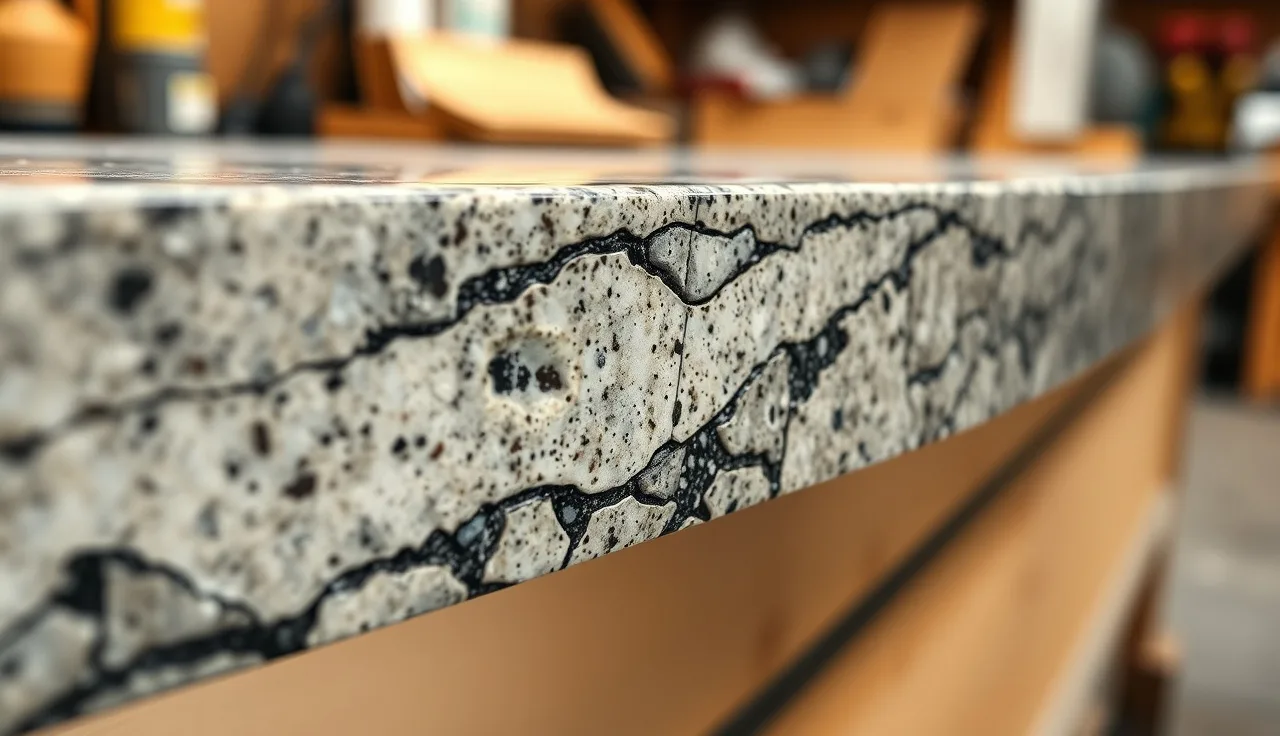
Chiseled or hand-chipped edge (sometimes called a quarry edge or natural broken edge) This is the profile most stone fabricators mean when they say "broken edge." A craftsperson, or more often a pneumatic hammer with a chisel bit, chips along the bottom or both faces of the slab edge to create a rough, irregular surface. The top face stays polished or honed. The edge face looks raw, like a stone pulled from the ground. It's common on marble countertops with leathered or antique finishes, on travertine, on thick quartzite slabs, and on outdoor kitchen counters.
Chiseled top edge (rustic or mountain edge) Same technique as above but applied only to the top arris, leaving the front face smooth. The silhouette from the front looks nearly square. The drama sits at eye level with the surface.
Split-face or rock-face edge Used on thicker slabs (3 cm and up, or on mitered builds). The full front face of the edge is mechanically or hand-split to expose raw stone texture across the entire visible edge surface. More common in commercial work and outdoor kitchens. This one isn't standard at every shop. Ask ahead.
Profiles that do NOT count as broken edges include the full bullnose, the ogee, the dupont, the waterfall (pencil or full), and laminated mitered edges. Those rely on curves, multiple round-over passes, or layered thickness rather than angular or fractured geometry.
How much do broken edge profiles cost compared to other edge options?
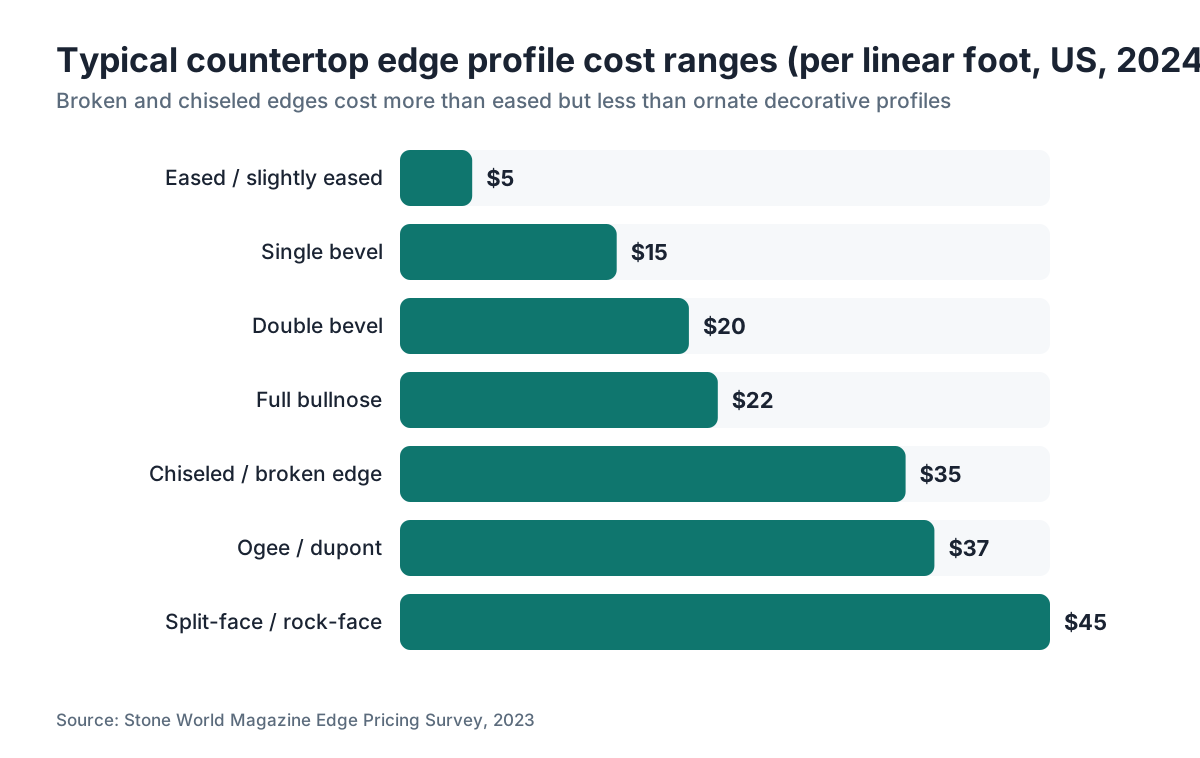
Edge pricing swings by shop, region, and material. Most fabricators price edges per linear foot on top of the slab cost. Here's an honest range based on current (2024-2025) shop pricing across the US:
| Edge Profile | Typical Price Range (per LF) | Notes |
|---|---|---|
| Eased / slightly eased | $0, $10 | Often included in base slab price |
| Single bevel | $10, $20 | Standard CNC operation |
| Double bevel | $15, $25 | Two passes, slightly more labor |
| Chiseled / hand-chipped edge | $20, $50 | Labor-intensive; hand work costs more |
| Split-face / rock-face | $30, $60+ | Rare; price varies widely by shop |
| Full bullnose | $15, $30 | Common round-over; more material removal |
| Ogee / dupont | $25, $50 | Complex profile; multiple router passes |
The eased edge is almost always the cheapest or free option because most shops fold it into their base countertop price. A hand-chiseled broken edge prices more like a decorative profile, since it takes skilled labor that can't be fully automated.
Material moves the number too. Chiseling granite takes more time than chiseling softer travertine or limestone. Fabricators working with harder stones often add a surcharge of $5 to $15 per linear foot on top of the base edge price. [1]
Here's a figure to plan around. The average countertop in a standard kitchen runs 25 to 30 linear feet of edge. A hand-chiseled broken edge at $40/LF on a 28-foot perimeter adds $1,120 to the job, before any inside corners or cutouts.
Which countertop materials work best with a broken edge profile?
Not every material takes a chiseled or broken edge well. The answer rides on how the material fractures, how thick the slab is, and what finish you pair with it.
Natural stone is the strongest fit. Granite, quartzite, limestone, travertine, and marble all fracture along natural cleavage planes, which is exactly what makes the chiseled look authentic. Granite is the hardest to chip by hand, but the result is durable and the irregular surface ages well. Softer stones like travertine and limestone chip more easily and show more dramatic texture. Marble countertops with a chiseled edge and honed top are a favorite for farmhouse and Mediterranean kitchens.
Quartz engineered stone takes a bevel, but not a true chisel. Engineered quartz is a composite, roughly 90 to 94 percent ground quartz bound with polymer resin [2], and it doesn't fracture the way stone does. A CNC-cut bevel looks clean and intentional. A hand-chipped edge on quartz tends to look damaged rather than rustic. Stick with eased or bevel if you're going modern, or pick a different material if you want the raw stone look.
Porcelain slabs accept a bevel cleanly. Full-body porcelain (12mm or thicker) takes a mitered bevel at the factory or in the shop. The consistent through-body color means the bevel face matches the surface, which reads intentional and contemporary.
Concrete countertops can be formed with any edge, including irregular hand-worked and intentionally rough broken looks. A skilled concrete artisan can hand-chip a formed edge or press aggregate into it for a natural feel.
Butcher block and wood don't chisel the way stone does, but a hand-planed or spoke-shaved broken chamfer on a butcher block countertop is a real woodworking technique. It's rarely offered at countertop shops. A custom woodworker can do it.
Laminate and solid surface do not suit broken edge treatments. Laminate edges depend on the core and laminate layer staying bonded, and chipping defeats that. Formica and similar products pair better with a post-formed or standard eased edge. See more on laminate countertops for the edge options there.
How is a chiseled or broken edge actually made?
The process depends on whether you're doing it by hand or with a pneumatic tool, and whether the shop does it before or after the slab is templated and cut to shape.
In a traditional hand-chiseled process, the fabricator sets the cut slab on a stable work surface with the edge to be chiseled overhanging slightly. A cold chisel or tungsten-carbide-tipped masonry chisel is held at roughly 20 to 30 degrees to the edge face and struck with a hammer in short, controlled blows along the edge. The goal is to break small, irregular flakes rather than cut uniform grooves. An experienced stone carver reads the grain of the material and adjusts angle and force to get a natural-looking break instead of a machined texture.
Pneumatic chisels or air hammers speed things up a lot. Most production shops that offer broken edges run a pneumatic hammer with a narrow chisel bit freehand along the edge. The result is less varied than true hand work but still reads as natural at normal viewing distance.
Stone fabrication is a silica dust operation, and chiseling and grinding are no exception. OSHA's respirable crystalline silica standard for construction requires wet methods or equivalent dust controls for cutting and grinding stone. [8] NIOSH has documented that grinding and chipping natural stone produces respirable crystalline silica, a serious occupational hazard that calls for engineering controls and respiratory protection. [10] Any shop chiseling edges dry without dust capture is cutting a corner that matters.
After chiseling, the top polished surface gets protected (usually masked with tape or padded), and the loose fines are blown off with compressed air. Some fabricators run a wire brush or diamond pad over the chiseled surface to smooth any dangerously sharp protrusions without flattening the texture. Others leave it completely raw.
For bevel edges, the process is simpler. On a CNC router, the operator loads a chamfering bit at the specified angle (usually 45 degrees) and runs the profile. On a hand grinder, the fabricator tilts an angle grinder with a flat diamond pad to the correct angle and traces the edge. Good fabricators use a fence or guide block to keep the bevel consistent.
There's no industry-standard certification for edge profile cutting in the US. The Marble Institute of America (now the Natural Stone Institute) publishes fabrication guidelines, but edge profiling is largely learned on the shop floor. [3]
Does a broken edge affect countertop durability or safety?
This is a real concern, more than a style question.
A sharp 90-degree raw slab edge chips easily, especially on granite, quartz, and porcelain. Any edge treatment that takes off or softens that corner improves durability, because the square arris is the thinnest cross-section of material and the most likely place for impact chips to start. An eased edge or bevel spreads edge impact across a wider surface area. That's a genuine structural benefit, more than an aesthetic one.
A hand-chiseled broken edge brings a different durability question. The surface is irregular, and some of the small protrusions the chiseling creates are thinner than the rest of the edge. Under a direct hit, those thin protrusions can chip further. The rough texture is also harder to seal evenly, which matters for porous stones like travertine or limestone that need regular sealing to resist staining. [4]
For safety, a properly finished broken edge is fine in a home kitchen. The chiseled surface is rough but not sharp the way a glass edge is. Most fabricators run a brief diamond pad over the texture to knock down any genuinely sharp protrusions. If you have young children at counter-edge height, a full eased or bullnose edge is still the safest choice because it removes all angular geometry. For adults, a well-finished chiseled edge isn't a meaningful hazard.
Cleaning a chiseled edge is more work. The irregular surface traps crumbs, grease, and cleaning residue. A stiff brush (not a metal one) and a stone-safe cleaner gets into the crevices. On a polished top with a chiseled edge, use the same cleaner you'd use on the top surface. [5]
How do broken edge profiles compare to bullnose and other common countertop edges?
Edge profiles sit on a spectrum from industrial-minimal to decorative-ornate. Broken edges and the bullnose head in two different directions away from the raw square cut.
The bullnose is the most recognized countertop edge in residential kitchens. It rounds the top and front face into a half-cylinder, hiding the slab thickness in a curve. It reads soft, traditional, friendly. It's the default for Corian and solid surface work, common in builder-grade kitchens, and still used in higher-end installs with traditional cabinetry. The bullnose countertop edge profile is the easiest to keep clean because there are no angular transitions to trap debris.
Broken edges push the other way. They play up the slab's thickness and materiality. A chiseled broken edge says "this is stone and I'm not hiding it." A bevel edge says "this is precise and modern." Both pull more visual attention to the edge than a bullnose does.
On cost, the full bullnose runs more than an eased edge and roughly the same as a single bevel, because it removes more material over multiple passes. The hand-chiseled broken edge costs more than both for hand work, and less than an ogee or dupont for the total fabrication time.
| Profile | Visual Style | Typical Cost Range | Best Material Match |
|---|---|---|---|
| Eased | Minimal, modern | $0, $10/LF | All materials |
| Single bevel | Crisp, contemporary | $10, $20/LF | Quartz, porcelain, granite |
| Bullnose | Classic, soft | $15, $30/LF | All materials |
| Chiseled / broken | Rustic, natural | $20, $50/LF | Natural stone |
| Ogee | Traditional, ornate | $25, $50/LF | Granite, marble |
The choice comes down to the design language of the kitchen and the material. A flat-front cabinet run looks better with a bevel or eased edge. A heavily veined marble island in a farmhouse kitchen looks better with a chiseled or eased edge than an ogee, which fights the veining.
What questions should you ask a fabricator before choosing a broken edge?
Six things are worth confirming before you commit to a broken edge on a quote.
First, ask whether the shop does the chiseling in-house or outsources it. Most mid-size shops run bevels on their CNC but hand-chip edges themselves or send them to a specialty fabricator. If it's outsourced, ask how that hits the timeline. Custom edge work can add one to three weeks to a job.
Second, ask to see a sample or a photo of their specific chiseled work. Every fabricator's broken edge looks different. Some are dramatically rough. Some are subtle. There's no standard. If the shop can't show you examples, that tells you they don't do it often.
Third, confirm the price per linear foot and count the footage yourself. Get the measurement from the template (if templating has happened) or from your own kitchen plan. Misquoted linear footage is one of the most common sources of countertop budget surprises. [6]
Fourth, ask about sealing. A chiseled edge on a porous stone needs sealer worked carefully into the rough texture. Ask whether the shop seals the edge face separately, or whether their standard seal covers it.
Fifth, ask whether the chiseling happens before or after the slab is cut to shape. Chiseling after cutting is standard and lets the fabricator work on the actual pieces. Some edge work is easier on the full slab.
Sixth, confirm the finish on the top surface and the edge face separately. A polished top with a rough chiseled edge is a deliberate contrast. A honed top with a chiseled edge is more unified. Make sure both are spelled out on the written order.
Fabricators using quoting software like SlabWise can attach edge profile line items straight to the quote, so the per-foot price and profile type sit in plain view on the customer-facing document. That cuts the back-and-forth on scope.
Are broken edges a good fit for outdoor countertops and kitchen islands?
Outdoor countertops have different demands than indoor surfaces, and broken edges hold up well outside.
The rough texture of a chiseled edge hides the weathering, water staining, and UV discoloration that show up on polished edges outdoors. A polished granite edge left in the rain and temperature swings for years loses its shine and develops micro-pitting. A chiseled edge already looks intentionally rough, so natural weathering reads as patina rather than damage.
Thicker slabs (3 cm or 4 cm) are more common outdoors because they handle temperature cycling and impact from outdoor cooking gear better. A chiseled edge on a 4 cm granite outdoor counter looks substantial in a way a thin eased edge doesn't.
On kitchen islands, the broken edge acts as a visual anchor. An island with a chiseled perimeter and a polished or leathered top reads as a statement piece, especially with waterfall designs where the edge stays visible on multiple sides.
The main outdoor caution is sealer and UV exposure. Any stone countertop outdoors needs a penetrating sealer rated for exterior use, and the chiseled edge face needs that sealer worked into the texture by hand. Annual resealing is the norm outdoors, compared to every one to three years for interior stone depending on the stone. [4]
How does edge profile selection affect countertop resale value?
Nobody has reliable data tying a specific edge profile to a home's resale price. The closest research comes from general kitchen renovation ROI studies, not edge-specific analysis. The 2024 Cost vs. Value report from Remodeling magazine found that a minor kitchen remodel (which includes countertop replacement) returns about 96.1 percent of its cost at resale, while a major upscale kitchen remodel returns about 38.7 percent. [7]
The takeaway is that the whole kitchen renovation matters far more to resale than any single countertop call. An appraiser sees stone versus laminate long before edge profiles.
Edge profiles still shape buyer perception, even if they never land on an appraisal line. A dated ogee edge on granite from 2004 reads as old. A clean eased or bevel edge on the same granite reads as current. If you're renovating for resale, the eased or single-bevel edge is the safer pick because it ages well and doesn't polarize buyers the way a heavily decorative profile can.
A hand-chiseled broken edge is a design commitment. Buyers who love it will love it. Buyers expecting a clean contemporary kitchen will read it as a flaw. For a flip or a near-term resale, stick with the eased edge and spend the difference elsewhere.
Can you add or change a broken edge profile after a countertop is installed?
In most cases, yes, with real limitations.
Adding an eased edge or bevel after installation works if the fabricator can reach the edge face with a hand grinder. The countertop doesn't have to come out. An experienced fabricator with a wet grinder and the right diamond pads can work in place. The mess (grinding slurry and fine stone dust) means careful masking of the surrounding cabinets and flooring. Budget around $15 to $30 per linear foot for in-place edge work, depending on access and how complex the new profile is.
Changing from a polished eased edge to a chiseled broken edge is also doable in place, though messier and noisier than cutting a bevel. The fabricator runs a pneumatic chisel or angle grinder along the existing edge. Whether the result looks as controlled as shop work depends on access, the stone, and the fabricator's skill.
Going the other way, from a chiseled broken edge back to a polished eased edge, is much harder. You'd have to grind the irregular texture down to a flat face and then re-polish, which removes material and may change the edge geometry or thin the countertop slightly at the edge. For most installations it isn't worth the trouble. Accept the existing profile or replace the slab.
If you're thinking about edge changes after installation, get a quote from the same fabricator who installed the counter. They already know the stone, the layout, and the tricky spots like inside corners. A new shop taking the job in place cold will charge more for the uncertainty.
Frequently asked questions
What is the difference between an eased edge and a broken edge?
An eased edge takes just the sharp arris off a square slab cut, leaving a nearly right-angle edge with a very small radius or flat at the top corner. A broken edge (in the specific sense) goes further, using chiseling or hand-chipping to create an irregular, rough surface across the edge face. In common use, both fall under the broader broken-edge category, but they look very different. Eased is subtle. Chiseled is dramatic.
Is a chiseled countertop edge hard to keep clean?
Harder than a polished eased or bullnose edge, yes. The rough, irregular surface traps crumbs, grease, and cleaning residue in its crevices. A stiff natural-bristle brush and a pH-neutral stone cleaner handles most of it. Avoid metal brushes, which can leave iron particles in porous stone. If the stone is limestone or travertine, plan on resealing the edge face annually, since sealer wears faster on rough surfaces than on polished ones.
How much does a chiseled stone edge cost per linear foot?
Hand-chiseled or pneumatically chiseled broken edges typically cost $20 to $50 per linear foot in 2024-2025 US shop pricing, depending on stone hardness, how dramatic the chiseling is, and whether it's done fully by hand or with pneumatic tools. Granite costs more to chisel than limestone or travertine because of its hardness. Count your linear footage carefully before approving the quote. A 28-foot kitchen perimeter at $40/LF adds $1,120 to the job.
What stone types look best with a broken or chiseled edge?
Natural stones with visible grain or crystal structure show the most authentic broken-edge look: granite, quartzite, marble, limestone, and travertine all fracture along natural planes that make the chiseled texture look intentional. Leathered or honed top finishes pair especially well with a chiseled edge because the matte surface unifies the look. Engineered quartz and porcelain don't fracture naturally, so a CNC-cut bevel is a better choice for those materials.
Does a broken edge on a countertop increase the price of the whole job?
Yes. Even a simple bevel adds $10 to $20 per linear foot over the base eased-edge price, and a hand-chiseled broken edge adds $20 to $50 per linear foot. On a typical kitchen with 25 to 30 linear feet of edge, a chiseled profile could add $500 to $1,500 to the total countertop cost. That's a real budget item, not an afterthought. Ask your fabricator to line-item the edge cost on the written quote.
Can a broken edge be done on a quartz countertop?
A bevel edge, yes. A true hand-chiseled or chipped broken edge, not really. Engineered quartz is a polymer-resin composite, not solid stone, and it doesn't fracture along natural cleavage planes. Chipping it produces an irregular, damaged-looking edge rather than the authentic rustic texture you get on granite or marble. For a modern broken-edge look on quartz, a 45-degree single bevel is the practical and attractive alternative.
What is the best edge profile for a farmhouse or rustic kitchen?
A hand-chiseled broken edge on honed marble or leathered granite is the top choice for farmhouse and Mediterranean-influenced kitchens. It suits thick slabs (3 cm and up) and reads genuinely old-world in a way that an ogee or dupont profile, despite their traditional associations, doesn't quite reach. An eased edge on a rough-sawn wood countertop is a close second for the farmhouse look without the stone budget.
Is a broken edge profile safe around children?
A properly finished broken edge is generally safe for adults but needs more thought in family kitchens. The chiseled texture is rough rather than truly sharp, and most fabricators run a quick diamond pad over the surface to remove genuinely dangerous protrusions before delivery. For households with toddlers at counter-edge height, a full bullnose or eased edge is safer because there are no angular transitions at all. Safety and looks are both real considerations. Prioritize based on your household.
How does a broken edge profile hold up on an outdoor kitchen countertop?
Very well. The rough texture weathers gracefully. Normal outdoor weathering reads as patina rather than damage. Thick slabs (3 cm or more) with a chiseled edge handle temperature cycling and impact well. The main maintenance requirement is sealing: use a penetrating sealer rated for exterior use and work it carefully into the chiseled texture. Plan on resealing annually outdoors, compared to every one to three years for interior stone.
How do fabricators actually make a broken edge profile?
For chiseled broken edges, a fabricator uses a cold chisel and hammer or a pneumatic air hammer with a narrow chisel bit, working along the edge face in short controlled blows to break irregular flakes of stone. The technique follows the natural grain of the material. For bevel edges, a CNC router with a chamfering bit or a hand angle-grinder at the specified angle handles it. After chiseling, a stiff brush removes loose fines and a light diamond-pad pass removes any dangerous protrusions.
Can you change a countertop edge profile after the countertop is already installed?
Yes, with limitations. Adding an eased edge or bevel in place is feasible for an experienced fabricator using a wet hand grinder, costing roughly $15 to $30 per linear foot. Adding a chiseled texture in place is messier but doable. Reversing a chiseled edge back to a polished face is harder: it takes grinding down the irregular texture and re-polishing, which removes material and rarely produces a result as clean as shop work. For most situations, it's easier to live with it or replace the slab.
What edge profiles are trending in kitchen design right now?
As of 2024-2025, the eased and single-bevel edges dominate new construction and remodels because they suit the flat-front, handle-free cabinet look that's been popular for several years. The chiseled broken edge is strong in rustic, natural, and Japandi-influenced spaces, especially on leathered granite or quartzite. The full bullnose has slowed in new installs but stays popular in traditional and transitional kitchens. Ogee and dupont profiles are less common in new work than they were in the early 2000s.
Does a broken edge require special sealing or maintenance compared to a standard polished edge?
Yes. The irregular surface from chiseling exposes more area to liquids and staining agents, and standard roller or wipe-on sealers don't reach the crevices evenly. Work the sealer into the chiseled texture with a stiff brush, let it penetrate fully, and wipe off excess before it hazes. On porous stones like limestone and travertine, seal the edge face every 12 months. Test with a water droplet: if it soaks in within a few minutes rather than beading, it's time to reseal.
Sources
- Stone World Magazine, Edge Profile Pricing Survey 2023: Fabricator edge pricing ranges from $0 for eased edges to $50+ per linear foot for hand-chiseled broken edges, with harder stones commanding a surcharge.
- NSF International, Engineered Stone Composition Standards: Engineered quartz countertops are composed of approximately 90-94% ground quartz particles bound with polymer resin.
- Natural Stone Institute, Fabrication Industry Standards and Guidelines: The Natural Stone Institute (formerly Marble Institute of America) publishes fabrication guidelines for the stone industry; edge profiling standards are covered in its technical manuals.
- Natural Stone Institute, Care and Maintenance of Natural Stone (consumer guidance): Porous natural stones including limestone and travertine require penetrating sealer and should be resealed annually in outdoor applications; rough surface textures require manual sealer application.
- Natural Stone Institute, Cleaning Natural Stone Surfaces (consumer guidance): pH-neutral cleaners are recommended for natural stone surfaces including rough-textured edges; metal brushes should be avoided on porous stone.
- NAHB National Association of Home Builders, Remodeling Cost Data: Linear footage miscalculation is among the most common sources of countertop job cost overruns cited by remodeling contractors.
- Remodeling Magazine, 2024 Cost vs. Value Report: A minor kitchen remodel returns approximately 96.1% of its cost at resale; a major upscale kitchen remodel returns approximately 38.7%.
- OSHA, Crystalline Silica Rule for Construction: OSHA regulations require dust controls including wet cutting methods for stone fabrication to limit crystalline silica exposure; these apply to chiseling and grinding operations.
- US Census Bureau, American Housing Survey: Kitchen remodeling is among the most common home improvement projects; countertop replacement is a frequent component of those remodels.
- NIOSH (CDC), Hazard Review: Health Effects of Occupational Exposure to Respirable Crystalline Silica: Chiseling and grinding natural stone produces respirable crystalline silica dust, a documented occupational hazard requiring respiratory protection and engineering controls.
- Tile Council of North America, ANSI A108 Installation Standards: Industry installation standards for stone countertops specify edge finishing requirements as part of acceptable workmanship definitions.
Last updated 2026-07-10