TL;DR
- Countertop edge profiles run from a plain eased edge (usually $0 extra) to a stacked ogee or waterfall that adds $30 to $80 per linear foot in labor and tooling.
- The profile changes how the slab looks, how it wears, how safe it is around kids, and how long a fabricator spends at the CNC or hand wheel.
- This guide names every mainstream profile, shows how each is modeled, and gives honest cost context.
What is a countertop edge profile and why does it matter?
An edge profile is the shape cut into the exposed vertical face and top corner of a countertop slab. It is not a cosmetic afterthought. The profile decides how water runs off the front, whether sharp corners chip under daily knocks, whether the slab reads thick or thin, and how long a fabricator spends running a wheel or CNC router to finish the piece.
For homeowners, the edge is often the first thing a hand touches when you lean against the counter. A sharp 90-degree edge bruises hips. A heavy bullnose collects soap scum. The wrong profile on a thin 1.2 cm slab cracks during fabrication. Those are real tradeoffs, not taste calls.
For fabricators, the edge is a cost driver. A square eased edge on a 3 cm slab might take 8 to 12 minutes of wheel time per linear foot. A full ogee on the same slab takes 25 to 40 minutes and needs a different tooling set. Quote a full-detail kitchen at the eased rate, then watch the homeowner upgrade to ogee at signing, and the shop eats the difference.
Modeling the profile accurately, in a sketch, a quoting tool, or a CNC program, is where shops protect their margins or give them away.
How are edge profiles modeled geometrically?
Every edge profile is a 2D cross-section swept along the length of an edge. Geometrically that makes it a ruled extrusion: the profile path follows the edge line of the top, and the resulting solid is the finished edge. Get the cross-section right and the whole edge is right.
CNC toolpath software handles this three ways. First, it stores the profile as a named template (a set of tool passes and depths) that the operator assigns to an edge segment. Second, the operator draws the cross-section as a 2D polyline and the CAM kernel extrudes it. Third, on hand-polished or router-table work, the profile lives only in the tooling itself, meaning the shape of the grinding wheel or router bit.
A modeler needs a handful of parameters: slab thickness (2 cm or 3 cm are the two common metric sizes, roughly 3/4 inch and 1-1/4 inch), the radius or depth of each arc, whether the profile is symmetric (same shape top and bottom) or asymmetric, and whether multiple layers of stone are laminated for a thicker look.
Mitered and laminated edges add a wrinkle. A 3 cm slab laminated with a 3 cm return at the bottom reads as 6 cm thick. The modeler has to treat the laminate piece as its own component with its own edge cut, and the joint between the two pieces gets glued and color-matched with epoxy. That joint line has to sit in the right visual spot, usually tucked behind the face of the profile, or the lamination looks sloppy.
Parametric CAD tools (SolidWorks, Rhino, dedicated fabrication software) treat the profile as a sketch swept along a 3D edge curve. This matters on curved counters, where the edge is not straight. On an inside radius, the tool has to be smaller in diameter than the radius or the bit gouges the neighboring face. Outside radii are easier. Both cases need a collision check on the toolpath before anything gets cut.
What are all the common countertop edge profiles by name?
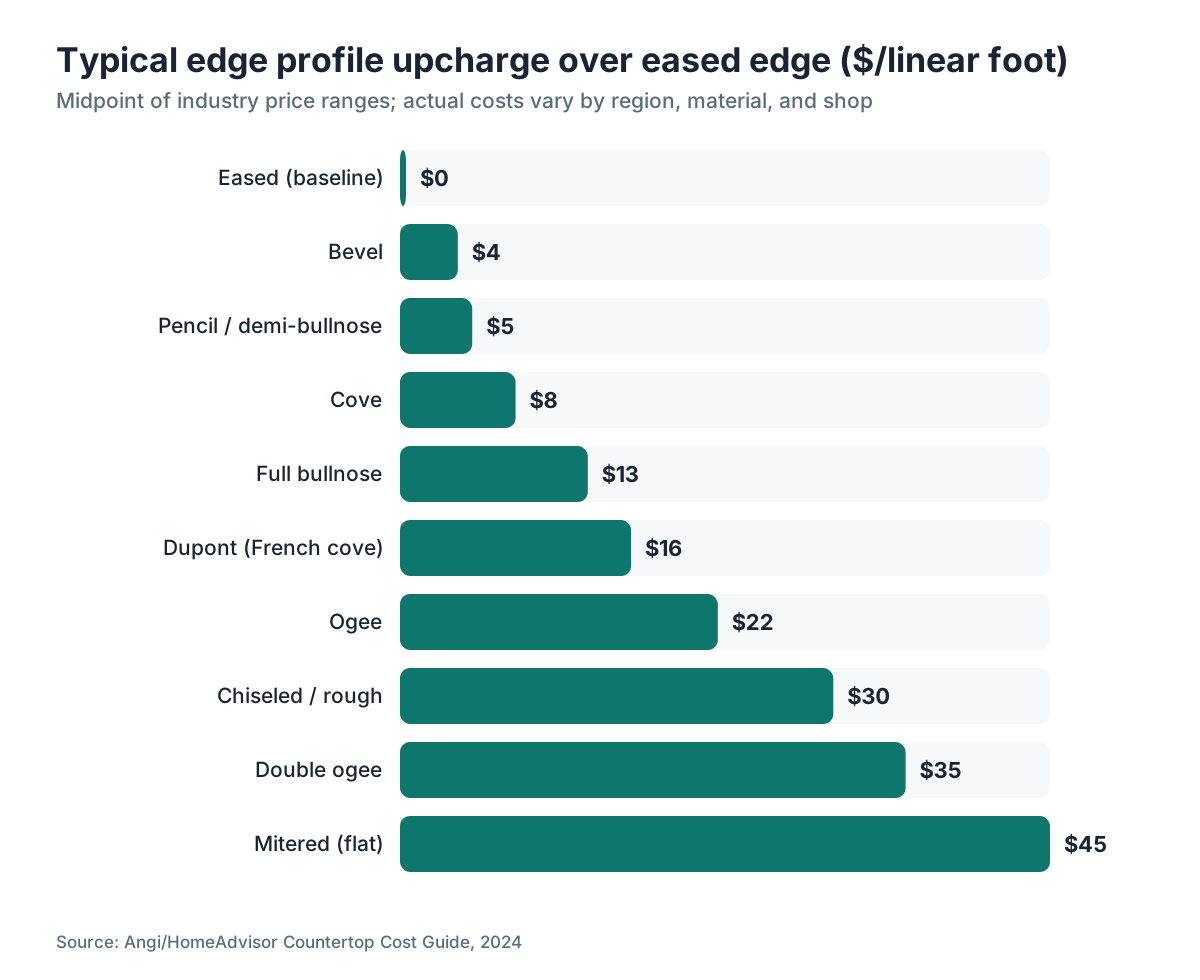
Here is a reference table of every mainstream profile. Linear-foot upcharges are approximate ranges pulled from fabricator pricing guides and trade publications [1][2]. Actual prices swing with region, material, and shop.
| Profile name | Cross-section description | Typical upcharge ($/LF over eased) | Min. recommended slab thickness |
|---|---|---|---|
| Eased (straight) | 90° corner, top arris broken slightly | $0 | 2 cm |
| Beveled | Angled flat cut on top corner, typically 45° | $2, $6 | 2 cm |
| Pencil/demi-bullnose | Small quarter-round on top corner only | $2, $8 | 2 cm |
| Full bullnose | Half-circle, top and bottom curved to center | $8, $18 | 3 cm |
| Demi-bullnose (half bullnose) | Quarter-round on top, square on bottom | $5, $12 | 2 cm |
| Ogee | S-curve: concave cove below, convex round above | $15, $30 | 3 cm |
| Double ogee | Two full ogee curves stacked | $25, $45 | 3 cm laminated |
| Dupont (French cove) | Concave cove cut into top surface, then drop | $10, $22 | 3 cm |
| Cove (waterfall) | Concave quarter-round on top corner | $5, $12 | 2 cm |
| Chiseled/rough | Intentionally fractured face | $20, $40 | 3 cm |
| Miter (flat) | Two pieces mitered at 45° for thick appearance | $30, $60 | 3 cm + return |
| Waterfall mitered | Full vertical slab drop to floor, mitered | $50, $120 | 3 cm |
| Stacked laminate | Two pieces bonded for thick edge, any top profile | $20, $50 | 2 cm × 2 |
| Flat polished | Eased but polished on the face, no shaping | $0, $4 | 2 cm |
| Shark nose | Thin front edge tapering to near-point | $10, $20 | 3 cm |
A few notes. The eased edge is the baseline in most shops: a square cut with a tiny flat break on the top corner to stop chipping, and most fabricators do not charge extra for it. The ogee is the most tooling-heavy single-piece profile, needing a purpose-ground wheel and several passes [3]. The chiseled edge is hand work, and the wide price range reflects that uncertainty. Waterfall and miter prices swing hard because they burn extra material, more than extra labor.
For kitchen countertops, eased and pencil are the safest defaults if you want the edge to disappear visually. For marble countertops, ogee and dupont carry a long traditional association. For granite countertops, the full bullnose ruled the 2000s and has since lost ground to eased and mitered profiles in contemporary kitchens.
How much does each edge profile add to the total countertop cost?
Edge upcharges are priced per linear foot of exposed edge. A typical kitchen has 20 to 35 linear feet once you count the island front, the perimeter counters, and any bar overhangs [2]. A bathroom vanity might run 8 to 12 linear feet.
Run the math on a 25-linear-foot kitchen with a 3 cm slab:
- Eased edge: $0 extra
- Pencil/demi-bullnose: $2, $8/LF x 25 = $50, $200
- Full bullnose: $8, $18/LF x 25 = $200, $450
- Ogee: $15, $30/LF x 25 = $375, $750
- Mitered (no extra profile): $30, $60/LF x 25 = $750, $1,500
That is real money on a job that might total $3,000 to $8,000 for material and fabrication. On a premium profile, the edge alone can be 10 to 20% of total project cost.
Material changes the picture too. Softer stones like soapstone and some marbles grind fast but can fracture on thin-walled profiles like shark nose. Harder stones like quartzite take longer to grind. Quartzite countertops with a double ogee cost noticeably more than the same profile in a softer calcite-based marble.
For laminate countertops and Formica countertops, post-form profiles (a single sweeping curve that wraps the top surface up to the backsplash in one continuous piece) are molded in at the factory and do not carry a per-foot upcharge the way stone does. You just order the post-form radius you want.
For solid surface like Corian countertops, profiles are routed and can be sanded smooth. Corian bends when heated, so fabricators can pull off some shapes, like a thin miter, that would be fragile in natural stone.
Which edge profiles work for which slab thicknesses?
Slab thickness is the single biggest constraint when you spec or model an edge profile. The two common natural stone thicknesses are 2 cm (about 3/4 inch) and 3 cm (about 1-1/4 inch). Some imported slabs come in 1.2 cm and some custom porcelain panels run 6 mm, but those are special-order cases.
A full bullnose needs a radius equal to half the slab thickness. On a 2 cm slab, that is a 10 mm radius, achievable but tighter and rounder than most people picture. On 3 cm, the 15 mm radius gives the classic look. Spec a full bullnose on a 2 cm slab with nobody catching it, and the finished piece looks compressed.
Ogee and double ogee need enough material depth to run the full S-curve without cutting through the back face. Most shops will not run a standard ogee on anything under 3 cm. On 2 cm stock, some shops offer a "baby ogee" or "mini ogee" that squeezes the curve, but the result is less defined and plenty of installers call it a cut corner.
Mitered edges use two separate pieces of stone. The face piece is cut at a 45-degree bevel on its bottom edge, and a return strip (usually cut from the same slab) is cut at 45 degrees on its top edge. The two glue together and read as one thick edge. Net visible thickness is roughly double the slab minus the kerf. On 3 cm stock, a miter looks like a 5.5 to 5.8 cm slab, which reads as substantial.
Laminated edges (two pieces bonded flat) are not the same as mitered. A laminate adds thickness only at the edge, not across the whole slab. It looks thick at the front but you can see it is hollow underneath. Some designers prefer the cleaner geometry of a miter for exactly that reason.
How do fabricators model and cut edge profiles using CNC machines?
CNC bridge saws and CNC routers both handle edges, but they work differently. A bridge saw uses a spinning diamond blade for straight and angled cuts (miters and bevels). The router uses shaped grinding or routing bits for contoured profiles. Most modern shops have both.
For a simple bevel on a 3 cm slab, the saw tilts to the bevel angle (typically 30 to 45 degrees) and runs the cut in one pass. For a bullnose, the router runs two or three passes with a profiled wheel: a roughing pass strips material fast, a semi-finishing pass refines the shape, a polishing pass brings it to the final finish. Each pass wants a different wheel grit [3].
The ogee is the most toolpath-intensive standard profile. It has a concave cove section (needs a conical or ball-nose wheel running a specific arc) and a convex round above it. Many shops run a single purpose-ground combination wheel that does both in one motion, but holding consistent depth of cut across a curved counter still takes careful programming.
The modeler sets the depth stops, the offset from the edge reference line, and the tool change sequence. Get the profile geometry wrong in the model and every piece comes out wrong. Good templating data feeds straight into CNC accuracy: if the digital template puts the edge line in the right place, the CNC stays on the cut. Off by 2 mm and the profile floats visually against the face of the cabinet.
Some shops use quoting and nesting software to carry the edge assignment from quote all the way to cut file. Tools like SlabWise let a shop assign a named profile to each edge segment during quoting, so labor cost is right from the start and the same assignment flows to the shop floor file without re-entry. That matters most on jobs with several profiles on one slab (say, a mitered island with an eased back edge and a pencil on the cooktop cutout).
For butcher block countertops, edges get cut with a router bit directly. The same names apply, though the tooling is wood-rated rather than diamond-tipped. Hardwood butcher block takes a tighter inside radius than stone because wood is more ductile.
What edge profiles are standard for quartz vs. natural stone vs. solid surface?
The material dictates which profiles are practical, which are fragile, and which are just expensive.
Engineered quartz (like Cambria countertops) is slightly harder than most granites and much harder than marble. It machines cleanly and holds sharp detail, so ogee and dupont profiles come out crisp and consistent. Quartz has no natural veining to fracture along either, so thin-wall profiles like shark nose carry less risk of random breakage than they do in a heavily veined marble.
Natural marble and limestone are calcite-based and soft (Mohs 3 to 4). They grind fast but can fracture along bedding planes. A chiseled edge on marble looks dramatic and fits the material's character. A very thin shark nose on heavily veined marble is risky: the vein is often a calcite-filled fracture, and the thin section can snap during handling or install.
Granite is igneous and hard (Mohs 6 to 7). It takes longer to grind and polish but holds detail well [4]. The full bullnose was the go-to granite profile through the 1990s and 2000s because a single pass of a convex wheel handled it, and that was the tooling most shops owned. Better-equipped shops now offer the full range.
Soapstone is soft (Mohs 1 to 2) and easy to machine, but it scratches easily in service. For soapstone countertops, the common edge is a plain eased or pencil. A complex ogee on soapstone dulls and loses its crisp definition over years of normal use.
Solid surface like Corian thermoforms and sands to essentially any shape. It is also repairable, so a chipped profile can be re-routed and re-polished in place. That makes solid surface a low-risk pick for complex profiles in high-use spaces.
Which edge profiles are safest for households with children?
Child safety in countertop edges is a real concern, though no federal rule mandates any specific profile. The worry is blunt impact at head height for toddlers (roughly 80 to 100 cm off the floor) and the risk of a sharp corner cutting skin.
The Consumer Product Safety Commission (CPSC) tracks injuries from furniture and household fixtures but does not publish countertop-specific edge data [5]. Pediatric home-safety guidance points the same direction: skip 90-degree eased edges at child height and lean toward rounded profiles.
In practice, the full bullnose and demi-bullnose feel the softest. A pencil edge is a reasonable middle ground. The ogee, despite its complex shape, has no more sharp corners than a demi-bullnose, because its sharpest point (the top of the convex section) is still a small radius, not a true 90-degree arris.
The mitered edge with a flat face is basically a sharp 90-degree corner at the bottom of the face. That corner sits at knee and shin height for adults but eye height for a crawling infant. If you have toddlers and you love the mitered look, ask the fabricator to add a small chamfer or radius to the bottom corner of the miter return. Most will do it at no charge.
Island overhangs need their own thought. An overhang edge at 90 cm (standard counter height) is exactly where a running toddler's forehead lands. A bullnose or demi-bullnose here is a sensible precaution. Whether it prevents an injury or just softens one is unknowable from published data, but the rounded profile at least presents a bigger impact surface and no sharp arris.
How do edge profiles affect countertop maintenance and cleaning?
The profile shape decides where water, crumbs, soap scum, and grease collect.
A flat eased edge is the easiest to wipe. One pass of a cloth and you are done. A full bullnose traps residue in the concave underside where the curve meets the bottom face, so you have to run a cloth into that curve to get it clean. An ogee is the hardest to clean of any standard profile: the S-curve makes two concave sections, one facing up and one facing in, and grease settles in both.
Near a cooktop, profile complexity turns into a real maintenance issue. On bathroom vanities, which see soap scum and toothpaste, the ogee's detail catches buildup visibly. For stone countertops in general, honed (matte) finishes on complex profiles hide mineral deposits and water spots better than polished finishes, but polished finishes wipe clean in a single stroke.
Chiseled edges are the outlier. The rough texture is intentional, but it is genuinely hard to sanitize. For a kitchen prep area, that is a hygiene concern. For a bathroom or a low-use decorative surface, it is fine.
The pencil edge and bevel are probably the best balance of style and cleanability for most kitchens. They break the monotony of a square edge, they do not trap grease, and they work on both 2 cm and 3 cm slabs.
Do edge profiles add significantly to the countertop installation timeline?
The profile drives fabrication time far more than install time. Installation runs mostly independent of the profile: the slab sits on the cabinets, gets leveled, and gets secured. The edge just has to clear adjacent surfaces like the cabinet door face or a tile backsplash.
The exception is the waterfall edge. A waterfall panel runs vertically from the countertop to the floor, needing a precise miter at the corner and either a floor return or a clean termination at the floor. Installing one takes careful coordination with the flooring, especially if there is tile. Installers typically add 30 to 60 minutes per waterfall end on countertop installation.
Fabrication is where the time shows. Industry benchmarks put an eased edge on a full kitchen (20 to 25 LF) at roughly 2 to 3 hours of CNC and polishing time. An ogee on the same kitchen can take 5 to 7 hours [3]. High-volume shops protect their schedule by limiting which profiles they offer or charging a premium that matches the real labor.
Lead time varies too. If the shop already has the right profiling wheel, they can start right away. If they need to order a custom wheel for a specific ogee geometry, add 1 to 2 weeks. Ask about tooling availability before you lock a profile on a time-sensitive job.
How do you specify an edge profile in a countertop quote or drawing?
Clear specification heads off the most common fabrication dispute: the homeowner pictured one thing, the shop built another, and nobody wrote it down.
A complete edge spec includes five things: the profile name (use the standard names from the table above, not invented descriptions), the slab thickness, whether a laminated or mitered return is included, the polish level (polished, honed, leathered), and which edges get the profile (front edges only, returns, sink cutout perimeter, full perimeter).
On a drawing, the profile gets called out in a detail bubble showing the cross-section, labeled with the profile name and the edge segment it applies to. For simple profiles, a note in the specification block does the job. For custom or complex profiles, a dimensioned cross-section drawing kills the ambiguity.
In digital quoting, store the edge assignment at the segment level, not as one value for the whole job. A kitchen where the island gets a mitered edge, the perimeter counters get a pencil, and the sink cutout gets an eased edge has three profiles to track. If your quoting system only holds one edge type per job, you will undercharge or overbuild something.
The Marble Institute of America (now part of the Natural Stone Institute) publishes fabrication standards that define standard profile geometries [6]. Cite that standard in a spec and a fabricator knows exactly what you mean without a drawing.
What should fabricators know about pricing edge profiles accurately?
The most reliable way to price edge profiles is time-based, not flat-rate. Track actual minutes per linear foot for each profile in your shop, on your material types, with your tooling. Then price on your shop rate plus tooling wear.
Tooling wear is a real cost most shops undercount. A profile wheel runs $150 to $600 depending on complexity [3]. On hard stone like quartzite or some granites, a profiling wheel might last 200 to 400 linear feet before it loses geometry. On softer materials, it can run 1,000 LF or more. Divide the wheel cost by its expected life on your common material mix and you get a tooling cost per linear foot that belongs in your profile pricing.
An honest caution: nobody in the industry publishes reliable, well-sampled data on these numbers. The ranges here come from fabricator trade publications and conversations at trade shows, not a controlled study. Your shop's numbers will differ based on equipment age, operator skill, and material mix.
The Natural Stone Institute's standards cover fabrication quality for stone products [6]. The Tile Council of North America publishes installation standards sometimes referenced for countertop work [7]. Neither publishes labor benchmarks in the sense of minutes per profile per material, which is a gap in the industry's published resources.
For shops running several jobs at once, carrying edge profile assignments from quote to template to shop floor without re-keying is where software pays for itself. A mis-keyed profile on a $4,000 slab is an expensive typo.
Frequently asked questions
What is the most popular countertop edge profile right now?
The eased edge (also called a straight or flat-polish edge) is currently the most common choice in new construction and remodels, mostly because it suits contemporary and transitional kitchen styles. The pencil and demi-bullnose sit close behind for homeowners who want a softer look without paying a premium. The full bullnose, which dominated through the 2000s, has faded in contemporary design but stays common in traditional kitchens.
Can you change a countertop edge profile after installation?
Yes, but it is labor-intensive and not always practical. A fabricator can come on-site with a handheld grinder and reshape an installed edge, though in-place work is harder to keep consistent than shop work. The more material you have to remove (going from eased to ogee, say), the harder it gets. The other direction, ogee to eased, means removing the detail, which is straightforward but permanent. Budget $15 to $40 per linear foot for on-site re-profiling.
What is the difference between an ogee and a dupont edge profile?
Both are complex curved profiles with different geometries. An ogee is an S-curve: a convex arc on top flowing into a concave cove below, ending at the slab bottom. A dupont (also called French cove or waterfall dupont) has a flat top face that drops to a concave cove cut into the top surface, then continues as a flat vertical face down the slab. The dupont looks more architectural and rectilinear; the ogee is more classically decorative.
How thick does a slab need to be for an ogee edge?
Most fabricators require 3 cm (about 1-1/4 inch) for a standard ogee. The S-curve needs enough material depth to run the full concave and convex sections without breaking through the back face. Some shops offer a compressed "mini ogee" on 2 cm slabs, but the proportions look tight and the curve loses definition. If you want a crisp ogee, spec 3 cm stock.
Does the edge profile affect how a countertop is supported?
Mostly no, with one exception: mitered and waterfall edges add real weight at the edge. A miter return on a 3 cm slab adds roughly 10 to 15 pounds per linear foot compared to an unsupported edge. Island overhangs with miter returns may need extra corbel or bracket support beyond what the cabinet carcass provides. Standard profiles like bullnose or ogee add negligible weight and do not change support requirements.
What countertop edge profile is best for a kitchen island with seating?
For a seating overhang, a demi-bullnose or an eased edge with a small bottom chamfer feels comfortable against legs and thighs. A full bullnose is soft but can feel thick and awkward for people sitting close. A mitered edge looks high-end but leaves a sharp bottom corner at shin height. If kids will sit at the island regularly, avoid any 90-degree arris at the bottom of the face panel. Pencil edge is a safe, clean choice.
What edge profile is used on laminate countertops?
Laminate countertops most often use a post-form edge, a pre-molded radius that curves from the countertop surface over the edge in one sweeping shape. It has no joint or seam on the corner because it is formed from a single sheet. Builders-grade laminate often uses a square self-edge with a separate laminate strip bonded to the face. Premium laminate tops can also be machined with a beveled or small-radius profile, though the range is narrower than stone.
Are chiseled or rough edge profiles harder to maintain?
Yes, noticeably so. A chiseled edge has a highly irregular surface with small pockets and fractures that trap grease, food particles, and mineral deposits from water. In a kitchen, that is a genuine hygiene issue near food prep. In a bathroom, it collects soap scum visibly. Cleanup is manageable with a stiff brush but takes more effort than any smooth profile. Most fabricators and designers steer chiseled edges toward low-use surfaces or outdoor kitchens.
How is a waterfall edge different from a regular mitered edge?
A regular mitered edge joins two pieces of the same slab at 45 degrees at the countertop corner to make a thick-looking edge with no visible seam. A waterfall edge takes the idea vertical: the countertop continues down the side of the island or cabinet all the way to the floor, with a 45-degree miter at the top corner and another at the floor return. It needs much more material and careful install coordination. It is one of the most expensive edge treatments available.
Does the edge profile show up in a countertop quote?
It should, but not every quote breaks it out clearly. A well-structured quote lists the profile by name, which edges it applies to, the linear footage charged, and the per-foot rate. If a quote just says 'edge included' without naming the profile, ask before you sign. Upgrading from an eased to an ogee after a contract is signed usually adds $15 to $30 per linear foot to the total, which surprises homeowners who skimmed the baseline assumption.
Can you put different edge profiles on different parts of the same countertop?
Yes, and it is fairly common on large kitchens. A typical setup: eased on the back edges near the wall, demi-bullnose on the island front, and a plain flat-polish on the sink cutout perimeter. Each edge segment gets its own profile assignment. Just make sure your fabricator quotes every segment separately, because a shop that sees 'ogee' and assumes it applies to every edge will quote very differently from one that reads the spec carefully.
What does 'eased edge' mean on a countertop?
An eased edge is a square cut with the top arris (the sharp right-angle corner) lightly broken by a small flat chamfer or a tiny radius, typically 1 to 3 mm. It is not fully square and it is not rounded. The break keeps the corner from chipping during fabrication, transport, and daily use. It is the baseline profile in most shops and carries no upcharge. In contemporary kitchen design, it usually reads as a clean, modern look.
How long does it take to fabricate an ogee edge versus an eased edge?
On a standard 3 cm granite or quartz slab, an eased edge runs roughly 8 to 12 minutes per linear foot of CNC and polishing time in a well-equipped shop. An ogee takes 25 to 40 minutes per linear foot because it needs multiple tool passes with different wheels and more careful inspection. On a 25-linear-foot kitchen, that gap is roughly 3 to 4 extra shop hours, which is a real labor cost and a real schedule hit.
Is there a standard reference for countertop edge profile names and dimensions?
The Natural Stone Institute (formerly the Marble Institute of America) publishes fabrication and installation standards that define common profile geometries and quality benchmarks for stone countertops. Their documentation is the closest thing to an industry standard for profile naming. ANSI A108 standards cover installation work more broadly. Individual quartz makers like Cambria also publish their own profile libraries with named options specific to their product line.
Sources
- Natural Stone Institute, Fabrication Standards for Dimension Stone: Industry standard profile names and fabrication quality benchmarks for dimension stone countertops
- Angi, Countertop Installation Cost Guide: Typical linear-foot upcharge ranges for edge profile upgrades in U.S. countertop installations
- Marmo Meccanica, Stone Machining Technical Reference: Profiling wheel costs, wear rates by material hardness, and CNC pass sequences for standard stone edge profiles
- U.S. Geological Survey, National Minerals Information Center: Granite Mohs hardness range of 6 to 7 and its implications for fabrication tooling wear
- U.S. Consumer Product Safety Commission: CPSC tracks furniture and fixture-related injuries but has no regulation mandating specific countertop edge profiles
- Natural Stone Institute, ANSI/NSI B48.1 Standard for Fabrication of Natural Stone: Published profile geometry definitions and tolerances referenced in stone countertop specifications
- Tile Council of North America, ANSI A108 Installation Standards: Installation standards sometimes referenced for stone countertop substrate and installation work
- Natural Stone Institute, Countertop Fabrication Quality Manual: Quality standards for polished finish on profiled stone edges and definition of standard profile types
Last updated 2026-07-09