TL;DR
- MSI (M S International) is one of the largest stone and surface distributors in North America.
- It supplies quartz, granite, marble, porcelain, and quartzite slabs to fabricators, who sell and install them.
- You can't buy direct from MSI as a homeowner.
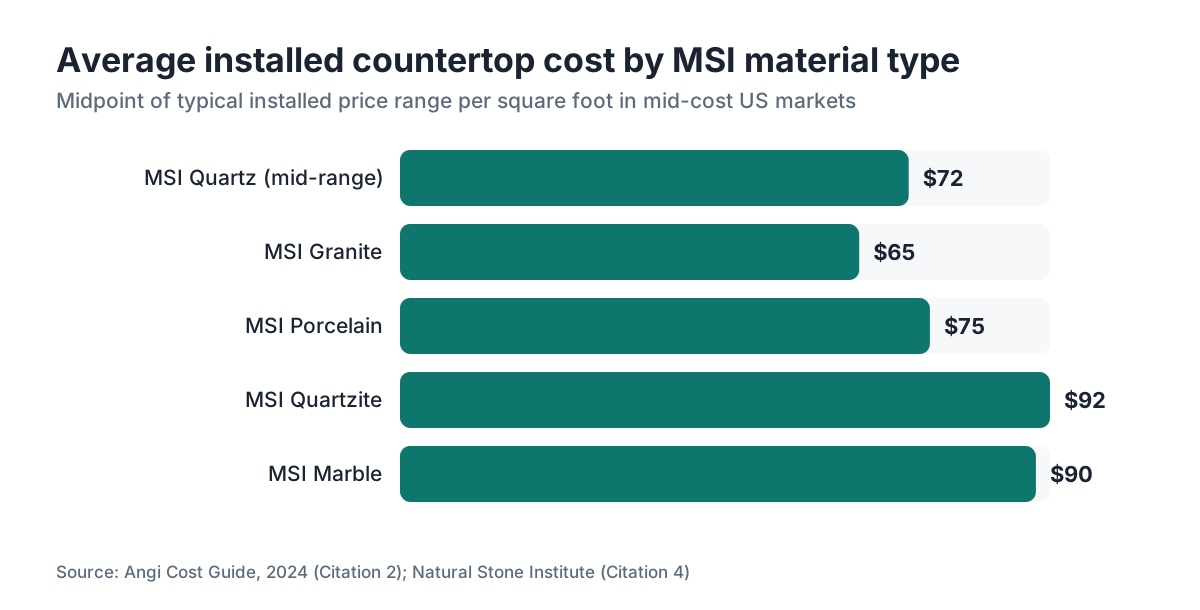
- Installed prices run $40 to $120 per square foot depending on material and market, with quartz landing in the $55 to $90 range.
What is MSI and how does it actually sell countertops?
MSI (M S International, Inc.) is a wholesale distributor based in Orange, California. It started in 1975 and now runs more than 50 distribution centers across the US and Canada, stocking slabs in quartz, granite, marble, quartzite, porcelain, sintered surfaces, and luxury vinyl [1]. It does not sell to homeowners. Walk into an MSI showroom and they'll show you slabs, then hand you a list of authorized fabricators in your area.
That distinction matters. The price MSI charges a fabricator for a slab is not the price you pay. Fabricators mark up material, then charge separately for fabrication labor, edgework, cutouts, and installation. So "MSI countertop prices" is shorthand for the total installed cost you pay through a fabricator who sources MSI slabs.
MSI's scale buys fabricators real things: consistent lead times, a deep color palette on the shelf, and slab sizes big enough for most residential and commercial kitchens. For a shop, that reliability beats any single product feature.
What materials does MSI make or distribute for countertops?
MSI carries surface materials across several categories. Knowing what MSI manufactures versus what it just distributes helps you read a quote.
MSI's engineered quartz sells under the MSI Quartz umbrella, including the Q Premium Natural Quartz line and premium collections like Naria and Terzetto [1]. These are manufactured slabs (crushed quartz bound with resin), not natural stone. They compete head-on with Cambria, Silestone, and Caesarstone.
Beyond quartz, MSI distributes imported natural stone: granite from Brazil, India, and Europe; marble from Italy, Turkey, and Spain; quartzite from Brazil; travertine from Turkey and Iran. It also carries porcelain slabs (thin-format panels up to 3cm thick) under its Stile and XL lines, which some designers use as countertop material for the heat resistance and large format [1].
Here's how the main MSI countertop categories compare:
| Material | Finish | Typical slab size | Installed price range | Sealing needed? |
|---|---|---|---|---|
| MSI Quartz | Polished, matte | 120" x 55" | $55, $90/sq ft | No |
| MSI Granite | Polished, leathered | 110", 120" x 55"+ | $45, $85/sq ft | Yes, annually |
| MSI Marble | Polished, honed | 110" x 55" | $60, $120/sq ft | Yes, frequently |
| MSI Quartzite | Polished, honed | 110" x 55" | $65, $120/sq ft | Yes, annually |
| MSI Porcelain | Polished, matte | Up to 126" x 63" | $55, $95/sq ft | No |
Prices reflect installed cost through a fabricator in a mid-cost US market. High-cost metros (NYC, LA, Seattle) run 15 to 30% above these figures. Rural markets can run 10 to 15% below.
For a deeper look at how engineered and natural stone compare on durability, maintenance, and resale, the quartz countertops and granite countertops guides go further on each.
How much do MSI countertops cost installed?
Installed price depends on four things: the material and color tier you pick, your local fabricator's labor rates, the complexity of your job (seams, edge profiles, sink cutouts), and current slab availability. Anyone who quotes you a flat number without asking about those is guessing.
MSI's quartz splits into three rough price tiers. Entry-level solids and simple patterns (think Calacatta Ida or white solids) sit around $55 to $65 per square foot installed. Mid-range veined designs (Carrara Marmi, Calacatta Gold) run $65 to $80. The premium collections with dramatic movement and book-matched patterns push $85 to $100 or more installed [2].
Natural stone is harder to bracket, because slab quality and color rarity swing the number hard. A standard Colonial White granite might install for $50 per square foot all-in. A rare Super White quartzite from the same MSI catalog could run $100 to $120 per square foot with a simple edge.
Extras add up fast. A basic eased edge is usually baked into the base quote. An ogee or dupont edge adds $15 to $25 per linear foot. Undermount sink cutouts run $150 to $300. Cooktop cutouts run $100 to $200. Want a waterfall island? Add $300 to $600 for the mitered pieces, more if you're book-matching natural stone.
The National Kitchen and Bath Association reports countertop material and installation runs roughly 10 to 15% of a full kitchen remodel budget on average [3]. For a typical 50 to 60 square foot counter area, that puts total installed MSI quartz cost in the $2,750 to $5,400 range before extras.
How does MSI quartz compare to other quartz brands?
MSI quartz sits in the mid-to-premium distributor tier: below Cambria (the only major domestic quartz manufacturer) and roughly alongside Silestone (Cosentino) and Caesarstone on quality perception and price [4]. It's a solid product from a supplier you can actually get slabs from this week.
Cambria slabs often cost 20 to 35% more than comparable MSI quartz and come with a lifetime residential warranty. MSI's Q Premium Natural Quartz carries a 10-year residential warranty [1]. That gap matters if you're staying put for decades. It matters less on a flip.
Silestone has a long commercial track record and carries NSF certification for food safety. MSI quartz meets GREENGUARD Gold standards for indoor air quality, which counts on school, healthcare, and commercial jobs [1].
Here's the part people skip: the fabricator's history with a brand matters as much as the brand. A quartz a shop runs weekly gets better cut yield, faster turnaround, and fewer surprises than an exotic slab they've never touched. Ask what they stock and what they're comfortable cutting before you fall for a specific name.
Against laminate countertops or formica countertops, any quartz is far more durable and far more expensive. Against marble countertops, MSI quartz is less porous, harder to scratch, and easier to live with, though it can't take heat the way marble can and has its own look limits.
What are the most popular MSI quartz colors and collections?
MSI's catalog runs into the hundreds of SKUs and turns over often, so naming exact colors that will still exist when you read this is a losing bet. A handful of collections stay stocked across MSI's network and show up most in fabricator shops, though.
Calacatta-style white quartz with gray veining is MSI's bread-and-butter. Colors in that family (Calacatta Ida, Calacatta Laza, Statuario Celano) mimic Italian marble at a fraction of the maintenance. They work in almost any kitchen and photograph well for listings, which is why builders and designers lean on them.
Carrara-style cooler whites with subtle gray movement (Carrara Marmi, Bianco Venatino) show up most in bathrooms and laundry rooms, where a softer look fits.
Bolder patterns with long veins in gold, taupe, or charcoal have picked up over the last few years. These chase quartzite and onyx looks. They're harder to seam invisibly, which is a fabricator problem: get samples in the shop before quoting.
On natural stone, MSI granite bestsellers have long included Bianco Romano, Colonial White, Uba Tuba, and Santa Cecilia, though availability shifts by region and season [1]. They earned it: steady supply, predictable patterning, competitive price.
One practical note. If you fall for a specific MSI color in a showroom, ask your fabricator to check current inventory at the nearest distribution center before you sign. Popular colors go on backorder. Nothing stings like a demoed kitchen sitting open while you wait on a slab.
How durable are MSI countertops for everyday kitchen use?
Durability depends entirely on which MSI material you mean. Quartz and porcelain behave nothing like granite or marble under daily kitchen abuse.
MSI quartz runs about Mohs 7, so keys, ceramic plates, and most kitchen tools won't scratch it. The resin binder (roughly 7 to 10% by volume) makes it slightly less heat-tolerant than natural stone: a pan straight off the burner can thermal-shock the surface into a crack or a discolored patch [4]. Trivets matter. That same resin makes quartz non-porous, so bacteria and staining liquids stay on top, a real edge over most natural stones.
MSI granite is tough in a different way. Most granite sits at Mohs 6 to 7 and shrugs off heat, but it's porous and needs sealing to keep oils, wine, and acids from staining [5]. Unsealed granite near a range soaks up grease and darkens. Annual sealing (more often for lighter colors) is the price of admission.
MSI marble and quartzite ask for the most care. Marble is calcite-based, so acids (lemon juice, vinegar, plenty of common cleaners) etch it and leave dull spots. Those aren't stains, they're surface damage. How to clean stone countertops covers the right products if you already have stone in place.
MSI porcelain slabs are very hard (Mohs 7 to 8), non-porous, and heat-resistant. The tradeoff is brittle edges and tricky fabrication. Cutting porcelain cleanly takes specific blades and skilled hands. Shops that don't run it regularly chip edges and crack slabs, so ask about experience first.
For a fair comparison with options like butcher block countertops or concrete countertops, durability is only part of the story. Both bring texture and character MSI stone can't fake.
Are MSI countertops easy to clean and maintain?
For MSI quartz and porcelain, daily cleaning is genuinely easy. Warm water and a few drops of dish soap on a microfiber cloth handles almost everything. Skip abrasive scrubbers, bleach-heavy cleaners, and high-pH products (oven cleaners, some bathroom sprays), which break down the resin surface over time [4].
For dried-on food, use a plastic scraper and warm water. No metal scrapers or steel wool on quartz.
MSI natural stone needs more thought. Clean granite, quartzite, and marble with a pH-neutral stone cleaner, not vinegar, citrus sprays, or generic all-purpose cleaners, which etch or strip sealant. How to clean quartzite countertops has specific guidance on products and frequency for quartzite, which lands between granite and marble on porosity.
Sealants wear off. The standard field test: drop a little water on granite or quartzite and wait 15 minutes. Beads up, you're fine. Soaks in and darkens, reseal [5]. Good penetrating sealants (Tenax, Bulletproof, StoneTech) cost $20 to $40 per bottle and cover most residential kitchens for a pass or two.
One thing quartz owners learn the hard way: certain cooking oils, left to bake on under heat, cause discoloration that won't wipe off. That's the oil polymerizing into the resin, not ordinary staining. Keep hot oily pans off the surface.
How do fabricators buy from MSI and what should they know about working with MSI slabs?
Fabricators open a trade account directly with MSI. Once approved, they order through MSI's online portal or their local distribution center, where they can also view slabs in person. MSI requires trade account holders to be licensed businesses, usually with a valid contractor or fabricator license depending on the state [1].
Slab consistency is generally good on MSI quartz because it's an engineered product with controlled manufacturing. Natural stone varies more, as it does from any distributor, because geology doesn't standardize. Lot-to-lot color variation in granite is normal. Bundle-to-bundle variation in quartzite can be dramatic. On any large or multi-phase project, pull slabs from the same lot and store them together.
MSI quartz slabs typically run 120 by 55 inches, though it varies by collection. Large-format porcelain can hit 126 by 63 inches or bigger. Knowing exact dimensions before templating matters for yield, especially on L-shaped or U-shaped kitchens with islands where layout drives material cost.
Quoting MSI-sourced jobs accurately means current pricing from your local branch, since slab prices move with shipping costs, import tariffs, and demand. In 2023 and 2024, tariffs on Chinese-manufactured quartz reshaped pricing across the industry, and MSI shifted some production accordingly [6]. If you're using shop management software for quoting, tools that let you plug in your actual slab cost by SKU (rather than fixed price tables) give you more honest job margins. SlabWise's quoting module, for one, lets you input current material cost from your supplier so the quote reflects what you paid, not what the software assumed.
Yield from an MSI quartz slab on a typical kitchen job (40 to 55 sq ft of counter, one sink cutout, one L-corner) usually runs 70 to 85% depending on layout. Good nesting software pushes that toward the high end. On premium slabs, that's real money per job.
Does MSI offer warranty coverage on countertop materials?
MSI's Q Premium Natural Quartz line carries a 10-year limited warranty for residential use against manufacturing defects [1]. It covers cracks or defects present at the time of fabrication, not damage from misuse, impact, or bad installation.
The warranty is manufacturer-to-consumer, but it runs through the fabricator chain. If something goes wrong, you call your fabricator, who calls MSI. Getting a claim honored comes down to documentation: keep your purchase receipt, fabricator invoice, and photos of any defect taken close to when you spotted it.
For natural stone (granite, marble, quartzite), MSI offers no material warranty, because natural stone variation is built in. Any warranty on natural stone installation comes from the fabricator, not the distributor.
Compare that to Cambria, which offers a lifetime residential warranty on its quartz, or Corian solid surface, which offers a 10-year residential warranty with extra coverage on commercial work [7]. For most homeowners, the warranty tier gap between MSI and premium brands matters less than picking a reputable fabricator who stands behind the install.
What should homeowners ask a fabricator before ordering MSI countertops?
Material is only part of it. The fabricator's skill, equipment, and communication decide whether your counters look great or eat three weeks of your life.
Here's what to ask before you sign:
Can I see recent completed jobs in the same material I'm ordering? Dramatic veined quartz, thin porcelain, and book-matched natural stone all take more skill than plain polished granite. Ask to see real work, not brochure photos.
Where will you cut and fabricate my slabs? Shops with CNC bridge saws and programmable routers produce more consistent edges and cutouts than shops working entirely by hand. That said, a skilled hand fabricator can beat a badly programmed CNC. Visit the shop if you can.
How do you handle seam placement? Seams on most kitchens are unavoidable. Where they land affects looks and structure. Ask to see the template layout before they cut anything.
What's the lead time from template to installation? Industry standard is 7 to 14 days for most quartz jobs from template date. Complex jobs, or work during peak season (spring and fall remodels), run longer. Get the estimate in writing.
What's included in your base price? Some fabricators quote material-only and stack labor on top. Others quote installed. Edge profile, cutouts, and old-countertop removal are often separate line items. Know exactly what you're comparing.
For more on what drives total kitchen countertop costs beyond material, the kitchen countertops guide has the full breakdown.
How does MSI quartz affect home resale value?
No clean data shows MSI quartz specifically adds more resale value than any other known quartz brand. What the data does show: updated countertops generally improve buyer perception and asking price in residential sales.
Remodeling Magazine's 2024 Cost vs. Value report found a minor mid-range kitchen remodel, which includes new countertop surfaces, returns roughly 96.1 cents per dollar spent at resale nationally, one of the better-returning home improvement projects [8]. Major kitchen remodels return less, around 49.5 cents per dollar in the same report.
The lesson for homeowners: brand recognition at the countertop level (MSI vs. Cambria vs. Caesarstone) rarely moves the needle in a residential sale. Buyers respond to visual quality, color, and condition. A well-installed MSI quartz in a popular white-and-gray veined pattern photographs and shows better than an exotic premium slab in a color half your buyers hate.
If you're remodeling for resale, the safe moves are simple. Pick a neutral, widely liked color. Pair it with clean white or soft gray cabinets. Spend on good fabrication. Don't buy the top slab tier if the neighborhood comps won't carry it.
How does MSI compare to other countertop surface brands?
Line MSI up next to the other major brands and the picture gets clear fast:
| Brand | Type | US warehouse network | Residential quartz warranty | Price tier (installed quartz) |
|---|---|---|---|---|
| MSI | Distributor + own quartz line | 50+ US locations | 10 years | Mid to premium |
| Cambria | Manufacturer (US-made) | Distributed nationally | Lifetime | Premium |
| Silestone (Cosentino) | Manufacturer (Spain) | ~20 US surface centers | 25 years | Mid to premium |
| Caesarstone | Manufacturer (Israel/US) | Distributed nationally | Lifetime | Premium |
| Wilsonart Quartz | Manufacturer | Distributed via dealers | 10 years | Entry to mid |
Silestone's 25-year warranty is the standout in that table and has been a real marketing lever [9]. Cambria's domestic manufacturing is a genuine draw for buyers who care about supply chain and lead times.
MSI's edge is distribution density and product breadth. Need a specific color this week? A network of 50-plus centers means it's more likely to be in-region stock than a brand running fewer warehouses. For a high-volume shop, that availability outweighs warranty-tier differences most days.
If you're weighing more affordable options, corian countertops (solid surface) sit in a different material class but compete on price and repairability, and the laminate countertops guide makes the case for budget surfaces done well.
What tariffs and sourcing changes affect MSI countertop pricing?
Quartz countertop imports have been hit with US antidumping and countervailing duty orders aimed mainly at Chinese-manufactured quartz. The US International Trade Commission found in 2019 that Chinese quartz imports were injuring the domestic industry, which led to duties that in some cases topped 300% on certain Chinese quartz products [6].
MSI answered by diversifying its quartz sources, pulling from India, Spain, and other countries outside those duty rates. The upshot: MSI quartz prices moved, but not as violently as pure Chinese-sourced product, and slab quality from Indian facilities has generally kept pace with the old Chinese sources.
As of 2024, natural stone imports (granite, marble, quartzite) from Brazil and India face no equivalent duty structure, part of why MSI's natural stone pricing has stayed relatively steady next to its quartz over the last several years [10].
For fabricators quoting jobs, the practical rule is boring but real: get current slab pricing from your MSI branch instead of leaning on price lists more than a few months old. Duty reviews and reclassifications can shift slab cost meaningfully, and a margin error on an $8,000 kitchen adds up fast.
Frequently asked questions
Can I buy MSI countertops directly without a fabricator?
No. MSI is a wholesale distributor and doesn't sell to homeowners. You work through an authorized fabricator or retailer with a trade account. MSI's website has a dealer locator that shows fabricators near you who carry their materials. The fabricator handles purchase, cutting, and installation. You can visit an MSI showroom to see slabs, but you'll still order through a pro.
How long does it take to get MSI countertops installed?
From template appointment to installation day, most fabricators take 7 to 14 business days for standard quartz and granite jobs. Complex jobs with waterfall edges, multiple seams, or special edge profiles take longer. Lead times stretch during peak remodeling season (roughly March through June and September through November). Get a written schedule from your fabricator before demolition starts.
Is MSI quartz made in the USA?
No. MSI quartz is manufactured overseas, primarily in India and Spain, with some product historically sourced from China before the 2019 antidumping duties shifted sourcing. MSI is a US-headquartered company with US distribution and warehousing, but the slabs themselves aren't domestically made. Cambria is the major quartz brand with US manufacturing, made in Minnesota.
What edge profiles are available with MSI countertops?
Edge profile depends on your fabricator, not MSI. Fabricators cutting MSI slabs can produce any edge their equipment supports: eased, bevel, bullnose, ogee, dupont, waterfall, and mitered profiles. Simple eased edges are usually included in base fabrication pricing. Decorative profiles like ogee or dupont add $15 to $25 per linear foot in most markets.
How do I find an MSI authorized fabricator near me?
MSI's website (msisurfaces.com) has a dealer locator where you enter your zip code and get a list of authorized fabricators and retailers stocking MSI materials. You can also visit an MSI showroom directly and get referred to local fabricators. Getting two or three quotes from different fabricators using the same MSI material is standard practice and worth the time.
Does MSI quartz stain or scratch easily?
No, not under normal use. MSI quartz is non-porous, so liquids don't penetrate and traditional staining is rare. The surface holds up well against scratching from everyday kitchen tools (Mohs hardness around 7). The real weak points are heat from hot pans directly on the surface, which can thermal-shock and discolor the resin, and cooking oils baked onto it. Use trivets and wipe spills promptly.
What is the difference between MSI quartz and MSI porcelain for countertops?
MSI quartz is engineered stone (crushed quartz plus resin binder), non-porous, around Mohs 7, but sensitive to direct heat. MSI porcelain slabs are fired ceramic at Mohs 7 to 8, fully non-porous, and heat-resistant. Porcelain is harder to fabricate cleanly (edge chips are common if the shop lacks experience) and costs a bit more to install. Quartz is the more common choice for residential kitchens.
How do MSI countertop prices compare to big box store countertops?
Big box stores like Home Depot and Lowes sell countertops through third-party fabricators at various price points, and they sometimes carry MSI-sourced material. Big box pricing often looks lower on paper but can carry restrictions on edge profiles, limited color selection, and longer lead times. A quote from an independent local fabricator using the same MSI material often lands at comparable or lower total cost.
Can MSI countertops be repaired if they chip or crack?
Yes. Quartz and natural stone can be repaired by an experienced fabricator using color-matched epoxy filler. The repair is often invisible on darker stones and more visible on light quartz or marble. Major cracks or full-slab breaks usually need section replacement. Small edge chips from heavy pots are the most common repair request and are usually fixed in under an hour by a pro.
Does MSI carry outdoor-rated countertop materials?
Yes, mostly its porcelain. MSI's porcelain slabs suit outdoor use in most climates because they're fully vitrified, non-porous, and UV-stable. Quartz is not recommended outdoors: UV exposure breaks down the resin binder over time, causing discoloration and surface degradation. Most MSI natural stone is technically outdoor-usable but needs more maintenance in freeze-thaw climates, where moisture penetration can cause spalling.
What thickness options does MSI quartz come in?
MSI quartz comes in 2cm (about 3/4 inch) and 3cm (about 1-1/4 inch) thicknesses. Most fabricators and designers default to 3cm for countertops because it looks substantial, needs no plywood buildup on most applications, and is more forgiving during fabrication. The 2cm option is thinner, lighter, and slightly cheaper per square foot, but it usually needs a plywood substrate and laminated edges to look right.
How do I know if an MSI quartz color will stay in stock long-term?
You don't, fully. No guarantee any specific color stays in MSI's catalog, and all major quartz brands discontinue colors regularly. If you have a two-phase project or expect to match material later (a future addition or bathroom), buy extra from the same lot during your original order. At minimum, note the lot number and ask your fabricator to save any large offcuts.
Is MSI quartz GREENGUARD certified?
Yes. MSI's Q Premium Natural Quartz products carry GREENGUARD Gold certification, meaning they meet strict chemical emission standards for indoor air quality. GREENGUARD Gold is the higher tier of UL's GREENGUARD program, required for many school and healthcare projects. This certification matters if you're specifying MSI for commercial or institutional work.
What are the biggest mistakes homeowners make when ordering MSI countertops?
The common ones: not visiting a fabricator showroom to see slabs in person (photos lie), not asking about seam placement before the template is cut, not getting a written scope listing what is and isn't included, and demoing old countertops before confirming the lead time. And ordering a trendy color without checking whether it will still be in stock if you ever need to match it.
Sources
- MSI Surfaces (msisurfaces.com), company overview and product catalog: MSI is a wholesale distributor with 50+ US distribution centers carrying quartz, granite, marble, quartzite, porcelain, and other surface materials; Q Premium quartz carries a 10-year residential warranty and GREENGUARD Gold certification
- HomeAdvisor / Angi, Quartz Countertop Cost Guide: Installed quartz countertop prices typically range from $55 to $100+ per square foot depending on color complexity and market
- National Kitchen and Bath Association (NKBA), Kitchen Design and Cost Survey: Countertop material and installation accounts for approximately 10 to 15% of a full kitchen remodel budget on average
- Natural Stone Institute (formerly Marble Institute of America), Quartz Surfaces Care and Maintenance Guidelines: Engineered quartz surfaces contain 7 to 10% resin binder making them non-porous but susceptible to thermal shock from direct heat; pH-neutral cleaners are recommended
- Natural Stone Institute, Stone Care and Maintenance: Granite and quartzite require periodic sealing; the water drop test (15 minutes) is the standard field method to assess sealant effectiveness
- US International Trade Commission, Quartz Surface Products from China (Investigation Nos. 701-TA-606 and 731-TA-1416): The USITC found in 2019 that Chinese quartz surface imports caused material injury to the US domestic industry, leading to antidumping and countervailing duty orders with some rates exceeding 300%
- Corian Design (DuPont / Corian), Warranty Documentation: Corian solid surface carries a 10-year limited warranty for residential applications with extended commercial coverage options
- Remodeling Magazine, 2024 Cost vs. Value Report: Minor kitchen remodels returned an average of 96.1 cents per dollar spent at resale in 2024 nationally; major kitchen remodels returned approximately 49.5 cents per dollar
- Cosentino (Silestone), Product Warranty Information: Silestone quartz surfaces carry a 25-year warranty for residential applications, one of the longest in the engineered quartz category
- US Geological Survey, National Minerals Information Center, Mineral Commodity Summaries: Stone (Dimension): Granite, marble, quartzite, and travertine are classified as dimension stone; the US imports significant volumes from Brazil, India, Italy, Turkey, and Spain annually
Last updated 2026-07-09