TL;DR
- Marble laminate countertops bond a printed marble image to a particleboard or MDF core.
- They cost $15 to $40 per square foot installed, resist stains better than real stone, and never need sealing.
- But they scratch through easily and can't be refinished.
- Smart for rentals and budget kitchens.
- Poor for heavy cooks or anyone who wants a 30-year surface.
What exactly is a marble laminate countertop?
Laminate is a layered sandwich. The top surface is a thin sheet of resin-impregnated paper printed with a high-resolution image, in this case a marble pattern, then fused under heat and pressure to a core of particleboard or medium-density fiberboard (MDF). That top layer is typically 0.028 inches thick for standard horizontal-grade laminate and up to 0.048 inches for post-formed or high-pressure laminate (HPL) used in commercial applications [1].
The term "marble laminate" just means the decorative layer is printed to look like marble: white Carrara veining, emperador brown swirls, Calacatta gold, or whatever pattern the manufacturer chose. You're buying the look, not the material. The substrate is wood-based, which matters the moment water finds a seam.
Most laminate sold in the US is high-pressure laminate, or HPL. The National Electrical Manufacturers Association (NEMA) grades HPL in its LD 3 standard, and the most common countertop grade is GP-50 (general purpose, 50 thousandths of an inch). Budget laminate at the low end of the price range often uses low-pressure laminate (LPL), which is thinner and less abrasion-resistant [1].
If you've seen the brand name Formica on a kitchen counter, you've seen laminate. Formica is the oldest and most recognized brand in the category, but Wilsonart, Pionite, and prefinished laminate from sheet vendors are all the same basic technology. Formica countertops have their own article if you want to go deeper on brand comparisons.
How much do marble laminate countertops cost?
Installed price runs roughly $15 to $40 per square foot for a standard kitchen. That wide range comes from three variables: the laminate grade you choose, whether you go with a prefabricated post-formed countertop from a home center or a custom-fabricated sheet, and your local labor market.
Here's how it breaks down:
| Option | Material cost/sq ft | Install cost/sq ft | Installed total/sq ft |
|---|---|---|---|
| Pre-formed laminate (big box, standard edge) | $3, $8 | $10, $18 | $13, $26 |
| Custom HPL, square edge, shop-fabricated | $8, $16 | $12, $22 | $20, $38 |
| Premium HPL, mitered or decorative edge | $14, $22 | $15, $25 | $29, $47 |
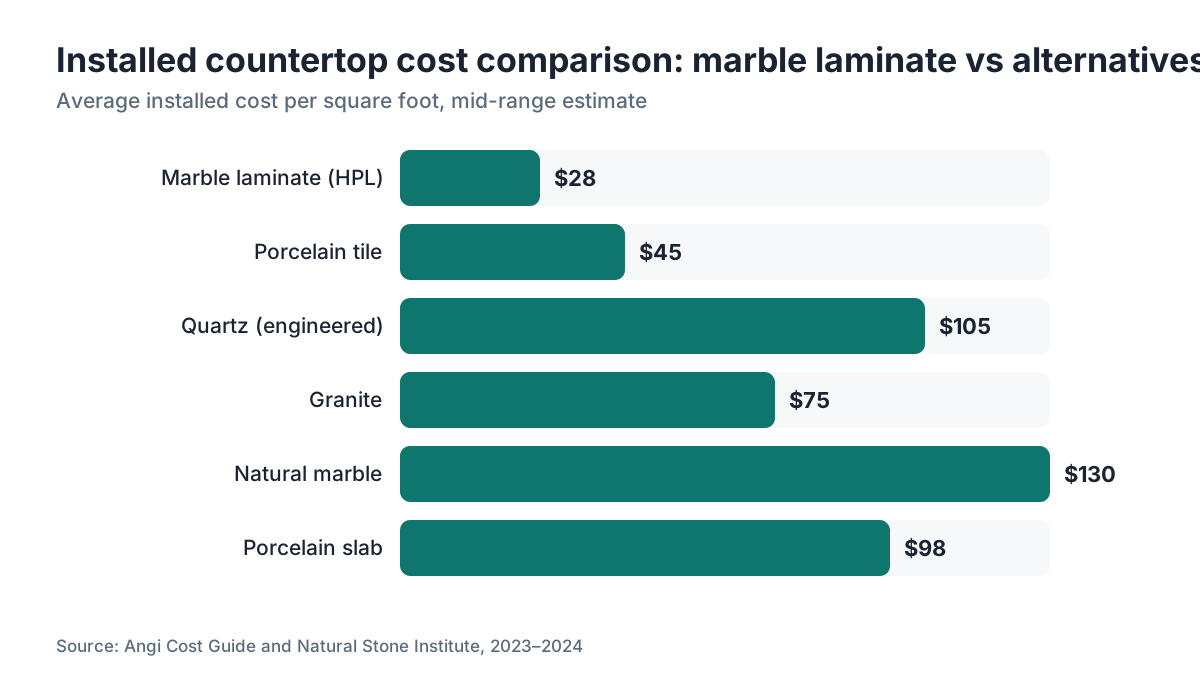
Comparison point: real marble countertops run $60, $200 per square foot installed depending on slab origin, thickness, and finish [2]. Marble countertops explains why that range is so wide. Quartz runs $55, $155 installed. Even granite countertops rarely come in below $50.
For a typical 30-square-foot kitchen, marble laminate lands at $450 to $1,200 all in. That same kitchen in natural marble could easily cost $1,800 to $6,000.
Labor is a real cost people underestimate. Laminate needs to be scribed to walls, seamed carefully, and the edges built up or finished. A bad seam shows immediately, and a seam near the sink is a water-damage risk. Budget $12 to $22 per square foot for professional installation unless you're confident doing it yourself.
DIY is genuinely feasible with laminate in a way it isn't with stone. A router, a laminate trimmer bit, contact cement, and a j-roller are the main tools. Home centers sell post-formed countertops in standard depths (25.5 inches is most common) that require only a miter cut to fit an L-shaped kitchen. That cuts your cost a lot, but it limits your edge and color options.
How durable is marble laminate compared to real stone?
Honest answer: it depends on what you mean by durable. Laminate beats real marble in two categories and loses in three others.
Where laminate wins. First, stain resistance. The resin surface doesn't have the open pores natural marble has, so red wine, coffee, and tomato sauce wipe right off if you catch them in a reasonable time. Real marble is calcium carbonate and will etch from acidic liquids (lemon juice, vinegar, anything with pH below about 5.5), which leaves a dull ring that no amount of cleaning fixes [3]. Laminate doesn't etch. Second, sealer cost. Marble needs periodic sealing, typically every 1 to 3 years depending on the stone's porosity [4]. Laminate needs no sealing ever.
Where laminate loses. Scratch resistance is the biggest weakness. The decorative print layer is thin, and a sharp knife or dragged cast-iron pan will cut right through it. You can't sand scratches out the way you can refinish a butcher block countertop. Once it's scratched, it's scratched. Heat is the second issue: hot pots can cause the resin to blister or delaminate. The standard recommendation is to keep things under 275°F on the surface, which basically means always use a trivet [5]. Third, seams. Laminate sheets max out at about 12 feet; longer runs need a seam. Those seams are both aesthetic and structural weak points. Water infiltration at a seam is the number-one cause of laminate countertop failure.
Expected lifespan with reasonable care: 10 to 20 years. Real marble and granite, if properly maintained, can outlast the house. That's the honest gap.
What are the best marble laminate patterns available right now?
Manufacturers have gotten genuinely good at this. Digital printing at high resolution and updated surface textures (some patterns now have subtle embossed grain that mimics stone) mean the best laminate options look convincing in most kitchens. The patterns you'll see most often:
Carrara white is the most popular. White or slightly gray background with thin gray veining, it mimics classic Italian Carrara marble. Wilsonart's Calcatta Marble and Formica's White Carrara are the most-specified versions in residential projects.
Calacatta patterns go bolder, with thicker veining and more contrast. They look dramatic on an island but can read as busy on a long run.
Emperador brown and fantasy brown mimic darker marbles with warmer tones. These hide wear and soil better than light options, which is worth factoring in for a busy kitchen.
Matte finishes have taken over most design circles over the last several years, and for good reason: gloss laminate picks up fingerprints visibly and can look cheap under direct lighting. The better HPL brands now offer a matte or satin finish that reads much more like real honed stone.
One honest note: the pattern repeat is finite, and in a large kitchen you'll see it repeat. Natural stone never repeats. Most people don't notice unless they're looking for it, but some do, and it's the giveaway that separates laminate from stone to a trained eye.
If you're comparing laminate to engineered quartz surfaces like Cambria countertops, the visual quality gap between premium HPL and quartz has narrowed, but quartz still wins on depth and variation.
Can marble laminate countertops handle water and humidity?
The surface itself handles water fine. The problem is what's underneath. MDF and particleboard swell when wet. A seam near the sink, a chip at an edge where the laminate didn't bond fully, or a crack in the caulk at the backsplash joint are all routes for water to reach the substrate. Once that substrate swells, there's no fixing it short of replacement.
The US Department of Housing and Urban Development's minimum property standards note laminate as acceptable for kitchen use but require proper sealing at all joints, particularly at sink cutouts and wall-to-counter transitions [6]. That guidance exists for a reason.
Practical steps that actually matter: use a stainless steel undermount sink with a full bead of waterproof silicone at the cutout. Recaulk the backsplash line every 2 to 3 years. Don't let standing water sit on a seam. These steps make the difference between a laminate counter that lasts 15 years and one that's replaced in 7.
If your kitchen has high humidity (no ventilation, lots of steam cooking) or the countertop location will see real water abuse, laminate is a risk. Solid surface like Corian countertops handles moisture better because there are no seams where water can infiltrate.
Is marble laminate hard to install yourself?
For post-formed countertops (the pre-shaped, pre-edged sections sold at home centers), DIY is genuinely doable for someone comfortable with a circular saw and a drill. You're basically cutting to length, mitering corners, and securing with clips from below. The manufacturers include instructions. Expect 2 to 4 hours for a simple kitchen.
Custom-fabricated laminate is harder. Bonding laminate sheet to a substrate, trimming with a router, and finishing edges cleanly takes practice. A botched edge trim is obvious and can't be patched well. Most pros would say: attempt it on a laundry room or basement bar first before you do the kitchen.
One step people skip and then regret: scribing. Kitchen walls are almost never perfectly square. Post-formed countertops typically have a built-in backsplash lip that needs to be scribed (planed or sanded to follow the wall contour) or the gap will be visible and unsealed. A scribing tool and a belt sander are the right answer. Caulk is the wrong answer for a gap over 3/16 inch.
For more on the full countertop installation process across materials, countertop installation covers what's the same and what's different by material.
How do you clean and maintain a marble laminate countertop?
Maintenance is genuinely low. Warm water and a few drops of dish soap handles almost everything. For stubborn residue, a non-abrasive cleaner like a liquid cleanser (Bar Keepers Friend in its liquid form, not the powder) works without scratching. What to avoid: abrasive scrubbing pads, powdered cleansers, bleach at full strength (it can discolor the pattern over time), and anything acidic used routinely.
Laminate doesn't need the sealing regimen real stone requires. You don't need marble-specific cleaners, stone conditioners, or any of the products marketed for stone care. Plain soap and water is genuinely the correct answer for routine cleaning.
For context on how demanding real stone cleaning can be, how to clean stone countertops lays out the full protocol for natural materials. Laminate skips all of that.
One thing to watch: the area immediately around the sink and stove. Grease buildup near the stove can discolor light laminate patterns over years. A degreasing dish soap used regularly keeps that in check. Near the sink, keep the caulk line intact and dry the counter after heavy use. That's genuinely the whole maintenance program.
What are the real disadvantages of marble laminate countertops?
Let's be direct about the downsides, because this is where a lot of buyer-facing content gets soft.
You can't cut on it. Full stop. Even momentary contact with a knife blade will score the surface. This isn't a matter of being careful; it's a material property. If you cook at volume and use a cutting board 100% of the time without exception, fine. But for a household that actually cooks, it's a real constraint.
You can't repair it well. Deep scratches, burns from a skillet, or chips at corners can't be invisibly fixed. Touch-up kits exist and reduce the visibility, but anyone looking closely will see the damage. Stone can be polished. Solid surfaces can be sanded. Laminate cannot.
It reads cheaper in person than in photos. Good laminate photos on manufacturer websites look nearly indistinguishable from stone. In person, in certain light, the uniform sheen and the lack of depth in the pattern read as laminate. This matters for resale in mid-to-high price homes. A National Association of Realtors survey found that kitchen renovations with stone or quartz countertops recouped more value than laminate on average, though the recoup rate varies significantly by market [7].
The substrate is vulnerable. Water, heavy impact, and extreme heat all threaten the core in ways that stone simply ignores.
None of these are reasons to universally reject laminate. They're reasons to choose honestly based on your actual use case and budget.
When does marble laminate make sense, and when should you skip it?
Marble laminate makes sense in these situations: rental property where durability and low cost matter more than longevity; a tight budget where the choice is laminate or no renovation at all; a low-use kitchen (a secondary bathroom vanity, a laundry room, a basement bar); a staging project where you need visual impact on a short timeline; or a household with adults who are disciplined about trivets and cutting boards.
Skip it in these situations: a kitchen where small children or heavy daily cooking is the norm; a high-value home where stone is expected by buyers; any surface that will see constant water exposure without careful caulk maintenance; or someone who plans to own the home for 20-plus years and wants to replace countertops once.
One thing worth saying plainly: cheap laminate installed poorly is worse than no renovation. A sagging, water-damaged laminate countertop lowers the perceived value of a kitchen more than dated but intact Formica. If the budget is tight enough that you'd be skimping on installation quality, wait and save.
For fabricators pricing jobs that include laminate work, knowing your exact material costs and labor time matters more on low-margin laminate projects than on stone, where there's more room. SlabWise's quoting tool handles laminate the same way it handles stone, so you can get accurate numbers without doing the math manually.
If you're comparing this category to other kitchen countertops broadly, laminate countertops has the full comparison across all laminate types, past just marble patterns.
How does marble laminate compare to other marble-look alternatives?
This is the question that matters most for someone actually shopping. Marble-look surfaces now come in five main material categories, and they're not equivalent.
| Material | Marble-look quality | Durability | Cost installed ($/sq ft) | Repairability |
|---|---|---|---|---|
| Marble laminate (HPL) | Good | Low-medium | $15, $40 | Poor |
| Porcelain tile | Good | High | $25, $65 | Grout is weak point |
| Quartz (engineered) | Excellent | High | $55, $155 | Poor |
| Natural marble | Perfect | Medium (etches) | $60, $200 | Refinishable |
| Porcelain slab (large format) | Excellent | Very high | $65, $130 | Poor |
Engineered quartz in a marble pattern is the most direct upgrade from marble laminate. It costs 2 to 4x more but offers dramatically better scratch and heat resistance, no visible seams in most kitchens, and better resale positioning. The visual quality of the top quartz brands is genuinely superior to HPL.
Porcelain slab is the newest option and deserves mention: these large-format panels can span most kitchens without a seam, are harder than quartz, and the printing technology is advancing fast. They're expensive to fabricate (the material is brittle and requires diamond tooling) but the surface performance is exceptional.
Natural marble remains the only option that's actually marble. It has the depth, variation, and aging character that no print can match. It also etches, scratches, and requires sealing. Some people love the aging process (a lived-in Carrara kitchen develops a patina). Others find it stressful. That's a personal call.
For anyone landing on laminate after comparing these: that's a valid choice, not a compromise in any pejorative sense. It's the right material for the right situation.
What should you ask a fabricator or installer before buying?
If you're working with a shop or installer rather than doing it yourself, five questions are worth asking before you sign anything.
First: what grade of laminate are you specifying? Ask for the NEMA grade or the HPL manufacturer name and product line. GP-50 is the minimum for a kitchen; some budget installs use thinner LPL that will show wear faster.
Second: how are you handling the seams, and where will they fall? Get the seam locations in writing. A seam behind the faucet, hidden from the main sightline, is acceptable. A seam in the middle of the primary work surface is not.
Third: what's the edge profile, and how is it built up? Standard laminate is about 1.5 inches thick at the front after the substrate buildup. A mitered edge (two 45-degree cuts joined at the corner) looks thicker and more stone-like but costs more. Know what you're getting.
Fourth: what warranty covers the installation, separate from the material? Material warranties from brands like Formica and Wilsonart typically cover defects for 5 years under normal use [8]. Installation workmanship is on the installer. Get that term in writing.
Fifth: how is the sink cutout sealed? This one question tells you a lot about the installer's experience. The correct answer is waterproof silicone fully bedded around the cutout perimeter with no gaps. If the answer is vague, that's a red flag.
Fabricators running multiple laminate jobs in a week will want accurate square footage and seam counts before quoting. SlabWise makes that faster, especially for jobs with multiple sections and cutouts, but any accurate takeoff process works as long as the numbers are right.
Frequently asked questions
Is marble laminate countertop good for kitchen use?
Yes, with caveats. Marble laminate handles daily kitchen use well if you're disciplined about using cutting boards and trivets. It's stain-resistant, easy to clean, and much less expensive than stone. Where it struggles is scratch resistance and heat exposure. For a light-to-moderate use kitchen or a rental, it's a reasonable choice. For a heavy-use family kitchen, the scratch risk is a real day-to-day frustration.
How realistic does marble laminate look compared to real marble?
In photos and at a glance, premium HPL marble patterns look very convincing. High-resolution digital printing has improved dramatically. Up close, in direct light, most people with some familiarity with stone will notice the lack of depth and the finite pattern repeat. Matte finish laminate reads more like honed stone than gloss. It won't fool a designer standing at the counter, but it photographs well and looks fine from normal viewing distance in a kitchen.
What's the difference between marble laminate and marble-look quartz?
The substrate and performance are completely different. Marble laminate is a printed paper layer on a wood-based core. Marble-look quartz is 90-plus percent ground quartz and resin, with a pattern running through the full surface layer. Quartz costs 2 to 4 times more but is far more scratch-resistant, handles heat better, and has no substrate that can swell from water. Visually, quartz offers more depth and variation. Laminate wins only on price.
Can you put a hot pan on marble laminate countertops?
No. This is probably the most common damage claim on laminate surfaces. Standard HPL can handle brief contact with temperatures up to roughly 275°F before blistering or delaminating, but a pan just off a gas burner can easily exceed 400°F. Always use a trivet. This isn't optional with laminate the way it might feel optional with stone. One careless moment creates a burn mark you can't repair.
How long do marble laminate countertops last?
With reasonable care, 10 to 20 years. The limiting factors are usually scratches that accumulate over time and water damage at seams or edges. Kitchens that see heavy daily use, small children, or poor maintenance at the sink caulk line often see failure in the 8 to 12 year range. Light-use kitchens or bathrooms with careful owners can get 20-plus years out of good HPL. The substrate material quality matters more than most people realize.
What edge profiles are available with marble laminate countertops?
The standard post-formed countertop has a bullnose or eased edge built in and a curved front lip. Custom-fabricated laminate can use any edge that's achievable with router bits: eased, beveled, ogee, or a built-up mitered edge that mimics a thick stone slab. The mitered edge (where the laminate wraps a 45-degree joint) is the most stone-like and adds $8, $18 per linear foot. Square or eased edges are cheapest. Avoid very ornate edge profiles; they're harder to keep clean and chip more easily.
Can you install marble laminate over existing countertops?
Sometimes. If the existing substrate is flat, stable, and the existing laminate or surface isn't damaged, a laminate overlay is possible. The added thickness (typically 1/16 inch plus substrate) can create issues at the sink lip and backsplash. Most installers prefer a fresh substrate for quality results. Post-formed countertop replacement over existing cabinets is common and doesn't require a full demo of the old surface in most cases.
Does marble laminate countertop add value to a home?
Modestly, in lower price-point homes. In mid-to-upper price homes, buyers generally expect stone or quartz and will discount laminate mentally. A National Association of Realtors report found kitchen renovations recouped between 52% and 67% of cost on resale on average, but the material choice matters more in higher-value markets [7]. Laminate makes sense as a budget upgrade that improves functionality and aesthetics; it's not a strong value-add play in competitive real estate markets.
What brands make the best marble laminate countertop patterns?
Wilsonart and Formica have the widest distribution and reliable quality at the mid-range. Formica's White Carrara and Wilsonart's Calcatta Marble are two of the most-specified marble patterns in residential work. Pionite and Nevamar offer good alternatives often available through sheet suppliers. For premium HPL with better texture and depth, look at Wilsonart's Quartz series or Formica's 180fx line, which uses a higher-resolution print process and is notably better than standard HPL at mimicking natural stone.
How do you repair a scratch or chip in marble laminate?
Laminate repair kits with color-matched filler are available, and they reduce the visibility of small chips and shallow scratches. They don't make the damage invisible. For deep scratches through the print layer, the only real fix is section replacement. If the scratch is at an edge or seam, a fabricator may be able to re-route and re-laminate that section. Surface scratches in the middle of a slab are the hardest to address and the main reason heavy-use kitchens may find laminate frustrating over time.
Is marble laminate the same as Formica?
Formica is a brand of laminate, the oldest and most recognized in the US. Marble laminate is a category of pattern. So a Formica counter in a marble pattern is a marble laminate countertop, but there are other laminate brands (Wilsonart, Pionite, Nevamar) that also make marble patterns. They're all high-pressure laminate; the brand distinction is mainly about pattern availability, finish quality, and which distributors carry them.
Can marble laminate be used for bathroom vanities?
Yes, and it's a strong use case. Bathroom vanities see less heavy daily use than kitchen counters, and water exposure is more controlled. Sink cutout sealing is still critical. Post-formed laminate vanity tops are a standard product at home centers. The marble laminate look works well in bathrooms where the aesthetic goal is a clean, light stone appearance at a budget price point. Just maintain the caulk at the wall and sink seams and it should last well.
How does marble laminate handle cleaning products?
Standard dish soap and water is all you need routinely. Laminate handles most household cleaners well. Avoid abrasive powders (they scratch the surface), undiluted bleach used repeatedly (it can discolor the print over time), and any solvent-based cleaners like acetone or paint thinner, which can damage the resin layer. Unlike natural marble, you don't need to worry about acidic cleaners etching the surface, which is a genuine advantage for everyday kitchen cleaning.
Sources
- National Electrical Manufacturers Association, NEMA Standards Publication LD 3: High-Pressure Decorative Laminates: HPL grades include GP-50 (general purpose, 0.050 inch nominal thickness) used for horizontal countertop applications; LPL is thinner and less abrasion-resistant
- HomeAdvisor / Angi, Marble Countertop Cost Guide: Real marble countertops cost approximately $60, $200 per square foot installed depending on slab origin, thickness, and finish
- Natural Stone Institute, Marble Care and Maintenance: Marble is calcium carbonate and etches from acidic liquids with pH below approximately 5.5, leaving dull rings that cannot be removed by cleaning alone
- Natural Stone Institute, Stone Sealer Selection and Application: Natural marble typically requires sealing every 1 to 3 years depending on porosity; laminate requires no sealing
- Formica Corporation, Laminate Care and Maintenance Guidelines: Standard HPL laminate should not be exposed to sustained temperatures above approximately 275°F; hot cookware can cause blistering or delamination
- U.S. Department of Housing and Urban Development, Minimum Property Standards for Housing (HUD Handbook 4910.1): HUD minimum property standards permit laminate countertops in kitchens but require proper sealing at all joints, particularly sink cutouts and wall-to-counter transitions
- National Association of Realtors, 2023 Remodeling Impact Report: Kitchen renovations recouped between 52% and 67% of cost on resale on average; stone and quartz countertops outperform laminate in value recovery in mid-to-upper price markets
- Wilsonart LLC, Laminate Warranty Statement: Wilsonart and comparable HPL manufacturers typically provide a 5-year warranty covering material defects under normal residential use
- U.S. Bureau of Labor Statistics, Consumer Price Index, Household Furnishings and Operations: Laminate countertop installation labor costs are part of the BLS household furnishings CPI tracking; regional labor rates drive significant variation in installed cost
- U.S. Environmental Protection Agency, Indoor Air Quality and Building Materials: MDF and particleboard substrates used in laminate countertops may off-gas formaldehyde; CARB Phase 2 and TSCA Title VI set emissions standards for composite wood products used in indoor applications
Last updated 2026-07-09