
TL;DR
- Local stone fabricators cut, edge, and install natural and engineered stone countertops.
- A good shop does templating, CNC or hand fabrication, and installation as one job.
- Installed prices run roughly $40 to $200 per square foot, depending on material and complexity.
- Vet 3 shops, check recent references, and get itemized written quotes.
- That's what keeps you from expensive surprises.
What does a stone fabricator actually do?
A stone fabricator takes a raw slab and turns it into the countertop sitting in your kitchen. They measure your space (templating), cut the stone to fit (fabrication), shape the edges, cut sink and cooktop holes, and install the finished pieces. Most shops also polish seams and apply the first coat of sealer on natural stone.
The word "fabricator" trips people up because it sounds like manufacturing. But the fabricator rarely quarries or sells the stone wholesale. You might pick your slab at a stone yard, then hire the fabricator to process it. Or many shops carry their own slab inventory and roll the material cost into one price. Either model works. Knowing which one you're dealing with matters when you compare quotes.
What separates a good shop from a bad one comes down to equipment, templating accuracy, and seam placement. A shop running a CNC waterjet or bridge saw holds tighter tolerances than pure hand-cutting. That said, a skilled hand-fabricator will beat a careless CNC operator any day. Equipment is a proxy, not a guarantee.
Fabrication and installation are almost always the same company. That's intentional. Split the template, the cut, and the install across three people, and you've built three places for measurement errors to compound. One shop, one chain of custody, fewer excuses when something is off.
How much does a local stone fabricator charge?
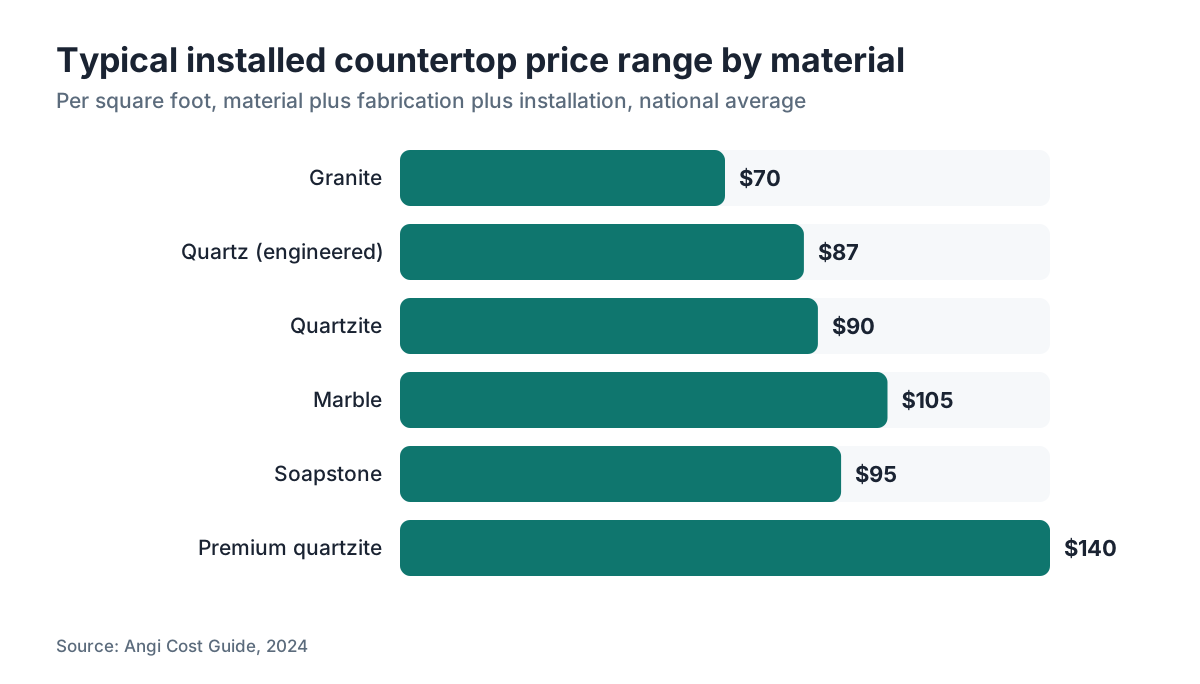
Installed countertop prices swing on material, region, edge profile, and shop overhead. The ranges below come from Angi cost data and NKBA cost benchmarks [1][2].
| Material | Typical installed range (per sq ft) |
|---|---|
| Granite | $40, $100 |
| Quartz (engineered) | $55, $120 |
| Quartzite | $60, $120 |
| Marble | $60, $150 |
| Soapstone | $70, $120 |
| Quartzite (premium) | $80, $200 |
These are installed prices, meaning material plus fabrication plus installation in one number. Some shops quote fabrication-only if you supply the slab, which usually runs $25 to $65 per square foot. Ask explicitly which one you're getting.
Edge profiles add cost. A standard eased or beveled edge is usually included. Ogee, waterfall, or laminated mitered edges can add $10 to $30 per linear foot on top of the base price. A 15-foot run with a complex edge can swing the total by $300 or more [1].
Region matters a lot. Fabricators in high cost-of-living metros (New York, San Francisco, Seattle) run 20 to 40 percent above the national midpoint. Rural shops with lower overhead undercut that, though you may pay for the delivery distance.
Tear-out and disposal of your old countertop is often a separate line item, typically $200 to $500 depending on material and scope. Always ask.
How do you find stone fabricators near you?
Start local, not digital. Stone yards and tile distributors near you almost always keep a short list of fabricators they trust. They see this work every week. A distributor's recommendation carries more weight than a Google review because the distributor has real skin in the game: their slab looks bad if the fabrication is sloppy.
Contractors and kitchen designers are the other referral source worth chasing. A GC who does frequent kitchen remodels has watched multiple fabricators perform under pressure. He knows which shops hit deadlines and which ones ghost on punch-list issues.
Online search works too, but filter carefully. Search "stone fabricator" plus your city, not "countertop company." Some retailers resell countertops and outsource the actual fabrication to a sub. That's not automatically bad, but you want to know it, because your recourse when something goes wrong runs through an extra layer.
The Natural Stone Institute (formerly the Marble Institute of America) runs a fabricator accreditation program with a third-party audit of the shop's processes, plus a member directory [3]. Accreditation is a useful first filter, not proof of quality.
Get at least three shops on your list before you request quotes. Three is the floor that gives you a real read on price spread and scope differences.
What questions should you ask a fabricator before hiring?
Ask these before you commit, not after you've signed:
-
Do you fabricate in-house or outsource any cutting? Some "fabricators" are resellers who subcontract the stonework. Not always a problem, but you should know.
-
What equipment do you use? CNC, bridge saw, waterjet, or hand tools? A shop that can walk you through its process is usually better than one that answers vaguely.
-
Can I see your shop? A clean, organized shop with stone stored vertically and good light at the workstation is a positive signal. Chipped remnants piled on the floor is a yellow flag.
-
Who does the template, and is it digital laser templating or physical templates? Laser templating (tools like Prodim or Laser Products Industries systems) is more accurate and cuts errors [4].
-
Who installs, and are they employees or subs? If they're subs, ask whether the same crew always does your jobs or whoever is free that day.
-
What's your lead time from template to install? Four to six business days is common for in-stock material. Two to three weeks is reasonable if the slab needs ordering.
-
Do you warranty your seams and installation? What does it cover, and for how long?
-
Can you give me references from jobs in the last six months? Recent references matter more than a portfolio photo from three years back.
What red flags tell you to walk away?
A quote with no line items is the biggest one. Hand you a single number with no breakdown for material, fabrication, edge work, cutouts, and installation, and you've got no way to compare it against anyone else, and no basis for a dispute when the final invoice climbs.
Pressure to skip the template visit. Templating in person is non-negotiable for a good fit. A shop that offers to quote and cut from blueprint measurements only is cutting a corner that almost always costs you more later, when seams don't close.
No license or insurance documentation. Fabricators in most states need a contractor's license to do installation work, and general liability insurance is standard. Ask for both before signing. California, for example, requires a C-54 tile contractor license or a B general contractor license for this kind of work [5]. Requirements vary, so check your state's contractor licensing board.
Prices that don't add up. A granite countertop installed for $22 per square foot should make you ask how. The answer is usually thin material, low-grade stone, hidden charges, or labor that skimps on support brackets and adhesive.
No physical address or shop. Mobile-only fabricators exist, and some are skilled, but with no shop to visit, you have less recourse and less visibility into how your slab is being handled.
Manufactured reviews. Watch for patterns: a wall of five-star reviews posted in one month after a long silence, or reviews recycling identical phrasing. Cross-check on at least two platforms.
How does the fabrication process work, start to finish?
Most reputable shops follow the same sequence.
Step 1: Slab selection. You pick your material, either from the fabricator's inventory or a separate stone yard. Buying from a yard means coordinating carefully. Some fabricators want to inspect the slab before you buy, to flag hidden fissures or color variation that changes seam placement.
Step 2: Template. After cabinets are installed and plumbing rough-in is done, the fabricator visits and creates an exact template of the countertop area. Sink positions, cooktop cutouts, and backsplash returns all get recorded here. Digital laser templating captures this as a CAD file that feeds straight into CNC cutting software.
Step 3: Fabrication. Back at the shop, the CAD file drives a bridge saw or CNC to cut the slab. Edges get cut and polished, cutouts made, and pieces dry-fitted before finishing. Two to four business days for a normal kitchen.
Step 4: Installation. The crew brings the finished pieces to your home, sets them on the cabinets, joins seams with color-matched epoxy, and secures everything. Undermount sinks usually go in at this visit or right after.
Step 5: Sealing (natural stone). Granite, marble, quartzite, and soapstone need a penetrating sealer at installation and periodically after. Many fabricators apply the first coat; you maintain it. There's ongoing guidance in how to clean stone countertops and material-specific guides like how to clean quartzite countertops.
Start to finish, figure one to three weeks for an in-stock slab, four to eight weeks if the material is special-order.
What's the difference between a fabricator and a countertop retailer?
A retailer sells countertops. A fabricator makes them. The line blurs constantly, because many fabricators run their own retail sales, and many retailers subcontract fabrication to a shop they have a relationship with.
Here's the practical difference. Buy from a retailer who subs out fabrication, and you're paying a markup on the fabrication, with quality control sitting at a company that doesn't touch the stone. That's not always a bad deal. A retailer with a well-managed sub, consistent quality checks, and a strong warranty can outperform a directly-hired fabricator who's terrible at customer service. But you have to ask the question.
Big-box stores like Home Depot and Lowes use subcontracted fabricators in your area. They measure, send the data to a regional shop, and install through a local crew. Pricing is often competitive on commodity materials like standard granite or basic quartz. Customization (unusual edges, complex miters, bookmatched slabs) is limited, and upcharges can be steep.
For a standard kitchen with a popular quartz or granite, big-box sourcing can be perfectly fine. For a specialty material, a complex layout, or a slab you hand-picked for its veining, a direct relationship with a local fabricator gives you far more control.
How do fabricator quotes work, and how should you compare them?
A proper fabricator quote is itemized. You want to see, at minimum: material cost per square foot, total square footage charged, edge profile cost per linear foot, number and type of cutouts (each one costs separately, typically $75 to $200 for undermount sinks and cooktops) [1], seam count, installation labor, tear-out if it applies, and any delivery or disposal fees.
Square footage confuses people. Fabricators usually charge for the full bounding rectangle of each piece, not the net area after cutouts. An undermount sink cutout still gets billed at full stone price, because the shop already cut that material and it's scrap. Industry standard, not a scam. But know it going in.
Compare scope assumptions, more than the bottom line. One shop includes a sealer coat and haul-away; another doesn't. One quotes a standard eased edge; another assumed an ogee. Put every quote on the same basis before you compare totals.
Shops that run digital quoting software, like the tools fabricators use on platforms such as SlabWise, can hand you a faster, more detailed breakdown because the square footage and material math is automated instead of hand-estimated. That works in your favor: itemized digital quotes are easier to check for errors and easier to compare side by side.
Never decide off a verbal or ballpark quote. Get it in writing with a line-item breakdown before you pay a deposit.
What materials can a local fabricator work with?
Most full-service stone fabricators handle the full range of natural and engineered stone:
Granite is the workhorse. Shops have fabricated it for decades, and the tooling and techniques are standardized. If you're weighing granite, the granite countertops guide covers grades and pricing in detail.
Quartz (engineered stone, brands like Cambria, Silestone, Caesarstone) is the fastest-growing category. It fabricates like granite but needs specific blade speeds because it's harder and more uniform. Many shops run Cambria-certified installer programs. See the Cambria countertops article for brand-specific notes.
Marble is softer and more porous than granite, which means more careful seam work and a higher chance of visible seams if the shop is careless. The marble countertops article covers what makes a well-fabricated marble install.
Quartzite (don't confuse it with quartz) is a quarried stone harder than marble and hard to cut cleanly. Not every shop has real experience with it.
Soapstone is dense and heavy with its own finishing conventions. How to clean soapstone countertops covers the maintenance side.
Some fabricators also work porcelain slabs, which are lighter but chip during cutting and need specific diamond tooling. Not all shops offer it, and the ones that do usually charge a premium for the extra care.
A few materials sit mostly outside a stone shop's scope: laminate countertops, Formica countertops, Corian countertops, and butcher block countertops go to specialists or general carpenters. Don't assume your stone shop does all of these.
What should you expect during and after installation?
Install day is usually faster than people expect. A typical kitchen with 40 to 60 square feet of countertop takes two to four hours with a two-person crew. Complex layouts with islands, awkward corners, or heavy stone (quartzite and marble slabs can run 18 to 20 pounds per square foot) take longer [6].
The crew needs the cabinets cleared. Empty everything from upper and lower cabinets near the work zone. Got a fragile backsplash tile? Mention it ahead of time, because seam grinding and polishing throws off vibration.
Talk seam location before install day, not on it. A good fabricator tells you where seams have to fall based on slab width (most slabs run 55 to 65 inches wide) and shows you the placement on the template or a drawing. Seams belong over cabinet supports, never in open spans. On a busy granite they nearly vanish. On a solid-color quartz they'll always be visible to anyone looking.
After installation, give the silicone at the sink and the epoxy at the seams 24 hours to cure before full use. Natural stone gets its first sealer coat at installation; resealing typically runs every one to three years depending on the stone and sealer [7]. See how to clean stone countertops for ongoing care. For the full picture from the homeowner side, countertop installation covers scope in detail.
See a gapped seam, a chip, or a rough edge? Document it with photos and notify the fabricator in writing the same day. Most reputable shops run a punch-list window of 48 to 72 hours after install. Getting issues on record inside that window protects you.
How do fabricators for countertops differ from kitchen countertop designers?
A kitchen designer makes decisions about layout, materials, and aesthetics. A fabricator does the physical work. Complementary roles, and in practice they're often separate companies.
For a standard kitchen remodel, you usually don't need a designer in the loop for the countertop step. You choose your material, the fabricator templates, cuts, and installs. Direct relationship.
Where designers earn their fee: a full kitchen renovation where you need help matching countertop material to cabinet colors, hardware, and flooring. A designer heads off expensive material mismatches. Some also carry trade pricing with fabricators that passes savings to you, though that's not universal.
For kitchen countertops specifically, the design and material-selection process deserves its own attention before you call a fabricator. Nail down your material and rough square footage before quotes, and you save time on both sides.
Some fabricators keep a designer on staff or offer a design consultation as a value-add. If your shop offers it and you're stuck on material choices, use it. Just don't let a sales-driven "design consultation" nudge you toward a higher-margin material you never needed.
What licenses, certifications, and insurance should a fabricator have?
Licensing requirements vary by state and sometimes by county. In California, stone fabricators and installers need a C-54 tile contractor license or a B general contractor license to legally do installation work [5]. Texas requires general contractor registration for most remodel work above a set dollar threshold. New York City runs its own Home Improvement Contractor (HIC) licensing system [8].
Safest approach: ask what license the fabricator holds and verify it on your state contractor licensing board's website. Most boards have a public lookup tool. A license number that doesn't show up, or shows up expired or suspended, is a hard stop.
General liability insurance should be at least $1 million per occurrence. Workers' compensation is required in most states once a company has employees. Ask for a certificate of insurance, not a verbal promise, and confirm it's current.
Industry certifications add another layer of confidence but aren't required. The Natural Stone Institute runs an accredited fabricator program with on-site audits [3]. A shop that passed an NSI audit has documented quality procedures, more than claimed them.
Manufacturer certifications matter for engineered stone. Cambria and Caesarstone both run authorized installer programs. Buy brand-name engineered stone, and an authorized installer is more likely to follow the manufacturer's installation spec, which matters if you ever file a warranty claim against the manufacturer.
Frequently asked questions
How long does it take a local fabricator to complete a countertop job?
From signed contract to installed countertop, four to ten business days is typical when the slab is in stock. The timeline breaks down roughly like this: one to two days to schedule and complete the template, two to four days of shop fabrication, then installation day. If the slab has to be ordered from a distributor, add two to six weeks for that lead time. Get the production schedule in writing before you pay a deposit.
Can I supply my own slab and just hire the fabricator for cutting and installation?
Yes, most shops offer fabrication-only pricing if you supply the slab. You pay for material separately at a stone yard, then pay the fabricator a per-square-foot rate for cutting, edging, and installation. This sometimes saves money but adds coordination work. Have the fabricator inspect the slab before you buy it, since they need to confirm it has no hidden cracks or sizing issues that will cause problems during cutting.
What is the typical deposit a fabricator requires?
Most shops ask for 50 percent at contract signing and the remaining 50 percent at installation or completion. Some require the full amount upfront, which is more common for custom or high-value slabs where the shop carries the material cost risk. Be cautious about paying 100 percent before work starts. Check your state's contractor payment laws: California, for example, caps initial deposits at 10 percent or $1,000 for home improvement contracts, whichever is less [5].
How many seams will my countertop have, and can I control where they fall?
Seam count depends on your layout and the slab width, typically 55 to 65 inches. Any run longer than the slab width needs at least one seam. You can influence seam placement during the template conversation: a good fabricator shows you options and explains the tradeoffs. Seams should always land over a cabinet support, never in an open span, and should avoid high-traffic areas like directly in front of the sink when possible.
Is a stone fabricator the same as a countertop installer?
In most cases, functionally yes. The company that fabricates your stone also installs it. Some retailers sell countertops and hire separate installation crews, which means your fabricator and installer are different entities. That works fine when it's well-managed but creates ambiguity when something goes wrong: the fabricator blames the installer's handling and the installer blames the fabrication. One company handling both is cleaner for accountability.
What questions should I ask when checking references for a fabricator?
Ask references: Did the final invoice match the quote? Any seam or edge quality issues after installation, and if so, how did the shop handle them? Did they show up on the scheduled installation date? Would you hire them again? A reference who praises the material but hedges on communication or follow-through is still useful information. Recent references (last six months) reflect the current crew and management, which matters more than old satisfied customers.
Do local fabricators warranty their work?
Most reputable shops offer a one-year workmanship warranty covering seam failure, edge chips from fabrication errors, and installation defects. That warranty is separate from any material warranty, which runs through the manufacturer for engineered stone. Get the warranty terms in writing before you sign. Pay attention to what voids it: using the wrong cleaners on certain stones, or modifying the countertop after installation, are common exclusions.
How do I know if a fabricator's quote is fair?
Get at least three itemized quotes from shops with comparable equipment and reviews, then compare them line by line. National average installed granite prices run $40 to $100 per square foot and quartz runs $55 to $120 per square foot according to cost survey data [1]. If one quote is more than 20 percent below the others, ask what's different about scope or material grade. A dramatically low quote usually means something is excluded or the material is lower quality.
Can a fabricator do outdoor countertops or just kitchen and bath?
Many fabricators work on outdoor kitchen countertops, but not all materials suit outdoor use. Granite handles freeze-thaw cycles reasonably well. Marble does not; it degrades with weathering and acid rain. Porcelain slab is increasingly popular outdoors. Ask the shop specifically about outdoor experience and which materials they recommend for your climate. Sealing requirements and schedules differ outdoors, and some sealers aren't UV-stable.
What's the difference between a local independent fabricator and a big-box store countertop program?
Big-box programs (Home Depot, Lowes) use regional fabricators under contract. Pricing can be competitive on commodity materials. Tradeoffs: limited material selection, standardized edge options, less flexibility on seam placement, and if something goes wrong your dispute runs through a retailer, not the fabricator directly. A local independent shop gives you more control, more material options, and a direct relationship, but quality varies more and you have to do your own vetting.
Does a fabricator handle countertop removal and disposal of old countertops?
Many do, but it's usually a separate line item rather than baked into the base quote. Tear-out and disposal of existing countertops typically costs $200 to $500 depending on material, size, and local disposal fees [1]. Tile countertops bonded to backer board take longer to remove and often cost more. Always ask whether tear-out is included and, if so, what the disposal method is. Some shops landfill stone; others can sometimes repurpose remnants.
How do I find a fabricator who works with unusual materials like quartzite or soapstone?
Ask directly about their experience with the specific material, and ask to see recent completed jobs. Quartzite is significantly harder than granite and can chew through blades; not every shop has dialed in their cutting speeds for it. Soapstone has its own finishing conventions, including oiling, that differ from granite sealing. A fabricator who can't tell you how they finish soapstone or what tooling they use for quartzite probably doesn't work with those materials regularly.
What happens if my countertop is damaged during installation?
Document it immediately with photos. Natural stone can crack during installation if it's not supported properly during transport or setting. Engineered stone can chip at edges. A reputable fabricator takes responsibility for damage on their watch and either repairs it or replaces the section. Your best position is the final payment: don't release the remaining balance until punch-list items are resolved. After final payment, your recourse is a warranty claim or, if the shop refuses, small claims court.
Sources
- Angi (formerly HomeAdvisor), Countertop Installation Cost Guide: Installed countertop price ranges by material, cutout costs, and tear-out pricing
- National Kitchen and Bath Association (NKBA), Cost vs. Value and industry cost benchmarks: NKBA cost survey data used as reference for installed countertop pricing benchmarks
- Natural Stone Institute, Accredited Fabricator Program: NSI maintains a member and accredited fabricator directory with third-party audit requirements
- Laser Products Industries, Digital Templating Systems: Digital laser templating systems capture countertop dimensions as CAD files for CNC fabrication
- California Contractors State License Board, License Classifications: California requires a contractor's license for installation work; deposit cap of 10% or $1,000 for home improvement contracts
- Marble Institute of America (MIA+BSI), Stone Installation Guidelines: Stone slab weight reference: quartzite and marble slabs can run 18 to 20 pounds per square foot
- Natural Stone Institute, Care and Maintenance of Natural Stone: Natural stone requires periodic sealing, typically every one to three years depending on stone type and sealer
- NYC Department of Consumer and Worker Protection, Home Improvement Contractor License: New York City requires a Home Improvement Contractor (HIC) license for remodel work
- U.S. Bureau of Labor Statistics, Occupational Outlook Handbook: Tile and Stone Setters: BLS data on tile and stone setter occupational classification and labor cost context
- Cambria, Authorized Dealer and Installer Program: Cambria runs an authorized installer certification program tied to manufacturer warranty claims
Last updated 2026-07-09