TL;DR
- Light granite countertops typically cost $40, $100 per square foot installed, depending on stone rarity and edge profiles.
- Popular colors include Alaska White, Colonial White, and Bianco Romano.
- They resist heat and scratches better than most surfaces, need sealing once a year, and pair well with dark or white cabinetry.
- Budget slabs run $40, $55 installed; exotic light granites can hit $150.
What counts as a light granite and which colors are most popular?
Light granite is any granite slab that reads as white, cream, beige, or pale gray from across the room. The background field of the stone is light, even if it carries dark veining or black and gold mineral flecks through it. That distinction matters because a white-background stone with heavy black veining can feel visually loud, while a soft taupe granite with minimal movement reads almost like a solid.
The most frequently sold light colored granite countertops in North America include Alaska White, Colonial White, Bianco Romano, Giallo Ornamental, Venetian Gold, River White, and Viscount White. Alaska White and Colonial White are quarried primarily in Brazil and tend to carry gray and black speckle patterns on a white or cream field. Bianco Romano, also Brazilian, adds warm beige tones. Giallo Ornamental and Venetian Gold lean toward cream and gold, which works especially well with oak or cherry cabinetry. River White reads more classically white with burgundy and gray veining.
Not all pale stones sold as granite are technically granite. Some, like Viscount White, are closer to gneiss or pegmatite by mineralogical classification. The countertop industry uses "granite" loosely to mean any hard crystalline igneous or metamorphic stone that isn't marble or quartzite. For practical purposes, hardness and porosity matter more than the geological label. If you want to be precise, ask your fabricator for the mineral composition or look up the quarry of origin.
Color consistency varies by quarry lot and slab position. Alaska White, for instance, shows noticeably more movement toward the center of some blocks than at the edges. Always view the specific slabs that will be cut for your kitchen, more than a sample tile, before you commit.
How much do light granite countertops cost installed?
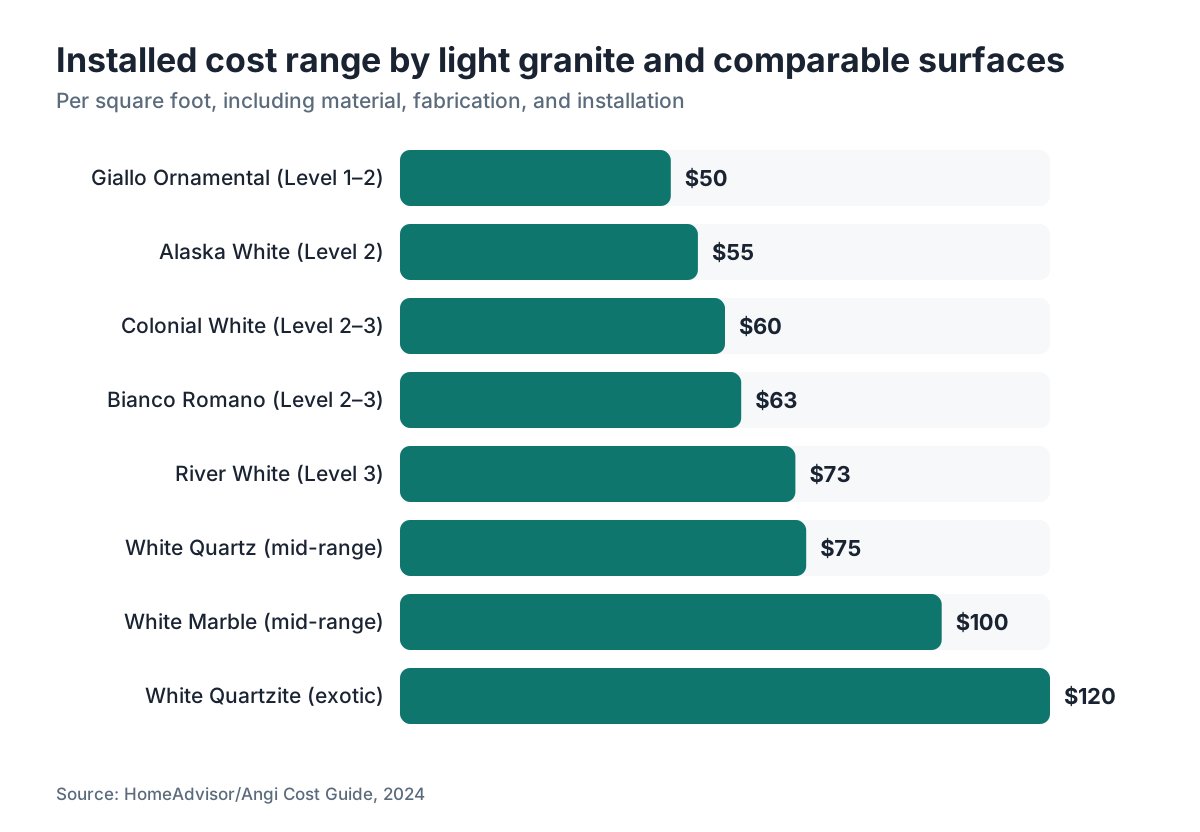
Installed cost for granite countertops runs roughly $40 to $150 per square foot when you include material, fabrication, and installation [1]. Light colored granites cluster toward the middle of that range. Here is a realistic breakdown by tier:
| Granite Name | Material Tier | Installed Cost Range (per sq ft) |
|---|---|---|
| Giallo Ornamental | Level 1 to 2 | $40, $60 |
| Alaska White | Level 2 | $45, $65 |
| Colonial White | Level 2 to 3 | $50, $70 |
| Bianco Romano | Level 2 to 3 | $50, $75 |
| River White | Level 3 | $60, $85 |
| Taj Mahal Quartzite (often confused with granite) | Exotic | $90, $150 |
Those ranges come from industry pricing surveys and fabricator cost data, and they shift by region. Labor is more expensive in coastal metros. A 40-square-foot kitchen in San Francisco will cost more than the same job in Memphis even with identical material.
What drives cost beyond the base slab price: edge profile (a mitered waterfall edge adds $25, $50 per linear foot), number of cutouts (each sink or cooktop cutout typically runs $100, $200), stone thickness (3 cm slabs run 20 to 30% more than 2 cm), and whether you need seams. Slabs are usually 55 to 65 inches wide and 100 to 130 inches long [2]. Kitchens wider than that need seams, which add labor.
Demolition of existing countertops, if the fabricator handles it, often adds $150, $400. Some fabricators include it; confirm before signing.
For homeowners comparing options, laminate countertops run $15, $40 installed and marble countertops can reach $200 per square foot for rare book-matched slabs. Light granite sits in a comfortable middle ground on price.
How does light granite compare to white quartz, marble, and quartzite?
The comparison that comes up constantly is light granite versus white quartz. Quartz (engineered stone, brands like Cambria and Silestone) has a uniform appearance because it is manufactured; granite has natural variation. Quartz is non-porous and needs no sealing. Granite is slightly porous and should be sealed annually. On heat resistance, granite wins clearly: quartz binders can discolor above 300°F, while granite handles hot pots without damage [3]. Quartz costs $50, $100 per square foot installed at comparable quality levels, so price is roughly comparable for mid-range options. If you want Cambria countertops, expect to pay $80, $120 installed.
Marble is the other common comparison. White marble like Calacatta and Carrara looks stunning but etches from acids, meaning lemon juice, tomato, and wine leave dull marks that require professional polishing to remove. Light granite does not etch. That alone is the reason many homeowners choose granite over marble for high-use kitchens. See the full breakdown on marble countertops.
Quartzite is a natural metamorphic stone that is harder than granite and often confused with it at the slab yard. Taj Mahal and White Macaubas are quartzites sold in the light palette. Quartzite also etches less than marble but can etch more than granite depending on the specific stone. It often costs more. If you see a pale white stone with dramatic veining being sold for $100 per square foot, it is probably quartzite, not granite. Ask for the Mohs hardness data and acid sensitivity test results before buying.
| Surface | Sealing Needed | Heat Resistant | Etch Risk | Installed Cost Range |
|---|---|---|---|---|
| Light Granite | Yes (annually) | Yes | Very low | $40, $100 |
| White Quartz | No | Limited (300°F) | None | $50, $100 |
| White Marble | Yes | Yes | High | $60, $200 |
| White Quartzite | Yes | Yes | Low, Medium | $80, $150 |
| Laminate | No | No | None | $15, $40 |
What are the real maintenance requirements for light granite?
Granite is a porous stone. Not as porous as marble, but porous enough that oils, wine, and dark liquids can penetrate if the sealer is worn out. Annual sealing is the standard recommendation from the Marble Institute of America and most fabricators [4]. The actual test is simple: put a tablespoon of water on the surface and wait 15 minutes. If it darkens the stone, the sealer has worn down and it is time to reseal.
Sealing a countertop yourself takes about an hour. A penetrating impregnator sealer (brands like Tilelab, StoneTech, or Miracle Sealants) costs $20, $40 per quart, and a quart handles most kitchens. Apply it with a cloth, let it absorb for 5 to 10 minutes, wipe off the excess, and let it cure for 24 hours before heavy use. You do not need a professional for routine sealing.
Daily cleaning is simpler: warm water and a few drops of dish soap works fine. Avoid anything acidic (vinegar-based cleaners, citrus sprays), anything abrasive (Comet, Scotch-Brite pads), or bleach-based products. Those can strip the sealer or dull the polish over time.
Light colors do show grease and residue more than a dark granite, but they hide etching better because light stones have less contrast change. A water stain on Alaska White is barely visible; the same stain on Absolute Black granite is obvious. For cleaning stone countertops more broadly, the guide on how to clean stone countertops covers method and product selection in more depth.
One thing nobody talks about enough: light granite can yellow near the cooktop over years of heat cycling and grease buildup. Good sealing and regular cleaning prevent it. If it has already yellowed, a poultice of baking soda and hydrogen peroxide left on overnight can draw out the staining, though results vary by stone.
Does light granite show dirt and stains more than darker stone?
In practice, light granite shows different things than dark granite, not necessarily more. Dark stones show water spots, soap film, and fingerprints prominently. Light stones show food residue and grease more clearly. Which bothers you more depends on your kitchen habits.
The specific concern for white or cream granites is that tomato sauce, coffee, and red wine can stain if left on an unsealed surface. Colonial White and Bianco Romano are slightly more absorbent than some other granites because of their mineral composition, so sealing discipline matters more with those stones.
If you have kids or cook heavily, Giallo Ornamental and Venetian Gold have a slight advantage because their warm gold and brown tones hide organic stains better than a true white stone. Alaska White, which reads quite white in most lights, will show a dark stain more clearly if the sealer is gone.
That said, I would not overweight this factor. Properly sealed light granite holds up well in real kitchens. The people who report staining problems almost always have either unsealed stone or stone that was sealed once and never again.
Which light granite is best for white or dark cabinets?
The short answer: nearly all light granites work well with white cabinets because the contrast comes from the stone's own veining and mineral movement, not from the cabinet color. With white shaker cabinets, River White and Bianco Romano add warmth without competing. Alaska White creates a clean, minimal look. If you want drama without going to a dark stone, White Fantasy granite has heavy gray veining on a white field that reads boldly against white cabinetry.
With dark cabinets, the contrast argument favors lighter, busier stones. Venetian Gold and Giallo Ornamental have enough gold and brown movement to anchor visually against espresso or navy blue cabinets. Bianco Romano and Colonial White also work well here, providing a bright field that lifts the whole kitchen.
Gray cabinets are the most flexible pairing. Any light granite complements gray because the undertones in the stone can either warm or cool the overall palette. Check the undertone of your cabinets first: blue-gray cabinets want a stone with blue or neutral undertones; greige cabinets want warm cream or gold tones in the stone.
The rule fabricators and designers repeat is: bring a cabinet door sample to the slab yard. Tile samples don't tell you enough. Stand the door against actual slabs in the warehouse light, then photograph it in your phone and view it in a dim room to simulate evening lighting. Light changes granite color significantly.
How is light granite fabricated and installed?
Fabrication for light granite follows the same process as any granite job. A template is taken of the existing countertop space (or the rough cabinet boxes after installation), either with a digital templating arm or a simple cardboard/luaun template. Digital templating with tools like Prodigi or Laser Products Industries systems is now common in mid-size and larger shops because it reduces measuring errors that cause costly remakes [5].
The slab is then laid out in shop software to minimize waste and align veining. This is where nesting logic matters: a single slab of River White may have to supply an island, a perimeter run, and a small bathroom vanity in the same project. Getting the layout right saves material and money. (Fabrication shops running quoting and nesting software like SlabWise can plan slab yield digitally before cutting begins, which reduces material waste and makes quotes more accurate.)
Cutting is done on a CNC bridge saw or waterjet for most shapes, with hand grinding for detailed edge profiles. Most light granites cut cleanly. Some with heavy mica content can chip slightly at thin edges, which is why eased and beveled edges are less risky than thin knife edges on very crystalline stones.
Installation takes 2 to 4 hours for most kitchens. The fabricator sets the slabs on the cabinets, levels them with shims, glues seams with color-matched epoxy, and caulks the backsplash joint. The caulk joint at the wall is intentional: it allows for slight seasonal movement and is easier to replace than a grouted joint if it discolors.
For the full process from templating to setting, the countertop installation guide covers each step in detail.
How long does light granite last and what affects its lifespan?
Properly maintained granite countertops last the life of the house. There is no structural failure mode in normal kitchen use. Granite does not warp, swell, or delaminate. The U.S. Geological Survey describes granite as an igneous rock quarried and used in construction for centuries, which gives you a sense of the material's durability at a geological scale [6].
In a practical kitchen sense, the threats to granite longevity are cracking from impact or poor support, staining from neglected sealing, and surface dulling from abrasive cleaners. Cracking is the most serious and the least common. A granite slab supported along its full length by cabinets doesn't crack under normal use. Overhanging sections longer than 12 inches without a support corbel or bracket are more vulnerable, especially in thinner 2 cm stone.
The polish can dull over decades of heavy use, but a professional stone restoration company can restore it through grinding and re-polishing. That process costs $200, $500 for a typical kitchen and returns the surface to near-original condition.
Compare that to laminate, which cannot be refinished and typically needs replacement after 10 to 20 years, or wood butcher block countertops, which require more frequent oiling and are vulnerable to water damage. For durability per dollar over a 30-year window, granite is hard to beat.
What should you check before buying a light granite slab?
Go to the slab yard in person. This is non-negotiable for light stones because variation within a single bundle (matched slabs from the same quarry block) can be significant. Two slabs labeled "Alaska White" from different lots may look noticeably different in warmth and pattern density.
Mark the slabs you want with chalk or a sticker immediately and confirm the fabricator will hold them. Busy slab yards sell stone quickly and verbal holds mean nothing if someone comes in with a deposit check.
Check for natural fissures. Hold a flashlight at a low angle across the surface. Fissures are natural cracks in the stone that have healed mineralogically; they are not structural defects but can look like cracks to a homeowner who didn't notice them before installation. True cracks that run through the thickness of the stone are a different matter and should be avoided.
Ask about the thickness. Most residential installations use 3 cm (roughly 1.25 inches) stone, which is strong enough for unsupported spans up to about 24 inches. Some suppliers still stock 2 cm material, which needs a plywood substrate underneath. Confirm which you are getting and what support is included in the fabrication quote.
Get everything in writing: the specific slab numbers, the edge profile, the number of cutouts, the delivery and installation date, and what happens if the slab cracks during fabrication. Reputable fabricators have replacement clauses. Those who don't often aren't worth the savings.
For context on how kitchen countertops selection works across all materials, that guide covers the full process from measuring to final selection.
Are there any environmental or health concerns with light granite?
Radon is the question that comes up periodically. Granite does contain trace amounts of naturally occurring radioactive elements, primarily uranium and thorium, which decay into radon gas. The U.S. Environmental Protection Agency has stated that the radon contribution from granite countertops is very low and that countertops are not considered a significant source of indoor radon [7]. The EPA's guidance is: if you are concerned about radon in your home, test the air (radon test kits cost $15, $30 at hardware stores), but attributing elevated radon readings to granite countertops specifically is not supported by the science.
Silica dust during fabrication is a serious and legitimate concern for workers, not for homeowners. The Occupational Safety and Health Administration has regulations specifically covering respirable crystalline silica in the stone fabrication industry [8]. Fabrication shops are required to use wet-cutting methods and proper respiratory protection. If you ever visit a fab shop, do not stand near a saw cutting dry.
For homeowners, the finished and polished slab presents no silica hazard. Normal cleaning and use of granite countertops poses no documented health risk.
On the environmental side, granite is a natural material with a long lifespan, which is favorable compared to engineered surfaces that require petroleum-based resins. The quarrying process does have environmental impact (land disturbance, diesel equipment, water use), but granite is not considered a significant environmental concern in building product life-cycle analyses.
How do fabricators price and quote light granite jobs?
For fabricators reading this: light granites are among the easiest materials to move because they photograph well and match almost any cabinet color. The pricing challenge is that customers often anchor on the lowest price they've seen online, which usually reflects Level 1 Giallo Ornamental without edge upgrades, cutouts, or tear-out.
A clean quote breaks out: slab cost (which varies by your supplier contract), fabrication labor (edge profiling, cutouts, polishing), installation labor, and any extras (removal of existing tops, corbel fabrication, silicone). Many shops bundle these into a per-square-foot number, which is fine for simple kitchens but creates margin problems on complex jobs with multiple cutouts and unusual edges.
For shops pricing light granite jobs at scale, job costing software that handles remnant tracking and slab yield makes a real difference. A 55x110 slab of Colonial White costs the same whether you use 85% of it or 60% of it; the remnant either becomes a future sale or a cost you absorb. Accurate nesting before the quote stage is where margin is made or lost on busy volume shops. SlabWise is built specifically for this workflow, from quote to cut layout, and a demo takes about 20 minutes.
On material sourcing: light Brazilian granites (Colonial White, Alaska White, Bianco Romano) are widely available through domestic slab distributors. Most major markets have at least two or three distributors stocking these. Lead times on standard levels run 1 to 5 days from distributor to your shop. Exotic light stones like White Fantasy or Viscount White from certain quarries can have 2 to 4 week lead times if your local distributor is out of stock.
Frequently asked questions
What is the most popular light granite for kitchens?
Alaska White and Colonial White are consistently among the top-selling light granites in North America. Both are Brazilian stones with white or cream fields and gray/black mineral movement, they are widely available, and they sit in the mid-price range at $45, $70 per square foot installed. Giallo Ornamental is the most common budget option, often available as a Level 1 or Level 2 stone.
Does light granite stain easily?
Sealed light granite resists staining well. The risk comes when the sealer wears out and the stone is left unprotected. Cream and white granites can absorb oil and dark liquids if a water droplet soaks in within 15 minutes (the standard absorption test). Annual resealing with a penetrating impregnator keeps the stone protected. Properly sealed, light granite handles normal kitchen use without staining.
How often should I seal light granite countertops?
Once a year is the standard guideline. Test it yourself by putting a tablespoon of water on the surface for 15 minutes. If the stone darkens under the water, reseal. High-use areas near the sink may need resealing more frequently. Penetrating impregnator sealers cost $20, $40 and one quart covers most kitchen countertop surfaces.
Is light granite out of style?
No. Light stone countertops have been the dominant residential choice for 20-plus years and remain the best-selling category at most slab distributors. White and cream kitchens consistently top design survey preference data. That said, style is subjective. If your cabinetry and flooring lean dark or moody, a light granite may not be the best fit for the overall design.
Can you use light granite in a bathroom?
Yes, and it works well there. Bathroom vanities have smaller footprints, which lowers cost. Light granite on a vanity brightens a small bathroom effectively. The same maintenance rules apply: seal it annually, avoid leaving standing water at the backsplash edge, and clean with pH-neutral products. Many homeowners use remnants from a kitchen job for a bathroom vanity at reduced material cost.
What edge profile looks best on light granite?
Eased (slightly rounded square) and beveled edges are the most popular choices for light granite today. They are clean, timeless, and cost less than ornate profiles. Ogee and bullnose edges add $10, $25 per linear foot and suit traditional kitchen styles. Mitered or waterfall edges cost $25, $50 more per linear foot and look dramatic on islands but require precise fabrication to avoid visible seam lines.
How thick should light granite countertops be?
3 cm (approximately 1.25 inches) is the standard for most residential kitchens. It is self-supporting for spans up to about 24 inches without corbels and does not require a plywood substrate. 2 cm stone costs 20 to 30% less but needs a plywood base and is more vulnerable to cracking at cutouts. For most homeowners, 3 cm is worth the difference.
Can light granite be repaired if it chips?
Yes. Small chips at edges or corners can be repaired with color-matched epoxy or acrylic fill. A good stone restoration professional can make a chip nearly invisible on most light granites, though stones with complex crystalline patterns are harder to match perfectly. Larger cracks or fractures may require a section replacement if they run through the slab, which is rare in normal use.
What is the difference between light granite and white quartzite?
Geologically, granite is igneous and quartzite is metamorphic. Practically, quartzite is generally harder and denser, with a different visual character: more flowing veining versus granite's mineral speckle pattern. Some quartzites (Taj Mahal, White Macaubas) are sold as light countertop stones but cost more than light granite and may etch slightly from acids, which granite almost never does. Ask for a specific acid sensitivity test at the slab yard.
Is light granite good for outdoor kitchens?
Granite handles outdoor use better than most surfaces. It is UV-stable (does not fade), heat-resistant, and unaffected by freeze-thaw cycles in most climates. Light granite in an outdoor kitchen will require more frequent sealing (twice a year) because sun and rain degrade sealers faster than indoor conditions. Polished finishes can become slippery when wet; a honed or leathered finish is a better choice for outdoor horizontal surfaces.
How much does a light granite kitchen countertop cost for an average kitchen?
An average kitchen has roughly 40 to 60 square feet of countertop. At $50, $70 per square foot installed for a mid-range light granite like Colonial White, that puts a full kitchen install at $2,000, $4,200. Add $300, $600 if you have an undermount sink cutout, a cooktop cutout, or a complex edge profile. Tear-out of existing laminate or tile adds $150, $400 if your fabricator handles it.
What cleaning products should I avoid on light granite?
Avoid acidic cleaners (vinegar, citrus sprays, many "natural" cleaners), bleach-based products, and anything abrasive. These strip the sealer and can dull the polish over time. Warm water and a small amount of dish soap handles daily cleaning. For tougher residue, a few drops of isopropyl alcohol in water works without damaging the surface. Dedicated stone cleaners are fine but not necessary for routine maintenance.
Do light granite countertops increase home value?
Remodeling Magazine's Cost vs. Value report consistently shows kitchen countertop upgrades recouping 60 to 80% of their cost at resale, with stone surfaces performing better than laminate in buyer perception surveys. No public data isolates light granite specifically from other stone types. Real estate agents in most markets report that stone countertops are a standard buyer expectation in mid-range and above homes, so the absence of stone may hurt value more than the presence of stone adds to it.
Sources
- HomeAdvisor (Angi), Granite Countertops Cost Guide: Installed granite countertop cost ranges from $40 to $150 per square foot depending on material grade, edge profiles, and region
- Marble Institute of America, Dimension Stone Design Manual: Standard granite slab dimensions are typically 55 to 65 inches wide and 100 to 130 inches long
- NSF International, Countertop Material Testing Standards: Quartz composite surfaces can discolor under sustained heat above approximately 300°F due to polymer binders; natural stone is not affected the same way
- Marble Institute of America, Care and Cleaning for Natural Stone Surfaces: Annual sealing with a penetrating impregnator is the standard maintenance recommendation for granite countertops in residential kitchens
- Natural Stone Institute, Fabrication and Templating Resources: Digital templating reduces measuring errors that cause costly slab remakes and is standard practice in mid-size and larger fabrication shops
- U.S. Geological Survey, Granite and Granodiorite: Granite is an igneous rock with well-documented long-term durability; it has been quarried and used in construction for centuries
- U.S. Environmental Protection Agency, Radiation in Granite Countertops: The EPA states that granite countertops are not considered a significant source of indoor radon and that their radon contribution is very low
- Occupational Safety and Health Administration, Respirable Crystalline Silica Standard for General Industry (29 CFR 1910.1053): OSHA regulations require wet-cutting methods and respiratory protection for workers cutting stone in fabrication shops due to silica dust hazards
- Remodeling Magazine, Cost vs. Value Report: Kitchen remodeling projects including countertop upgrades recoup approximately 60 to 80% of their cost at resale according to annual cost vs. value data
- National Kitchen and Bath Association, Design Preferences Survey: Stone countertops are a standard buyer expectation in mid-range and above residential kitchens according to NKBA design trend reporting
Last updated 2026-07-09