TL;DR
- Santa Cecilia light granite is a cream-to-gold Brazilian granite with burgundy garnets and gray quartz crystals.
- Installed cost runs $40, $90 per square foot depending on edge profiles, thickness, and region.
- It seals well, resists scratches, and holds up reliably in kitchens.
- Its warm tones pair with white, cream, and dark wood cabinets.
What is Santa Cecilia light granite?
Santa Cecilia light granite is quarried in the state of Espirito Santo in southeastern Brazil, mostly around the municipality of Cachoeiro de Itapemirim. Brazil is one of the world's leading granite exporters, and Espirito Santo is its granite heartland [1]. The stone comes out of the ground in large blocks, gets sawn into slabs typically 3/4 inch (2 cm) or 1.25 inch (3 cm) thick, and ships worldwide.
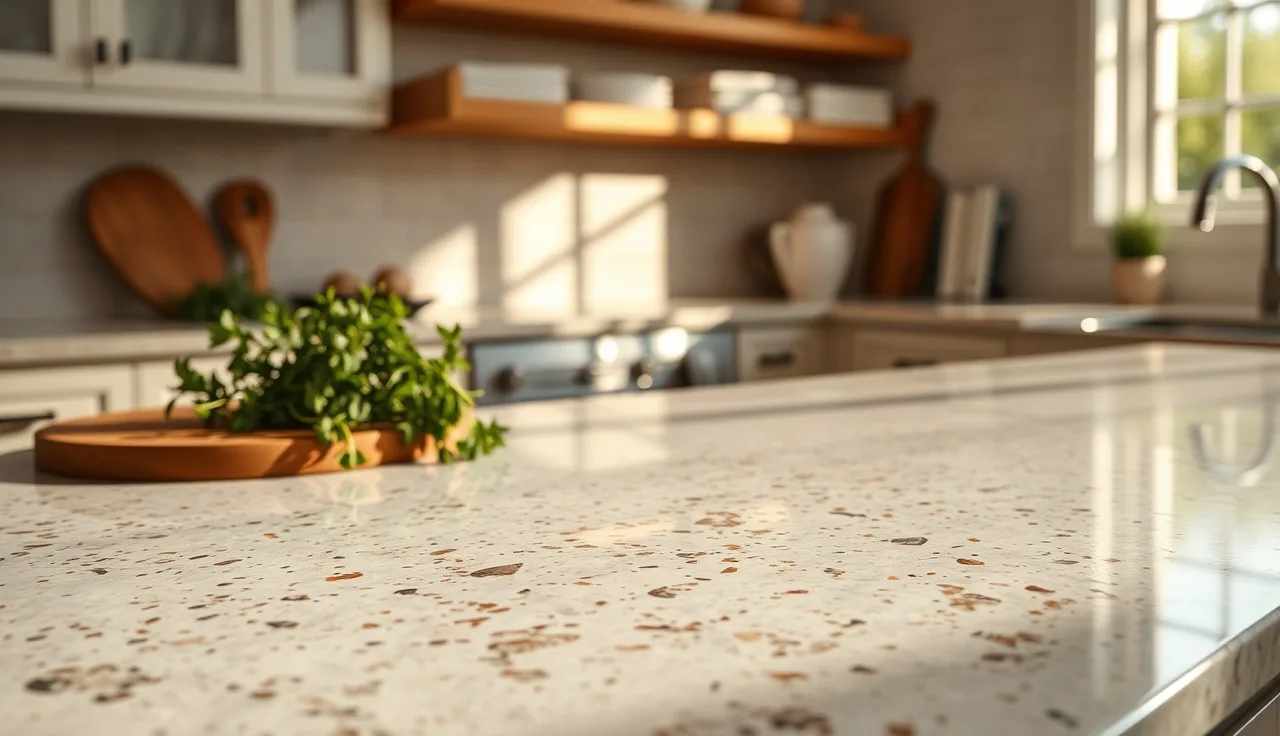
The background color is a warm cream, ivory, or pale gold, which is where the "light" in the name comes from. Scattered through that background you'll find burgundy and rust-colored garnet crystals, gray and black biotite flecks, and occasional white or smoke-gray quartz patches. The effect is busy without being chaotic. Some slabs lean more yellow-gold. Others stay closer to beige. The variation from slab to slab is real, so visiting the slab yard and picking your actual slabs matters more than approving a sample tile.
The "light" designation separates it from Santa Cecilia Dark (sometimes called Santa Cecilia Classic or Santa Cecilia Gold), which has the same mineral composition but a noticeably more saturated gold-brown background. Light is the more versatile seller because the lighter base works with more cabinet colors.
Geologically, this is a coarse-grained igneous rock classified as a granite under commercial standards, though a strict petrologist might call it a granitoid or granodiorite based on its feldspar-to-quartz ratios [7]. For countertop purposes, the commercial classification is what matters. It behaves like granite, prices like granite, and gets maintained like granite.
What does Santa Cecilia light granite cost?
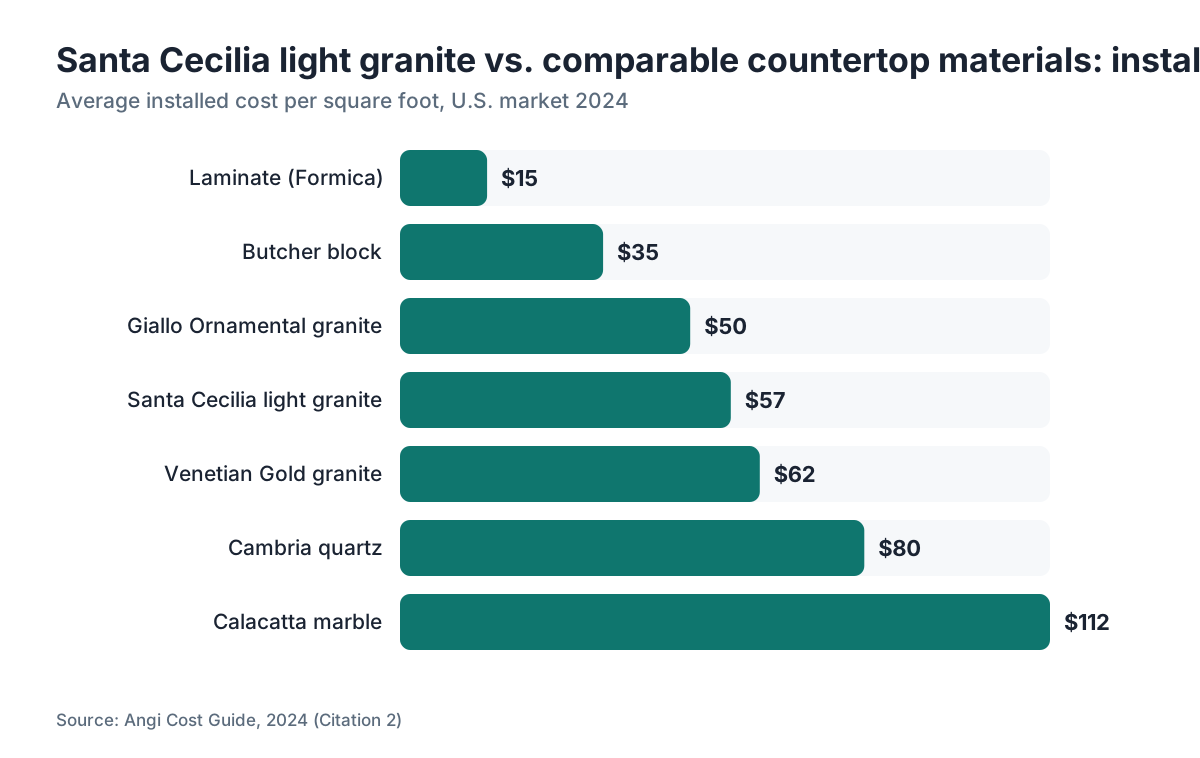
Installed cost for Santa Cecilia light granite runs roughly $40 to $90 per square foot in most U.S. markets, with the spread driven by slab thickness, edge profile, cutouts, and regional labor rates [2]. Raw slab material without fabrication commonly prices at $10 to $30 per square foot depending on grade and whether you're buying from an importer's warehouse or paying a local distributor markup.
| Cost factor | Typical range |
|---|---|
| Slab material only (per sq ft) | $10, $30 |
| Fabrication and installation (per sq ft) | $25, $55 |
| Total installed, standard edge (per sq ft) | $40, $75 |
| Total installed, premium edge profiles (per sq ft) | $60, $90 |
| Sink cutout (each) | $75, $150 |
| Cooktop cutout (each) | $50, $125 |
| Edge upgrades (ogee, waterfall, etc.) | $15, $30 per linear ft extra |
Santa Cecilia light sits in the entry-to-mid range of granite pricing. It costs more than generic commodity granite sold as "builder grade," but far less than exotic marbled granites like Blue Bahia or leathered quartzites. That middle position is a big reason it stays one of the most consistently stocked stones at U.S. slab distributors.
For a typical kitchen with 40 square feet of countertop, a homeowner in a mid-cost metro should budget $2,400 to $3,600 fully installed with an eased or beveled edge. Upgrading to an ogee or stacked ogee edge, adding a full-height backsplash, or requesting a waterfall island end panel pushes that toward the upper end.
Want a fast ballpark for your specific layout before calling a fabricator? The kitchen countertops guide covers how to measure your square footage accurately so the quote doesn't surprise you.
How does Santa Cecilia light look in a real kitchen?
The dominant impression is warm and earthy. The cream-to-gold background reads as neutral in most lighting, which is why it pairs with so many cabinet finishes. White Shaker cabinets, antique cream raised-panel doors, medium-tone oak, dark espresso, even charcoal gray all work. That flexibility is unusual. Most busy granites fight with either dark or light cabinetry, but Santa Cecilia light reads as a warm neutral that bridges the gap.
The burgundy garnets are the defining feature. They catch light at certain angles and can look almost jewel-like under recessed LEDs or sun coming through a window. Under flat fluorescent light, they flatten out and the slab reads calmer. If your kitchen has strong directional lighting, you'll get more visual interest than in a north-facing room with diffuse light.
The movement is moderate. Busier than a solid-color granite like Absolute Black, calmer than something like Labrador Antique or Blue Bahia. Design photographers often call Santa Cecilia light a "safe" choice, which is fair and not an insult. Kitchens with this stone photograph well because the counter doesn't compete with everything else in the frame.
For flooring, warm-toned wood floors in honey, pecan, or walnut are a natural match. Light travertine tile works too. The pairing to think hard about is cool-gray tile flooring. The yellow undertone in the granite and the blue-gray floor can clash in a way that isn't obvious on a small sample but reads clearly across a full kitchen.
Is Santa Cecilia light granite durable enough for a kitchen?
Yes, with honest caveats. Granite as a class rates 6 to 7 on the Mohs hardness scale, which means your kitchen knives (around 5.5 to 6.5 Mohs) will not scratch the surface under normal use [3]. Santa Cecilia light is no exception. You can set a hot pan on it and the stone won't scorch, though thermal shock over repeated cycles can eventually stress a slab, so trivets are still smart.
The real durability variable is porosity. All natural stone has some porosity, and granite's porosity varies by specimen. Santa Cecilia light is a moderately porous granite. Without sealing, red wine, coffee, and cooking oil can penetrate the surface and stain over time. Properly sealed, those same liquids bead up and wipe away. The Marble Institute of America recommends testing your granite's current seal by placing a few drops of water on the surface. If the water beads up after 30 minutes, the seal is still active [4].
Etching is not a concern with granite. Etching (the dull marks acids leave on stone) is a calcite problem, and calcite is the mineral in marble and limestone, not granite. You can leave a lemon on Santa Cecilia light and come back the next day to no damage, as long as the sealer is intact. This is one of the main reasons homeowners who love the marble look but need durability land on Santa Cecilia light as a compromise. Warm, patterned, durable.
For a closer comparison with stone types that do etch, how to clean quartzite countertops is worth reading, since quartzite gets mislabeled and sold as granite and the maintenance difference matters.
What granite hates is impact. Drop a heavy cast iron skillet edge-first on a corner and you can chip the stone. Corners and edges take the most abuse, which is partly why many homeowners choose a slightly rounded or softened edge profile over a sharp mitered edge.
How do you seal and clean Santa Cecilia light granite?
Sealing is straightforward. Most fabricators apply a sealer at installation, but that first coat isn't permanent. Stone care manufacturers generally recommend re-sealing annually in heavy-use kitchens, and every 2 to 3 years in lighter-use areas like bathrooms [4]. The exact interval depends on the sealer product and the stone's actual absorption rate, which you can check with the water-bead test above.
For a do-it-yourself seal, penetrating (impregnating) sealers are the right category. Topical sealers that sit on the surface change the appearance and wear off unevenly. Clean the surface first, let it dry completely (at least 24 hours after cleaning with any water-based product), apply the penetrating sealer per the manufacturer's instructions, buff off the excess before it dries hazy, and you're done. The whole job takes about an hour.
Daily cleaning needs nothing fancy. Warm water and a few drops of dish soap on a soft cloth handles 95 percent of kitchen messes. Skip abrasive scrubbing pads, which dull the polished finish over time. Skip bleach and ammonia-based cleaners, which break down sealers faster than normal wear.
For a stubborn stain that has already set, a poultice made from baking soda and water (or a commercial stone poultice for oil-based stains) applied overnight and then removed can pull the stain out without damaging the surface. The how to clean stone countertops guide walks through this step by step for the cases where soap and water aren't enough.
How does Santa Cecilia light compare to other granite options?
Santa Cecilia light fills a specific niche. Warm-toned, moderate movement, entry-to-mid price, consistent availability. Here's how it stacks up against the stones homeowners most often compare it with.
| Stone | Background color | Movement | Installed cost (avg) | Acid resistance | Notes |
|---|---|---|---|---|---|
| Santa Cecilia light | Cream/gold | Moderate | $40, $75/sq ft | High | Warm, universally available |
| Giallo Ornamental | Cream/white | Low-moderate | $35, $65/sq ft | High | Cooler tone, less garnet |
| Venetian Gold | Gold/brown | Moderate-high | $45, $80/sq ft | High | More saturated than SC light |
| Typhoon Bordeaux | Cream with burgundy swirls | High | $50, $85/sq ft | High | More dramatic, less forgiving |
| White Ice | White/gray | Low | $40, $70/sq ft | High | Cooler, cleaner look |
| Calacatta marble | White/gray | High | $75, $150/sq ft | Low (etches) | Beautiful but high maintenance |
| Cambria Torquay (quartz) | White/gray | Moderate | $60, $100/sq ft | Very high | Engineered, no sealing needed |
Giallo Ornamental is the stone most often cross-shopped with Santa Cecilia light. They share a Brazilian origin and a warm base color, but Giallo Ornamental reads cooler and quieter, with fewer and smaller garnets and a background closer to off-white than gold. If your cabinets are bright white, Giallo Ornamental can be a cleaner pairing. If your cabinets carry any cream or warm tone, Santa Cecilia light looks more intentional.
For homeowners weighing granite against engineered quartz, the tradeoffs are sealing versus no sealing, natural variation versus consistency, and real-stone feel versus a more uniform look. Cambria countertops covers the quartz side in detail, and granite countertops gives the full category context for where Santa Cecilia light fits in the granite market.
Against marble, Santa Cecilia light wins on maintenance every time. It doesn't etch, doesn't need constant attention, and costs less. It loses on the specific look of true marble veining, which some homeowners value enough to accept the maintenance tradeoff. That's a personal call, not a wrong one. Marble countertops covers what you'd actually be getting into on the maintenance side.
What thickness and finish options are available?
Santa Cecilia light slabs come in two standard thicknesses. Two-centimeter (about 3/4 inch) slabs are the thinner option, traditionally used for vertical applications or, when edge-built with a laminated strip, for countertops. Three-centimeter (about 1.25 inch) slabs are the current standard for kitchen countertops in most of the U.S. and don't need lamination to look substantial at the edge [8].
The 3 cm slab costs more per square foot for raw material (more stone, more weight, more shipping), but fabrication is simpler because there's no built-up edge to glue. For most kitchens, 3 cm is the better choice. For bathroom vanities, either works.
Finish options include polished (the glossy mirror surface most people picture), honed (a matte satin finish that cuts glare and hides fingerprints better), and leathered or brushed (a textured surface with a slight sheen, made by running diamond-tipped brushes across the stone after cutting). Polished is by far the most common for Santa Cecilia light because the polish amplifies the garnet crystals and the natural luster of the feldspar in the background. A honed finish makes the stone look more subdued and a bit more contemporary. Leathered is less common for this particular stone but is available from fabricators willing to run it.
Edge profiles are a separate decision and a meaningful one for both look and cost. A standard eased or pencil edge is included in most fabricator base quotes. Upgrading to a beveled, bullnose, ogee, or double ogee edge adds $10 to $30 per linear foot. Waterfall ends (where the counter continues vertically down the side of an island) need matching slab material and extra fabrication labor, typically $300 to $600 or more per waterfall panel depending on height.
What cabinets and backsplashes pair well with Santa Cecilia light?
The warm cream-gold base gives you a lot of room. White cabinets work, but you'll get the best result with a slightly warm white or cream undertone rather than a stark cool white. Pure bright white (think Benjamin Moore White Dove or Chantilly Lace) can make Santa Cecilia light look yellowed by comparison. Warm whites and off-whites (Swiss Coffee, Antique White) look intentional instead of mismatched.
For backsplash, the most consistent advice from kitchen designers is to pull one of the colors already in the stone rather than introduce a new color. Subway tile in off-white or cream is the safest choice and almost never looks wrong. A mosaic tile that includes creams, tans, and one burgundy or rust accent can look striking. Avoid tiles with heavy gray or blue tones unless your cabinets are also in that palette, because those cool tones fight the warm stone.
Dark cabinets in espresso, charcoal, or navy pair well with Santa Cecilia light because the light stone creates contrast. This combination photographs well in kitchen design content for a reason. It's high contrast without being jarring, and the burgundy garnets read as accent colors that tie the two elements together.
For hardware and fixtures, warm metals (brushed brass, unlacquered brass, oil-rubbed bronze) are a natural match. Polished chrome and brushed nickel also work because they're neutral enough not to conflict. Matte black hardware has become popular and works well against the light stone as a graphic contrast.
How do you buy Santa Cecilia light granite and what should you look for at the slab yard?
Santa Cecilia light is one of the most consistently available granites in the U.S. wholesale system. Most major regional importers carry it year-round, and it's stocked at national distributors like MSI International and Pental Granite and Marble, among others. Your fabricator will have access to at least one source with it in stock almost regardless of where you are.
Even with that availability, slabs vary enough that going to the yard and selecting your own material is worth the trip. Bring a cabinet door sample or paint chip if you can. Bring your phone for photos. Look at the slabs in natural light if the yard has outdoor viewing (many do), because showroom lighting shifts how the gold tone reads.
Things to check at the yard: Look for fissures, which are natural separations in the crystal structure that show up as hairline cracks. Minor fissures are normal in granite and don't signal a structural problem, but large fissures running across a slab should make you cautious, especially if they cross an area that will be cantilevered or unsupported [10]. Check for pitting, small holes in the surface that usually appear at the boundary between crystals. Some pitting is normal and gets filled during fabrication. Excessive pitting over a large area can signal lower-quality material.
If your project needs more than one slab (large kitchens often need two or three), select consecutive-numbered slabs from the same quarry lot. They were cut from adjacent blocks and match far more closely than slabs from different shipments.
For fabricators managing multi-job granite purchasing, slab inventory and nesting efficiency hit material waste and job profitability directly. Tools like SlabWise help fabricators see which cuts come from which slabs before any stone gets cut, which trims remnant waste on high-volume material like Santa Cecilia light.
Once you've chosen your slabs, confirm with your fabricator how templating works. Most shops now use digital templating with a laser or Proliner device, which produces more accurate templates than the old cardboard method and cuts down on fitting problems at installation. Countertop installation covers what to expect from the template-to-install timeline.
How long does Santa Cecilia light granite last?
Properly installed and maintained, granite countertops last decades. I'm not aware of an industry-standard lifespan study with a tight confidence interval, but granite has been a building and surface material for thousands of years, which is the practical answer to the durability question. The limiting factors are almost always installation quality, edge chip damage from impacts, or sealing neglect, not the stone wearing out.
For resale value, granite countertops have historically been viewed positively by buyers. The National Association of Realtors surveys homeowner and realtor perceptions of renovation projects periodically. In their 2023 Remodeling Impact Report, kitchen renovations including countertop upgrades ranked among the projects with the highest "joy scores" from homeowners and consistent positive return-on-cost perception from realtors [5]. Stone countertops specifically aren't broken out, but granite has been a standard expectation in mid-to-upper market kitchens for more than two decades.
One honest limitation: Santa Cecilia light is a dated look in some design circles. It was one of the most popular granites installed during the 2000s housing boom, so kitchens with this stone sometimes read as early-2000s to design-conscious buyers. Whether that matters depends entirely on your market, your price point, and how buyers in your area think about granite versus quartz. In many markets, granite still carries no generational stigma. In high-turnover urban markets with younger buyers, there's often a preference for the uniformity of quartz. Neither outcome is predictable with precision.
Is Santa Cecilia light granite a good choice for bathrooms?
Yes, and in some ways it's better suited to bathrooms than kitchens. Bathroom vanities have less surface area (lower cost), face fewer harsh cleaning agents, and see less thermal stress. The warm tone works particularly well with cream, white, or wood-toned vanities.
Porosity still matters here. Bathrooms have steady moisture exposure from humidity and splashing, and a stone that isn't sealed properly can absorb that moisture and eventually grow mold or mildew below the surface. The sealing protocol is the same as for kitchens, just applied less urgently since the stone may not need re-sealing as often given lower acid and oil exposure.
For a 2 cm slab on a bathroom vanity with an undermount sink, a fabricator will typically laminate the front edge to give it visual thickness. With 3 cm material, that's unnecessary. Either works fine structurally. The choice is mostly visual and budget-driven.
For shower walls, Santa Cecilia light can be used but needs more maintenance vigilance than a countertop. The daily moisture and soap scum in a shower means sealing is more important and more frequent. Many fabricators will recommend a denser, lower-porosity stone for shower surrounds. Worth talking through with your fabricator before committing to it in a wet application.
Frequently asked questions
Is Santa Cecilia light granite still popular?
It's still one of the most consistently stocked granites in U.S. distribution, which tells you demand hasn't collapsed. Trend coverage sometimes labels it dated because of its widespread use in the 2000s, but in most residential markets it remains a solid seller. Buyers who put practicality and budget over trend-currency tend to be very happy with it.
What is the difference between Santa Cecilia light and Santa Cecilia dark?
The difference is the background color. Santa Cecilia light has a cream-to-pale-gold base. Santa Cecilia dark (also sold as Santa Cecilia Classic or Santa Cecilia Gold depending on the distributor) has a deeper, more saturated gold-brown background. The mineral composition and movement pattern are similar. The dark version reads warmer and more dramatic. Light is generally the better seller in markets with white or cream cabinetry.
Does Santa Cecilia light granite need to be sealed?
Yes. It's a moderately porous granite, meaning liquids can penetrate the surface and stain without a sealer. Most fabricators apply a sealer at installation. Homeowners should re-seal annually in high-use kitchens. The water bead test (put a few drops of water on the surface; if they bead up after 30 minutes, the seal is still working) is the simplest way to check whether your stone needs re-sealing.
Can you cut on Santa Cecilia light granite?
You can, but you shouldn't. The stone is hard enough that your knives won't scratch it under normal use, but cutting directly on granite dulls your blades fast. More practically, knives pick up microscopic stone particles over time. Use a cutting board. It protects your knives and extends the life of your sealer, since blade contact repeatedly breaks down the sealer film in one spot.
How do you remove a stain from Santa Cecilia light granite?
For fresh spills, blot immediately with a clean cloth. Don't wipe, which spreads the stain. For set-in stains, a poultice works best: mix baking soda with water to a peanut-butter consistency for water-based stains, or use acetone with baking soda for oil-based stains. Apply to the stain, cover with plastic wrap, tape the edges, and leave overnight. Remove, rinse, and let dry. Repeat if needed. Never put bleach on the stone directly.
What backsplash tile goes with Santa Cecilia light granite?
The safest and most common pairing is off-white or cream subway tile in a classic 3x6 format. It echoes the light background of the stone and doesn't compete with the garnet accents. Tumbled travertine tile is also a natural pairing given the shared warm earth tones. Avoid tiles with heavy cool gray or blue tones unless your cabinet palette explicitly pulls in those colors, because they'll fight the stone's warm undertone.
What paint color goes with Santa Cecilia light granite countertops?
Warm whites and off-whites work well on walls and cabinets: Benjamin Moore Antique White, Swiss Coffee, or comparable tones. On walls, greige tones (warm gray-beige) are a consistent pairing. Avoid cold grays and cool whites, which make the gold-cream stone look yellowed by contrast. Soft sage greens and muted sage-blues can also work on walls because they're low-saturation enough not to clash with the warm base.
How thick should Santa Cecilia light granite countertops be?
Three centimeters (about 1.25 inches) is the standard for kitchen countertops in the U.S. today and the better choice for most projects: no edge lamination needed, cleaner edge profiles, simpler installs. Two-centimeter slabs cost less for raw material and work fine on bathroom vanities or when budget is tight. If a fabricator quotes 2 cm for your kitchen, ask whether a built-up laminated edge is included in the price.
How many square feet does a typical Santa Cecilia light granite slab cover?
A standard granite slab is typically 55 to 65 square feet, though jumbo slabs from some quarries reach 75 to 90 square feet. For a kitchen with 40 square feet of countertop, one slab usually covers the project with remnant left over. Larger kitchens often need two slabs, which is why selecting consecutive-numbered slabs from the same quarry lot at the yard matters for color consistency.
Does Santa Cecilia light granite chip easily?
The surface won't scratch under normal kitchen use, but edges and corners can chip if struck hard by a heavy object. This is true of all granite. Corners are the most vulnerable point, which is why many designers prefer a slightly softened edge profile (beveled, bullnose, or eased) over a perfectly sharp mitered corner. If a small chip happens, an experienced stone fabricator can often fill it with color-matched epoxy and polish it to near-invisibility.
Is Santa Cecilia light granite good for outdoor kitchens?
It can work in covered outdoor kitchens in moderate climates, but it's not ideal for areas with hard freeze-thaw cycles. Granite has some porosity, and water that penetrates the stone and then freezes can cause spalling or cracking over time. If you're in a climate with regular sub-freezing winters and want natural stone outdoors, ask your fabricator about lower-porosity options and whether a sealer rated for outdoor freeze-thaw conditions makes sense.
How does Santa Cecilia light compare to quartz for a busy family kitchen?
Quartz countertops are non-porous and never need sealing, a real practical advantage in high-traffic kitchens with young kids. Santa Cecilia light granite is durable but needs periodic sealing and is slightly more vulnerable to staining if a spill sits a long time. Granite edges can chip from impacts; quartz is a bit more forgiving there. The tradeoff is that granite is natural stone with unique variation, while quartz looks consistent and manufactured. Both are good choices. The decision comes down to how much maintenance you'll actually do.
Can Santa Cecilia light granite countertops be repaired if they crack?
Small cracks and chips can usually be repaired by an experienced stone restoration professional using color-matched epoxy or resin. The repair can be nearly invisible if the crack is minor and the technician is skilled. Larger cracks that run through the full thickness of the slab are a structural problem and in most cases mean the section needs replacement. Cracks often occur at stress points: near sink cutouts, at unsupported overhangs, or from impact. Proper installation with adequate support prevents most structural cracks.
Sources
- U.S. Geological Survey, National Minerals Information Center (dimension stone production data): Brazil is one of the world's leading granite exporters; Espirito Santo state is a primary quarrying region
- Angi, Granite Countertop Cost Guide: Installed granite countertop cost range of $40, $90 per square foot depending on region, slab grade, and edge profile
- U.S. Geological Survey, Mohs Hardness Scale reference: Granite rates 6 to 7 on the Mohs hardness scale; common kitchen knives are approximately 5.5 to 6.5 Mohs
- Natural Stone Institute (formerly Marble Institute of America), Care and Cleaning for Natural Stone Surfaces: Water bead test for evaluating granite sealer effectiveness; recommendation to re-seal kitchen granite annually with heavy use
- National Association of Realtors, 2023 Remodeling Impact Report: Kitchen renovations including countertop upgrades ranked among projects with highest joy scores and consistent positive return-on-cost perception
- U.S. Geological Survey, Mineral Commodity Summaries, Dimension Stone: Brazil is consistently among the top global producers and exporters of dimension stone including granite
- Natural Stone Institute, Dimension Stone classification of granite and granodiorite: Commercial classification of granite and granodiorite under the dimension stone categories
- National Institute of Standards and Technology, Office of Weights and Measures, metric conversion reference: Standard slab thickness conversions: 2 cm equals approximately 3/4 inch; 3 cm equals approximately 1.25 inches
- U.S. Environmental Protection Agency, Indoor Air Quality: Natural stone including granite does not off-gas volatile organic compounds under normal indoor use conditions
- Natural Stone Institute, Natural Stone Glossary: fissure versus crack: Fissures are natural separations in crystal structure that do not indicate structural failure; different from cracks caused by stress or impact
Last updated 2026-07-09