TL;DR
- The right kitchen countertop depends on your budget, how hard you cook, and your cabinet layout.
- Quartz leads remodels right now because it needs no sealing and costs $50, $150 per square foot installed.
- Granite, marble, butcher block, laminate, and concrete all have real use cases.
- This guide walks through every material, edge profiles, layout rules, and the design mistakes fabricators see over and over.
What countertop materials are actually available for kitchens?
You have more options than you probably want. The main categories are natural stone (granite, marble, quartzite, soapstone), engineered stone (quartz brands like Cambria, Silestone, Caesarstone), solid surface (Corian), laminate (Formica and its competitors), butcher block, stainless steel, concrete, and porcelain slabs. Each one behaves differently in a real kitchen. These are genuine trade-offs, not marketing variations.
Natural stone is cut from quarried slabs, so every piece is one of a kind. That's a feature for some people and a headache for others, because you can't reorder an identical replacement if you chip a section years later. Engineered quartz is roughly 90 to 93% ground quartz bound with polymer resin, which makes it non-porous and consistent in pattern from batch to batch [1]. Solid surface like Corian blends acrylic and minerals, and you can sand out damage, which is something stone can't do. Laminate has gotten genuinely better in the last decade. Porcelain slabs are newer, they take heat well, and they're unforgiving to cut and install, so fabrication labor runs high.
The kitchen countertops overview goes deeper on all of these. The decision tree most fabricators actually use is short. What's your budget per square foot? How much heat, acid, and abrasion will this surface take? Does the look matter more than the durability? Answer those three and the list gets short fast.
How much do kitchen countertops cost installed?
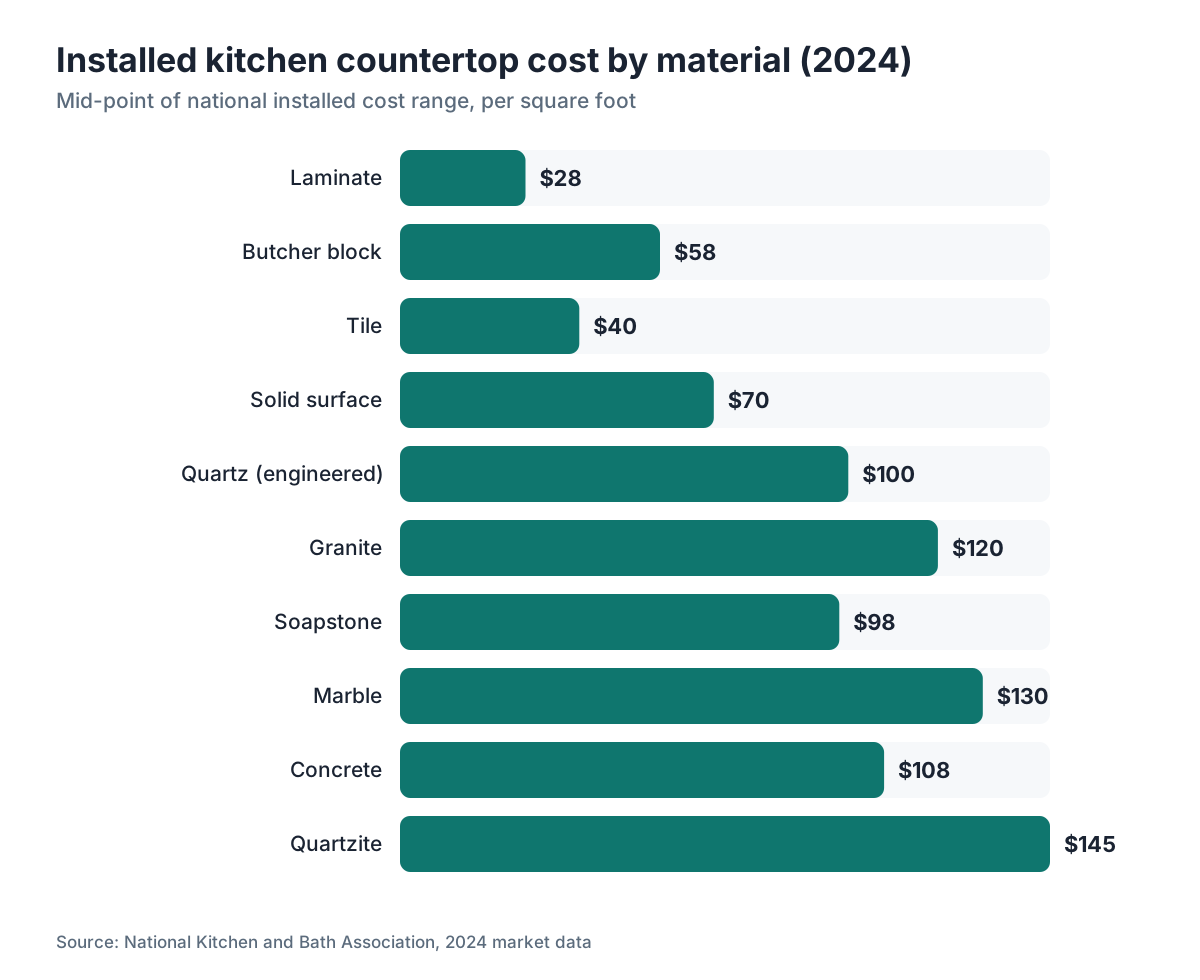
Countertop cost swings with material, your region, edge profile, and how many cutouts (sink, cooktop) your layout needs. The table below uses 2024 national averages for installed cost per square foot from the National Kitchen and Bath Association and industry supplier data [2].
| Material | Installed cost per sq ft (low) | Installed cost per sq ft (high) |
|---|---|---|
| Laminate | $15 | $40 |
| Butcher block | $30 | $85 |
| Tile | $20 | $60 |
| Solid surface (Corian) | $45 | $95 |
| Quartz (engineered) | $50 | $150 |
| Granite | $40 | $200 |
| Marble | $60 | $200+ |
| Quartzite | $70 | $220 |
| Soapstone | $65 | $130 |
| Concrete | $65 | $150 |
| Stainless steel | $80 | $200+ |
| Porcelain slab | $60 | $180 |
A typical kitchen has 25 to 40 square feet of countertop. At the national median of roughly $80/sq ft installed for mid-grade quartz, that's $2,000 to $3,200 for the countertop alone, before demolition, plumbing reconnect, or backsplash [2]. Edge profiles add up. A simple eased edge is usually included in the base price, while a full ogee or mitered waterfall edge adds $15 to $30 per linear foot.
Demolition and haul-away of old countertops runs $200 to $500 depending on material and local disposal rules. Plumbers charge $150 to $400 to disconnect and reconnect an undermount sink. These aren't countertop costs, but they land on the same invoice and they catch people off guard.
Want a real number before you set foot in a showroom? A fabricator's quoting tool (like the one at SlabWise) can build a rough estimate from your layout dimensions and material choice in a few minutes. That gives you a baseline before anyone tries to talk you into exotic stone.
Which countertop material holds up best in a working kitchen?
Durability is not one number. Scratch resistance, heat resistance, stain resistance, and impact resistance are separate things, and different materials fail in different ways.
Engineered quartz scores high on scratch and stain resistance because the resin binder seals the surface. It can discolor under sustained high heat, though. Set a 500 degree cast iron pan directly on quartz and the thermal shock can crack the resin or leave a permanent dull spot [1]. Use a trivet.
Granite is harder than quartz on the Mohs scale (typically 6 to 7, versus quartz composite's more resin-dependent surface) and it handles heat better. The catch is that granite is porous. It needs sealing at installation, then re-sealing every 1 to 3 years depending on the stone's density and how much you cook [3]. A water bead test tells you when: drip water on the surface, and if it soaks in instead of beading, seal it.
Marble countertops are beautiful, and etching is close to guaranteed in a cooking kitchen. Lemon juice, tomato sauce, wine, and vinegar all react with the calcite in marble and leave dull marks that polishing won't fully erase. If you want marble, hone it from the start and make peace with patina. Plenty of people love it. Plenty regret it. Know which camp you're in before you buy.
Butcher block is warm and repairable. You can sand out scratches and gouges, then re-oil. The real enemy is standing water around the sink, which warps the wood and grows mold if it isn't sealed and maintained [4]. Keep the butcher block countertops run away from the sink zone, or pair it with a well-sealed undermount surround.
Laminate countertops and Formica countertops scratch, resist easy repair, and the edge swells when moisture gets in. But the price is real. At $15 to $40/sq ft installed, laminate is hard to beat for a rental, a starter home, or a secondary work surface. Modern high-pressure laminate is not the 1980s product. The texture and matte finishes now look genuinely decent.
Soapstone and quartzite are the two sleepers fabricators name when you ask what they'd put in their own kitchens. Soapstone is non-porous and never needs sealing. Quartzite is harder than granite and doesn't etch like marble, despite the marble look.
How do you design countertop layout for a functional kitchen?
Layout is where a lot of homeowners spend too little attention. You can pick a gorgeous material and still cook in a kitchen that fights you, because the countertop zones don't match how you actually work.
The National Kitchen and Bath Association publishes planning guidelines that most designers treat as a floor, not a ceiling. One of the more useful ones is the 36-inch minimum landing area next to a refrigerator and on at least one side of a cooktop [5]. That number exists because without it, you're setting hot pans on the floor or wrestling grocery bags while the fridge door swings into you.
Plan for four work zones. Prep is usually the longest uninterrupted stretch, 36 to 48 inches if you can get it. Cooking is the counter flanking the range or cooktop. Cleanup is the sink zone, where you want room on both sides. Serving is often the island or peninsula. These zones should flow in a logical order for your traffic patterns instead of simply filling wall space.
Seams matter more than showroom salespeople admit. A quartz or granite slab is typically 55 to 65 inches wide and 110 to 130 inches long [1]. Any run longer than the slab creates a seam. Skilled fabricators hide seams at inside corners, near the sink, or at a break in cabinetry. A seam dropped in the middle of a long open run is visible, and on heavily veined marble or quartzite it's jarring unless the fabricator does a book-match. Ask exactly where seams will land before you sign the contract.
Seating overhangs get wrong-sized more than they should. A bar-height overhang for stools needs 12 inches minimum, and 15 is more comfortable. Counter-height overhang for knee room needs at least 15 inches. Too short, and people can't sit without knocking their knees on the cabinet face.
What countertop thickness and edge profiles are standard?
Most stone countertops are fabricated at 3/4 inch (2 cm) or 1.25 inch (3 cm) thick. Three-centimeter is the current standard for residential kitchens in the U.S. It doesn't need a plywood substrate to feel solid, and it gives you a single-layer edge that looks substantial [1]. Two-centimeter slabs cost slightly less because there's less material, but they often need a built-up laminated edge to look as thick, which adds labor.
Edge profiles run from plain to showy. The main ones:
- Eased: a slightly softened 90-degree corner. Clean. Common. Included in most base prices.
- Beveled: a 45-degree cut on the top edge. A step up from eased, no extra drama.
- Bullnose: fully rounded top and bottom. Soft, dated-looking in some rooms, practical around kids.
- Ogee: an S-curve profile. Traditional kitchens love it. Costs more because it takes more passes on the CNC.
- Mitered: two pieces of stone joined at 45 degrees to fake a thick slab from thin material, or to make a 3-cm edge read like 6 cm. Labor-heavy.
- Waterfall: the surface continues straight down the side of the island or cabinet to the floor. It needs precise templating and adds real material and labor cost.
Match the profile to your cabinets. Shaker cabinets pair well with eased or beveled edges. Ornate raised-panel cabinets can carry an ogee without looking busy. Flat-front modern cabinets read best with eased or mitered edges.
How do sink and cooktop cutouts affect countertop design?
Every cutout removes material and weakens the stone right where it's cut, which changes both the design and the price. Undermount sinks need precise cutting and polishing of the stone edge inside the cutout, which takes time and adds $100 to $200 depending on the sink shape [2]. Farmhouse (apron-front) sinks require the front cabinet face to be removed or notched, which affects the cabinet build-out and sometimes the countertop overhang on the sink side.
A cooktop cutout on a thin peninsula can leave a structurally weak section. A 30-inch or 36-inch cooktop cutout leaves only a few inches of stone on each side. Fabricators usually spec a 3 cm slab (not 2 cm) here and sometimes add a support bracket underneath. Ask directly about support if your cooktop lands on an island or peninsula.
Sink placement relative to the window is a preference question that kitchen designers have argued about for generations. The case for centering the sink under the window is natural light while you wash dishes. The counter-case is that plumbing runs get long and expensive when the window doesn't line up with the existing drain stack. Get your plumber's read on this before your designer locks the plan.
For countertop installation specifics, including what fabricators check during the template appointment, that article walks through the step-by-step process.
What are the most common kitchen countertop design mistakes?
Fabricators see the same errors on repeat. Here's what actually goes wrong.
Choosing material before confirming the budget. Someone falls for a $180/sq ft quartzite slab, gets templated, and the quote comes back at $7,000 for a 38-square-foot kitchen. Set a hard budget first and let the material follow.
Ignoring the slab yield. A 55x110-inch slab has about 42 square feet of surface. Your kitchen might need 35 square feet finished, but once you account for waste from layout, cutouts, and natural defects in the stone, you might need a second slab. Fabricators running quoting and nesting software can model this exactly for your layout, which is one of the genuinely useful things software like SlabWise does for shops. Ask your fabricator to show you the cut plan before you finalize material.
Going too light for the amount of cooking you do. White and light gray quartz shows every spill, oil splash, and water spot more than a mid-tone or veined stone does. Cook real food aggressively and light stone means near-constant wiping.
Underestimating the visual weight of a busy stone. A heavily veined marble or dramatic granite looks stunning as a 12x12-inch sample and overwhelming across 40 square feet of counter. Ask to see the full slab standing upright, not the corner chip. Many suppliers have slab yards you can walk.
Skipping the sealer on natural stone. Granite and marble ship sealed once from the fabricator. That seal doesn't last forever. Most fabricators recommend re-sealing granite every 1 to 3 years [3]. Skip it and you get permanent staining that no cleaning fixes.
Ordering before measuring twice. Countertop sells by the square foot but templates from a physical measurement of your actual cabinets. Countertops ordered from blueprint dimensions rather than templated from installed cabinets often don't fit. Template after the cabinets are installed and leveled. Always.
How do you match countertops to cabinet colors and kitchen styles?
There are no hard rules here, but there are reliable patterns that hold up across thousands of kitchens.
White or light cabinets (shaker or inset) give you the most room to play. Dark stone (black granite, soapstone, dark quartzite) throws high contrast and reads modern. White or light marble creates a soft, airy tone-on-tone look. Mid-tone warm quartz in cream or greige reads transitional, which is the majority of remodels.
Dark cabinets are harder to pair. Light stone gives you the contrast that keeps a dark kitchen from feeling heavy. White quartz, light marble, or light granite against navy, dark green, or charcoal cabinets is the combo that's driven a lot of the dark-cabinet trend. Match dark stone to dark cabinets and it reads dramatic and intentional in a big kitchen with good light, or oppressive in a small galley.
Wood-tone cabinets and butcher block counters can work together if the tones stay distinct (very light maple cabinets, darker walnut butcher block). Too similar and it looks muddled. Mixing helps. Stone or quartz on the perimeter with butcher block on the island is a common, functional split.
Veining direction matters more than people expect. A marble or quartzite with strong diagonal veining should run consistently across the kitchen, not at random angles on different sections. A good fabricator lays out the pieces on a cut plan with veining in mind. Ask to see that plan before fabrication starts.
Cambria countertops and Corian countertops give you controlled, repeatable patterns that make matching across sections or ordering more material easier than natural stone. That's a real advantage in a complex kitchen layout.
How do you care for and clean kitchen countertops long-term?
Daily upkeep is mostly simple. Wipe spills fast, use mild dish soap and water, dry the surface after. The differences show up by material.
Natural stone (granite, marble, quartzite, soapstone) should never see acidic cleaners, bleach, or abrasive pads over the long haul. Vinegar, lemon juice, and many commercial bathroom cleaners etch marble and dull the polish on other stones [6]. Use pH-neutral stone cleaners. The how to clean stone countertops guide has specific product picks.
Engineered quartz is more forgiving but not bulletproof. Harsh chemicals like oven cleaner or paint remover damage the resin binder. Manufacturers also warn against long stretches of direct sunlight, which can cause slight yellowing or color shift in some quartz products over time [1].
Butcher block needs food-safe oil or wax on a schedule, especially around the sink. Mineral oil is the standard pick: cheap, food-safe, effective [4]. Apply monthly for the first year, then a few times a year as the wood settles.
Laminate and solid surface are the lowest-maintenance options. Laminate can't be refinished, so scratches are permanent, but daily cleaning is just soap and water. Solid surface (Corian and similar) sands lightly to remove minor scratches and scorch marks, which is a genuine long-term edge for busy households.
Quartzite care is close to granite, but the stone is harder and denser, so it absorbs sealers more slowly and often needs less frequent re-sealing. The how to clean quartzite countertops article has sealer schedules based on stone density.
What questions should you ask a fabricator before ordering?
Most of the regret homeowners feel about countertops traces back to a question they didn't ask before ordering. Here's what to cover.
Where will the seams be, and can I see the cut plan? A good fabricator can show you a diagram of exactly how the slabs get cut and where the joins fall in your kitchen. If they won't or can't, that's a red flag.
How many slabs does my project need, and will you hold both from the same lot? Lot-to-lot variation in granite and quartzite can be big. You want your perimeter and island cut from slabs with the same background.
Is the templating included in the price? Most shops include one template visit. A second visit (if cabinets aren't ready) often costs $150 to $300. Ask upfront.
What's the lead time from template to install? Standard residential lead times run 7 to 14 business days for common materials, longer for exotic stone or custom edge profiles [2]. If contractors are working to a schedule, this matters.
What's the warranty on fabrication? A reputable shop warrants fabrication defects (chips from cutting, wrong dimensions, visible voids) for at least a year. Manufacturer warranties on engineered stone like Cambria run 10 years to lifetime [7].
Do you install in-house or subcontract? Subcontracted installs aren't automatically worse, but knowing who shows up at your house and who is accountable if something goes wrong is worth knowing.
What happens if a slab cracks during installation? Cracks during install are rare but real, especially on thin sections near cutouts. Ask whether the shop eats the replacement slab or whether that cost lands on you.
How do islands and peninsulas change countertop planning?
Islands are where countertop decisions get expensive fast. An island adds square footage, often needs its own slab (so you might need two slabs total for the kitchen), and it's visible from every angle, so the stone selection gets more scrutiny than the perimeter.
A waterfall edge on an island is the current showroom darling. Both sides get a vertical panel of stone running to the floor, which takes precise cutting and often a separate piece of stone. The material cost roughly doubles for the island section. The labor is real. It looks dramatic on the right stone. It's a waste of money on busy patterned stone, where nobody can read the continuity at the corner anyway.
The island is usually where seating happens too. Plan seating overhangs before fabrication, not after. A 12-inch overhang supports counter-height seating with a standard stool. Taller bar-height seating needs a 15-inch overhang and often a thicker countertop or support corbels if the overhang runs past what the slab can safely cantilever. Standard stone cantilevers unsupported to roughly 10 to 12 inches beyond the cabinet edge before you need corbels or a sub-base [5]. If someone asks for 18 inches of unsupported overhang on a 3/4-inch slab, push back.
Peninsulas attach to the wall on one side, which limits slab access during installation. A long peninsula sometimes needs the slab brought in before adjacent cabinets are finalized, or cut in sections and seamed. Plan the install sequence with your cabinet installer and fabricator together.
Frequently asked questions
What is the most popular countertop material for kitchens right now?
Engineered quartz is the top-selling countertop material in U.S. kitchen remodels. It needs no sealing, comes in consistent colors and patterns, and costs $50 to $150 per square foot installed. Granite stays popular for buyers who want natural stone. The National Kitchen and Bath Association tracks material preferences annually and has reported quartz as the leading choice in new construction and remodels for several years running.
How much countertop does a typical kitchen need?
Most residential kitchens have 25 to 45 square feet of countertop surface. A modest galley kitchen might run 20 square feet; a large kitchen with an island can top 60. Fabricators template the actual cabinets after installation instead of measuring blueprints, which gives more accurate square footage. That final number drives both material cost and how many slabs you'll need.
Can I mix two different countertop materials in one kitchen?
Yes, and it often works well. A common combo is stone or quartz on the perimeter with butcher block on the island, which separates prep and serving zones both visually and practically. Another popular split is marble on the island (a baking surface) and granite or quartz on the perimeter (cooking and cleanup). The key is keeping the two materials clearly separated so the transition reads as a choice, not a budget shortfall.
Does countertop color affect resale value?
No solid national data isolates countertop color as a standalone resale driver. Appraisers assess kitchen quality as a category rather than scoring individual finishes. Neutral tones (white, light gray, greige, mid-tone beige) are broadly appealing and unlikely to turn buyers off. Very bold or polarizing choices, like bright red laminate or heavily patterned stone, narrow your buyer pool. If you're renovating to sell, neutral is the safer bet.
What is the minimum countertop depth for a kitchen?
Standard countertop depth is 25 inches, covering a 24-inch deep base cabinet with a 1-inch overhang. The National Kitchen and Bath Association recommends at least 24 inches of depth for primary work areas. Shallower depth, which shows up in narrow galley kitchens or custom furniture-style pieces, limits how far you can set items back from the edge and makes the kitchen feel cramped.
How long does countertop installation take?
The install day itself usually runs 3 to 6 hours for a typical kitchen, longer for complex layouts with islands, multiple cutouts, or waterfall edges. The full timeline from signed contract to install day runs 2 to 4 weeks: about a week for templating and scheduling, plus 7 to 14 business days of fabrication for common materials. Exotic stone or a backlogged shop can push that to 4 to 6 weeks.
Are quartz countertops heat-resistant enough for a kitchen?
Quartz handles brief contact with warm pots reasonably well, but sustained high heat (above about 300 degrees) can damage the polymer resin that binds engineered quartz, causing discoloration or surface cracking. Leading quartz manufacturers including Cambria advise against placing hot pots directly on the surface. Use a trivet or hot pad. Granite and soapstone take heat better because they have no resin component.
What is a waterfall countertop edge and how much does it cost?
A waterfall edge means the countertop material continues straight down one or both sides of an island or peninsula to the floor. It needs precise miter cuts at the corner and usually a separate slab piece for the vertical panel. Expect to add $800 to $2,500 to the island cost depending on material, height, and whether both sides waterfall. The look is strongest on stone with clear veining or a linear pattern.
Do I need to seal new stone countertops before use?
Reputable fabricators seal natural stone (granite, marble, quartzite) before delivery. You usually don't need to re-seal right away, but ask your fabricator what product they used and when they recommend the first re-seal. For most granite that's 1 to 3 years depending on porosity. Marble benefits from more frequent sealing, especially in an active kitchen. Quartz and soapstone don't need sealing.
What is the difference between quartzite and quartz countertops?
Quartzite is a natural metamorphic rock quarried from the earth. Quartz countertops are engineered products made from ground quartz crystals bound with polymer resin. Quartzite looks like marble, needs sealing, and is harder than granite. Engineered quartz is non-porous, needs no sealing, and comes in controlled patterns. The names sit confusingly close, but the products differ completely in origin, maintenance, and behavior.
How do I choose between granite and quartz for my kitchen?
Cook heavily and don't want to seal annually? Quartz is easier. Want natural variation, the ability to set hot pans on the surface, and you're fine sealing every 1 to 3 years? Granite is a strong choice. Granite generally costs less at the entry level ($40/sq ft installed), but premium granites match quartz pricing. Both last decades in a kitchen with normal care. The maintenance commitment is the real tiebreaker.
Can laminate countertops look good in a kitchen design?
Modern high-pressure laminate looks far better than older versions. Matte finishes, concrete textures, and realistic stone patterns have made laminate a legitimate choice for budget remodels, rentals, and secondary surfaces. The limits remain: edges are vulnerable to moisture, scratches are permanent, and the material can't be repaired the way solid surface can. At $15 to $40 per square foot installed, it's hard to argue against laminate on a tight budget.
What countertop overhang is needed for bar seating at an island?
Counter-height seating (a standard 36-inch counter with 24 to 26-inch seat height stools) needs a minimum 15-inch overhang for knee clearance. Bar-height seating (a 42-inch counter with 28 to 30-inch seat height stools) needs at least 12 inches, with 15 more comfortable. The NKBA guidelines specify a minimum 15-inch knee space depth for seating areas. Overhangs past 10 to 12 inches on stone usually need corbel or bracket support.
How do I get an accurate countertop quote before choosing a fabricator?
Get your kitchen measurements (length of each counter run, depth, number of cutouts), pick two or three material candidates, and request line-item quotes from at least three fabricators. A proper quote spells out material and slab source, square footage, number of seams and their locations, edge profile, cutouts, and installation. Per-square-foot quotes without those details are hard to compare. Some fabricators offer online quote tools for rough estimates before the template visit.
Sources
- Cambria, Product Care and Warranty Information: Engineered quartz is composed of approximately 90 to 93% ground quartz bound with polymer resin; heat above threshold temperatures can damage the resin surface; manufacturer advises against direct hot pan contact.
- National Kitchen and Bath Association, Kitchen and Bath Market Index / industry cost data: Installed countertop cost ranges by material and typical kitchen square footage; lead times of 7 to 14 business days; cutout and demolition cost ranges.
- Marble Institute of America (Natural Stone Institute), Care and Maintenance of Natural Stone: Natural stone countertops including granite require sealing on installation and re-sealing every 1 to 3 years depending on stone porosity; acid-based cleaners etch marble and should be avoided.
- University of California Agriculture and Natural Resources, Wood Care Publications: Mineral oil is a food-safe, recommended finish for wood surfaces including butcher block; regular oiling prevents warping and moisture damage around sink areas.
- National Kitchen and Bath Association, NKBA Kitchen Planning Guidelines: 36-inch minimum landing area adjacent to refrigerator and cooktop; minimum 15-inch knee space for seating areas; stone cantilever overhang limits for unsupported spans.
- Natural Stone Institute, Cleaning and Protecting Natural Stone: Acidic household cleaners, vinegar, lemon juice, and many commercial bathroom products etch polished marble and other calcareous stones, causing permanent dull marks.
- Cambria, Limited Lifetime Warranty: Cambria quartz products carry a limited lifetime warranty covering manufacturing defects; other engineered quartz manufacturers typically offer 10-year to lifetime coverage.
- U.S. Census Bureau, American Housing Survey: Kitchen remodeling is one of the most common home improvement projects; countertop replacement is a primary component of kitchen renovation spending tracked in the survey.
- U.S. EPA, Indoor Air Quality - Building Materials: Countertop material composition and emissions guidance for solid surface and laminate products in residential applications.
- National Institute of Standards and Technology (NIST), Voluntary Product Standard PS 1 for Structural Plywood: Substrate and support requirements relevant to countertop underlayment specifications and structural support standards.
Last updated 2026-07-09