TL;DR
- Installing kitchen countertops costs $20, $200 per square foot installed, depending on material.
- Laminate runs $20, $40, quartz and granite $50, $100, marble and quartzite $75, $200.
- Professional installation adds $30, $50 per square foot on top of material.
- DIY is realistic for laminate and butcher block.
- Stone slabs need a fabricator with a CNC saw and polishing gear.
What does it actually cost to install kitchen countertops?
Total installed cost stacks three things: the material, fabrication (cutting and edge profiling), and the physical install. Most homeowners see a quote as one line item, but fabricators price all three separately. Understand that split and you can compare quotes fairly.
For most kitchens in the 40 to 60 square foot range, the national midpoint for fully installed countertops runs roughly $2,500, $4,500 for quartz or granite, according to data compiled by the National Kitchen and Bath Association [1]. Budget materials like laminate and tile drop that number to $800, $2,000. High-end materials like quartzite or marble push it past $6,000 for the same footprint.
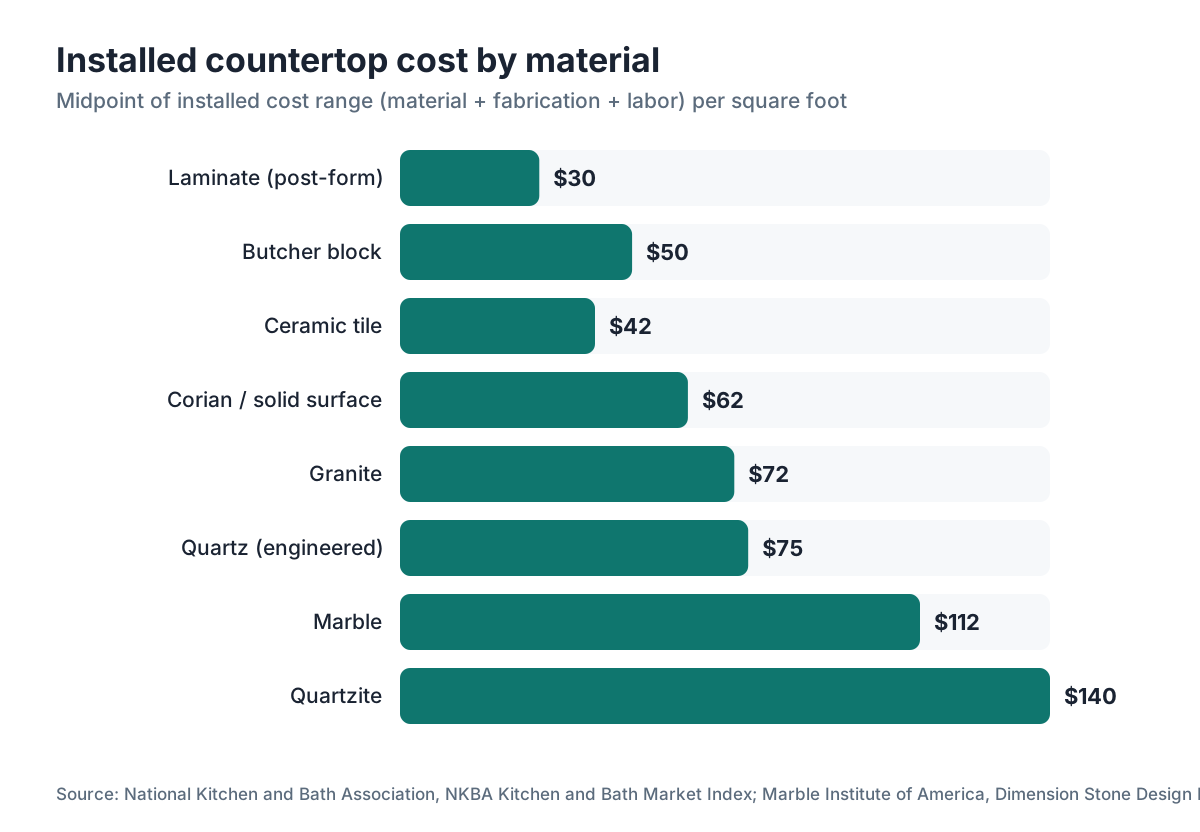
Here is what the numbers look like broken out by material. These are installed prices, meaning material plus fabrication plus labor, for a typical kitchen:
| Material | Installed cost per sq ft | Notes |
|---|---|---|
| Laminate (post-form) | $20, $40 | Mostly labor; material is cheap |
| Butcher block (wood) | $35, $65 | Requires sealing after install |
| Tile (ceramic/porcelain) | $25, $60 | Grout lines are a maintenance issue |
| Quartz (engineered) | $50, $100 | Largest installed market share |
| Granite (natural stone) | $45, $100 | Wide range by slab origin |
| Marble | $75, $150 | Fabrication more expensive |
| Quartzite | $80, $200 | Hard stone, slower to cut |
| Soapstone | $70, $120 | Softer; needs regular oiling |
| Corian / solid surface | $45, $80 | Seams can be invisible |
Granite installed sits at $45, $100 per square foot, with the national average around $65, $75 for a mid-grade slab [1]. Exotic granites imported from Brazil or India push the top end. Domestic granites or remnant slabs can hit the low end if your kitchen is small enough to cut from leftover inventory.
Labor alone, separate from material, typically runs $10, $30 per square foot for stone [2]. Laminate labor is cheaper because the material is lighter and the cuts are simpler. Complex layouts, multiple cutouts, or an old kitchen with walls out of square all add time and cost.
What are the steps in a professional countertop installation?
A professional stone install follows a predictable order, and knowing it helps you dodge surprises. From signed contract to finished countertop, plan on 1 to 3 weeks for stone, faster for prefab materials.
Demo and prep. The old countertops come out first. Plywood underlayment, if present, gets inspected or replaced. Cabinets are checked for level. A variance of more than 1/8 inch across a run needs shimming before anything gets installed, or the stone can crack.
Templating. For natural stone and engineered quartz, a fabricator templates the space either with cardboard and a marking tool (old-school) or a digital laser templating device. Digital templating is faster and more accurate. The template captures every wall angle, the sink cutout location, cooktop cutouts, and the precise overhang on each side. On a typical kitchen, templating takes 45 to 90 minutes.
Fabrication. The template goes back to the shop. A CNC waterjet or bridge saw cuts the slab to shape. Edge profiles (eased, beveled, ogee, and so on) are routed and polished. Cutouts for sinks and cooktops are made. This shop time usually runs 3 to 7 business days depending on backlog.
Delivery and installation. Stone slabs are heavy. A 3-centimeter granite slab weighs roughly 18 to 20 pounds per square foot [3]. A typical 50-square-foot kitchen countertop weighs 900 to 1,000 pounds total, so a two- or three-person crew is standard. Slabs come in through the widest entry point, often a side door or sliding glass door. They get set on the cabinets, checked for fit, and adhered with silicone or epoxy. Seams are filled and polished to match the surrounding stone. Undermount sinks are usually clipped from below.
Curing and cleanup. Silicone needs 24 hours to cure fully. The fabricator will tell you when you can use the sink and when to avoid setting heavy pots. Polished surfaces get a final wipe-down and a first coat of sealer if needed.
The whole installation day for a medium kitchen usually runs 3 to 6 hours. Complications, like a sink that's slightly off the cabinet centerline or a wall that curves, add time.
Can you install kitchen countertops yourself?
Yes, for some materials. No, for stone slabs. Here's the honest breakdown.
DIY-friendly: Laminate (post-form or sheet), butcher block, tile, and Corian-style solid surface in simple runs. These materials cut with a circular saw or jigsaw, weigh a manageable amount, and don't need polishing equipment. A skilled DIYer can install a post-form laminate countertop in an afternoon.
Not practical for DIY: Natural stone (granite, marble, quartzite, soapstone) and engineered quartz. The slab weighs hundreds of pounds, needs a bridge saw or CNC waterjet to cut cleanly, and the edge profile needs a wet polisher with diamond pads. Most fabricators won't sell you an unfinished slab for DIY installation, and the risk of a cracked slab on delivery or during setting is real.
Laminate countertops and Formica-style surfaces are the classic DIY choice for budget renovations. The material costs $5, $15 per square foot, and installation needs basic carpentry tools. YouTube tutorials are accurate for straight runs. Corners and miters add complexity.
One honest caveat on DIY: make a measuring mistake on a stone slab and you pay for a new slab. Fabricators won't warranty a slab you took possession of. The savings from skipping professional installation vanish fast on a $1,500 slab.
If you do go DIY on laminate or butcher block, the two mistakes that bite hardest are ignoring out-of-square walls (scribe the back edge to the wall rather than assuming it's straight) and under-sizing the sink cutout. Measure from the manufacturer's sink template, not the sink itself.
How do you prepare cabinets for new countertop installation?
Cabinet prep is the step most homeowners underestimate. Fabricators have walked into kitchens where the cabinets varied 3/4 inch in height across a 10-foot run. That kind of variance cracks stone.
The first check is level. Run a 4-foot or 6-foot level across the top of the cabinets. Every cabinet in a run should sit within 1/8 inch of the same height. If they don't, shim the low spots before the template appointment. Some fabricators include shimming in their install quote; others charge separately. Ask.
The second check is the cabinet box condition. Old kitchens sometimes have soft spots in the cabinet tops from water damage, especially under the sink. Replace the plywood deck if it's soft. Stone needs solid support, and a failed cabinet under a stone top is expensive to fix after the fact.
For undermount sinks, the sink cabinet gets extra attention. The sink opening in the countertop is cut to the template, and the sink clips attach to the underside of the slab. The cabinet face frame has to clear the undermount clips. Some older cabinet styles get in the way, and a carpenter may need to notch or trim the frame.
Plumbing disconnect is usually the homeowner's job before installation day, or a plumber's. Fabricators do not normally disconnect and reconnect plumbing, though some will manage it for an extra fee. Confirm this before the install appointment.
How long does countertop installation take from start to finish?
The timeline runs in three phases that trip up homeowners used to same-day services.
First is material selection and order placement. Once you choose a slab or material, the fabricator locks it in. For natural stone, the specific slab is your slab once purchased, since each one is unique. For quartz, sheets are more interchangeable.
Second is template to fabrication. After the template visit, most shops need 5 to 10 business days to fabricate stone countertops. High-volume shops in busy seasons can push that to 2 weeks. Prefab countertops (pre-cut to standard sizes) move faster.
Third is installation day. The actual install takes 3 to 6 hours for a standard kitchen. Plan to be home. Plan to have pets and kids elsewhere.
Total timeline from contract signing to finished install:
| Material | Typical total timeline |
|---|---|
| Laminate (post-form prefab) | 1 to 3 days |
| Butcher block | 1 to 5 days |
| Quartz or granite (custom fab) | 10 to 20 business days |
| Marble, quartzite (complex) | 14 to 25 business days |
Rush fabrication is possible at some shops for a premium, sometimes 20 to 30% added cost, if their schedule allows.
What are the most popular countertop materials and how do they compare for installation?
The material you pick drives more than looks. It sets the complexity and cost of installation, the timeline, and what happens if something goes wrong later.
Quartz (engineered stone) is the most-installed material in U.S. kitchens by volume in recent survey years, partly because it's consistent in thickness and color, which makes fabrication predictable [9]. Brands like Cambria are engineered quartz. It installs the same as granite process-wise.
Granite is natural stone, so every slab is different. Color and veining vary lot to lot. Installed granite averages $65, $75 per square foot for a mid-grade stone in a standard U.S. market [1]. It's harder than quartz and slightly heavier.
Marble is softer and etches from acids (lemon juice, vinegar). Fabrication is similar to granite, but the stone is more delicate to handle, and polishing scratches out of marble during installation takes more care.
Butcher block is the DIY-friendly wood option. It installs with construction adhesive and screws driven up through the cabinet. You finish the top with food-safe mineral oil after installation.
Laminate / Formica is the budget option that's had a design comeback. Modern laminate mimics stone convincingly. Installation is straightforward, but seams show, and water at the seams can swell the substrate over time.
Corian and solid surface is mid-range, repairable with sanding, and available in continuous runs because the seams are chemically welded and invisible. Installation needs a certified fabricator for warranty coverage.
For a full overview of options before you decide, kitchen countertops covers the tradeoffs in detail.
What are the most expensive parts of countertop installation?
Homeowners zero in on material cost and get blindsided by line items that stack up fast.
Slab upgrades. Stone is sold in grades (Level 1, 2, 3, or similar tier labels). A Level 1 granite might run $45/sq ft installed; a Level 4 exotic is $100+. This is the single biggest cost variable.
Edge profiles. An eased edge (simple flat bevel) is usually included. An ogee, waterfall, or dupont edge adds $15, $30 per linear foot. A standard 50-sq-ft kitchen has roughly 20 to 25 linear feet of exposed edge. An upgraded profile can add $400, $600 to the job.
Sink cutouts. A basic sink cutout runs $100, $200. An undermount farm sink with an apron cutout is more complex and costs more.
Backsplash cuts. If the fabricator cuts a stone backsplash from the same slab, that's additional linear footage of material and labor.
Tear-out of existing countertops. Demo and haul-away adds $150, $400 depending on the market and how much material has to go.
Plumbing reconnection. If you need a plumber to disconnect and reconnect the sink, budget $150, $300 depending on your market.
The fabricator quote should itemize all of these. If it doesn't, ask.
How do fabricators measure and quote countertop jobs?
Fabricators price countertops by the square footage of slab needed, not by your finished countertop area. That trips up homeowners who measure their counter surface and then see a bigger number on the quote.
The reason is yield. A rectangular slab doesn't yield only rectangles. When the fabricator cuts the island, the perimeter runs, and the sink cutout, the leftover pieces (the cutout, the corner waste, the thin strips) are useless for your job. Industry practice is to charge for the full rectangle bounding each piece, or to apply a waste factor, typically 15 to 20% added to net square footage [2].
The fastest way to sanity-check a quote is to measure net countertop area (length times depth for each run, add them up), then add 20% and multiply by the per-square-foot rate quoted. That should roughly match the quoted total.
Fabricator software like SlabWise automates this yield math using digital nesting, which optimizes how pieces lay out on the slab to cut waste. That matters more to the fabricator than the homeowner, but it can shave quoted prices at shops that pass the savings through.
For a comparison shop on getting accurate quotes, countertop installation has a section on reading fabricator quotes.
What permits and building codes apply to countertop installation?
In most U.S. jurisdictions, replacing countertops in kind (same material, same layout) does not require a building permit [4]. It counts as a cosmetic replacement, not a structural or system change.
Permits come into play in two scenarios. First, if you're doing a full kitchen remodel that moves plumbing, gas lines, or electrical, those trades need permits regardless of the countertop material. Second, in some jurisdictions, altering a kitchen in a rental property triggers disclosure or a permit.
No federal building codes specifically govern countertop materials. The International Residential Code (IRC) and International Building Code (IBC) do not specify countertop materials for residential kitchens [5]. Local amendments vary.
One area does have regulatory language: radon in granite. The EPA has published guidance on granite countertops and radon, concluding from testing and studies that most granite countertops emit radon well below EPA action thresholds, though there's natural variation by stone origin [6]. The EPA's own position: "EPA does not recommend testing granite countertops for radon" as a routine matter, though homeowners with concerns can do so.
For commercial kitchens (a different reader, but worth flagging), the NSF/ANSI 2 food equipment standard requires countertop surfaces to be smooth, non-porous, and cleanable [7]. Residential kitchens aren't subject to NSF standards, but the principle still guides smart material choices.
How do you care for new countertops after installation?
The first 24 hours after installation matter. Silicone adhesive needs time to cure, and the fabricator will tell you how long to keep heavy pots and pans off the surface. Granite and quartzite seams filled with epoxy cure harder faster but still earn a day of rest.
Sealing stone is the main ongoing task. Most granite and marble comes pre-sealed by the fabricator, but that first seal doesn't last forever. A rough guide: granite needs resealing every 1 to 3 years depending on stone porosity, marble every 6 to 12 months because it's more porous [3]. A water bead test tells you when the seal is failing. Drop a tablespoon of water on the surface. If it beads, you're fine. If it soaks in under a minute, reseal.
For quartzite, which many homeowners confuse with quartz, see how to clean quartzite countertops for material-specific care. For soapstone, which self-heals minor scratches and needs periodic oiling rather than sealing, how to clean soapstone countertops has the full routine. For general stone maintenance, how to clean stone countertops covers the basics that carry across granite, marble, and quartzite.
Butcher block needs food-safe mineral oil on installation and every month or two after that, especially around the sink. Let it soak in overnight, wipe off the excess.
Engineered quartz needs almost nothing. Soap and water. Avoid abrasive pads and harsh chemicals, which dull the finish over time. Unlike natural stone, quartz is non-porous and never needs sealing.
One thing damages more countertops than anything else: heat. Even granite can thermally shock and crack from a hot pan dropped straight off the burner. Use trivets. Always.
What are the biggest installation mistakes homeowners make?
Measuring yourself and trusting those measurements for a stone order is the top mistake. Walls in older homes are almost never square or straight. A measurement at one end of a wall run can differ from the other end by 1/2 inch or more. Fabricators template in person for a reason. If a fabricator offers to quote and cut off your measurements alone, that's a red flag.
Skipping the level check on cabinets before template day wastes time and can force a second visit when the crew shows up and finds cabinets that need shimming first.
Not confirming sink and faucet hole locations before fabrication is another expensive error. Once the slab is cut, moving a faucet hole or resizing a sink opening means a new slab or an ugly patch.
Picking a countertop color from a small showroom sample and never viewing the actual slab is a classic natural-stone blunder. A 4-inch sample doesn't represent a 60-square-foot slab with veining, variation, and movement. Go to the yard and approve the specific slab before fabrication starts. Reputable fabricators expect this.
And this one: not getting the seam location agreed in writing before fabrication. Seams are necessary when a run runs longer than a single slab (typically over 10 feet). Where the seam lands matters aesthetically. The fabricator optimizes for material yield; you want the seam landing somewhere inconspicuous, like the center of a seating area or away from the main prep zone. Settle it before the saw runs.
How do you get accurate quotes for countertop installation?
Get at least three quotes, and make sure they cover identical scope. The variables that turn a comparison into apples-to-oranges: edge profile included or extra, demo and haul-away included or extra, sink cutout included or extra, number of seams, and whether the quote includes a first sealer coat.
Bring your measurements to each quote conversation, but expect the fabricator to run their own template before a final price locks. Initial quotes based on your measurements are estimates.
Ask about slab origin and grade. A quote for "granite" could mean a domestic Level 1 commodity stone or an imported Level 3 exotic. Those aren't comparable products at the same price.
At shops running quoting software, the estimate you get often includes a slab layout diagram showing how your pieces nest. Software like SlabWise generates these automatically and gives fabricators a more accurate waste calculation, which can trim padding in quotes. If you're a fabricator reading this and quoting by hand, that's the demo worth watching.
Online countertop quote calculators give you a ballpark fast. The National Kitchen and Bath Association's cost research suggests homeowners typically spend 10 to 15% of their overall kitchen remodel budget on countertops [1]. For a $30,000 remodel, that's $3,000, $4,500 for countertops, which tracks with the per-square-foot numbers above for mid-range materials.
Frequently asked questions
How much does it cost to install a kitchen countertop per square foot?
Installed cost (material plus fabrication plus labor) runs $20, $40 per square foot for laminate, $45, $100 for granite and quartz, and $75, $200 for marble and quartzite. Labor alone adds $10, $30 per square foot for stone. A typical 50-square-foot kitchen runs $2,500, $5,000 for mid-range stone, fully installed.
How long does kitchen countertop installation take?
Installation day takes 3 to 6 hours for a standard kitchen. The total timeline from contract to finished install is 10 to 20 business days for custom stone, because fabrication takes 5 to 10 days after templating. Laminate and prefab butcher block can be done in 1 to 3 days. Rush fabrication is possible at some shops for an added premium.
Do I need a permit to replace kitchen countertops?
In most U.S. jurisdictions, replacing countertops in kind does not require a permit. It's a cosmetic replacement, not a structural or system alteration. Permits are required if the project moves plumbing, gas, or electrical. Always check with your local building department if you're unsure, especially in condos or rental properties.
Can I install granite countertops myself?
Not practically. Granite slabs weigh 18 to 20 pounds per square foot, need a bridge saw or CNC waterjet to cut cleanly, and need a wet polisher for edge profiles. Most fabricators won't sell unfinished slabs for DIY installation. The risk of cracking a $1,500+ slab during a DIY install outweighs the labor savings for nearly every homeowner.
What countertop material is easiest to install yourself?
Post-form laminate is the easiest DIY countertop material. It's light, cuts with a circular saw, and installs with construction adhesive and screws. Butcher block is a close second and installs similarly. Both materials are forgiving enough that a skilled DIYer can finish a standard kitchen in a day with basic tools.
How much does it cost to install granite kitchen countertops specifically?
Granite installation costs $45, $100 per square foot fully installed, with a national average around $65, $75 for mid-grade stone. A 50-square-foot kitchen runs $2,250, $5,000. Exotic imported granites push the top end. Remnant slabs for small kitchens can hit the bottom of that range. Edge profiles and sink cutouts add to the total.
What is the difference between templating and measuring for countertops?
Measuring means recording dimensions with a tape measure. Templating means capturing the exact shape of the space, including wall angles, curves, and precise cutout locations, either with a physical cardboard template or a digital laser device. Stone fabricators always template in person because walls in real kitchens are rarely square, and even a 1/4-inch error causes problems.
How long after installation can I use my countertops?
You can use most stone countertops lightly within a few hours of installation. Full silicone cure takes 24 hours, so avoid heavy loading or using the area as a cutting surface for a day. The fabricator will give specific guidance. Undermount sinks are usually usable the same day, but some fabricators prefer to wait 24 hours before reconnecting plumbing.
Do fabricators remove and dispose of old countertops?
Most do, for an additional fee. Demolition and haul-away typically adds $150, $400 depending on the market, the quantity of material, and whether it involves heavy stone. This should be a separate line item in your quote. To save money, you can demo and dispose of the old countertop yourself before the template appointment.
What is a countertop waste factor and why does it affect my quote?
When a fabricator cuts your pieces from a slab, the leftover material (cutout waste, corner offcuts, unusable strips) can't be reused for your job. Fabricators add a waste factor, typically 15 to 20% of net square footage, to account for it. That's why your quote may show more square footage than you measured. It's standard industry practice, not padding.
What edge profiles add the most cost to a countertop job?
Eased and beveled edges are usually included in the base price. Ogee, dupont, and waterfall (mitered) profiles add $15, $30 per linear foot. A typical kitchen has 20 to 25 linear feet of exposed edge, so an upgraded profile can add $400, $750 to the job. The waterfall edge (where the surface folds down vertically over a cabinet side) needs extra slab material and adds the most cost.
How do I know if my cabinets are ready for new countertops?
Check two things: level and structural condition. Cabinets should sit within 1/8 inch of the same height across a full run; anything more needs shimming before the template visit. Also check under the sink area for soft spots or water damage in the cabinet deck. Replace any compromised plywood before installation. Most fabricators will flag issues during the template appointment.
Are countertop seams visible and can they be avoided?
Seams are visible on close inspection but should be tight and color-matched. They're unavoidable when a run exceeds a single slab length, typically over 9 to 10 feet. A good fabricator minimizes seams and places them away from main prep areas. Agree on seam placement before fabrication starts. Engineered quartz seams can be almost invisible with precise color matching.
Does a new countertop installation come with a warranty?
It depends on the material and fabricator. Engineered quartz makers like Cambria offer 10-year to lifetime warranties on the material itself, but those require professional installation and may carry specific care requirements. Fabricators typically warrant their own workmanship (seams, edge quality, cutouts) for 1 to 2 years. Get warranty terms in writing before signing a contract.
Sources
- National Kitchen and Bath Association, NKBA Kitchen and Bath Market Index: Average installed countertop costs and share of overall kitchen remodel budgets for quartz and granite in U.S. kitchens
- U.S. Bureau of Labor Statistics, Occupational Employment and Wage Statistics: Tile and Stone Setters: Labor cost ranges for stone and tile installation workers in the United States
- Marble Institute of America (MIA+BSI), Dimension Stone Design Manual: Weight per square foot of 3cm granite slab material and sealing frequency guidelines for natural stone
- International Code Council, International Residential Code (IRC) 2021: Countertop replacement in kind does not constitute a structural alteration requiring a permit under the IRC
- International Code Council, International Building Code (IBC) 2021: No IBC provision specifies countertop materials for residential kitchens
- U.S. Environmental Protection Agency, Granite Countertops and Radiation: EPA does not recommend routine testing of granite countertops for radon; most emit below EPA action thresholds
- NSF International, NSF/ANSI 2: Food Equipment: Commercial food-contact surfaces must be smooth, non-porous, and easily cleanable per NSF/ANSI 2
- U.S. Department of Housing and Urban Development, Healthy Homes Program: Renovation work in pre-1978 housing (including kitchens) may trigger Lead Renovation, Repair and Painting Rule requirements
- Home Innovation Research Labs, Annual Builder Practices Survey: Engineered quartz is the most-installed countertop material in new U.S. single-family kitchens by volume in recent survey years
- U.S. Consumer Product Safety Commission, Safety Standards for Kitchen Products: No federal consumer product safety standard governs countertop installation methods for residential kitchens
Last updated 2026-07-09