TL;DR
- Countertop installation costs range from about $15 per square foot for laminate to $250 or more for premium marble, material and labor included.
- A typical 30-square-foot kitchen runs $500 to $7,500 depending on what you pick.
- Labor alone usually adds $10, $30 per square foot on top of material cost.
- Complexity, edge profiles, and cutouts push the total higher.
What does countertop installation cost on average?
The honest answer is: it depends enormously on material, and that single choice swings the budget more than anything else. According to the U.S. Census Bureau's American Housing Survey, kitchen remodeling is one of the most common home improvement projects, and countertops are typically one of the two or three largest line items [1]. Industry pricing surveys from HomeAdvisor and Remodeling Magazine's Cost vs. Value Report put the national average for a full kitchen countertop replacement at roughly $1,500 to $5,500 for a standard 30-square-foot kitchen, all in [2].
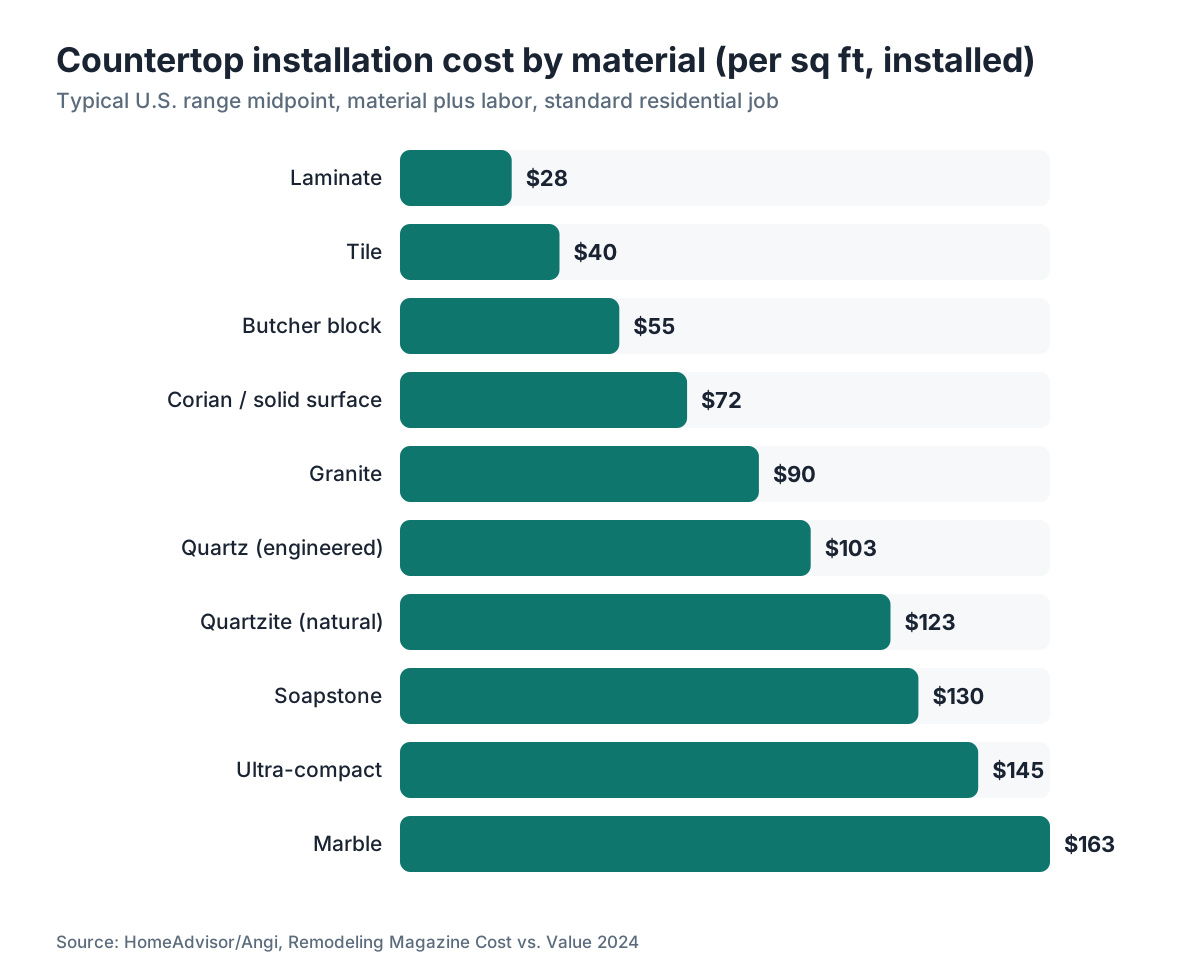
That range sounds wide, but it makes sense once you see the per-square-foot breakdown. Laminate sits at the low end ($15, $40 per square foot installed). Granite runs $50, $130 installed. Quartz lands at $55, $150. Marble pushes $75, $250 or higher for rare stones. Engineered materials like Corian and similar solid surfaces fall around $45, $100 installed.
Labor is usually $10, $30 per square foot on top of material cost, though some fabricators bundle it into an all-in price per square foot. If a shop quotes you separately for labor and material, that's actually easier to compare against other bids.
Square footage is measured by the fabricator during a template visit, not by you with a tape measure. Fabricators measure the actual slab area including overhangs (typically 1.5 inches on the front, sometimes more for a waterfall edge or thick island), so your finished countertop square footage is always a bit larger than the raw cabinet top area.
How does material choice change the total price?
Material is the biggest lever you have. Here's a realistic per-square-foot installed range for the most common options:
| Material | Low ($/sq ft) | High ($/sq ft) | Notes |
|---|---|---|---|
| Laminate | $15 | $40 | DIY-friendly; limited edge options |
| Butcher block | $30 | $80 | Needs sealing; can be refinished |
| Tile | $20 | $60 | Grout maintenance is real |
| Corian / solid surface | $45 | $100 | Hidden seams; scratches polish out |
| Granite | $50 | $130 | Natural variation; needs sealing |
| Quartz (engineered) | $55 | $150 | Low maintenance; wide color range |
| Quartzite (natural) | $65 | $180 | Harder than marble; needs sealing |
| Marble | $75 | $250+ | Etches and stains; classic look |
| Soapstone | $80 | $180 | Develops patina; very heat resistant |
| Ultra-compact (Dekton, Neolith) | $90 | $200 | UV and heat resistant; brittle to impact |
Prices above include fabrication and basic installation for a straightforward layout [2][3]. They do not include removal of existing countertops (add $3, $10 per linear foot) or plumbing reconnection (add $150, $400 depending on your market).
The cost of marble countertops installed deserves special attention because the range is so wide. Entry-level Carrara marble runs $75, $120 per square foot installed. Calacatta Gold or Statuario can run $200, $350 per square foot because those slabs are rare and the material cost alone is high. If you're pricing marble countertops, always ask the fabricator to show you the actual slab you're buying, more than a sample chip. Pattern matching across multiple slabs adds labor cost too.
Granite countertops are often cheaper than people expect. Commodity granite colors (Santa Cecilia, Uba Tuba, Venetian Gold) are globally abundant and heavily stocked, so a basic granite install can be very competitive with quartz. Exotic granites with rare patterning cost more. The kitchen countertops guide on this site goes deeper on the full decision matrix if you're still choosing a material.
What labor costs are included in a countertop installation quote?
A standard countertop installation quote from a fabricator typically bundles several labor components together, even if the invoice only shows one line.
Templating is the first step. A technician comes out, measures the actual cabinets, marks sink and cooktop locations, and creates a digital or physical template. This usually takes one to two hours and costs $75, $200 as a standalone charge, though many shops waive it when you buy the material through them.
Fabrication covers cutting the slab to shape, polishing edges, and cutting sink and cooktop holes at the shop. This is the most labor-intensive part. A simple rectangular layout with a single undermount sink cutout might take three to four shop hours. An L-shaped kitchen with two sinks, a cooktop cutout, and mitered corners can run eight to twelve hours.
Installation is the on-site part: the crew (usually two people for stone) carries in the slabs, sets them on the cabinets with adhesive or silicone, joins seams, and caulks the backsplash gap. For a standard kitchen this takes two to four hours. Heavy stone in a tight space with stairs takes longer.
Some shops charge for sealing as a separate line item ($50, $150 for a kitchen). Others seal as part of installation. Ask before you sign.
If you're working with a fabricator on the quoting side, software like SlabWise can help price these components accurately from a digital template, reducing the back-and-forth on change orders when a cutout or edge profile changes.
What extra charges show up after you get a quote?
This is where budgets get surprised. The base quote often assumes a clean, simple job. Real kitchens rarely are.
Edge profiles are the most common add-on. A simple eased or beveled edge is usually included. Ogee, waterfall, dupont, or chiseled edges add $10, $25 per linear foot. On a 50-linear-foot kitchen perimeter, that's $500, $1,250 extra.
Sink cutouts are typically $100, $250 each. Cooktop cutouts run similar. A farmhouse sink with an apron front requires extra material and fitting time, often $200, $350 additional.
Seams cost money both in material (you lose stone at each seam) and labor. A kitchen with an island plus a perimeter run will almost certainly have at least one seam. Ask where seams will fall before you approve the layout.
Removal of existing countertops is not always quoted automatically. If you have old tile glued to plywood, or laminate that's been glued down, removal takes longer and costs more. Budget $100, $400 for removal depending on material and size.
Plumbing reconnection is usually not in the fabricator's scope. You'll need your own plumber (or sometimes the general contractor) to reconnect the sink drain and supply lines. In most U.S. markets that's $150, $400 for a straightforward reconnect [4].
Backsplash tile installation is a separate trade. If your backsplash runs to the underside of wall cabinets and the new countertop changes the reference height, budget for tile work separately.
Leveling and shimming can also add cost if your cabinets aren't level. Fabricators will shim, but if significant carpentry work is needed to level a cabinet run, that's a carpenter's job, not the stone installer's.
How much does countertop installation cost for a bathroom vanity?
Bathroom vanities are smaller but not proportionally cheaper. Setup time, travel, and minimum job charges mean a 10-square-foot vanity top often costs $400, $900 installed even in mid-range materials.
For a single bathroom vanity (typically 2 to 5 square feet of countertop), expect:
- Laminate or cultured marble: $200, $500 installed
- Quartz or granite: $400, $900 installed
- Marble: $500, $1,200 installed
Double vanities (8 to 15 square feet) cost more but get closer to a per-square-foot rate that makes sense. Most fabricators have a minimum charge of $400, $600, which is why a tiny powder room vanity feels expensive on a per-square-foot basis.
Bathroom installations also often include a vessel sink opening or an integral sink, both of which add to the quote. An undermount sink cutout in a bathroom is the same charge as in a kitchen: $100, $250 depending on the shop.
Does countertop thickness affect the installed price?
Yes, and more than most people realize. The two standard thicknesses for natural stone and engineered quartz are 2 cm (about 3/4 inch) and 3 cm (about 1.25 inches). Most residential jobs in the U.S. now use 3 cm as the default because it looks more substantial and doesn't require a plywood buildup layer underneath.
2 cm slabs need a build-up strip (a piece of stone laminated to the front edge) to achieve a full-thickness look, which adds labor and material cost. In practice, 3 cm slabs often come out close in total cost to 2 cm plus build-up.
Ultra-thick profiles (4 cm or mitered waterfall edges that create the illusion of 6+ cm thickness) are a premium. A mitered island waterfall in quartz can add $1,000, $3,000 to a job depending on the island size.
Laminate and solid surface products have their own thickness standards and don't follow the stone logic. Laminate countertops are typically 1.5 inches thick as a finished post-formed piece, or thinner as a sheet glued to substrate.
What is the cost of installing marble countertops specifically?
Marble gets its own section because the cost of installing marble countertops varies more than any other material, and there are real maintenance costs to factor in that other materials don't have.
On the low end, honed Carrara marble in a simple kitchen layout runs $75, $100 per square foot installed. That's honest pricing for a commodity marble that's widely quarried in Italy and stocked by most slab distributors [8]. A standard 30-square-foot kitchen in Carrara comes out to $2,250, $3,000.
In the middle range, marbles like Calacatta Borghini, Arabescato, or Statuario Extra run $120, $180 per square foot installed because the raw slab cost is higher and the veining pattern requires more careful layout and potential waste.
At the top, rare marbles such as Calacatta Gold or Breccia Capraia can hit $200, $350 per square foot installed, and that's when you see the real cost of marble countertops installed. On a 50-square-foot kitchen, that's $10,000, $17,500 for countertops alone.
Beyond the install price, marble needs sealing every 1 to 3 years (budget $50, $150 per application for professional sealing, or do it yourself for $20, $40 in product cost). Acidic liquids like lemon juice, vinegar, and wine etch polished marble surfaces. That's not a defect, it's just how calcite-based stone works. The Natural Stone Institute puts it plainly: marble is susceptible to etching from acids because of its calcite content [8]. A honed finish hides etch marks better than a polished one.
If you love the look but want lower maintenance, quartzite (a metamorphic rock, not engineered) gives a similar look with better acid resistance. See the guide on how to clean quartzite countertops for a sense of ongoing care. For marble care specifically, the how to clean stone countertops guide applies directly.
How do fabricators calculate square footage and price a job?
Fabricators don't price by the footprint of your cabinets. They price by the slab area needed to produce your finished countertops, including overhangs, waste from cuts, and material lost at seams.
A standard countertop overhang is 1.5 inches (1 inch on the back near the wall, 1.5 inches on the front). Island countertops sometimes have 10 to 15 inch overhangs on the seating side, which adds significant square footage.
The industry standard for waste factor on a simple rectangular kitchen is about 15 to 20%. On a complex layout with multiple angles, a bay window, or large sink cutouts, waste can hit 25 to 30%. You're paying for the full slab area the fabricator has to purchase, more than what ends up on your cabinets.
Some shops show you the full slab price and deduct remnants. Others quote a flat per-square-foot installed rate and absorb the waste into their margin. Neither approach is more honest, but asking how waste is handled helps you compare quotes apples to apples.
For shops quoting on software, the nesting step (fitting your cut pieces onto the available slab area to minimize waste) directly affects what you charge. SlabWise handles this digitally, which helps fabricators reduce material waste and generate accurate quotes faster. If you're a fabricator getting inconsistent margins on complex jobs, that's often a nesting and waste-factor problem.
See the countertop installation guide for more on what the installation process looks like from the fabricator's side.
Can you save money by buying your own slab and hiring a fabricator separately?
Sometimes. Slab distributors (sometimes called slab yards or stone yards) do sell direct to consumers in many markets. If you find a slab you love at a distributor, you can theoretically buy it and then hire a fabricator to cut and install it.
The catch is that most fabricators prefer to source material themselves for a few reasons. They know which distributors have consistent quality. They have accounts with credit terms. And honestly, material markup is part of their margin. Some fabricators will refuse to work with owner-supplied material. Others will accept it but charge a higher fabrication rate to offset the lost markup, which can wipe out your savings.
Where buying your own slab can genuinely save money is on exotic or specialty slabs where you've found a specific piece at a good price, or when a distributor has a remnant sale. Remnants (leftover slab pieces from other jobs) can be dramatically cheaper for small bathrooms or islands. A remnant large enough for a 15-square-foot bathroom vanity might be $150, $400 in material vs. $600, $900 for a fresh slab allocation.
For budget-conscious projects, laminate countertops and Formica countertops are genuinely the most cost-effective options, and modern laminate quality has improved a lot. Corian countertops and Cambria countertops occupy different parts of the market and are almost always fabricator-sourced due to brand distribution agreements.
For wood lovers, butcher block countertops are one area where skilled DIYers can meaningfully cut cost by doing their own installation, since the material is available at home improvement stores and doesn't require a stone fabricator.
How do countertop installation costs vary by region?
Labor rates vary substantially by geography. A granite install in rural Tennessee costs less than the same job in San Francisco, and by more than a little. Major metro areas in California, New York, and the Pacific Northwest run 30 to 50% above national average labor rates. The South and Midwest generally run 10 to 20% below [4][9].
Material costs are more uniform nationally because slabs are shipped long distances. A Cambria quartz slab costs roughly the same in Dallas as it does in Boston at the distributor level. But some materials with regional quarrying (some granites in the Southeast, certain Texas limestone products) have lower transport costs in their home markets.
Permit requirements for countertop installation are minimal in most jurisdictions. Replacing countertops is typically a cosmetic alteration that doesn't require a building permit. If the project involves changing the location of a sink (which requires moving plumbing) or adding an electrical outlet near the new countertop (which requires an electrical permit), those trades have their own permit requirements [7].
Always get at least three quotes for any job over $2,000. In a competitive market, bids for the same scope can vary 20 to 40% between shops, and the cheapest bid isn't always the worst quality or the priciest the best.
What questions should you ask a fabricator before you sign?
A few things are worth confirming in writing before any contract is signed.
First, ask what's included in the square footage price. Does it include templating, standard edge profile, one sink cutout, and sealing? Or is each of those a separate add-on? Shops that bundle everything into one price are easier to compare; shops that itemize aren't being sneaky, they're just pricing differently.
Second, ask to see the actual slab before fabrication. For natural stone, you should be looking at the slab you're buying, ideally with a layout drawn on it showing where your countertop pieces will come from. Vein direction, color variation, and any natural fissures should be visible and acceptable to you before the saw runs.
Third, ask about the seam locations and how they'll be handled. Seams in stone are filled with color-matched epoxy and polished. A well-done seam is barely visible in good lighting. A poorly done seam is obvious. Ask to see photos of finished seams from past jobs.
Fourth, ask about the warranty and what happens if a slab cracks during fabrication or installation. Reputable fabricators carry insurance and will replace a damaged piece. Get that commitment in writing.
Fifth, confirm who is responsible for plumbing reconnection. Some full-service remodelers include a plumber on their crew. Most stone fabricators do not. Know who's doing that work and budget for it separately if needed.
Is DIY countertop installation realistic, and does it save money?
For some materials, yes. For others, no.
Laminate sheet countertops, post-formed laminate, and butcher block are all realistic DIY installations with basic carpentry skills. Laminate sheet work requires contact cement, a router, and patience, but YouTube tutorials are genuinely good for this. Post-formed laminate (the kind with the rounded front edge already built in) is almost plug-and-play.
Tile countertops are also DIY-able with basic tiling skills. The downside is grout maintenance forever.
Natural stone, engineered quartz, and ultra-compact surfaces are not realistic DIY projects for almost anyone. A full 3 cm granite slab weighs 18 to 20 pounds per square foot. A 30-square-foot kitchen has 540 to 600 pounds of stone, usually in two or three pieces that require two strong people minimum and often special suction cups to handle safely. Cuts and polishing require diamond tooling and water-fed equipment that most homeowners don't own. There's also a real health angle: OSHA warns that cutting engineered stone releases crystalline silica dust, and it set specific rules for the industry [10]. Mistakes are expensive because you can't return a cut slab.
Solid surface (Corian-type) is somewhere in between. It's lighter than stone, cuts with woodworking tools, and seams are chemically fused and can be polished. Some skilled woodworkers do solid surface DIY installs successfully.
The realistic DIY savings for laminate or butcher block is $200, $600 in labor on a typical kitchen. For stone, the savings don't exist because the risk of a broken slab or a botched seam erases any potential gain.
Frequently asked questions
How much does it cost to replace kitchen countertops in 2025?
A standard 30-square-foot kitchen countertop replacement costs roughly $1,500 to $5,500 all in, depending on material. Laminate is the low end at $15, $40 per square foot installed. Quartz and granite run $55, $150 per square foot installed. Marble and premium natural stones can push $200+ per square foot. Labor (templating, fabrication, installation) usually adds $10, $30 per square foot on top of material.
What is the cheapest countertop material to install?
Laminate is the cheapest option at $15, $40 per square foot installed. Post-formed laminate with a pre-built edge is even faster to install and sits at the low end of that range. Tile is similarly affordable at $20, $60 installed but comes with ongoing grout maintenance. Butcher block runs $30, $80 installed and is a DIY-friendly option that can look substantially more expensive than its price.
How much does granite countertop installation cost?
Granite countertop installation costs $50, $130 per square foot in most U.S. markets, material and labor bundled. On a 30-square-foot kitchen, that's $1,500, $3,900. Commodity granite colors (Santa Cecilia, Uba Tuba) sit at the low end because they're widely stocked. Exotic or rare granite with unusual patterning costs more. Add $100, $250 per sink cutout and extra for premium edge profiles.
How much does quartz countertop installation cost?
Quartz countertop installation costs $55, $150 per square foot installed, all in. Mid-range quartz from major brands like Cambria, Silestone, or Caesarstone runs $70, $110 per square foot installed in most markets. Entry-level quartz from lesser-known brands can come in under $65. Quartz is low maintenance (no sealing required), which means lower lifetime cost than marble even when the upfront price is similar.
What does marble countertop installation cost per square foot?
Marble countertop installation costs $75, $250+ per square foot, all in. Entry-level Carrara marble runs $75, $100 installed. Mid-tier marbles like Calacatta Borghini run $120, $180. Rare stones like Calacatta Gold push $200, $350 per square foot installed. The cost of marble countertops installed also has an ongoing component: sealing every 1 to 3 years and accepting that acidic liquids will etch the polished surface over time.
How much does countertop installation cost for a bathroom vanity?
A bathroom vanity countertop costs $400, $900 installed for quartz or granite on a standard single vanity (2 to 8 square feet). Most fabricators charge a minimum job fee of $400, $600, which makes small vanities feel expensive per square foot. Laminate or cultured marble vanity tops run $200, $500 installed. Marble vanity tops run $500, $1,200. Always confirm whether a sink cutout and under-mount drop are included in the quote.
Does countertop installation include sink and faucet reconnection?
Usually not. Stone fabricators cut the sink opening and set the countertop, but plumbing reconnection (supply lines, drain, garbage disposal) is a separate scope. Budget $150, $400 for a plumber to disconnect before the install and reconnect after. Some full-service remodelers include a plumber in their crew; most standalone stone fabricators do not. Confirm this in writing before your install day.
How long does countertop installation take from template to finish?
The typical timeline is 7 to 14 days from template to installation for most stone shops. Template day is followed by 3 to 7 shop days for fabrication, then an installation day. Some busy shops run 2 to 3 week lead times, especially in peak remodeling seasons (spring and fall). Laminate and solid surface jobs can move faster. Custom or exotic stone with pattern matching can take 3 to 4 weeks.
What adds cost to a countertop installation quote?
The most common add-ons are: premium edge profiles ($10, $25 per linear foot over a basic eased edge), additional sink or cooktop cutouts ($100, $250 each), removal of old countertops ($100, $400), extra seams in complex layouts, waterfall or mitered island edges ($500, $3,000 extra), and professional sealing ($50, $150). Not having level cabinets can also add cost if shimming or carpentry work is needed before the stone can be set.
Is it cheaper to buy a slab yourself and hire a separate fabricator?
Sometimes, but not reliably. Many fabricators charge higher labor rates when you supply your own material to offset the lost material markup. Remnant slabs from a stone yard can be a genuine deal for small bathrooms or islands. For a full kitchen in a standard material, buying through the fabricator is usually easier and not significantly more expensive. Always compare the all-in price, more than the slab cost.
Do countertop installers need a license or permit?
In most U.S. jurisdictions, replacing countertops does not require a building permit because it's a cosmetic alteration. Licensing requirements for fabricators vary by state; there's no universal national standard. If the project involves moving plumbing or adding electrical outlets, those specific trades need licensed contractors and permits. Check with your local building department if you're unsure about your specific project scope.
How do I compare countertop installation quotes fairly?
Ask each shop for a line-item breakdown that includes: material type and grade, square footage being quoted, edge profile, number of cutouts, removal of existing countertops (yes or no), sealing, and whether templating is included. A quote that bundles everything into one number isn't dishonest, but it's harder to compare. Get at least three quotes for any job over $2,000. Price differences of 20 to 40% between shops for identical scope are common.
What countertop material has the lowest total cost of ownership?
Quartz engineered stone has a strong case for lowest total cost of ownership among mid-to-upper materials. It needs no sealing, resists staining well, and doesn't etch like marble. Laminate is cheaper upfront but harder to repair if damaged. Granite has a low ongoing cost once sealed annually. Marble has the highest ongoing cost because of regular sealing and etch risk. Butcher block needs periodic oiling but refinishing extends its life substantially.
Sources
- U.S. Census Bureau, American Housing Survey: Kitchen remodeling is among the most common home improvement projects tracked in the American Housing Survey
- Remodeling Magazine, Cost vs. Value Report 2024: National average installed cost ranges for major countertop materials and kitchen countertop replacement projects
- HomeAdvisor (Angi), Countertop Installation Cost Guide: Per-square-foot installed price ranges for laminate, granite, quartz, marble, and other countertop materials
- Bureau of Labor Statistics, Occupational Employment and Wage Statistics, Construction Trades: Regional labor rate variation for construction and installation trades; basis for geographic cost adjustment
- International Residential Code (IRC), published by the International Code Council: Countertop replacement is generally a cosmetic alteration not requiring a building permit; plumbing and electrical changes do require permits under IRC
- Natural Stone Institute (formerly Marble Institute of America), Stone Care and Maintenance: Marble requires sealing every 1 to 3 years and is susceptible to etching from acidic substances because of its calcite content
- U.S. Energy Information Administration, Construction and Materials Cost Data: Material and construction cost data supporting regional price variation in building and remodeling materials
- Occupational Safety and Health Administration (OSHA), Crystalline Silica Standard: Stone fabrication involving engineered stone releases high levels of crystalline silica; OSHA has specific regulations covering this work
Last updated 2026-07-09