TL;DR
- Entry-level quartz countertops run $40, $70 per square foot installed.
- Premium brands run $80, $150.
- You hit the low end by choosing in-stock remnants, solid colors over veined patterns, eased edges, and local fabricators over big-box stores.
- The material itself is the same durable engineered stone at every price.
- You're paying for pattern and brand.
What does inexpensive quartz actually cost per square foot?
Budget quartz lands in the $40, $70 per square foot range for material plus fabrication plus basic installation. That number covers the slab, cutting, edge profile, and setting. It does not cover sink cutouts, unusual edge treatments, or tear-out of your old countertop, which add $50, $200 each depending on complexity.
The National Kitchen and Bath Association's 2023 data puts the average countertop replacement project at roughly $3,500, $4,500 for a typical U.S. kitchen of about 55 to 65 square feet. [1] Make disciplined choices and that same kitchen can land closer to $2,200, $3,500.
Premium quartz from brands like Cambria or high-end Silestone runs $80, $150 installed. [2] The stone itself is essentially the same engineered product: ground quartz bound with polymer resin. You're paying for pattern complexity, brand licensing, and retailer margin. That single fact is the foundation of buying smart.
One honest caveat: prices swing hard by region. A quote in coastal California or New York City runs 20 to 35% higher than the same job in the Midwest or Southeast, mostly from labor cost differences. [11] Get at least three local quotes before you trust any number you read online as a benchmark.
Where does the price difference come from between cheap and expensive quartz?
The price spread in quartz is almost never about durability. It comes from four things: pattern complexity, brand premium, distributor markup, and edge profile.
Pattern complexity is the biggest driver. A solid white or gray quartz with no veining costs a fabricator less to source and less to match at seams. A quartz engineered to mimic Calacatta marble with long flowing veins needs careful slab orientation, more waste, and a higher wholesale price. That complexity flows straight to your invoice.
Brand premium is real. Cambria markets exclusively through authorized dealers and holds firm on pricing. [2] The quality is good, but you pay for the exclusivity. Off-brand or private-label quartz from the same manufacturing regions (China, Spain, Israel) runs 30 to 50% less at the distributor level.
Distributor markup depends on how many hands the slab passes through. Big-box stores like Home Depot and Lowe's buy in volume but add their own margin and often subcontract fabrication, which stacks a second margin on top. A local fabricator who buys direct from an importer frequently beats the big-box installed price by $10, $20 per square foot. [3]
Edge profiles are small but real. An eased edge (a slight bevel on the top corner) is standard and usually included. An ogee, waterfall, or mitered edge can add $15, $40 per linear foot. On a kitchen with 25 linear feet of edge, that's $375, $1,000 added purely for looks.
Which quartz brands are actually budget-friendly?
A few names come up over and over at the low end of the market. Here's who they are and what they run installed.
MSI Quartz (Q Premium Natural Quartz): MSI is one of the largest stone importers in North America, and their quartz line is widely available through local fabricators. Pricing typically lands $45, $65 installed. [3]
Viatera (LG Hausys): South Korean quartz sold through distribution, usually $50, $70 installed. Consistency is good. The pattern library is smaller than premium brands.
Silestone entry level: Silestone runs a tiered structure. Their basic colors in the Essential or Basiq series land closer to $55, $75 installed, well below their premium N-Boost lines. [10]
Pental Quartz and similar regional importers: Many regional distributors carry private-label or house-brand quartz from Chinese or Spanish manufacturers. These can be excellent value, $40, $60 installed, but verify thickness (2 cm vs. 3 cm matters for durability) and ask for a product data sheet.
Store-brand remnants: This is the real secret. A remnant is a leftover piece from a larger slab. Fabricators sell remnants at steep discounts, sometimes 40 to 60% off the per-square-foot rate, because storage costs them money. For a bathroom vanity, a small island, or a laundry room, a remnant can cut your material cost to nearly nothing.
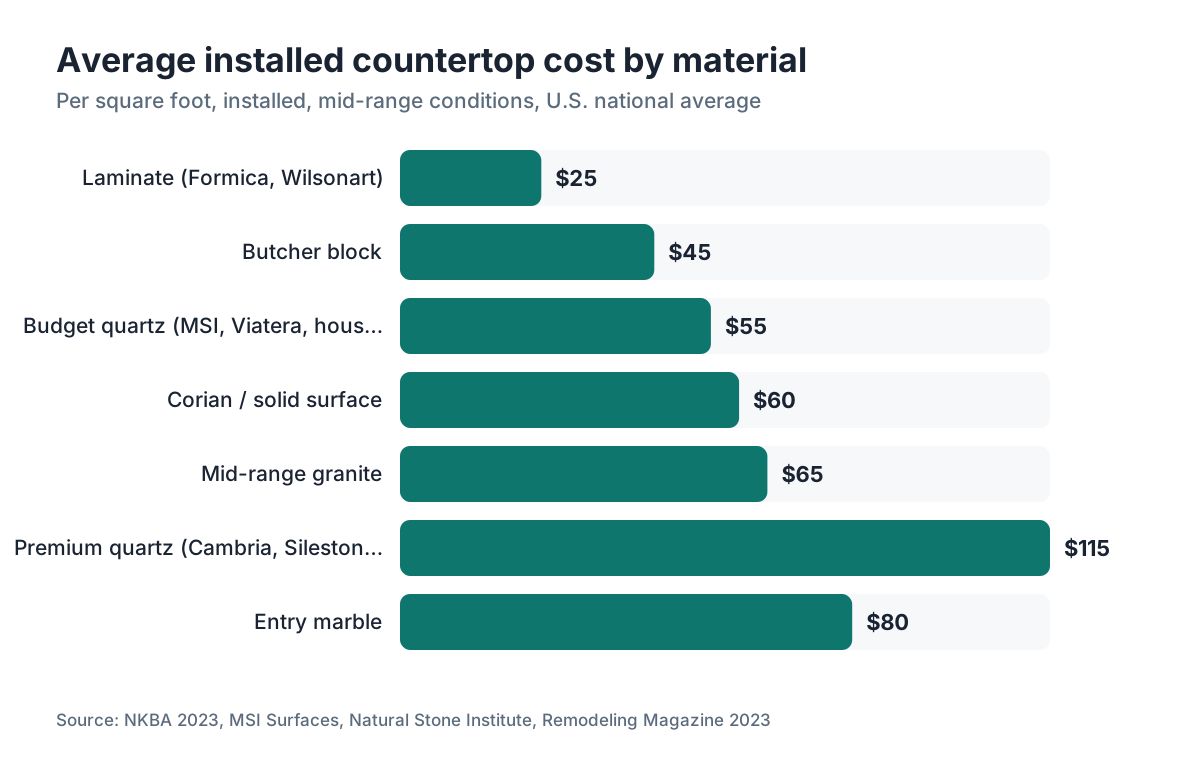
Here's how these brands stack up against full natural stone and solid-surface options:
| Material | Avg. installed cost/sq ft | Maintenance | Resale appeal |
|---|---|---|---|
| Budget quartz (MSI, Viatera, house brand) | $40, $70 | Very low | High |
| Premium quartz (Cambria, Silestone N-Boost) | $80, $150 | Very low | High |
| Granite (mid-range) | $50, $80 | Low (seal yearly) | High |
| Laminate (Formica, Wilsonart) | $15, $35 | Medium | Lower |
| Butcher block | $30, $60 | Medium-high | Medium |
| Corian / solid surface | $45, $75 | Low | Medium |
Sources: NKBA 2023 [1], MSI distributor pricing [3], Cambria dealer pricing [2].
If budget is the only constraint and looks matter less to you, laminate countertops and butcher block countertops are worth a serious look. They cost less and are easier to DIY.
How do you find cheap quartz slabs near you?
The fastest path to low-cost quartz is calling local fabricators directly and asking two questions: What do you have in stock right now? Do you have any remnants?
Fabricators buy slabs by the bundle, so they often have material sitting in the yard that they paid for months ago and want to move. Stock material sells at a discount because the fabricator avoids carrying cost. Remnants sell at an even steeper discount. Neither deal shows up on a showroom price tag.
Distributor open houses are another underused option. Stone distributors (the companies that import slabs and sell to fabricators) sometimes open their warehouses to the public for clearance events. You can walk the yard, pick a slab, and arrange your own fabricator. Prices at these events can run $8, $15 per square foot for the raw slab alone.
Facebook Marketplace and Craigslist occasionally have leftover slabs from remodels or fabricator overstock. Verify the exact dimensions before committing, and have a plan for how you're getting a 300-pound slab home and cut.
Home Depot and Lowe's do run quartz programs, and their installed pricing is sometimes competitive on simple jobs, but read the contract carefully. Some programs use third-party installers, and fabrication quality control is less consistent than a dedicated shop.
Before you commit to quartz, compare the full field of kitchen countertops options.
What are the best ways to lower your quartz countertop quote?
Six moves reliably cut what you pay, and none of them sacrifice durability.
Choose a solid color or simple pattern. Veined quartz forces the fabricator to book-match or orient slabs, which raises waste and labor. A solid white or gray adds nothing to that process.
Pick eased or beveled edges. Fancy edges are pure cosmetic cost. Eased is clean and modern. Save the ogee for never.
Reduce square footage. Sounds obvious, gets missed constantly. Measure your actual countertop area, not the footprint of your cabinets. Peninsula overhangs can add 6 to 12 square feet you might not need if you drop the overhang from 12 inches to 8 inches.
Avoid undermount sinks if you can. Drop-in sinks are cheaper to accommodate. Undermount needs a polished reveal cut under the rim, which adds labor. The difference is typically $75, $150.
Ask for a 2 cm slab on supported countertops. Standard U.S. countertops are now typically 3 cm (about 1.25 inches), but 2 cm slabs cost less. On a fully supported countertop with a front apron, 2 cm works fine. Many fabricators default to 3 cm without being asked. Asking saves $5, $10 per square foot.
Get three quotes, in writing. The variance between fabricators on the same job can be 20 to 30%. A written quote forces clarity on what's included (demo, sink cutout, edge profile, number of seams) so you're comparing apples to apples.
Fabricators who use quoting software (SlabWise is one option [4]) can generate accurate itemized quotes faster, which means you spend less time chasing vague ballpark numbers.
Is cheap quartz as durable as expensive quartz?
For practical kitchen use, yes. Quartz's durability comes from its makeup: roughly 90 to 94% ground quartz crystal by weight, bound with polyester resin and pigment. [5] That formulation is consistent across price points. The scratch resistance, heat resistance, and stain resistance of a $45/sq ft MSI slab and a $120/sq ft Cambria slab are functionally the same.
The real differences at lower price points are narrow: surface finish consistency (some budget quartz has slightly less uniform polish), color consistency across slabs from the same batch (matters at seams), and warranty terms. Cambria offers a lifetime warranty transferable to the next homeowner. [2] Many budget brands offer 10 to 15 year warranties. That gap matters if you're selling the house in two years and a buyer's inspector scrutinizes warranties.
Quartz is not indestructible at any price. It can chip at corners from sharp impacts. It can discolor from long exposure to strong UV near windows (that's resin yellowing, not stone degradation). It's not rated for direct pot-from-stove contact, though most people do it occasionally without consequence. The NSF/ANSI 51 standard for food-contact surfaces, which quartz typically meets, governs cleanliness, not heat tolerance. [6]
Buy budget quartz with confidence for durability. Buy premium quartz if the pattern matters to you or you want the transferable warranty for resale.
How does cheap quartz compare to granite, laminate, and other low-cost options?
Quartz at $40, $70 installed sits in a competitive band with mid-range granite, solid surface, and the top end of laminate. Here's the honest breakdown.
Granite vs. budget quartz: Granite countertops at the mid-range run $50, $80 installed. Granite is natural stone, so patterns are genuinely unique, and many buyers prefer that over an engineered look. But granite needs annual sealing and can harbor bacteria in micro-pores if left unsealed. Quartz skips all of that. For a low-maintenance homeowner, budget quartz beats granite even at similar prices.
Laminate vs. budget quartz: Laminate countertops (including Formica countertops) run $15, $35 installed. That price gap is real. Laminate has improved a lot. Modern high-pressure laminate is scratch-resistant and convincing at a glance. But it can't be refinished if it chips at an edge, it swells with sustained water at seams, and it reads as laminate to most buyers at resale. Budget quartz holds a clear edge in durability and perceived value.
Corian/solid surface vs. budget quartz: Corian countertops run $45, $75 installed, which overlaps with budget quartz. Corian is repairable (scratches sand out), joins with no visible seam, and comes in integrated sink options. Quartz is harder and more scratch-resistant. This one's a close call. Your choice comes down to whether you want repairability (Corian) or harder scratch resistance (quartz).
Marble vs. budget quartz: Marble countertops at entry level run $60, $100 installed and need sealing. Etching from acidic foods is common, and upkeep runs higher. Want the marble look without the babysitting? A veined quartz at $55, $65 is the rational alternative.
Cleaning care is similar across most stone-look surfaces. The care principles in guides like how to clean stone countertops apply to quartz too, though quartz skips the sealing step.
What are the most common mistakes people make buying cheap quartz?
The biggest mistake is confusing a low material price with a low total cost. A fabricator who quotes $30/sq ft for material and then charges $25/sq ft for fabrication, $15 for an undermount reveal, $10 for a complex layout, and $200 for demo ends up more expensive than a competitor who quoted $55 all-in. Always ask for a written, itemized quote covering every line item.
Second biggest mistake: buying from a box store because it feels safer. The price is often higher, the fabrication quality is less consistent, and the scheduling is worse. Independent local fabricators tend to do better work at better prices on quartz specifically, because it's their core business.
Third mistake: ignoring thickness. A 2 cm slab on an unsupported overhang (a breakfast bar with no cabinets underneath) can crack. If your design has overhangs over 6 to 8 inches without support, insist on 3 cm or add a support bracket. Your fabricator should flag this automatically. If they don't, ask directly.
Fourth mistake: buying a color from a small chip sample. Quartz slabs can look very different at full scale than a 4-inch sample suggests. Go to the slab yard and look at the actual full slab that will be cut for your job. This matters most with veined patterns, where the scale of the veining only reads correctly at full size.
Fifth mistake: not asking about seam placement. Quartz is a manufactured product with a maximum slab size (typically around 55 x 120 inches). Most kitchens need at least one seam. Where it lands changes how the counter looks. Get seam placement in writing before you approve the fabrication drawing.
Can you install quartz countertops yourself to save money?
Technically yes. Legally, no permit is required in most jurisdictions for countertop installation itself (though plumbing reconnection after a sink replacement may need one in some states). [7] Practically, DIY quartz installation is a high-risk job.
The slabs are extremely heavy. A 3 cm quartz slab weighs roughly 18 to 20 pounds per square foot. [8] A typical kitchen section can weigh 300 to 500 pounds. Lifting, maneuvering, and setting that without professional equipment risks injury and slab breakage. A cracked slab mid-installation is not returnable.
Fabrication (the cutting, edge polishing, sink cutout) needs CNC machinery or skilled hand tools. You can't realistically DIY fabrication. What you can potentially DIY is the setting step, if you buy pre-fabricated pieces from a modular quartz supplier. Some online retailers and IKEA-style lines sell pre-cut quartz sections for standard cabinet configurations. This can trim total cost by $8, $15/sq ft by dropping the installation labor charge.
For anything custom, the honest advice is simple: pay for professional countertop installation. The savings from a failed DIY on a $2,000 slab are negative.
If saving money is the goal, the smarter lever isn't DIY installation. It's choosing the right material, slab, and fabricator from the start.
How do fabricators price quartz jobs, and how can knowing this help you negotiate?
Fabricators price quartz jobs on a few core variables: material cost (what they paid for the slab), fabrication labor (machine time plus finishing), edge profile labor, cutouts (sinks, cooktops, outlets), delivery and installation labor, and overhead margin.
Material cost is their real cost from the distributor plus the margin they add. On a $30/sq ft wholesale slab, a shop might mark up 40 to 60%, landing at $42, $48/sq ft on the material line of your quote. That's standard. It covers the cost of carrying inventory and waste.
Fabrication labor is largely fixed per square foot for a simple job. It climbs for complex layouts, odd angles, and lots of cutouts. Edge profiles add per-linear-foot charges.
Here's where you have room to move: material selection (choose what's in stock), edge profile (choose eased), cutout count (minimize them), and timing (shops book out weeks, so a job that fills a slow week might get a small discount). You generally can't negotiate fabrication labor rates down much, because they're driven by real equipment and time costs.
Shops running modern quoting software, like SlabWise [4], can show you a line-by-line breakdown of where each dollar goes. That transparency shows you exactly which choices push cost up, instead of handing you one number and leaving you to guess.
Asking for an itemized quote instead of an all-in number is the single most powerful move a homeowner can make. Fabricators who resist itemizing are usually protecting a padded line item somewhere.
What questions should you ask before signing a quartz countertop contract?
These are the questions that separate a smooth project from a dispute. Get written answers to all ten before you sign.
- What specific slab brand, color, and lot number are you quoting? (Protects against substitution.)
- What thickness is included: 2 cm or 3 cm?
- What edge profile is included, and what do upgrades cost?
- How many seams will there be, and where exactly will they land? (Ask to see the fabrication drawing.)
- Is the sink cutout included, and is it priced for drop-in or undermount?
- What does the quote include for demolition and haul-away of existing countertops?
- What is the warranty on fabrication, and what is the manufacturer warranty on the material?
- Who specifically is doing the installation: your employees or a subcontractor?
- What is the payment schedule, and what triggers the final payment?
- What is the lead time from deposit to installation, and what happens if material is backordered?
Written answers to all ten eliminate 90% of the disputes fabricators and homeowners end up in. A reputable shop answers every one without hesitation.
Does cheap quartz affect home resale value?
Short answer: quartz countertops read as quartz to buyers and appraisers regardless of brand or price tier. Nobody distinguishes between MSI and Cambria on a home tour or an appraisal report.
Remodeling Magazine's 2023 Cost vs. Value report puts a mid-range kitchen remodel (which includes countertops) at roughly 85.7% cost recovery nationally, meaning you get back about 86 cents per dollar spent. [9] The specific countertop brand isn't a tracked variable in that data. What matters is whether stone countertops are present, not which brand.
Brand can matter indirectly. If a buyer specifically asks about the countertop and the seller says "it's an imported house-brand quartz" versus "it's Cambria," there may be a perceived value difference. But that's a negotiation-room conversation, not an appraisal-room variable.
Buying specifically for resale in 2 to 3 years and want to maximize return? Quartz at any price tier is a safe choice. The NKBA reports that stone countertops rank among the top features buyers look for in kitchens. [1] Budget quartz checks that box.
Cambria countertops at the premium tier carry a transferable lifetime warranty that some buyers look for in a listing. It's a legitimate resale differentiator, just not a large one.
Frequently asked questions
What is the cheapest type of quartz countertop you can buy?
Entry-level quartz from importers like MSI, Pental, or regional house brands in solid colors starts around $40, $50 per square foot installed. Remnants from a local fabricator can go lower, sometimes $25, $35 per square foot, because the shop is clearing storage space. Solid colors with an eased edge and no undermount sink cutout hit the lowest possible price on a given job.
Is it cheaper to buy quartz at Home Depot or through a local fabricator?
Local fabricators are usually cheaper, often by $10, $20 per square foot on the installed total. Home Depot subcontracts fabrication and installation, adding margin at each step. Local shops buy direct from distributors and do their own work. The exception is an occasional big-box promotional price, or a job so small that a shop's minimum charge exceeds what a box store quotes.
How much does a quartz countertop cost for a small bathroom?
A standard bathroom vanity top of 10 to 15 square feet runs roughly $400, $800 installed at budget quartz prices. A fabricator remnant can bring that under $300. The variables are edge profile, whether you want an undermount sink cutout, and whether you need a backsplash piece. Bathroom jobs are where remnants make the most financial sense, since the required square footage is small.
What is the difference between 2 cm and 3 cm quartz, and which saves money?
2 cm quartz (about 3/4 inch) costs less per square foot than 3 cm (about 1.25 inch) because there's less material. On fully supported countertops with no significant overhang, 2 cm works fine. For overhangs over 6 to 8 inches or unsupported spans, 3 cm is safer. Ask your fabricator explicitly. Most default to 3 cm without offering the choice. The savings can be $5, $10 per square foot.
Can quartz countertops be installed over existing countertops to save money?
Some fabricators will install quartz over an existing solid surface if the substrate is flat, level, and structurally sound. This avoids demo and haul-away costs of $100, $300. But it raises counter height (which affects upper cabinet clearance), can void some warranties, and requires the existing top to be in near-perfect condition. Most shops discourage it. Ask your specific fabricator whether they offer it.
Does cheap quartz stain or scratch more easily than expensive quartz?
No. Stain and scratch resistance in quartz comes from the quartz-to-resin ratio and surface polish, which are consistent across price tiers. All quartz is engineered to similar hardness (typically 7 on the Mohs scale). Budget quartz may show slightly less uniform polish on close inspection, but for kitchen use the performance difference between a $45 and a $120 per square foot quartz is not meaningful.
How long do cheap quartz countertops last?
Budget quartz countertops last 20 to 30 years with normal use, the same expected lifespan as premium quartz. The binding resin can yellow near south-facing windows over 10 to 15 years from UV exposure, but that affects all quartz regardless of price. The stone component doesn't degrade. Most budget brands offer 10 to 15 year warranties and premium brands offer lifetime warranties, but material performance is similar.
What colors of cheap quartz are most available and cheapest?
Solid whites, creams, and grays are consistently the cheapest quartz colors because they're stocked in high volume and need no pattern-matching at seams. Think Bianco White, Arctic White, or Grigio Gray style names across various brands. Simple salt-and-pepper speckle patterns are also low cost. Anything with long flowing veins, heavy movement, or multi-color blending costs more due to slab orientation requirements and higher waste.
Are there quartz countertop remnants for sale near me?
Most local fabricators keep a remnant pile and will sell from it. Call shops directly and ask. Remnants rarely appear on websites because they sell fast and change constantly. A remnant large enough for a bathroom vanity (typically 2x4 feet or larger) can cost $100, $300 for the piece, plus fabrication and installation. This is the single best way to get quartz at a fraction of normal cost on smaller projects.
Is quartz worth it over laminate if I'm on a tight budget?
If budget is genuinely tight and you plan to sell within five years, high-quality laminate at $15, $35 installed is a reasonable choice. Modern laminate is tougher than its reputation and costs half what budget quartz costs. Staying more than five years? Budget quartz wins on durability, resale perception, and the absence of maintenance. The $20, $30 per square foot premium over laminate pays off over a decade.
How do I get an accurate quartz countertop quote without a salesperson upselling me?
Measure your countertop area yourself (length times width of each section in square feet, added together). Know your edge preference before you call. Ask for an itemized quote in writing with separate line items for material, fabrication, edge, each cutout, demolition, and installation. Comparing three itemized quotes tells you far more than comparing three all-in numbers, because it shows where each fabricator runs high or low.
Does quartz countertop color affect price significantly?
Yes. Solid or near-solid colors are the cheapest, typically at the base price for a given brand. Patterned or veined colors add 15 to 30% to material cost. Ultra-realistic marble-look quartz can add 40 to 60% over a plain white in the same product line. Fabrication cost itself barely changes by color, so the premium is pure material markup. Choosing a simpler color is one of the easiest ways to cut your total bill.
What should I watch out for with very cheap quartz from unknown brands?
Check the slab thickness (some budget imports run 18 to 19 mm instead of the standard 20 mm for 2 cm, which can weaken cutouts). Ask for a product data sheet or spec sheet. Verify warranty terms in writing. Check that the distributor has U.S. inventory so replacement material is available if a piece breaks during installation. A reputable local fabricator who sources budget slabs is your best protection against low-quality product.
Sources
- National Kitchen and Bath Association, 2023 Cost vs. Value and Design Trends: Average countertop replacement project costs $3,500, $4,500 for a typical U.S. kitchen; stone countertops rank among the top features buyers look for
- Cambria, Warranty and Dealer Program overview: Cambria offers a lifetime warranty transferable to the next homeowner and markets exclusively through authorized dealers
- MSI Surfaces, Q Premium Natural Quartz product and pricing information: MSI quartz is one of the largest-volume quartz importers in North America, with installed pricing typically landing $45, $65 per square foot through local fabricators
- SlabWise, countertop fabrication quoting software: Fabrication quoting software that generates itemized quotes and shows cost breakdowns by material, fabrication, and edge profile
- Marble Institute of America (now Natural Stone Institute), Engineered Stone Technical Overview: Engineered quartz consists of roughly 90 to 94% ground quartz crystal by weight bound with polyester resin and pigment
- NSF International, NSF/ANSI 51 Food Equipment Materials standard: NSF/ANSI 51 governs food-contact surface cleanliness; quartz surfaces typically meet this standard but it does not address heat tolerance
- U.S. Department of Housing and Urban Development, Homeowner Guide to Permits and Inspections: Countertop installation itself typically does not require a permit in most U.S. jurisdictions; plumbing reconnection may require one depending on state and local codes
- Natural Stone Institute, Stone Weight Reference Data: A 3 cm quartz slab weighs approximately 18 to 20 pounds per square foot
- Remodeling Magazine, 2023 Cost vs. Value Report, Midrange Kitchen Remodel: A mid-range kitchen remodel returns approximately 85.7% of cost nationally in resale value per the 2023 Cost vs. Value Report
- Silestone by Cosentino, Product Line and Pricing Tiers: Silestone has a tiered pricing structure; entry-level Essential and Basiq series runs closer to $55, $75 installed, below their premium N-Boost lines
- U.S. Bureau of Labor Statistics, Construction Labor Cost Indices by Region: Regional labor cost differences mean countertop installation quotes in coastal markets run 20 to 35% higher than Midwest or Southeast markets
Last updated 2026-07-09