TL;DR
- Blue quartz countertops run $50 to $120 per square foot installed, depending on brand, edge profile, and job complexity.
- They come in navy, teal, soft gray-blue, and bold cobalt.
- As engineered stone, they resist stains and never need sealing.
- The color selection is smaller than white or gray, but it's growing fast.
What exactly is blue quartz, and how is it made?
Blue quartz is engineered stone, not a rock you quarry and slice. Manufacturers grind natural quartz crystals, mix them with polymer resins (usually around 7 to 10% by weight), add pigments, and press the mix under vacuum into slabs [1]. The pigment step is what makes blue possible. You can dial in almost any hue, from a whisper of coastal gray-blue to a saturated cobalt that reads nearly black in dim light.
Natural quartz, the mineral, is clear to milky white on its own. Blue color in engineered slabs comes entirely from added pigment and, in some lines, flecks of glass or metallic particles that catch light and give the surface depth. That's different from natural blue quartzite, a metamorphic rock with actual mineral color, and it's wildly different from sodalite or azurite slabs sometimes sold as "blue granite." If a fabricator quotes you on "blue quartz" and hands you a slab with visible natural veining running in chaotic directions, ask whether you're looking at engineered quartz or quartzite. They're not the same material.
The leading engineered-quartz brands with blue lines include Cambria, Silestone, MSI Q Premium, and Caesarstone. Cambria's Isle collection and Silestone's Blue Sahara are two of the most commonly specified blue options in the U.S. market [2]. Smaller regional suppliers import white-label slabs from manufacturers in Spain, India, and China, and some of those carry competitive blue options at lower price points, though quality control varies.
What shades of blue quartz are actually available?
The blue quartz category has grown a lot since about 2018, when navy kitchens started showing up in design media. Today you can find at least five distinct color families.
Soft gray-blue. Muted coastal or Scandinavian palettes. These read differently under warm versus cool lighting, which matters a lot in a kitchen. Pull a sample and hold it under your actual kitchen light before you commit.
True navy. Dense, dark, close to a painted navy cabinet but with the texture of stone. Popular for bathroom vanities where the surface area is smaller and a bold color reads well without swallowing the room.
Teal and blue-green. Less common but available, mostly in glass-particle blended slabs. These work in backsplash-heavy kitchens where the countertop and tile are meant to coordinate.
Cobalt and bold blue. Saturated, high-contrast. Mostly used as a statement island top paired with white perimeter counters. A small slice of the market but steady in hospitality and restaurant work.
Marbled blue-white. Engineered patterns that mimic natural stone, with white or gold veining on a blue background. Cambria's Britannica Warm and some MSI lines land here. These are the easiest to design around because the veining breaks up the color.
One practical note. Blue quartz shows water spots and fingerprints more than white or gray, especially in matte or honed finishes. Polished finishes wipe clean faster. Worth knowing before you order honed navy for a busy family kitchen.
How much do blue quartz countertops cost?
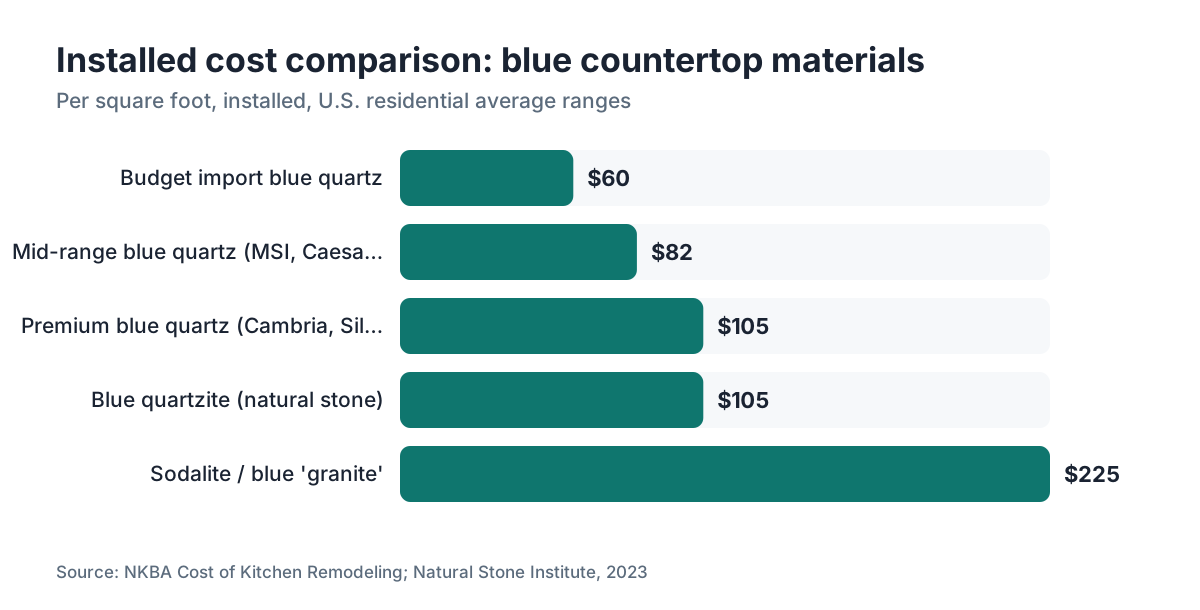
Material and installation together land between $50 and $120 per square foot for most residential jobs [3]. That's a real range, not a hedge. Here's where you fall in it.
| Tier | Material cost (per sq ft) | Installed cost (per sq ft) | Who it fits |
|---|---|---|---|
| Budget import slab | $18, $30 | $50, $70 | Price-sensitive buyers, rental properties |
| Mid-range domestic/brand | $30, $55 | $70, $95 | Most homeowner projects |
| Premium brand (Cambria, Silestone) | $55, $90 | $90, $120 | Design-forward renovations |
| Custom or rare color | $80, $140+ | $110, $160+ | Commercial, custom homes |
Installed cost covers templating, cutting, edge profiling, and setting the slab. It does not cover demo of old countertops (usually $5, $15 per linear foot extra), plumbing disconnect and reconnect, or backsplash tile. A standard kitchen with 40 square feet of counter runs $2,000 to $4,800 installed at mid-range pricing [8].
Blue doesn't cost more than white or gray quartz from the same manufacturer's line. Price is driven by brand tier, thickness (2 cm vs. 3 cm), and edge complexity. A waterfall edge on an island can add $200, $600 depending on the shop. Mitered edges cost more than that.
Fabricators who run quoting software can give you a detailed breakdown fast. SlabWise is one tool fabricators use to build itemized quotes that show material, labor, and edge work separately, which makes it easier to compare bids. More on comparing quotes below.
How does blue quartz hold up compared to other countertop materials?
Engineered quartz, whatever the color, tests well for scratch and stain resistance. The Mohs hardness of quartz, the mineral, is 7, which makes the surface harder than most knives [1]. The resin binder is softer, but in normal kitchen use the quartz particles set the surface behavior. You won't scratch it with a chef's knife, though you should still use a cutting board because the stone will dull your blades.
Stain resistance is where quartz beats natural stone like marble and even most granites. The surface is non-porous because the resin fills the space between particles, so coffee, wine, and oils don't soak in the way they would in a polished limestone. No sealing required, ever [5].
Heat is the real weakness. The polymer resin in quartz can discolor or warp under sustained high heat. The Marble Institute of America and manufacturers like Caesarstone both recommend trivets for pots straight off the stove [7]. A 400°F pan set on quartz for a few minutes may leave no visible mark, but repeated exposure or a single very hot cast iron skillet can cause irreversible thermal shock, especially near seams [5]. This matters more with dark blue slabs because discoloration shows.
Against granite countertops, blue quartz is more consistent in color (no natural variation to manage) and easier to maintain, but more heat-sensitive. Against marble countertops, quartz is far more stain-resistant. Against laminate countertops or formica countertops, quartz costs more upfront but holds up longer under heavy use.
Does blue quartz need sealing or special maintenance?
No. Sealing is not required and most manufacturers advise against it. The resin binder makes the surface effectively non-porous. Any sealant you apply sits on top without penetrating, and some leave a residue that dulls the finish over time [5].
Daily cleaning is soap and water or a pH-neutral countertop spray. Skip anything highly alkaline (oven cleaners, drain cleaners) or highly acidic (undiluted vinegar used as a cleaner, or rust removers). Those won't wreck the surface on contact, but repeated exposure degrades the resin and eventually dulls the polish.
For stubborn stains, a little isopropyl alcohol on a soft cloth handles most kitchen messes. For dried adhesive or paint, a plastic scraper followed by isopropyl alcohol is the standard shop move. Never use abrasive scrubbing pads on a polished finish.
Blue quartz in a bathroom picks up soap scum like any surface does. A squeegee after use or a weekly wipe with diluted dish soap keeps it clean. If you're comparing how to clean stone countertops across materials, quartz is the lowest-maintenance option in the engineered category [9].
Is blue quartz a good choice for kitchen islands?
Yes, with caveats. An island is where a bold color pays off, because it's often the focal point of the kitchen. A navy or cobalt island top with white shaker perimeter cabinets is one of the most common design requests fabricators see right now.
Islands take more abuse than perimeter counters. They're where people prep food, where kids sit and eat, where you set hot pans while unloading the oven. The heat sensitivity from the section above matters more here. Plan for trivets and mean it.
Seam placement matters a lot on islands. A 96-inch island often needs a seam because standard slabs max out around 120 inches long. On a blue surface, especially solid navy, seams show more than on a variegated pattern. Talk layout with your fabricator before you buy. A good one shows you where the seam falls and what it will look like. If they don't bring it up, ask.
Waterfall edges look sharp on a solid blue slab. Because the full thickness shows at the edge, color consistency matters. Confirm the slab is pigmented all the way through the body, more than at the surface. Most quality engineered quartz stays consistent through the full 3 cm, but the question is worth asking.
For kitchen countertops in general, blue quartz works best when the rest of the design stays fairly neutral. It's a commitment.
What are the most popular blue quartz brands and product lines?
A few brands dominate the U.S. fabrication market for blue quartz.
Cambria. Made in the U.S., in Eden Prairie, Minnesota. Blue lines include Britannica, Isle, and several designs in the Coastal collection. Cambria is premium-tier, usually at the top of the price range, and it offers a lifetime warranty to the original purchaser [2]. Cambria fabricators have to be certified, which affects who can quote you on their slabs. See more at cambria countertops.
Silestone by Cosentino. Spanish manufacturer with wide U.S. distribution. Blue Sahara, Azul Platino, and Ocean are the known products. Silestone added an antibacterial surface treatment called HybriQ in newer lines, which uses a hybrid inorganic polymer resin in place of some petrochemical content [6].
MSI Q Premium Natural Quartz. Sold through Home Depot and independent fabricators. Blue options (Midnight Majesty, Blue Celeste) land in the mid-range on price. Quality is solid for the money.
Caesarstone. Israeli manufacturer, distributed worldwide. Blue options are more limited but the product quality is well regarded. Airy Concrete and some gray-blue hues cross into blue depending on lighting.
Vicostone and Pental. Mid-tier imported brands with a handful of blue options each, popular with fabricators who need competitive pricing on big commercial jobs.
One thing to know. The blue quartz market is niche enough that your local fabricator may stock only a few blue slabs. Don't assume you can walk in and grab a blue slab the same week. Lead times of 2 to 6 weeks are normal for less-common colors.
How do fabricators quote and cut blue quartz?
From the shop side, blue quartz is priced and processed like any other engineered quartz slab. The steps are templating, digital layout, CNC cutting, edge profiling, polishing, and installation.
Templating happens with either a physical template (older shops) or a laser measuring system. The digital file goes into nesting software, where the fabricator lays out the pieces to minimize waste. On a solid blue slab, pattern matching isn't a concern (no veining to align), which makes layout simpler and can cut material waste versus a heavily veined pattern.
Waste matters more than homeowners expect. A slab runs 55 to 65 square feet. A kitchen job might need 42 square feet of finished counter, but after sink and cooktop cutouts, plus offcuts and layout constraints, actual yield lands around 50 to 55% of the slab. If your job needs two slabs and the second is mostly cutoffs, you still pay for two slabs of material. Fabricators using quoting tools like SlabWise can show homeowners the actual nesting layout so there are no surprises on material counts.
Edge profiles add machining time and material exposure. On a dark navy slab, an eased or beveled edge shows the full slab thickness in that blue, which looks great. An ogee or waterfall edge needs more setup time on the CNC and hand-polishing, hence the higher cost.
Setting a 3 cm quartz island top takes at least two people. A 6-foot island piece weighs roughly 130 to 160 lbs. Drops and cracks during installation are rare with experienced crews but not unheard of. Verify your installer is insured.
How does blue quartz compare to blue quartzite, sodalite, and other blue natural stones?
This is one of the most common sources of confusion in stone shopping. The word "quartz" shows up in both engineered quartz and natural quartzite, but they're completely different materials.
Natural blue quartzite is a metamorphic rock, mostly quartzite with iron oxide or other mineral inclusions that give it blue-gray tones. Fantasy Brown, Azul Macaubas, and Van Gogh are popular imports. Quartzite is harder than marble and more heat-resistant than engineered quartz, but it's porous and needs periodic sealing. Color varies slab to slab because it's natural [10]. See more about how to clean quartzite countertops.
Sodalite is a semi-precious stone sold as "blue granite" by some suppliers. It's actually a feldspathoid mineral, rich blue with white calcite veining. Stunning, expensive (often $150, $300+ per square foot installed), and genuinely one-of-a-kind. It's porous and needs care.
Blue Bahia granite is a natural granite with blue feldspar crystals, quarried mostly in Brazil. Price runs $80, $150+ installed for good material. It's a real granite countertop and behaves like granite, meaning it needs periodic sealing but tolerates heat better than engineered quartz.
Engineered blue quartz is the most consistent, lowest-maintenance option in this group. It won't have the depth and one-off character of a sodalite slab, but it also won't chip if you set something heavy on it wrong, and it costs a fraction of the price.
| Material | Heat resistance | Stain resistance | Sealing needed | Price range (installed/sq ft) |
|---|---|---|---|---|
| Engineered blue quartz | Low-moderate | Excellent | No | $50, $120 |
| Blue quartzite | High | Moderate | Yes | $70, $140 |
| Sodalite (blue "granite") | High | Low-moderate | Yes | $150, $300+ |
| Blue Bahia granite | High | Good | Yes | $80, $150+ |
What should you ask a fabricator before ordering blue quartz?
A few questions save you from surprises.
Can I see the actual slab I'm getting? For solid blue or patterned blue with veining, slab-to-slab variation is real. Ask to see and approve the specific slab before fabrication starts. Reputable fabricators hold the slab for you once you put a deposit down.
Where will the seam fall? On a long island or L-shaped kitchen, seams are often unavoidable. On dark solid blue, they show. Ask for a layout drawing with seam placement marked.
Is this through-body color? Confirm the blue pigment runs the full thickness. On cheap slabs, edges can show a lighter core.
What's your lead time? Blue is a specialty color. If your slab isn't in stock, budget 2 to 6 weeks for the supplier to deliver before fabrication even starts.
What's included in the quote? Edge profile, cutouts, and delivery/installation sometimes get line-itemed separately. Compare complete installed costs across bids, more than material prices.
What's your warranty on fabrication workmanship? That's separate from the manufacturer's material warranty. A crack that shows up at a cutout or seam in the first year is a fabrication defect, not a material defect.
For countertop installation generally, getting at least three quotes from local fabricators is the standard advice, and it's still good advice.
What design styles work well with blue quartz countertops?
Blue quartz works within a narrower band of design contexts than neutral countertops. Here's where it actually lands.
Coastal and nautical kitchens. The most obvious match. Soft blue quartz with white shaker cabinets, weathered oak flooring, and brushed nickel hardware reads polished but relaxed. Teal or gray-blue beats cobalt here.
Moody, dark kitchens. Navy quartz on lower cabinets painted charcoal or forest green, with brass hardware, feels layered and current. Blue counters against a related dark cabinet color (not blue-on-blue) read as sophisticated rather than cartoonish.
Bathroom vanities. Smaller surface area means you can go bolder. A navy or cobalt quartz vanity top with white marble-look wall tile and matte black fixtures is a very common current design.
Two-tone kitchens. Blue quartz on the island, white quartz on the perimeter, white uppers, navy lowers. This is probably the most-requested setup that specifically uses blue quartz right now. It gives you the color without swamping the room.
Where blue quartz tends to look awkward: with warm wood cabinets (it fights the orange undertones in maple or pine), with busy backsplash tile (two bold elements compete), or in very small kitchens where a dark surface can read as cramped.
Lighting matters enormously. Navy quartz in a north-facing kitchen with no under-cabinet lighting can look almost black. Warm LED lighting (2700K to 3000K) shifts the blue toward purple or gray. Cool white lighting (4000K+) makes blue punch. See actual samples in your space under different light sources.
Are there any durability concerns specific to blue quartz?
The color itself doesn't change structural durability. Blue quartz chips, cracks, and performs like white quartz from the same product line and brand. But a few things are worth knowing.
On polished dark surfaces, any chip, scratch, or crack shows more than on a light or variegated surface. A small chip on a navy countertop exposes the lighter quartz aggregate underneath. Chips on engineered quartz can sometimes be repaired with color-matched filler, but on a dark solid color, an invisible repair is genuinely hard. If you're rough on countertops, a patterned or marbled blue is more forgiving than solid navy.
Fading is a legitimate concern in direct sunlight. The pigments in engineered quartz can shift slightly under sustained UV exposure. That's rarely an issue for interior countertops but does matter for outdoor kitchens or kitchens with large south-facing skylights. Manufacturers vary on whether their warranties cover UV fading. Read the fine print.
The resin content makes quartz slightly flexible compared to natural stone. In normal spans it doesn't matter. On very long unsupported overhangs (more than 12 to 14 inches beyond the cabinet face), quartz can flex and crack over time. That's a structural installation concern, not a color concern, but it's worth flagging since waterfall island configurations are popular with blue quartz.
For soapstone or other natural stones with different maintenance profiles, see how to clean soapstone countertops.
Frequently asked questions
How much does a blue quartz countertop cost per square foot?
Installed cost runs $50 to $120 per square foot for most residential projects. Budget import slabs land closer to $50 to $70 installed. Premium brands like Cambria or Silestone typically run $90 to $120 installed. Specialty or custom blue colors can exceed $130. Material alone, without installation, is usually $18 to $90 per square foot depending on brand tier.
Is blue quartz a natural stone?
No. Blue quartz countertops are engineered stone, made from ground natural quartz crystals, polymer resin, and blue pigment. Natural quartzite, sodalite, and blue Bahia granite are actual quarried rocks. Blue quartzite is a natural metamorphic stone sometimes confused with engineered quartz. They behave very differently in daily use and maintenance.
Does blue quartz stain easily?
No. Engineered quartz is non-porous because resin fills the gaps between quartz particles. Coffee, wine, and oil don't soak into the surface the way they would in marble or unsealed granite. Soap and water handles most spills. No sealing is needed. Avoid strong alkaline cleaners like undiluted bleach, which can degrade the resin over time.
Can you put hot pans on blue quartz countertops?
You shouldn't. The polymer resin that binds engineered quartz can discolor or warp under sustained heat. A hot cast iron skillet or a pan pulled straight from a 450°F oven can cause irreversible thermal shock or discoloration, especially near seams. Always use a trivet or hot pad. On dark blue surfaces, heat damage shows more than on lighter countertops.
What brands make blue quartz countertops?
The main U.S. brands are Cambria (Isle and Britannica lines), Silestone (Blue Sahara, Azul Platino), MSI Q Premium (Midnight Majesty, Blue Celeste), Caesarstone, Vicostone, and Pental. Cambria is U.S.-manufactured and premium-priced. Silestone is Spanish. MSI sources from multiple manufacturers and generally hits a lower price point.
What cabinet colors go with blue quartz countertops?
White cabinets are the most popular pairing and work with almost every blue shade. Navy or dark charcoal cabinets with a navy quartz countertop can work if they're different tones, but blue-on-blue needs careful lightness contrast. Warm wood cabinets in maple or pine typically fight the cool blue undertones. Sage green and off-white cabinets both coordinate well with teal or soft blue quartz.
How do I clean blue quartz countertops?
Soap and water or a pH-neutral countertop spray covers daily cleaning. For stubborn spots, isopropyl alcohol on a soft cloth works well. Avoid abrasive scrubbing pads on polished surfaces. Don't regularly use highly acidic or alkaline cleaners (undiluted vinegar, bleach, or drain cleaners). No sealer is needed or recommended. Wipe up water spots on dark polished surfaces promptly, since they show more.
Is a seam visible on blue quartz countertops?
Yes, and more so than on patterned or lighter surfaces. On solid navy or cobalt quartz, seams show because the slab edge is slightly different in texture than the polished face. Good fabricators use color-matched epoxy and align slabs carefully to keep them subtle. Ask your fabricator to show the layout and where seams will fall before fabrication begins.
Does blue quartz fade in sunlight?
Potentially. Engineered quartz pigments can shift slightly under prolonged UV exposure. For standard interior kitchens this is rarely a problem, but south-facing rooms with large skylights or outdoor kitchen applications are a real concern. Check whether the manufacturer's warranty covers UV fading. Cambria and Silestone both publish warranty documents, and the UV coverage language varies by product line.
How thick should blue quartz countertops be?
For kitchen countertops, 3 cm (about 1.2 inches) is the standard residential thickness and the right choice for most applications. It doesn't need laminated edges to look substantial and is structurally sound for typical spans. Some fabricators still offer 2 cm at lower cost, but it usually needs a plywood substrate and is more prone to cracking at cutouts.
What is the difference between blue quartz and blue quartzite?
Engineered blue quartz is a man-made slab of ground quartz crystals, resin, and pigment. Blue quartzite is a natural metamorphic rock quarried and sliced into slabs. Quartzite needs periodic sealing, tolerates heat better, and varies slab to slab in color. Engineered quartz is consistent, non-porous, and needs no sealing, but is more heat-sensitive. Price ranges overlap, with premium quartzite running higher.
Can blue quartz be used in bathrooms?
Yes, and it's one of the better applications. Bathroom vanities have smaller surface areas, so a bold blue doesn't overwhelm the space. Quartz's non-porous surface resists moisture and soap. A navy or cobalt vanity top with white tile walls and dark hardware is a very popular current setup. The lack of sealing requirements makes it particularly low-maintenance in a bathroom.
How long does it take to get blue quartz countertops installed?
The timeline from order to installation is typically 2 to 5 weeks for in-stock slabs. If your blue is a specialty color not in the local fabricator's inventory, add 2 to 6 weeks for slab delivery. Templating happens after cabinets are installed. Fabrication takes 3 to 7 business days. Installation is usually a one-day job. Confirm the slab is in stock before scheduling cabinet installation.
Is Corian or quartz better for a blue countertop?
Corian (solid surface) and engineered quartz are both non-porous and low-maintenance, but they differ in key ways. Corian is softer and scratches more easily, though scratches sand out. Quartz is harder and more scratch-resistant, but chips can't be repaired as cleanly. Corian blue options exist and tend to cost less, but quartz looks more like natural stone. For a high-use kitchen, quartz holds up better.
Sources
- U.S. Geological Survey, Mineral Resources Program, Quartz Crystal: Natural quartz (SiO2) has a Mohs hardness of 7 and is mixed with polymer resins at approximately 7 to 10% by weight to produce engineered stone slabs.
- Cambria, Product Warranty and Product Lines: Cambria manufactures engineered quartz in the U.S. and offers a lifetime warranty to the original purchaser on their residential countertop products.
- National Kitchen and Bath Association (NKBA), Cost of Kitchen Remodeling: Engineered quartz countertop costs including installation typically range from $50 to $120 per square foot across residential projects in the U.S.
- Caesarstone, Care and Maintenance Guide: Caesarstone recommends against placing hot pots or pans directly on quartz surfaces and advises against applying sealers, which are unnecessary given the non-porous surface.
- Cosentino Silestone, HybriQ Technology Product Documentation: Silestone's HybriQ technology uses a hybrid inorganic polymer resin, reducing petrochemical content in newer quartz product lines while maintaining surface performance.
- Marble Institute of America, Care and Cleaning of Natural Stone and Engineered Stone: The Marble Institute of America recommends trivets for engineered quartz surfaces to prevent thermal shock, citing polymer resin susceptibility to high heat as the primary concern.
- U.S. Department of Housing and Urban Development, Residential Kitchen Renovation Cost Data: A standard kitchen countertop installation involves approximately 40 square feet of material and is typically completed in one day by a two-person crew.
- NSF International, Certification Standards for Kitchen Surfaces: Non-porous countertop surfaces including engineered quartz do not require antimicrobial sealing treatments to meet kitchen hygiene standards under NSF testing protocols.
- Natural Stone Institute, Quartzite vs. Quartz: Material Identification Guide: Natural quartzite is a metamorphic rock requiring periodic sealing and tolerating higher heat than engineered quartz; the two materials are frequently confused in retail sales contexts.
Last updated 2026-07-09