
TL;DR
- Countertop sticker shock usually hits when a homeowner expects laminate prices but gets quoted natural stone.
- The fix is not discounting, it's breaking down where the money actually goes, offering real material alternatives, and resetting expectations before the number lands.
- Most fabricators who lose a sale on price lose it in the first 60 seconds after delivery.
Why does countertop sticker shock happen so often?
The short answer: the internet gives homeowners wildly inconsistent price signals. A quick search turns up articles quoting granite at $40 per square foot installed, while a real shop in a real city might quote $85 to $130 per square foot for the same material once you add edges, cutouts, fabrication labor, and delivery [1]. That gap is enormous, and nobody warns the customer it exists before they walk in.
There's also a perception problem baked into big-box retail. Home improvement stores sell remnants and basic slabs at aggressive prices, and those prices anchor what people think countertops should cost. When a custom fabricator quotes a full kitchen at $6,000 to $9,000, the customer is mentally comparing it to a $2,500 Home Depot estimate they saw online, even if that estimate doesn't include templating, specialty edges, or a complex island [2].
Fabrication is genuinely labor-intensive. A single L-shaped kitchen with a farmhouse sink cutout, mitered edge, and two-inch thick stone might take a skilled fabricator four to six hours of CNC time, an hour of hand-polishing, and a two-person installation crew half a day on site. The material itself is often 40 to 50 percent of the total job cost; the rest is skilled labor, overhead, and equipment depreciation. Customers rarely see any of that.
The result is a predictable collision: the homeowner arrives excited, the fabricator delivers a fair quote, and the conversation derails before it should.
What's the right way to deliver a high price without losing the customer?
Deliver the number with context before you deliver the number itself. That's the whole game.
If you hand someone a $7,200 quote cold, the first thing their brain does is compare it to every anchor they have: the $2,000 IKEA countertop their neighbor got, the vague number from a home renovation show, the generic internet range. You lose that comparison every time because those anchors are cheaper and they're already lodged.
Instead, walk them through the build-up. Something like: 'Your kitchen has 68 square feet of stone, plus a full bullnose edge on the island, two sink cutouts, and material-to-material seaming at the peninsula. Here's what each piece costs.' When the customer sees $2,900 in material, $1,800 in fabrication, $600 in edge work, and $900 in installation and templating, the total of $6,200 lands differently than a single number does. They can react to parts of it, ask questions about specific line items, and feel like they understand what they're buying.
Keep your voice matter-of-fact. Fabricators who apologize for their price or get defensive when questioned lose credibility fast. You priced it fairly; own it. A simple 'This is what quality stone work costs in this market' is more persuasive than any discount.
The other thing that works: show the customer what they'd give up to hit a lower number. 'If you want to get to $5,500, we could go with a standard eased edge instead of the waterfall, and look at a Tier 1 granite rather than the quartzite you picked. Want me to run that version?' That's not caving, it's problem-solving, and it keeps the customer in the conversation instead of walking out.
What are the real countertop price ranges customers should expect in 2025?
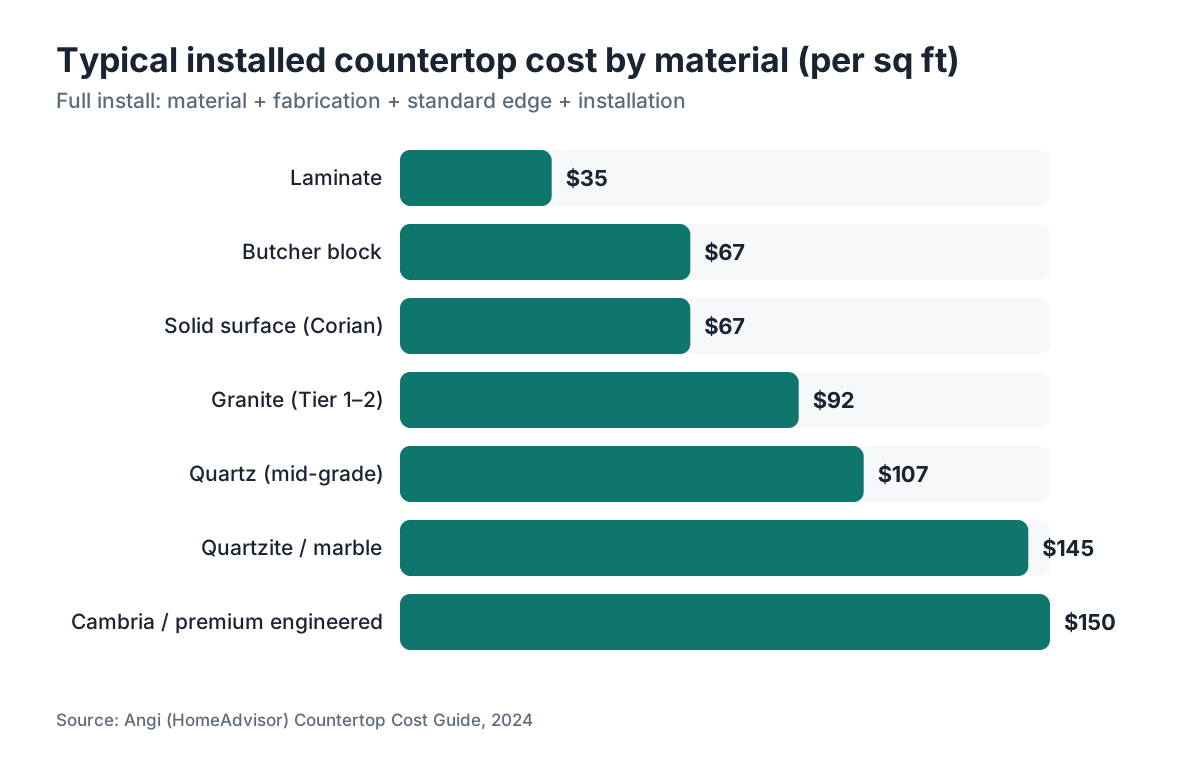
Prices vary by region, material, and fabricator, but here are honest ranges based on what mid-market shops charge for fully installed countertops (material plus fabrication plus basic edge and installation) [1][3]:
| Material | Typical installed range (per sq ft) |
|---|---|
| Laminate (Formica-style) | $20, $50 |
| Butcher block / wood | $35, $100 |
| Solid surface (Corian-type) | $45, $90 |
| Granite (Tier 1 to 2) | $65, $120 |
| Quartz (engineered, mid-grade) | $75, $140 |
| Quartzite / marble | $90, $200+ |
| Cambria or premium engineered | $100, $200+ |
A standard kitchen with 40 to 55 square feet of countertop area typically runs $3,000 to $7,000 installed for granite or quartz. Larger kitchens, premium stone, complex edges, or urban markets can push that to $10,000 to $15,000 without blinking [1].
For homeowners who are genuinely shocked, laminate countertops and butcher block countertops are legitimate options that look good and last, not consolation prizes. A well-installed Formica countertop in a rental or a budget reno is a perfectly smart choice. There's no shame in it, and fabricators who treat those materials dismissively lose sales unnecessarily.
For fabricators: if you work with a quoting tool that breaks out line items automatically, customers follow the math much easier. Software like SlabWise lets you generate itemized quotes in minutes, which means you spend less time explaining and more time closing.
Should you discount to close a sticker-shocked customer?
Rarely. And never as a first response.
Here's why discounting is dangerous: the first discount tells the customer your original price was arbitrary, which makes them wonder what else is arbitrary. It also trains them to negotiate on every future job referral they send your direction.
There's a difference between adjusting scope and discounting price. Adjusting scope means changing what you're doing: simpler edge profile, different material tier, removing the decorative corbels, skipping the specialty ogee on the island. The price per unit of work stays the same; you're just doing less work. That's honest and professional.
A true discount, meaning you do the same work for less money, should only happen if there's a business reason: you need to fill a slow week, you're burning a remnant piece that would otherwise sit in inventory, or you have a long-term relationship with a general contractor sending you volume. One-off retail customers rarely justify it.
If a customer's budget is genuinely $1,500 less than your quote and there's no scope reduction that gets you there, be honest. 'I can't do this job for that budget and make it right. Here's what I'd recommend...' Then point them toward a different material category or help them prioritize which surfaces get the premium stone and which get something more economical. Kitchens sometimes mix: granite countertops on the perimeter, butcher block on a secondary prep area, or a less exotic material in the laundry room.
Losing a customer who can't afford your work is not a failure. Discounting into a job you'll resent is.
What should a fabricator say in the first 60 seconds after a customer says 'that's way more than I expected'?
This is the moment that separates shops that close well from shops that lose sales unnecessarily. The worst response is silence or immediate defensiveness.
A script that actually works:
'I hear you. Can I ask what range you were expecting? I want to make sure we're comparing the same things, a lot of online prices don't include fabrication, templating, or installation, and those add up fast. Let me walk you through exactly what's in this number.'
That one response does three things. It invites the customer to tell you their anchor (which you need to know), it explains why the gap might exist without making them feel stupid, and it puts you in teacher mode rather than seller mode. People trust teachers more than sellers.
After they give you their expected number, you'll usually find one of three situations:
-
They were comparing apples to oranges (your full install vs. their memory of a rough material-only quote). Walk them through the breakdown. Most customers in this camp close at or near your original number once they understand it.
-
They genuinely budgeted for a different material tier. Offer real alternatives without making them feel like they're settling. Marble countertops are beautiful and genuinely less expensive than premium quartzite; Cambria countertops are engineered but carry serious quality and come with a warranty.
-
Their budget is simply too small for any natural or engineered stone. Be kind and direct. Laminate has gotten dramatically better in the last decade; solid surface is durable and installs with tight, nearly invisible joints. Don't pretend otherwise to save their feelings.
The fabricators who close the most sales in this moment are the ones who stay curious rather than defensive.
What parts of a countertop quote are driving most of the cost?
Understanding the cost breakdown helps both fabricators explain it and homeowners evaluate it honestly [4].
Material is the most visible line item, typically 40 to 55 percent of a job's total cost. The slab you pick sets the floor, and exotic material like book-matched marble or leathered quartzite can double the material cost of a basic Tier 1 granite.
Fabrication labor covers cutting, polishing, and edge work. A basic eased edge on a simple rectangle is fast. A waterfall edge on a thick-mitered island takes hours of hand-finishing. Edge profiles alone can add $15 to $40 per linear foot to a job, and most customers don't realize they're choosing that when they pick a profile out of a binder [1].
Cutouts (sinks, cooktops, faucet holes) run $100 to $300 each depending on complexity and material. An undermount farmhouse sink in quartzite is genuinely difficult work; the fabricator is cutting a precision opening in an unforgiving material with no room for error.
Templating and installation together often add $400 to $900 for a standard kitchen. Templating is a skilled measurement step, more than someone with a tape measure; a bad template means a ruined slab.
Delivery matters too. Moving stone safely takes specialized equipment and experienced crew. That's real cost.
When customers understand that the $500 they want to cut might mean getting a simpler edge or a less exotic material rather than the fabricator padding their margin, the conversation gets a lot more productive.
How do you help a customer choose a less expensive material without making them feel bad about it?
Frame it as optimization, not downgrade.
'Given what you've told me about how you use the kitchen and your budget, here's what I'd actually pick if it were my house.' That phrasing is disarming because it's honest advice, not a sales move.
For customers coming down from quartzite or marble, quartz engineered stone is a genuinely excellent material: non-porous, consistent, lower maintenance, and usually $20 to $40 per square foot less installed [1]. The kitchen countertops guide here covers those tradeoffs in detail if you want something to hand a customer.
For customers who need to drop further, laminate has changed dramatically. Modern high-pressure laminate with realistic stone prints and subtle texture is not your grandmother's Formica. It's warm, it's fast to install, and a good fabricator can do a clean job with tight seams. Worth mentioning as a real option rather than an afterthought.
Corian countertops and other solid surfaces sit in the middle ground: easy to repair if scratched, joined with joints you can barely see, and more expensive than laminate but less than stone. Some customers love that proposition.
What you should not do: steer someone toward a cheaper material and then install it poorly because you mentally wrote off the job. A well-installed laminate kitchen refers friends. A sloppy stone job does not.
What mistakes do fabricators make that cause sticker shock in the first place?
The biggest mistake is the cold quote: handing someone a number without context, or sending a PDF estimate with no conversation attached. Sticker shock is largely preventable if you set expectations upstream.
Before a customer comes in for a consultation, give them a rough range by phone or email. Something like: 'For a kitchen that size in the materials you're describing, you're typically looking at $5,000 to $9,000 installed. Does that fit your budget?' That one question saves both parties an hour of wasted time and prevents the cold-quote ambush.
Another mistake: not asking the customer about budget early enough. Many fabricators treat budget conversations as awkward or presumptuous. It's neither. A contractor asking 'What range are you working with?' in the first five minutes of a consultation is professional, not rude. It helps you show them the right slabs.
Overbuilding the quote is a real issue too. If a customer says they want something simple, don't upsell three edge upgrades and a book-match layout into the first draft. Scope creep in a quote can double the number and make a reasonable project look unaffordable. Quote what they asked for, then offer upgrades separately.
Lastly, shops that publish rough starting prices on their website reduce no-hope consultations significantly. 'Starting at $75 per square foot installed for Tier 1 granite' on a website filters out customers whose budgets can't touch stone, which is good for everyone.
How should a homeowner respond when they get a quote that feels too high?
First: don't panic and don't immediately shop for the cheapest alternative. A quote that feels high might be fair, or it might actually be high. You need more information before you know which.
Ask the fabricator to break down the quote line by line. Material cost, fabrication, edges, cutouts, installation, delivery. If they can't do that or won't, that's information too.
Get two or three competing quotes, but compare them carefully. A quote of $5,200 from one shop and $7,000 from another doesn't mean the first is the right choice. Check what's included: does the lower quote include templating? Installation? The same edge profile? Countertop installation costs vary and are sometimes quoted separately from fabrication.
Ask what would make the job less expensive. A good fabricator will tell you honestly: pick a different material, simplify the edge, use a drop-in sink instead of undermount. If the response is just 'there's nothing I can do,' move on.
Check reviews specifically for installation quality, more than price. A botched installation on a $7,000 stone job is a much worse outcome than a smooth one on a $6,000 job. The savings mean nothing if the seam is visible or the edge chips in a year.
For natural stone maintenance questions once you've made your choice, resources like how to clean stone countertops or specific guides for quartzite and soapstone can help you understand long-term care before you commit.
When is it okay to walk away from a sticker-shocked customer?
When the gap between their budget and your minimum viable price is so large that no scope reduction closes it.
Some customers come in wanting $15,000 of stone work on a $3,000 budget. That's not a negotiation failure on your part; it's a budget mismatch, and the kindest thing you can do is acknowledge it plainly and point them somewhere useful rather than pretending a solution exists.
Also walk away when a customer uses sticker shock as a pressure tactic. There are customers who genuinely can't believe the price, and there are customers who use shock as an opening bid in a negotiation they planned from the start. The second type usually signals themselves: they arrived with printed competitor quotes, they start the conversation by telling you your margins are too high, or they immediately ask 'what's your best price.' These customers often become difficult throughout the job, and a signed contract with a difficult customer is sometimes worse than no contract at all.
For fabricators with tight shop capacity, every low-margin or high-friction job you take is a high-margin, smoother job you don't have time for. That math is real.
If you're turning away a customer who genuinely just doesn't know what things cost and you could have helped them understand, that's a loss worth reflecting on. But walking away from a customer whose budget and expectations are structurally incompatible with your work is not a failure.
What tools help fabricators give faster, clearer quotes that prevent sticker shock?
The core problem with sticker shock is the information gap between what fabricators know and what customers see. Detailed, itemized quotes close that gap.
Shops that still quote in single lump sums are working against themselves. A $7,400 total is a wall. A breakdown showing $2,800 in slab material, $1,600 in fabrication, $800 in edge work, $400 in cutouts, and $1,800 in templating and installation is a conversation. Customers can point to a line item and ask about it, which means they understand what they're buying.
Fabrication quoting software makes this faster. SlabWise, for example, generates itemized quotes with line-item breakdowns and updates in real time when you swap materials or edge profiles, so you can show a customer two versions of their job side by side during the consultation instead of promising to email them tomorrow. That kind of real-time transparency prevents a lot of cold-quote sticker shock.
Visual tools also help. If a customer can see a rendered version of their kitchen with the slab they picked, they have emotional buy-in before the price arrives. That buy-in doesn't make the price smaller, but it makes the value feel more concrete.
For shops not ready for software, even a simple line-item Excel template beats a paragraph total. The investment in building a clean quote format pays back in fewer lost sales.
Frequently asked questions
How do I explain countertop prices to a customer who keeps comparing to big-box store prices?
Big-box stores sell material only, often from overstock or lower-grade slabs, and their install estimates typically exclude specialty edges, cutouts, and full-service templating. Explain what's in your price versus what's in theirs. Most customers, once they see an apples-to-apples comparison, find the gap much smaller than they thought. If they're still comparing a basic laminate install to your stone quote, that's a material conversation, not a price conversation.
Is it normal for a countertop quote to vary $2,000 or more between shops?
Yes, and it's not always because one shop is ripping you off. Differences in material grade, fabrication equipment quality, warranty terms, edge options included, and local labor markets all drive variation. A lower quote may exclude templating or delivery. Always ask both shops to quote identical scope: same square footage, same edge profile, same cutouts, same installation service. Then compare line by line.
What's the cheapest countertop material that still looks good?
Modern laminate, meaning high-pressure laminate from brands like Formica or Wilsonart with realistic stone prints, runs $20 to $50 per square foot installed and looks considerably better than it did fifteen years ago. Butcher block is another legitimate option in the same range. If you want something that reads as premium but costs less than quartzite, Tier 1 granite and basic quartz both deliver strong value around $65 to $90 per square foot installed.
How do fabricators handle customers who demand a discount after the quote is delivered?
The most effective response is to offer a scope change rather than a price cut. Ask which part of the job they'd like to modify: a simpler edge profile, a different material tier, or dropping an optional feature. If the budget is genuinely incompatible with the scope, say so directly. Cutting your price for the same work devalues your quote and signals that your original number was padded, which rarely builds trust.
Should fabricators list prices on their website to reduce sticker shock consultations?
For most shops, yes. Even a 'starting at' range filters out customers whose budgets can't reach your materials and saves everyone time. It also sets a realistic anchor before anyone walks in. Shops worry that publishing prices will scare customers away, but customers who leave because of a published price would have left after your quote anyway. The ones who stay are better qualified leads.
How much does edge profile choice affect the total countertop price?
More than most customers realize. A basic eased or beveled edge on standard material might be included in the base price. An ogee, waterfall, or mitered edge can add $15 to $40 per linear foot. A 60-linear-foot kitchen perimeter with a premium edge profile adds $900 to $2,400 to the job. Edge choice is one of the fastest ways to adjust scope and bring a quote into budget without changing material.
What questions should a homeowner ask before signing a countertop contract?
Ask: Is templating included? Is installation included? What edge profile is quoted? How many cutouts? What slab grade or tier is specified? Is there a warranty on fabrication and installation? What's the lead time from deposit to install? Getting answers to those questions in writing prevents the most common sources of post-signature disputes and ensures you're comparing quotes on equal terms.
How do I know if a countertop quote is actually fair or if the fabricator is overcharging?
Get two to three itemized quotes from shops with solid reviews and compare line by line. Check local fabricator reviews specifically for installation quality. Industry cost benchmarks suggest fabrication and labor typically account for 45 to 60 percent of a total installed price; if a shop's numbers fall in that range and they can explain every line item, the quote is probably fair. Extreme outliers in either direction warrant a closer look.
Can you mix countertop materials to save money on a kitchen?
Yes, and it works well in practice. A common approach is premium stone on the main perimeter and island where you prep and entertain, and a less expensive material on a secondary counter, laundry room, or bar area. Butcher block at a baking station next to granite perimeter counters is a popular combination that saves money and adds visual interest. The key is making the transition intentional so it reads as a design choice.
Does countertop thickness affect price significantly?
Yes. Standard stone countertops come in three-centimeter thickness, which is now the industry default for most applications. Two-centimeter stone costs a bit less in material but usually requires a built-up edge lamination to look finished, which can eat the savings. Going up to a four-centimeter mitered profile is a premium option that adds cost in both material and fabrication labor. For most homeowners, three-centimeter is the right default unless you have a specific design reason to deviate.
How long should a countertop consultation take, and what should it cover?
A thorough consultation for a standard kitchen runs 45 to 75 minutes. It should cover: your material preferences and budget range, the shop's process from template to install, lead times, what's included in the quote, and a walkthrough of the slab options in that budget. If a shop quotes you in under 15 minutes without asking about your sink type, edge preferences, or budget, they're guessing at scope, and the quote may have surprises later.
What's the lead time for countertop fabrication and installation, and does it affect cost?
Most shops run two to four weeks from signed contract to installation for a standard kitchen, though busy season or specialty materials can push that to six weeks or more. Rush jobs, if a shop offers them, typically carry a surcharge of 15 to 25 percent. Lead time itself doesn't usually affect base price, but if you're working around a contractor schedule or kitchen demo timeline, ask about availability upfront rather than after you've signed.
Are engineered quartz countertops worth the premium over granite?
Depends on your priorities. Quartz is non-porous and requires no sealing, which matters for busy kitchens. Granite needs sealing every one to three years and can stain if neglected. Quartz typically runs $10 to $30 per square foot more installed than comparable granite, and that premium mostly buys you lower maintenance and more consistent color. If you want natural stone character or veining, granite often looks better. If you want reliable performance with minimal care, quartz earns its price.
How do fabricators recover a customer who leaves after sticker shock and doesn't respond to follow-up?
Send one follow-up email within 48 hours that includes a revised version of the quote at a lower scope point, more than a discount. Something like: 'I put together an alternate version using Tier 1 granite and an eased edge that comes in at $4,800. Happy to walk through the differences if helpful.' That gives them a reason to re-engage without making them feel like you're chasing. If they don't respond after one follow-up, let it go.
Sources
- HomeAdvisor (Angi), Countertop Installation Cost Guide: Typical installed countertop prices by material, including labor and installation, ranging from $20/sq ft for laminate to $200+ for premium quartzite or marble
- National Kitchen and Bath Association (NKBA), Kitchen and Bath Market Index: Countertop material and installation represent a significant cost category in kitchen remodeling; mid-range kitchen remodel averages vary significantly by material tier and region
- Remodeling Magazine, Cost vs. Value Report 2024: Kitchen countertop replacement and mid-range kitchen remodel cost breakdowns showing material versus labor proportion in renovation projects
- U.S. Bureau of Labor Statistics, Occupational Employment and Wage Statistics: Stone Cutters and Carvers: Skilled stone fabrication labor rates, supporting the claim that fabrication and installation labor represent a major share of countertop project costs
- U.S. Bureau of Labor Statistics, Producer Price Indexes for Construction Materials: Natural stone and fabricated stone product price trends, informing real material cost ranges used in the article
- Marble Institute of America (Natural Stone Institute), Natural Stone Installation Guidelines: Industry standards for stone countertop templating, fabrication, and installation practices, including standard slab thickness specifications
- HomeAdvisor (Angi), Granite Countertop Cost Guide: Granite countertop installed cost ranges by tier, including edge profile upcharges of $15 to $40 per linear foot for premium profiles
- Remodeling Magazine, Cost vs. Value Report: Major Kitchen Remodel: Major kitchen remodel average costs nationally, used to contextualize countertop's share of overall kitchen renovation budgets
- Federal Trade Commission, Pricing and Advertising Guidelines for Home Improvement: FTC guidance on transparent pricing practices in home improvement sales, relevant to quote disclosure and scope clarity requirements
- National Association of the Remodeling Industry (NARI), Consumer Resources: Industry guidance on what should be included in contractor quotes and how homeowners should evaluate competing bids
Last updated 2026-07-11