
TL;DR
- High-volume countertop replacement (apartment turns, hotel renovations, condo conversions) breaks shops that treat each unit like a custom kitchen.
- The fix is batch quoting, standardized templating runs, material pre-buys, and a sequenced install schedule.
- Shops that systematize these jobs typically cut per-unit labor time by 20-35% after the first phase of a project.
What counts as a high-volume countertop project?
High-volume means you're replacing countertops in multiple identical or near-identical units under one contract, usually on a deadline set by someone other than you. Think apartment building renovations (20 to 500 units), hotel room upgrades, senior living facilities, condo conversions, or student housing. The defining feature is repetition. The same layout, or close to it, over and over.
That repetition is both the opportunity and the trap. On the opportunity side, repeated layouts mean faster templating, predictable material yields, and simplified quoting once you nail the unit count. On the trap side, a small error in your unit quote multiplies across every unit, a scheduling slip in phase one cascades into phases two and three, and a material shortage on unit 47 can idle a whole crew.
The contract structure also changes. Instead of one homeowner, you have a general contractor, a property management company, or a developer. Payment terms are often net-30 or net-45, not COD. Change orders require more paperwork. And if you miss a substantial completion date, you may face liquidated damages clauses. These projects are genuinely different from residential custom work, and the shops that handle them well treat them as a separate product line.
How should you quote a high-volume countertop job without leaving money on the table?
The single biggest quoting mistake on multi-unit jobs is averaging without verifying. A contractor hands you a floor plan and says "all 80 units are the same." They rarely are. Field measurements from an existing building almost always turn up variation: out-of-square walls, columns that eat into countertop runs, different plumbing rough-in locations between floors or wings.
Here is the quoting sequence that holds up:
- Walk a sample set of units before you price anything. For a 100-unit building, physically measure 5 to 10 representative units across different floors and different wings. Calculate the actual square footage range, more than the plan dimension.
- Quote on the high end of that range for material, and flag it explicitly in your proposal. If the units come in smaller, you credit back. Developers accept this once you explain it.
- Build a unit-price structure, not a lump sum. Quote a per-unit price for the standard unit and a per-unit adder for known variations (peninsula, bar top, laundry room, etc.). This makes change orders fast and keeps you whole when the unit mix shifts.
- Price material separately from labor if your market allows it. Material cost on a 200-unit project can swing $40,000 to $80,000 depending on slab yield and waste factor. Keeping it transparent protects both sides.
- Account for mobilization. Getting a crew to a job site, parking, elevator access, and debris removal takes time that disappears on a single custom kitchen quote but adds up fast across 80 units.
For material pricing on large projects, negotiate a project-price commitment from your supplier before you submit your bid. Most slab distributors will lock a price for 60 to 90 days on a verified PO, which protects your margin if quartz or granite prices move. The Producer Price Index for stone products (BLS series PCU327991327991) has shown year-over-year swings of 5 to 12% in recent years, so an unlocked price on a 6-month project is real exposure [1].
Software helps a lot here. Tools like SlabWise let you build a template unit quote and multiply it across a unit count, then adjust for variations, which cuts quoting time from hours to minutes on a 50-unit bid. But even in a spreadsheet, the logic is the same: nail one unit, then scale.
What material choices make the most sense for high-volume projects?
Durability and consistency win over aesthetics on most commercial multi-unit jobs. Tenants, hotel guests, and condo buyers are less likely to examine grain variation than a homeowner who spent months choosing a slab. That said, the property class matters. A luxury condo conversion has different expectations than a Class B apartment turn.
| Material | Typical installed cost per sq ft (2024) | Durability | Consistency across units | Notes |
|---|---|---|---|---|
| Quartz (engineered) | $65-$110 | High | Excellent | Same batch = same look; ideal for multi-unit |
| Granite | $55-$100 | High | Moderate | Natural variation can cause homeowner complaints |
| Laminate (Formica, etc.) | $20-$40 | Moderate | Excellent | Fast, light, easy for crews; lower-end properties |
| Butcher block | $35-$70 | Moderate | Good | Requires sealing; slower install |
| Solid surface (Corian, etc.) | $45-$85 | Moderate-high | Excellent | Field-seamed, joints sand out to invisible |
| Marble | $75-$150+ | Moderate (porous) | Poor | High variation; hard to match across units |
| Porcelain slab | $70-$120 | Very high | Good | Heavy; fabrication harder; growing in hotels |
For most apartment and hotel jobs, engineered quartz is the default answer [2]. You can order the same color from the same manufacturer and get consistent appearance across 200 units. The slab dimensions are standardized, so your nesting/yield calculations are predictable. And the surface is durable enough that a property won't be calling for repairs in year two.
For entry-level properties, laminate countertops and Formica countertops are genuinely the right call. They install fast, they're light (important for upper floors without freight elevators), and the cost savings are real. A Class C apartment turn at $25 per square foot installed versus $75 for quartz is a $50/sq ft difference. On 80 units averaging 30 square feet each, that's $120,000. That math drives real decisions.
Granite countertops work well on mid-to-high projects, but natural variation creates risk. If a tenant in unit 4C has dramatically different coloring than unit 4D, and those units go on the market as identical, you can get complaints. If you go granite, specify a consistent color from a single quarry run and inspect the slabs before you commit.
For luxury multi-family, marble countertops and Cambria countertops appear regularly, but marble especially requires careful maintenance documentation for tenants. High-end engineered stone is often the better choice: same look, lower long-term maintenance headache.
How do you template efficiently across dozens of units?
Templating is the operation that most high-volume projects underestimate. On a 100-unit job, if templating each unit takes 45 minutes and you have a two-person team, you're looking at 75 hours of templating alone, and that's before fabrication starts. Cutting that to 25 minutes per unit saves 33 hours, which is real money.
Digital templating tools (Proliner, Laser Products Industries digital templater, or similar) pay for themselves fast on projects above 30 units [3]. The time savings over manual templating are well documented by the tools' own user data, and the accuracy improvement reduces waste at the saw. Manual templating with cardboard or luan is still common and works fine, but it's slower and more error-prone at scale.
The practical sequencing that works best: pre-measure 10 units as described above, flag any anomalies, then run your templating crew through the building in a sweep pattern that minimizes elevator and stairwell time. Group units by floor. Mark any unit that deviates from the standard template before the crew leaves the building, not after they're back in the shop.
Build a standard template file for the "typical unit" and save it as the baseline in your job. Every unit that matches the standard gets a checkbox. Units that deviate get a flagged variation file. When the fabrication order goes to the saw, the standard units run as a batch job, and the deviations run separately with crew review. This alone cuts fabrication errors significantly.
Number and label everything. On a 60-unit job with kitchen and two bathrooms per unit, you can have 180 countertop sets in process simultaneously. A labeling system that ties each piece to a unit number and a room ("Unit 214 Kitchen," "Unit 214 Bath 1") is not optional. Shops that use generic job numbers and rely on memory get pieces mixed up. Pieces get mixed up, installs get delayed, crews stand around.
How do you schedule fabrication and installation without bottlenecking?
The scheduling problem in high-volume work is a pipeline problem, not a calendar problem. You have three stages that must flow smoothly: template, fabricate, install. If any stage runs faster than the next, you get inventory piling up. If any stage falls behind, you get crews waiting.
For a 100-unit project, a realistic sequencing model looks like this. Template 10 units on day one, start fabricating those 10 on day two, and begin installing the first 5 on day four or five (depending on your fab cycle time). Run all three operations in parallel from that point forward, with templating always staying 10 to 15 units ahead of install. This buffer absorbs templating anomalies and fabrication queue variability.
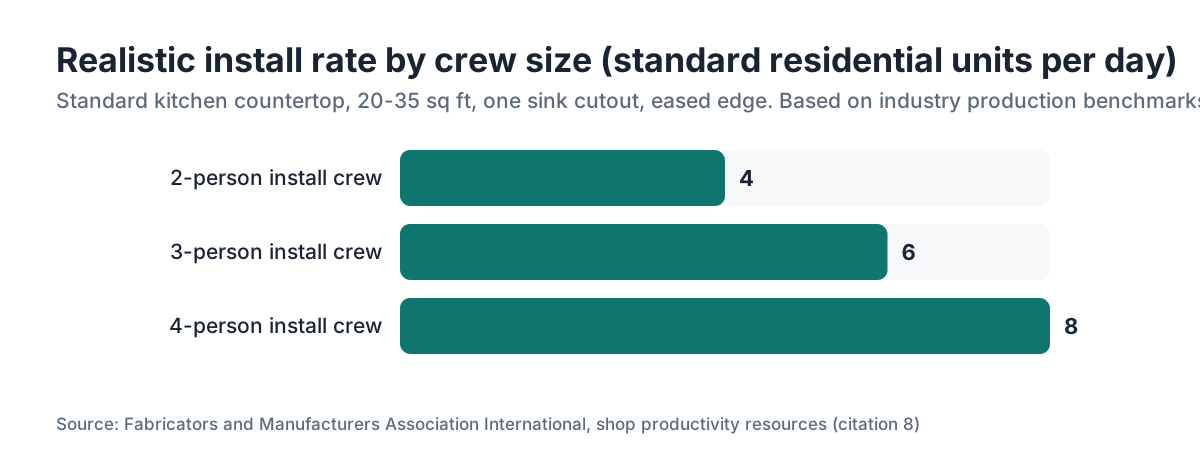
The install rate is usually the constraint. A two-person install crew in a multi-unit building can realistically complete 3 to 5 standard kitchen countertop installs per day, depending on sink cutouts, edge profile complexity, and building logistics (elevator access, parking, unit readiness). A three-person crew might reach 5 to 7 units per day. These are honest numbers, not best-case numbers.
Unit readiness is a problem you cannot fully control but must plan for. On renovation projects, units often aren't ready when the schedule says they will be. Cabinet installation runs late, plumbing rough-in gets moved, flooring runs over. Build a 15 to 20% schedule buffer or explicitly call out in your contract that your install schedule is contingent on unit availability. If the GC holds you to a completion date regardless, your buffer needs to be built into your pricing, not absorbed as labor cost.
Phased delivery also helps. Instead of trying to install all 100 units in a continuous run, negotiate a phased schedule: units 1-25 by date X, units 26-60 by date Y, units 61-100 by date Z. This gives both sides checkpoints and makes cash flow more predictable. Phased payment tied to phased completion is standard on projects above about 30 units.
What staffing and crew structure works best for these projects?
The worst staffing approach is pulling your regular custom residential crews and just assigning them to the multi-unit job. Their habits, their pace, and their workflow are built around one kitchen at a time. That works fine for custom work but is inefficient at scale.
The better approach is designating a dedicated multi-unit crew or crews, at least for the duration of a major project. These crews develop a rhythm with the building, the layout, and the material. After the first 10 or 15 units, they're operating from muscle memory on the standard layout. Their per-unit time drops, often significantly.
Crew structure that works for commercial multi-unit installs: a lead installer who does layout, scribing, and sink cutouts, supported by one or two helpers who handle carry, set, and seam work. On standard unit kitchens (20 to 35 sq ft, no island, one sink), this three-person crew can hit 5 to 6 units per day once they're in their rhythm.
For large projects, some shops subcontract the install to a trusted installation-only crew and keep their own people in the shop on fabrication. This can work, but it requires tight piece labeling and a clear hand-off process. The install crew needs to be able to find the right piece for the right unit without calling the shop.
On the fab side, running a dedicated shift for the multi-unit batch job (rather than mixing it with custom residential orders on the same saw) reduces changeover time and keeps the flow predictable. If your shop runs CNC, program the full batch and run it as a job lot overnight or during a second shift.
How do you manage material procurement and slab inventory for a big project?
Material procurement on a high-volume project is a separate discipline from one-off purchasing. Lock in the price, confirm the quantity, and stage delivery to match your fab schedule without burying your yard.
For quartz on a 100-unit project, calculate your net square footage from the template data, apply your yield factor (typically 70 to 80% for standard residential layouts on 126" x 63" slabs, depending on cutouts and edge waste), and then add 10% contingency [4]. Order the full project quantity in one PO if possible. Manufacturers can honor color consistency better when the order ships from the same production run.
For natural stone, the consistency challenge is real. If you need 300 slabs of a granite color, confirm with your distributor that they have or can source a consistent lot. Color variation between quarry runs on the same named material can be substantial. Ask to see the actual lot before you commit, or at minimum ask for lot number documentation.
Stage delivery in phases matched to your fabrication schedule. Taking delivery of 300 slabs at once creates storage problems, breakage risk, and capital tied up in inventory. Ask your supplier for a blanket PO with phased releases ("release 75 slabs every 3 weeks"). Most distributors on large projects will accommodate this.
Store slabs on proper A-frame racks, keep them covered if outside, and keep the yard organized by unit phase. A slab that gets damaged in storage on a multi-unit job is more than a repair cost, it's a scheduling problem. If that slab was earmarked for a unit going in next week and the replacement lead time is two weeks, you've got a cascade.
What contract terms should you insist on for high-volume countertop jobs?
The contract is where multi-unit jobs get shops in trouble more than any other single factor. Contractors and developers have experienced legal teams who write contracts that protect them first. You need to read carefully and push back on several common clauses.
Liquidated damages clauses specify a dollar amount the contractor can deduct from your payment for each day the project runs late [5]. These clauses are common and legally enforceable. Before you accept one, calculate whether the daily LD amount is actually tolerable given your project margin. A $500/day LD on a $200,000 project contract is very different from a $2,000/day LD.
Lien rights on commercial projects are governed by state law and vary significantly by state. Most states require you to serve a preliminary notice (sometimes called a "notice to owner" or "notice of furnishing") within a specific number of days of first furnishing materials or labor, or you lose lien rights [6]. On commercial multi-unit projects, contractors sometimes delay payment and hope subcontractors miss their notice deadline. Know your state's deadline. In California, for example, a subcontractor who doesn't have a direct contract with the owner must serve a preliminary 20-day notice within 20 days of first furnishing [7]. Miss it and your lien rights are substantially compromised.
Payment terms should include a mobilization payment (10 to 15% of contract value) paid before you purchase material. On a $300,000 multi-unit job, buying $80,000 in slabs before you've received a dollar is a cash flow problem. Get that mobilization payment in writing as a contract term, not a verbal agreement.
Unit readiness language matters. Your contract should specify that install dates are contingent on units being delivered in a defined ready condition (cabinets set and level, plumbing rough-in complete, flooring done or protected, unit accessible). If the GC can't deliver ready units, the schedule adjusts accordingly and you are not responsible for delay penalties.
Retainage is common on commercial projects: the owner holds 5 to 10% of each progress payment until substantial completion [10]. Negotiate retainage release tied to phase completion, not total project completion. If you finish 80 units and the GC runs 6 months late on the final 20, you don't want 10% of your contract sitting in retainage until they finish.
How do you handle quality control across a large number of units?
Quality control at volume is a systems problem, not a supervision problem. You can't personally inspect 200 countertop installations. You need a checklist, a sign-off protocol, and a punch list process that runs without you in the room.
Build a per-unit installation checklist. It should cover: pieces delivered and matching unit label, countertop level (checked with a 4-foot level at minimum three points), seams tight and flush, sink cutout accurate and sink clips installed, edge profile consistent and free of chips, caulk line clean at wall and backsplash, and final surface free of scratches or damage. The installer signs the checklist for each unit and photos the countertop before they leave.
Assign a site lead whose job includes random QC inspections. On a 100-unit project, inspecting 1 in 5 units at completion is a reasonable sampling rate. If the site lead finds repeated problems with a specific crew member or a specific material issue, they catch it at unit 20, not unit 80.
For seam quality specifically, high-volume projects often expose inconsistency in your shop's seam preparation. A seam that looks fine on a one-off custom job can look amateur when you're making the same seam 60 times. Standardize your seam prep: consistent gap, consistent color-match protocol, consistent clamping procedure.
Punch list management is its own skill. On a 100-unit project, you will have a punch list at the end. Budget labor for it, assign a dedicated crew to work through it, and track it by unit number with expected completion dates. A punch list that lingers is the most common reason retainage gets withheld beyond the agreed timeline.
What does a realistic timeline look like for different project sizes?
Timeline expectations from GCs and developers are often optimistic to the point of being detached from reality. Here are honest benchmarks based on typical shop capacity, not best-case scenarios.
| Project size | Template phase | Fabrication | Installation | Total calendar time (realistic) |
|---|---|---|---|---|
| 10-20 units | 1-2 days | 3-5 days | 3-5 days | 2-3 weeks |
| 20-50 units | 3-5 days | 7-14 days | 7-14 days | 4-7 weeks |
| 50-100 units | 5-10 days | 14-21 days | 14-21 days | 7-12 weeks |
| 100-200 units | 10-20 days | 25-40 days | 25-40 days | 12-20 weeks |
| 200+ units | Phased; 30+ days | Phased | Phased | 5-12 months |
These timelines assume overlapping phases (templating, fab, and install running in parallel) and a shop with adequate capacity. They also assume roughly 3 to 5 units per install-crew-day and a fabrication shop that can produce 5 to 10 standard residential units per day with a typical CNC setup [8].
Three things blow up these timelines. Unit readiness delays (the GC's problem, your schedule hit). Material delivery delays (increasingly common since 2020 supply chain disruptions). And scope creep, meaning units that weren't in the original contract getting added mid-project.
Get your timeline commitment in writing and attach it to a unit-readiness schedule from the GC. If they can't produce a unit-readiness schedule, that's a warning sign about their own project management.
How do you keep cash flow healthy on a long multi-unit project?
Cash flow is the operational risk that kills shops on big projects. A $500,000 multi-unit contract looks great on paper. But if you have to buy $150,000 in material upfront and wait 45 days for each progress payment, you can be doing well on paper while struggling to make payroll.
The fix is front-loading your cash inflows relative to your cost outflows. Push for:
- A mobilization payment of 10 to 20% before any material purchase.
- Progress payments tied to unit completion milestones, billed monthly or bi-weekly, not at project completion.
- Net-30 payment terms rather than net-45. On a $500,000 project, net-45 versus net-30 is $20,000 sitting in someone else's account for an extra 15 days.
- Supplier terms that give you 30 days net on material invoices, so your material cost timing lags your billing rather than leading it.
Track job cost in real time, not at month end. On a 100-unit project, it's easy to feel busy and productive while actually losing money per unit because labor ran over or material waste was higher than estimated. Weekly job cost reports, even informal ones, catch this before it compounds.
Have a line of credit before you need it. If you chase multi-unit projects regularly, arrange one while your books are healthy. The SBA 7(a) loan program and local bank lines of credit are the standard options for small fabrication shops [9]. Trying to arrange financing after a cash crunch starts is much harder than having it available as a buffer.
What technology and software make high-volume projects manageable?
The technology stack for high-volume countertop work isn't exotic. You need a quoting tool, a digital templating system, a scheduling and project management tool, and CNC if your volume justifies it.
For quoting, any tool that lets you build a unit template and multiply it across a unit count saves time and reduces errors. Spreadsheets work but break down on large projects with many unit variations. Purpose-built countertop quoting software like SlabWise is built for this kind of scaling and includes nesting optimization to reduce material waste on batch runs. On a 100-unit project, even a 2% improvement in slab yield saves meaningful money.
Digital templating with a device like a Prodim Proliner or an LPI digital templater integrates with CNC software directly, eliminating manual data entry between template and saw file. The Proliner, for example, is used by a large portion of production shops in North America precisely because the template-to-CNC workflow is tight [3].
For scheduling on the job site, a simple project management tool (Asana, Buildertrend, or even a shared Google Sheet with unit status columns) is enough for most shops. The key fields: unit number, template date, fab completion date, scheduled install date, actual install date, punch list items, sign-off date. That's the whole workflow in one place.
Countertop installation logistics also benefit from a unit-by-unit delivery manifest: what pieces go on which truck, in what order, for which units on that day. Install crews that show up without a clear piece manifest waste time on the truck sorting pieces. That time adds up across 100 units.
For material choices and ongoing care information to pass to property managers, detailed care guides for each surface type help reduce warranty calls. Property managers overseeing kitchen countertops in rental units especially benefit from surface-specific guidance on stone cleaning and maintenance.
Frequently asked questions
How many units does a project need before I should change my process?
Ten units is a reasonable threshold. Below 10, your standard residential workflow with minor adjustments is fine. At 10 to 20 units, you start to benefit from batch templating, standardized unit quotes, and phased scheduling. At 50 or more units, a fully dedicated crew, a formal scheduling system, and negotiated supplier terms are basically required to stay profitable.
What is a fair markup on high-volume countertop projects compared to custom residential?
Most shops run lower gross margin percentage on high-volume work (30 to 40% gross vs. 40 to 50% on custom residential) but higher absolute dollars and higher revenue per crew day. The margin trade-off is worth it if the volume is consistent. Don't go below 28 to 30% gross on a large job; that's the floor where you absorb any cost variance and still break even.
Can I use the same quartz color across 200 units and guarantee it looks the same?
You can get very close. Order from one production run and ask for a batch or lot number commitment from the manufacturer. Engineered quartz is more consistent than natural stone, but slight shade variation between production batches does occur. Pull a sample from each pallet delivery and compare it against your reference sample before it goes to the saw. Flag any visible shift and address it with the supplier before installation.
What is the most common mistake shops make on their first big multi-unit job?
Underpricing mobilization and logistics time. Shops quote the square footage correctly but forget that moving crews in and out of an occupied or partially occupied building, dealing with elevator schedules, managing parking, and handling debris removal across 80 units consumes 10 to 20% of install labor above what a single residential job requires. Add that to your quote explicitly.
How do I handle a unit that turns out to be very different from the standard layout?
This is exactly what unit adders in your contract are for. If your quote structure has a per-unit standard price and a list of named adders (corner unit with extra run, L-shape vs. U-shape, added bar top, etc.), a non-standard unit just triggers the appropriate adder. Document it with a photo at template time, get written approval from the GC before you fabricate, and invoice the adder on that unit's line item.
What lien rights do I have if a developer doesn't pay on a multi-unit project?
Mechanics lien rights on commercial projects are governed by state law and vary significantly. Most states require you to serve a preliminary notice within a specific window (often 20 days from first furnishing) to preserve lien rights. Miss that deadline and your remedy shrinks to a breach of contract claim, which is harder to enforce. Know your state's statute and set a calendar reminder the day you first deliver material or show up on site. The American Institute of Architects publishes state-by-state lien law summaries as a starting point [6].
How do I calculate how many slabs I need for a 50-unit quartz project?
Measure or estimate the net countertop square footage per unit. Multiply by 50 to get gross project square footage. Divide by the usable yield per slab (a standard 126" x 63" quartz slab is about 55 square feet gross; typical usable yield after cuts and waste is 38 to 44 square feet for a standard residential layout). Then add 10% contingency. For 50 units at 30 sq ft net each: 1,500 sq ft divided by 40 sq ft usable yield = 37 to 38 slabs, plus 4 contingency slabs, so order 41 to 42 slabs [4].
Should I require a site supervisor from the GC to be present during my installs?
For a project above 30 units, yes. Your contract should require the GC to provide access coordination and a point of contact reachable during install hours. You don't need the GC physically present for each unit, but you need someone who can open a locked unit, resolve a unit-readiness dispute, and document any pre-existing damage so it doesn't get charged back to you. Get this in writing before the project starts.
What edge profiles work best for high-volume projects?
Eased edge and simple bevel are the right answers for most multi-unit work. They're fast to machine, consistent, and durable. Ogee, bullnose, and waterfall edges add machining time per linear foot, which multiplies across hundreds of units. Save the decorative profiles for the lobby or clubhouse. Standardize on one edge profile per project wherever possible; switching profiles mid-job costs time and creates room for crew errors.
How do I protect myself from scope creep on a 100-unit project?
Define scope precisely in the contract: exact unit count, specific unit numbers or building wing references, specific material and edge profile, and specific inclusions (sink cutouts, seams, backsplash or not). Any unit added after contract execution is a written change order with its own pricing. Scope creep on multi-unit jobs is almost universal; the question is whether you have a mechanism to get paid for it. Without written change order language in your contract, you probably won't be.
Is it worth buying a digital templating tool if I only do 2 or 3 big jobs per year?
At 2 to 3 jobs per year, the math is close. A Prodim Proliner costs roughly $20,000 to $30,000. If your big jobs average 60 units and digital templating saves you 15 minutes per unit, that's 15 hours per project, or about 30 to 45 hours per year saved. At a $75 to $100 all-in labor cost per hour, that's $2,250 to $4,500 saved per year plus reduced rework from measurement errors. Payback is 5 to 10 years on time savings alone, but rework avoidance and accuracy on CNC integration can shorten it considerably [3].
What surface is easiest to maintain in a rental unit or hotel room?
Engineered quartz is the industry standard answer for rentals and hotels. It's non-porous (no sealing required), resistant to most common stains, and hard enough to handle tenant misuse better than marble or soapstone. Solid surface (like Corian) is also low-maintenance and can be repaired in place if scratched. Avoid marble and unsealed natural stone in rental applications; maintenance requirements are high and damage from tenant neglect is expensive to fix.
How should I document unit completion for payment and warranty purposes?
Photo document every completed unit before you leave. A timestamped photo showing the countertop set, the sink installed, and the unit number visible (written on tape on the wall or cabinet) takes 60 seconds and is worth it on day 90 when someone claims damage. Store photos organized by unit number in a cloud folder. For warranty purposes, a simple sign-off sheet signed by the GC's site supervisor at phase completion establishes the warranty start date clearly.
Sources
- U.S. Bureau of Labor Statistics, Producer Price Index, Series PCU327991327991 (Cut stone and stone products): Year-over-year price swings of 5 to 12% in stone products, making unlocked pricing a real exposure on multi-month projects
- U.S. Geological Survey, Minerals Yearbook, Manufactured Stone: Engineered quartz (manufactured stone) is widely used in multi-unit residential and commercial countertop applications due to consistency of appearance and hardness
- Natural Stone Institute (formerly Marble Institute of America), Dimension Stone Design Manual and fabrication standards: Typical usable yield per quartz slab for residential layouts is 38 to 44 square feet; 10% material contingency is standard practice on large projects
- American Bar Association, Forum on Construction Law, materials on liquidated damages in construction contracts: Liquidated damages clauses in construction contracts are legally enforceable when the specified daily amount is a reasonable pre-estimate of actual damages
- American Institute of Architects, contract documents and lien law resources: Mechanics lien rights on commercial projects require preliminary notice within specific state-mandated timeframes; missing deadlines substantially reduces lien rights
- California Civil Code Sections 8200-8216, Preliminary Notice Requirements: In California, a subcontractor without a direct contract with the owner must serve a 20-day preliminary notice within 20 days of first furnishing materials or labor to preserve lien rights
- Fabricators and Manufacturers Association International, shop productivity resources: A typical production stone fabrication shop with CNC can produce 5 to 10 standard residential countertop units per day depending on complexity
- U.S. Small Business Administration, 7(a) Loan Program: SBA 7(a) loans are a standard financing option for small fabrication shops needing working capital for large commercial projects
- Associated General Contractors of America, construction payment and retainage resources: Retainage of 5 to 10% per progress payment is standard on commercial construction projects; retainage release tied to phase completion is a negotiable contract term
Last updated 2026-07-11