
TL;DR
- Most natural stone and quartz slabs run 55 to 65 inches wide, so a kitchen longer than that gets at least one seam.
- Customers who insist every seam disappear often end up with weak joints, wasted material, or a rejected install.
- The fix is early education, honest material limits, and a written seam-placement agreement signed before any stone gets cut.
Why do customers want all their seams hidden in the first place?
Nobody wants to pay $5,000 for a countertop and then stare at a line running across it. That reaction makes sense. The trouble is that the expectation of one unbroken surface gets set by showroom photos, magazine spreads, and manufacturer marketing images that show slabs in ideal, controlled conditions, usually on shorter runs where one slab covers the whole thing.
A homeowner sees a beautiful 48-inch island in a photo, orders a 96-inch island, and assumes the same clean look is just a matter of skill. It isn't. The slab physically doesn't come in that size. Standard quarry slabs for granite, marble, and engineered quartz measure between 55 and 65 inches wide and 100 to 130 inches long, depending on origin and manufacturer [1]. A 96-inch island means a seam. Period.
Respect the emotional weight behind seam anxiety too. Countertops are often the single most expensive finish in a kitchen remodel. Homeowners stretching a budget feel every visible flaw as proof they got a lesser product. Some got burned before by fabricators who dropped a seam somewhere clumsy. That history is real, and it earns some skepticism.
What are the actual physical limits on hiding seams?
Slab size is the first hard wall. Natural stone quarried in Brazil, Italy, or India usually yields finished slabs in the 55 to 65 inch width range, with some jumbo slabs reaching 75 inches from specialty quarries. Engineered quartz makers like Cambria, Silestone, and Caesarstone publish their standard dimensions; Cambria countertops slabs, for example, run roughly 56 x 120 inches or 65 x 132 inches depending on the collection [2]. If your run exceeds the slab width, a seam isn't optional.
Grain and pattern matching is the second limit. Stones with dramatic veining, like Calacatta marble or quartzite, need the veins to line up across the seam or the whole surface looks fractured. Matching wants extra material, specific cut angles, and sometimes bookmatching two adjacent slabs cut from the same block. That process can cut usable slab yield hard, which drives up cost and sometimes forces a seam into a spot the customer didn't expect [3].
Thickness matters. Thinner slabs (3cm is now standard; 2cm is getting rare) are structurally weaker at the joint. Unsupported spans over dishwashers, cooktops, or sinks are exactly where seams should not go, because the joint can crack under thermal cycling or the everyday vibration of normal use. The Marble Institute of America recommends avoiding seams over appliance cutouts whenever possible [4].
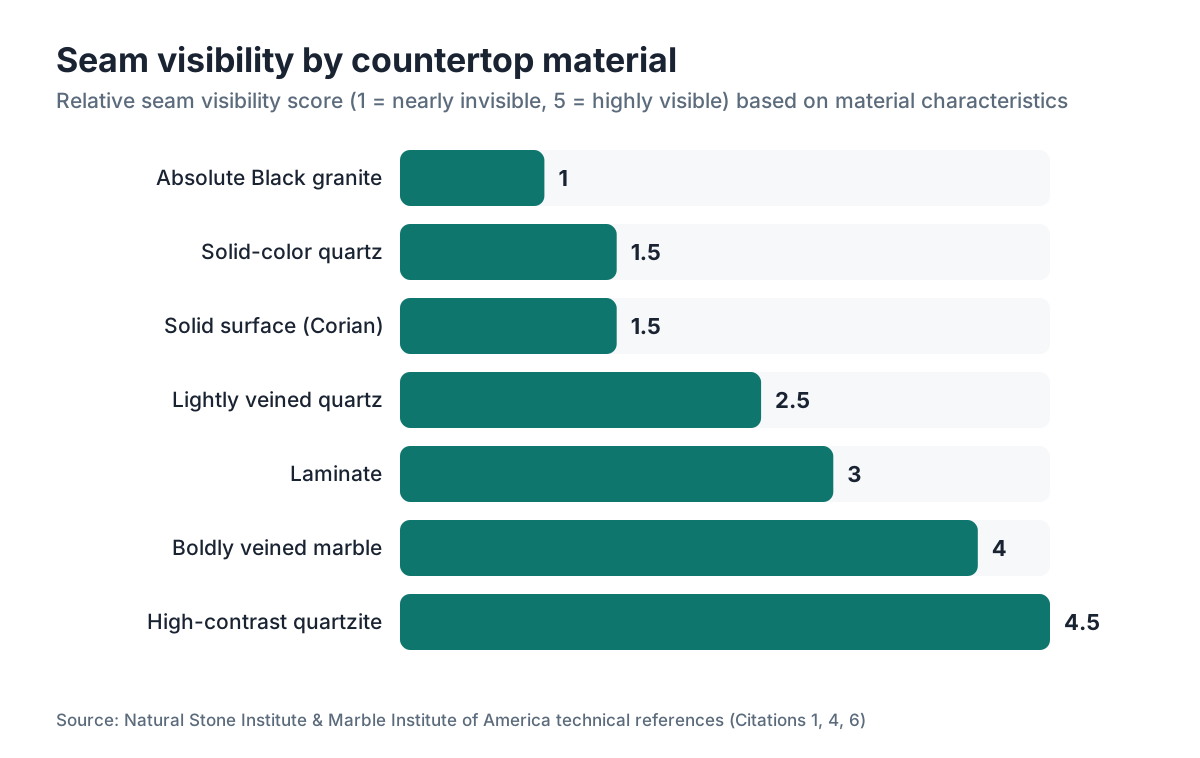
Seam visibility also depends heavily on the material itself. Absolute Black granite hides seams almost perfectly. White quartzite with bold veining shows every seam no matter how well it's cut. Customers chasing busy, high-contrast stones should hear that truth before they fall in love with the slab.
How should fabricators explain seam placement to customers without losing the sale?
Start with the physical facts before you talk price. Pull out a tape measure in the showroom and walk the customer through why their 110-inch peninsula needs at least one seam. Show them the real slab dimensions. Some shops keep a laminated one-pager with common slab sizes and a simple diagram. That artifact makes the explanation feel like engineering, not an excuse.
Then shift the conversation from "hidden or visible" to "well-placed or poorly placed." A seam near the sink, where it disappears under functional clutter, is nearly invisible in daily life. A seam in the dead center of an open island is where eyes land. Ask the customer where they want the seam, not whether they want one. That reframe hands some control back and tends to defuse the standoff.
Use photos of real kitchens with well-placed seams. Before-and-after comparisons of a seam at a cooktop transition versus one floating in open counter space do more convincing than any speech. If you don't have your own library of install photos, the National Kitchen and Bath Association publishes installation guides with seam-placement examples [5].
Be honest about what skilled work costs. A tight, epoxy-filled, color-matched seam on dark granite polished flush can genuinely be hard to find from three feet away. That quality takes time. If a customer wants the best possible seam, quote the labor for it and say why.
Which countertop materials hide seams better than others?
This question has a real answer, and customers deserve a direct one instead of a hedge.
Absolute Black granite and other solid-black or near-solid stones hide seams extremely well. The uniform color means even a slightly imperfect fill vanishes under normal lighting [6]. Solid-colored engineered quartz (white or gray without heavy veining) also performs well because the pattern stays consistent across the slab. Cambria countertops with solid or lightly textured patterns are a common fabricator pick for exactly this reason.
At the other end, marble countertops with dramatic veining, high-contrast quartzites, and bookmatched exotic stones will show seams unless the fabrication is exceptional and the placement is strategic. Customers drawn to those stones need to understand the tradeoff upfront.
Laminate countertops and Corian countertops (solid surface) belong in this conversation because solid surface can be seamed with near-invisibility. Corian and similar solid-surface materials get thermally welded and sanded flush, which makes seams genuinely hard to find. Raise that if a customer's main worry is seam visibility and they're open on material. Formica countertops also bond at seams, but the joint stays visible at close range.
| Material | Seam Visibility | Why |
|---|---|---|
| Absolute Black granite | Very low | Uniform dark color, epoxy matches easily |
| Solid-color quartz | Low | Consistent pattern, no veining to misalign |
| Veined quartz | Medium | Pattern disruption at the seam is noticeable |
| Marble / quartzite (veined) | High | Vein mismatch amplified by high contrast |
| Solid surface (Corian, etc.) | Very low | Thermal weld plus sanding, color-through material |
| Laminate | Medium-High | Visible edge join, no fill option |
What happens when a fabricator agrees to hide seams that can't actually be hidden?
Bad things. Rushing a seam to an "invisible" spot often means dropping it where structural support is weakest. A seam over an unsupported span can crack within a year, especially in stones that run thinner or carry natural fissures. A cracked seam in a $4,000 marble countertop is a dispute, a repair call, and sometimes a lawsuit.
Over-promising invisibility also builds a customer who will scrutinize the install under a flashlight, hunting for the flaw they were told wouldn't exist. No seam is truly invisible under a flashlight at six inches. Once someone's been promised otherwise, any visible joint becomes grounds for rejecting the job.
Fabricators who cave to this pressure also waste more material chasing perfect seam spots, cutting slabs into large offcuts with no reuse value. That waste comes straight out of margin. One way to put it: you pay twice for the same problem, once in stone and once in the callback.
The legal exposure is real. If a seam fails because it landed in a structurally compromised spot to satisfy a customer demand, and no written agreement documented that choice, the fabricator usually eats the repair. Get it in writing.
How should fabricators document seam placement agreements?
A seam placement drawing is standard practice in professional shops. If you're not doing it, start now. The drawing shows the countertop layout to scale, marks every seam with a dimension from a fixed reference point (usually the wall), and gets a customer signature before any stone gets cut.
The document should state plainly that seam location is the fabricator's professional recommendation based on slab size, material behavior, and structural needs. If the customer wants a different location against that recommendation, note it as "customer-directed placement" and have them initial it specifically. That language protects you if the seam cracks or if they claim later they didn't know where it would land.
Some shops add a one-paragraph explanation of seam characteristics to their standard contract: what a seam is, that it will be visible under certain lighting, and that color variation between adjacent slabs is natural. The Marble Institute of America's care and installation guidelines back this kind of disclosure practice [4].
Shops running quoting and job-management software can attach seam drawings straight to the job record. SlabWise, for example, generates layout diagrams you can print or email for sign-off as part of the quoting workflow, which keeps the paper trail in one place.
Photograph the finished seam before installation. Date-stamped photos showing a tight, flush, color-matched seam at delivery are your best defense if a customer later claims the seam was botched.
What are the best strategies for seam placement that customers will actually accept?
The best seam placement is one the customer helped choose. Here's how to run that conversation.
First, map the activity zones. Seams near the sink, behind the faucet, or at a corner transition get visually buried by fixtures and use. A seam in the middle of a prep area where someone rolls dough every morning is one they'll see every day. Ask the customer how they use the space.
Second, use the backsplash as cover. A seam that ends at a tile backsplash or a structural wall is harder to spot than one floating in open counter. Where the layout allows it, push seams to transition points.
Third, think about seam direction relative to natural light. A seam running parallel to a window with strong raking light catches the light and shows more. A seam running perpendicular to the main sight line from the kitchen entry reads as less prominent than one running parallel to it.
Fourth, consider edge profile. A mitered seam on a waterfall island edge takes extreme precision but can look like a designed joint rather than a construction necessity. Some customers actually prefer a clearly intentional seam to one that's trying to hide and failing.
Fifth, bookmatch adjacent slabs when veining is in play. Cutting two slabs from the same block and mirroring them across the seam line turns the seam into a design feature. It takes planning, costs more in material, and needs matched slabs, but for dramatic stones it can be the right answer [3].
What should homeowners ask a fabricator about seam placement before signing?
If you're a homeowner collecting quotes, ask these questions straight and watch how the fabricator responds. The quality of the answers tells you a lot about who you're hiring.
Ask where every seam will go and why. A good fabricator shows you a drawing. If they say "we'll figure it out during templating" without committing to a process, that's a yellow flag.
Ask to see the actual slab you're getting, more than the sample. Seam visibility depends on the specific slab's pattern and color variation. Two slabs of the same stone type can behave very differently at a seam.
Ask what the seam filler is. Epoxy color-matched to the stone is standard for natural stone. Some shops use a clear epoxy that reads differently than either stone color; some use a pigmented mix that may or may not hold its match as it ages.
Ask what happens if the seam disappoints you after installation. Get that answer in writing. A confident shop stands behind tight seam work. Vague answers here often mean they know the seam may let you down.
For granite countertops or marble countertops with strong veining, ask specifically whether the veins get matched across the seam and whether that needs extra material. If it does, ask how the cost gets handled.
Read the countertop installation process overview too, so you understand what templating, cutting, and installation actually involve. Informed homeowners get better work.
Are there countertop materials that don't need seams at all?
Mostly no, but a few cases are worth knowing.
Solid-surface materials like Corian can be fabricated in very large pieces and joined with thermal welds that are genuinely hard to see. For runs up to about 144 inches, a skilled solid-surface fabricator can sometimes deliver a single-piece top with no visible joint. The catch is that solid surface is softer, more prone to heat damage, and doesn't carry the prestige or resale value of natural stone or engineered quartz [7].
Butcher block countertops get edge-glued from the start by their own manufacturing; every visible line in the wood is a joint. That changes the conversation entirely, since the material's whole look is defined by those joints.
For natural stone and engineered quartz, a joint-free surface is only possible if the entire countertop fits within a single slab. That generally caps you at runs under about 55 inches of width, which covers many bathroom vanities and short kitchen sections but almost never a full kitchen layout.
Porcelain slabs now come in larger formats, with some manufacturers offering slabs up to 126 x 63 inches or larger, which stretches the joint-free zone slightly past natural stone [8]. Even those have limits, and porcelain's brittleness during fabrication makes large unsupported pieces risky.
How do you handle a customer who refuses to approve a seam plan and is holding up the job?
This comes up more than fabricators like to admit. A customer has fallen so hard for a particular stone that they can't accept the physical reality of installing it, and the job stalls.
Start by resetting to the contract. What did the quote and agreement say about seam location? If it was vague, that's partly on the shop, and a compromise is fair. If the seam drawing was signed and the customer is now backing out, walk through the signed document together, calmly.
Offer a concrete demonstration. Some shops cut a short seam sample from scrap in the same stone, epoxy it, polish it, and show the customer what the finished seam actually looks like under kitchen lighting. That physical sample often ends the standoff faster than any argument.
If the customer wants a location that's structurally problematic (say, over a cooktop cutout), document your professional objection in writing and have them sign a specific acknowledgment of the risk. Some fabricators attach a waiver for customer-directed structural decisions. That's not punitive. It's honest about who is making the call.
Know when to walk away. A customer who wants something physically impossible, refuses to sign any documentation, and will reject the install regardless of quality is a customer who costs you more in disputes than they're worth in revenue. That's a hard call but a real one.
For shops running software to manage jobs, keeping the seam diagram and all customer communications in one job record (instead of scattered across texts and emails) makes these conversations far easier. That documentation discipline, whether you use dedicated software like SlabWise or even a shared folder, separates shops that win disputes from shops that swallow losses.
What does a quality seam actually look like, and what standards exist?
A well-executed seam on polished granite or quartz should be flush (no lip between the two pieces), tight (gap as close to zero as the stone's natural variation allows), and color-matched with epoxy. The Marble Institute of America's residential standards suggest seams in polished stone should have a gap of no more than 1/16 inch under normal conditions, though tighter is always better and skilled fabricators regularly hit 1/32 inch or less [4].
Visibility rides on viewing angle, lighting, and material. Even a perfect seam in Calacatta marble will show from across the room in raking light. A good seam in Absolute Black granite is genuinely hard to find without touching it. Managing expectations means tying the quality standard to the specific stone.
Honed and leathered finishes can hide seams better than high-polish finishes on some stones, because the lower reflectivity cuts the light-catching at the seam line. Worth mentioning to customers picking between finishes on a stone with bold veining.
The National Kitchen and Bath Association publishes installation guidelines that address seam standards, and some fabricators reference these in their contracts to establish that their work meets a recognized professional standard [5]. Citing a third-party standard shifts the reference point from "the fabricator said it was good" to "it meets the industry standard," which helps in dispute resolution.
Frequently asked questions
Can any countertop be installed without seams?
Only if the entire surface fits within a single slab. Most natural stone and quartz slabs are 55 to 65 inches wide and 100 to 130 inches long. Bathroom vanities under 55 inches, small bar tops, and short kitchen sections can often go joint-free. Anything longer almost always needs at least one seam. Solid-surface materials like Corian can thermally weld pieces with near-invisible joints, which is the closest thing to no visible joint on longer runs.
Where is the best place to put a countertop seam?
Near a sink, behind a faucet, at a corner transition, or at the edge of an appliance cutout. These spots get busy with fixtures and daily use, so the seam disappears into the context. The worst placement is the center of an open island or a peninsula where the eye has nothing else to land on. Always push seams toward natural visual breaks in the layout.
How visible is a seam on granite countertops?
It depends heavily on the stone. Solid dark granites like Absolute Black make seams nearly invisible; a skilled fabricator can match epoxy so closely the joint is hard to find by touch. Granites with strong color variation or bold patterning show seams more. Viewing distance and lighting matter too. Under raking natural light from a nearby window, even a tight seam catches shadow.
Will a quartz countertop seam be noticeable?
On solid or lightly textured quartz it's usually subtle. On heavily veined patterns it can be obvious if the veins don't align. Engineered quartz makers produce repeating patterns, so seam matching is a matter of alignment rather than bookmatching like natural stone. Ask your fabricator to show you the specific pattern repeat and how they plan to align it at the seam before committing.
Can a fabricator move a seam after the stone is already cut?
No. Once the stone is cut, the seam location is fixed. Moving it would mean cutting new pieces, which usually means buying more material. This is why the seam placement drawing has to be approved before any cutting begins. If a customer changes their mind after templating but before cutting, there may be a redesign charge; after cutting, additional material costs are almost certain.
What epoxy is used to fill countertop seams and does it last?
Most fabricators use a two-part color-matched polyester or epoxy resin. High-quality two-part epoxies are UV-stable and chip-resistant, and a well-filled seam can last the life of the countertop without reapplication. Cheaper polyester fillers may yellow or crack over time. Ask your fabricator what product they use and whether it's UV-stable, especially in kitchens with direct sunlight near the seam.
Should a seam ever go over a dishwasher or cooktop?
No. Both are heat sources that create thermal cycling stress, and dishwashers add vibration. The Marble Institute of America recommends keeping seams away from appliance cutouts because those spans are unsupported and the seam is the weakest point in the stone. A cooktop seam that cracks from thermal stress is expensive to repair and hard to argue against as a structural failure.
Is a seam over a sink a problem?
Less of a problem than over a cooktop, but not ideal. Moisture exposure at the joint over time can affect the epoxy bond, particularly if the stone wasn't properly sealed. Many fabricators prefer to place the seam just to one side of the sink rather than directly over it, which keeps the seam visible from above but away from constant water exposure.
What is bookmatching and does it actually hide seams?
Bookmatching means cutting two slabs from the same block and flipping one to mirror the other, so the veins flow symmetrically across the seam. It doesn't hide the seam so much as turn it into a design feature. On dramatic stones the mirrored pattern makes the seam look intentional. It requires selecting matched slabs at the yard and planning the cut carefully; expect to pay more for both material and labor.
How should fabricators handle a customer who rejects the countertop because of seam visibility?
Start with the signed seam placement drawing. If the seam is in the agreed location and meets the quality standard (flush, tight, color-matched), you have a documented basis for saying the work was performed as specified. Offer to show the seam in different lighting. If the complaint is legitimate (the seam is raised, gapped, or poorly colored), repair it. If it meets standard and the customer expected an invisibility that was never promised, that's a contract conversation.
Do honed or leathered finishes hide seams better than polished?
Generally yes. Polished surfaces reflect light sharply, which highlights any variation at the seam line. Honed and leathered finishes scatter light more diffusely, cutting the visual contrast at the seam. On stones where seam visibility is a concern, suggesting a honed or leathered finish is a legitimate fabrication strategy, not only an aesthetic preference. The tradeoff is that these finishes may need more frequent sealing.
How much does a difficult seam add to the cost of a countertop job?
A standard seam is typically built into base fabrication pricing. A bookmatched seam, a mitered waterfall seam, or a seam needing color-blending on a complex stone can add $150, $500, or more depending on the shop and region. Extra material to achieve pattern alignment at a seam can add significantly more, especially if matching requires pulling from a second slab.
Sources
- Marble Institute of America, Dimension Stone Design Manual: Standard quarry slabs for granite and marble typically measure 55–65 inches wide and 100–130 inches long depending on quarry origin and block yield.
- Cambria, Product Specifications: Cambria quartz slabs are available in standard dimensions of approximately 56 x 120 inches and 65 x 132 inches depending on collection.
- Natural Stone Institute, Fabrication Technical Reference: Bookmatching requires adjacent slabs cut from the same block; vein alignment at the seam demands specific cut angles and increases material waste.
- Marble Institute of America, Residential Installation Guidelines: MIA recommends avoiding seams over appliance cutouts; seam gaps in polished stone should not exceed 1/16 inch under residential installation standards.
- National Kitchen and Bath Association, NKBA Kitchen and Bath Planning Guidelines: NKBA publishes installation guidelines that address seam placement and workmanship standards for kitchen countertop installations.
- Natural Stone Institute, Stone Color and Seam Visibility Technical Bulletin: Solid-color granites such as Absolute Black allow epoxy color-matching that makes seams difficult to detect under normal kitchen lighting conditions.
- DuPont Corian, Technical Design and Fabrication Guide: Corian solid surface can be thermally welded and sanded flush to create seams that are nearly invisible; material is susceptible to heat damage above 212°F.
- Tile Council of North America, Large Format Porcelain Slab Overview: Large-format porcelain slabs are produced in sizes up to 126 x 63 inches by some manufacturers, extending joint-free coverage compared to standard natural stone slab dimensions.
- National Kitchen and Bath Association, 2023 Kitchen and Bath Market Index: Natural stone and engineered quartz are among the most commonly specified countertop materials in kitchen remodels tracked by the NKBA market index.
Last updated 2026-07-10