
TL;DR
- Builder countertop accounts offer volume but routinely destroy margins through slow payment, change-order chaos, and race-to-bottom pricing.
- Profitable shops treat builders like any other commercial client: firm per-linear-foot or per-square-foot pricing with documented minimums, net-15 or net-30 terms enforced by lien rights, and a hard look at true job cost before signing any preferred-vendor agreement.
Why do builder accounts go wrong for fabricators?
The pitch sounds great. A production builder needs 40 kitchens in a subdivision, all the same layout, repeat installs every two weeks. Volume means the saw stays busy, your crew gets efficient, and overhead spreads thin. Then the invoices age out to 60, 90, 120 days. The builder's purchasing manager calls to renegotiate pricing mid-project because lumber costs spiked. A superintendent changes a sink cutout on three units after templating. Nobody told you.
This is the standard arc of a builder account that was never structured correctly from the start. The problem is not that builder work is inherently unprofitable. The problem is that fabricators accept terms from builders they would never accept from a retail homeowner.
A homeowner pays a deposit before templating and the balance before or at install. A builder pays when the builder decides to pay. That asymmetry is the root of almost every builder-account disaster. Fix the terms first, then worry about everything else.
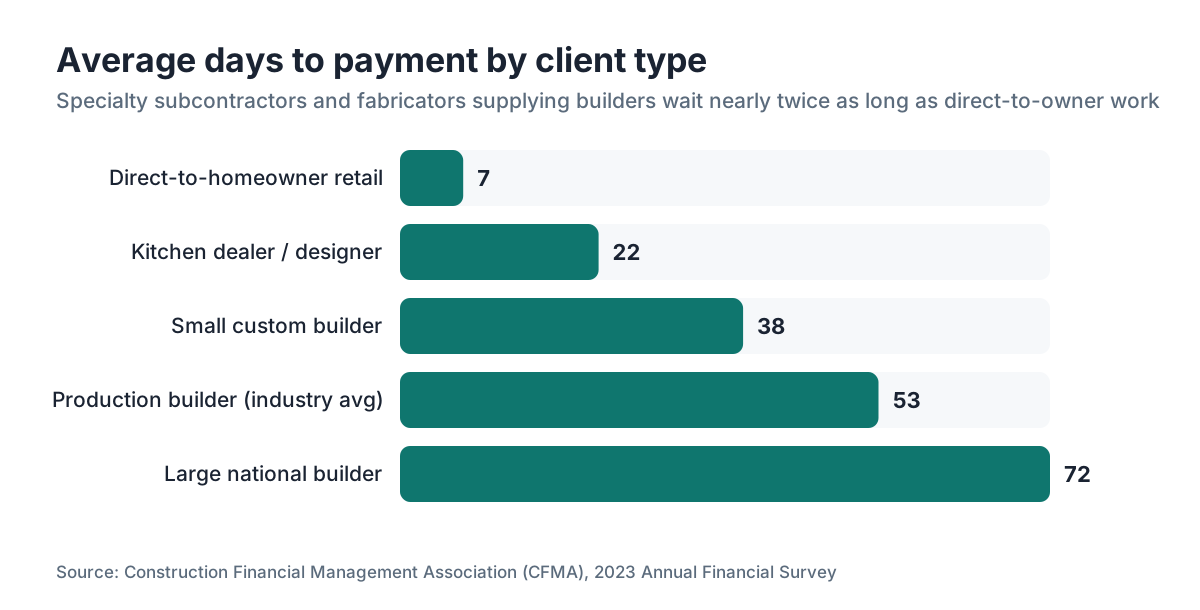
The Construction Financial Management Association surveys contractors annually on payment delays. Their 2023 data found that specialty subcontractors waited an average of 53 days to receive payment from general contractors, compared to about 30 days for direct-to-owner work [1]. Fabricators who supply builders sit in roughly the same seat as a specialty subcontractor, which means that 53-day average applies to you.
What margin should builder work actually hit?
Most shops I've talked with target 40-55% gross margin on retail countertop work. Builder work almost always carries a negotiated discount, because builders know they represent volume and they use that against you. The question is how much discount is defensible.
A 10-15% discount off your standard retail price is the most I'd give a builder before the math stops working. Here's why. Your fixed overhead (shop lease, equipment payments, insurance, admin salaries) doesn't go down because a builder job is predictable. Labor efficiency does improve on repeat layouts, but you still pay the same per-square-foot for stone. Disposal, templates, fuel, and installation labor are real costs that don't compress much at builder scale.
Run actual job costing on your last three builder installs before you agree to any pricing schedule. If you don't have job-costing data, that's the first problem to solve. Shops running QuickBooks, Xero, or dedicated fabrication software like SlabWise can tag every material purchase, labor hour, and delivery against a job number so you see true margin, more than the spread between material cost and invoice price.
Target no lower than 35% gross margin on builder accounts. If a builder's requested price gets you below that, the volume argument doesn't save you. You're just losing money faster.
| Account type | Typical gross margin | Payment terms | Change-order risk |
|---|---|---|---|
| Retail homeowner | 45-55% | Deposit + balance at install | Low (one decision-maker) |
| Kitchen dealer / designer | 38-48% | Net 30, usually reliable | Low-medium |
| Small custom builder | 35-45% | Net 30-45, variable | Medium |
| Production builder | 30-42% | Net 45-60, often slow | High (multiple supers) |
| Large national builder | 25-38% | Net 60-90, may require EDI | Very high |
How should you price builder countertop work?
Builder pricing almost always comes down to a per-square-foot rate tied to a material tier. The builder picks an allowance, say $45/sq ft installed for a builder-grade quartz, and every buyer who upgrades beyond that pays the overage directly to you at retail or a mild discount.
The allowance-and-overage model is genuinely good for fabricators if you set the base allowance correctly. Make sure the base allowance actually covers your cost on the most common material in the development. Builders routinely set allowances below your cost on purpose, banking on upgrades to generate margin for themselves or betting that homebuyers will absorb the difference. Don't let them.
For templating, price it as a line item. A lot of production builders want templating included in the per-square-foot rate. Resist that. Template charges, running $150-$350 per visit depending on your market [2], protect you when a buyer changes their mind after a template is done. If templating is already baked into the square-foot price, a re-template is pure loss.
Edge profiles are another line item builders try to bundle. Charge them separately. A basic eased edge is fine to include, but ogee, waterfall, or double-bevel edges require more machine time and tooling wear. Charging $8-$20 per linear foot for upgraded edges on top of the base rate is standard and defensible [2].
Minimum job sizes matter too. Set a minimum square footage or minimum dollar amount per unit. A builder who drops a 10-square-foot bathroom vanity on you as a standalone install costs you two technician hours in transit and setup for what might be a $200 job. A $400 minimum per install location is reasonable and most production builders will accept it.
For the actual negotiation, bring your standard pricing sheet. Don't open with discounts. Let the builder ask for volume pricing, then offer a tiered schedule: X price at 12 units per year, Y price at 24 units per year, Z price at 36+. Tying discounts to volume commitments gives you protection if the builder's project slows or stalls.
What contract terms protect you with builder clients?
The single most powerful move you can make before starting any builder account is getting a signed subcontractor agreement with net-15 or net-30 payment terms written in. Handshake deals and purchase orders with no payment terms leave you collecting at the builder's convenience.
Key clauses your agreement needs:
Payment terms. Net 30 maximum. Include a late payment fee, typically 1.5% per month on unpaid balances, which is legal in most states and is enough to make late payment mildly painful for the builder [3].
Change orders. Any field change to a countertop layout, sink location, or edge profile after templating requires a written change order signed by the builder's authorized rep before you proceed. This one clause prevents more arguments than any other.
Access requirements. You need the space to be within a defined temperature range (most adhesives and silicones require above 50°F [4]), the substrate cabinets to be level and plumbed, and utilities out of the way. If a unit isn't ready and you roll a truck, you charge a trip fee.
Lien rights. Most states give material suppliers and subcontractors the right to file a mechanics lien against the property if they aren't paid [3]. But preliminary notices are often required before the lien right attaches, and deadlines are strict. In California, for example, a subcontractor who doesn't have a direct contract with the owner must serve a Preliminary Notice within 20 days of first furnishing labor or materials [5]. Know your state's rules before you start work, not after you're owed money.
Dispute resolution. Specify the jurisdiction and governing law. If the builder is out of state, you don't want to litigate in their home county.
Get a lawyer to draft or review the agreement once. Pay for that once. It costs far less than one unpaid builder invoice.
How do you handle slow or nonpayment from builders?
Don't let it get old. An invoice at 45 days needs a phone call, not an email. An invoice at 60 days needs a certified letter. An invoice at 90 days needs a lien filed or threatened.
The mechanics lien is your most powerful tool. A lien clouds the title to the property, which means the builder can't sell or refinance any unit in the project until the lien is resolved. Builders hate liens more than almost anything because they clog closings. Filing a lien is often enough to get paid without ever going to court [3].
Before you file, understand the process in your state. Most states require:
- A preliminary notice or pre-lien notice served early in the project
- A lien claim filed within a set deadline after last furnishing labor or materials (varies from 60 to 180 days by state)
- A lawsuit to enforce the lien within a further deadline if the lien is disputed [3]
The American Subcontractors Association tracks state lien law variations and is a reasonable starting resource [6].
For accounts that chronically pay late but eventually pay, you have two options: charge the late fee every cycle without exception (which at least compensates you for the float), or stop working for that builder. There's no award for being the most patient subcontractor. A builder who pays 90 days out costs you real money because you're financing their project on your credit line.
Should you use builder-grade materials or your standard stock?
Production builders almost always spec lower-cost materials: laminate, entry-level quartz, or basic granite. That's fine. The question is whether you stock those materials or special-order them, and whether you're pricing material cost correctly.
If a builder spec calls for a particular Silestone or Cambria color, you either carry it or you don't. If you don't, add a material lead time clause to your agreement. Builders who set a 5-day rough-to-install schedule will slam you if your slab supplier needs 10 days.
For entry-level granite countertops, expect raw slab costs in the $6-$15 per square foot range for commodity colors from domestic distributors [7]. For builder-grade quartz, raw costs run $12-$22 per square foot depending on brand and color [7]. These numbers shift with transportation costs and supplier relationships, so verify with your current vendor pricing.
Laminate is having a real revival in entry-level new construction because it installs fast and the newer designs look far better than what was available 20 years ago. If a builder asks about laminate countertops or Formica countertops, don't dismiss it. The margin on laminate can actually be stronger than on stone because your labor cost per square foot is lower.
Keep your builder-spec materials physically separate from your retail-client stock. Mix-ups between a builder's $14/sq ft quartz and a homeowner's $45/sq ft quartz are the kind of error that generates a very bad day.
How do you manage scheduling and workflow for builder accounts?
Builder work runs on construction schedules, which shift constantly. A framing delay pushes cabinet install, which pushes your template window, which cascades into your install slot. If you've promised the builder a 5-day template-to-install turnaround and the cabinets are late, you still get blamed when install is late.
The fix is scheduling buffers and communication protocols. Set a formal process: builder's superintendent confirms cabinet readiness (level, plumbed, at temperature), you schedule template within 48 hours of confirmation, install follows within your standard lead time. That lead time should be in your contract, not promised verbally on a job site.
For production subdivisions running multiple units at once, batch your templates. If you're doing an entire street of the same floor plan, templating four units in one day beats four separate visits. Same for install crews: running the same model repeatedly means your installers get fast. A seasoned crew can drop time-per-unit hard on a repeat floor plan, which is where builder work's efficiency gains actually show up.
Job management software matters here. Whether it's a construction management platform or a fabrication-specific tool, you need a way to see all pending templates, confirmed install slots, and outstanding invoices for a builder account in one view. Chasing individual purchase orders through email threads is how things fall through cracks.
For countertop installation logistics specifically, document the site conditions on every unit with photos before you set the stone. Scratched floors, out-of-level cabinets, and pre-existing damage all become your problem if you don't document them before you walk in.
What's the right way to handle upgrades from builder homebuyers?
Upgrades are the real money on a builder account if you set them up right. When a builder offers countertop upgrades through their design center, you want to be the one selling those upgrades directly to the buyer, not having the builder mark them up and hand you a spec.
The cleanest arrangement: you run a countertop upgrade program where buyers select from your sample library (or a curated subset of it), you price them directly off your retail schedule less a modest builder-account discount, and you split nothing with the builder. The builder gets to offer upgrades without carrying inventory or expertise. You get retail margin on upgrade work.
Make sure your contract with the builder explicitly covers who controls the upgrade transaction. Some builders want to capture the full upgrade revenue and just hand you a purchase order. That's fine for them, terrible for you, because you're doing retail-complexity work (customer-facing selection, field changes, individual finishes) at builder pricing.
Kitchen countertops with waterfall edges, marble countertops in primary baths, and exotic stones are natural upgrade options that generate strong margin. Have a curated sample display you can either leave at the builder's design center or send buyers to your showroom to view.
How do you evaluate whether a builder account is actually worth keeping?
At least once per quarter, run the numbers on each builder account. You want gross margin by account, average days to payment, re-template rate (how often you're going back because the original template didn't hold), and change-order rate. Those four metrics tell you almost everything.
A builder account worth keeping looks like this: gross margin above 35%, payment within 45 days consistently, re-template rate under 5%, and change orders handled through your written process without arguments.
A builder account worth firing looks like this: margin below 30%, payments dragging past 60 days, constant field changes called in by supers with no paperwork, and a purchasing manager who renegotiates pricing every quarter.
Yes, fire builder accounts. The capacity you free up from a bad builder account almost always earns more when you redirect it to retail homeowners or kitchen dealers. Many shops that run profitable fabrication businesses cap builder work at 30-40% of total revenue specifically to keep one slow-paying builder from threatening cash flow.
One concrete test: take the gross revenue from the builder account over the last 12 months and multiply it by your margin percentage. Now estimate how many hours of template, production, and install time that revenue consumed. Divide your dollar margin by those hours. That's your effective hourly margin contribution. Compare it to what you earn on retail work. If retail is meaningfully higher, that's your answer.
What do builder contracts typically get wrong, and how do you fix them?
Builders hand fabricators their own standard subcontractor agreements. Those agreements are written by the builder's lawyers to protect the builder. They routinely include:
Pay-when-paid clauses. This provision says the builder only has to pay you after the builder gets paid by their lender or buyer. Some states limit or prohibit these clauses for certain subcontractors [3]. Know your state law before signing one.
Unilateral change rights. Language that lets the builder modify the scope of work without your signature. Never accept this.
Indemnification that's too broad. Standard clauses sometimes try to make you indemnify the builder for any claim arising from the project, even claims you have no responsibility for.
Arbitration in the builder's home jurisdiction. If they're based in another city, arbitrating disputes there costs you money even when you're right.
The fix for all of these is to negotiate. Builders expect subcontractors to sign their boilerplate without reading it. The fabricators who push back, ask for pay-when-paid clauses to be struck, and add their own payment terms addendum are the ones who get reasonable agreements. Builders who refuse to negotiate at all on payment terms are telling you something important about how they treat vendors. Listen to them.
For shops managing multiple builder relationships, a simple contract management system tracking expiration dates, payment term summaries, and lien notice deadlines is not optional. It's how you stay ahead of the paperwork.
How can fabrication software help you run builder accounts better?
The efficiency gains that make builder work worth pursuing come from systematizing the quote, template, and job-costing process. Without that system, you're managing builder volume with retail-shop procedures, which is where the wheels come off.
Fabrication software with builder-account features should handle tiered pricing (so the builder's negotiated rate applies automatically without a manual override every time), job costing against each unit, and invoice aging reports that flag builder accounts approaching your payment-term thresholds.
SlabWise is built for exactly this kind of workflow: quoting from a material library that supports builder-tier and retail-tier pricing, tracking each unit through template and install, and surfacing the margin data you need to evaluate the account. If you're running builder volume on spreadsheets and email, a demo is worth your time.
Scheduling integrations that let your install crew see confirmed units and your office team see pending templates cut the communication overhead that eats up admin hours on busy builder accounts. The goal is to make a 30-unit subdivision feel operationally similar to running 30 retail jobs, but with the efficiency of a repeated layout.
What are the tax and business structure considerations for large builder accounts?
When a single builder account represents more than 20% of your annual revenue, you have a concentration risk that affects both your tax planning and your business valuation if you ever sell the shop.
From a tax standpoint, the issue is mostly about cash-basis versus accrual accounting. If you invoice a builder in December and they pay in February, when you recognize that revenue matters. The IRS has specific rules for contractors and subcontractors on the completed-contract method and the percentage-of-completion method for long-term contracts [8]. Most countertop fabricators don't hit the thresholds for required long-term contract accounting (the gross receipts test exempts small businesses under $29 million in average annual gross receipts as of 2023 [8]), but confirm it with your accountant.
The business risk angle: a buyer evaluating your shop will discount revenue that's concentrated in one or two builder relationships. Diversification across at least five to eight clients, with no single client above 15-20% of revenue, produces a more defensible business and a better multiple if you ever sell.
Liability exposure is another consideration. If a builder goes bankrupt mid-project (not uncommon in housing downturns), your mechanic's lien rights and your position as a secured creditor depend on whether you followed all the notice and filing requirements. Bankruptcy courts treat unsecured creditor claims from subcontractors poorly. The lien you filed correctly before the bankruptcy is worth far more than the one you were planning to file after [3].
Frequently asked questions
What payment terms should I require from a builder?
Net 30 is the standard to push for. Net 45 is acceptable for large production builders if you're enforcing a late fee of 1.5% per month on unpaid balances. Net 60 or longer puts serious cash-flow pressure on most fabrication shops and should only be accepted if the volume is large enough and the builder's creditworthiness is verified. Always get payment terms in writing in a signed subcontractor agreement, never as a verbal promise from a superintendent.
How do I file a mechanics lien against a builder who won't pay?
Lien laws vary by state, but the basic sequence is: serve a preliminary notice early in the project (within 20 days of first furnishing in many states), document your last date of furnishing labor or materials, then file the lien claim with the county recorder before your state's deadline (typically 60-180 days after last furnishing). An attorney familiar with construction law in your state is the right resource. The American Subcontractors Association is a starting point for state-specific guidance.
Is it worth offering a volume discount to a builder?
Only if the discount is tied to a contractual volume commitment and doesn't take your gross margin below 35%. A tiered discount schedule is smarter than a flat discount: the builder earns lower pricing at higher verified annual unit counts. This protects you if the project stalls or the builder reduces their pace. Never discount before you've verified the builder's pipeline is real, not projected.
How do I handle change orders on builder jobs?
Require a written change order signed by the builder's authorized representative before you touch any layout change, sink cutout revision, or edge upgrade. Set this up in your original subcontractor agreement. Verbal approvals from superintendents are not enforceable. A short change order form with scope, price adjustment, and a signature line is enough. Many fabrication shops use a digital form sent by text or email for field efficiency.
What gross margin should builder accounts hit to be worth keeping?
Target 35% gross margin as your floor. Below that, the volume advantage doesn't compensate for the operational overhead, slower payment, and cash-flow risk. Run actual job costing quarterly on each builder account to verify your margin. Many shops discover their builder margin is 5-10 points lower than they assumed once labor, re-templates, and trip fees are properly attributed.
Can a builder's pay-when-paid clause legally delay my payment indefinitely?
In some states, yes. Pay-when-paid clauses are enforceable in many jurisdictions but are prohibited or limited in others. California, for example, has specific rules around these clauses in construction contracts. A few states require that subcontractors still be paid within a reasonable time even if the owner hasn't paid the general contractor. Have an attorney review any pay-when-paid clause before you sign a builder agreement.
Should I let the builder run the upgrade sales to homebuyers, or do it myself?
If you can negotiate it, run the upgrade program yourself. You earn retail margin on what is essentially retail-complexity work: customer-facing selection, individual finishes, possible field changes. If the builder insists on capturing upgrade revenue and issuing you a purchase order, make sure the purchase order price reflects the additional complexity and doesn't use your standard builder-tier rate for what is effectively a custom job.
How many builder accounts is too many for a shop my size?
A reasonable ceiling is builder work at 30-40% of total annual revenue, across at least three to four different builder clients. Concentrating more than 20% of your revenue in a single builder account creates serious cash-flow and business-continuity risk. No single client should be able to slow-pay or terminate your relationship and threaten your shop's survival.
What materials should I recommend for builder-grade countertops?
Entry-level quartz and commodity granite are the workhorses of production builder programs because they're durable, widely available, and relatively easy to fabricate. Laminate has made a real comeback for entry-level new construction thanks to better designs and fast installation. Whatever the builder specifies, make sure your raw material cost plus fabrication labor plus install cost fits inside the allowance with enough room for 35%+ gross margin.
How do I price templating for builder accounts?
Charge templating as a separate line item, not bundled into your per-square-foot rate. Typical template fees run $150-$350 per visit depending on your market and whether you use digital templating. Bundling templating into the square-foot price means re-templates caused by the builder's schedule changes or cabinet re-installs come out of your pocket. A standalone template charge also makes the cost visible, which discourages unnecessary change requests.
What should I document before installing countertops in a builder's unit?
Photograph every cabinet for level and plumb, note any damage to flooring or walls, and verify the space is within the temperature range required for your adhesives and silicone (typically above 50°F). Document cabinet height consistency, especially at the peninsula or island transition. If anything is out of spec, put it in writing to the superintendent before you set the stone. Problems you document before install are the builder's problem. Problems you don't document become yours.
How do I evaluate whether a new builder account is creditworthy before signing on?
Ask for three trade references from other subcontractors and actually call them. Check the builder's license status with your state contractor licensing board. Run a basic credit check through a commercial credit agency. Search county records for any pending or filed mechanics liens against properties in their current projects. A builder with multiple outstanding subcontractor liens is a builder who doesn't pay their subs. That information is public and free to find before you sign anything.
Sources
- Construction Financial Management Association (CFMA), 2023 Annual Financial Survey: Specialty subcontractors waited an average of 53 days to receive payment from general contractors in 2023.
- HomeAdvisor / Angi, Countertop Installation Cost Guide: Template fees typically run $150-$350 per visit; edge profile upgrades run $8-$20 per linear foot above a standard eased edge.
- Legal Information Institute, Cornell Law School, Mechanics Lien Overview: A mechanics lien gives material suppliers and subcontractors a security interest in the improved property when they are not paid; pay-when-paid clause enforceability varies by state.
- Dow Chemical / Dow Construction, Silicone Sealant Application Guidelines: Most construction silicones and adhesives require substrate and air temperatures above 40-50°F for proper cure.
- California Department of Consumer Affairs, Contractors State License Board, Mechanics Lien Requirements: In California, a subcontractor without a direct contract with the owner must serve a Preliminary Notice within 20 days of first furnishing labor or materials to preserve lien rights.
- American Subcontractors Association: The ASA tracks state-by-state lien law variations and subcontractor payment rights.
- RSMeans Building Construction Cost Data, 2024 Edition: Commodity granite slabs run approximately $6-$15 per square foot at the distributor level; builder-grade quartz runs $12-$22 per square foot depending on brand.
- IRS Publication 538, Accounting Periods and Methods; IRS Rev. Proc. 2023-34 gross receipts threshold: Small contractors with average annual gross receipts under $29 million (2023 threshold) are generally exempt from required long-term contract accounting methods.
- National Association of Home Builders (NAHB), Builder Trade Payment Survey: Production builders negotiate volume discounts with trade subcontractors; subcontractor payment disputes are among the most common builder-trade conflicts reported.
- Marble Institute of America / Natural Stone Institute, Fabrication and Installation Standards: Standard industry guidance for countertop installation requires cabinets to be level within 1/8 inch over 10 feet before stone installation proceeds.
Last updated 2026-07-11