
TL;DR
- A countertop change order mid-fabrication gets expensive because the stone may already be templated, programmed, or cut.
- Fabricators should put a written change-order clause in every contract before work starts.
- Homeowners who catch a change before the slab is cut usually pay a small rescheduling fee.
- Changes after cutting often mean buying replacement material outright.
Why do countertop change orders happen mid-fabrication?
Most change orders happen because the kitchen around the countertop is still moving. A cabinet crew runs late and the base cabinets shift position. The homeowner switches to an undermount sink after templating. The GC adds an island that wasn't in the original scope. Sometimes the homeowner just changes their mind about the edge profile or sink cutout after seeing the actual slab in the shop.
Fabrication shops run on tight production schedules. A slab can go from template to CNC cut in 24 to 48 hours at a busy shop, and some shops batch jobs overnight. So a change request that arrives Tuesday morning may already be dead by Tuesday afternoon.
The root cause in most disputes is simple. Neither party knew exactly where the job sat in the production queue. The homeowner assumed "we haven't installed it yet" meant "nothing is committed." The fabricator assumed "I told them we'd start cutting Wednesday" counted as written notice. Both assumptions are wrong.
What does a countertop change order actually cost?
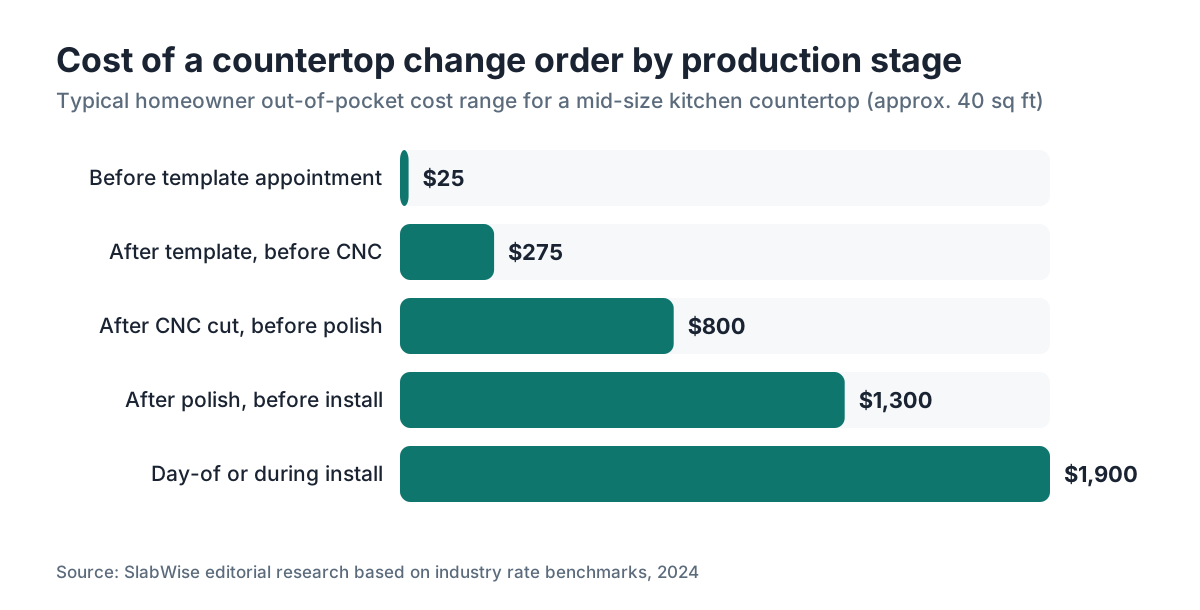
Cost depends on two things: when the change hits and what it touches. A change before cutting might cost a $50 admin fee. A change after the slab is cut can run past $2,000 because you're buying replacement stone. Here's a realistic breakdown by production stage:
| Stage when change is requested | Typical cost to homeowner | Why |
|---|---|---|
| Before template appointment | $0, $50 admin fee | Nothing cut, scheduler rebooks |
| After template, before CNC | $150, $400 | Remeasure fee, new DXF files, rescheduling |
| After CNC cut, before polish | $400, $1,200+ | Slab may be scrap; new material needed |
| After polish, before install | $600, $2,000+ | Finished pieces wasted; full remake |
| Day-of or during install | $800, $3,000+ | Labor, delivery, full remake, potential cabinet damage |
Those numbers reflect informal industry benchmarks reported in trade discussions. There's no single authoritative survey covering every U.S. fabricator, so treat them as ranges, not gospel. Your actual exposure depends on slab cost, square footage, and your fabricator's contract language.
The biggest variable is material. A mid-grade granite slab runs roughly $40 to $60 per square foot wholesale [1]. A 40-square-foot kitchen uses material worth $1,600 to $2,400 before any labor. If that slab is cut and the pieces can't be reused on another job, the shop has a legitimate claim for the material plus the labor already spent.
Engineered quartz and branded products like Cambria raise the stakes because those slabs get ordered specifically for your job and often can't go back to the distributor. Natural stone fabricators sometimes have more room because a cut slab can become a remnant sold on a smaller job.
At what production stage is a change order still reversible?
Think of fabrication as a one-way ratchet. Each step makes reversal more expensive, and at most shops the real point of no return is CNC programming, not cutting. Once a CNC file gets built from the DXF template data, the production slot is committed. Some shops send DXF files to the machine queue the same day as the template.
Before the template visit, almost anything changes for free or close to it. Sink style, edge profile, dimensions if cabinets aren't installed yet, even slab selection.
After the template visit, the shop has a measurer's labor cost tied up and the DXF file exists. After CNC programming, changing the layout means writing a new file and possibly re-nesting the slab to check whether the new cuts still fit the stone. After any cut is made, you own those cuts.
Here's the practical rule. If you have any doubt about dimensions, cabinet positions, or appliance specs, hold the template appointment. Don't template until every cabinet is set, leveled, and shimmed to final height. Delaying a template costs you a scheduling gap. Re-templating after a wrong measurement costs you a slab.
What should a fabricator's change-order clause include?
A change-order clause decides who pays what when plans change. Without one, you're negotiating mid-crisis with no ground rules, and the person with the finished countertop tends to win.
A solid clause covers six things:
-
A written-only requirement. Verbal requests don't count. Every change gets submitted in writing (email is fine) and acknowledged in writing by the shop.
-
A production cutoff definition. State exactly what "production has begun" means at your shop. At most shops that's the moment the DXF file goes to CNC programming. Define it so there's no argument later.
-
A fee schedule by stage. Even a rough one. "Changes before CNC programming: $150 revision fee. Changes after CNC programming: cost of material affected plus labor at $[X] per hour."
-
A response-time window. Once the shop gets a change request, how long does the homeowner have to confirm before the shop proceeds as originally planned? 24 hours is common.
-
A material ownership statement. If a slab is cut and the change makes those pieces unusable, who owns the scrap? Most contracts say the shop keeps it to sell as remnants. The homeowner shouldn't pay for scrap and also lose it.
-
A scope-of-change definition. Adding a new countertop surface is a new line item, not a change order. An edge profile change on an existing surface is a change order. A dimension change is a change order. Spell it out.
The Construction Management Association of America and the American Institute of Architects both publish standard change-order language in their contract documents [2][3]. Even a small residential shop can adapt that language without a lawyer.
How should a homeowner request a change order without burning the relationship?
Call first, then follow up in writing right away. Don't send an email and wait. Stone shops are loud and busy, and email sometimes sits for a day. A phone call gets attention. The written follow-up creates the record.
When you call, be specific. "I need to change the sink cutout from a top-mount 33-inch to an undermount 33-inch" is useful. "I want to change some things" is not. The fabricator needs to know if this is a DXF edit or a full remeasure.
Ask directly: "Has the slab been programmed or cut yet?" That answer tells you what you're facing. If they say no, push for a timeline commitment: "Can we put a 48-hour hold on this job while I confirm the new sink dimensions?" Most shops will do this for a customer who's communicating clearly.
If the slab is already cut, don't argue about whether it "should" be reversible. Ask what the shop's actual out-of-pocket cost is for the cut material. That number is the floor of your negotiation. A shop that paid $1,800 for a slab and cut it on your job has a real loss. Acknowledge it, then negotiate the labor portion separately.
For bigger projects covering kitchen countertops or full countertop installation, schedule a check-in call the week before your template just to confirm nothing has shifted.
How do fabricators document and price a change order?
Good documentation protects both sides. Treat a change order like a mini contract addendum, not a note scribbled on the job ticket.
At minimum, a written change order should include the original scope, the new scope, the price difference (positive or negative), any schedule impact, and both parties' signatures or written acknowledgment. An email from the homeowner reading "I approve this change and the additional $350 charge" is legally enough in most states for a contract modification, though a countersigned PDF is cleaner.
Pricing a mid-fabrication change means accounting for:
- Wasted material (cost of unusable cut pieces)
- Labor already performed (CNC programming, cutting, polishing)
- Rescheduling cost (the job re-enters the queue and may delay other customers)
- New material cost if a replacement slab is needed
- New labor cost for the replacement fabrication
Some shops price change orders off a flat shop rate, charging labor at $75 to $120 per hour for skilled stone fabricators in most U.S. markets, though rates vary by region. Others charge a flat change-order admin fee plus the actual cost of any wasted material.
For shops running production software, job cost tracking is the backbone of accurate change-order pricing. Software that ties template data to CNC files to material allocation lets you tell a customer exactly what got consumed before the change, down to the square foot. SlabWise, for example, tracks job status and material usage so that calculation is a lookup, not a guess.
What happens when the homeowner refuses to pay a change-order charge?
This is where it gets uncomfortable, so let's be direct about the options.
The fabricator's main power is possession of the finished or partly finished countertop. In most U.S. states a fabricator can hold that work under an artisan's or mechanic's lien until payment [4]. The details vary by state. Some allow a lien on the countertop itself as personal property. Others treat it as an improvement to real property once installed, which triggers different lien procedures and timelines.
For real property improvements, most states require the contractor to record a mechanic's lien within a set window after the last day of work, often 60 to 90 days depending on the state [4]. California's deadline is 90 days from completion of work under Civil Code Section 8412 [5]. Texas requires a lien affidavit by the 15th day of the third calendar month after the month the claimant last provided labor or materials [6].
Before anyone calls a lawyer, most disputes settle through direct negotiation. The fabricator should document actual costs and present them plainly. The homeowner should reread the original contract. If that contract had no change-order clause and the shop proceeded on a verbal okay, the homeowner has real grounds to contest at least the labor portion.
Small claims court handles most residential countertop disputes. Limits range from $2,500 in some states up to $25,000 in others [7]. Filing fees are low and lawyers aren't required. Written documentation almost always decides the outcome.
How does material type affect change-order risk?
Not every material carries the same change-order risk, and knowing the differences before you sign is worth real money.
Natural stone (granite, marble, quartzite) is the highest-risk category. Each slab is unique. If it's cut for your job and the change makes those pieces unusable, the fabricator can't put that exact stone back. Remnants sometimes sell, but large custom cuts have limited resale value. Granite countertops and marble countertops in rare or exotic patterns carry extra risk because replacement material may not match.
Engineered quartz from makers like Cambria is more consistent but usually ordered by the fabricator specifically for your job. Once a slab is cut, returns to the distributor are generally off the table. The exposure is close to natural stone.
Laminate, including Formica countertops and similar products, carries lower risk because material costs are lower and offcuts are more forgiving. A laminate shop can often absorb a small dimension change without much financial pain.
Solid surface like Corian countertops sits in the middle. It's more forgiving for seam adjustments, but factory-ordered colors carry the same reorder problem as engineered quartz.
Butcher block countertops are arguably the most forgiving. A fabricator can trim and recut without total loss in many cases, as long as the change comes before final shaping.
Can a homeowner cancel a countertop order entirely mid-fabrication?
Yes, but the cost depends entirely on contract language and production stage.
A cancellation before fabrication begins usually counts as a contract rescission. Many fabrication contracts carry a non-refundable deposit (often 50% of the project total) to cover the shop's risk on material and scheduling. Cancel before the template and you may lose that deposit.
A cancellation after material is ordered but before the template can trigger a restocking fee if the fabricator can return the slab, or a full material charge if it was special-ordered. Distributors sometimes take slab returns within a short window, often 5 to 10 business days, but that's not guaranteed.
A cancellation after the slab is cut is basically a full-charge event. The fabricator's position is that they performed the contracted work on the contracted material, so the homeowner owes the cost. That's defensible in most states under standard contract law.
The FTC's cooling-off rule, which allows cancellation of certain door-to-door sales within 3 business days, generally does not apply to a fabrication contract negotiated at the shop or signed remotely [8]. It covers sales made at locations other than the seller's place of business. Signing at a fabricator's showroom doesn't trigger it.
What's the best way to avoid change orders in the first place?
The best defense is a checklist-based pre-fabrication sign-off. Before the template appointment, every decision that affects fabrication gets locked in writing.
Here's what to confirm before the template:
- Sink model and installation type (top-mount vs. undermount vs. farmhouse)
- Faucet hole quantity and placement
- Edge profile on every surface
- Cooktop or range cutout dimensions if applicable
- Final material and slab selection (with slab number)
- Backsplash height if the fabricator is cutting the backsplash
- Any special cutouts (soap dispensers, pop-up outlets, built-in appliances)
Homeowners: get the sink in the house before the template. Measure the actual sink, not the spec sheet. Spec sheets are sometimes wrong, and undermount dimensions vary by manufacturer.
Fabricators: send a pre-template checklist to every client 5 to 7 days out. Ask them to confirm each item in writing. If they haven't confirmed, delay the template. A scheduling inconvenience is far cheaper than a mid-production change order.
Jobs that go sideways almost always share one thing. Somebody made an assumption and never verified it. The fix isn't a better change-order form. The fix is killing the conditions that create change orders.
How should fabricators track job status to catch changes before they're costly?
Production visibility is the difference between a $150 revision fee and a $1,500 remade slab. If the shop doesn't know exactly where each job sits in the queue, it can't answer a change request intelligently.
At a minimum, track these milestones: template completed, DXF sent to programmer, CNC file approved, slab pulled from inventory, cutting scheduled, cutting complete, polishing complete, install scheduled. Each one changes the price of a change order.
Smaller shops running jobs on a whiteboard or spreadsheet can do this manually, but it takes someone updating the board consistently. The failure mode is a job that looks pre-cut on the board but is actually already on the machine.
Fabrication software that ties template data to job status and material tracking makes this far more reliable. SlabWise is built around this exact problem, connecting quote and template data to production status so a shop owner can look at a job and instantly see its stage before quoting a change. A free demo is available at slabwise.com if you want to see how it works.
Whatever tool you use, keep the policy the same. Before anyone tells a customer what a change costs, pull up the job status and confirm the actual production stage. Never quote a change-order price from memory.
Frequently asked questions
Can a fabricator charge me for a change order I requested verbally?
Yes, if your original contract doesn't require written change orders. Most residential contracts are informal enough that a verbal request followed by fabricator action creates a binding modification. The safer move: put every change in writing immediately, even by text or email, so there's a record of what you asked for and when. If the fabricator acted on a verbal change you later dispute, you'll need evidence of what was actually agreed.
What is a fair change-order fee for a countertop shop to charge?
A flat admin fee of $100 to $200 for minor changes before cutting is common and reasonable. After the slab is cut, charging actual material cost plus the labor time already spent is standard. What's not reasonable is a full remake fee when only one piece was affected. Ask the shop to itemize exactly what was wasted and what the replacement costs.
Does a countertop change order need to be in writing to be enforceable?
Technically, oral contract modifications are enforceable in most states for contracts under the statute of frauds threshold (often $500). But proving a verbal change order in court is very hard. Written confirmation, even a simple email exchange, is enforceable and leaves no room for dispute about what was agreed. Both fabricators and homeowners benefit from writing every change down before work proceeds.
How long does a countertop fabricator have to notify me of a change-order cost?
Your contract determines this. If the contract is silent, there's no legal clock, but reasonable practice is notice before any extra work or material is committed. If a fabricator finds a change is needed during production (a slab defect, say), best practice is to stop, notify the homeowner, get written approval of the added cost, then proceed. Work done without notice is harder to collect on.
Can I lose my deposit if I change the countertop material mid-project?
Possibly. If the original slab was ordered and can't be returned, the deposit may apply entirely to that material loss. If the fabricator can return or resell the slab, a partial refund might be appropriate. Check your contract for the specific deposit terms. Many contracts state that the deposit covers material acquisition and is non-refundable once the slab is ordered.
What if the countertop change was caused by a contractor error, not my request?
If the fabricator's team made the error (wrong measurement, wrong sink cutout, wrong edge profile), the cost of correction is on the fabricator, not you. Document it immediately with photos and written notice. Don't let the shop proceed with a fix before acknowledging in writing that the error was theirs. If your GC caused a cabinet measurement error that led to a bad template, that dispute is between you and the GC.
Is there a grace period to change a countertop order after signing?
There's no universal legal grace period for countertop fabrication contracts. The FTC three-day cooling-off rule doesn't apply to contracts signed at the fabricator's place of business. Some shops offer a voluntary change window in their contracts, often 24 to 48 hours after signing before material is ordered. If your contract doesn't include one, assume the order is binding immediately.
How do I document a countertop change order if the shop doesn't have a formal process?
Send an email to the shop's main contact with a clear subject line like 'Change request for [your name] job.' In the body, describe exactly what you want, reference the original spec, and ask them to confirm by reply. That email thread is your documentation. Print it or save it to a folder. If the shop replies confirming the change and any cost, you have a written contract modification.
Can I add a backsplash or new surface as a change order after fabrication has started?
A new surface that wasn't in the original scope is really a new mini contract, not a change to the original job. Fabricators should price it as a separate line item with its own material and labor. Lumping it into a change order creates accounting confusion. The only reason to call it a change order is if there's existing material in the shop (a large slab with enough remnant) that can be used without ordering new material.
What states have the strongest protections for homeowners in countertop disputes?
California, New York, and Texas have well-developed mechanic's lien and consumer protection statutes covering home improvement contractors, including fabricators. California's Home Improvement Contract law (Business and Professions Code Section 7159) requires specific contract disclosures for jobs over $500. Most states require contractors to be licensed, and working without a license weakens a contractor's ability to enforce payment claims.
How much notice should I give a fabricator before a change request?
The earlier the better, but the real threshold is before the CNC file goes to the machine. At most shops that's 24 to 48 hours after the template appointment. If you know a change is coming, call the day of or the day after the template visit. Don't wait until you've confirmed the new spec with your supplier. Call to flag the potential hold first, then confirm the details.
Do change-order rules apply the same way to big box store countertop orders?
Big box retailers (Home Depot, Lowe's) use third-party fabricators and their own contracts, which usually have stricter cancellation terms and less flexibility for changes. Their processes are more standardized, so deviation is harder and often more expensive. If you're considering changes after signing with a big box retailer, call their countertop department directly and ask for the specific change-order policy in writing before you assume anything.
Sources
- HomeAdvisor (Angi), Granite Countertops Cost Guide: Mid-grade granite slab material runs roughly $40, $60 per square foot wholesale; retail installed costs range $80, $175 per square foot depending on region and complexity
- Construction Management Association of America (CMAA), Contract Documents: CMAA publishes standard construction management contract language including change-order procedures used as industry reference for residential and commercial projects
- American Institute of Architects, AIA Contract Documents (A201 General Conditions): AIA A201 defines change order procedures including written authorization requirements and cost accounting methods that smaller contractors adapt for residential use
- Cornell Legal Information Institute, Mechanic's Lien Overview: A mechanic's lien lets a contractor or supplier secure payment against property they improved; recording deadlines and whether the claim attaches to personal or real property vary by state
- California Legislative Information, Civil Code Section 8412: California Civil Code Section 8412 sets a 90-day deadline from completion of work to record a mechanic's lien on residential property
- Texas Property Code Chapter 53, Mechanic's Lien: Texas Property Code Section 53.052 requires a lien affidavit by the 15th day of the third calendar month after the month the claimant last provided labor or materials
- U.S. Courts, Small Claims Court Overview: Small claims court dollar limits vary by state, ranging from $2,500 to $25,000, covering most residential countertop disputes without requiring an attorney
- Federal Trade Commission, Consumer Advice: The FTC cooling-off rule allows cancellation of certain sales within 3 business days but applies only to sales made at a location other than the seller's normal place of business
- California Department of Consumer Affairs, Contractors State License Board, Home Improvement Contracts (B&P Code Section 7159): California Business and Professions Code Section 7159 requires specific written disclosures in home improvement contracts over $500, including change-order procedures
- National Kitchen and Bath Association (NKBA), Professional Resource Library: NKBA industry guidance identifies mid-project specification changes as one of the leading causes of cost overruns in kitchen remodeling projects
- Natural Stone Institute (formerly Marble Institute of America), Fabrication Standards: Natural Stone Institute fabrication standards confirm that once a slab is cut to custom dimensions it has limited or no salvage value for return to distributor inventory
Last updated 2026-07-10