
TL;DR
- When a warranty claim lands on your desk, your first move is documentation, not defensiveness.
- Photograph everything, pull your original contract and shop drawings, and decide whether the failure traces to material, workmanship, or homeowner misuse.
- Most valid fabrication defects cost $200 to $1,500 to fix.
- A clear written warranty policy, signed before the job starts, is the only reliable way to cap your exposure.
What actually triggers a countertop warranty claim?
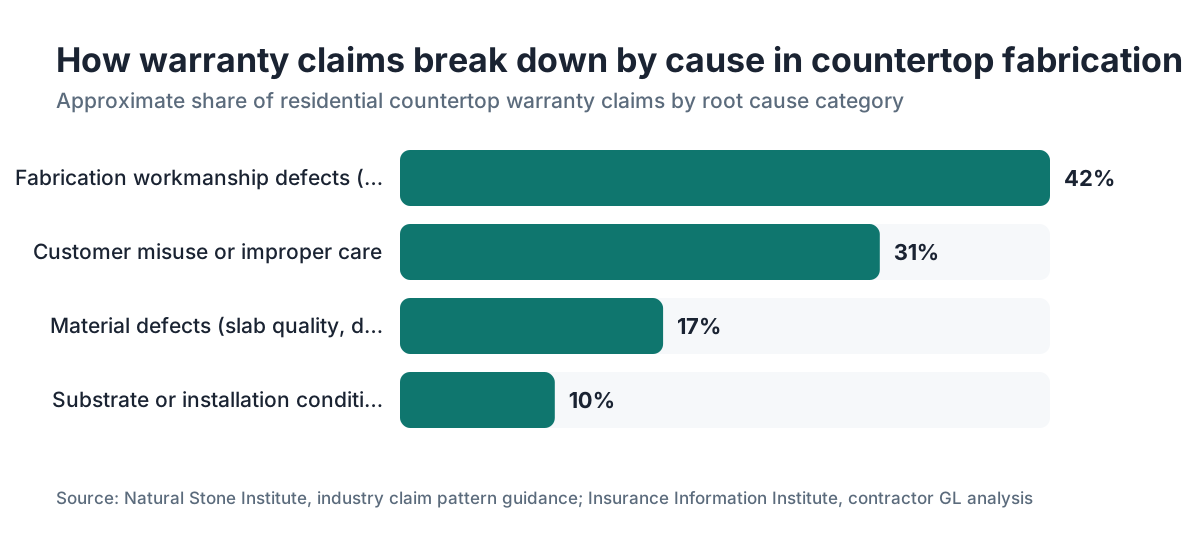
Most warranty claims fall into one of three buckets: visible fabrication defects (chips at the sink cutout, seams that open up, uneven polish), material failures (cracks that run from the slab's natural fissures, delamination on engineered stone), or customer-caused damage that the homeowner believes should be covered. Knowing which bucket you're in before you pick up the phone saves you money and goodwill.
Fabrication defects are the ones you own. A seam that separates within the first year almost certainly means the epoxy was wrong for the material, the joint wasn't clean, or the substrate shifted. A chip at a cutout corner usually means the radius was too tight or the blade was worn. These are fixable, they're on you, and arguing your way out of them costs more in reputation than just fixing the thing.
Material failures are trickier. Natural stone carries fissures, inclusions, and soft veins that can fail years after installation. Your contract and the material's manufacturer documentation matter here. If you can show the customer approved the slab in person (a sign-off sheet, or a photo of the customer standing beside the slabs at your yard), you have a strong argument that a pre-existing fissure isn't your workmanship problem.
Customer misuse is the third category and the most contentious. Thermal cracking from hot pans set directly on quartz, staining because the homeowner never sealed the marble, chips from impact on an edge profile specified as thin as 1 cm: none of these are fabrication defects. But you'll spend far more time proving that than you would have spent getting a care guide signed at delivery.
What should your written warranty policy say before a job starts?
A fabricator who hands over countertops without a written warranty policy is writing a blank check. The policy doesn't need to be long. It needs to exist in writing, be signed by the customer before fabrication starts, and cover four things: what you warrant, for how long, what voids the warranty, and your remedy procedure.
A common industry structure is a one-year workmanship warranty covering defects in fabrication (seam quality, edge consistency, cutout accuracy, surface finish) and a pass-through of whatever the material manufacturer offers on the slab itself. Cambria, for example, offers a lifetime limited warranty on its quartz surfaces that passes through to the homeowner, so you can reference that in your contract rather than trying to replicate it [1]. Natural stone from a quarry supplier carries no such manufacturer warranty, so for granite or marble your workmanship warranty is all there is.
The "what voids it" section is where most fabricators underinvest. At minimum, include: failure to follow the written care guide you provide at installation, modifications to the countertop by anyone other than your shop, damage from impact or thermal shock, and settlement or movement of the underlying cabinet structure. Get specific. "Improper use" is too vague to enforce.
Your remedy clause should state that your liability is limited to repair or replacement of the defective section, not consequential damages like a kitchen backsplash you accidentally damaged or a ruined dinner party. Courts in most states will enforce a consequential-damage limitation in a consumer contract if it's clearly written and not unconscionable. Consult your state's contractor licensing board guidance for language that fits your jurisdiction [2].
Keep signed copies. Digital signatures via DocuSign or a PDF returned by email work fine. If a claim arrives two years later and you have no signed warranty document, you're arguing without a net.
How do you document a countertop claim properly when it comes in?
When a homeowner calls or emails about a problem, your first response is to listen without admitting fault. Gather the job number, the date of installation, and a description of the issue. Then schedule an in-person inspection within a reasonable window, usually five to ten business days, and make no commitment about coverage until you've seen it.
At the inspection, photograph everything: wide shots showing the full countertop run, medium shots of the defect in context, close-up macro shots of the failure point itself. Put a ruler or a coin in the frame for scale. Note the ambient conditions. Is there a gap at the wall because the house has settled? Is there a missing cabinet support under a long overhang? Bring your original shop drawing or cut sheet and compare the installed dimensions to what was specified.
Ask the homeowner directly, and write down the answers: When did you first notice this? What happened right before you noticed it? Has anyone else worked on or near the countertop since installation? Their answers, in your inspection notes with a date and their signature or at least an email confirmation afterward, become part of your claim file.
If the failure involves a material question you can't settle on-site, take a sample or commission a materials report. Some fabricators work with a local stone supplier or independent inspector who can assess whether a crack propagated from a natural fissure or from a fabrication stress. That report costs $150 to $500 and can be decisive if the claim escalates.
Shop management software that stores job photos, signed contracts, and delivery confirmations in one place makes retrieval fast. SlabWise, for example, keeps quote documents and shop drawings tied to the job record, so you're not hunting through email when a claim arrives 18 months later.
How do you determine if the defect is yours, the material's, or the homeowner's fault?
This is the central judgment call, and you need to make it honestly. Blaming the material or the homeowner for a legitimate fabrication defect comes back on you in reviews and, worse, in small claims court.
For seam failures, the question is whether the epoxy bond failed cohesively (the epoxy itself cracked) or adhesively (it pulled off the stone). Adhesive failure usually means the surfaces weren't clean or the epoxy wasn't right for that material. Cohesive failure in a well-bonded seam usually means substrate movement or an impact event, neither of which is your fabrication defect. You can see the difference under decent magnification.
For cracks in natural stone, compare the crack's path to the fissure map you should have on your slab photos taken before fabrication. A crack that follows an existing fissure is a material issue. A crack that radiates from a drilled hole or a cutout corner and ignores every natural feature is almost certainly a fabrication stress riser you created.
For surface damage (etching, staining, scratches), the material and the homeowner's care behavior matter enormously. Marble etches from acid exposure, and that's not a fabrication defect no matter what the homeowner expected [3]. Quartz can be bleached by certain cleaning products, which is typically a homeowner-misuse issue that most manufacturer warranties explicitly exclude [1].
Edge chip claims are often genuinely ambiguous. A thin mitered edge on quartz is vulnerable to impact, and it's possible neither the fabricator nor the homeowner did anything wrong. In those cases, repair it at cost or at a shared cost, and update your standard disclosure for that profile.
What's the process for resolving a valid workmanship claim?
Once you've decided the defect is yours, move fast. Delay breeds bad reviews and legal exposure. The sequence: acknowledge in writing that you've completed your inspection and are taking responsibility for the repair, propose a specific remedy with a timeline, execute it, and get a written satisfaction acknowledgment when you're done.
Most seam repairs mean grinding the seam open, cleaning, re-epoxying, and re-polishing. For edge chips, you can often resin-fill and re-hone to an acceptable match if the chip is small. For cracks, the options are resin injection for stable cracks or, if the piece is structurally compromised, section replacement. Full slab replacement is rarely necessary and rarely the right call for a localized defect.
Keep detailed records of your repair labor and materials. If a material manufacturer is involved (because the defect traces to a slab quality issue), you'll want those records to support a supplier claim. Most distributors and manufacturers have a formal defect claim process that requires photos, original purchase invoice, and a written description of the failure. Submit those promptly, because most have a reporting window, sometimes 30 days from the time you identify a potential material defect.
After the repair is done, have the homeowner sign a repair completion form or send a confirmation email stating the claim has been resolved to their satisfaction. That document closes the loop and protects you from a re-opened claim on the same issue.
When should you push back on a warranty claim?
Not every claim is valid, and accepting all of them unconditionally teaches customers that fabricators are an easy mark. Push back when the evidence clearly supports your position.
Valid reasons to deny a claim: the failure mode is explicitly excluded in your signed warranty (impact damage, thermal cracking, chemical damage from the wrong cleaners), the customer can't produce evidence the countertop was maintained per your care guide, or a third party modified the installation after you finished (a plumber who cracked the stone mounting a sink rim, for instance).
Valid reasons to offer a partial solution without full admission: the defect is borderline, the customer is a repeat buyer or a referral source, and a goodwill repair costs less than the relationship. That's a business call, not a warranty call, and there's nothing wrong with making it explicitly. You can say: "This one is outside our warranty, but we want to take care of you. We'll repair it at our materials cost."
If a homeowner threatens legal action, stop negotiating verbally and put everything in writing from that point on. Notify your general liability insurer. Most contractor GL policies cover property damage claims, and your insurer may want to manage the resolution directly once litigation is threatened. Your policy's per-occurrence deductible is usually $500 to $1,000, and many valid countertop claims fall below it, but the insurer still needs to know [4].
Small claims court is a real risk for amounts under $5,000 to $10,000 depending on the state. In small claims, judges weigh documentation heavily. A fabricator who shows up with signed contracts, inspection photos, and a written warranty policy wins more often than one who shows up with a verbal account of what happened.
How do material manufacturer warranty claims work?
If you've traced the defect to the material itself, file a claim with the manufacturer or distributor rather than absorbing the cost yourself.
Engineered stone manufacturers like Cambria and Silestone have formal warranty claim portals and generally require: proof of purchase (your distributor invoice), the job address, dated photos of the defect, and a description of the installation conditions. Cambria's warranty states it covers "defects in material and workmanship under normal use and service conditions" and requires notification within a reasonable time of discovery [1]. Silestone's Lifetime Natural Beauty warranty, introduced in 2020, covers staining and scratches under normal use but excludes damage from improper care [5].
For natural stone slabs, you're dealing with a distributor or direct importer, not a manufacturer warranty in the traditional sense. Most distributors will negotiate case by case if you can document a genuine material defect, but there's no standard process. Your strongest hand is the ongoing purchase relationship.
Timing matters. File your supplier claim as soon as you've confirmed the defect is a material issue, even before you've fully resolved the homeowner's claim. Wait until after you've made the homeowner whole and your documentation of the failure may be gone and the supplier's claim window may have closed.
Keep a section of the failed material whenever you can. A physical sample of a delaminating engineered stone or a slab with an anomalous internal crack is far more persuasive than photos alone when you're asking a distributor for credit.
What does general liability insurance actually cover in countertop warranty situations?
General liability insurance for a fabrication shop typically covers third-party bodily injury and property damage. A countertop that cracks and falls, injuring a homeowner or damaging their property, is a GL claim. A seam that opens up and ruins a homeowner's floor by letting water in is a GL claim. Pure workmanship defects where the only damage is to the countertop itself are generally not GL claims. Those are warranty or contract disputes [4].
The distinction matters because many fabricators assume their insurance covers all warranty issues. It usually doesn't. Your GL policy probably has a "your work" exclusion that bars coverage for property damage to the work itself unless it causes damage to something else [4].
Errors and omissions (E&O) or professional liability insurance is the coverage that fills that gap for design-related mistakes. Most small fabrication shops don't carry it, but if you do significant kitchen design or specify materials beyond pure fabrication, it's worth discussing with your broker.
Contractor's tools and equipment insurance covers your shop equipment. It has nothing to do with customer warranty claims but gets confused with the others all the time.
The practical takeaway: notify your insurer any time a claim exceeds $2,000 or involves a threat of legal action, even if you're not sure it's a GL event. They can tell you whether coverage applies, and late notification is one of the most common reasons insurers deny otherwise-valid claims.
How do you handle warranty claims for specific materials like quartz, granite, or marble?
Different materials fail in different ways, and your claim-handling approach should follow the failure.
For quartz countertops, the biggest warranty issues are thermal discoloration (white patches near stove areas), seam opening from substrate movement, and chipping on thin profiles. Thermal discoloration is almost always a manufacturer warranty issue if it happens under normal cooking conditions. Most major brands exclude only direct open-flame exposure. Seam failures in quartz are almost always fabrication or substrate issues, because quartz doesn't have the natural fissures that complicate granite seam analysis.
For granite countertops, cracks and fissures are the primary claim driver. The key question is whether a fissure was visible and noted at slab selection. A fabricator who photographs every slab with the customer present before cutting has a far stronger defense than one who doesn't. Granite also etches far less than marble, so chemical damage claims are less common.
For marble countertops, etching is the elephant in the room. Marble reacts with anything acidic, including lemon juice, wine, and most household cleaners [3]. This is not a defect. It's the nature of the material. Your warranty policy and your pre-install disclosure should state this plainly, and your installation packet should include a written care guide. If it does, you have a very defensible position when a homeowner complains that their marble island looks dull after six months.
For butcher block countertops, claims often involve warping, cracking at seams, or finish failure. These are almost entirely care-related: not enough oiling, water pooling at the sink, or a dishwasher dumping steam onto the underside of the wood. A signed care guide is your first line of defense again.
Engineered surfaces like Corian and Formica laminate carry strong manufacturer warranties with formal claim processes. Corian's warranty, backed by DuPont/Trinseo, is renewable and covers cracking and breakage under normal use [6]. Formica laminate claims generally run through the laminate manufacturer for material failures and through the fabricator for peeling, bubbling, or delamination at the edges, which is an installation defect.
What are the biggest legal risks fabricators face on warranty claims?
The largest legal exposure comes from claims that cross from a contract dispute into a consumer protection violation. Most states have consumer protection statutes that let a homeowner recover attorney's fees if they prove a contractor acted deceptively or made false representations [2]. A fabricator who tells a customer their marble is "maintenance-free" and then denies a warranty claim for etching has a consumer protection problem, more than a warranty dispute.
The Federal Trade Commission's "Guides for the Advertising of Warranties and Guarantees" (16 CFR Part 239) apply to written warranties on consumer products and require that warranty terms be available before the sale [7]. Most fabricators don't think of themselves as selling a consumer product, but a countertop installed in a home qualifies under the Magnuson-Moss Warranty Act if you offer a written warranty and the transaction is $15 or more [8]. Magnuson-Moss doesn't require you to offer a warranty, but if you do, the law governs what it must contain and how disputes must be handled.
Small claims court is the most common litigation venue for countertop disputes. Amounts below $10,000 (the threshold varies by state, roughly $2,500 in some, up to $25,000 in a few) can be filed without an attorney [9]. A homeowner with photographs of a failed seam and a verbal denial from the fabricator often wins, regardless of the underlying merits, because judges in small claims default to the party with better documentation.
Contractors' license bonds exist specifically to cover customer claims against licensed contractors. If your state requires a contractor's license for countertop work, your bond is a source of recovery for a customer with a valid claim. Know your state's bond amount and the claim process, because a homeowner who learns about the bond and files against it is a serious escalation [10].
What's a good warranty claim tracking system for a busy fabrication shop?
A claim that isn't tracked is a claim that falls through the cracks, comes back as a one-star review, or turns into a lawsuit. At minimum, you need a log that captures: job number, customer name, date claim received, nature of the complaint, inspection date, determination (fabricator fault / material fault / customer misuse / contested), remedy offered, remedy completion date, and final resolution.
For a shop doing under 50 jobs a month, a spreadsheet works. For larger operations, warranty tracking built into your job management system is much cleaner. When job records, photos, and signed documents live in the same system as the warranty log, you're not hunting through Dropbox folders when a claim arrives.
SlabWise's job tracking keeps quote history, shop drawings, and delivery records tied to each project, so you have the baseline documentation ready without any special effort at claim time. Dedicated software or a well-kept spreadsheet, either way, the habit of logging every claim (even the ones you resolve in a single phone call) pays off when you're trying to spot patterns. If three claims in a row involve seam failure on the same distributor's quartz product, that's a supplier quality signal worth acting on.
Review your claim log quarterly. Look for patterns by material, installer, season (moisture and substrate movement get worse in winter in cold climates), or edge profile. Process improvement is cheaper than claim resolution.
How do you communicate with homeowners during the warranty process without making things worse?
The tone of your first response sets the trajectory of the whole claim. Homeowners who feel dismissed come back louder and leave reviews. Homeowners who feel heard and treated like adults almost always stay manageable, even when the outcome isn't what they wanted.
Respond to every claim in writing within 24 to 48 hours of receipt, even if all you're confirming is that you got the complaint and will schedule an inspection. Don't apologize in a way that admits liability before you've inspected. "I'm sorry you're having this experience" is fine. "We clearly made a mistake" before you've seen the issue is not.
After inspection, put your determination in writing with your reasoning. If the claim is valid and you're going to fix it, say so clearly and give a date. If the claim is outside your warranty, explain why using the specific language from the signed warranty document. Reference the section. People accept a denial much better when they can see the exact rule being applied than when they get a vague "that's not covered."
If the resolution involves a partial goodwill gesture, be explicit that it's a goodwill gesture, not an admission that the warranty applies. "While this damage falls outside our workmanship warranty because it appears to be the result of impact, we want to take care of you and are offering to repair it at our materials cost of $180" is both honest and customer-friendly.
Never argue with a customer on a review platform. If a bad review appears, respond once, factually and briefly, and invite the customer to contact you directly. More than one response from the fabricator on a negative review looks defensive and pulls more eyes to the problem.
Frequently asked questions
How long should a fabricator's workmanship warranty be?
One year is the most common term in the countertop industry for workmanship defects, though some shops offer two years. Material manufacturer warranties run separately and often longer. What matters more than the length is the clarity of what's covered. A one-year warranty with precise exclusions is more enforceable and fairer to both parties than a vague "lifetime" claim.
Does the Magnuson-Moss Warranty Act apply to countertop fabricators?
It can. The Magnuson-Moss Warranty Act applies to written warranties on consumer products costing more than $15. If you provide a written warranty to a homeowner for a countertop installed in their home, the Act governs how that warranty must be structured and what dispute resolution options you must offer. If you don't offer a written warranty, the Act doesn't compel you to. [Source: 15 U.S.C. § 2301 et seq.]
Can I limit my warranty liability to repair or replacement only?
Yes, in most states you can limit remedies to repair or replacement and exclude consequential damages in a consumer contract, provided the limitation is clearly written and not unconscionable. Courts generally uphold remedy limitations in written consumer contracts when they're conspicuous and the customer had a chance to review them before signing. Have your contract reviewed by an attorney familiar with your state's consumer protection law.
Who is responsible if a crack appears in a granite countertop two years after installation?
It depends on the crack's origin. A crack following a pre-existing fissure in the stone is a material issue, not a fabrication defect, especially if the customer approved the slab. A crack radiating from a cutout corner or a drill hole usually indicates a fabrication stress riser and is the fabricator's responsibility. Dated pre-fabrication slab photos are the most valuable evidence in making this call.
What if a homeowner files a claim against my contractor's license bond?
A bond claim is a formal escalation. The surety company will investigate, and if they pay the claimant, they will seek reimbursement from you. Respond to the surety promptly with all your documentation: signed contract, warranty terms, inspection notes, and photos. Bond amounts vary by state, typically $5,000 to $25,000. A valid paid bond claim also appears on your license record in most states.
Should I carry errors and omissions insurance as a countertop fabricator?
If you do any design work, material specification, or layout consulting beyond pure fabrication, E&O coverage is worth considering. Standard general liability excludes professional advice errors. E&O coverage fills that gap. Premiums for a small fabrication shop typically run $1,000 to $3,000 per year depending on revenue and scope. Get quotes from a broker who works with contractors.
How do I handle a warranty claim when the homeowner did the installation themselves?
If you fabricated but did not install, your warranty should cover fabrication defects only and explicitly exclude improper installation by others. If a homeowner self-installed and a crack appears at a cutout, the installation conditions matter: was the cabinetry level, was the countertop properly supported? Document exactly what you supplied and what you didn't. Your exposure is limited to the quality of the cut and finish you delivered.
Is etching on marble covered by a fabrication warranty?
No. Etching is a chemical reaction between acid and calcium carbonate, which is what marble is made of. It's not a fabrication defect. Your warranty policy should state this explicitly, and your installation packet should include a care guide explaining that acidic substances will etch polished marble. A signed acknowledgment of that fact is your best defense if a homeowner files a claim over a dull, etched surface.
What should I do if a customer threatens a lawsuit before I've had a chance to inspect?
Respond in writing within 24 hours, confirm you've received their concern, and request access for an inspection at a specific time. Notify your general liability insurer. Do not make any admission or settlement offer until you've inspected and documented the issue. Put everything in writing from that point forward. If litigation is formally filed, contact an attorney before responding to any court documents.
How do quartz manufacturer warranty claims get filed?
Most major quartz brands require a claim submitted through their dealer or distributor, with photos, the original purchase invoice, the installation address, and a written description of the defect. Cambria requires notification within a reasonable time of discovering the defect. Silestone's process runs through Cosentino's customer service. File within 30 days of identifying a potential material defect, because most manufacturer policies have implied timeliness requirements.
Does my fabrication warranty cover countertop damage caused by a plumber after installation?
No. Third-party modification or damage after your installation is complete is outside your warranty scope, provided your warranty explicitly excludes it. If a plumber cracked the stone mounting a faucet, the liability runs to the plumber and potentially the homeowner's contractor chain, not to your shop. Document the condition of the countertop at installation with dated photos so you have a baseline if this question ever comes up.
How do I track warranty claims across multiple jobs and installers?
A shared log, whether a spreadsheet or built into your job management software, capturing job number, installer, material, defect type, and resolution is the minimum. Review it quarterly. If one installer accounts for a disproportionate share of claims, that's a training or quality-control issue worth addressing before it becomes a legal issue. Patterns by material or supplier also help you make better purchasing decisions.
Sources
- Cambria USA, Warranty Information page: Cambria offers a lifetime limited warranty covering defects in material and workmanship under normal use and service conditions, which fabricators can reference and pass through to homeowners.
- Federal Trade Commission, Statutes library: Most states have consumer protection statutes that allow homeowners to recover attorney's fees if a contractor acts deceptively or makes false representations, creating heightened exposure beyond a simple warranty dispute.
- Natural Stone Institute, Care and Maintenance guidance: Marble etches when it contacts acidic substances because its calcium carbonate composition reacts chemically with acid; this is a material property, not a fabrication defect.
- Insurance Information Institute, General Liability Insurance explainer: General liability policies typically include a 'your work' exclusion that bars coverage for property damage to the contractor's own completed work unless that work causes damage to something else.
- Cosentino Group, Silestone warranty documentation: Silestone's Lifetime Natural Beauty warranty, introduced in 2020, covers staining and scratches under normal use but excludes damage from improper care and maintenance.
- Corian Design (Trinseo), Warranty page: Corian's warranty covers cracking and breakage under normal use and is backed by the manufacturer, providing a pass-through option for fabricators.
- Federal Trade Commission, Guides for the Advertising of Warranties and Guarantees (16 CFR Part 239): FTC warranty advertising guides require that written warranty terms on consumer products be made available to the consumer before the sale.
- Magnuson-Moss Warranty Act, 15 U.S.C. Chapter 50 (§ 2301 et seq.): The Magnuson-Moss Warranty Act governs written warranties on consumer products costing more than $15 and sets rules for what those warranties must contain and how disputes are handled.
- National Center for State Courts, Small Claims Court information: Small claims court monetary limits range from approximately $2,500 to $25,000 depending on the state, allowing homeowners to sue fabricators without an attorney for most countertop disputes.
- Contractors State License Board (California CSLB), Contractor Bonds overview: State contractor license bonds must be maintained and are accessible to consumers who file valid claims against a licensed contractor; paid bond claims typically appear on the contractor's license record.
Last updated 2026-07-11