
TL;DR
- Rush countertop jobs stay manageable when you charge a real premium (usually 20 to 40% above standard), keep a written checklist for accepting them, protect in-progress slabs with hard scheduling rules, and use digital templating and nesting to compress turnaround without burning out your crew.
- Most of the pain comes from under-pricing and sloppy intake, not the work itself.
What actually makes a rush job disruptive in the first place?
"Rush" covers a dozen different situations, and treating them as one thing is where shops get burned. A homeowner who needs an island top in five days is a different animal from a contractor whose plumber moved up the rough-in and now needs 80 square feet of quartz by tomorrow morning. Both are rush jobs. The chaos they cause is not the same.
Disruption shows up at three chokepoints: saw time, the CNC or router queue, and installer scheduling. If your saw is booked eight hours a day and you squeeze in an unplanned cut, something else slips. The crew doesn't work faster. The blade path doesn't compress. All that changes is the order of operations, and reshuffling that order mid-week usually means somebody else's deadline gets quietly pushed.
The second source is information gaps. Rush jobs land with incomplete measurements, undecided edge profiles, or a sink cutout the customer hasn't confirmed. A normal job has days to gather that. A rush job hits your desk and you're expected to move in hours. Missing info on a fast job is a production killer because it creates false starts. You load the slab, start nesting, then stop because the sink template never arrived.
The third source is crew fatigue. Say yes to every rush without a system, and your fabricators start treating every job like a possible emergency. That mental overhead is real. Research on task switching finds that unplanned interruptions raise error rates and slow total output even when the interrupting task itself gets done on time [1]. Disruption isn't only a scheduling problem. It's a cognitive load problem.
How should fabricators price rush countertop jobs?
Charge more. That sentence needs no softening.
The common guidance from fabrication and tile business consultants puts rush premiums in the 20 to 40% range above your standard job price [2]. Some shops go higher for true same-day or next-day work. The premium is not a punishment. It covers real costs: overtime if you need it, accommodations for the jobs you bump, expedited material if your supplier charges for it, and the admin drag of squeezing a new estimate and template into a packed week.
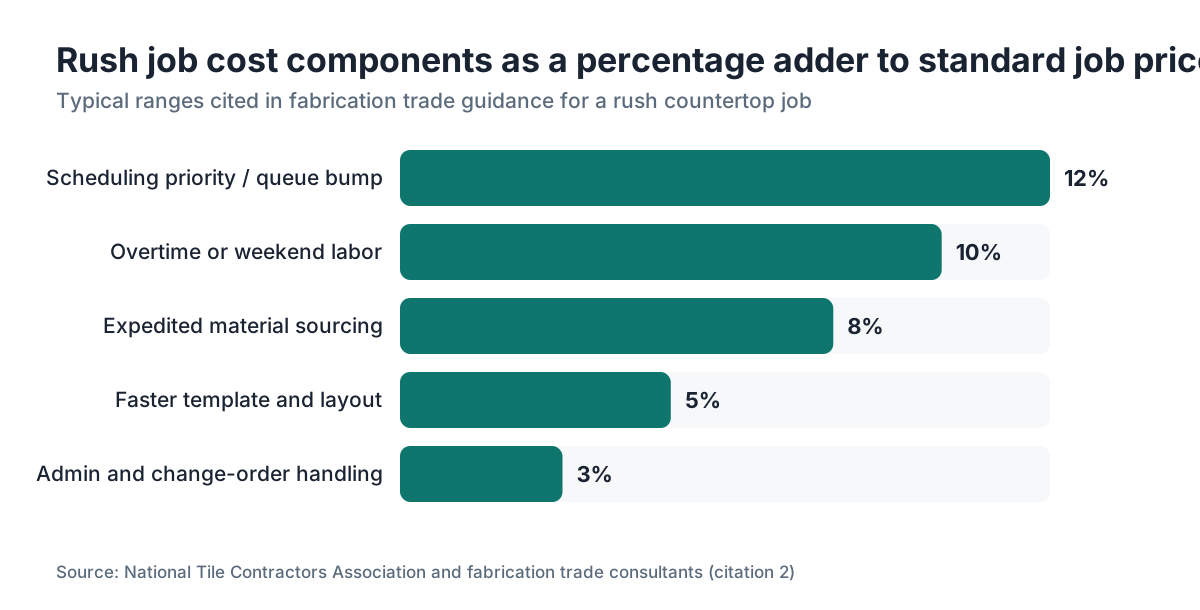
Break the premium into parts so you can explain it without sounding arbitrary. A rough breakdown looks like this:
| Rush cost component | Typical adder |
|---|---|
| Scheduling priority (bumping queue) | 10 to 15% of job total |
| Overtime or weekend labor | $25 to 60/hr above standard labor rate |
| Expedited material sourcing (if slab is not in stock) | Cost-plus: actual supplier surcharge + 15% |
| Faster template and layout time | $75 to 150 flat |
| Administrative / change-order handling | $50 to 100 flat |
If the customer balks, that tells you something useful. A genuinely urgent customer almost always accepts a fair rush fee. A customer who argues hard about the surcharge either isn't as urgent as claimed, or they're hunting for someone desperate enough to eat the cost. Either way, you learned something before committing your shop.
One trap to skip: shaving the rush fee to close the deal and hoping to make it up on volume. You won't. The disruption cost to your existing queue is real, and absorbing it in silence trains customers to expect rush service at standard prices.
What's a good intake process for deciding whether to accept a rush job?
Every shop needs a short decision checklist for rush requests. Without one, the answer defaults to whoever picks up the phone. Salespeople say yes. Shop managers say no. The argument happens after you've already half-committed.
A workable checklist has four gates.
Gate 1: Do we have the slab? If the material is in your yard and it's the right size, your risk drops sharply. If you need to source it, add two to four days of uncertainty and adjust your promised turnaround. Never promise a turnaround you can't control.
Gate 2: Is the job template-ready? You need cabinets installed, firm sink and appliance selections, and ideally a digital template or verified field measurement in hand. If not, template time becomes your first scheduling constraint, and it has to happen before anything else moves.
Gate 3: What's the current saw and CNC load? Check the actual schedule, not your gut. If you're at 90% capacity this week, a rush job means someone gets bumped. Name who gets bumped before you say yes, and confirm that's acceptable.
Gate 4: Can your installer take it? A finished top sitting on a rack because your install crew is booked is not a successful rush job. Lock in the install window before you commit to the customer.
All four gates green? Take the job and charge the premium. One gate yellow? You can often still take it with a slightly longer turnaround. Two or more red? The honest answer to the customer is, "We can do this in X days, not Y. Here's what that looks like." That's a service, not a failure.
How do you schedule rush jobs without bumping existing customers?
The cleanest fix is a capacity buffer. Run your saw and CNC at 80 to 85% of theoretical daily capacity and you have a built-in slot for urgent work without touching anyone else's job. Most shops don't run this way because the pressure to fill every hour is real. But shops that keep a buffer report fewer scheduling fires and similar or better monthly revenue, because they're not bleeding profit into rework and overtime [3].
If you're already maxed out, the bump decision has to be explicit and documented. The logic goes like this: find the job in your queue with the most timeline cushion, call that customer before you commit to the rush client, explain it honestly, and offer a small accommodation (a modest discount, priority on their next job, something tangible). Most customers with real flexibility will work with you. If they won't, that's your signal not to bump them.
Never silently push a job. A customer who discovers their job slipped because you took a rush order without a word is an angry customer. That same customer, told in advance and offered an option, is usually fine.
Scheduling software helps because it makes your actual load visible instead of trapped in someone's head or scrawled on a whiteboard. When you can see a Gantt-style view of the week's slab work, CNC time, and install slots, deciding where a rush job fits takes minutes instead of a three-person argument between people with different mental pictures of the schedule. Shop management platforms built for countertop fabricators earn their keep here, because they show capacity in real time [4].
Some shops set aside one day a week, often Friday, as flex capacity. That day is lightly scheduled by default and soaks up rush jobs, change orders, and rework without bleeding into the regular queue. It costs some throughput on slow weeks. On busy weeks it's the line between controlled chaos and actual chaos.
How does templating affect rush job turnaround, and can you speed it up?
Templating is often the longest single delay in a rush job. On a standard job you might template Monday, process the template Tuesday, cut Wednesday, and install Thursday or Friday. That's a four or five-day cycle. A rush job compresses it to one or two days, which means templating and cut planning have to happen almost on top of each other.
Digital templating helps most. Laser systems like the Proliner or LT-55 produce a file that drops straight into your CAD/CAM workflow with no manual re-entry. That collapses the template-to-cut handoff from hours to minutes [5]. Still cutting paper or cardboard templates on rush jobs? You're adding two to four hours of transcription and layout you can't spare when the customer needs the slab in 48 hours.
When a site visit genuinely can't happen in time, a verified field measurement from a contractor or GC with a documented drawing can substitute. Put that policy in writing. You accept field measurements on rush jobs only with a signed acknowledgment that the customer owns any error from measurements they provided. That's not harsh. It's honest about who controls the accuracy.
On the nesting side, digital nesting cuts material waste and layout time at once. A manual layout on an odd slab shape for a rush kitchen might take an experienced fabricator 45 minutes. A nesting tool handles it in under five. When you're trying to get a job out the door in two days, that gap decides whether you make the install window or miss it. SlabWise was built for exactly this workflow: quoting and nesting in one place, so you're not re-keying data between systems or losing time on manual layout calls [4].
If your shop runs high volume, keep one templater on-call or on a flexible schedule. Paying for partial-day availability is far cheaper than the ripple effect of a missed template appointment on a rush job.
What materials are easiest to work with on a rush timeline?
Not all materials behave the same when the clock is tight.
Engineered stone (quartz) is the most forgiving for rush jobs. It's dimensionally consistent, stocked deep at most distributors, and cuts predictably with none of the natural-stone surprises. Brands like Cambria, Silestone, and MSI keep broad distribution networks that cut sourcing delays [6].
Granite works if you already have the specific slab in your yard. If you need to source it, granite's natural variation means you or the customer have to approve the exact slab before cutting. That approval step eats time you may not have.
Marble and quartzite are the hardest to rush. Both need careful layout for vein matching, both can crack on aggressive timelines if the stone isn't handled and supported properly during cutting, and neither tolerates shortcuts in finishing. Our guides on marble countertops and how to clean quartzite countertops show how much care these materials demand in normal use, which tells you how demanding they are in fabrication.
Laminate and Formica countertops fabricate fast, often same-day for simple shapes, but they usually want different tooling and workflow than a stone shop runs day to day, so they don't always help.
Butcher block countertops and Corian countertops source and cut quickly if the supplier has stock, but most stone shops aren't set up to process them well.
The honest answer for most stone fabricators: if a rush job needs material you don't already have on hand, add two to four business days for sourcing, plus approval time. Don't promise a timeline you can't control.
How do you protect your crew from burnout on rush jobs?
Rush jobs carry a hidden cost that never shows up on the job ticket: fatigue that piles up. When fabricators work steady overtime, skip breaks, and carry the pressure of back-to-back tight deadlines, error rates climb. A crack from a too-fast cut. A seam that never got enough dry time. An edge profile slightly off because someone was hurrying the finish work. These aren't character flaws. They're predictable results of sustained overload, and OSHA flags fatigue and long hours as a documented driver of workplace error [9].
The Fair Labor Standards Act requires overtime pay (time and a half) for non-exempt employees working over 40 hours per week [7]. If you're regularly pushing crew into overtime to handle rush volume, that cost belongs in your rush pricing. The SBA's guidance on premium pricing makes the same point: build every cost component, including labor and overtime, into the tier you charge [10]. Plenty of shops undercount this.
Beyond the legal piece, the practical ceiling is real. Most fabricators can sustain one or two genuine rush pushes a month without a meaningful drop in quality. More than that and you need to hire, add capacity, or say no more often. No scheduling trick erases the physical and cognitive limits of the people running the machines.
A clear rush-limit policy helps. Some shops cap rush jobs at one per week. Others assign specific crew members to handle rush work on a rotation, spreading the load. Some pay a small rush bonus when a job comes in hot and ships on time, which turns "management created a problem" into "a shared challenge with shared upside." None of these are complicated. They just need a decision.
How do you communicate with customers during a rush job?
More than almost any other job, rush work demands active communication. The timeline is tight and the customer is already stressed. Your job is to shrink their uncertainty without over-promising.
Set a hard cutoff for information. "We need your sink confirmation by noon Tuesday or we push the install to Thursday." Not a soft ask. A firm deadline with a stated consequence. Customers on tight timelines respond to concrete conditions because it helps them run their own logistics.
Send one or two progress updates even when everything's on track. A text that reads "Slab is cut and in polish, on schedule for Thursday morning install" costs you 30 seconds and kills the odds of a panicked call at 4pm Wednesday.
If something goes wrong, call right away. A crack during cutting on a rush job is not better news at 5pm. The customer needs time to make decisions, and so do you. Early bad news is almost always easier to handle than late bad news.
For contractors and GCs on rush jobs, set a direct contact protocol before the job starts. They need one person to call, not a general shop number. Name that contact and make sure the whole team knows who it is.
What systems and tools actually reduce rush job chaos?
Honest answer: the biggest gains come from process, not gear. A shop with a clear intake checklist, documented rush pricing, a weekly capacity buffer, and a crew communication protocol handles rush jobs better than a shop with expensive software and no process. Start with process.
That said, specific tools do move the needle.
Digital templating (laser systems) compresses the template-to-cut handoff from hours to minutes. For any shop doing more than 10 to 15 jobs a week, the return is straightforward [5].
Shop management or ERP software that shows real-time capacity across every work center (saw, CNC, polish, install) makes scheduling faster and more accurate. When the schedule lives in one visible system instead of a whiteboard or someone's memory, you can answer "can we take this rush job?" in three minutes instead of thirty.
Nesting software matters because manual material layout is one of the slowest steps in prepping a rush job for cutting. Automated nesting also trims waste, which compounds. The Stone Fabricators Alliance estimates that cutting slab waste by even 3 to 5% has a meaningful margin impact for a shop doing serious monthly volume [8].
CRM or quoting software that lets you build and send a rush quote fast matters because every minute between "customer calls" and "customer has a signed quote" is a minute they might spend calling your competitor. A shop that quotes a rush job in ten minutes beats one that takes two hours.
For countertop installation specifically, run a pre-built install checklist no matter how tight the timeline. It catches the errors that creep in when someone's hurrying. Checklist discipline degrades under time pressure exactly when it matters most.
What should shops do when they can't take a rush job?
Say no clearly and fast, and offer an alternative.
A slow or vague refusal costs you more than a clean one. The customer is on a deadline. Take 24 hours to tell them you can't do it and they've lost a day of finding someone who can. That's a bad experience they'll remember, even though you technically never committed.
A clean no sounds like this: "We can't hit your Thursday deadline with our current schedule. We could do Tuesday of next week if that works, or I can refer you to [shop name] if you need someone for Thursday." That's a useful answer.
The referral is worth taking seriously. Countertop fabrication is local enough that shops often know each other, and handing off a job you can't take is a good-faith move that tends to come back around. If you have a standing relationship with another fabricator, formalize it. You take their overflow some weeks, they take yours on others.
For customers who are genuinely price-sensitive and timeline-flexible, offer a spot on your regular queue at standard pricing with a firm completion date. Some "rush" customers are just anxious. A confident "we'll have it done by the 18th, no rush fee" can close the job as well as a rush premium, and it's honest about your real capacity.
What do fabricators often get wrong about rush job management?
The most common mistake is treating rush jobs as exceptions when they aren't. If your shop handles two or three rush requests a week, they're not exceptions. They're a product line. Price them like one, schedule for them like one, and train your team on the protocol like one.
Second mistake: under-pricing. Shops often tack on a modest 10% fee that doesn't come close to covering queue disruption, overtime, and faster sourcing. Then they wonder why rush jobs feel unprofitable even when the revenue looks fine. The 20 to 40% premium cited by industry consultants exists for a reason [2].
Third: accepting rush jobs without confirmed measurements. You cannot rush a job that has no template. Full stop. Shops that take rush work before the template is done usually end up with a job "rushing" through fabrication while it sits idle for two days waiting on field dimensions. The urgency evaporates. The queue disruption stays.
Fourth: not telling existing customers when their job gets hit. Silence is not neutral. It reads as avoidance, and when the customer finds out their job slipped, "we had a rush order" makes it worse, not better. Proactive communication, even the uncomfortable kind, protects relationships.
Fifth: running rush jobs through the same templating and approval steps as regular work without compressing any of them. If your standard approval takes three email rounds and a printed sign-off, you need a parallel fast-track that reaches the same outcome in two hours instead of two days. That means pre-approved edge profiles, digital sign-off, and one point of contact with authority to approve.
Frequently asked questions
How much should I charge for a rush countertop fabrication job?
A 20 to 40% premium above your standard job price is the range most industry consultants recommend for rush work. Break it into parts: scheduling priority (10 to 15%), overtime labor if needed ($25 to 60/hr above standard rate), expedited material at cost-plus, and flat fees for faster templating and admin. A customer who truly needs rush service almost always accepts a fair, itemized premium. One who argues hard is signaling the urgency may be less real than claimed.
What's a realistic minimum turnaround time for a countertop rush job?
For a stone countertop with the slab already in your yard and a digital template in hand, 24 to 48 hours from template to cut slab is doable for a small job in a well-equipped shop. Add a day for polishing and curing on some edge profiles. For a full kitchen that needs material sourcing, allow three to five business days minimum. Anyone promising under 24 hours on a stone job is probably cutting corners on process, not time.
How do I keep existing customers from getting bumped when I take a rush job?
The cleanest approach is a capacity buffer: run your saw and CNC at 80 to 85% of theoretical daily capacity so rush jobs fill available slack without touching the existing queue. If you're maxed out, find the most schedule-flexible existing job first, call that customer before you commit to the rush client, and get explicit agreement before changing anything. Never silently delay a committed job. Customers told in advance, with a reason, almost always cooperate.
Should I designate specific crew members for rush jobs?
Rotating designated rush crew members spreads fatigue and builds specialized expertise in fast-turnaround work. Some shops also pay a modest rush bonus to whoever handles the job when it ships on time, which reframes the situation positively. The key is that it's a planned rotation, not whoever happens to be free, so the load stays predictable and fair across your team.
Can I take a rush countertop job if I don't have the slab in stock?
You can, but add two to four business days for sourcing uncertainty and factor in that the customer needs to approve the specific slab (especially for granite or natural stone with visible variation). Always get customer approval before cutting a sourced slab on a rush job. Charge the actual expedited sourcing cost from your supplier, plus a margin. Never promise a turnaround that depends on a slab arriving on a date your supplier hasn't confirmed in writing.
What information do I need from a customer before starting a rush countertop job?
You need confirmed field measurements or a digital template, final sink and appliance selections with cutout dimensions, a chosen edge profile, a signed quote with the rush surcharge, and a confirmed install window. Missing any one of these stalls the job mid-production. Set hard deadlines for each piece of information with stated consequences (the timeline moves if we don't have X by Y time) and put those deadlines in writing before you start.
Is it better to say no to a rush job than to take it and disrupt production?
If two or more of your four intake gates are red (no slab, no template, full CNC capacity, no install slot), a clear fast no is almost always better than a slow yes. The disruption from a poorly scoped rush job ripples into three or four later jobs. A clean refusal with an honest alternative timeline often wins the job anyway, because customers on tight deadlines value certainty over a vague promise of speed.
How does digital templating reduce rush job turnaround time?
Laser templating systems like the Proliner generate a file that loads directly into CAD/CAM software, cutting out the manual transcription and layout step of paper templates. That collapses the template-to-cut handoff from two to four hours to under fifteen minutes. For a 48-hour rush job, that's not a minor gain. It's often the single biggest compressible step in the whole process. Any shop handling regular rush volume should strongly consider laser templating on that basis alone.
How do overtime laws affect rush countertop job pricing?
Under the Fair Labor Standards Act, non-exempt employees must be paid at least 1.5 times their regular hourly rate for hours over 40 in a workweek. If a rush job pushes any fabricator past 40 hours, that overtime is a real cost that belongs in your rush pricing. Many shops undercount it. Track actual labor hours on rush jobs for a month and compare to what you charged. The gap is usually bigger than you expect.
What's the best way to communicate a delay to an existing customer when their job gets bumped for a rush order?
Call them directly, explain the situation honestly, give the new specific completion date, and offer a concrete accommodation (modest discount, priority on their next job, or similar). Don't email a vague delay notice. Don't say "we're running a little behind." Give them a real new date and a reason. Customers told directly and respectfully almost always stay customers. Customers who find out their job slipped without warning frequently don't.
How many rush jobs per week can a countertop shop realistically handle without quality problems?
It depends on shop size, but the practical limit for most small to mid-size shops (two to four fabricators) is one to two genuine rush jobs per week before error rates rise and crew fatigue shows. If your shop consistently gets more than that, treat rush work as a formal product tier with dedicated capacity, specific pricing, and a designated crew rotation rather than as a string of exceptions.
What edge profiles should I avoid offering on rush countertop jobs?
Multi-step profiles (double ogee, dupont, layered profiles) need far more finishing time than simple eased, beveled, or bullnose edges. On a rush timeline, the finishing bottleneck often matters more than the cutting time. Offer a defined menu of rush-eligible profiles and tell customers upfront that complex profiles add one to two days to any timeline. Most customers in a genuine rush pick the simpler option without much fuss.
Should I refer rush countertop jobs to a competitor when I can't handle them?
Yes, and do it fast. A same-day referral to a shop you trust keeps your relationship with the customer and builds goodwill with the competitor you refer to. Many successful fabricators have informal referral agreements with one or two nearby shops: you handle their overflow some weeks, they handle yours in return. Formalize that relationship before you're stuck mid-rush trying to make calls from scratch.
Sources
- American Psychological Association, 'Multitasking: Switching costs': Unplanned task interruptions increase error rates and reduce overall throughput even when the individual interrupted task is completed on time.
- National Tile Contractors Association, Business of Tile resources: Rush premiums in the 20 to 40% range above standard job pricing are the guidance from fabrication and tile trade business consultants.
- Manufacturing Extension Partnership (NIST MEP), Capacity planning resources: Shops running at 80 to 85% theoretical capacity report fewer scheduling disruptions and comparable revenue to shops running at full capacity, due to lower rework and overtime costs.
- SlabWise, Countertop fabrication quoting and nesting software: Shop management platforms that combine quoting and nesting reduce data re-entry and manual layout time on rush jobs.
- Cambria, Distribution and availability information: Major engineered stone brands maintain broad distribution networks that reduce material sourcing delays compared to natural stone.
- U.S. Department of Labor, Fair Labor Standards Act overtime requirements: The Fair Labor Standards Act requires overtime pay at 1.5 times the regular rate for non-exempt employees working over 40 hours per week.
- Stone Fabricators Alliance, Industry resources and margin analysis: Slab waste reduction of even 3 to 5% through nesting software has meaningful margin impact for shops doing significant monthly volume.
- Occupational Safety and Health Administration, Worker fatigue and workplace safety: Sustained overtime and schedule pressure increase worker error rates, with relevance to precision manufacturing environments like stone fabrication.
- U.S. Small Business Administration, Business Guide: Service businesses are advised to account for all cost components including labor, overtime, and administrative burden when setting premium pricing tiers.
Last updated 2026-07-10