
TL;DR
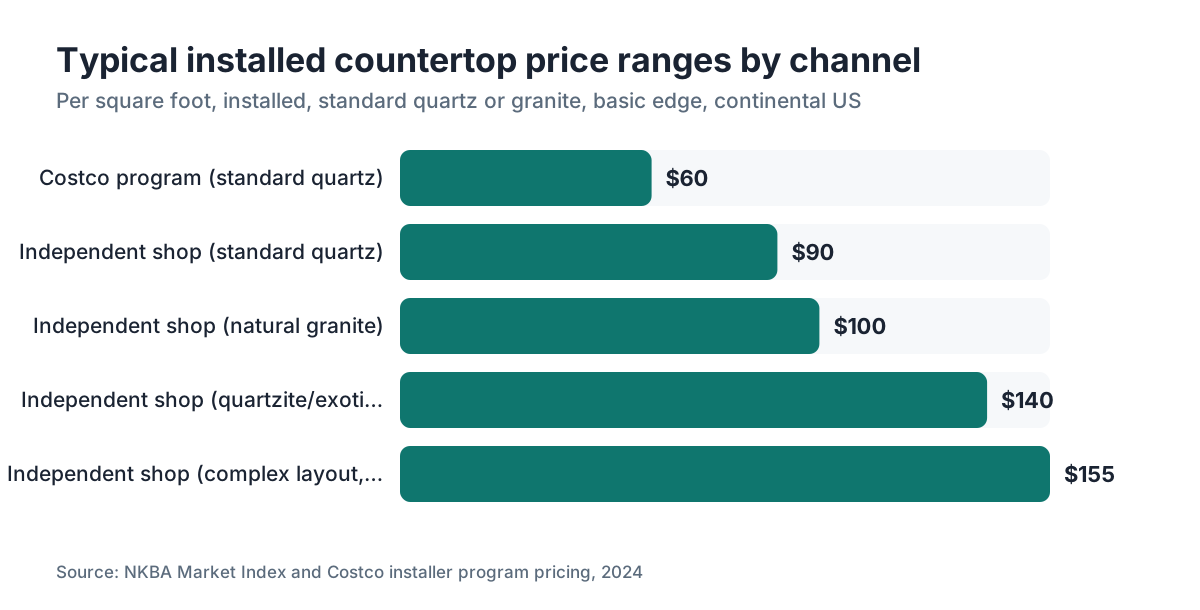
- Costco sells countertops through third-party installers at roughly $45 to $75 per square foot installed, using limited slab lists and standardized labor.
- Independent fabricators typically charge $65 to $150 and up, depending on material, edge profile, and complexity.
- The gap is real and explainable.
- This guide gives you the exact words to say, what to show, and when to walk away.
What does Costco actually charge for countertops?
Costco's countertop program runs through third-party installers like International Granite and Stone (IGS), and it prices standard quartz and granite installs at roughly $45 to $75 per square foot, including a basic edge and removal of the old surface [1]. That price is real. Don't argue with it.
Here's what homeowners miss. That range reflects Costco's buying power against a short approved list of 2cm and 3cm quartz, plus installers bidding on volume instead of craft. The selection is narrow. Custom edges cost extra. Exotic stone isn't in the program at all.
The number on Costco's website is usually a starting price for a plain rectangular kitchen. No island cutout. No apron sink. No mitered waterfall. Complexity gets upcharged fast, and the final invoice often lands close to what an independent shop would have charged from the start [2].
Still, on a plain kitchen with standard quartz, Costco can honestly beat you on price. Say so out loud. You lose the customer the second you pretend a lower number doesn't exist somewhere.
Why do independent fabricators cost more than Costco?
The honest answer is overhead, selection, and skill. Your shop carries a CNC, a bridge saw, a waterjet, polishing gear, a template crew, and a delivery truck whether the phone rings or not. Costco's program pushes almost all of that onto regional installers who fight for thin margins on high volume [3].
Here is where the difference actually shows up:
Slab selection. Costco stocks a curated set of quartz and granite SKUs. You can pull from any distributor, match a vein direction, source a rare quartzite, or let a homeowner hand-pick their slab at the yard. Want Cambria quartz or a book-matched marble slab? Costco doesn't have it.
Edge complexity. A waterfall, a mitered edge, or a live edge takes a skilled operator and multiple CNC passes. Costco pricing assumes an eased or simple ogee. Each step up in complexity adds labor that a volume installer prices at a premium, because it breaks the workflow that makes their program cheap.
Templating accuracy. Good shops template with laser devices and feed those numbers straight into the cutting software. That precision earns its keep on a $12,000 quartzite island. On a basic white quartz kitchen, a homeowner probably won't notice. On a full-height stone backsplash, they will.
Accountability. With Costco, a warranty claim travels through Costco, then the third-party installer, then whoever cut the slab. With your shop, the person who answers the phone is the person who cut the stone. That's the whole pitch in one sentence.
What should fabricators say when a customer brings up Costco pricing?
Don't get defensive. That's rule one. The moment a competitor's name rattles you, the customer reads it as proof the comparison has teeth.
Agree on what Costco does well, then move the conversation to what's different about this job.
A script that works:
"Costco runs a solid program for standard kitchens. If your job fits what they offer, they're worth a look. What I'd compare is the full scope: what stone you want, what edges, how many cutouts, what timeline. Once we lay that out, the quotes will either come close, or you'll see exactly where the difference is."
That framing does three jobs at once. It shows you're not scared. It moves the anchor from raw price to scope. And it gets the customer describing their kitchen in detail, which almost always turns up complexity the Costco program handles badly.
If they have an actual Costco quote in hand, ask to see it. Read the line items. Point out what's in and what's missing. If the quote skips removal, haul-away, or the sink cutout, say so calmly and add those to your own number so the comparison is fair.
How do you show value without just talking about quality?
"We have better quality" is the weakest thing a fabricator can say. Every shop says it, and no customer can verify it standing in your showroom. Show the value. Don't announce it.
A few moves that actually work:
Bring photos of your seams. A tight seam on absolute black granite, or a matched vein across a seam in quartzite, proves skill without a word from you. Volume installers aren't optimizing seam placement on hard stones.
Show the slab, not a chip. If you have a real distributor relationship, invite the homeowner to the yard to pick their own piece. Costco ships from a central warehouse. You can point at the exact stone going into their kitchen. That moment creates attachment, and attachment justifies price.
Explain your template process. Walk them through how you template, how you lay out the job in software to kill seams and waste, and how you confirm dimensions before a single cut. Shops running SlabWise can show a digital layout of the customer's actual slab before any stone gets cut. That's something they can see.
Put the warranty in writing. Get specific about what you cover and for how long. If you stand behind your seams and edges for a set period, print it and hand it over. Vague promises don't sell. A signed warranty does.
What are the real differences in material quality between Costco and independent shops?
It depends heavily on the material. For standard quartz brands (Silestone, MSI, Cambria), Costco and independent shops buy from the same manufacturers [4]. The slab is the slab. Fabrication and edge work is where the real difference lives.
Natural stone is a wider gap. Costco works from a pre-selected inventory. You can source granite, quartzite, or marble from several distributors and let the customer pick at the yard. A single lot of granite varies a lot in pattern and color across shipments, and a homeowner who chose their slab in person ends up far happier than one who chose off a sample card.
Budget materials like laminate or Formica? Costco doesn't compete there. Those products live with local suppliers and installers anyway.
Specialty materials tell the same story. Corian and other solid surfaces, or butcher block, generally aren't in Costco's program. A shop that handles those has no Costco comparison to defend at all.
Is competing on price against Costco ever the right move?
Sometimes. If you run high volume, carry low overhead per square foot, and your supplier deals give you sharp slab pricing, you can price competitively on standard quartz kitchens and still make money. Some shops build their whole model on it.
But chasing Costco's price on plain jobs gets tighter every year. Their installers are on volume contracts. You aren't. Match their number on a simple kitchen and you're eating into the margin that pays for your CNC, your template crew, and your warranty work.
The steadier play for most independent shops is to win the jobs Costco can't take. Complex layouts. Exotic stone. Tight deadlines where a local shop templates and installs in two weeks instead of four to six. High-end remodels where the customer cares about seam placement on a book-matched slab. On those, you're not competing with Costco. You're in a different market.
How should fabricators handle a customer who has already gotten a Costco quote?
Ask to see it. That's not aggressive. It's professional. A customer who brings a competitor quote is telling you they want to buy from someone. They just haven't picked who.
When you review it:
Check what's included. Removal and disposal? Itemized edge profiles? Are cutouts (sink, cooktop, faucet holes) listed separately or buried? Many volume-program quotes are thin on line items, which makes them look cheaper until the installer shows up and starts adding charges.
Check the material spec. Which quartz line? What thickness? A 2cm slab and a 3cm slab are not the same product, and the price gap between them is real [5].
If the Costco quote is genuinely apples-to-apples and lower, say so. Tell the customer where you're higher and why. If you can't defend the difference in words they buy, you probably shouldn't have the job. Let it go. The customers who understand what you do are the ones worth keeping.
For homeowners researching the countertop installation process and costs, walking two quotes side by side is often the most useful hour of the whole project.
How do you build a quote that wins against big-box competition?
Your quote is part of the pitch. A one-number quote on a sticky note loses to a detailed document every time, because the detailed document looks like it came from someone who knows what they're doing.
A winning quote has:
- A line-itemized breakdown: material (by square foot and slab name/lot), edge profile (by lineal foot), cutouts (by type and count), removal and haul-away, fabrication, template fee, and installation.
- A clear list of what's included and what costs extra (corbels, matching backsplash pieces, special cutouts).
- A stated timeline from deposit to install.
- Warranty terms in writing.
- A photo or rendering of the slab if you have one.
The federal cost-estimating guidance backs this up: line-itemized breakdowns build client trust and cut disputes compared to lump-sum numbers [9]. Costco's installer sends a single price. You send a document. That gap reads as competence to the customers you actually want.
What types of customers are comparing you to Costco, and which are worth pursuing?
Customers who open with "Costco quoted me X" fall into three buckets.
Bucket one is price above everything. They want the cheapest countertop that looks fine, and they'll compare you to every shop in a 30-mile radius. Unless you're built to be the low-cost option, this customer costs more time than they return. Thank them, hand over an honest quote, and don't chase the discount.
Bucket two is doing homework. They got a Costco quote because it was easy, but they aren't married to it. They want to understand what they're buying. This one is worth your full effort. Spend the time. Walk the differences. Take them to the yard. These buyers convert at full margin once they trust you.
Bucket three already knows what they want and just needs to hear your price is fair. They found a stone Costco doesn't carry, or their layout is complex, or they got burned by a volume installer before. Your best customers. Quote them fast, follow up quick, and get out of their way.
The mistake most shops make is treating all three the same way.
What do homeowners need to know before comparing any two countertop quotes?
If you're a homeowner holding a Costco quote and an independent quote, verify four things before you decide.
First, confirm the scope matches. Same material (exact brand, line, thickness). Same edge profile. Same cutout count. Same treatment of removal, in or out. The fastest way to get surprised on install day is to assume both quotes cover the same work.
Second, check thickness. Quartz comes in 2cm and 3cm. Most installers use 3cm because it doesn't need a built-up edge or plywood substrate for overhangs [5]. Some budget quotes spec 2cm to shave the price. The Natural Stone Institute's design guidance notes that 2cm stone needs a support system for overhangs beyond a few inches while 3cm spans standard overhangs on its own [10]. Know which one you're getting.
Third, understand the timeline. Volume programs run four to eight weeks from order to install, depending on the regional installer and slab availability. A local shop can sometimes template and install in two weeks. If your kitchen is gutted and you're eating off paper plates, that gap is money.
Fourth, know who to call when something goes wrong. With a local shop, you have a direct line. With a big-box program, you route through customer service channels that may not move fast.
For care after install, see how to clean stone countertops for a practical reference.
Frequently asked questions
How much does Costco charge for granite countertops?
Costco's granite program through third-party installers typically runs $45 to $75 per square foot installed for standard granite, including a basic edge. Complex jobs with island cutouts, specialty edges, or difficult layouts get upcharged. The final price on a complex kitchen can land close to what an independent fabricator charges, well above the starting number the website shows.
Is Costco quartz the same quality as a local fabricator?
For major quartz brands (Silestone, MSI, Cambria), the slab comes from the same manufacturers no matter who installs it. The difference is fabrication: edge work, seam placement, template accuracy, and who answers when something goes wrong. On simple layouts, that difference is small. On complex jobs, it's large.
Why would someone pay more for an independent countertop shop over Costco?
Wider stone selection, the ability to hand-pick a slab at the yard, custom edge profiles, tighter seams on complex layouts, faster local timelines, and a direct warranty relationship with the person who fabricated the top. Exotic stones like rare quartzite or book-matched marble aren't available through Costco's program at all.
How do fabricators respond to customers who say 'Costco is cheaper'?
Agree that Costco runs a solid program for standard kitchens, then redirect to scope. Ask the customer to walk through material, edges, cutouts, and timeline. Once the full scope is on paper, the comparison turns concrete instead of emotional. If Costco genuinely fits that job better, say so. You want referrals from people who trust you, not resentment from people who felt pushed.
Does Costco offer exotic stone countertops like quartzite or marble?
No. Costco's program uses a pre-approved inventory of standard quartz and granite SKUs. Exotic natural stones like quartzite, soapstone, or rare marbles need sourcing through specialty distributors. Independent fabricators with those relationships, who can template custom jobs, are the only option for a homeowner who wants something outside the standard catalog.
How long does a Costco countertop installation take compared to a local shop?
Costco's program typically runs four to eight weeks from order to install, depending on regional installer availability and slab logistics. A local independent shop can often template and install in two to three weeks, sometimes less for in-stock material. For a gutted kitchen or a hard renovation deadline, that timeline gap matters.
What should I check when comparing a Costco countertop quote to another fabricator?
Verify four things: exact material spec (brand, line, thickness), which edges are included, whether removal and haul-away are in the price, and the cutout count. Quotes that look far apart on a lump-sum basis often turn out nearly identical once scope is matched line by line. Ask both vendors to itemize before you decide.
Is 2cm or 3cm quartz better, and does it affect price?
3cm is standard for most countertops because it doesn't need a plywood substrate or a built-up laminated edge for overhangs, which cuts labor and adds rigidity. 2cm costs less per square foot in material but often needs added substrate work. Some budget quotes spec 2cm to lower the headline price. Confirm thickness when you compare.
Can a small fabrication shop realistically compete with Costco on price?
On plain white quartz kitchens, probably not long-term without giving up margin. The smarter play for most independent shops is work Costco can't take: complex layouts, exotic stone, custom edges, and jobs where local speed and direct accountability matter. Win those projects and you're not really in the same market.
What should a fabricator's quote include to win against big-box competition?
A line-itemized breakdown: material by square foot and slab lot, edge profiles by lineal foot, each cutout type counted, removal, haul-away, and installation. Add a stated timeline, warranty terms in writing, and a photo or layout of the slab if you have one. A detailed document signals credibility that a lump-sum price never can.
Do Costco countertop installers do template and measure, or does the homeowner supply dimensions?
Costco's program sends a templater through the third-party installer after the sale. The homeowner doesn't supply dimensions. The template method and equipment vary by regional installer, so ask which method they use and whether digital templating is included, especially on complex jobs with irregular walls or large islands.
How do I know if a countertop customer is worth pursuing or just price shopping?
Ask about their stone preference, their layout, and their timeline. Customers who already know what material they want, or who have a complex kitchen, are usually serious buyers who pay for expertise. Customers who open with the lowest price they've seen and show no interest in what's different about your work are usually better off at Costco. Save your time for the right jobs.
Sources
- Costco Wholesale, Countertop Installation Services product page: Costco countertop program through third-party installers prices standard quartz and granite installs in the $45 to $75 per square foot range including basic edge profiles and removal
- Consumer Reports, Kitchen Countertops Buying Guide: Volume-program countertop quotes often start at a lower price that increases significantly with cutouts, edge upgrades, and non-standard layouts
- U.S. Small Business Administration: Independent fabrication shops carry fixed equipment and labor overhead that volume programs offset by working through regional installer networks on thin per-job margins
- Natural Stone Institute, Fabrication and Installation Standards: Engineered quartz slabs from major manufacturers are supplied to multiple installer channels including big-box and independent fabricators from the same production facilities
- Natural Stone Institute, Dimension Stone Design Manual: Quartz countertops are manufactured in 2cm and 3cm thickness; 3cm is standard for countertop applications and eliminates the need for a plywood substrate on overhangs
- U.S. Bureau of Labor Statistics, Occupational Outlook Handbook: Tile and Stone Setters: Stone fabrication and countertop installation labor rates vary by region, with skilled CNC operators and template crews commanding higher wages than volume production workers
- National Kitchen and Bath Association, NKBA Kitchen and Bath Market Index: Independent fabricators report quartz and granite countertop installed prices ranging from $65 to over $150 per square foot depending on material, edge complexity, and regional labor costs
- U.S. General Services Administration: Line-itemized cost breakdowns in contractor quotes improve client trust and reduce post-contract disputes compared to lump-sum estimates
- Natural Stone Institute, Dimension Stone Design Manual (slab thickness and support requirements): 2cm stone requires a substrate support system for overhangs greater than a few inches; 3cm stone can span standard overhangs without additional support under most countertop conditions
Last updated 2026-07-11