TL;DR
- A farmhouse (apron-front) sink pairs beautifully with butcher block countertops, but water is the enemy.
- You need a tight reveal, proper sealing with a penetrating oil or film finish, and a wood species with tight grain (hard maple, teak, or white oak).
- Budget $400 to $1,200 for the butcher block plus $300 to $800 for a quality fireclay or cast-iron farmhouse sink, before installation labor.
Why do people pair farmhouse sinks with butcher block?
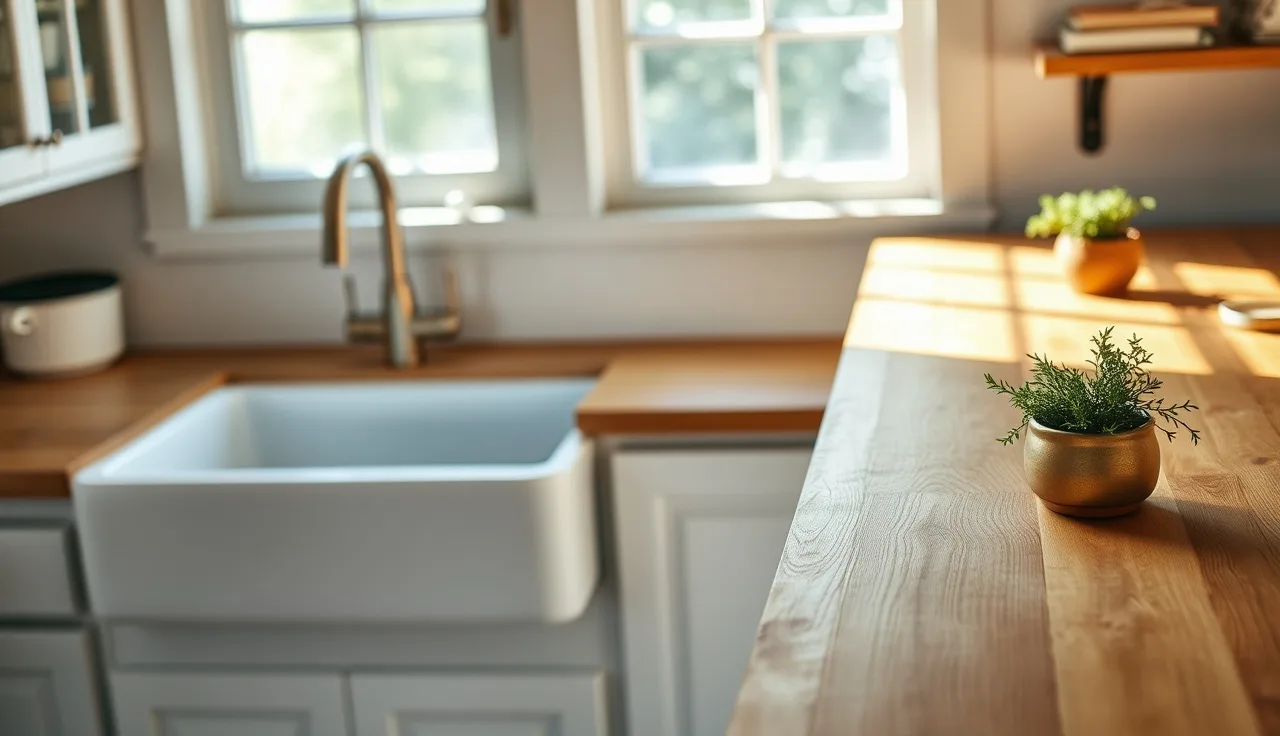
The look is the obvious answer. An apron-front sink drops into a cabinet run and exposes a wide, flat face, and butcher block beside it reads warm and handmade in a way that stone does not. Together they signal a certain kind of kitchen: unhurried, a little rustic, functional in an old-world sense.
But the pairing is more than aesthetic. Butcher block is forgiving to work on and easy to repair. Unlike granite or quartz, you can sand out a stain or a deep scratch yourself without calling a fabricator. The wood surface also stays closer to room temperature than stone, so it does not feel cold in a winter kitchen. Farmhouse sinks, especially fireclay, share that warm, tactile quality.
The practical tension is water. A farmhouse sink concentrates dishwashing, vegetable washing, and splashing right at the edge of a material that is damaged by prolonged moisture. The sink-to-countertop joint is where most butcher block kitchens fail, and it is the detail that separates a 10-year installation from a 2-year one. Getting that joint right is the whole game.
What types of farmhouse sinks work best with butcher block?
Farmhouse sinks fall into a few main categories, and the choice affects how you cut and support the countertop around them.
Fireclay is the most popular for this pairing. It is dense, heavy (a 33-inch sink can weigh 100 to 160 lbs), and resists chipping well. The matte or gloss white finish reads cleanly against wood grain. Rohl, Kohler, and Shaws are the brands fabricators encounter most often.
Cast iron with enamel behaves similarly but is even heavier. It transfers more cold to the surrounding cabinet in winter and chips if you drop something hard, though the chip is repairable. Kohler's cast-iron farmhouse line has been around long enough that resale parts are available.
Stainless steel apron-front sinks are cheaper and lighter, starting around $300, but the industrial look fights the warm character of butcher block. Some kitchens pull it off with a brushed finish and white oak countertops, but it takes deliberate design.
Copper patinas beautifully against wood, but it dents, and the antimicrobial surface properties, while real, do not offset the maintenance demands for most homeowners.
From a fabrication standpoint, the spec that matters most is the apron depth (how far the sink face extends below the countertop front) and whether the sink is an undermount-style or a drop-in farmhouse. True undermount apron sinks require the countertop to be cut with a flush or slightly proud reveal, and that cut edge in butcher block needs extra sealing attention because end grain absorbs water faster than face or edge grain [1].
Which wood species holds up best next to a sink?
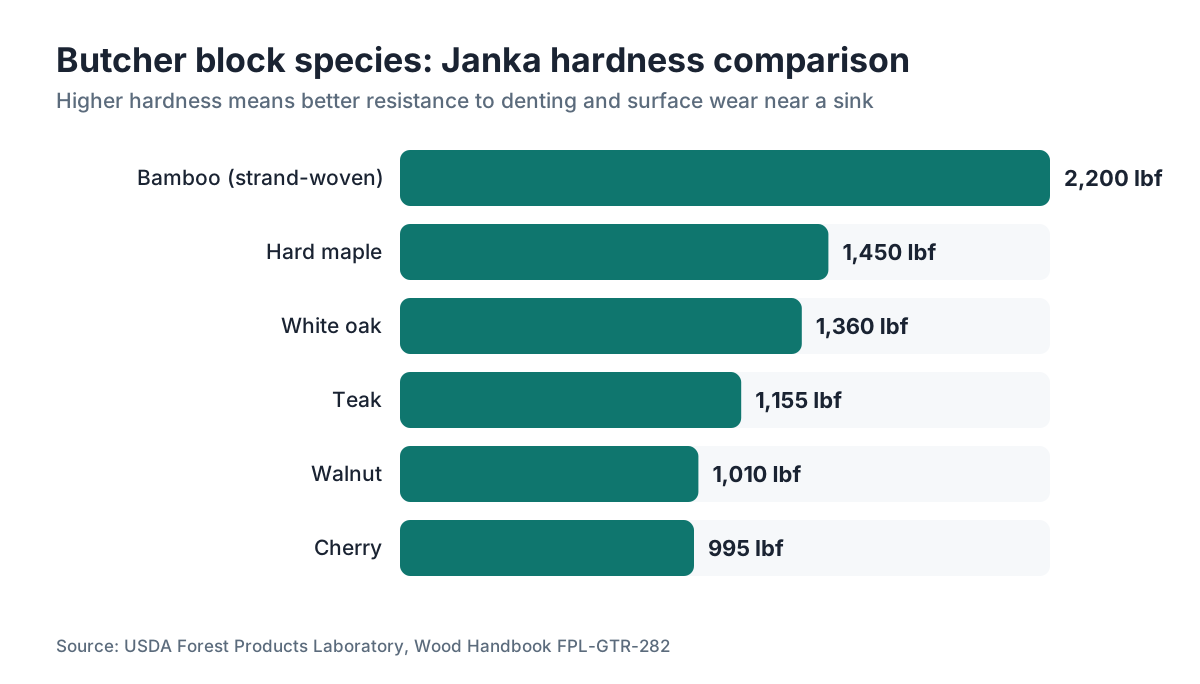
Not all butcher block is equal near water. The properties that matter are Janka hardness (resistance to denting and wear), grain tightness (how much water the surface absorbs), and natural oil content (some species resist moisture without added finish).
| Species | Janka Hardness (lbf) | Natural Oil Content | Relative Cost (per sq ft, unfinished) |
|---|---|---|---|
| Hard maple | 1,450 | Low | $12 to $20 |
| Walnut | 1,010 | Low | $18 to $35 |
| White oak | 1,360 | Moderate | $15 to $28 |
| Teak | 1,155 | High (silica-rich) | $30 to $60 |
| Cherry | 995 | Low | $16 to $30 |
| Bamboo (strand-woven) | 1,800 to 2,600 | Low | $10 to $18 |
Hard maple is the industry workhorse. It is the default for professional butcher block countertops, takes finish well, and costs less than most alternatives. Near a sink, you want it edge-grain or face-grain, not end-grain, because end-grain blocks absorb water through the cut ends much faster than the tight side-grain surface [1].
Teak is the genuine standout for moisture resistance. It has high natural silica and oil content that makes it resistant to water even without a finish, which is why it has been used in marine applications for centuries [2]. The cost is a real barrier, and the silica dulls saw blades faster, which adds fabrication cost.
White oak has tyloses in its pores, microscopic structures that essentially block water infiltration. That is why white oak has traditionally been used for wine barrels while red oak leaks. Near a sink, that porosity difference matters. If you want an affordable species with real moisture resistance built in, white oak is the choice [10].
Walnut and cherry are beautiful but softer and more thirsty. Use them if the look is the priority, seal every edge with care, and accept that maintenance is not optional.
How do you seal butcher block near a farmhouse sink?
There are two sealing philosophies: penetrating oils that soak into the wood fiber, and film finishes that build a layer on top of the surface. Both work. They fail differently, and the failure mode matters near a sink.
Penetrating oils (mineral oil, food-grade linseed oil, Waterlox Original, Danish oil) soak in and protect from within. They do not peel or crack, so there is no moment where water gets under a damaged film and causes rot. The downside is they need reapplication every 6 to 12 months depending on use, and they do not resist hot cookware as well as film finishes. Pure mineral oil by itself is not enough near a sink, even though it is food-safe, because it does not fully cure or form a continuous barrier [3].
Film finishes (polyurethane, conversion varnish, Waterlox Sealer/Finish) build a hard surface layer. They resist water better day-to-day, handle wet glasses and spills, and need less frequent reapplication. The risk is that any crack or chip in the film lets water get underneath, and when that happens beside a sink, the damage runs invisibly until you have a soft, dark, molding section of wood. Film finishes near a sink demand immediate repair of any damage.
For the sink joint specifically, where the butcher block meets the sink rim or the cut edge of the wood, neither oil nor standard film finish is enough on its own. The joint needs a silicone that stays flexible, because wood expands and contracts with humidity, and a rigid caulk will crack. Plumber's or 100% silicone in a neutral-cure formula is the right call. Clear or white, matching the sink color, applied in a clean, continuous bead.
Many fabricators also apply a thick bead of silicone or epoxy to the underside of the butcher block at the sink cut-out edge before setting the sink, so that edge is never exposed to splash from below [4].
Reapplication schedule matters. The USDA Forest Products Laboratory has published guidance noting that wood near water sources needs more frequent finish maintenance than wood in dry areas of the kitchen [1]. A good rule of thumb: inspect the sink-adjacent area every 3 months, and reapply penetrating oil or touch up film finish any time the wood looks dry or shows water absorption.
What is the correct reveal and gap at the sink-to-countertop joint?
This is the detail that most DIY installs get wrong and most fabricators get right by habit.
The reveal is the amount of countertop that extends past the sink apron face. For a true flush installation, the countertop front edge sits exactly even with the sink face. For a slight reveal, the countertop overhangs by 1/8 to 3/16 inch, giving you a drip edge that sends water down into the sink instead of behind the sink face and into the cabinet.
For butcher block, a 1/8-inch reveal is the safer choice compared to flush, specifically because wood moves. A perfectly flush install in summer, when the wood is fully expanded from humidity, can end up with the sink apron face protruding past the wood in a dry winter, catching water and trapping it against the wood end grain at the joint.
The gap between the sink rim and the butcher block cut-out should be filled with silicone, not left open. Even 1/32 of an inch of open gap at the rim will channel water straight down into the substrate and cabinet below over time.
For undermount-style farmhouse sinks (where the apron sets into the cabinet face and the countertop sits on top), the underside of the cut-out edge is the most vulnerable point. Some fabricators epoxy a thin strip of hardwood or apply several coats of film finish to that end-grain edge before installation. Others run a solid wood or plywood substrate underneath as a sacrificial layer.
For drop-in farmhouse sinks with a rim, the rim itself creates a gasket, but the caulk joint at the rim-to-wood interface is still the weak point. Clean, continuous silicone, no gaps.
How much does a farmhouse sink with butcher block countertop cost?
Costs vary enough that any single number is misleading, but here are the honest ranges based on current retail and fabrication pricing.
Butcher block countertop for a typical kitchen (25 to 40 square feet): $300 to $1,200 for the material alone, depending on species and thickness. IKEA's solid-wood countertop lines start around $12 to $15 per square foot for birch and oak, and they are widely used as a budget entry point [8]. Custom-milled hard maple or walnut from a specialty supplier runs $25 to $60 per square foot.
Farmhouse sink: entry-level stainless apron sinks start at $250 to $350. Fireclay from Rohl, Kraus, or similar runs $500 to $1,200. Shaws Original (Rohl), the benchmark fireclay that most designers spec, retails around $1,000 to $1,400 for a single-basin 30-inch version.
Installation labor: countertop installation for butcher block runs $200 to $500 for most kitchens if the material arrives cut to size. Custom fabrication adds $150 to $400. Plumber installation for the sink runs $150 to $400 depending on region and the complexity of the drain configuration [12].
Sealing materials: a quality penetrating oil finish (Waterlox, Rubio Monocoat, or equivalent) runs $40 to $100 for enough to do a full kitchen countertop with multiple coats.
A complete budget-range install: $1,000 to $1,800. A quality mid-range install with fireclay and white oak: $2,500 to $4,000. High end with teak or walnut and a premium sink: $5,000 or more, easily.
One cost often overlooked is cabinet modification. Farmhouse sinks require the cabinet below to have the face frame cut out to accept the apron, and the base cabinet may need reinforced supports to handle a fireclay or cast-iron sink's weight. Budget $100 to $300 for that work if the cabinet is not pre-configured for an apron sink.
Can you install a farmhouse sink with butcher block yourself, or do you need a pro?
Honestly, the butcher block side of this job is within reach for a competent DIYer. The sink side is where it gets harder.
Cutting butcher block takes a circular saw with a sharp rip blade, or a jigsaw for the sink cut-out. The cut-out opening for the sink apron is not complicated geometry, but the tolerances matter because you are cutting into a $500 to $1,500 piece of material. A practice cut on scrap first is not optional.
Sealing the cut edges right after cutting matters even more. If you cut the opening and leave it unsealed overnight while you fit the sink, that end-grain edge will absorb moisture and can raise or warp before you ever finish the install.
The plumbing connection means shutting off the water supply, disconnecting the existing drain, and reconnecting to the new sink. That is within the scope of a competent DIYer in most states for a standard drain connection. Permit requirements vary: some jurisdictions require a licensed plumber for any drain work, others do not. Check your local building department's requirements.
If the existing base cabinet needs its face frame modified to accept the apron sink, and you have not done that kind of carpentry before, hire a carpenter or a kitchen installer. A wrong cut on a cabinet can mean a new cabinet.
Fabrication shops that work with butcher block regularly can cut the countertop, pre-seal the cut edges, and deliver it ready to install. That service typically costs $150 to $400 and removes the highest-risk step from a DIY job. Software like SlabWise helps those shops price and quote those jobs quickly, which means faster turnaround for homeowners who call around.
For the actual countertop and sink setting: if you are comfortable with a saw, a drill, and basic plumbing, you can do this. If you are not, the cost of a professional install is small next to replacing warped butcher block in year two.
What are the most common problems with this pairing, and how do you avoid them?
Water damage at the sink joint is the most common failure by a wide margin. The wood immediately around the sink cut-out goes soft, dark, and eventually moldy. The fix is careful sealing and caulking at installation, not after you notice the problem.
Warping or cupping happens when one side of the butcher block absorbs more moisture than the other. Seal the underside of the countertop as thoroughly as the top surface. Many homeowners seal the top and forget the bottom, and the moisture differential cups the panel upward. The Forest Products Laboratory notes that uneven moisture exposure is a primary driver of wood panel movement [1].
Finishing incompatibility with the cutting surface. If you want to actually cut food on the butcher block (more than use it as a counter), you need a food-safe finish. Polyurethane is technically food-safe once fully cured, but the FDA and most food safety authorities treat finishes like mineral oil and natural oil blends as the appropriate choice for food-contact surfaces [6]. A film finish that chips can contaminate food.
Staining near the sink: wet cast-iron pans, standing water, and food acids all stain butcher block. A light sand with 120-grit followed by a fresh oil coat fixes most stains. This is the material's big advantage over stone: it is repairable.
Sink weight cracking the wood: a 100-lb fireclay sink that is not properly supported can, over time, stress the substrate under the butcher block and cause cracking or excessive deflection. The sink must be supported by the cabinet structure, not by the countertop alone. Clips or brackets that fasten the sink to the countertop should not bear the full weight of the sink [9].
Silicone caulk shrinkage and separation: silicone shrinks as it cures, and a thin bead shrinks enough to open a gap. Apply a full, rounded bead and tool it into the joint. Inspect it yearly and replace any section that has pulled away from either surface.
How do you maintain butcher block countertops long-term next to a sink?
Maintenance is the price of admission for butcher block near water. If you want a surface you can ignore for years, stone is the better material. Butcher block rewards attention and punishes neglect.
For oil-finished countertops, the standard schedule is: apply a penetrating oil every 1 to 3 months for the first year, then 2 to 4 times per year after the wood is fully saturated. The test is simple. Drip water on the surface. If it beads, the finish is intact. If it soaks in within 30 seconds, reapply oil.
For the area immediately next to the sink, monthly inspection is worth it. Look for any darkening of the wood, softness when pressed, or separation of the caulk bead. Catch these early.
For film-finished countertops, inspect for scratches and chips. Touch up with the same finish product used originally. If the film has peeled in a section, that section needs to be sanded back to bare wood and refinished. You cannot patch peeling polyurethane without removing it.
Sanding and refinishing is the advantage butcher block has that stone cannot match. A full sand with 80-grit followed by 120-grit and 220-grit, then fresh finish, returns the surface to essentially new condition. That process takes a day, costs $30 to $80 in materials, and is within DIY capability. Stone stains, scratches, or etches are permanent without professional intervention.
Do not use the countertop immediately beside the sink as a drying rack. That is the spot that takes the most sustained wet exposure. A silicone or wood drying mat in that zone extends the life of the finish a lot.
How does butcher block compare to other countertop materials for a farmhouse kitchen?
The farmhouse aesthetic works with several materials, and butcher block is not always the right call. Here is an honest comparison for the context of a farmhouse sink pairing.
Soapstone: dense, non-porous, and does not need sealing. It develops a natural patina and scratches sand out. It pairs beautifully with a farmhouse sink and is actually lower-maintenance than butcher block near water. The downside is cost ($70 to $120 per square foot installed) and it requires a fabricator. You cannot DIY-cut it easily. See how to clean soapstone countertops for more on that material's maintenance.
Marble: gorgeous, but porous and acid-sensitive. Near a farmhouse sink, marble etches from dish soap over time and stains from cooking oils. It is a bad choice functionally, even though it looks perfect.
Granite: granite countertops are harder and more stain-resistant than marble, nearly maintenance-free once sealed, but they lack the warmth people want when they choose butcher block. They read more modern or transitional than farmhouse.
Laminate: the gap in material cost is real. A full kitchen in laminate with a farmhouse sink costs $500 to $1,000 all-in for the material, compared to $800 to $2,500 for butcher block. Laminate countertops have improved a lot and can replicate a wood look. Near water, they actually outperform real butcher block because they do not absorb moisture. The trade-off is you cannot sand and refinish them.
Quartz: extremely durable and non-porous, but heavy, expensive, and reads modern. A farmhouse kitchen with quartz does not hang together the way one with butcher block or soapstone does.
If you want the warmth of butcher block without the water sensitivity, and the farmhouse look is the goal, soapstone is genuinely worth a look. If budget is the constraint, well-maintained butcher block at $12 to $20 per square foot is hard to beat.
For a full look at the material options across the kitchen, the kitchen countertops guide covers the whole range.
What do fabricators need to know about cutting butcher block for a farmhouse sink?
If you run a shop that does mostly stone, butcher block is a different animal. A few things that burn shops not used to it.
First, blade selection. A triple-chip or combination blade with 40 to 60 teeth rips and crosscuts butcher block cleanly. The diamond blade you use on granite will not cut wood. Keep dedicated wood blades in the shop.
Second, the sink cut-out template. For farmhouse sinks, the cut-out is more than a rectangular hole in the countertop. The front edge of the cut-out has to match the cabinet face frame opening, and the depth of the cut-out must match the sink's installation spec sheet. Shaws, Rohl, and Kohler all publish installation templates or dimension sheets. Use them. A 1/4-inch mistake at the front edge changes the reveal and can mean the sink apron sticks out past the cabinet face.
Third, seal the cut edges in the shop before delivery. This is a service detail homeowners will not know to ask for and will thank you for later. Brush two or three coats of Waterlox or a similar penetrating finish on the cut-out edges and any field cuts before the piece ships. This kills the most common failure point.
Fourth, butcher block is heavier than most homeowners expect. A 36-by-96-inch section of 1.5-inch hard maple weighs roughly 90 to 110 lbs. Make sure the delivery and installation crew knows what they are handling.
For fabricators running multiple butcher block quotes alongside stone jobs, SlabWise handles mixed-material quoting so you do not have to keep a separate spreadsheet for wood versus stone jobs.
For a detailed look at the full fabrication and countertop installation process, that guide covers templates, setting, and common mistakes across all material types.
Are there any building code or structural considerations for this combination?
Building codes do not specifically regulate which countertop material you pair with which sink type, but there are structural and plumbing considerations that vary by location.
The main structural concern is the cabinet below the sink. Fireclay and cast-iron farmhouse sinks are heavy enough that standard base cabinet shelves cannot serve as the sole support. Most sink manufacturers specify that the sink must rest on the cabinet base frame or on added cross-supports, not on the butcher block countertop [9]. Check your sink's installation manual for the specific load requirement.
For plumbing, most jurisdictions follow the International Residential Code (IRC) or local amendments for drain configuration and venting [7]. The farmhouse sink itself has no special code requirements beyond what any sink has. If you are moving the drain location, that work typically requires a permit in most municipalities.
For food prep surfaces in commercial settings, the FDA Food Code requires that food-contact surfaces be smooth, non-porous, and easily cleanable [6]. Residential kitchens are not regulated under the FDA Food Code, but if you have any kind of commercial use of your kitchen, even a small catering operation, check with your local health department before installing butcher block as a food prep surface.
Some homeowners' associations have rules about countertop materials that could affect resale, though this is rare for butcher block specifically. More often, HOA kitchen rules affect appliance types and finishes visible from common areas.
Frequently asked questions
Can you use an apron-front sink with IKEA butcher block?
Yes, and it is one of the most common budget approaches. IKEA solid-wood countertop panels can be cut for a farmhouse sink cut-out just like custom butcher block. The 1.5-inch panels provide adequate support for most fireclay sinks as long as the cabinet is properly reinforced underneath. Seal the cut edges right after cutting. IKEA's wood countertops start around $12 to $15 per square foot for birch or oak.
How do you prevent mold under the sink where butcher block meets the sink rim?
A continuous bead of 100% silicone caulk at the sink rim-to-countertop joint is the primary defense. The caulk must be flexible enough to move with the wood's seasonal expansion and contraction. Inspect it every 6 months and replace any section that has pulled away. Also seal the underside of the countertop, more than the top, so the wood does not pull moisture from the humid cabinet below.
Is teak really worth the cost for butcher block near a sink?
If you genuinely want the most water-resistant wood and can absorb the $30 to $60 per square foot material cost, teak is defensible. Its natural silica and oil content gives it moisture resistance that other species only reach through a finish. But white oak at $15 to $28 per square foot delivers most of the same benefit for far less money, and hard maple with a Waterlox finish performs well enough for most homes.
What finish is food-safe on butcher block near a sink?
Mineral oil, food-grade linseed oil, and natural wax-oil blends (like Rubio Monocoat) are considered food-safe for food-contact surfaces. Polyurethane is technically food-safe once fully cured, but the FDA's food safety guidance points toward natural penetrating oils for surfaces that contact food directly. Near a sink, a penetrating oil finish also handles minor damage better than a film finish that can crack and harbor moisture.
How often does butcher block near a sink need to be refinished?
For oil-finished countertops, plan on a fresh coat of penetrating oil every 1 to 3 months in the first year, then 2 to 4 times per year after that. The area immediately next to the sink may need attention monthly. The test: drop water on the surface. If it soaks in within 30 seconds, apply oil. For film finishes, spot-repair any chips or scratches immediately and expect a full sand-and-refinish every 5 to 10 years.
Does a farmhouse sink void a butcher block warranty?
Most butcher block manufacturers, including John Boos and LL Flooring, have warranty language that covers defects in materials and manufacturing but excludes damage from improper sealing or water exposure. A farmhouse sink installation does not void a warranty by itself. Failing to seal the cut-out edges properly, and then getting water damage, would not be covered. Read your specific manufacturer's warranty before cutting.
How thick should butcher block be for a farmhouse sink installation?
1.5 inches is the standard and adequate for most residential installations. Thicker panels (2 to 2.25 inches) add weight and cost without meaningful structural benefit in most applications. Some homeowners choose thicker panels for a heavier visual weight, especially with a large fireclay sink. If the sink is particularly heavy (over 120 lbs), a 1.5-inch panel with proper cabinet support beneath the sink matters more than panel thickness.
Can you use end-grain butcher block next to a farmhouse sink?
Technically yes, but it is not recommended as the primary surface right next to the sink. End-grain butcher block is the premium cutting surface, but the exposed cut ends absorb water much faster than face-grain or edge-grain surfaces. If you want end-grain in your kitchen, keep it away from the wet zone or stay extremely diligent about sealing and maintain a silicone caulk joint with no gaps.
What undermount sink reveal is correct for butcher block?
A 1/8-inch positive reveal, where the countertop front edge extends 1/8 inch past the sink apron face, is the right target for butcher block. Flush or zero reveal looks clean but leaves no margin for seasonal wood movement, which can push the apron past the wood in dry winter conditions. A small positive reveal creates a drip edge and accommodates expansion, extending the life of the caulk joint.
Does a farmhouse sink affect the resale value of a home with butcher block countertops?
The pairing is popular enough that it reads as a designed choice, not a dated one. Both materials tie to transitional and farmhouse-style kitchens that have had strong buyer appeal in the U.S. market for a decade [11]. The risk to resale is a poorly maintained butcher block showing water damage around the sink. That reads as neglect and defers buyers. A well-maintained installation is neutral to mildly positive.
Is it hard to cut the sink opening in butcher block yourself?
The cut itself is within DIY capability if you are comfortable with a jigsaw or circular saw. The challenge is the tolerance: the opening must be sized precisely to the sink's template, the front edge must line up with the cabinet face opening, and you must seal all cut edges immediately. Practice on scrap, use the sink manufacturer's template, and have your silicone and finish materials ready before you make the cut.
What is the best way to clean butcher block countertops next to a sink every day?
Wipe up standing water right away. Clean with a damp cloth and mild dish soap, then dry the surface. Do not let it air-dry with water pooling. Avoid soaking the surface. Once a week, a light wipe with diluted white vinegar kills surface bacteria without damaging an oil finish. Do not use bleach on oil-finished butcher block. It raises grain and strips the finish. For film-finished surfaces, mild soap and water is fine.
How does walnut butcher block hold up near a farmhouse sink compared to maple?
Walnut is softer (Janka 1,010 versus maple's 1,450), so it dents more easily and absorbs moisture somewhat faster. Near a sink, maple is the more practical choice. Walnut's appeal is purely aesthetic: the dark grain is stunning against a white fireclay sink, but it needs more diligent sealing and shows wear faster. If you go walnut, use Waterlox or a similar oil-varnish blend and reapply it every 2 to 3 months near the sink.
Can you put hot pots on butcher block near the sink?
No. Wood does not handle sustained direct heat well regardless of the finish type. A pot at 300 to 400 degrees Fahrenheit will scorch the finish and can char the wood fiber underneath. Use a trivet or silicone mat. This is a genuine limitation compared to stone countertops, and it applies everywhere on the butcher block surface, more than near the sink. Near the sink, heat plus moisture is particularly damaging.
Sources
- USDA Forest Products Laboratory, Wood Handbook: Wood as an Engineering Material (General Technical Report FPL-GTR-282): End-grain wood surfaces absorb water faster than face-grain or edge-grain surfaces; uneven moisture exposure is a primary driver of wood panel warping and cupping
- FAO Forestry Department, Teak (Tectona grandis): Ecology and Silviculture: Teak has high natural silica and oil content that contributes to its moisture and weathering resistance, historically used in marine construction
- USDA Forest Products Laboratory, Finishing of Wood (FPL publication): Mineral oil alone does not fully cure or form a continuous barrier and is insufficient as a sole protective finish for wood surfaces near water sources
- John Boos & Co., Butcher Block Care and Maintenance Instructions (manufacturer guidance): Fabricators and installers are advised to seal all cut edges and undersides of butcher block countertops before and after installation to prevent moisture infiltration
- U.S. Food and Drug Administration, FDA Food Code 2022, Section 4-101.11 (Characteristics of food-contact surfaces): Food-contact surfaces must be smooth, non-porous, and easily cleanable under FDA Food Code; food-grade oils are identified as appropriate for wood food-contact surfaces
- International Code Council, International Residential Code (IRC) Plumbing provisions: Most U.S. jurisdictions adopt the IRC or local amendments governing drain configuration, venting requirements, and permit requirements for residential plumbing modifications
- IKEA US, solid wood kitchen countertop product specifications: IKEA solid wood kitchen countertop panels in birch and oak start at approximately $12 to $15 per square foot and are available in 1.5-inch thickness suitable for farmhouse sink installations
- Kohler Co., Farmhouse and Apron-front Sink Installation Guide: Kohler specifies that apron-front cast-iron sinks must be supported by cabinet base structure, not by the countertop alone, due to the weight of cast-iron and fireclay models
- University of Massachusetts Amherst, Wood Science and Technology Program, Wood Properties and Uses: White oak contains tyloses in its pores that block water infiltration, making it significantly more moisture-resistant than red oak and comparable to higher-cost species near water sources
- National Kitchen and Bath Association (NKBA), 2023 Kitchen and Bath Market Index: Farmhouse and apron-front sinks have been among the top five requested sink styles in U.S. kitchen renovations for multiple consecutive years per NKBA industry surveys
- HomeAdvisor / Angi, True Cost Guide: Countertop Installation Costs 2024: Professional countertop installation labor for butcher block typically runs $200 to $500 for standard kitchen sizes; plumber installation for a new sink runs $150 to $400 depending on region
Last updated 2026-07-09