
TL;DR
- Cabinet dealers are the warmest lead source a countertop fabricator can find.
- Every kitchen they sell needs a surface on top, and the homeowner already trusts them.
- A written referral agreement, a same-day quote habit, and steady follow-up turn those conversations into repeat volume.
- Shops that run this well pull 30 to 50% of new jobs from cabinet partners, with no ad spend.
Why do cabinet companies make such good referral partners?
Every cabinet sale ends with the same question: now what goes on top? Cabinet dealers talk to homeowners at the exact moment countertop buying intent peaks. They've been in the home, they've taken measurements, and the homeowner already trusts them. That's about as warm as a lead gets.
The timing lines up perfectly. Custom and semi-custom cabinet orders typically run 4 to 12 weeks [1]. That gap is the window where homeowners pick material, collect quotes, and decide. A dealer who hands your card to a customer at point of sale puts you in front of that buyer before they've Googled a single fabricator.
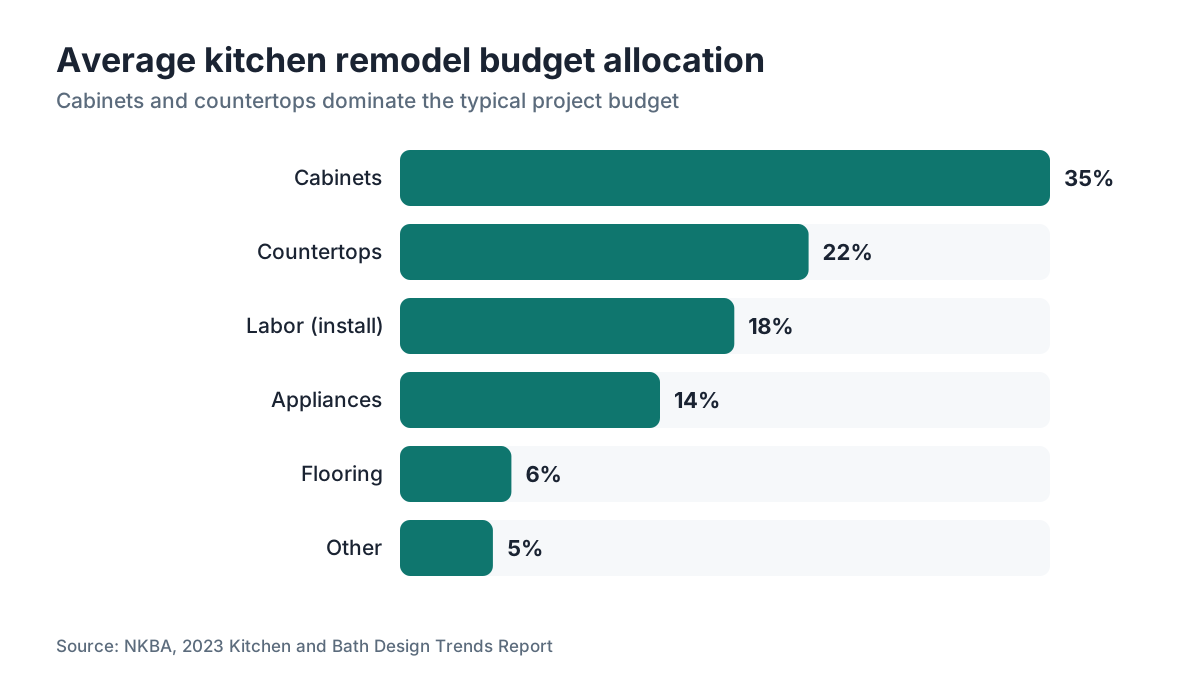
The economics are simple. The National Kitchen and Bath Association reports the average major kitchen remodel runs $75,000 or more, with cabinets and countertops together taking roughly 55 to 65% of that budget [2]. A dealer moving 20 kitchens a month sits on a deep pool of countertop work. You don't need all of it. Convert 30% of one partner's referrals and you've added real revenue without spending a dollar on advertising.
The dealer wins too. Homeowners ask their cabinet rep for countertop recommendations constantly, and a trusted answer beats a shrug every time. Having someone reliable to name makes the dealer's staff look sharp and gives the customer one less thing to figure out. That mutual benefit is the whole pitch.
What types of cabinet companies should you approach first?
Not every cabinet company is the same kind of opportunity. Segment matters more than most fabricators think.
Independent kitchen and bath dealers are usually the best first target. They're locally owned, the owner or sales manager decides without waiting on corporate, and they care about referral quality because their name is on it. These shops often sell mid-to-high-end lines like KraftMaid, Wellborn, or Medallion, and those customers are already comfortable spending on stone [3].
Home center cabinet departments are a different animal. Their installers usually have referral deals locked in at the corporate level, and local managers can't redirect customers. Worth a conversation someday. Not your first call.
Custom cabinet shops, the small millwork operations that build from scratch, can be your best partners. Their clients are high-budget by definition and expect a premium job. One or two of these can outperform ten mid-market referral sources.
Builders and remodeling contractors who buy cabinet packages are a related category. They aren't cabinet companies, but they often pick the countertop on the homeowner's behalf. Once you're on a builder's vendor list, the volume gets steady and predictable.
A realistic first-year target: 5 to 8 local independent dealers and 2 to 3 custom shops you'd genuinely want to work with. Quality beats quantity, always. One partner sending 15 jobs a year is worth more than ten sending one apiece.
How do you actually approach a cabinet dealer for the first time?
Cold emails and a stack of business cards at the front desk go nowhere. Cabinet dealers get pitched by every flooring rep, appliance rep, and countertop shop inside a 50-mile radius. Your approach has to look different from all of them.
Walk in during a slow business hour with a specific, concrete offer. Not "I'd love to be your countertop partner." Try "I can turn a countertop quote around for your customer in under 24 hours, and I'll make you look good doing it." Speed is rare in this trade, and dealers feel the sting of slow fabricators because homeowners blame the dealer when a project stalls.
Bring samples and your best material photos. But lead with process and reliability, not pretty slabs. The dealer has seen slabs. What they haven't seen is a fabricator who shows up on time, doesn't create warranty headaches, and leaves customers happy.
Ask questions before you pitch. How do they handle countertops now? Is their current fabricator frustrating them? What do their clients usually ask for? Listening first does two things. It tells you whether there's a real fit, and it signals you're a professional instead of one more vendor pushing product.
Follow up once, about a week later. Not three times. If two touches produce nothing, move on. This relationship only works if it comes from real mutual benefit, and chasing it says the opposite.
What should a countertop referral agreement actually include?
A handshake works until it doesn't. Putting the basics in writing protects both sides and sets expectations before any money moves.
Here's what a simple referral agreement should cover:
| Term | What to specify |
|---|---|
| Referral fee (if any) | Dollar amount or percentage; typical range is $100 to $300 flat or 3 to 5% of the countertop sale [4] |
| Exclusivity | Whether you're the exclusive recommended fabricator or one of several |
| Lead handoff process | How the dealer sends you leads (email, phone, shared CRM) |
| Quote turnaround | Your committed response time (24 to 48 hours is competitive) |
| Customer data handling | Who owns the contact; state privacy law compliance if applicable |
| Term and termination | How long the agreement runs; notice period to end it |
| Material quality disclosure | Who communicates material grades and expectations to the homeowner |
On referral fees: plenty of strong partnerships run without any. The exchange is already fair, the dealer gets a trusted resource and you get warm leads. Cash referral fees add friction. Sales staff may start steering customers by commission instead of fit, and the homeowner rarely hears about the arrangement. In some states, undisclosed referral fees in consumer transactions can trip contractor licensing or consumer protection rules [5]. Read your state's contractor regulations before you agree to any paid structure.
A cleaner alternative: give the dealer's customers a small discount, say $150 to $200 off any job over $2,000, that the dealer extends as goodwill. The homeowner saves money, the dealer looks generous, and no hidden payment flows to a salesperson.
How do you structure the lead handoff so nothing falls through the cracks?
The agreement is only as good as the process behind it. Most partnerships die here, not in the negotiation.
The simplest reliable handoff: the dealer's rep emails or texts you the customer's name, contact info, the cabinet line they ordered, and a rough timeline. You reach the customer directly within 24 hours. The dealer gets a quick confirmation so they know it happened.
Running real volume across several partners? A lightweight CRM, or even a shared Google Sheet, tracks lead status and keeps leads from going cold. Fabrication software like SlabWise ties into your quoting workflow so the moment a lead lands, a quote is already moving. Speed is what keeps the partnership breathing.
Define what "a referral" means before the first one arrives. Any homeowner who asks about countertops? Only customers who've placed a cabinet order? Someone still in the design phase? Ambiguity here breeds disputes, especially once a fee is involved. Write the definition into the agreement.
Set a review rhythm. A monthly 15-minute check-in with your dealer contact, even by text, catches problems before they fester and keeps you top of mind when the next customer walks in. Most fabricators skip this step. The ones who don't are the ones who hold partnerships for years.
What makes a cabinet company actually keep sending you leads?
Landing the first referral is easy compared to keeping the pipeline open. Dealers stop referring for three predictable reasons: slow response, customer complaints that land on them, and the sense that they've been forgotten.
Quote speed is the single most controllable factor you have. If a homeowner gets your quote the same day they leave the showroom, you're almost certainly the only fabricator they'll talk to. Most competitors take 3 to 7 days, sometimes longer. A 24-hour turnaround is a real edge, not a slogan.
Report back to the dealer on every job. A short note when you've templated, when the install is scheduled, and when the job wraps keeps them in the loop and shows you're caring for their client. Dealers hear about problems instantly and almost never hear about the smooth jobs. Change that.
Handle the occasional mess with transparency. Stone cracks. Deliveries slip. A seam lands where the customer didn't expect it. The worst move is letting the homeowner vent to the dealer before you've said a word about it. Get ahead of it. Dealers who trust you to own problems are the ones who keep referring.
Bring value past the leads. Run a lunch-and-learn for their sales staff on countertop materials. Put together a one-pager comparing granite countertops and marble countertops that a rep can hand a customer. Small investments like these build loyalty cash never buys.
Should you offer the cabinet company's customers any special deal?
A small customer-facing incentive tied to the referral usually beats paying the dealer directly. It gives the sales staff something real to say ("our countertop partner gives our clients a discount"), and it gives the homeowner a reason to follow the referral instead of shopping around.
The math has to hold up. A $150 to $200 discount on a $3,000 to $5,000 job is a 3 to 5% give, roughly what you'd spend acquiring that lead through paid ads. You're not losing money. You're moving the acquisition cost around.
Don't discount off materials. Take the flat dollar amount off labor or fabrication instead. That protects you on large-slab jobs where material eats most of the price and margin is already thin.
Some fabricators offer a free edge upgrade instead of a dollar discount. It costs almost nothing in labor but reads as valuable to homeowners, especially on kitchen countertops where the edge profile is a visible design choice.
Whatever you offer, keep it simple enough that the dealer can say it in one breath. "They'll give you $150 off your countertop" is a sentence a salesperson delivers without fumbling. A tiered discount scheme is not.
How do you handle a customer who wants a material the cabinet company doesn't sell?
This comes up all the time. A homeowner saw butcher block at a friend's place, or fell for a specific Cambria countertops pattern, or wants laminate countertops to stay on budget. The dealer may not carry or install any of it.
Your job is to serve what the homeowner actually asked for, not steer them to whatever's easiest for you. If a referred customer asks about butcher block countertops, quote it. If you don't fabricate it, send them to someone who does and tell the dealer straight. That kind of honesty earns more goodwill than switching the customer to a material with a fatter margin.
For materials you fabricate but the dealer rarely discusses, use the referral to educate. A one-page sheet covering stone, engineered quartz, and alternative surfaces is genuinely useful. It makes the dealer's staff look sharp and kills the "I don't know, ask the fabricator" moment that feels like a hole in the customer's experience.
On countertop installation: spell out in the agreement and in customer communications who installs, whether it's you or a sub, and who the homeowner calls if something's wrong afterward. Dealers get blamed for install problems because they're the familiar face. Removing that ambiguity protects the partnership.
How do you track whether the partnership is actually making you money?
Most fabricators never measure their referral sources. So they don't know which partnerships deserve attention and which produce one job a year while eating relationship-management time.
At minimum, tag every job in your quoting system with its lead source. Five seconds per job, and you get data you can actually use. After six months, pull the numbers: leads per partner, close rate from lead to job, average job value, and gross margin by source. Some dealers refer piles of price-shoppers. Others send clients ready to buy premium stone. Over a year, that difference is enormous.
A simple tracking table looks like this:
| Partner | Leads (6 mo) | Jobs Closed | Close Rate | Avg Job Value | Revenue |
|---|---|---|---|---|---|
| Partner A | 18 | 11 | 61% | $4,200 | $46,200 |
| Partner B | 8 | 3 | 38% | $2,800 | $8,400 |
| Partner C | 22 | 7 | 32% | $5,100 | $35,700 |
Partner A closes at a high rate. Partner C brings the most revenue but at a lower close rate, meaning more unconverted leads soaking up your quoting time. These are real business decisions, and you can only make them with numbers in front of you.
If a partner hasn't produced at least 4 to 6 jobs in six months, have the honest conversation. Either the referral process is broken and fixable, or the fit is wrong. Either answer beats carrying a dead partnership for a year.
What are the biggest mistakes fabricators make with cabinet partnerships?
The most common failure is signing the agreement and going quiet. No follow-up, no communication, then surprise when the leads dry up. A partnership is a relationship, not a filed form.
Second: promising turnarounds you can't hit. Commit to 24-hour quotes, then routinely deliver in four days, and the dealer stops referring after the first complaint. Under-promise a little, over-deliver every time. Simple idea. Plenty of shops get it backwards.
Third: not knowing the dealer's product line. Walk in to meet a shop selling painted inset cabinetry at premium prices, then pitch your laminate service, and you've announced you don't understand their business. Learn what they sell and who their customers are, then speak to that.
Fourth: competing with the dealer. Some fabricators try to sell cabinets on the side or hold a referral deal with a competing cabinet company in the same market. Fastest way there is to kill a partnership. If you pursue several cabinet relationships, keep them in different geographic areas or price segments, never direct competitors of each other.
Fifth: underestimating the sales floor. The owner may sign off, but if the reps on the floor have never heard of you, leads never flow. Spend 20 minutes in the showroom with the staff, bring samples, and make it dead easy for them to recommend you. Their buy-in is the real mechanism.
How do digital tools and quoting software change this partnership model?
The cabinet referral model works far better when your back office can match the speed the dealer promised their customer.
A dealer who says "our countertop partner will quote you by tomorrow" is now on the hook for that promise. If your quoting means measuring notes by hand, sketching templates, and a two-day back-and-forth, you'll break that promise regularly. Software that builds a quote from a cabinet layout or rough dimensions, pulls live material pricing, and emails a clean proposal in under an hour changes the whole dynamic.
SlabWise is built for exactly this workflow. It handles quoting and nesting for stone shops, so when a dealer sends a lead with basic specs, you produce a real quote fast instead of burning an hour on manual math. Running several cabinet partnerships at once? That speed advantage compounds.
Digital tools also help the relationship side. A dashboard showing active leads per partner, quote status, and job progress gives you data for real conversations with your dealer contacts. "Here's where all your referrals stand right now" beats "I think we've done pretty well together" every time.
Your best long-term partners are the dealers whose customers keep having smooth experiences. Software doesn't replace the relationship. It clears out the friction that quietly erodes one.
Are there legal or licensing considerations when referring clients between trades?
This varies by state and trade, and it deserves real attention instead of assuming a handshake referral is legally simple.
Contractor licensing laws in many states regulate who can legally pay or receive referral fees for construction work. California is one example. Under the Contractors State License Board's rules [5], certain unlicensed referral arrangements tied to construction contracts are restricted. Florida, Texas, and others have contractor licensing statutes that touch referral compensation too.
The Federal Trade Commission's guides on endorsements and testimonials require that a material connection between parties be disclosed when one recommends another [6]. A dealer paid to refer customers to a fabricator has a material connection to that recommendation, and technically should disclose it.
This doesn't make all paid referrals illegal. It means you should read your state's contractor licensing statute, talk to a local attorney if real money is changing hands, and document the arrangement. The lowest-risk move: structure the incentive as a customer-facing discount instead of a dealer payment, and keep records of every referral and its outcome.
For fabricators working across state lines, consistency counts. Whatever disclosure or referral structure you choose, apply it the same way everywhere. Patchwork arrangements leave compliance gaps.
Frequently asked questions
How much should I pay a cabinet company for countertop referrals?
Most strong partnerships run with no direct cash payment to the dealer. If you do pay, the typical range is $100 to $300 flat per closed job or 3 to 5% of the countertop sale. Customer-facing discounts ($150 to $200 off the homeowner's job) are often cleaner both legally and practically. Check your state's contractor licensing rules first, since some states restrict undisclosed referral compensation.
How many cabinet company partnerships should a fabricator have?
Start with 3 to 5 and grow only if your quoting and production can handle the volume. Depth beats count. One strong partner sending 15 jobs a year outperforms five weak ones sending three each, and takes far less work to maintain. After 12 months, you'll have data showing which dealer types match your shop's strengths.
What do I say when I first call a cabinet company about a referral partnership?
Skip the generic "let's partner" line. Lead with a specific, useful offer: fast quote turnaround (name the hours), a sample kit for their showroom, or a lunch for their sales staff. Ask about their situation first, whether they have a fabricator now and whether it's working. Dealers respond to fabricators who understand their problems, not ones showing up to sell.
Can I partner with multiple cabinet companies in the same market?
Yes, but be thoughtful. Partnering with two dealers who compete directly creates awkward situations and can damage both relationships if it surfaces. Focus on dealers in different geographic zones, price segments, or product specialties (custom versus semi-custom). Being upfront about your other partnerships beats hoping nobody finds out.
How do I convince a cabinet dealer to switch from their existing fabricator?
Don't pitch against the current fabricator directly. Ask instead whether any part of the current setup isn't working. Lead times, warranty handling, and communication gaps are the usual pain points. Offer to handle one or two jobs as a trial, ideally ones on a timeline or complexity the current fabricator struggles with. Let your performance make the case.
What materials should my shop offer to serve cabinet dealer referrals?
At minimum: quartz, granite, and marble. Those cover most of what cabinet dealer clients want. Add quartzite and porcelain and you'll handle the high-end requests. Keep a referral relationship with a butcher block or laminate specialist for jobs outside your scope, because sending a customer to the right resource instead of turning them away reflects well on you and the dealer both.
How fast should I respond to a lead from a cabinet partner?
Same day, ideally within a few hours. The industry average for fabricator quote response is 3 to 5 days, genuinely slow when homeowners expect fast answers. A same-day or next-morning reply puts you ahead of nearly every competitor. If the dealer promised their customer a quick turnaround, matching or beating it is what keeps the referrals coming.
Do cabinet companies expect exclusivity when they refer countertop customers?
Some do, some don't. Ask directly in the first conversation. If they want exclusivity, find out what they mean: are they asking to be your only cabinet partner in their market, or that you not recommend competing dealers to your own customers? Both are negotiable. Document whatever you agree to. Fuzzy exclusivity expectations cause friction six months in.
What happens if the cabinet dealer's customer is unhappy with my work?
Reach the dealer before the homeowner does, if you possibly can. Explain the situation and your fix. Dealers get blamed for vendor problems because the homeowner sees them as the point of trust. Getting ahead of it protects the dealer's relationship with their client and, by extension, yours with the dealer. Resolve the warranty issue fast and fully, even if it costs more than you'd like.
How do I track which cabinet company partnerships are most profitable?
Tag every job with its lead source at intake. After six months, pull leads per partner, close rate, average job value, and gross margin. Some partners send many low-close or low-margin leads; others send fewer but better-qualified clients. That data shows where to invest relationship time and where to have a frank talk about fit. Without tracking, you're managing by feel.
Is a written referral agreement legally required?
Not in most cases, but it's strongly advisable. A written agreement sets expectations on lead handoff, response-time commitments, any compensation, and how either side can exit. Disputes over who owns a customer, or whether a fee applies to a job that closed six months later, resolve much faster when the terms are on paper. Keep it short. One or two pages is plenty.
What if the cabinet company wants to mark up my countertop pricing to their customers?
That's a legitimate model, sometimes called a reseller or trade arrangement. The dealer quotes the customer a total that includes your work plus their markup. Get clear on who holds the contract (you and the homeowner, or you and the dealer), who handles customer communication, and who owns the warranty. Markup arrangements work, but they need clear roles and more trust in the dealer.
Sources
- National Kitchen and Bath Association (NKBA), Kitchen and Bath Market Index: Custom and semi-custom cabinet lead times typically run 4 to 12 weeks depending on manufacturer and order complexity
- National Kitchen and Bath Association (NKBA), 2023 Kitchen and Bath Design Trends Report: The average major kitchen remodel runs $75,000 or more; cabinets and countertops together represent roughly 55 to 65% of total project budget
- National Kitchen and Bath Association (NKBA), Industry Member Directory and Dealer Segment Data: Independent kitchen and bath dealers are identified as a primary segment for mid-to-high-end cabinet brands and associated stone countertop sales
- Remodeling Magazine, Cost vs. Value Report 2024: Referral fees in remodeling trades commonly range from 3 to 5% of project value or $100 to $300 flat per closed job
- California Contractors State License Board, Licensing Requirements and Referral Fee Restrictions: California CSLB rules restrict unlicensed referral arrangements tied to construction contracts and require disclosure of compensation in consumer referrals
- Federal Trade Commission, Guides Concerning the Use of Endorsements and Testimonials in Advertising: The FTC requires that material connections between an endorser and a seller be disclosed when one party recommends another
- U.S. Census Bureau, American Housing Survey: Kitchen remodeling is among the most common home improvement projects, with countertop replacement frequently reported in kitchen remodel projects
- Harvard Joint Center for Housing Studies, The State of the Nation's Housing 2023: Home improvement spending, including kitchen and bath remodeling, remained elevated post-pandemic with kitchen projects averaging over $20,000 nationally
- National Association of the Remodeling Industry (NARI): Referral-based leads consistently report the highest close rate and lowest customer acquisition cost compared to digital or paid advertising sources for remodeling contractors
- U.S. Small Business Administration, Manage Your Business guidance: The SBA notes that formal written referral agreements protect both parties in trade referral arrangements and clarify compensation, liability, and lead ownership
Last updated 2026-07-11