TL;DR
- Granite countertops come in two standard thicknesses: 3/4 inch (2 centimeters) and 1-1/4 inch (3 centimeters).
- The 3cm slab is the modern default for kitchens because it needs no plywood substrate and looks substantial at the edge.
- The thinner 2cm option still shows up in bathrooms and some custom builds.
- Edge profiles and laminated edges change the visual thickness without changing the slab itself.
What are the standard granite countertop thicknesses?
Two thicknesses cover almost every granite job: 2cm (roughly 3/4 inch) and 3cm (roughly 1-1/4 inch). Those metric numbers come from how granite gets cut at the quarry and sized at the processing plant, and the stone trade kept centimeters even in markets that measure everything else in inches.
The 3cm slab is the current standard for kitchen countertops in North America. Walk into any granite yard today and most of the slabs you see will be 3cm. The 2cm option is thinner, lighter, and costs a little less per square foot of material, but it needs a 3/4-inch plywood substrate underneath to keep it from cracking, which adds labor and eats into the material savings.
A small niche exists for ultra-thin work, sometimes sold as 1.2cm or 8mm gauged granite tile. Those are not slab countertops in any real sense. They are thin sheets glued to an existing surface, and most fabricators will not quote them unless you ask by name. For anyone buying a countertop, 2cm and 3cm are the only two numbers that matter.
Here is the practical rule. When a salesperson quotes you without naming a thickness, assume 3cm. Ask anyway. The answer changes weight, edge options, substrate requirements, and, to a smaller degree, price.
What does 2cm granite look like versus 3cm?
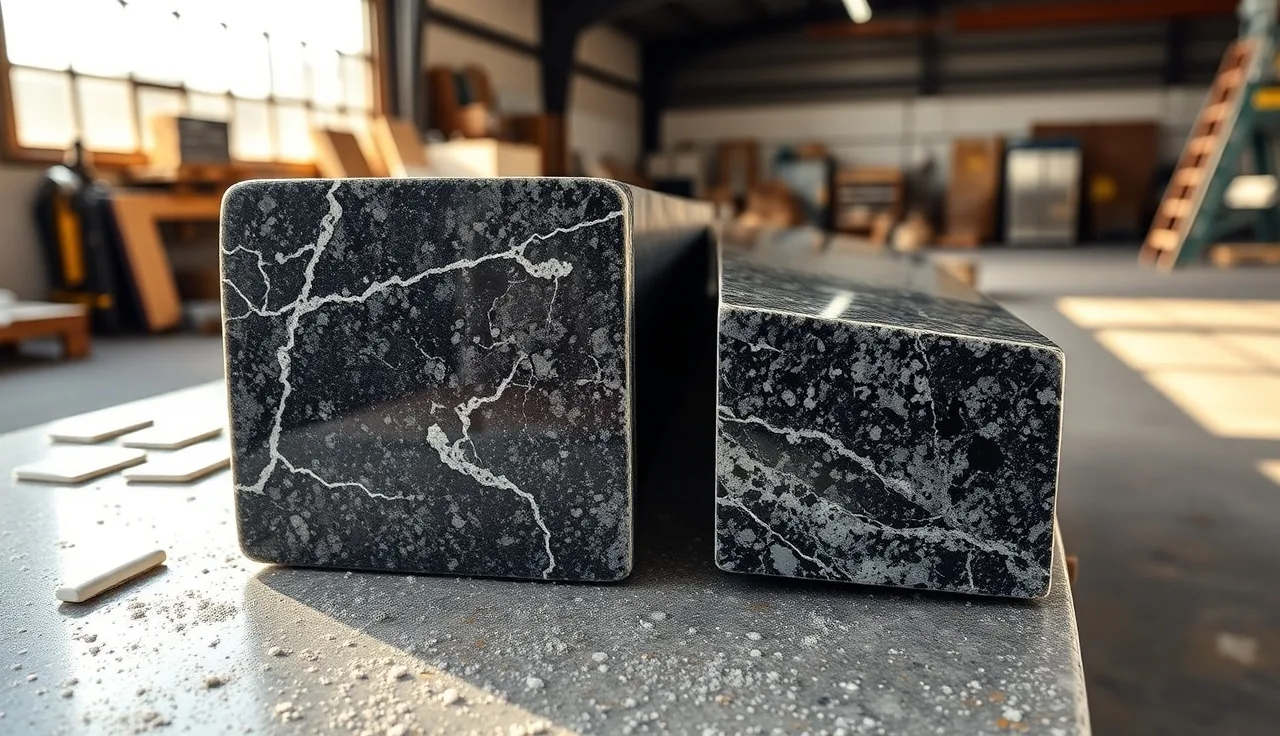
Side by side, the top surfaces look almost the same. The edge gives it away. A 3cm slab has an edge about 1-1/4 inches tall, which reads as heavy and solid in person. A 2cm slab with a simple eased edge looks thin, closer to a tile, which is exactly why most fabricators laminate the edge on 2cm work.
Laminating means gluing a strip of matching granite along the front edge so a 2cm slab presents like a 3cm or even 4cm one. It costs more, but the finished edge photographs and reads like a full-thick countertop. Run a finger along the underside and you can feel the seam. From above it disappears.
For kitchen countertops, the 3cm look is so expected that a laminated 2cm edge is often the only way to satisfy a contractor or a future buyer. Bathroom vanities are different. There, 2cm stays perfectly acceptable, and some designers reach for it because the thinner profile fits a narrower edge reveal.
Edge profiles bend perception too. A fat ogee or a mitered waterfall edge on a 3cm slab can read as 2 or even 3 inches at the face. That is all shaping of the same 3cm stone underneath.
Which thickness is right for a kitchen countertop?
Go with 3cm. Nearly every fabricator, designer, and remodeler who works stone every day will tell you the same. The reasons pile up fast.
A 3cm slab needs no plywood backer in most installs. That takes out a failure point, because plywood cups, swells with moisture, and goes uneven over the years. A 3cm slab also crosses unsupported openings, like a cooktop or sink cutout, with less cracking risk, because the extra thickness spreads load and stress. And the resale expectation in most US markets has landed on the heavier look. A listing with thin countertops often takes a hit in buyer perception even when the stone is identical.
The one honest case for 2cm in a kitchen is a fixed cabinet height where the countertop stacks on existing substrate and you cannot give up that extra 3/8 inch of vertical room. That is rare. The other case is pure budget on a surface nobody studies, like a laundry room counter.
For granite countertops in particular, 3cm dominates so completely that some suppliers have trimmed their 2cm inventory. If your supplier only stocks 2cm in the slab you love, factor that into where you buy.
How much does granite thickness affect cost?
Less than most people guess, at least on raw material. A 3cm slab uses roughly 50% more stone volume than a 2cm slab from the same block, but slabs sell by square foot of surface, not by volume. The quarry and processor absorb most of the difference. In practice, 3cm granite runs about $5 to $15 per square foot more than comparable 2cm material, though that swings hard by stone type, rarity, and supplier.
The real money moves in fabrication and install. A 2cm slab needs that plywood substrate, which adds roughly $3 to $6 per square foot in material and labor, plus the laminated edge if you want a thick look. Add it all up and 2cm often lands at the same price as 3cm, or higher, for a finished kitchen.
Bathroom vanities flip the math. Shorter runs mean less substrate, and edge lamination may not be needed at all. There, 2cm genuinely saves money.
Quoting software models these swings in seconds. Tools like SlabWise let a shop price substrate, edge lamination, and slab waste into the quote automatically, so a homeowner sees a real apples-to-apples comparison between thicknesses instead of a stack of guesses. A rough installed range for 3cm granite in a typical kitchen runs about $40 to $100 per square foot, depending on stone grade, edge work, and region [1].
Here is the short version: 2cm granite looks cheaper per square foot and often finishes more expensive once the plywood and lamination land on the invoice. The table below shows how the factors stack up.
| Factor | 2cm slab | 3cm slab |
|---|---|---|
| Raw slab cost (avg, per sq ft) | Lower by ~$5-15 | Baseline |
| Plywood substrate needed? | Yes (~$3-6/sq ft added) | Usually no |
| Edge lamination typical? | Yes, adds cost | No |
| Unsupported span performance | Weaker | Stronger |
| Weight per sq ft (approx) | ~12-13 lbs | ~18-19 lbs |
| Best application | Bathrooms, secondary surfaces | Kitchens, primary counters |
How much does granite countertop thickness affect weight?
Granite weighs roughly 160 to 165 pounds per cubic foot, depending on the mineral mix of the stone [2]. That comes out to about 12 to 13 pounds per square foot for a 2cm slab and 18 to 19 pounds per square foot for 3cm. A standard kitchen with 40 square feet of counter runs around 480 to 520 pounds of stone in 2cm, or 720 to 760 pounds in 3cm, before you count the cabinet structure underneath.
For standard cabinetry built to normal load specs, that difference is not a structural problem. It matters in a few spots: custom furniture pieces, RV and boat builds, wall-hung cabinets used as a display shelf, and older homes where a contractor already flagged the framing as marginal. In those cases, 2cm saves real pounds.
Weight also drives logistics. Installers handle 3cm slabs differently than 2cm ones. Thicker slabs are harder to carry, take more hands, and cost more to ship. Import a specialty stone from overseas or truck a slab to a remote site and thickness hits your freight bill directly.
Does granite thickness affect how the countertop holds up over time?
Yes, and the reason is plain physics. A thicker slab spreads stress across a bigger cross-section, so it cracks less easily from a point load, a hard impact, or thermal shock from a hot pan set straight on the stone. Sink and cooktop openings create stress concentration points, and a 3cm slab handles them better than a 2cm slab crossing the same gap.
Surface durability is a separate story. Hardness, porosity, and crystal structure drive staining, scratching, and wear far more than thickness does. A 2cm slab of dense, low-porosity granite resists stains better than a 3cm slab of a thirstier variety. Thickness is a structural trait. Surface toughness is a material trait. Do not mix them up.
For marble countertops and softer stones, the same thickness logic holds, but the surface story shifts, since marble etches from acids in ways granite shrugs off. Thickness buys you structural safety. Sealing and daily habits buy you surface protection. If you want the practical maintenance side, the guides on how to clean stone countertops and how to clean quartzite countertops cover it.
What edge profiles are available and how do they change perceived thickness?
Edge profiles get cut into the exposed front edge after fabrication. They never change the slab's actual thickness. They change what a person in your kitchen sees and touches.
On a 3cm slab, an eased edge (a slight softening of the top corner) shows the full 1-1/4-inch face. A bevel or bullnose shapes that same stone into a different line. A mitered edge goes further: two pieces get cut at 45 degrees and joined into a thick waterfall edge that can read as 2 to 3 inches tall from a standard 3cm slab. Mitered edges cost more in labor and waste more material, but the look is genuinely different.
On a 2cm slab with a laminated edge, fabricators match the strip to build a flat or shaped edge that presents as 3cm or 4cm. To anyone not hunting for the underside seam, it reads as solid.
Ogee, dupont, waterfall, and chiseled profiles all carry different labor rates, because each takes more passes on the CNC or the edge polisher. Your fabricator should hand you edge pricing next to slab pricing, since on a long perimeter a fancy profile can add $10 to $30 per linear foot.
For comparison, laminate countertops and Formica countertops also come in standard thicknesses (usually 1-1/2 inch over particleboard) and use post-formed edges to build their finished look. Same visual vocabulary, different material.
How does granite thickness compare to other countertop materials?
Knowing where granite sits against other materials helps you picture your kitchen if you mix surfaces or swap out an old counter.
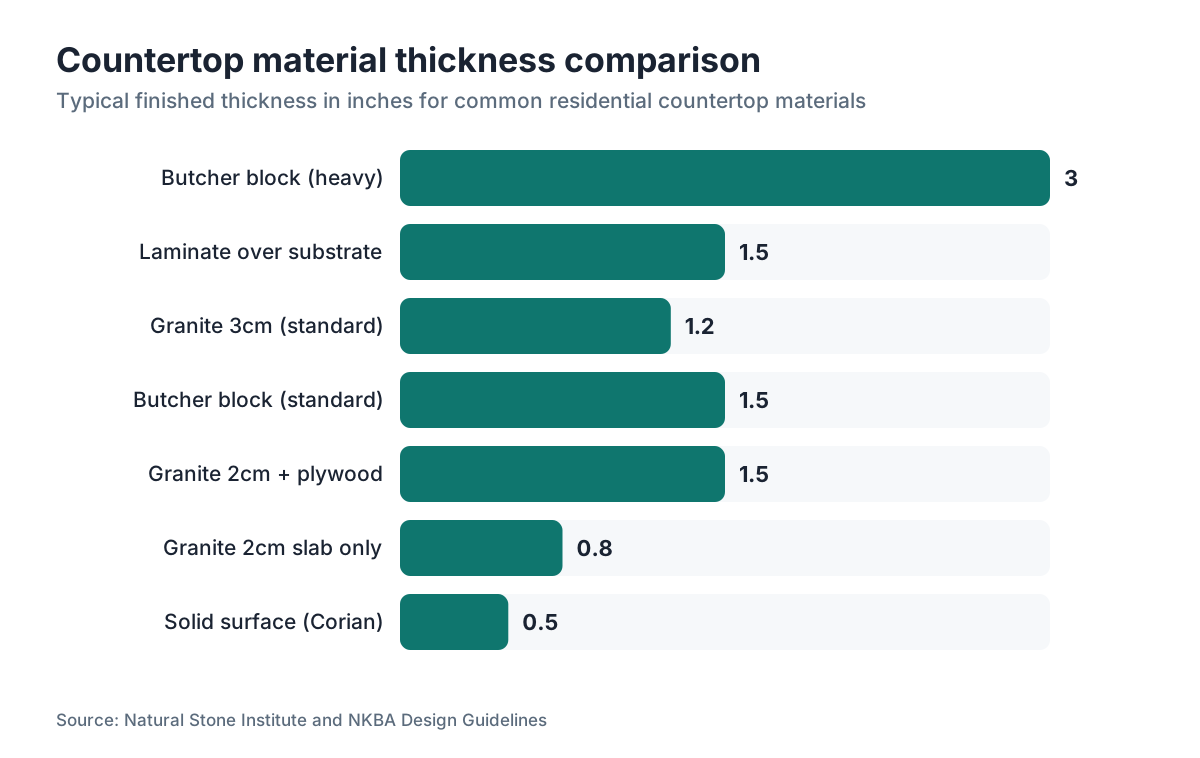
Laminate over particleboard or MDF usually runs 1-1/2 inches total, because the substrate has to carry a thin surface layer. Solid surface like Corian countertops is usually 1/2 inch. Engineered stone like Cambria countertops uses the same 2cm and 3cm sizing as natural granite, since it runs through similar processing gear. Butcher block countertops vary the most: 1-1/2 inch is common, but 2-inch and 3-inch versions exist for heavy-use tops.
Here is a swap worth watching. Replacing old laminate with granite changes counter height by about 1/4 inch, since a 1-1/2-inch laminate substrate gives way to a 3cm slab with no substrate. That quarter inch can affect appliance fit, dishwasher and range height especially, so check it before fabrication starts.
| Material | Typical thickness | Substrate needed? |
|---|---|---|
| Granite (standard) | 3cm (1-1/4") | Usually no |
| Granite (thin) | 2cm (3/4") | Yes (3/4" plywood) |
| Engineered stone (Cambria, etc.) | 2cm or 3cm | Same as granite |
| Laminate (Formica, etc.) | 1-1/2" total with substrate | Built-in |
| Solid surface (Corian) | 1/2" | Often yes |
| Butcher block | 1-1/2" to 3" | No |
| Marble | 2cm or 3cm | Same as granite |
What thickness should you specify for a bathroom vanity?
Bathroom vanities are where 2cm granite earns its keep. The runs are short, the spans over sinks are small, and the weight savings count more in wall-hung or furniture-style vanities. Plenty of designers spec 2cm for baths on purpose, because the thin profile fits the scale of the fixture.
Edge choice matters more here than in a kitchen, because you meet the edge at face height while you stand at the mirror. A simple eased or pencil edge on 2cm looks clean and deliberate. A heavy ogee looks out of scale.
Undermount sinks work with both thicknesses, but 3cm gives the installer more material at the cutout lip, which makes a cleaner undermount seam easier to hit. Got a large single undermount bowl? 3cm is the safer spec. A standard drop-in, or two small undermounts in a double vanity? 2cm is fine.
One more thing: granite is only one bath option. To weigh stone choices for wet rooms, the guide on how to clean soapstone countertops and the general countertop installation guide cover material selection where water is a constant.
How do fabricators measure and verify granite thickness?
At the slab yard, thickness gets checked with calipers at several points along the edge. Stone is a natural material, so even within one slab the thickness can vary by 2 to 4 millimeters from edge to edge, especially on hand-selected slabs that never ran through a modern calibrating machine [3].
Calibrated slabs are ones ground at the plant to bring variation inside a tight tolerance, usually plus or minus 1mm. Most commercial slabs imported today are calibrated. Uncalibrated or "natural-thickness" slabs show up more in premium exotics and in material from smaller quarries with less processing gear. Industry standards for dimension stone, including ANSI/NSI 373, define the allowable thickness tolerances for fabricated products [4].
Why care? A slab that varies by more than a few millimeters needs extra shimming at install, which adds time and risks an unlevel surface. Ask your fabricator or slab yard whether the material is calibrated. For nearly any residential job, calibrated stock is the better pick.
During templating, a good fabricator also checks the cabinet tops for level and marks the high and low points. The aim is a countertop that lands level no matter what the slab does below, done through careful shimming and adhesive bed thickness at install.
Where does SlabWise fit into the granite thickness decision?
Thickness runs through every line of a countertop quote: slab cost, substrate cost, edge cost, install labor. Quote by hand and it is easy to drop the plywood substrate line on a 2cm job, or misprice the edge lamination.
SlabWise is countertop fabrication software built for quoting and nesting. It lets a shop set pricing rules per thickness, so the right costs pull in the moment a job gets specified. The homeowner-facing quote then reflects the true cost of the chosen thickness without the fabricator having to remember every line by hand. If you run a shop and want a faster, more accurate quoting workflow, the demo is worth 20 minutes.
Homeowners, here is the practical move: get multiple quotes and make sure each one names the same thickness. A 2cm kitchen quote looks cheaper on paper and often is not once it is installed. Ask each shop to price the same thickness, the same edge profile, and the same substrate spec, so you are comparing the same project instead of three different ones.
Frequently asked questions
How thick are granite countertops in inches?
The two standard thicknesses are 3/4 inch (2cm) and 1-1/4 inch (3cm). The 3cm option is the modern default for kitchen countertops in North America. The 2cm option shows up mainly in bathroom vanities and some secondary surfaces. Both measurements come from how granite slabs are cut and sized at the processing plant.
Is 2cm or 3cm granite better for a kitchen?
3cm is better for most kitchens. It needs no plywood substrate, spans sink and cooktop cutouts more safely, and meets the visual expectation buyers hold for kitchens in North American markets. The 2cm option needs a substrate and edge lamination that often push its installed cost to the same as 3cm or higher.
What is the standard granite countertop thickness for bathrooms?
2cm (3/4 inch) is common and accepted for bathroom vanities. Shorter spans and smaller sink cutouts cut the structural advantage of 3cm, and the thinner profile fits bathroom scale. That said, 3cm still works fine in bathrooms and gives more material at the sink cutout for a cleaner undermount seam.
Can you get granite countertops thicker than 3cm?
Yes, but it takes special ordering or mitered construction. Some fabricators build a 4cm or 5cm look by mitering two pieces of 2cm or 3cm granite and joining them at the front edge. True solid slabs thicker than 3cm are uncommon in the residential market and require sourcing from a quarry that cuts at non-standard dimensions.
Does granite thickness affect sealing requirements?
No. Sealing frequency and sealer type depend on the stone's porosity, not its thickness. A dense, dark granite with low porosity may need sealing once every few years. A lighter, more porous granite may need it yearly. Thickness has nothing to do with how the surface absorbs liquids.
How heavy is a granite countertop by thickness?
Granite weighs roughly 160 to 165 pounds per cubic foot. That works out to about 12 to 13 pounds per square foot for 2cm slabs and 18 to 19 pounds per square foot for 3cm. A 40-square-foot kitchen in 3cm granite weighs roughly 720 to 760 pounds total, which sits within normal load capacity for standard kitchen cabinetry.
What is a laminated granite edge and does it change the thickness?
A laminated edge is a strip of matching granite glued to the front face of a 2cm slab to make it look as thick as 3cm or 4cm. It does not change the actual slab thickness. The seam shows on the underside but disappears from above. It adds labor and material cost, and it is the standard way to get a thicker visual edge on a 2cm install.
Do I need plywood under a granite countertop?
It depends on thickness. A 3cm slab usually needs no plywood substrate and rests straight on cabinet rails or a perimeter support. A 2cm slab generally needs a 3/4-inch plywood backer to prevent cracking, especially over sink and appliance cutouts. Always confirm the substrate spec with your fabricator before install begins.
How thick is a granite tile versus a granite slab countertop?
Granite tiles for countertops run about 3/8 inch (roughly 1cm) thick, about half the thinnest standard slab. They need a backer board or mortar bed and leave grout lines on the surface. Standard slabs in 2cm or 3cm have no grout lines and a continuous surface, which makes them more practical and more hygienic for kitchen use.
Can thin granite countertops crack more easily?
Yes, relatively. A 2cm slab has a smaller cross-section to resist bending stress, so it is more prone to cracking at unsupported spans like sink cutouts, or from a sharp impact. The risk is manageable with proper plywood substrate support, but 3cm is the more forgiving choice for cutout-heavy kitchen layouts.
Does granite thickness affect the price per square foot?
Somewhat. 3cm granite runs about $5 to $15 per square foot more in raw material than comparable 2cm, but 2cm usually needs a plywood substrate ($3 to $6 per square foot) and edge lamination. The total installed cost of a 2cm counter often lands close to or above 3cm once every factor is counted, especially in kitchens.
How do I know what thickness my existing granite countertop is?
Measure the edge with a ruler or calipers. An exposed edge near 3/4 inch means 2cm. Near 1-1/4 inch means 3cm. If the edge looks thicker, check for a laminated seam on the underside of the front edge. You can also shine a flashlight under the overhang to see whether a plywood layer sits beneath the stone.
Is there a building code requirement for granite countertop thickness?
No federal building code in the United States sets a required granite countertop thickness. Local codes govern cabinet structure and load capacity, not the countertop material. Thickness selection is an industry standard and a structural best-practice call, not a legal one. Some commercial projects carry specs that reference thickness, but residential installs do not.
Sources
- Consumer Reports, Kitchen Countertop Buying Guide: Installed granite countertop costs typically range from roughly $40 to $100 per square foot depending on stone grade, edge complexity, and region
- USGS, National Minerals Information Center: Dimension Stone: Granite density is approximately 160 to 165 pounds per cubic foot depending on mineral composition
- Natural Stone Institute (formerly Marble Institute of America), Natural Stone Specifications: Natural stone slab thickness can vary by several millimeters across a single slab; calibrated slabs are processed to tighter tolerances
- Natural Stone Institute, ANSI/NSI 373 Dimension Stone Standard: Industry standards for dimension stone define allowable thickness tolerances for fabricated stone products
- U.S. Census Bureau, American Housing Survey: Kitchen remodeling is one of the most common home improvement projects, with countertop replacement among the top components
- National Kitchen and Bath Association (NKBA), Design Guidelines: Standard countertop height is 36 inches from finished floor; countertop thickness affects final working surface height and must be coordinated with appliance specifications
- U.S. Department of Energy, Building Technologies Office: Countertop and appliance height coordination is a standard part of kitchen design; thickness changes can affect dishwasher and range fit
- Home Innovation Research Labs, Builder Practices Survey: Stone countertops including granite account for a large and growing share of kitchen countertop installations in new U.S. construction
- Natural Stone Institute, Care and Maintenance of Natural Stone: Sealing requirements for granite depend on porosity of the specific stone, not on slab thickness
Last updated 2026-07-09