TL;DR
- New countertops typically cost $15 to $200 per square foot installed, depending on the material.
- Laminate runs $15 to $40, granite $40 to $100, quartz $50 to $120, and marble $75 to $250.
- A typical kitchen with 30 to 40 square feet of surface lands between $1,500 and $5,000 for mid-range stone.
- Labor, edge profiles, and cutouts add 20 to 40% on top of the slab price.
What is the average cost of new countertops?
"Average" depends almost entirely on the material you pick. According to the U.S. Bureau of Labor Statistics Consumer Expenditure Survey, Americans spend a median of roughly $3,000 to $5,000 on a full kitchen countertop replacement, but that number hides a massive spread [1]. A laminate job in a small kitchen can land under $800. A book-matched quartzite kitchen in a big open-plan home can pass $20,000.
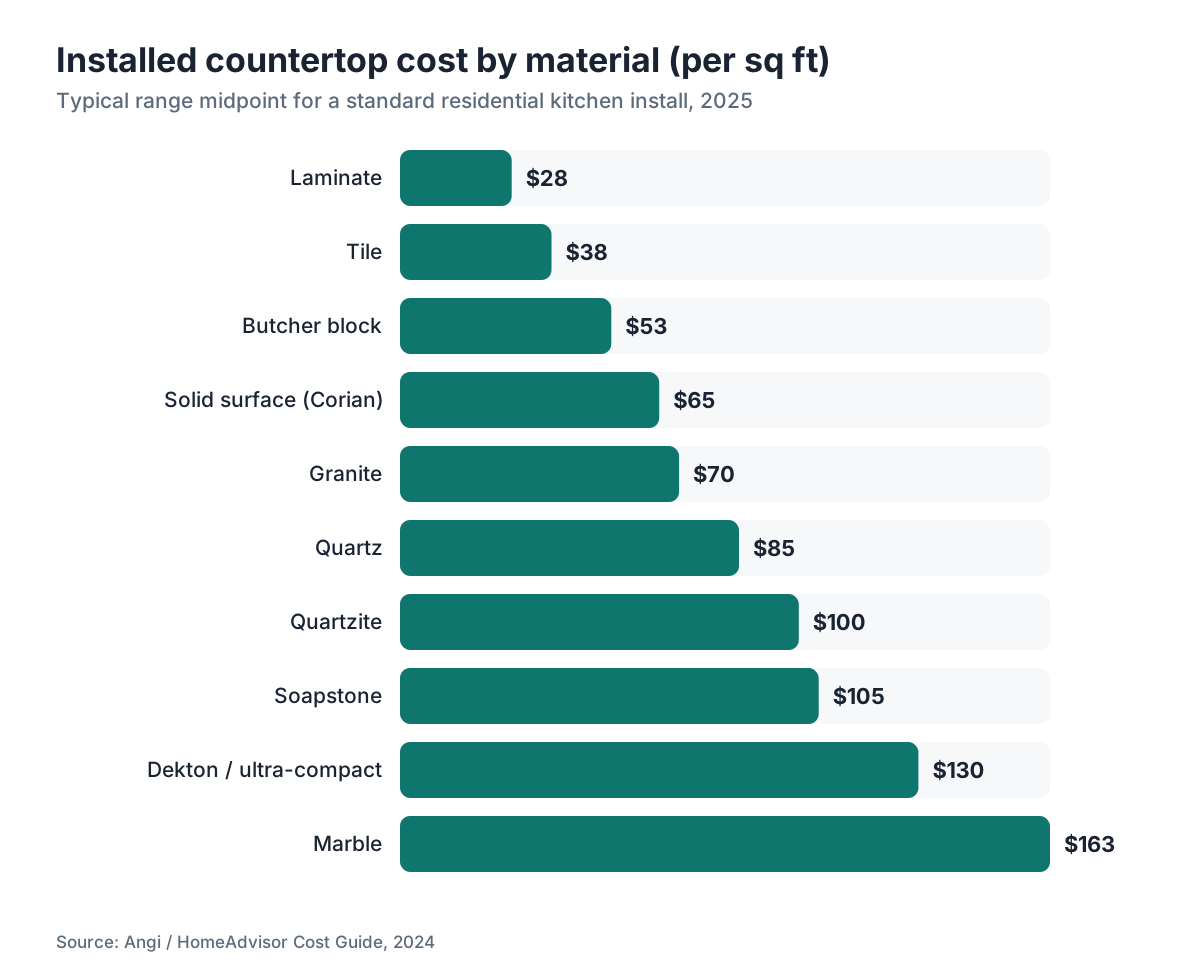
The number to anchor on is cost per installed square foot, because you can multiply it by your own kitchen size. Here is a realistic range for the most common materials in 2025:
| Material | Installed cost per sq ft | Typical 35 sq ft kitchen |
|---|---|---|
| Laminate / Formica | $15, $40 | $525, $1,400 |
| Butcher block | $35, $70 | $1,225, $2,450 |
| Tile (ceramic/porcelain) | $20, $55 | $700, $1,925 |
| Corian / solid surface | $45, $85 | $1,575, $2,975 |
| Granite | $40, $100 | $1,400, $3,500 |
| Quartz (engineered) | $50, $120 | $1,750, $4,200 |
| Quartzite (natural) | $65, $135 | $2,275, $4,725 |
| Marble | $75, $250 | $2,625, $8,750 |
| Dekton / ultra-compact | $80, $180 | $2,800, $6,300 |
| Soapstone | $70, $140 | $2,450, $4,900 |
These ranges come from fabricator pricing surveys and remodeling cost databases. They include material and basic installation but leave out demo, plumbing reconnection, and backsplash work [2]. Your number lands somewhere inside that range based on where you live, how complex the job is, and which slab tier you pick.
What factors make countertop prices go up or down?
Material is the biggest lever, but far from the only one. Here are the things that routinely move a quote by 15 to 50%.
Square footage. Obvious, but people consistently underestimate their surface area. Measure the full perimeter, add the island, and remember that fabricators measure to the wall rather than to the usable surface. Islands alone often add 10 to 15 square feet.
Slab tier within a material. Granite spans three commercial tiers. Level 1 (builder-grade, thin, common colors) might install for $40, $55 per square foot. Level 3 (exotic origins, dramatic veining, thicker cut) runs $90, $120 or more. Most showrooms label their tiers Level 1 through Level 3 or Group A through Group C, but the labeling is not standardized across the industry.
Thickness. Standard slab thickness is 3 cm (about 1.25 inches). Some materials still sell at 2 cm, which needs a laminated edge to look substantial and adds labor. Going thicker, say 4 cm or 5 cm, adds material weight and cost.
Edge profile. A basic eased edge is usually in the quote. A full bullnose, ogee, or waterfall mitered edge can add $15, $40 per linear foot of finished edge [3]. On a kitchen with 25 linear feet of exposed edge, that is a $375, $1,000 swing.
Cutouts. Every sink hole, cooktop cutout, or outlet pop-up takes CNC or hand-cutting time. Fabricators typically charge $150, $400 per cutout, depending on material and shape. An undermount sink with a tight radius in quartzite costs more than a simple drop-in hole in granite.
Location and labor market. A fabricator in San Francisco charges more per hour than one in rural Tennessee. The National Association of Home Builders tracks regional remodeling cost indices that show a 30 to 45% spread between the most and least expensive U.S. metros [4].
Demo and haul-away. Removing old countertops costs $5, $15 per square foot if the fabricator handles it, or $200, $600 as a flat fee. Some fabricators include it. Most do not.
Plumbing reconnection. With an undermount sink, a plumber disconnects and reconnects the drain and supply lines. Budget $150, $400 for that work, almost always a separate contract with a licensed plumber.
How much do new granite countertops cost?
Granite is still the most common natural stone in U.S. kitchens, and new granite countertops cost about $40 to $100 per square foot installed for the vast majority of slabs [2]. A standard 30 to 40 square foot kitchen runs roughly $1,500 to $3,500 all-in.
What pushes granite toward the top of that range? Exotic origins (Brazil, Norway, India) rather than domestic quarries, tight consistent veining that wastes more slab in layout, very dark or very light backgrounds that show every scratch, and polished finishes on complex edge profiles. What keeps it low? Domestic production, a simple edge, basic colors like Ubatuba black, or buying a remnant slab if your kitchen is small.
The average price for granite lands around $50, $70 per square foot in industry cost databases, but that midpoint reflects mid-tier slabs in medium-cost labor markets [2]. A granite countertop cost calculator (the kind built into estimating software or offered by fabricators on their sites) will ask for total square footage, number of cutouts, linear feet of finished edge, slab tier, and your ZIP code. Those inputs are enough to produce a range within 10 to 15% of the actual quote.
For a deeper look at granite, including how to pick a slab and what to expect at the yard, see our guide to granite countertops.
How much do new quartz countertops cost?
New quartz countertops run $50 to $120 per square foot installed, putting a typical 35-square-foot kitchen between $1,750 and $4,200 [2]. Quartz is engineered: crushed quartz bound with polymer resin. Price is more predictable than natural stone because there is no variation in slab yield.
Brand matters more with quartz than with granite. Caesarstone, Cambria, Silestone, and MSI all publish dealer price lists, and the installed cost reflects both the brand tier and the collection within a brand. Entry collections from major brands often land at $55, $75 installed. Premium collections with realistic vein movement or jumbo formats push $95, $130.
Cambria is made in the U.S. (Jordan, Minnesota) and positions itself as a premium product. Installed prices typically run $80, $130 per square foot [5]. You can read more about what drives Cambria pricing in our Cambria countertops guide.
One thing fabricators know that homeowners often miss: quartz is heavy and brittle at long spans. Very large islands or L-shapes may need extra support or seams that a natural stone layout might avoid. Ask about seam placement before you sign.
What does laminate or Formica countertop installation cost?
Laminate is the cheapest installed countertop option, typically $15 to $40 per square foot [2]. For a 35-square-foot kitchen that is $525 to $1,400 total, making it the one category where a full kitchen replacement can come in under $1,000 if you go with stock post-form countertops from a home center.
Custom laminate (fabricated to your exact dimensions, with a finished end cap and choice of pattern) costs more than post-form prefab, but still stays well below stone. Formica is a brand name that became generic shorthand for high-pressure laminate. The product itself is thin paper soaked in melamine resin, bonded to a particleboard substrate. It is not heat-proof or cut-proof. For a rental unit, a budget renovation, or a laundry room, it is hard to beat the value.
See our full breakdown of laminate countertops and Formica countertops if you want to go deep on pattern options and durability trade-offs.
How much does countertop installation cost beyond the material?
Labor is the part of the quote that surprises most homeowners. Fabricators bundle their cutting, polishing, and installation labor into the per-square-foot price, so it does not show as a separate line in most quotes. But it is real. Labor typically accounts for 30 to 50% of the total installed price for stone [6].
For a straightforward granite or quartz job, labor costs roughly $10, $35 per square foot depending on complexity. That covers templating (measuring the space precisely), CNC or hand fabrication, and the install crew. More complex jobs, like a kitchen with three separate countertop zones, a curved island, or a raised bar top, push labor higher because each piece needs separate handling and seam alignment.
Templating is sometimes a separate line item at $100, $200 for the trip, credited back if you proceed with the fabricator. Some shops now use digital laser templating, which cuts measurement error and can speed up the job by a day or two.
For a full breakdown of what happens during installation and what to look for, see our countertop installation guide.
How does kitchen size affect total countertop cost?
Most U.S. kitchens fall between 25 and 70 square feet of countertop surface. Small galley kitchens might have 20 to 25 square feet. A large open-plan kitchen with a big island can hit 60 to 80 square feet or more.
Here is how material cost scales with kitchen size at the midpoint price for each tier:
| Kitchen size | Laminate | Granite (mid) | Quartz (mid) | Marble (mid) |
|---|---|---|---|---|
| Small (25 sq ft) | $688 | $1,688 | $2,125 | $4,063 |
| Medium (35 sq ft) | $963 | $2,363 | $2,975 | $5,688 |
| Large (50 sq ft) | $1,375 | $3,375 | $4,250 | $8,125 |
| XL (70 sq ft) | $1,925 | $4,725 | $5,950 | $11,375 |
These numbers use the midpoint of each range from the first table and assume a standard install with one sink cutout and a basic edge. They are rough ballpark figures, not quotes.
One thing that does not scale linearly: cutouts and edges. You might have the same number of cutouts in a 25-square-foot kitchen as in a 70-square-foot one. Fixed costs (templating, cutouts, edge work) eat a bigger share of a small job, which is why fabricators sometimes set minimum job sizes or minimum charges.
Are there hidden costs in a countertop quote?
Yes. Most of the unpleasant surprises fall into a few predictable buckets.
Out-of-square walls. Kitchens are rarely perfectly square. When walls are off, the template takes longer and material waste goes up. Fabricators handle this at installation, but a badly out-of-square wall can add labor cost that was not in the original quote.
Unsupported spans. Building codes in most jurisdictions require support every 24 to 36 inches for stone countertops [7]. If your cabinets lack a full-depth top rail or the island design leaves a long unsupported overhang, the fabricator may add metal support brackets. Budget $50, $150 per bracket.
Seam location disputes. In a perfect world you would have no seams. In reality slabs are finite (typically 55 to 65 inches wide and 100 to 130 inches long), so L-shaped kitchens and long runs need seams. Where the fabricator places the seam affects waste, looks, and sometimes price. Get seam placement in writing before templating.
Material waste. Fabricators work with whole slabs. If your kitchen needs one-third of a slab, you paid for the whole slab. Most shops keep remnants or offer remnant credits, but not all. Understand the shop's remnant policy before you sign.
Tile or stone variability. With natural stone, the slab you see in the yard is the slab you get. Approve a slab and then ask for a different one, and you may pay a restocking fee. Visit the yard and mark your slab with tape before fabrication begins.
What is the cheapest way to replace countertops?
If budget is the main constraint, here is what actually saves money rather than just feeling frugal.
Laminate post-form countertops from a home center are genuinely the cheapest option, often under $30 per linear foot including installation if you buy from the store [2]. They look a lot better than they did 20 years ago. If you are renovating a rental or a room that does not need to impress anyone, this is what I would do.
Remnant slabs are the next best play. Fabricators pile up offcuts that work for small kitchens, bathrooms, or laundry rooms. A remnant piece of granite or quartz large enough for a standard bathroom vanity might cost $150, $400 for the material, with normal fabrication labor on top. Some shops post their remnant inventory online.
Butcher block is an underrated mid-range option. Installed cost is $35, $70 per square foot, and a confident DIYer can save the installation labor because wood countertops do not need stone-cutting equipment. The catch is ongoing maintenance: wood needs oiling, does not love standing water, and shows knife marks. Our butcher block countertops guide covers what that maintenance actually looks like in practice.
Corian and other solid-surface materials ($45, $85 installed) are worth a look if you want a smooth, jointless look without stone pricing. The material is repairable with sandpaper, which natural stone is not. See our Corian countertops overview for the trade-offs.
One more rule: do not over-renovate for the neighborhood. If comparable homes in your area sell with $50/sq ft granite, installing $110/sq ft quartzite is unlikely to return its cost at resale.
How do I get an accurate countertop quote?
The single biggest mistake homeowners make is asking for a quote without a measurement. Every number you get without a template is a guess, and most in-store estimates lean low because they assume a clean install.
To get a quote that will not blow up on you:
-
Measure your countertop footprint yourself first. Length times depth for each section, add them up. This is rough, but it tells you whether you are dealing with a 25-square-foot job or a 60-square-foot job.
-
Count your cutouts. Sink holes, cooktop cutouts, and outlet pop-ups each add cost. Know how many you have.
-
Walk a slab yard before committing to a fabricator. Prices vary by shop, and so does slab quality and selection. Choose your specific slab, more than a material category.
-
Get at least three quotes. The spread in the market is real: two fabricators quoting the same material and scope can be 20 to 35% apart [6]. Do not assume the lowest quote is the best or that the highest is the most honest.
-
Ask for the quote to be itemized: material cost per square foot, fabrication labor, installation labor, cutouts, edge profile, and any travel or delivery fee. A fabricator who refuses to itemize is hiding something.
Shops that use quoting software (like SlabWise) tend to produce faster, more consistent quotes because the pricing math is built in rather than done on a legal pad. If a fabricator takes more than a week to send you a quote, that is a workflow signal worth noting.
Once you have a quote you like, read the care requirements for your chosen material. Natural stones need sealing and have specific cleaning rules. Our guides on how to clean stone countertops and kitchen countertops are good starting points.
Do countertop costs vary by region?
Significantly. Labor costs in the countertop trade track closely with broader construction labor wages, which the Bureau of Labor Statistics Occupational Employment and Wage Statistics program tracks at the metro level [8]. The difference between the cheapest and most expensive U.S. metros for stone installation labor is 35 to 50%.
Material costs also vary geographically because of freight. Granite quarried in Georgia costs less to ship to a fabricator in Atlanta than to one in Seattle. Exotic Brazilian quartzite moves the opposite way: it comes in through East Coast ports and costs more in the interior of the country.
As a rough frame: if the national midpoint for installed granite is $60 per square foot, you might see $45, $50 in lower-cost Southern and Midwestern markets, and $70, $90 in the Bay Area, New York metro, or Seattle. Hawaii and Alaska add another 15 to 25% because of shipping.
The National Association of Home Builders publishes regional construction cost data annually that shows these labor differences. The 2024 data showed an average construction labor wage spread of roughly 42% between the lowest and highest cost regions in the U.S. [4]
Does replacing countertops add value to a home?
It depends on the baseline. The 2024 Cost vs. Value report published by Zonda (formerly Hanley Wood) found that a minor kitchen remodel, which includes countertop replacement, returns about 96% of its cost at resale on the national average, while a major upscale kitchen remodel returns only about 38% [9]. That gap is striking.
Here is the read: replacing worn, dated, or damaged countertops with a reasonable mid-range option recovers nearly all of its cost because it removes a negative factor for buyers. Upgrading from already-acceptable granite to premium marble in a mid-range neighborhood often does not recover the money because the comps do not support it.
Countertops alone rarely produce a dollar-for-dollar return on the premium portion of their cost. The value is in not losing buyers, not in commanding a higher price. If your current countertops are cracked, heavily stained, or laminate in a market where buyers expect stone, replacing them makes sense financially. If you are upgrading from decent granite to better granite purely for resale, the math rarely works.
If you are choosing a material partly for ease of long-term care, read up on specific options: marble countertops, how to clean quartzite countertops, and how to clean soapstone countertops all cover what ongoing maintenance actually costs in time and money.
How fabricators price countertop jobs (and what that means for your quote)
Understanding how fabricators build their prices helps you read a quote intelligently and ask the right questions.
Most shops price on a total-square-foot basis that bundles material cost plus a markup (typically 30 to 60% margin on material, depending on shop size and overhead) plus labor. The material portion reflects what they paid at the slab yard or from a distributor, plus freight and handling. A fabricator paying $12, $18 per square foot for a mid-grade granite slab will sell it to you at $28, $40 per square foot before labor, then add $12, $25 per square foot in labor, landing in that $40, $65 range you see quoted.
Bigger shops with automated CNC equipment can spread their machine costs over more jobs and often compete harder on price. Smaller shops that hand-fabricate may charge more but offer tighter tolerance work or more flexibility on unusual designs.
Fabrication software has changed how quotes come together. Tools that automate nesting (laying out pieces on a slab to minimize waste) help fabricators give more accurate quotes because they know actual yield before they commit to a price. SlabWise, for example, is built around this quoting and nesting workflow, which is why quotes from shops using it tend to have fewer surprises when the job actually runs.
For homeowners, the practical takeaway is this: a fabricator who measures before quoting, shows you the slab you will get, and hands you an itemized number is doing it right. One who quotes off the cuff, over the phone, without measurements, is guessing.
Frequently asked questions
How much do new countertops cost for an average kitchen?
A medium kitchen with 30 to 40 square feet of countertop surface typically costs $1,500, $3,500 for mid-grade granite, $1,750, $4,200 for quartz, or $525, $1,400 for laminate. All-in price depends on material, edge profile, number of cutouts, and your local labor market. Get at least three itemized quotes with actual measurements before committing.
What is the cheapest countertop material available?
Laminate (including Formica-style post-form tops) is the least expensive option at $15, $40 per square foot installed. Tile runs close at $20, $55 installed. Butcher block is the cheapest natural material at $35, $70 installed. These are real installed prices, not material-only costs from a home center.
How much does it cost to replace kitchen countertops with granite?
Granite countertop replacement costs $40, $100 per square foot installed for most residential slabs, putting a 35-square-foot kitchen between $1,400 and $3,500. Exotic or high-tier granite can push above $120 per square foot. The average cost for new granite countertops in the U.S. is roughly $50, $70 per square foot for a mid-grade slab in a mid-cost market.
Is quartz or granite more expensive?
Quartz tends to run slightly higher than comparable-grade granite: $50, $120 installed for quartz vs. $40, $100 for granite. The ranges overlap a lot in the middle. Premium exotic granite can exceed premium quartz. Quartz offers more price predictability because it is engineered to spec; granite pricing varies more because every slab is unique.
How do I calculate how many square feet of countertop I need?
Measure each countertop section: length in inches times depth in inches, then divide by 144 to get square feet. Add all sections including the island. Most kitchens run 25 to 50 square feet of countertop. Fabricators add a waste factor (typically 10 to 15%) for cuts and matching, so your quote may be based on slightly more square footage than your measured surface.
What does a countertop edge profile cost?
A basic eased or beveled edge is usually included in the quote at no extra charge. Decorative profiles like full bullnose, ogee, dupont, or waterfall typically add $15, $40 per linear foot of finished edge. On a kitchen with 20 to 25 linear feet of exposed edge, a premium profile can add $300, $1,000 to the total job cost.
How much does a sink cutout add to the countertop cost?
Most fabricators charge $150, $400 per cutout for undermount sinks, depending on the material and shape. Simple rectangular holes in softer materials are less. Tight-radius undermount cuts in hard stone like quartzite are more. Drop-in sink holes are generally on the low end of that range because they do not require a polished edge inside the cutout.
Can I install countertops myself to save money?
Laminate post-form countertops from home centers are genuinely DIY-friendly; installation is within reach of someone comfortable with a jigsaw and basic carpentry. Natural stone and engineered quartz require specialized cutting equipment, seam grinding, and adhesive technique. Attempting to install stone yourself usually ends in cracked material or visible seams. The DIY savings on stone rarely justify the risk.
How long does countertop installation take?
Templating takes 1 to 2 hours for a standard kitchen. Fabrication takes 3 to 7 business days after templating, sometimes longer for complex jobs or busy shops. Installation takes 2 to 6 hours for most kitchens. You will typically be without your sink for 24 to 48 hours while adhesive cures. Budget 7 to 14 days from template to completed install for most shops.
Do I need to seal granite or quartz countertops?
Granite is porous and needs sealing at installation, then re-sealing every 1 to 3 years depending on the stone and use. A basic penetrating sealer costs $20, $50 per bottle at retail. Quartz is non-porous and does not need sealing. Marble and quartzite need sealing similarly to granite. Soapstone does not seal; it is treated with mineral oil to darken evenly.
What is the average cost of new quartz countertops from major brands?
Entry-level collections from brands like Caesarstone, MSI, or Silestone typically install at $55, $80 per square foot. Premium collections from those same brands, plus Cambria and high-end Dekton, run $90, $130 installed. Cambria, which is U.S.-manufactured, tends to land at $80, $130 per square foot installed. Always ask whether the quoted price includes the full install or only the material.
How much does countertop removal and disposal cost?
Removing existing countertops typically adds $5, $15 per square foot to the project, or $200, $600 as a flat haul-away fee, when handled by the fabricator. Some fabricators include demo in their quote; most do not. If you remove the old tops yourself (manageable with laminate, harder with stone), you save that labor but still need to arrange disposal, which may cost $50, $150 at a transfer station.
Are countertop costs tax-deductible?
In most cases, no. Countertop replacement in a primary residence is not deductible as a current expense for federal income tax purposes. It may be added to your home's cost basis, which reduces taxable gain when you sell. In a rental property, countertop replacement may be depreciable as a capital improvement. Check with a tax professional; IRS Publication 530 covers home improvement basis rules.
What is the most durable countertop material for the money?
Quartz engineered stone is probably the best durability-per-dollar for most kitchens: it resists staining, does not need sealing, and holds up well to daily use. Granite is close and costs slightly less. Soapstone and quartzite are both very hard and long-lasting but cost more and need more care. Laminate wears out in 10 to 20 years with heavy use; stone and quartz last 30 years or more with normal care.
Sources
- U.S. Bureau of Labor Statistics, Consumer Expenditure Survey: Median household spending on kitchen remodeling including countertops context for average costs
- HomeAdvisor (Angi), Countertop Installation Cost Guide 2024: Installed cost per square foot ranges for laminate, granite, quartz, marble, and other countertop materials
- Natural Stone Institute, Countertop Edge Profile Pricing: Edge profile upcharges of $15, $40 per linear foot for decorative profiles on natural stone
- National Association of Home Builders, Construction Cost Survey 2024: Regional construction labor wage spread of approximately 42% between lowest and highest cost U.S. regions; 30 to 45% metro spread in remodeling cost indices
- Cambria, Official Dealer Pricing Information: Cambria quartz is manufactured in Jordan, Minnesota; installed prices typically $80, $130 per square foot
- National Kitchen and Bath Association (NKBA), 2023 Design and Industry Report: Labor accounts for 30 to 50% of total installed stone countertop cost; quotes for the same scope can vary 20 to 35% between fabricators
- International Code Council, International Residential Code (IRC): Building codes require support every 24 to 36 inches for heavy countertop materials in residential construction
- U.S. Bureau of Labor Statistics, Occupational Employment and Wage Statistics (OEWS): Metro-level wage data for construction and stone fabrication trades showing 35 to 50% spread between cheapest and most expensive U.S. metros
- Zonda (formerly Hanley Wood), 2024 Cost vs. Value Report: Minor kitchen remodel returns about 96% of cost at resale nationally; major upscale kitchen remodel returns about 38%
- IRS Publication 530, Tax Information for Homeowners: Home improvements including countertops may be added to cost basis but are not currently deductible for a primary residence
- U.S. Geological Survey, National Minerals Information Center: U.S. dimension stone production and import data underpinning regional granite and marble pricing differentials
Last updated 2026-07-09