TL;DR
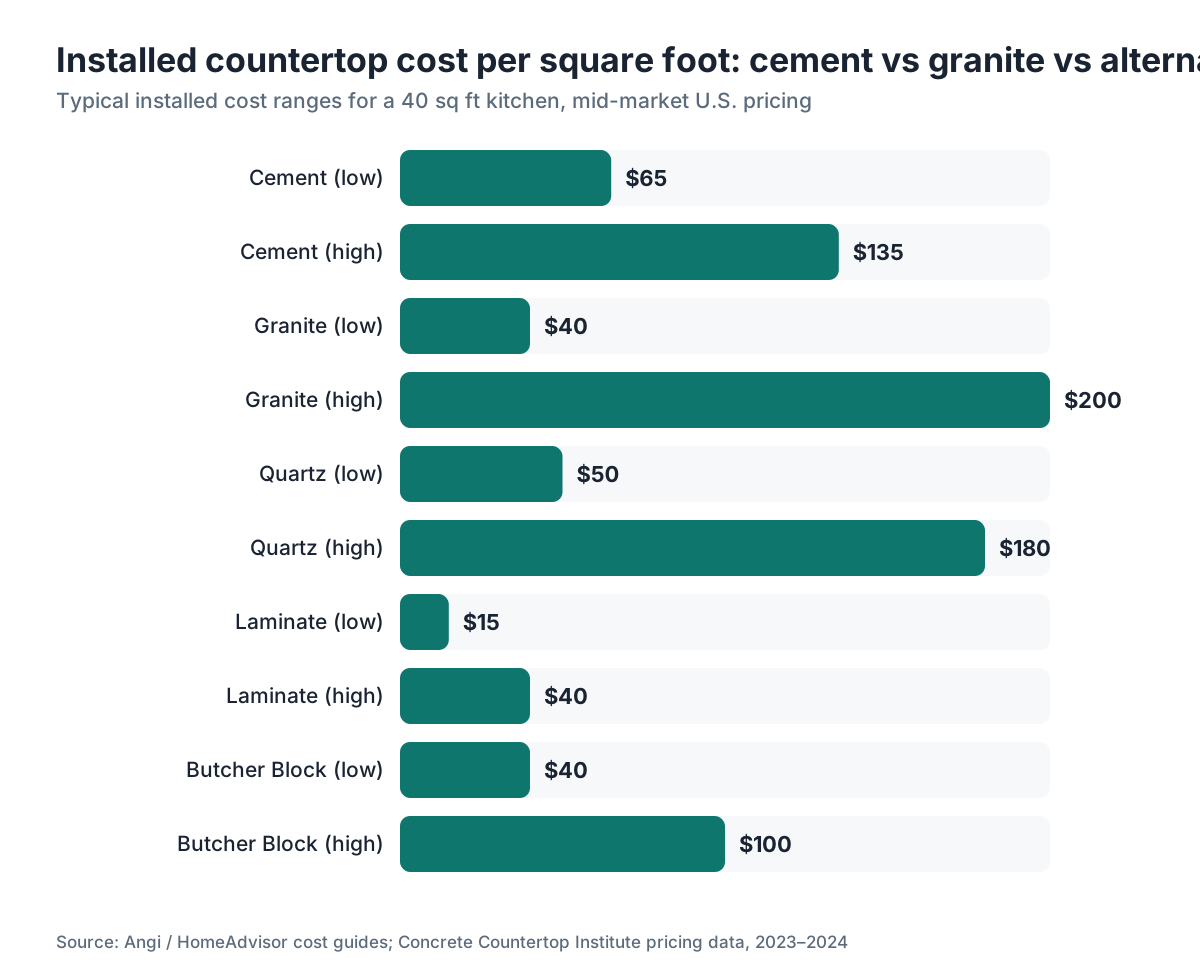
- Cement countertops typically cost $65, $135 per square foot installed, depending heavily on local labor and complexity.
- Granite runs $40, $200 per square foot installed, with the wide range driven by slab grade and fabrication.
- On a typical 40-square-foot kitchen, cement usually costs more than mid-grade granite once you factor in sealing, curing time, and the specialized labor cement demands.
What does each material actually cost per square foot?
Let's put the numbers on the table first.
Cement countertops land between $65 and $135 per square foot installed, with most homeowners paying somewhere in the $85, $110 range for a reasonably complex kitchen [1]. That spread is wide because cement is almost entirely a labor product. The raw materials (Portland cement, sand, pigment, fiber reinforcement) cost maybe $8, $15 per square foot. Everything else is the fabricator's time, skill, and overhead.
Granite runs $40, $200 per square foot installed [2]. Entry-level granite (think uniform gray or black slabs from high-volume importers) sits at $40, $60 installed. Mid-grade granite with visible movement and color variation runs $75, $120. Premium exotics like Blue Bahia or Van Gogh granite can push past $200. The slab itself might be 40 to 60% of the total cost; granite countertop fabrication cost accounts for the rest, covering cutting, edge profiling, sink cutouts, and installation.
On a standard kitchen with 40 square feet of countertop:
| Material | Low estimate | Mid estimate | High estimate |
|---|---|---|---|
| Cement (installed) | $2,600 | $3,800 | $5,400 |
| Granite (installed) | $1,600 | $3,600 | $8,000+ |
| Quartz (installed, for reference) | $2,000 | $4,200 | $7,200 |
The overlap is real. A mid-grade cement job and a mid-grade granite job cost similar money. Where they diverge: budget granite is far cheaper than budget cement, and premium granite can exceed premium cement if you choose an exotic slab.
Why does cement cost so much given cheap raw materials?
This is the question most homeowners ask when they see the price. Portland cement is not expensive. A 94-pound bag costs roughly $12, $18 at a building supply house [3]. The pigments, sand, perlite or glass fiber reinforcement, and polymer admixtures might add another $30, $80 in materials per countertop. So why the $85/sq ft bill?
Skill. Cement countertops are cast, cured, ground, and sealed by hand. There is no CNC machine cutting a slab to spec. The fabricator builds a form, mixes and pours the concrete (or GFRC, glass fiber reinforced concrete, which is the industry's preferred method for thinner, lighter panels), then waits 24 to 72 hours for initial cure before demolding. After demolding comes grinding, filling pinholes, sealing, and buffing. A good fabricator easily has 12 to 20 labor hours in a single kitchen [1].
GFRC panels, the lighter alternative to cast-in-place or precast solid concrete, cut the weight problem (solid concrete runs 18 to 20 lbs/sq ft; GFRC drops to 8 to 12 lbs/sq ft) but require spray equipment and even more specialized technique [4].
Few fabricators do this well. That scarcity drives price. In a mid-sized metro, you might find 3 to 5 shops that do quality concrete work versus 30 to 50 that fab granite. Less competition, higher rates.
What drives granite countertop fabrication cost?
Granite pricing has three moving parts: slab cost, fabrication, and installation.
Slab cost depends on origin, rarity, and thickness. Most residential granite comes in 2 cm (about 3/4 inch) or 3 cm (about 1-1/4 inch) thickness. Three-centimeter slabs are the current standard because they don't need a plywood substrate and hold up better around sinks. A 3 cm slab in a common color like Uba Tuba or Santa Cecilia might run $40, $60 per square foot at the slab yard. A 3 cm slab of Van Gogh or Blue Bahia can be $150, $300 per square foot before anyone touches a saw [2].
Fabrication adds $35, $75 per square foot for a typical job. That covers the bridge saw or waterjet cut, CNC edge profiling, sink cutout (usually $150, $350 extra per sink), seam work, and polish. Fabricators running efficient shops with modern equipment and good quoting software (software like SlabWise helps shops estimate material yield and avoid costly offcuts) can sharpen their margins without racing to the bottom on price.
Installation adds $10, $30 per square foot depending on access, number of seams, and whether the substrate needs work. Island installations with corbels and waterfall edges cost more than a simple L-shape.
Edge profiles matter more than most homeowners realize. A standard eased edge is usually included. An ogee or full bullnose on 3 cm granite can add $15, $30 per linear foot. On a kitchen with 20 linear feet of exposed edge, that's $300, $600 just for the profile upgrade.
For a detailed look at what granite fabrication involves, see our guide to granite countertops.
How does the cost of cement countertops vs granite change by project type?
The comparison shifts depending on what you're building.
Small bathrooms and powder rooms (8 to 15 sq ft): Cement starts to look more competitive here because the per-piece setup cost is spread over fewer square feet, but so does granite. Expect both to run higher per-square-foot on tiny projects. A bathroom vanity in cement might be $900, $1,500; in granite, $600, $1,800 depending on grade.
Standard kitchen (35 to 55 sq ft): This is where the numbers in the table above apply. Mid-grade granite usually beats mid-grade cement by $300, $800 total if you're flexible on the slab choice. Cement wins on uniqueness and custom color-matching.
Large kitchen or commercial bar (80+ sq ft): Cement labor costs scale almost linearly with square footage. Granite slab yield gets more efficient on large jobs because a fabricator wastes proportionally less material. Large granite jobs often come in cheaper per square foot than small ones. Large cement jobs do not get that break.
Outdoor kitchens: Cement holds up better outdoors than polished granite, which can turn slippery when wet and may take more thermal stress. Cement is breathable and handles freeze-thaw cycles reasonably well if sealed correctly [1]. This is one scenario where paying the cement premium makes functional sense, more than aesthetic sense.
Custom islands with integrated sinks or drain boards: Cement is unbeatable here. A cast-in-place drain board is formed right into the concrete. Granite requires a separate cutting board insert or accepts water pooling. If you want an integrated concrete sink, expect to add $500, $1,500 to the concrete job.
What are the long-term costs of owning each material?
Purchase price is only part of the story. Both cement and granite need maintenance, and cement needs a lot more.
Sealing is the biggest ongoing cost for cement. A quality penetrating sealer plus a topcoat (wax, acrylate, or an epoxy finish) applied at installation is not the end. Most fabricators recommend resealing cement every 1 to 3 years depending on use and the sealer system [1]. A professional reseal runs $100, $300 for a typical kitchen. If you DIY with a product like Z Counterform's Z-Seal or Buddy Rhodes Cement Countertop Sealer (both real products, though prices change, so verify current pricing), materials cost $30, $80 per application.
Granite sealing is simpler. Most granite benefits from a penetrating impregnator sealer once a year, or once every 3 to 5 years for dense, low-porosity granites. The Natural Stone Institute treats sealer maintenance on granite as a homeowner task, not a professional service call [5]. A bottle of granite sealer runs $15, $40.
Cracking is cement's chronic risk. Concrete cracks. Full stop. Control joints help. Fiber reinforcement helps. Good mix design helps. But a cement countertop installed without proper reinforcement and curing can develop hairline cracks within months. Repairs are possible but visible if the pigment doesn't match perfectly. Granite doesn't crack under normal household conditions; it can chip at the edge if struck hard, and edge chip repair costs $75, $200 per chip.
Staining: Cement is more porous than most granite and will stain from oil, wine, and citrus if the sealer fails. Granite's porosity varies widely by stone (some granites are nearly impervious; others absorb water readily), but it's generally more forgiving than cement.
For comparison, see how other natural stones stack up in our guide to kitchen countertops.
Is cement or granite harder to install, and does that affect price?
Yes, and the installation method is fundamentally different between the two.
Granite arrives at your home as a finished slab (or pre-cut pieces) from the fabrication shop. The installer places it on cabinets, applies silicone adhesive, makes seams, and connects the plumbing. A standard kitchen takes 2 to 4 hours with a two-person crew. It is heavy, typically 18 to 20 lbs per square foot for 3 cm, but the process is well understood [5].
Cement can be cast in place (poured directly on the cabinets, which is rare because of the mess and curing time on-site), precast in the shop and delivered as finished panels, or cast as GFRC panels. Precast solid concrete is brutally heavy, sometimes requiring structural reinforcement of the cabinets. GFRC panels are lighter and the industry trend, but they still need careful seam work and multiple topcoat applications after installation.
The installation timeline for cement is measured in days, not hours. Even precast panels need topcoat finishing after seams are set. Many fabricators schedule a return visit 24 to 48 hours post-install to do final sealing and buffing. That second trip is either baked into the quote or appears as a surprise line item. Ask explicitly.
Contractor willingness matters too. Many general contractors and kitchen remodelers have no experience with cement and will refuse to coordinate it or will add a premium for the coordination hassle. Granite installation is a commodity service in most markets.
How do cement countertops compare to granite on resale value?
This is where honest uncertainty is required, because nobody has clean apples-to-apples data on this.
The National Association of Realtors' 2023 Remodeling Impact Report [6] covers kitchen remodels broadly but doesn't break out countertop material by type. The report does show that a complete kitchen upgrade recoups roughly 67 cents on the dollar at resale, on average. Whether granite or cement gets you more of that 67% is genuinely unclear.
What we do know from appraiser guidance and real estate forums: granite is a known commodity that buyers recognize and value. "Granite countertops" is a literal bullet point in MLS listings and shows up constantly in real estate marketing because buyers read it as a signal of quality. Cement countertops are polarizing. Some buyers love the artisan look; others see maintenance risk and walk.
If resale value is a meaningful factor in your decision, granite is the safer bet. If you're staying in the home for 10+ years, personal preference and functional fit matter more than resale optics.
Premium granite from a recognized origin (Brazilian quartzites like Taj Mahal, certain Indian granites) may add more measurable value than cement simply because it's identifiable and appraiser-friendly.
Can you save money by doing cement countertops yourself?
Technically yes. Practically, it depends on your skill level and tolerance for a bad outcome.
DIY cement countertop kits exist. Buddy Rhodes, Z Counterform, and Cheng Concrete (all real brands) sell form systems, mix additives, and pigments aimed at DIYers. Materials for a 40-square-foot kitchen might run $400, $800, which is a big savings versus $3,800 in professional installation [11].
But the failure modes are real. Improper mix water ratio leads to weak, porous concrete. Inadequate vibration leaves bug holes (pinholes) that look bad and resist easy repair. Poor sealing leads to staining within weeks. And if you cast in place, you've committed to something that cannot be easily removed if it goes wrong.
The learning curve is steep. Most experienced cement countertop fabricators made bad countertops before they made good ones. If you go DIY, start on a test piece, not your kitchen.
DIY granite is not a realistic option. Granite slabs weigh hundreds of pounds, require a bridge saw or angle grinder for cuts (angle grinder results are rough at best), and seams done by hand look like seams done by hand. Fabricators train for years on granite work. This is one to leave to professionals.
For a sense of what professional countertop installation involves, that breakdown is worth reading before you decide to DIY either material.
How do you get an accurate quote for either material?
Getting a real number requires more than a phone call with square footage.
For granite, a reputable fabricator will want to template your kitchen (measure precisely using a digital templating arm or laser tool) before giving a final price. Some give rough estimates over the phone; treat those as ballparks. The final price depends on your actual square footage, waste factor (how efficiently your layout cuts from a standard slab), edge linear footage, number of cutouts, and the specific slab you choose from their yard.
Ask fabricators:
- What's included in the per-square-foot price (edge profile, cutouts, installation)?
- How do you handle seams, and where will they land?
- What is the lead time from template to install?
- What stone grades are represented in your price tiers?
For cement, quotes require even more information: color direction, finish (polished, matte, acid-washed), embedded elements (aggregate, glass), edge profile, and whether you want an integrated sink or drain board. A cement fabricator who quotes without this information is guessing.
Get three quotes for either material. The lowest quote is not always the best value; ask what's excluded. For a granite countertops job especially, the slab itself is a one-time selection, and you'll live with that stone for decades.
Fabricators running modern quoting software can produce itemized, accurate quotes faster and with less back-and-forth. That helps you as a homeowner because you get a real number sooner and can compare apples to apples across shops.
Are there cheaper alternatives worth considering?
If the cement vs granite decision comes down to budget, a few alternatives are worth a look.
Laminate countertops have come a long way. Modern laminate (Formica, Wilsonart, and similar) runs $15, $40 per square foot installed and now comes in convincing stone looks. The edges give it away up close, but for a rental, a guest bath, or a home where durability and budget matter more than stone authenticity, laminate is rational. See also our Formica countertops guide.
Butcher block countertops run $40, $100 per square foot installed and offer warmth that neither cement nor granite delivers. Maintenance is real (oiling, sanding scratches), but many homeowners prefer the feel and repairability.
Corian countertops and similar solid surface materials run $65, $125 per square foot installed. They come without visible seams, repair easily, and feel warmer to the touch than stone. They scratch more easily than granite, but the scratches sand out.
Quartz (engineered stone like Cambria countertops) sits at $75, $150 per square foot installed and is the dominant premium alternative to granite right now. It's non-porous, consistent, and easier to maintain than either granite or cement.
The honest answer: cement is a specialty product that costs what it costs because of labor intensity. If you love the look and want custom color and form, pay for it. If you're trying to approximate the look on a tighter budget, a high-quality laminate or quartz will serve you better than a cement job done cheaply.
Frequently asked questions
Is cement cheaper than granite for countertops?
Usually no. Budget granite ($40, $60/sq ft installed) is nearly always cheaper than any quality cement work ($65, $135/sq ft installed). Mid-grade and premium granite overlaps heavily with cement pricing. Where cement might beat granite on cost is in highly exotic slab granite above $150/sq ft, which is rare. For most kitchen projects, granite is the more affordable choice unless you're comparing budget granite to luxury granite.
How long do cement countertops last compared to granite?
Granite lasts indefinitely with basic care; there are quarried stone countertops in use after 50+ years. Cement can also last decades, but it depends almost entirely on sealer maintenance and whether the concrete was properly reinforced and cured. A neglected cement countertop can show stains, cracks, and surface deterioration within 5 to 10 years. A well-maintained one holds up for 20 to 30 years. Granite is a lot more forgiving of owner neglect.
Do cement countertops stain more than granite?
Yes, generally. Cement is porous and will absorb oil, wine, citrus juice, and other liquids if the sealer fails or wears through. Granite varies widely in porosity by stone type, but most granites are less porous than cement and more tolerant of sealer lapses. Both materials benefit from a penetrating impregnator sealer, but cement needs more frequent attention and a topcoat system that granite doesn't.
What is GFRC and does it cost less than solid concrete countertops?
GFRC stands for glass fiber reinforced concrete. It uses a spray or cast method to create a shell of fiber-reinforced concrete, typically 3/4 inch thick, rather than a solid pour. It weighs 8 to 12 lbs/sq ft versus 18 to 20 lbs/sq ft for solid concrete. GFRC is now the preferred method among professional cement countertop fabricators. It doesn't cost much less than solid precast because the labor is similar, but it reduces structural demands on your cabinets.
How much does a granite countertop fabrication and installation typically add to the slab price?
Fabrication and installation together add roughly $35, $75 per square foot to the slab cost in most markets. A sink cutout adds $150, $350. Edge profile upgrades (ogee, full bullnose) add $15, $30 per linear foot above the base eased edge. On a 40-square-foot kitchen, fabrication and install might total $1,400, $3,000 on top of whatever you paid for the slab itself.
Can cement countertops be repaired if they crack or stain?
Cracks can be filled with a matching cement slurry or epoxy filler, but color matching is imperfect and repairs are usually visible up close. Surface stains can sometimes be removed by stripping the sealer and using a poultice (baking soda and hydrogen peroxide for organic stains, acetone for oil), then resealing. Deep stains that have penetrated the concrete body are very hard to remove and may require grinding the surface, which changes the finish.
Is cement or granite better for outdoor kitchens?
Cement handles outdoor conditions well if sealed correctly; it's breathable and manages freeze-thaw cycles reasonably in most climates. Polished granite can turn slippery when wet and may take more thermal stress outdoors. Flamed or brushed granite finishes perform better outdoors than polished. For most outdoor kitchen projects, cement is the more functional choice, though the higher labor cost applies just as much outdoors as indoors.
Does granite add more resale value than cement countertops?
Granite is the safer choice for resale. It's a recognized feature in real estate marketing and buyer expectations, and appraisers treat it as a standard upgrade. Cement countertops are polarizing: some buyers see artisan craftsmanship, others see maintenance risk. The NAR's 2023 Remodeling Impact Report shows kitchen upgrades recoup roughly 67 cents on the dollar at resale, but there's no granular data separating cement from granite outcomes specifically.
How do I find a good cement countertop fabricator?
Ask to see a portfolio of finished kitchens, more than staged photos. Request references from clients 2 to 3 years after install so you can ask about cracking and sealer performance. Ask specifically whether they use GFRC or solid precast and why. Verify that they apply a commercial-grade sealer system, more than a penetrating sealer alone. Concrete countertop fabricators are much rarer than granite shops, so expect to wait 4 to 8 weeks for a quality shop.
What edge profiles are available for cement countertops vs granite?
Cement can be formed into almost any edge shape, including organic curves, built-in drain boards, and custom relief patterns. Granite edges are CNC-machined and limited to profiles the shop programs: eased, beveled, bullnose, ogee, dupont, waterfall. Granite edges are precise and consistent; cement edges have a hand-crafted variation that some find appealing and others find uneven. Custom cement edge work typically adds $20, $50 per linear foot to the base price.
How thick are cement countertops compared to granite?
Standard granite for residential use is 3 cm (about 1-1/4 inch) thick. Cement countertops vary: solid precast is often 1.5 to 2 inches thick for structural integrity. GFRC panels are typically 3/4 inch thick with a backing layer. The visual edge thickness can be built up with a mitered cement strip to mimic any thickness you want, which is one of cement's aesthetic advantages over natural stone.
Are there health or food safety concerns with cement countertops?
Portland cement itself is non-toxic once fully cured and sealed [8]. The primary concern is the sealer, not the concrete. Some topcoat sealers (certain polyurethane or epoxy systems) are not rated for direct food contact. A penetrating impregnator sealer beneath a food-safe wax or a specifically food-safe topcoat addresses this. Ask your fabricator which sealer system they use and whether it has NSF or FDA food-contact clearance for the specific product.
How long does it take to install granite versus cement countertops?
Granite installation typically takes 2 to 4 hours for a standard kitchen with a two-person crew, following a 1 to 2 week fabrication lead time after templating. Cement involves a longer production window (3 to 7 days in the shop for cure), a half-day to full day for installation, and often a return visit 24 to 48 hours later for final sealing and buffing. From first contact to usable countertop, cement typically runs 3 to 5 weeks; granite runs 1 to 3 weeks.
Sources
- Concrete Countertop Institute, 'Pricing Concrete Countertops': Cement countertops run $65, $135 per square foot installed; a typical kitchen requires 12 to 20 fabricator labor hours; outdoor and sealing performance guidance.
- HomeAdvisor / Angi, 'How Much Do Granite Countertops Cost?': Granite countertops cost $40, $200 per square foot installed depending on slab grade and region.
- Quikrete, Portland Cement product data: Portland cement (94 lb bag) retail price range of roughly $12, $18 at building supply outlets.
- Concrete Countertop Institute, 'GFRC Countertops Overview': GFRC panels weigh 8 to 12 lbs/sq ft versus 18 to 20 lbs/sq ft for solid concrete; spray technique and fiber reinforcement described.
- Natural Stone Institute (formerly Marble Institute of America), 'Care and Maintenance of Natural Stone': Granite sealing is generally a homeowner maintenance task; standard granite slab is 3 cm; installation weights and standards.
- National Association of Realtors, '2023 Remodeling Impact Report': Complete kitchen upgrades recoup roughly 67 cents on the dollar at resale on average.
- U.S. Bureau of Labor Statistics, 'Occupational Employment and Wages: Tile and Stone Setters': Labor cost context for stone installation trades; wage data used to understand why fabrication adds $35, $75/sq ft to slab cost.
- Portland Cement Association, 'Concrete in the Home': Portland cement is non-toxic once cured; mix design and water-to-cement ratio guidance relevant to countertop fabrication.
- Natural Stone Institute, 'Sustainability Report and Stone Industry Data': Slab thickness standards (2 cm, 3 cm) and industry norms for granite residential applications.
- U.S. Geological Survey, 'Stone, Dimension (Granite) Mineral Resources': Granite origin, quarrying, and import data supporting price variation by stone type and origin.
- HomeAdvisor / Angi, 'How Much Do Concrete Countertops Cost?': DIY cement countertop material costs $400, $800 for a 40-square-foot kitchen; professional installation benchmarks.
- National Association of Home Builders, 'What Home Buyers Really Want': Granite countertops listed as a recognized buyer preference feature in kitchen specifications.
Last updated 2026-07-09