TL;DR
- Resurfacing granite costs $200, $1,200 for a typical kitchen.
- The price depends on the method: professional diamond polishing runs $3, $8 per sq ft, epoxy coating runs $200, $500 DIY or $500, $1,000 pro, and full grinding plus honing runs $5, $15 per sq ft.
- Chip repairs add $150, $400 each.
- Replacement runs $40, $200 per sq ft installed, so resurfacing wins unless the stone is cracked through.
What does 'resurfacing' actually mean for granite?
Granite resurfacing is not one thing. The word covers at least four different services, and each has its own price, process, and result. Figuring out which one you actually need is step one.
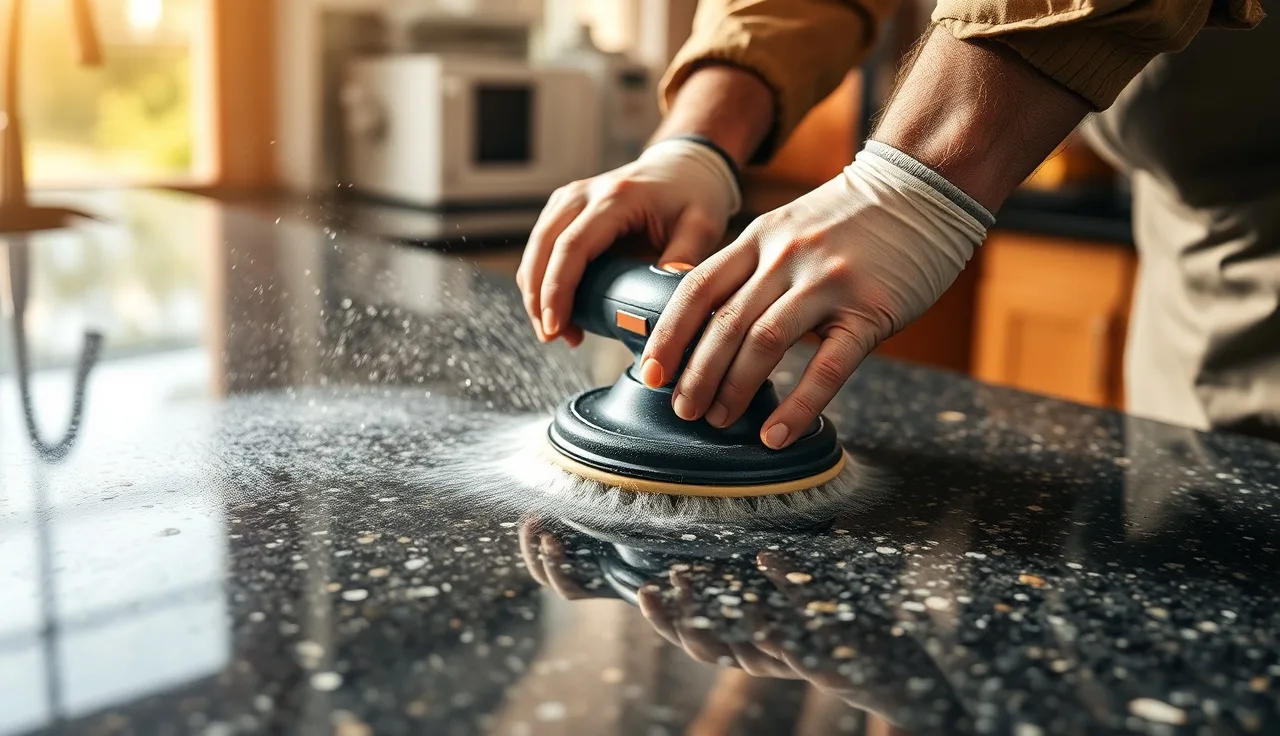
Professional diamond polishing restores the factory gloss to scratched or etched stone. A technician runs progressively finer diamond pads over the surface with a wet polisher, then finishes with a buffing compound. This is the most common service and the one most people are really asking about.
Honing takes the surface from polished to matte. You'd ask for it on purpose, or a technician will hone a badly scratched slab before re-polishing it. Same tools, just stopping at a lower grit.
Grinding is aggressive. It removes a measurable layer of stone to kill deep scratches, chips, and lippage (height differences between slabs). It's loud, wet, and needs real equipment.
Epoxy or paint coatings go over the existing stone instead of cutting into it. These are the "countertop refinishing kits" you see at home improvement stores. They can look decent on laminate or tile. On granite, they're a workaround most professionals roll their eyes at, though the cost is low.
Sealing is maintenance, not resurfacing. Contractors sometimes bundle it in, and homeowners sometimes confuse the two. Sealing alone runs $1, $3 per sq ft and protects the stone. It does nothing for scratches or dullness.
How much does granite resurfacing cost per square foot?
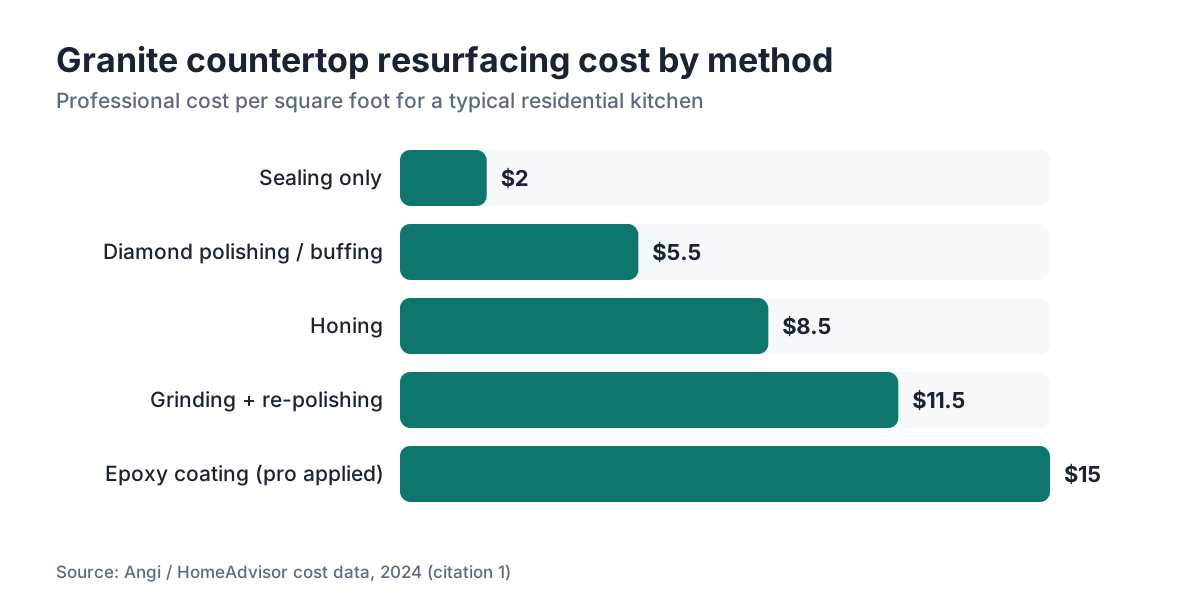
Professional diamond polishing runs $3, $8 per square foot. Full grinding and re-polishing runs $8, $15 per square foot. For an average kitchen with 40 to 50 sq ft of granite, that works out to $120, $400 for a polish and $320, $750 for a grind. Here's the full breakdown by method [1][2]:
| Method | DIY cost | Pro cost (per sq ft) | Best for |
|---|---|---|---|
| Diamond polishing / buffing | $40, $120 kit | $3, $8 | Surface scratches, dullness |
| Honing | Not practical DIY | $5, $12 | Heavy scratching, matte finish request |
| Grinding + re-polishing | Not practical DIY | $8, $15 | Deep scratches, chips, lippage |
| Epoxy coating (DIY kit) | $100, $300 | $500, $1,000 | Surface color change, budget jobs |
| Chip/crack repair only | $20, $60 materials | $150, $400 per chip | Isolated damage |
| Sealing (add-on) | $30, $80 | $1, $3 | After any resurfacing |
Those numbers come from contractor estimates and cost-tracking data from home improvement platforms [1][2].
Geography swings the price hard. The same job in San Francisco or New York can cost 30 to 50% more than in a mid-size Midwestern city. Stone restoration contractors are also rare compared to general tile or floor crews, so thin local supply pushes prices up in some markets.
Project minimums are real. Most stone restoration contractors charge a $150, $300 minimum no matter the square footage, so a small bathroom vanity often gets priced at the minimum instead of the per-square-foot rate.
What does full granite countertop replacement cost, for comparison?
New granite countertops installed by a fabricator run $40, $200 per sq ft all-in, depending on slab grade, edge profile, cutouts, and local labor [3]. That's the number you're weighing resurfacing against.
For a 45 sq ft kitchen at mid-grade ($60, $100 per sq ft installed), that's $2,700, $4,500. The replacing granite countertops cost for a large kitchen with an island can easily hit $6,000, $10,000 or more.
That gap makes resurfacing look great when the stone itself is sound. A $400 polish versus a $4,000 replacement is an easy call if all you're fighting is dullness or surface scratches.
The math flips with through cracks, real structural damage, or a plain desire for a different material. No amount of polishing fixes a slab that's broken at a seam and lifting, and grinding cannot change the color or species of stone you already have.
Fabrication software like SlabWise gives shop owners a faster way to price replacement jobs. If you're collecting competing bids, a fabricator using modern quoting tools can often hand you a written estimate the same day instead of scheduling a separate measure.
If you're weighing a different material entirely, laminate countertops run $15, $40 per sq ft installed, Corian countertops run $40, $80, and engineered quartz like Cambria countertops runs $70, $120. None of them feel or wear exactly like granite, but the cost difference is real.
What factors drive the price up or down?
Square footage is the obvious lever. It's rarely the only one.
Slab condition is probably the biggest swing. Granite that's just lost its shine near a busy cooking zone needs a light polish. Granite with ring-shaped etching from harsh cleaners, deep scratches from a dragged cast iron pan, or chips from a dropped pot needs a lot more work. Some contractors bill severely damaged stone by the hour instead of by the square foot, and $75, $150 per hour is common for skilled stone technicians.
Edge profiles add cost. Polishing a flat or eased edge is simple. An ogee or dupont edge has curves the technician works by hand, which takes longer. Budget an extra $2, $5 per linear foot for complex edges.
Accessibility matters. An outdoor kitchen, a breakfast bar the technician can't get under, or a backsplash that limits tool swing all slow the job down. Some contractors add a flat surcharge. Others just quote higher.
How many pieces? A single monolithic slab is simpler than six separate sections around an L-shaped kitchen with an island and a bar. Moving between pieces eats time.
Counter prep. If the counter is covered in stuff the contractor can't move, or appliances need shifting, that's either your prep or their added labor. Do the prep yourself and save the money.
Local market. There's no national licensing board for stone restoration contractors [4], so pricing floats on what the local market bears. Three written estimates is the only reliable way to learn your rate.
Can you DIY granite resurfacing, and is it worth it?
Light polishing is genuinely DIY-able. Products like MB Stone Polish or Tenax Ager are real, sold at stone supply houses and some hardware stores. For $30, $80 in materials and a few hours, you can bring back some of the surface gloss on lightly scratched granite. The result won't match a professional diamond polish, but it's not nothing.
Major work is a different animal. Diamond polishing pads for a wet grinder run $80, $200 per set, and the 4.5-inch angle grinder most people own is the wrong tool. Pros use variable-speed wet polishers (5-inch or 7-inch) with water feed systems that keep the pads from loading up and hold the dust down. Silica dust from cutting or grinding stone is a real respiratory hazard. OSHA sets a permissible exposure limit of 50 micrograms per cubic meter (8-hour TWA) for respirable crystalline silica [4], and dry-grinding granite in your kitchen blows past that fast without controls.
Epoxy coating kits are worth naming here. Rust-Oleum's Countertop Transformations and similar products run $100, $300 for a DIY application. They bond reasonably well to clean, sanded granite. They look like painted stone, not like granite. Life expectancy under normal kitchen use is 3 to 7 years before peeling or chipping shows, based on consumer reports from home improvement forums (no formal study on this exists that I've found). Renting and just need it to look better for a few years? Fine. Own the house and love the stone? A professional polish is a much better use of the money.
For cleaning and upkeep between professional jobs, how to clean stone countertops covers the right products and technique.
What specific damage can resurfacing fix, and what can't it fix?
Resurfacing is genuinely good at surface scratches (the fine web of micro-scratches that makes granite look cloudy), etch marks from acidic cleaners, loss of polish over time, minor edge chips (filled with matching epoxy and polished), and lippage between slabs at seams.
Resurfacing cannot fix through cracks, a seam that has separated and is lifting, staining that has soaked deep into the stone (common with light-colored granites that never got sealed right), or delamination of the stone from the substrate.
Chip repairs deserve a closer look. A trained technician fills chips with colored polyester or epoxy resin mixed to match the surrounding stone, then sands and polishes flush. A good color match is nearly invisible from normal viewing distance. A bad match is obvious from across the room. Before hiring anyone for chip repair, ask to see photos of finished work on similar stone. Results vary a lot by skill.
Crack repairs are trickier. Hairline cracks can sometimes be stabilized with a penetrating epoxy resin and made less visible, but a surface treatment does not restore the structural integrity of a cracked slab. A crack running through a sink or cooktop cutout is a safety concern and usually means replacement, not repair.
Stain removal is a separate service. Oil-based stains (cooking grease) and organic stains (wine, coffee) in granite often come out with a poultice. That isn't resurfacing, but stone restoration contractors typically offer it. A poultice application runs $50, $150 per stain treated.
How do you find and vet a granite resurfacing contractor?
Stone restoration is a small specialty. Not every tile or flooring contractor does it well. Here's how to land the right person.
Start with the Natural Stone Institute (which absorbed the Marble Institute of America) [5]. Its member directory lists contractors by region, and members agree to follow industry standards.
Ask for references from granite jobs specifically, more than marble or tile. Granite is hard (typically 6 to 7 on the Mohs scale) [6] and needs different diamond grit sequences than softer stones like marble (3 to 4 on Mohs) or travertine. A contractor who mostly works marble can over-polish or under-polish your granite.
Get written estimates with line items, not a single lump total. You want to see square footage counted, method described (diamond polish, honing, grinding), edge linear footage and charge, sealer included or not, and cleanup.
Ask about dust and water control. Professional wet polishing makes slurry, not dry dust, which is safer and easier to clean. The contractor should bring plastic sheeting, a wet-dry vacuum, and either a slurry containment setup or a clear disposal plan. Granite slurry down a residential drain is a bad idea, and some municipalities regulate it [7].
Check insurance. General liability at $1 million per occurrence is the standard for tradespeople working in homes. Ask for the certificate before they start.
A fair range to expect in writing: $3, $8 per sq ft for polishing, $8, $15 per sq ft for grinding and re-polishing. A quote of $1 per sq ft means someone inexperienced planning a quick buff that won't do much. A quote of $20 per sq ft for basic polishing is overpriced unless the stone is wrecked.
How long does granite resurfacing last?
A professional diamond polish, done right on intact granite, holds up 5 to 15 years under normal kitchen use before the surface visibly dulls again. The range is wide because it rides on traffic, whether the stone gets sealed regularly, how harsh the cleaners are, and whether the polish reached a fine enough grit (1500 to 3000 grit and above for true high gloss).
Regular sealing stretches the life. The Natural Stone Institute recommends a simple water-drop test for sealer effectiveness: if water beads and doesn't darken the stone within a few minutes, the sealer is still working [5]. Most residential granite benefits from resealing every 1 to 3 years, depending on porosity.
Epoxy coatings (the painted-over type) have a much shorter life, typically 3 to 7 years before wear or peeling shows in high-use areas. They can be re-coated, but each re-coat needs cleaning and deglossing, and the new layer bonds less perfectly than the original.
Chip and crack repairs done with polyester or epoxy resin are essentially permanent structurally. The fill doesn't shrink or expand with normal kitchen temperature swings. But if the repair wasn't polished to match the surrounding grit, you'll catch a slight texture difference in the light.
The honest answer on intervals: nobody has good longitudinal data on residential granite polishing life. The 5 to 15 year range comes from contractor experience and Natural Stone Institute guidance, not a controlled study.
What are the signs that your granite needs resurfacing vs. just cleaning?
The simplest test is water. Pour a little on the surface. If it beads, the granite is sealed and probably just needs cleaning. If it soaks in and darkens the stone within a few minutes, the sealer is gone. Bare, unsealed granite dulls faster and stains more easily, but lost sealer means resealing, not resurfacing.
Run your fingers across the surface. If it feels rough or sandpapery instead of smooth and glassy, and cleaning hasn't changed that, the surface is scratched beyond what sealing or cleaning can fix. That's a polishing job.
Look at the surface in raking light (low-angle light from a window or a held flashlight). Fine scratches jump out. A network of micro-scratches that looks like crazing is a polishing candidate. Deep individual scratches that catch your fingernail are a honing or grinding candidate.
Yellow or brownish discoloration that won't wipe off is usually a stain, not a polish problem. A poultice handles that before or after polishing.
If the surface looks fine but feels sticky even after cleaning, a product has left residue. Streak-free alkaline cleaners made for stone (not vinegar, not Windex, not bleach) are the fix. The how to clean stone countertops guide covers the right products.
Actual dullness, visible cloudiness in a surface that used to shine, and no improvement from cleaning are the clear signals that resurfacing is the right call.
Is resurfacing granite worth it financially?
For most homeowners with structurally sound stone that has just dulled or scratched, yes. A $300, $500 professional polish on a 45 sq ft kitchen is a legitimate spend when the alternative is $3,000, $5,000 to replace.
The calculus shifts in a few spots. If you're planning to sell, real estate agents often note that granite in good shape is a selling point. A $400 job that brings dull granite back to looking new is likely worth more than $400 in perceived value, though no controlled study pins a specific figure on that.
If the stone was coated with epoxy in the past, getting back to natural granite means stripping the coating first, which adds cost and headaches. Some contractors won't touch previously coated granite at all.
If your stone just isn't what you want anymore (outdated color, wrong for a remodel), resurfacing is a waste of money. Polishing can't change what the stone fundamentally looks like. In that case, replacement or a new surface is the honest answer.
Fabrication shops that price jobs accurately can tell you fast whether a replacement fits your budget. SlabWise gives shop owners instant cost breakdowns that account for slab yield and labor, which helps both the shop and the homeowner see the real number before anyone commits.
Comparing materials before you decide? Kitchen countertops has a broad cost comparison, and marble countertops and butcher block countertops cover two common granite alternatives.
What questions should you ask before hiring a granite resurfacing contractor?
Before anyone sets up a wet polisher in your kitchen, get clear answers to these.
What grit sequence do you use? A pro should say they work from a coarser grit (roughly 50 to 200 for grinding, 400 to 800 for honing) up through finer grits to 1500 or 3000 for high gloss. A vague answer is a red flag.
Wet or dry polishing? Wet polishing controls silica dust and produces a better result. Dry polishing is faster and cheaper for the contractor and kicks up dust for you.
What do you do about slurry? The water-and-stone slurry from wet polishing has to go somewhere. A professional has a plan that doesn't involve your kitchen sink.
Is sealing included? Most reputable jobs end with a sealer application. If it's not in the quote, ask the price to add it.
What's your warranty? A good contractor re-does sections that don't meet the agreed finish standard. Get it in writing.
Can I see granite work, not marble? The materials behave differently. Granite-specific experience matters.
What happens if you chip my edge or damage my sink? Know their insurance and their policy before anyone starts grinding near a $600 undermount sink.
Frequently asked questions
How much does it cost to resurface granite countertops in a small kitchen?
A small kitchen with 25 to 30 sq ft of granite typically costs $150, $300 for professional diamond polishing, assuming no severe damage. Most contractors have a minimum charge of $150, $300 regardless of size, so small jobs often hit the minimum rather than the per-square-foot rate. Get a written estimate before assuming a size discount applies.
Can you resurface granite countertops yourself?
Light surface polishing is doable with $30, $80 in stone polish products. Anything past that (honing, grinding, chip repair) needs professional equipment and carries real silica dust risk. OSHA's permissible exposure limit for respirable crystalline silica is 50 micrograms per cubic meter over an 8-hour shift, a limit easily blown past by dry-grinding granite without controls.
What's the difference between resurfacing, refinishing, and repolishing granite?
These terms get used interchangeably in the market, but they mean different things. Repolishing restores the gloss with diamond pads. Refinishing often means applying an epoxy or paint coating over the existing surface. Resurfacing technically means removing material from the surface, though contractors use it loosely for any restoration work. Always ask exactly what process is included before signing anything.
How long does granite countertop resurfacing take?
A professional polish on a typical kitchen (40 to 50 sq ft) takes 2 to 5 hours depending on condition. Add sealing and drying time and the surface is usually usable the same day. Heavier grinding jobs take longer, sometimes two visits. Clear everything off the counter before the contractor arrives; that prep is on you.
Does resurfacing granite remove stains?
Polishing removes surface scratches and restores gloss but does not pull out deep stains. Oil-based and organic stains that have soaked into unsealed granite need a poultice treatment, a separate service running $50, $150 per stain. Many stone restoration contractors offer both, so ask whether stain removal is bundled or priced separately.
How much does it cost to fix a chip in granite countertops?
Chip repair by a professional stone restorer runs $150, $400 per chip, depending on size, location, and color-matching difficulty. Edge chips are the most common. The technician fills the chip with colored polyester or epoxy resin, then sands and polishes it flush. DIY chip kits exist for $20, $60 but demand skill and patience for an invisible result.
Is it cheaper to resurface or replace granite countertops?
Resurfacing wins on cost in almost every case where the stone is structurally sound. Professional polishing runs $3, $8 per sq ft versus $40, $200 per sq ft for new granite installed. On a 45 sq ft kitchen, that's $135, $360 for resurfacing versus $1,800, $9,000 for replacement. Replacement makes sense when the stone is cracked through, structurally compromised, or you want a completely different look.
How often does granite need to be resurfaced or repolished?
Most well-maintained granite in a residential kitchen holds its polish 5 to 15 years before noticeable dulling calls for professional attention. Heavy use, abrasive cleaners, and poor sealing speed up dulling. Regular resealing every 1 to 3 years (confirmed by the water bead test) stretches the interval between professional polishing jobs.
Can a badly scratched granite countertop be restored?
Yes, in most cases. Deep scratches that catch your fingernail need honing (removing the polish layer) followed by re-polishing. Honing runs $5, $12 per sq ft plus $3, $8 per sq ft for polishing, so figure $8, $20 per sq ft total for badly scratched stone. The one scenario where restoration fails is if the scratch is actually a crack running through the slab.
Do epoxy countertop coating kits work on granite?
They bond to clean, sanded granite and can change the surface color and sheen. Life expectancy under kitchen use is roughly 3 to 7 years before wear or peeling shows. Professionals generally avoid recommending them for granite because the result doesn't look like natural stone, and removal requires stripping before any future natural-surface restoration. For a rental or a temporary fix, they're a defensible budget option.
Does homeowners insurance cover granite countertop damage?
Standard homeowners policies cover sudden and accidental damage (like a crack from impact) but not wear, dullness, or gradual deterioration. Even for covered claims, most policies carry deductibles of $1,000, $2,500, which often exceeds the repair cost. Read your specific policy language before filing, since filing and not collecting can affect your rates.
What should I do to maintain granite after resurfacing?
Seal within a week of the polishing job if sealing wasn't included. Use only pH-neutral stone-safe cleaners, never vinegar, citrus, or bleach. Wipe spills right away, especially wine, coffee, and cooking oil. Don't drag metal objects across the surface. Reseal when the water bead test fails (water soaks in and darkens the stone within a few minutes). A simple routine adds years to the polish life.
Sources
- HomeAdvisor (Angi), Granite Countertop Resurfacing Cost Guide: Professional granite polishing runs $3, $8 per sq ft; grinding and re-polishing runs $8, $15 per sq ft for residential projects.
- HomeGuide, Granite Countertop Cost Guide: Granite countertop chip repair costs $150, $400 per chip from a professional stone restorer.
- U.S. Bureau of Labor Statistics, Consumer Expenditure Surveys, Home Improvement Data: Countertop replacement cost benchmarks used to contextualize fabrication and labor costs in residential renovations.
- OSHA, Occupational Exposure to Respirable Crystalline Silica, Final Rule (29 CFR 1926.1153): OSHA's permissible exposure limit for respirable crystalline silica is 50 micrograms per cubic meter as an 8-hour time-weighted average.
- Natural Stone Institute, Care and Maintenance Guidelines: The Natural Stone Institute recommends the water bead test to assess sealer effectiveness; recommends resealing every 1 to 3 years depending on porosity.
- U.S. Geological Survey, Mineral Resources Program, Granite Characterization: Granite typically rates 6 to 7 on the Mohs hardness scale, harder than marble (3 to 4) and most manufactured countertop surfaces.
- U.S. Environmental Protection Agency, Construction and Demolition Debris Management: Stone slurry from wet polishing operations may be subject to local wastewater disposal regulations at some municipal treatment facilities.
- National Institute of Standards and Technology: Referenced for context on regional labor cost variation in skilled trades for residential renovation.
- Natural Stone Institute, Stone Industry Education: Industry grit sequences for granite polishing (50 to 3000 grit) and standards for surface finish grades referenced in fabrication education materials.
- U.S. Census Bureau, American Housing Survey: Average kitchen countertop area in U.S. homes used to contextualize typical project square footage (40 to 50 sq ft for an average kitchen).
Last updated 2026-07-09