TL;DR
- Home Depot stocks roughly 8 to 12 countertop edge profiles depending on the material you choose.
- A basic eased or beveled edge is usually included in the quoted price.
- Upgraded profiles like ogee, full bullnose, or waterfall cost $10, $30 per linear foot extra.
- The right choice depends on your kitchen style, how much maintenance you want, and the material you're working with.
What edge profiles does Home Depot actually offer?
Home Depot's edge selection changes with the material, and that trips up a lot of shoppers. You don't get the same menu for laminate post-form tops that you get for granite or quartz slabs cut in their fabrication program.
For laminate countertops sold as pre-built post-form pieces (think the roll of laminate over a particleboard substrate that wraps around the front edge), the edge is built in. You're getting a rounded or square post-form edge and that's that. No upgrades. If you want a different profile in laminate, you'd need to order a custom laminate top with a separate edge treatment, which Home Depot does offer through its countertop measure-and-install service.
For stone slab materials, including granite, quartz, and quartzite ordered through Home Depot's installation program, the list typically runs: eased, beveled (a 45-degree cut at varying depths), half bullnose, full bullnose, ogee, double ogee, dupont, and waterfall (also called a mitered or straight-drop edge). Some markets add cove, chiseled, and triple pencil. The exact lineup depends on which fabricator Home Depot has contracted in your area, since they subcontract stone work to regional shops [1].
For solid surface materials like Corian, the profiles depend on the fabricator's router bit inventory. Expect eased, beveled, bullnose, and ogee as standard options, with more complex profiles available on request.
Here's the move: call or visit your local Home Depot countertop desk and ask specifically which profiles their current stone fabricator offers for your chosen material. The answer will be more accurate than anything on their website.
How much does an upgraded edge profile cost at Home Depot?
Base price for a Home Depot stone countertop includes one standard edge, usually eased or a 1/8-inch bevel. Everything past that is an upcharge, priced per linear foot of exposed edge. This is where homeowners consistently get surprised.
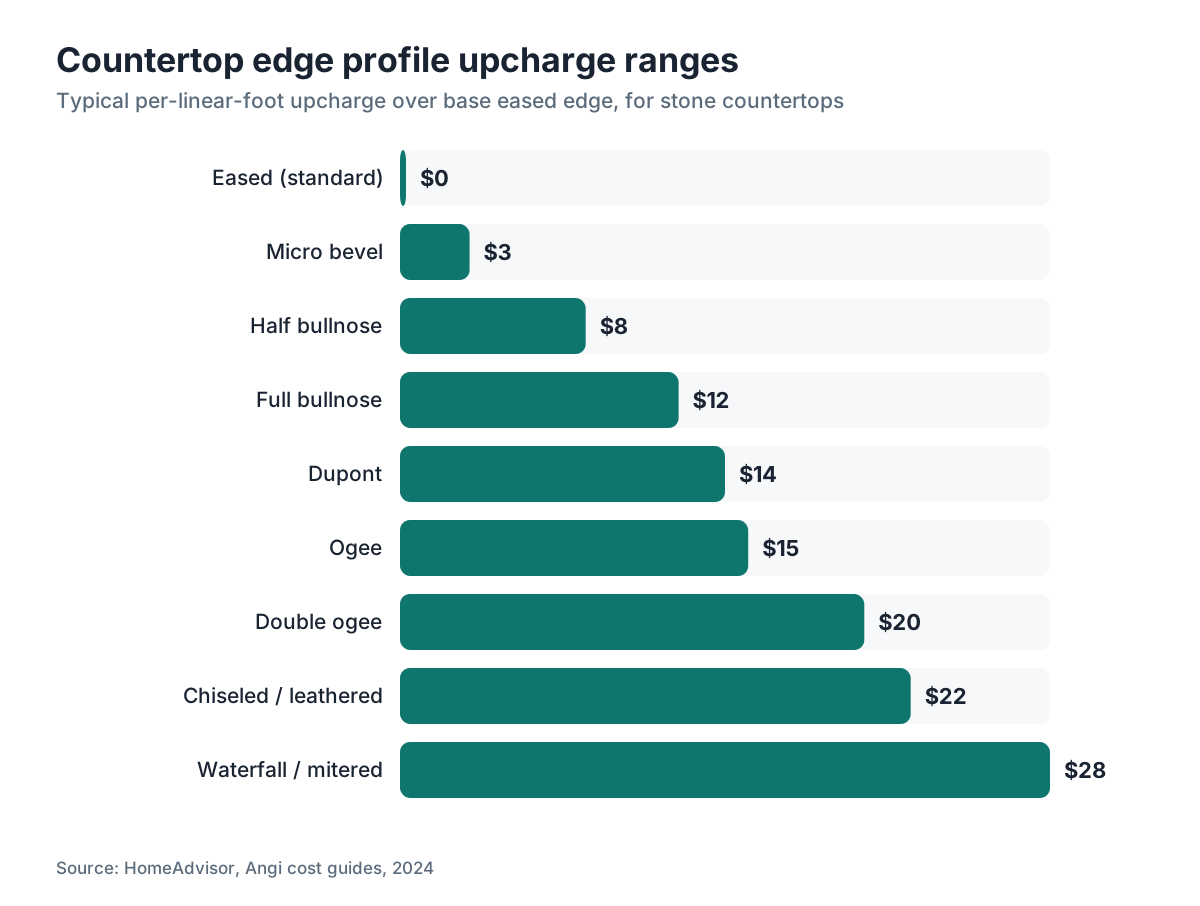
Typical upcharge ranges, based on what Home Depot and their contracted fabricators have published and what third-party pricing surveys show [2]:
| Profile | Typical Upcharge (per linear foot) |
|---|---|
| Eased (standard) | $0 (included) |
| Beveled (1/4 to 1/2 inch) | $0, $5 |
| Pencil / Micro Bevel | $0, $5 |
| Half Bullnose | $5, $10 |
| Full Bullnose | $8, $15 |
| Ogee | $10, $20 |
| Double Ogee | $15, $25 |
| Dupont | $10, $18 |
| Waterfall / Mitered | $20, $35 |
| Chiseled / Leathered Edge | $15, $30 |
These are upcharges on top of the slab price. A standard kitchen has roughly 25 to 40 linear feet of exposed edge. At a $15-per-foot premium for an ogee, that's $375 to $600 added to your total. On a $4,000 granite project, that's real money.
Home Depot's stone countertop program starts around $45 per square foot for basic granite, including installation, through their measure-and-install service [2]. Edge upgrades get itemized separately in the final quote. Always ask for the edge total, more than the per-linear-foot rate, so you can compare apples to apples.
What is each edge profile and what does it look like?
These profiles have real geometric definitions. Knowing them helps you read what you're actually getting off a showroom sample.
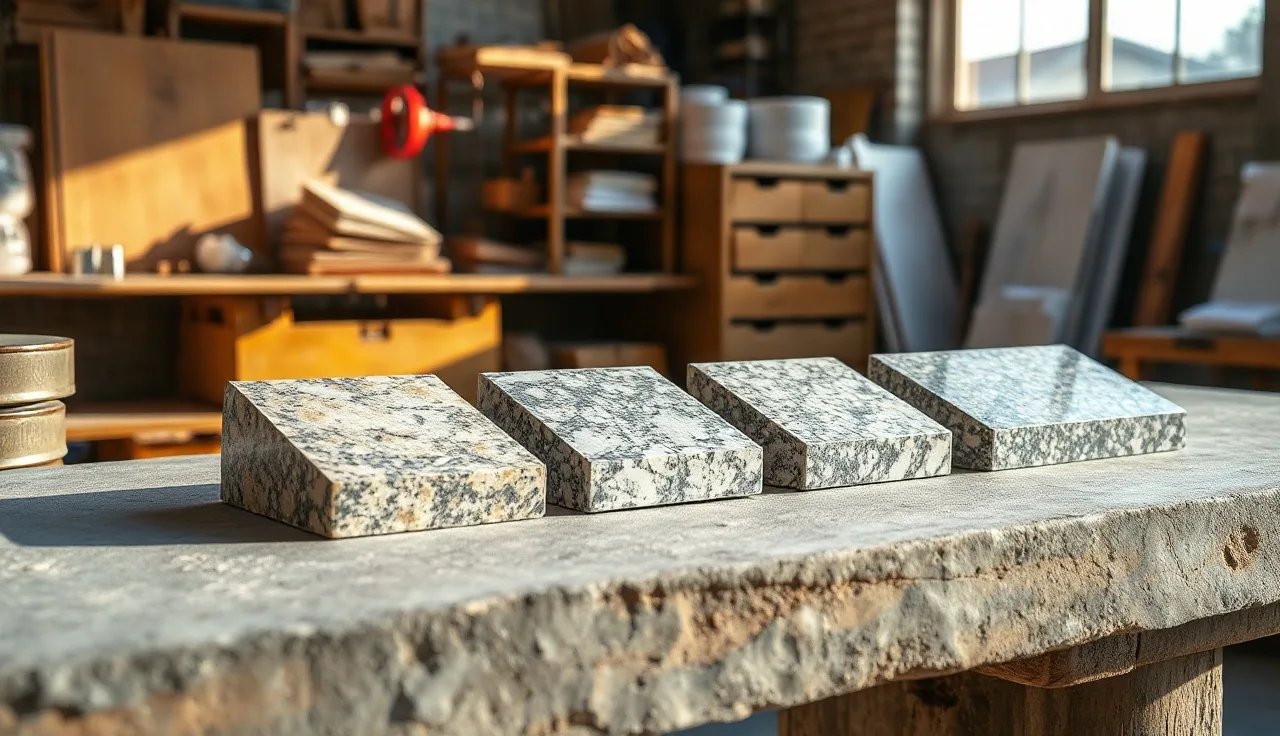
Eased edge. A square corner with the top arris lightly softened (usually 1/16 inch). It looks nearly flat. This is the most common profile in modern kitchens and the default on most Home Depot stone quotes. Clean, contemporary, easy to wipe.
Beveled edge. The top corner is cut at 45 degrees. Depth varies: a micro bevel is barely visible, a 1/2-inch bevel is bold and obvious. Bevels read as contemporary or transitional depending on depth.
Bullnose. A half bullnose curves the top corner into a soft quarter-round. A full bullnose curves the entire thickness of the counter into a half-circle, so both the top and bottom corners are rounded. Full bullnose was everywhere in the 1990s and early 2000s. It's less fashionable now but very forgiving on bumped hips.
Ogee. A classic S-curve profile: concave on top, convex below. Formal and traditional. The double ogee repeats the S twice, adding more visual weight. Both take more grinding time, which is why they cost more.
Dupont. Similar to an ogee but with a flat step between the curves. It reads as slightly more geometric than a straight ogee.
Waterfall / Mitered edge. This isn't a profile in the traditional sense. It's a design choice where the countertop material runs vertically down the cabinet side to the floor, with the top and side pieces joined at a 45-degree miter. It's expensive because it takes extra material and precision. A waterfall island in 3-centimeter quartz can easily add $800 to $2,000 to a project just for the two drops [3].
Chiseled / Eased natural. The edge is worked with a chisel or router to give a rough, natural-break look. Common on quartzite and some granites. Not great if you have young kids who run into corners.
Cove dupont / Cove ogee. Variations that add a concave cove to the underside. They read as ornate and show up less often in current kitchens.
If you're comparing options online, the National Kitchen and Bath Association (NKBA) publishes terminology standards that most fabricators follow, so profile names stay fairly consistent across the industry [4].
Which edge profile is the most popular right now?
The eased edge is the runaway choice in new installations. It fits the current preference for flat, minimal cabinetry and solid-color or textured surfaces. Industry surveys from NKBA's Design Trends report consistently show square or eased edges leading, with waterfall edges growing fast in higher-end remodels [4].
Beveled edges are the next most common. They add a little dimension without looking fussy, and they're usually no extra cost.
Ogee profiles peaked around 2005 to 2015. You still see them in traditional-style kitchens, but they're rare in new builds. If you're remodeling to sell, an ogee on white quartz can actually read as dated to buyers who've been watching design content.
Waterfall edges are popular in design media but expensive enough that they're still relatively rare in real installations. The fabrication complexity is real: every miter joint has to be near-perfect or the seam reads badly.
For a practical kitchen with moderate traffic, I'd go eased or small bevel. It's the easiest to clean, the least likely to chip, and it doesn't fight any cabinet style. Want a little personality without spending more? A 1/4-inch bevel adds shadow and definition for essentially nothing extra.
Which edge profiles are safest with kids and high-traffic kitchens?
Sharp corners chip more easily than curved ones on stone. A standard eased edge has a very small flat on the corner, but it's still relatively sharp. Full bullnose is the softest, most forgiving profile for a home with children because there's no corner to chip and no hard edge to bump a hip on.
Chipping risk also depends on the stone. Granite has a crystalline structure that tends to chip cleanly. Quartzite chips similarly. Quartz (engineered stone) has a resin binder that resists chipping better than natural stone, which is one reason fabricators often feel comfortable cutting sharper profiles on quartz [5].
For the leading edge of an island where people repeatedly bump against it, a half or full bullnose profile in quartz is a reasonable choice even if you don't love the look. The trade-off: a rounded edge is slightly harder to keep clean at the very curve, because crumbs lodge at the joint between the top surface and the edge.
Chiseled edges are the worst choice for high-traffic areas. The rough texture collects grime, and the uneven surface can snag fabric and cut fingers during cleaning. They look great in photographs and become annoying within about a week of daily cooking.
Does the edge profile affect countertop thickness or how a countertop looks overall?
Yes, and by a lot. The edge profile is one of the main ways you control the visual weight of a counter.
Most Home Depot stone countertops use 3-centimeter (about 1-3/16 inch) slabs. That's thick enough to look substantial with an eased edge. Some premium installations use a mitered build-up, where a second piece of stone gets glued under the front edge to make the counter appear 4 to 6 centimeters thick. This adds cost but creates a heavy, dramatic look.
An ogee or dupont profile on a 3-centimeter slab reads as formal and traditional. The same slab with an eased edge reads modern and clean. The stone underneath is identical. The profile is doing all the visual work.
Thickness also matters for waterfall edges. Standard waterfall installations use the same 3-centimeter material running vertically. The miter joint is the piece that makes or breaks it: a gap or a misaligned grain seam is immediately visible and impossible to ignore. Fabricators who do a lot of waterfall work get better yields on miters, which is worth asking about.
For laminate countertops, thickness is fixed by the substrate and laminate stack, usually 1-1/2 inches. Post-form edges wrap the laminate around a pre-routed curve. Custom laminate tops can get a wood edge strip or an aluminum T-molding for different looks, but the range is much narrower than stone.
How does edge profile choice differ for granite vs. quartz vs. laminate at Home Depot?
Each material has real constraints that shape which profiles are practical.
Granite. Most profiles work well. Granite is hard and takes a good polish on curved profiles. The risk is that very thin, delicate profiles (like a razor-sharp eased edge with almost no flat) can chip at the corners over time, especially on softer granite varieties. Harder granites like Absolute Black or Blue Pearl hold sharp edges better than softer, more porous granites [5].
Quartz (engineered stone). The resin content makes quartz slightly more resistant to chipping on edges than natural granite, so thin eased and beveled profiles hold up well. Some fabricators note that quartz shows seam lines more visibly than granite on complex profiles like double ogee, because the engineered pattern doesn't flow naturally around a curve. See granite countertops and kitchen countertops for a broader material comparison.
Laminate. As noted, post-form laminate has a built-in profile and you can't change it without a custom order. Custom laminate tops through Home Depot can use a beveled or square edge, sometimes with a contrasting color strip. The range is limited. See laminate countertops for more on what to expect.
Butcher block. Home Depot sells butcher block countertops pre-made with a square or lightly eased edge. Custom routing is possible if you're buying an unfinished panel and doing your own work. The wood takes almost any profile a router bit can cut. See butcher block countertops for more.
Solid surface (Corian, etc.). Solid surface is thermoplastic and easy to shape. Fabricators can rout almost any profile. The material is also repairable, so a chipped edge can be sanded and refinished. See Corian countertops for details.
One fact worth holding onto: stone profiles at Home Depot get done by an outsourced fabricator, so the actual skill level and equipment quality vary by market. Keep that in mind when comparing quotes.
How do I choose an edge profile that fits my kitchen style?
Match the profile geometry to your cabinet door style. That's the simplest and most reliable rule.
Flat-panel (Shaker or slab) cabinets pair best with eased, beveled, or waterfall edges. The clean lines read consistently. Adding an ogee to flat-panel cabinets creates a visual conflict that most designers catch immediately.
Raised-panel and detailed cabinet doors pair naturally with ogee, dupont, or double ogee edges. The decorative countertop edge continues the language of the cabinetry.
Transitional kitchens (the largest category in new builds) work well with a half bullnose or a medium bevel. Those profiles stay neutral enough to not fight either direction.
Think about the sink and faucet, too. A farmhouse (apron) sink sits below the countertop level, and the front apron pulls attention away from the edge, so you have more flexibility. An undermount sink shows a clean line at the cutout, which makes an eased or beveled edge look especially intentional.
If you're working with a professional kitchen designer, the NKBA recommends that edge profile, backsplash material, and cabinet hardware be selected together as a coordinated system, not one at a time [4]. That's good advice. Picking the edge in isolation often leads to regret.
Fabricators who use countertop quoting software like SlabWise can generate rendered edge-profile previews during the quote, so you can see roughly how each option will look before you commit. Ask your Home Depot contractor if their shop can do that.
What should I ask before signing a Home Depot countertop installation contract?
Home Depot's countertop installation is a turnkey service: they measure, fabricate (through a subcontractor), and install. The contract is with Home Depot, not the fabricator, which limits your ability to go straight back to the shop if something goes wrong. Know that going in.
Questions worth asking before you sign:
- Which fabrication shop does this store use? Can you visit the shop or see photos of their edge work?
- What is the exact edge profile included in the base price, and what are the upcharge amounts for every upgrade option?
- Is the edge price quoted per linear foot of total edge or only exposed edge? (Cabinets cover some edges; you should not pay the upgrade price for those.)
- What is the seam policy? Where will seams fall, and can you approve seam placement before fabrication?
- What is the warranty on the installation, and who honors it if the fabricator changes?
- What is the lead time from measure to installation?
Home Depot's standard installation warranty varies by market and material. Their general contractor warranty program covers workmanship for one year [6]. Material defects get handled separately by the manufacturer.
For a deeper look at the full process, the countertop installation guide covers what to expect at each stage.
Can I get a different edge profile after installation?
Mostly no. Changing a stone edge profile after installation means the stone has to come out of the kitchen, go back to a fabricator's shop, get re-profiled, re-polished, and be reinstalled. The cost approaches or beats what a profile upgrade would have cost originally, and you risk chipping or cracking the slab during removal.
There's one exception: a fabricator with in-place polishing equipment can sometimes refine an edge on-site. Softening a sharp eased edge to a small bevel is doable with hand-held diamond pads. Converting an eased edge to a full ogee on-site is not realistic.
Solid surface (Corian) is different. Because it's machinable and repairable, a skilled technician can re-rout and re-finish an edge in place for some profile changes. The range of feasible changes is still limited.
For laminate post-form tops, you can't change the profile at all without replacing the top.
The practical takeaway: get the edge decision right before fabrication. Use physical samples, not photos. Ask the store if you can see the profile options in the same material you're ordering, not in some other stone.
How does edge profile affect countertop cleaning and maintenance?
Every crevice collects crumbs and bacteria. Profiles with tight inside curves, like the concave part of an ogee or a cove profile, are harder to wipe clean than a flat bevel.
The CDC's guidelines on kitchen sanitation say food-contact surfaces should be cleanable and non-porous [7]. Stone and solid surface countertops meet the non-porous standard (especially quartz and solid surface), but edge geometry decides how easily you can actually reach every surface with a cloth.
A full bullnose has no sharp angles, so a wet cloth slides over it easily, though the very bottom of the curve at the cabinet face can accumulate grime. An eased edge is the easiest to wipe: one pass across the top, one pass down the front face, done.
For anyone sealing natural stone, the edge faces need sealer applied just like the top surface. More complex profiles mean more surface area and more time during sealing. See how to clean stone countertops for material-specific guidance, and how to clean quartzite countertops if that's what you're working with.
Soapstone is one material where edge profile rarely matters for maintenance, since soapstone gets treated with mineral oil and is naturally antimicrobial. See how to clean soapstone countertops for that case.
Is the Home Depot edge selection competitive with independent fabricators?
For common profiles, yes. For complex or custom profiles, usually not.
An independent fabricator typically has a larger router bit library and more freedom to cut unusual profiles. They can often do custom work, like a one-off cove shape or a built-up laminated edge with contrasting stone, that Home Depot's subcontracted shops won't attempt.
Home Depot's advantage is the warranty umbrella (you deal with one company if something goes wrong) and the financing options they offer. Their pricing runs competitive for standard stone work in markets where they have established fabricator relationships.
For unusual materials, complex edge designs, or highly detailed custom work, most experienced kitchen designers send you straight to a local fabricator rather than through a big-box retail channel. You get direct communication with the person actually cutting your stone, and you can review the slab in person before fabrication.
Pricing data from HomeAdvisor and Angi shows granite countertop installation through a local independent fabricator averages $40 to $100 per square foot installed, against Home Depot's advertised starting ranges that typically begin around $45 per square foot for basic options [2][8]. The ranges overlap heavily. The difference usually comes down to the quality of individual shops and the material grades available, not a systematic price gap.
For specialty materials like Cambria countertops or marble countertops, Home Depot may or may not carry the specific slab you want. Their inventory is more limited than a dedicated stone yard.
Frequently asked questions
Does Home Depot charge extra for a bullnose edge on granite?
Yes, usually. A half bullnose typically adds $5 to $10 per linear foot over the base eased edge price. A full bullnose runs $8 to $15 per linear foot extra. On a kitchen with 30 linear feet of exposed edge, that's $150 to $450 added to your quote. Always confirm the upcharge with your specific store and their fabricator, since pricing varies by market.
What is the default edge profile included in Home Depot's countertop price?
The standard included edge is an eased edge, a nearly square corner with the top arris lightly softened. Some markets include a small bevel at no extra charge. Anything beyond that, including half bullnose, full bullnose, ogee, or dupont, carries an upcharge per linear foot. Check your itemized quote before signing.
Can I see edge profile samples at Home Depot before I decide?
Most Home Depot countertop departments have a display board with sample profiles, usually in a generic stone material. These show the geometry but not necessarily the color or texture of your actual slab. Ask specifically to see a sample in the material you're ordering. If the store can't show you one, ask if you can visit the fabrication shop or at least see photos of finished edges in your material.
Which edge profile is easiest to clean on a kitchen counter?
Eased and small beveled edges are the easiest to clean. They have no tight curves or inside radii where crumbs or grease can gather. Full bullnose is a close second. Ogee and cove profiles have inside curves that are harder to reach with a cloth. Chiseled or rough-textured edges are the hardest to clean and not recommended for anyone who cooks regularly.
Does the edge profile change how much a countertop costs to fabricate overall?
Yes. Complex profiles like ogee or double ogee take more grinding time, more polishing passes, and more skill from the operator. Waterfall edges take extra material and precision mitering. Those costs pass to you as per-linear-foot upcharges. Simple profiles like eased or bevel are fast to run and are typically included in the base fabrication price.
What edge profile works best for a kitchen island?
On an island, all four sides are usually visible and exposed. An eased or beveled edge looks clean from every angle and is easy to wipe down. If people frequently bump the island while passing, a half bullnose softens the impact. Waterfall edges on two sides of an island create a dramatic look but add significant cost. Avoid chiseled edges on island corners where people brush past regularly.
Can Home Depot do a waterfall countertop edge?
Some Home Depot fabrication partners offer waterfall (mitered) edges, but not all of them. It depends on the shop in your area. Waterfall edges take extra slab material for the vertical drops and precision miter cuts. Expect to pay $20 to $35 per linear foot in upcharge for the profile itself, plus the cost of the additional material for the vertical panels, which can add $800 to $2,000 or more.
Is an ogee edge out of style in 2024 and 2025?
In modern and transitional kitchens, yes, an ogee edge reads as dated. It peaked in popularity through the early 2010s. Traditional-style kitchens with raised-panel cabinets can still carry an ogee naturally. If you're remodeling to sell within a few years, a neutral eased or small bevel edge is safer because it doesn't alienate buyers who have contemporary taste.
What edge profile is best for quartz countertops?
Eased and beveled edges are the most popular choices for quartz and suit its clean, engineered look. Quartz's resin content makes it slightly more chip-resistant than natural stone on sharp edges. A waterfall edge in quartz is dramatic and relatively feasible because the consistent patterning of engineered stone hides minor miter seams better than natural granite with random veining.
Does a laminate countertop from Home Depot come with edge profile options?
Pre-made post-form laminate countertops have a fixed built-in edge, usually a rounded post-form profile, and you can't change it. Custom laminate tops ordered through Home Depot's measure-and-install service offer a few more options, typically a square or beveled edge, sometimes with a contrasting strip. The range is far more limited than stone.
How do I compare Home Depot's edge pricing to an independent fabricator?
Get line-item quotes from both sources showing the base slab price, edge upcharge per linear foot, total linear feet of exposed edge, and installation fee separately. Don't compare total project prices without knowing what's included in each. Edge upcharges at independent fabricators can range from slightly less to significantly more than Home Depot depending on the shop and the profile complexity.
What is a dupont edge and how is it different from an ogee?
A dupont edge has a flat horizontal step between a concave upper curve and a convex lower curve. An ogee is a pure S-curve with no flat step. The dupont reads as slightly more geometric and structured. Both are traditional profiles. The dupont is less common than ogee and tends to cost a similar amount, in the $10 to $18 per linear foot upcharge range.
Does edge profile selection affect the resale value of my home?
Directly, very little. Buyers notice countertop material and color far more than edge profile. Indirectly, a heavily dated edge (like a double ogee on contemporary cabinets) can make a kitchen look older, which affects perceived value. The safe move for resale is a neutral eased or small bevel that won't conflict with any buyer's taste.
Can I change my edge profile selection after the countertop template is done but before fabrication?
Yes, and this is the last practical window to do it. Once the template is approved, the fabricator programs the CNC machine using that profile. Changes after programming may cost a small fee for reprogramming, but they're generally feasible. Changes after the stone is already cut are much harder and may require re-cutting. Confirm your profile selection in writing at templating.
Sources
- Home Depot, Countertop Installation Services: Home Depot countertop installation is handled through subcontracted regional fabricators; edge profiles available depend on the local shop
- Angi, Waterfall Countertop Cost: Waterfall countertop edges can add $800 to $2,000 or more for the two vertical drops in material and fabrication
- National Kitchen and Bath Association (NKBA), Design Trends Report: NKBA publishes edge profile terminology standards and design trends data showing square and eased edges leading current preferences
- Natural Stone Institute, Granite Fabrication Standards: Granite hardness and crystalline structure affect chipping risk at edge profiles; harder granites hold sharp profiles better than softer varieties
- Home Depot, Pro Referral and Installation Warranty Terms: Home Depot's installation program includes a one-year workmanship warranty on contractor-installed projects
- CDC, Food Safety in the Home Kitchen: CDC guidelines emphasize that food-contact surfaces should be non-porous and cleanable; edge geometry affects how completely surfaces can be wiped
- Angi, Granite Countertop Cost Guide: Independent fabricator granite installation averages $40, $100 per square foot installed, a range that overlaps with big-box retail programs
- MIA+BSI (Marble Institute of America), Countertop Specifications: Industry specification standards for stone countertop edge profiles, seam placement, and finish requirements
Last updated 2026-07-09