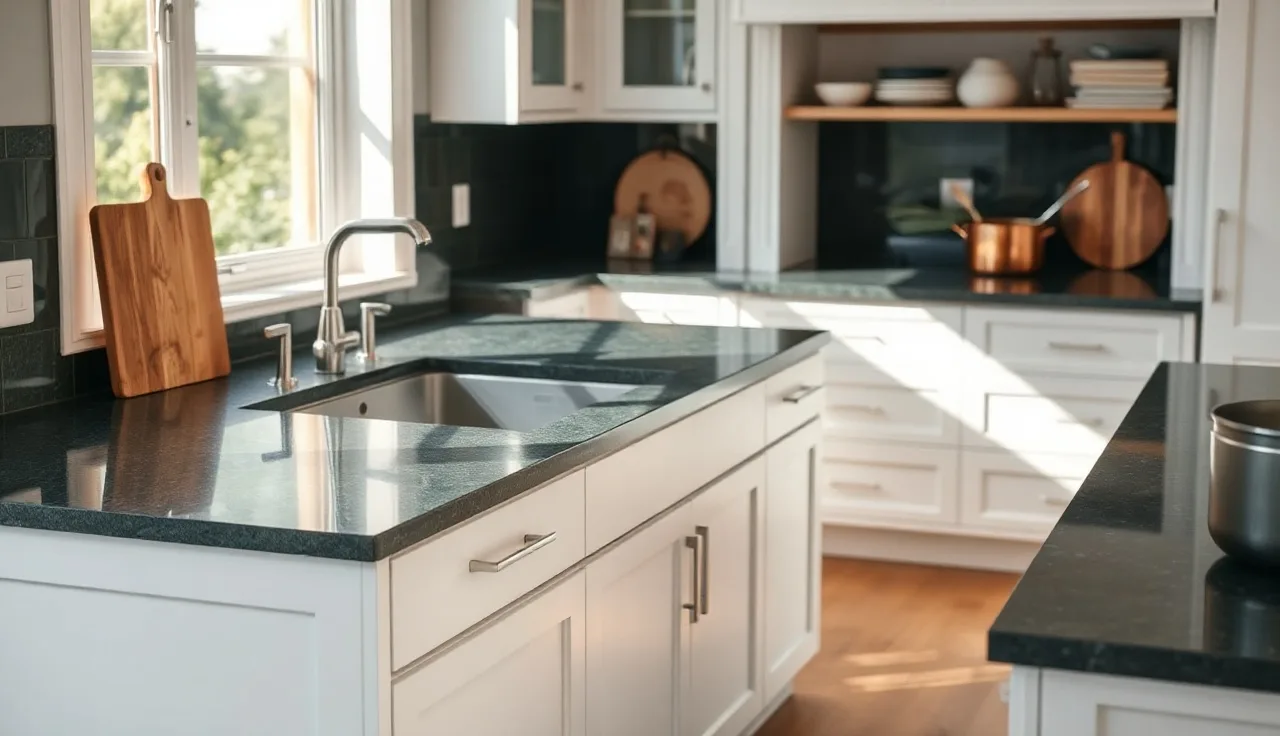
TL;DR
- Green granite countertops run $40 to $200 per square foot installed, depending on the variety and how exotic the slab is.
- Popular picks include Verde Butterfly, Uba Tuba, Emerald Pearl, and Sea Green.
- Green granite is hard, heat-resistant, and needs sealing every one to three years.
- The color never fades because it comes from the stone's minerals, not a dye.
What makes granite green, and why does the shade vary so much?
Granite gets its color from the minerals locked inside it when the magma cooled millions of years ago. Green hues come mostly from feldspar (often amazonite or microcline), hornblende, chlorite, and in some slabs epidote or fuchsite. The exact mineral mix, plus how the crystals grew and how fast the rock cooled, decides whether you get a muted sage, a deep forest green, or something almost black-green with flashes of gold.
That's why two slabs both labeled "green granite" can look unrelated. Uba Tuba from Brazil skews so dark it reads almost black under some lights, with tiny sparkles of gold and green. Verde Butterfly from Brazil is paler, more gray-green, with sweeping movement. Sea Green from India sits between them, warm and olive-toned with visible grain.
Origin drives a lot of the variation. Brazil dominates the market for darker, heavily patterned greens. India supplies most of the calmer, more uniform ones. Norway's Emerald Pearl is its own thing entirely: a very dark stone with an iridescent shimmer that comes from a high concentration of labradorite feldspar. Knowing which mineral creates the green in your slab matters, because chlorite-heavy stone tends to be slightly more porous than a quartz-heavy granite, and that changes how often you seal.
Because the color comes from mineral content, it doesn't fade. A green granite installed in 1995 is the same green today. No pigmented or tinted surface can promise that.
What are the most popular green granite varieties and how do they compare?
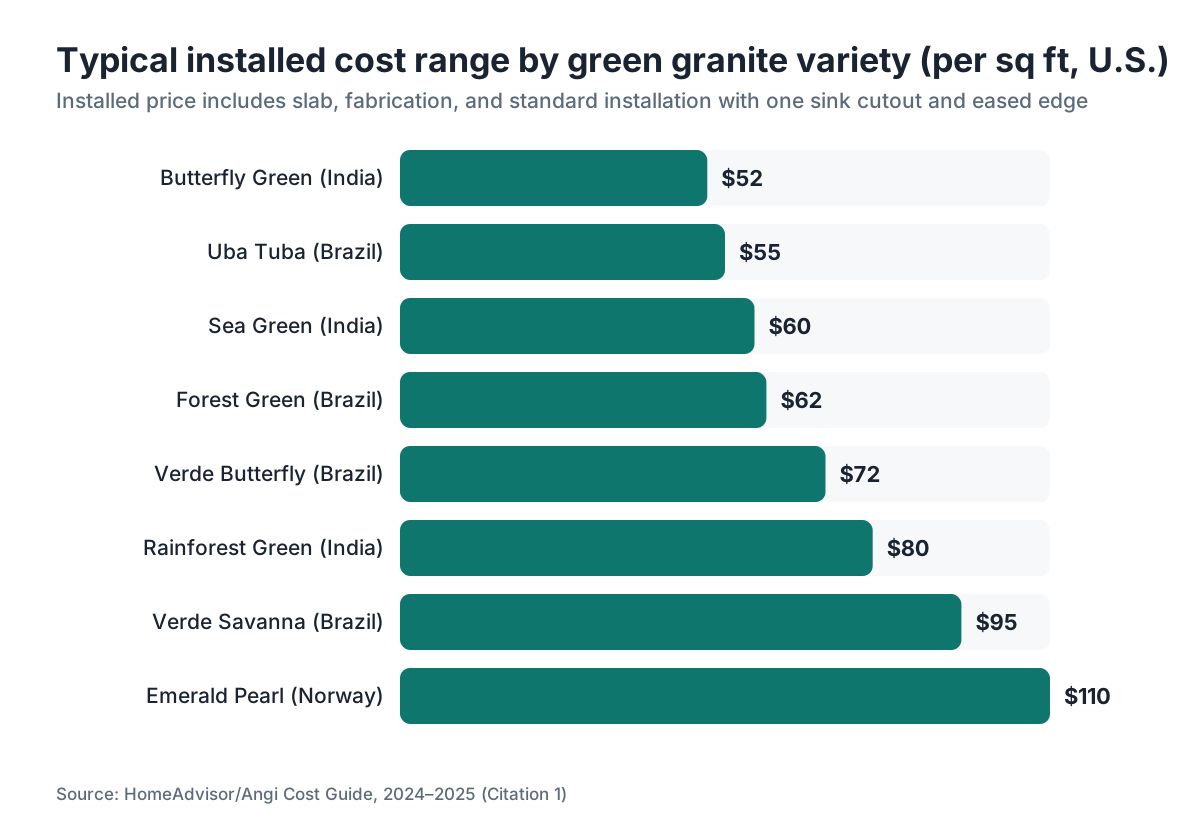
Here's how the most widely available green granites stack up. Prices are approximate, installed, in the U.S. market as of mid-2025, and they move with region, slab thickness, and edge profile.
| Variety | Origin | Dominant look | Installed price range (per sq ft) | Porosity | Best use |
|---|---|---|---|---|---|
| Uba Tuba | Brazil | Very dark green-black, gold/green sparkle | $40, $70 | Low | High-traffic kitchens |
| Verde Butterfly | Brazil | Gray-green, sweeping white/black veining | $55, $90 | Low-medium | Kitchen islands, dramatic statement |
| Sea Green | India | Olive-green, subtle grain, calm movement | $45, $75 | Low | Understated kitchens, bathrooms |
| Emerald Pearl | Norway | Very dark, iridescent labradorescent sheen | $80, $140 | Low | Contemporary, luxury kitchens |
| Verde Savanna | Brazil | Medium green, bold white/black veining | $70, $120 | Medium | Feature islands |
| Butterfly Green | India | Pale sage, irregular dark movement | $40, $65 | Low-medium | Budget-friendly green option |
| Rainforest Green | India | Green with brown/gold veining | $60, $100 | Medium | Eclectic or warm-toned kitchens |
| Forest Green | Brazil | Deep forest tone, low movement | $45, $80 | Low | Modern and transitional kitchens |
Uba Tuba is the single most popular green granite in the U.S., mostly because it's priced accessibly and hides crumbs, smudges, and wear better than any lighter stone. Want something that takes care of itself visually? Uba Tuba is the honest answer.
Emerald Pearl is the priciest here for a reason. Norway's Larvik quarry produces a limited supply, and the iridescent effect is genuinely hard to fake. It also photographs beautifully, which is why it shows up so often in design media.
For kitchen countertops where the homeowner wants green without drama, Sea Green and Butterfly Green are underrated. They read as neutral in most lighting and pair with both warm and cool cabinetry.
How much do green granite countertops cost?
Green granite runs about $40 per square foot installed on the low end (basic Butterfly Green or Uba Tuba, simple edge, straightforward layout) up to $200 or more for rare exotics, thick slabs, or complex fabrication loaded with cutouts and mitered edges [1]. That's the honest range.
The main cost drivers, roughly in order of impact:
-
The slab itself. Quarry availability, import costs, and fabrication waste all feed into slab price. Exotic stones like Emerald Pearl or dramatic Brazilian slabs cost more partly because the slabs are larger and heavier to ship, partly because demand outpaces supply.
-
Fabrication complexity. A simple 30-square-foot run with one sink cutout costs less per square foot than an island with a waterfall edge, undermount sink, and cooktop cutout. Every cutout and every linear foot of specialty edge adds labor.
-
Thickness. Standard countertops use 3/4-inch (2 cm) or 1.25-inch (3 cm) slabs. The 3 cm slab looks more substantial and skips the built-up edge needed to fake thickness, but it weighs more and costs more per square foot.
-
Region. Labor costs swing hard. The same Uba Tuba slab costs more to fabricate and install in San Francisco than in Tulsa.
For granite countertops generally, the National Kitchen and Bath Association has tracked installed costs in the $50, $150 per square foot range for mid-grade material, which matches where most green options land [2].
A typical kitchen with 50 square feet of countertop comes out to $2,000, $7,500 installed for a mainstream green granite. That's a real number, not a marketing range, though premium material and complex work push it higher.
Fabricators: if you quote green granite jobs and fight the waste factor on slabs with dramatic veining like Verde Butterfly, a digital nesting tool cuts slab waste in a way manual layout can't. SlabWise's quoting and nesting software handles it automatically if you want to see how it does on your typical job mix.
Is green granite good for kitchen countertops?
Yes, with a few caveats. Granite is one of the harder natural stones used for countertops, typically 6 to 7 on the Mohs hardness scale [3]. Knives won't scratch it under normal use (though you'll dull your knives long before the granite notices). It shrugs off heat better than engineered surfaces: set a hot pan straight on granite and it won't crack or discolor the way quartz can.
Green granites tend to cluster toward the denser end of the granite range. Uba Tuba has a very low water absorption rate, which is why fabricators and homeowners both like it. More porous options like Rainforest Green or some Verde Savanna slabs need sealing more attentively. That's a maintenance step, not a dealbreaker.
The honest limitations:
Granite can chip at the edges if you slam something heavy and sharp into a corner. Thin edges (like a 1/4-inch pencil edge) are more exposed than a heavier bullnose or eased edge. Small kids or a busy kitchen? Pick a thicker, more forgiving edge profile.
Dark greens like Uba Tuba show white residue from hard water, dried soap, and mineral deposits more than a lighter stone would. Wiping the sink area dry after use becomes a habit fast.
Against other kitchen countertops, green granite competes well with marble countertops (which etch from acids and need more care) and easily beats laminate countertops or formica countertops on durability, though those cost far less upfront.
What cabinet and paint colors pair well with green granite?
This is where homeowners get tripped up. Green granite has undertones that read differently in person than in photos, so matching it to cabinetry means seeing actual samples under your own kitchen lighting.
For dark greens (Uba Tuba, Emerald Pearl, Forest Green):
- White or cream cabinets work because the contrast is high and the green reads almost as a dark neutral.
- Natural wood tones (white oak, walnut, maple) complement the mineral look without fighting it.
- Black cabinetry can work with Emerald Pearl specifically because the iridescence keeps the combination from going flat.
- Skip gray-blue cabinets unless you've confirmed the undertones don't clash with the gold or brown flecks in your slab.
For medium greens (Sea Green, Butterfly Green, Verde Butterfly):
- Warm whites and off-whites are safest. True bright white can make these stones look muddy.
- Sage green cabinetry with a lighter green granite sounds like too much green, but it often works because the tones are close enough to read as one palette.
- Warm terracotta or cream cabinetry pairs well with the olive-leaning Indian greens.
For dramatic patterned greens (Verde Savanna, Rainforest Green):
- Simple, quiet cabinetry. These slabs already have a lot happening. A white or single neutral cabinet lets the stone carry the room.
- Busy hardware or a loud tile backsplash competes. Keep the surrounding elements calm.
Wall color matters too. A green granite under warm yellowed walls looks very different from the same stone under cool gray walls. The minerals in the slab respond to whatever reflects off the walls.
One concrete recommendation: get a real sample (a piece at least 8x8 inches, not a small chip) and live with it in your kitchen for a few days. Morning light, evening artificial light, and overcast midday are three different scenarios, and they'll show you three different stones.
How do you seal and maintain green granite countertops?
Granite needs a penetrating sealer because it's porous at the microscopic level [4]. The sealer doesn't coat the surface like wax. It fills the tiny pores so liquids can't soak in and stain. Most residential green granites need sealing every one to three years, depending on the stone's porosity and how hard the countertop gets used.
The water test tells you if the sealer still works. Pour a few tablespoons of water on the counter, wait 15 minutes, then wipe it off. If the stone darkens where the water sat, reseal. If it looks unchanged, you're fine.
For daily cleaning, pH-neutral dish soap in warm water is enough. The acids in vinegar, lemon juice, and many "natural" cleaners break down the sealer over time and eventually etch the surface. Harsh abrasives scratch the polish. For more detail, the guidance in how to clean stone countertops applies directly to green granite.
Sealing is easy. Clean the surface, let it dry completely, wipe on the sealer with a clean cloth, let it soak for the time on the label (usually 10 to 30 minutes), then wipe off the excess. No sanding, no cure time, no pro required. Products like StoneTech BulletProof or Tenax Hydrex have a good reputation in the trade, though the brand matters less than using an actual penetrating sealer instead of a topical one.
For hard, dense stones like Uba Tuba, you might go two to three years between sealings. More porous options like Rainforest Green earn a yearly schedule. When in doubt, do the water test.
A couple more notes. Don't use the countertop as a cutting board, even though the granite could take it, because your knives can't. Wipe up oil-based spills fast. Oil penetrates the sealer more aggressively than water and leaves a dark stain that's hard to pull back out.
How does green granite compare to green quartz and other green countertop options?
Green countertop options in 2025 include natural granite, engineered quartz, recycled glass surfaces, soapstone (which skews gray-green), and green-hued porcelain slabs. Each one makes a different tradeoff.
Green granite vs. green engineered quartz (like Cambria countertops or other quartz brands):
Quartz is non-porous and never needs sealing. That's a real convenience win. The color is consistent slab to slab because it's manufactured, which makes matching a future repair easier. The catch is heat. Most quartz makers explicitly tell you to use a trivet, because the polymer resin binding the quartz particles can discolor or crack from sudden heat [5]. Granite has no such limit.
Quartz also can't reproduce the mineral sparkle or natural movement of stones like Emerald Pearl or Verde Butterfly. Manufactured green quartz looks noticeably uniform up close. Some people love that. Some find it flat.
Green granite vs. soapstone: Soapstone is naturally non-porous (mostly talc and chlorite) and needs no sealing, but it's soft enough to scratch and dent under regular kitchen use [6]. The green-gray versions are elegant, but the mindset is different: you're accepting a surface that patinas and marks rather than one that resists marking. See how to clean soapstone countertops for what that maintenance looks like.
Green granite vs. butcher block countertops: Not a direct competitor in most kitchens, but some people pair green granite perimeter counters with a wood island or prep zone. The contrast works, and the two surfaces have different care needs, which some find annoying and others find fine.
Want natural stone with real variation, heat resistance, and long-term durability? Granite wins on those. Want zero maintenance and perfect color consistency? Engineered quartz is the rational pick.
Does green granite add resale value to a home?
Probably yes, but the granite doesn't deserve all the credit. Kitchen renovations with new countertops rank among the improvements buyers notice and pay attention to. The National Association of Realtors' Remodeling Impact Report found that kitchen upgrades, countertop replacements included, recoup a meaningful share of their cost at resale, though the exact recovery varies by project and local market [7].
What the data doesn't back is the idea that a specific countertop color turns into a clean price premium. A well-executed green granite in a kitchen that cohesively matches its cabinets is an asset. A dark green granite clashing with outdated cabinetry in a house full of mid-2000s beige is more likely a neutral or slight negative for buyers who'd have to rip it out.
Fabricators and real estate agents mostly agree on one thing: natural stone is expected in a certain price tier of home. In markets where comparable houses have natural stone, not having it hurts resale more than having it helps. In lower price tiers, laminate countertops or Corian countertops are common enough that granite isn't a strong differentiator.
Green specifically is a calculated risk if resale is on your mind. Neutral granites (whites, creams, grays) appeal to more buyers. Deep Uba Tuba reads nearly neutral because it's so dark it acts like a black surface. The statement greens, like Verde Savanna with bold white veining, thrill some buyers and make others start pricing a replacement in their heads. If resale is your top priority, lean toward Uba Tuba or another darker, less polarizing variety.
What should you know before buying and installing green granite?
A few things catch people off guard during the buying process.
You're buying the actual slab, not a category. Two slabs of "Uba Tuba" from the same quarry can differ noticeably in pattern density or background tone. If the exact look matters, visit the slab yard, approve the specific slab that'll be cut for your job, mark it, photograph it, and confirm with your fabricator which slab is reserved for you.
Movement in the slab affects layout. Slabs with dramatic veining (Verde Butterfly, Verde Savanna) need careful nesting to match or balance the pattern across the run, especially at a seam. Ask your fabricator how they'll handle the pattern across any seam, and make them show you the layout before cutting. This is exactly where digital nesting tools like SlabWise change slab utilization, dropping both waste and cost on patterned material.
Lead times vary. A common stone like Uba Tuba is often in stock locally. An exotic or large-format slab may need to be ordered from a regional distributor, with two to six week lead times. Build that into your schedule.
Edge profiles cost money. A standard eased edge is usually in the base price. A mitered waterfall edge, ogee, or stacked laminated edge adds labor and material. Get full edge pricing upfront.
Template before you order anything else. Your fabricator should template (digitally or physically) after the cabinets are fully installed and level. Nothing gets cut until the template is done. This is the step that prevents expensive mistakes. See countertop installation for the full breakdown of what installation involves.
Inspect the slab for fissures, pits, and natural voids before fabrication starts. These are natural features of granite, not defects, but you want to know where they are so the layout can hide them in less visible spots or dodge them entirely.
Are there any health or safety concerns with green granite?
The radon question comes up most. Some granites do contain trace amounts of uranium and thorium, which decay into radon gas [8]. The EPA has studied this, and the consistent finding is that granite countertops are not a significant source of indoor radon compared to soil and foundation pathways, which are the dominant radon sources in U.S. homes [9]. EPA guidance states that "although some granite may emit radon, the levels are generally very low and not a significant health risk."
Worried anyway? The right move is testing your home's air for radon (the EPA recommends every home test), not avoiding granite. Radon test kits run $15, $30 at hardware stores and give you actual data about your home instead of material-specific guessing [9].
The other concern people raise is crystalline silica dust during fabrication. That's a real occupational hazard for the people cutting and grinding stone in a shop, not for homeowners living with the finished surface. OSHA set permissible exposure limits for silica dust and issued a specific construction standard (29 CFR 1926.1153) covering workers handling siliceous materials [10]. Fabricators should be wet cutting and wearing proper respiratory protection. Once a countertop is polished and installed, it isn't releasing silica into your home's air.
For everyday use, a sealed granite countertop is food-safe. The surface doesn't harbor bacteria the way a porous or cracked one would, and no special cleaning agents are needed.
How do you find a reputable fabricator and get a fair price?
Getting a fair price on green granite is easier once you understand what you're actually buying. The installed price has three parts: slab cost, fabrication cost (cutting, edging, sink cutout, polishing), and installation labor. Some shops quote these separately, some give one number. Either way, ask for the breakdown.
Get at least three quotes. Not so you take the lowest one, but because three quotes tell you if one shop is way out of line in either direction. A quote 40% below the others is worth a second look: thinner material? A greener crew? A lower-grade slab?
Ask to see finished work with similar material. A shop that's done a lot of dark green granite has calibrated its equipment and process for it. Ask specifically whether they've worked with the variety you picked.
Check licensing rules for your state. Several states require a contractor's license for stone installation. California, for one, requires a C-54 Tile (Ceramic and Mosaic) contractor license for stone installation work [11]. Rules vary by state, so check your local contractor licensing board.
One test for online quote tools: if the tool doesn't ask for your specific slab variety and edge profile before spitting out a price, the number isn't reliable. A real quote needs at minimum the square footage, material grade, edge profile, cutout count, and whether any seams are required.
Fabricators reading this: a consistent quoting workflow matters more than most shops admit. Inconsistent quotes lose jobs, and worse, they create margin problems when you win them at the wrong price. A quoting tool built for stone fabrication, not a generic spreadsheet, handles material yield and edge pricing the way they actually behave.
Frequently asked questions
Is green granite hard to maintain compared to other countertop materials?
No, it's about average for natural stone. Most green granites need sealing every one to three years with a penetrating sealer, plus regular cleaning with pH-neutral soap and water. That's less work than soapstone, which needs periodic oiling, and roughly equal to other granite colors. It's more involved than quartz, which needs no sealing, but the tradeoff is granite's better heat resistance.
Will green granite look dated in a few years?
Darker greens like Uba Tuba have been on the market continuously since the 1990s and haven't noticeably dated. Statement greens with bold movement are more trend-dependent, like any bold design choice. If longevity matters to you, Uba Tuba or Sea Green are safer bets than a highly patterned Verde Savanna, which reads more as a specific design moment.
What is Uba Tuba granite and why is it so popular?
Uba Tuba is a dark green-black granite quarried in Brazil, named after a coastal city in São Paulo state. It's popular because it's priced accessibly ($40, $70 per sq ft installed in most U.S. markets), very low-porosity and forgiving to seal, and good at hiding daily grime and water spots. Its dark neutral tone pairs with almost any cabinet color. It's been the bestselling green granite in the U.S. for decades.
How does Emerald Pearl granite differ from other green granites?
Emerald Pearl comes from a single quarry in Larvik, Norway, and gets its look from a high concentration of labradorite feldspar that produces an almost iridescent sheen. It's darker than most green granites, closer to black-green, and the optical effect shifts dramatically with the light angle. Supply is tighter than Brazilian or Indian greens, which keeps the price higher, typically $80, $140 per sq ft installed.
Can you use green granite in a bathroom?
Yes, and it works especially well in bathrooms because the square footage is small, so even a pricey slab stays within a manageable budget. Dark green like Uba Tuba with white fixtures is a classic combination. The same sealing and cleaning rules apply. Avoid leaving soap, shampoo bottles, or standing water on unsealed granite, since the minerals in soap can leave residue.
Is green granite more or less expensive than white granite?
At the mainstream level, green and white granites price out similarly. Common whites like Colonial White or White Ice run $45, $85 per sq ft installed, overlapping directly with Uba Tuba and Sea Green. Exotic whites like White Fantasy or Super White command premiums close to premium greens. The rarity of the specific quarry, not the color itself, drives price differences at the upper end.
What edge profile works best with green granite countertops?
For dark greens like Uba Tuba, an eased or slightly beveled edge looks clean and modern. For slabs with visible movement (Verde Butterfly, Verde Savanna), an eased or bullnose edge lets the pattern be the focus. Mitered waterfall edges suit patterned greens on islands but add significant fabrication cost. Avoid very thin pencil edges on dark stones, since chips show more prominently at a fine edge.
How do I get an accurate quote for green granite countertops?
Measure your square footage accurately (length x depth of each run, added up), then tell the fabricator your chosen material, desired edge profile, and how many sink or cooktop cutouts you need. Those four inputs drive most of the price. Get at least three quotes. Be skeptical of any quote that doesn't ask about edge profiles and cutouts, because a shop quoting without those details is guessing.
Does green granite stain easily?
Low-porosity greens like Uba Tuba resist staining very well when sealed. More porous varieties like Rainforest Green are more vulnerable, especially to oil-based spills. In every case, the sealer is your main protection: wipe up oily spills fast, reseal on schedule, and don't park a full olive oil bottle on the stone long-term. With proper care, staining is rare.
What backsplash tile works with green granite countertops?
Simple is usually better. White subway tile, cream limestone, or a neutral stone mosaic keeps the attention on the granite instead of competing with it. If your green granite has gold or brown flecks (like Uba Tuba or Rainforest Green), a warm-toned backsplash in terracotta, cream, or beige pulls those tones forward. Skip backsplash tiles with strong pattern if the countertop already has strong movement.
Can green granite countertops be repaired if they chip?
Small chips and edge damage can be repaired by a stone restoration pro using color-matched epoxy or polyester filler. On very dark greens like Uba Tuba, a good repair is nearly invisible. On slabs with complex mineral patterns, matching the fill color to the exact spot takes skill. Large cracks usually mean replacing the section. Prevention is easier: use a thicker edge profile in high-traffic corners.
Is green granite a good choice for outdoor kitchens?
Granite handles outdoor use reasonably well because it's UV-stable (the color won't fade in sunlight), hard, and heat-tolerant. The concern outdoors is freeze-thaw cycling in cold climates: water that has soaked into unsealed pores can expand and crack the stone over repeated freezes. Seal outdoor granite at least annually, and lean toward a very low-porosity stone like Uba Tuba or Emerald Pearl for outdoor use.
Sources
- HomeAdvisor (Angi), Granite Countertops Cost Guide: Installed granite countertop prices range from approximately $40 to $200 per square foot depending on material grade, fabrication complexity, and region
- National Kitchen and Bath Association, NKBA Design Trends and Cost Data: Installed granite countertop costs for mid-grade material consistently tracked in the $50, $150 per square foot range
- U.S. Geological Survey, Hardness of Common Minerals (Mohs Scale reference): Granite typically rates 6 to 7 on the Mohs hardness scale due to its quartz and feldspar content
- Natural Stone Institute, Care and Maintenance of Natural Stone Surfaces: Penetrating sealers are recommended for granite because the stone is porous at the microscopic level and susceptible to liquid absorption and staining without treatment
- NSF International, Standard 51 Food Equipment Materials (referenced by quartz manufacturers for heat limitations): Engineered quartz manufacturers advise against direct heat contact due to the polymer resin binder, which can discolor or crack under sudden thermal exposure
- National Association of Realtors, Remodeling Impact Report: Kitchen upgrades, including countertop replacements, rank among home improvements that buyers notice and that can recoup meaningful cost at resale
- U.S. Environmental Protection Agency, Radiation Protection: Some granite contains trace amounts of uranium and thorium that decay into radon, but EPA guidance states the levels from countertops are generally very low and not a significant health risk
- U.S. Environmental Protection Agency, Radon: A Citizen's Guide: EPA recommends every home be tested for radon; soil and foundation pathways are the dominant radon sources in U.S. homes, not countertop materials
- U.S. Occupational Safety and Health Administration, Crystalline Silica Standard (29 CFR 1926.1153): OSHA established permissible exposure limits for crystalline silica dust and issued 29 CFR 1926.1153 specifically covering construction workers handling siliceous materials including stone fabrication
- California Contractors State License Board, License Classifications: California requires a C-54 Tile (Ceramic and Mosaic) contractor license for stone countertop installation work
Last updated 2026-07-10