TL;DR
- Granite countertops typically cost $40 to $200 or more per square foot installed, with most homeowners paying $50 to $100 per square foot for mid-grade material, fabrication, and installation.
- Total kitchen projects commonly run $2,000 to $8,000.
- Price depends on stone grade, edge profiles, cutouts, and your region.
- Entry-level slabs start around $15, $25 per sq ft material-only.
What does granite cost per square foot in 2025?
The honest range is $40 to $200 per square foot installed, and that spread is real, not a hedge. A basic Level 1 granite in a straightforward kitchen with simple edges and no fancy cutouts lands right at $40 to $55 per square foot all-in. A rare exotic slab, book-matched, with waterfall edges and multiple sink cutouts can blow past $200 per square foot without anyone doing anything wrong.
Most homeowners end up somewhere in the $60 to $100 per square foot range for a mid-grade granite with a standard edge, one undermount sink cutout, and professional installation. For a typical kitchen with 40 to 60 square feet of countertop, that works out to $2,400 to $6,000 total. The national average floats around $3,200 to $4,500 depending on which survey you look at, though regional labor costs move that number a lot.
Material-only prices, when you buy a slab direct from a distributor or big-box store and hire fabrication separately, run roughly $15 to $50 per square foot for the stone itself. Fabrication (cutting, polishing, edge work) adds another $20 to $40 per square foot on top of that. Installation typically adds $10 to $30 per square foot depending on complexity. Those three buckets together make up your installed price.
Here's something fabricators don't always say out loud. Many shops quote in square footage but price their labor per linear foot of edge work, because edging is where the time goes. Ask for an itemized quote that separates slab cost, fab cost, and install cost. You'll spot waste faster that way.
For a full overview of granite as a material, see our guide to granite countertops.
What drives granite countertop prices up or down?
Stone grade is the biggest single variable. Fabricators and distributors sort granite into levels, usually labeled Level 1 through Level 4 or sometimes Level 5 and beyond, though the labeling is not standardized across the industry. A Level 1 stone is typically a thinner slab (often 3/4 inch or 2 cm) in a common color like Santa Cecilia or Uba Tuba, imported in high volume. A Level 4 stone might be a 1.25-inch (3 cm) rare-color granite quarried in small quantities.
Thickness matters on its own, separate from grade. Three-centimeter slabs (about 1.25 inches) are stronger and need less support, but they cost more. Two-centimeter slabs are cheaper, but they usually need a plywood substrate and crack more easily during fabrication. The price difference between 2 cm and 3 cm in the same color runs $5 to $15 per square foot.
Edge profiles add cost fast. A simple eased or beveled edge is usually baked into a base quote. Ogee, dupont, laminated mitered edges, or anything that needs multiple router passes can add $15 to $40 per linear foot. A 30-linear-foot kitchen perimeter with an ogee edge could add $450 to $1,200 to your total.
Cutouts are a big hidden cost. A standard undermount sink cutout runs $150 to $250. A cooktop cutout is similar. Each one adds setup time and raises the risk of cracking a slab. Faucet holes usually cost $25 to $50 each.
Seams cost money too, in labor and in how the counter looks. Larger kitchens or L-shapes almost always need at least one seam. Seam placement and color-matched epoxy fills add $150 to $300 per seam in most markets.
Region changes everything. Labor in San Francisco or New York runs 30 to 50 percent higher than labor in Memphis or Kansas City. Stone distributors also price by shipping distance from ports. Granite from Brazil, India, Norway, or Italy arrives through specific ports, and shops near those ports pay less for freight.
How do granite grades work and what does each level cost?
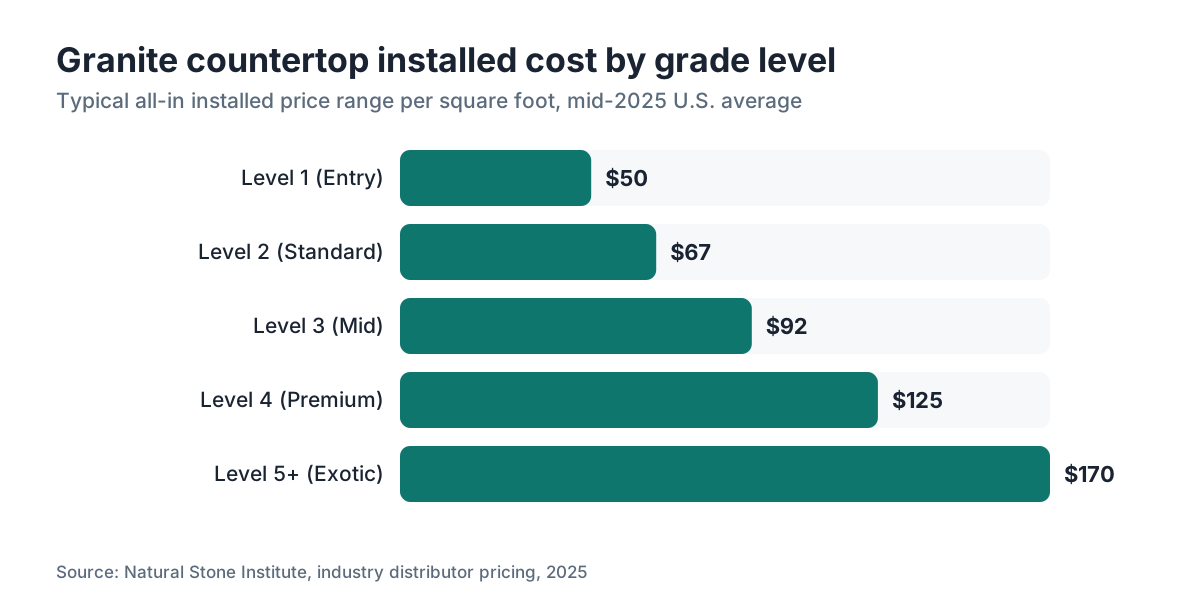
Grade levels are a sales tool invented by distributors, not a formal quality standard. No industry-wide body certifies a stone as Level 2 versus Level 3. That said, the levels do track real differences in rarity, thickness, visual movement, and import cost.
| Grade Level | Typical Slab Thickness | Approx. Material Cost (per sq ft) | Approx. Installed Cost (per sq ft) | Example Colors |
|---|---|---|---|---|
| Level 1 (Entry) | 2 cm | $15, $25 | $40, $60 | Uba Tuba, Santa Cecilia, Baltic Brown |
| Level 2 (Standard) | 2 to 3 cm | $25, $40 | $55, $80 | Giallo Ornamental, New Venetian Gold |
| Level 3 (Mid) | 3 cm | $40, $60 | $75, $110 | Bianco Romano, Azul Platino |
| Level 4 (Premium) | 3 cm | $60, $90 | $100, $150 | Blue Bahia, Titanium, Lemurian Blue |
| Level 5+ (Exotic) | 3 cm | $90, $150+ | $140, $200+ | Van Gogh, Fantasy Brown, rare book-match slabs |
Those material cost figures reflect typical distributor pricing in mid-2025 for standard slab sizes (roughly 50 to 60 square feet per slab) [1]. They shift with region, current quarry output, and currency exchange rates, since most granite is priced in USD but quarried abroad.
One honest reality: Level 1 granite from a good shop, well-fabricated, looks excellent. The jump from Level 1 to Level 2 is often more about color availability than quality. The jump from Level 3 to exotic is where you're genuinely paying for rarity. If your kitchen design works with a Level 1 or 2 stone, nothing about it is structurally inferior.
If you're comparing granite to engineered stone, our kitchen countertops guide puts the full material comparison in one place.
How much does a full kitchen granite countertop project cost?
A typical U.S. kitchen has 30 to 60 square feet of countertop, though larger kitchens with islands push that to 80 to 100 square feet. Match those ranges against realistic installed price bands and the totals come out like this:
| Project Size | Sq Ft | Low End ($50/sq ft) | Mid ($80/sq ft) | High ($130/sq ft) |
|---|---|---|---|---|
| Small kitchen | 30 sq ft | $1,500 | $2,400 | $3,900 |
| Average kitchen | 45 sq ft | $2,250 | $3,600 | $5,850 |
| Large kitchen | 65 sq ft | $3,250 | $5,200 | $8,450 |
| Kitchen + island | 80 sq ft | $4,000 | $6,400 | $10,400 |
Those numbers assume one sink cutout, a standard edge profile, and no backsplash. Add $300 to $500 for a backsplash if you want the same stone continued up the wall.
Demolition and removal of old countertops adds $150 to $400 depending on what's there and how it was installed. Most shops offer removal, or you can DIY it to save money. Old tile counters are messier and more expensive to remove than laminate.
Plumbing disconnection and reconnection is sometimes handled by the fabricator's installer and sometimes needs a licensed plumber. In states with strict plumbing licensing rules, that's a separate $150 to $300 cost. Ask before you sign any contract.
If this is a full kitchen remodel, granite countertops usually run 10 to 20 percent of the total renovation budget. The National Kitchen and Bath Association reports a major remodel averages around $25,000 and a minor one around $15,000 [2].
What are the installation costs for granite countertops?
Installation is often folded into the per-square-foot price, but you should understand what you're actually paying for. It covers templating, delivery, placement, securing the stone, and silicone sealing around sinks and walls.
Templating, where a technician comes to your kitchen and measures precisely, costs $50 to $200 as a standalone service if it isn't included. Most fabricators fold it into the quote. Digital templating with a laser measure or Proliner device is now standard at larger shops and cuts error a lot. Traditional wood or cardboard templating still works fine and is common at smaller shops.
Delivery and install day usually involve two to four workers, because granite slabs are heavy. A 3 cm slab runs roughly 18 to 20 pounds per square foot. A 50-square-foot countertop weighs 900 to 1,000 pounds, and the crew has to walk that through your house. Damage to door frames, floors, and cabinets happens with inexperienced crews. Ask about their damage policy before install day.
Installation labor by itself, separate from material and fabrication, runs $200 to $600 for most kitchens. In high-cost metros it can hit $800 to $1,200.
The extra charge homeowners least expect is cabinet leveling. If your cabinet run isn't level, the fabricator has to shim the stone and sometimes scribe the back edge. That adds $100 to $300 and it's legitimately necessary for a good result. It's not a scam. It should be disclosed before install day, not billed as a surprise.
See our full guide on countertop installation for a detailed walkthrough of the process.
How does granite price compare to quartz, marble, and other countertop materials?
Granite's price range overlaps a lot with quartz and marble, which surprises homeowners who expect a clean hierarchy. Here's an honest comparison:
| Material | Installed Cost Range (per sq ft) | Maintenance Cost | Notes |
|---|---|---|---|
| Granite (entry) | $40, $60 | Low (seal every 1 to 3 yrs) | Best value in stone |
| Granite (premium/exotic) | $100, $200+ | Low | Price rivals marble |
| Quartz (engineered) | $55, $150 | Very low (no sealing) | Consistent look, no natural variation |
| Marble | $75, $250 | Medium-high (etching, sealing) | Softer, more maintenance-prone |
| Quartzite | $65, $200 | Low-medium | Often confused with quartz; it's a natural stone |
| Laminate | $15, $40 | Very low | Can look convincing; not heat-proof |
| Butcher block | $35, $75 | Medium (oiling) | Warm look; not for wet areas without sealing |
For most kitchens, entry-level granite is the best value in natural stone. It's harder than marble, more heat-resistant than engineered options, and the price competes with good quality laminate countertops once you factor in longevity.
Mid-range granite and mid-range quartz are priced almost identically in most markets, which is why fabricators quote them side by side. Quartz wins on consistency and zero-sealing maintenance. Granite wins on heat resistance and a look nobody else has, since no two slabs are alike.
Marble countertops look stunning but etch from acidic foods and demand more upkeep. Granite doesn't etch. That's a practical daily-use difference worth knowing.
Engineered brands like Cambria countertops sit at $80 to $150 per square foot installed and compete head-to-head with Level 3 and Level 4 granite on price.
How do fabricators actually calculate a granite countertop quote?
Understanding how shops build their quotes helps you read proposals critically. Most fabricators start with a square footage takeoff of your countertop area, often with a minimum order (many shops won't fabricate less than 15 to 20 square feet). They multiply that by the slab cost per square foot, add fabrication labor, then add line items for edges, cutouts, seams, and installation.
The slab is often priced at the full slab even if your project doesn't use all of it. This is called waste or overage. A typical 3 cm granite slab is 50 to 65 square feet. If your kitchen needs 40 square feet, you may be buying 50 to 55 square feet of material on paper because of how the pieces cut from the slab. High-volume shops can use remnants from other jobs, which drops your cost. Ask if they have remnant pieces in your color, especially for smaller projects.
Fabrication software tools, like SlabWise, let shops digitally nest your template against the actual slab to squeeze out more yield and cut waste, which makes a real difference in material cost on larger projects. If a shop is quoting you on square footage, ask whether their price reflects actual slab yield or a flat rate.
Edges are often priced per linear foot of exposed edge. A kitchen might have 25 to 40 linear feet of exposed edge. At $15 per linear foot for a basic edge, that's $375 to $600. An ogee edge at $35 per linear foot would be $875 to $1,400 for the same kitchen. That one decision changes your total by $500 or more.
Get at least three quotes from local fabricators. Prices vary 20 to 30 percent between shops for identical stone and work, and you'll learn a lot from how they itemize the differences.
What extra costs should you budget for that aren't in the base quote?
Most quotes cover material, basic fab, and installation onto existing level cabinets. Here are the extras that regularly catch homeowners off guard:
Support corbels or brackets: Required if you have an overhang greater than 10 to 12 inches without cabinet support underneath. Each corbel runs $50 to $150 installed.
Sealer application: Some shops apply the first sealer as part of installation. Many don't. A professional sealer application runs $75 to $200. DIY sealers cost $15 to $50 per bottle and work fine if you follow directions. The Natural Stone Institute recommends testing seal effectiveness with the water droplet test annually and resealing when water no longer beads [3].
Plumbing reconnection: See the installation section above. Budget $150 to $300 if you can't DIY it.
Permits: Countertop replacement in an existing kitchen almost never needs a permit in most U.S. jurisdictions. If it's part of a full renovation involving electrical or plumbing, your contractor should pull the appropriate permits. Check with your local building department. The International Residential Code, which most U.S. jurisdictions have adopted, governs residential construction [4].
Disposal of old countertops: Usually $50 to $150 extra if the fabricator handles it. Some areas have recycling options for stone.
Backsplash tile work: If you want a tile or stone backsplash as part of the project, that's typically a separate contractor and a separate quote.
Total typical extras above the base quote: $300 to $800 for an average kitchen. Budget for them up front instead of getting surprised.
Does granite add value to your home?
The short answer is yes, but probably not dollar for dollar. Remodeling Magazine's annual Cost vs. Value Report consistently shows minor kitchen remodels (which include countertop upgrades) recoup 70 to 80 percent of project cost at resale in most U.S. markets [5]. A major kitchen remodel recoups less, around 50 to 60 percent nationally.
Spend $5,000 on granite countertops and you might add $3,500 to $4,000 to your home's value on average. But that's a national average. In a market where granite is the baseline buyers expect for homes in a certain price range, not having it can hurt your sale price more than having it helps.
Appraisers and real estate agents consistently rank updated countertops among the top three things buyers notice in kitchens, alongside appliances and cabinets. Granite signals durability and quality in ways laminate simply doesn't, no matter how far laminate technology has come.
Selling within two years? The value-add math matters a lot. Staying ten years? Buy what you actually want to live with. The money calculus comes second.
For a broader look at how granite stacks up against other materials, the kitchen countertops comparison is a good next read.
How do you get an accurate granite countertop quote?
Measure your countertop area first, or get a rough measure. For each section, multiply length by depth and add them up. Standard counter depth is 25.5 inches (about 2.1 feet). A 10-foot run of counter is roughly 21 square feet. An island at 4 feet by 6 feet is 24 square feet. Write down total square footage before you call any shop.
Know your edge preferences before the consultation. Look at photos online (Houzz is useful for this) and come in with a preference. Shops can burn 20 minutes teaching you about edges when you could have decided in advance.
Ask each shop to quote in writing with line items for: stone cost per square foot, total square footage, edge profile cost per linear foot, number of cutouts and their cost, seam count and cost, and installation. Any shop that refuses to itemize is either hiding something or is disorganized. Neither is what you want.
Ask about slab selection. Will you choose your specific slab at the yard, or will the shop pick one from a lot? Slab selection is worth doing in person for anything above Level 1, because veining, color variation, and pattern movement change enormously slab to slab. What you see on a sample board in the showroom is a 12-inch tile, not a slab.
Ask about lead time. Typical lead time from measure to install is two to three weeks. High-demand shops in busy seasons may quote four to six weeks. Custom work or special-order stone takes longer.
Want an instant ballpark before calling any shops? Use the SlabWise quote tool to get a calibrated range for your region before you walk into a showroom. Coming in with a number in your head makes the conversation go better.
For cleaning and sealing granite once it's installed, our how to clean stone countertops guide covers everything you need.
Is granite worth it compared to cheaper alternatives?
Granite at Level 1 to 2 pricing ($40 to $70 per square foot installed) competes head-to-head with high-quality laminate or solid surface once you account for longevity. A properly sealed granite countertop installed today should last the lifetime of the house with normal care. Most laminate countertops last 10 to 20 years before swelling edges, worn surfaces, or dated patterns prompt replacement.
Formica countertops and other laminate products now look remarkably good and cost $15 to $40 per square foot installed. If your budget is tight and your kitchen is a rental or a starter home you'll sell in five years, laminate is a reasonable choice and nobody should shame you for it.
Butcher block countertops at $35 to $75 per square foot installed are warm and beautiful but need oil maintenance and can't handle pooling water near a sink without proper sealing. They're excellent for islands that see cutting board use.
Corian countertops (solid surface) run $45 to $80 per square foot installed. They're joined without visible seams, repairable, and come in many colors. They scratch more easily than granite and can't take direct heat.
For most homeowners who plan to stay more than five years and want a low-maintenance natural stone, entry to mid-level granite is the best combination of price, durability, and looks you can buy. That's not an inflated claim. It's the reason granite has stayed the most popular countertop stone in U.S. kitchens for decades, with roughly 30 to 35 percent market share in natural stone applications [6].
What should you watch out for when buying granite countertops?
Bait-and-switch on slab grade happens. A shop advertises granite starting at $35 per square foot and gets you in, then shows you the Level 1 stone (thin, limited in color, and often doesn't match your kitchen). The upgrade to something you actually like lands at $65 to $80. This isn't always dishonest, but know what to expect going in.
Measuring errors cut both ways. An overestimate means you're paying for stone that gets thrown away. An underestimate means the shop orders another slab and you may wait three weeks for the second piece, or they cobble together remnants that don't match well. Ask the fabricator to confirm their measurement against yours before they order.
Radon is a real but usually minor concern. The EPA has noted that some granite can emit small amounts of radon gas, though levels in most installed countertops sit well below action thresholds [7]. If you're worried, EPA-certified radon test kits cost $15 to $30 and measure air concentration. The EPA's action threshold for indoor radon is 4 pCi/L [7].
Unlicensed installers are a risk in states that require contractor licensing for home improvement work. About 40 states require some form of contractor licensing for residential work above certain dollar thresholds [8]. Work done without proper licensing can complicate home sale disclosures and may not be covered by homeowner's insurance if something goes wrong.
Seam placement is the craftsmanship issue that separates good shops from bad ones. A seam dropped in the middle of a visual field where you'll stare at it every day is poor planning. Ask to see the templating layout before fabrication begins. Good shops show you where seams will land and why.
Frequently asked questions
How much does a granite countertop cost for a small bathroom?
Small bathroom vanities typically need 5 to 15 square feet of stone. At $50 to $100 per square foot installed, expect to pay $250 to $1,500 depending on stone grade and edge work. Many fabricators have a minimum charge of $300 to $500, so a tiny project may cost more per square foot than a kitchen. Check if the shop has remnant pieces that fit your vanity dimensions to save money.
What is the cheapest granite countertop option?
Level 1 granite in common colors like Uba Tuba, Santa Cecilia, or Colonial White can be installed for $40 to $55 per square foot in most markets. Using a remnant slab from a fabricator's yard brings costs down further, sometimes to $30 to $45 per square foot installed for smaller projects. Stick with a simple eased edge and skip decorative cutouts to keep the job straightforward and cheap.
Does the price of granite countertops include installation?
Usually yes, when quoted per square foot by a fabrication shop. Most shops quote an all-in installed price that covers material, cutting, edge work, and installation labor. Always confirm. Some suppliers quote material-only prices, especially when buying through a big-box store or direct from a distributor. Add $10 to $30 per square foot for fabrication and $10 to $30 per square foot for installation if the quote is material-only.
How long does granite countertop installation take?
The physical installation typically takes two to four hours for an average kitchen once the crew arrives. The full timeline from signed contract to install day is usually two to three weeks, covering templating, slab ordering or selection, and shop fabrication. Countertops are usually usable within 24 hours after installation, once caulk and silicone adhesives cure fully.
How often does granite need to be sealed and what does it cost?
Most granite should be sealed every one to three years depending on porosity and use. Test whether yours needs it by dripping water on the surface: if it soaks in rather than beading, reseal. A professional sealer application costs $75 to $200. DIY sealers cost $15 to $50 per bottle and work well if applied correctly. Penetrating sealers (also called impregnators) beat topcoat sealers for daily-use countertops.
Can I install granite countertops myself to save money?
DIY granite installation is technically possible but genuinely difficult. Slabs weigh 18 to 20 pounds per square foot at 3 cm thickness, making a 50-square-foot countertop close to 1,000 pounds that has to be maneuvered through a house without cracking. Cuts and edge work need diamond tooling most homeowners don't own. You can save $10 to $30 per square foot on labor, but a cracked slab or bad seam costs far more. Most experts advise against it.
What granite colors are the most affordable?
High-volume imported colors tend to be cheapest because the quarrying and shipping infrastructure is well-established. Uba Tuba, Santa Cecilia, Baltic Brown, New Venetian Gold, Giallo Ornamental, and Colonial White are consistently among the most affordable granites in U.S. markets. Rare or exotic colors (deep blues, strong greens, multi-color swirls) cost more simply because less of them is quarried each year. Sticking with a Level 1 or Level 2 color in these families keeps material cost down.
Is granite more expensive than quartz countertops?
At the entry level, granite is often cheaper. Level 1 granite installs for $40 to $60 per square foot while entry quartz (like IKEA Silestone or basic engineered stone) runs $55 to $80. At mid and high grades, prices converge and cross over. Premium granite from exotic quarries at $130 to $200 per square foot is priced similarly to premium quartz brands. Quartz needs no sealing, which saves $75 to $200 every year or two in maintenance cost.
What questions should I ask a granite countertop fabricator before hiring?
Ask whether their quote is itemized with separate line items for material, fabrication, edges, cutouts, and installation. Ask whether you can select your specific slab at the yard. Ask where seams will be placed. Ask what their policy is for damage during installation. Ask about lead time and whether it changes if you want a specific stone. Ask whether plumbing reconnection is included or needs a licensed plumber. These questions separate experienced shops from disorganized ones.
How many square feet of granite does a typical kitchen need?
Most kitchens need 30 to 60 square feet of countertop. A simple galley kitchen might need 25 to 35 square feet. An L-shaped kitchen with an island commonly needs 60 to 90 square feet. Measure your existing countertops by multiplying length by depth for each run and summing them. Standard counter depth is 25.5 inches. Add 10 to 15 percent for waste when estimating how much slab to order.
Does granite countertop price vary by region in the U.S.?
Yes, significantly. Labor costs in high-cost metro areas like San Francisco, New York, Boston, and Seattle run 30 to 50 percent above the national average. Stone prices are also higher farther from major ports where Brazilian and Indian granite arrives. Homeowners in the Southeast and Midwest typically pay 10 to 20 percent less than those on the coasts for the same stone and quality of work.
What is the difference between granite and quartzite, and does it affect price?
Granite is an igneous rock formed from cooled magma. Quartzite is a metamorphic rock formed from sandstone under heat and pressure. They look different and behave differently: quartzite is harder and more heat-resistant but can be more porous. Quartzite is often more expensive than comparable granite, running $65 to $200 per square foot installed. The two are sometimes mislabeled, so ask for a stone identification test if it matters to you.
Can you negotiate the price of granite countertops?
Yes, and it's worth trying. Fabricators have more flexibility on slow jobs and in slow seasons (typically January and February). Asking about remnant slabs, simplifying your edge profile, or combining your project with a neighbor's order (some shops give small discounts for back-to-back installs) can each save 5 to 15 percent. Shops rarely advertise these options but will use them to win your business over a competitor.
How do radon concerns affect granite countertop decisions?
The EPA has evaluated this and found that while some granite contains trace uranium and can emit small amounts of radon, the countertop contribution to indoor radon levels is generally very low compared to radon entering from soil and foundation [7]. If you're concerned, test your home's air with an EPA-certified test kit ($15 to $30). Countertops are rarely the meaningful source. EPA's residential action threshold is 4 picocuries per liter of air.
Sources
- Natural Stone Institute (formerly Marble Institute of America), Stone Industry Education: Granite slab pricing and grade classifications used by fabricators and distributors in the U.S. market
- National Kitchen and Bath Association, Industry Research: Average kitchen remodel costs: approximately $25,000 for major remodels and $15,000 for minor remodels in recent U.S. surveys
- Natural Stone Institute, Care and Maintenance Guidelines: Water droplet test method for checking granite sealer effectiveness, with recommendation to reseal when water no longer beads
- International Code Council, International Residential Code: The International Residential Code governs residential construction standards and permit requirements adopted by most U.S. jurisdictions
- Remodeling Magazine, Cost vs. Value Report 2024: Minor kitchen remodels recoup 70 to 80 percent of project cost at resale in most U.S. markets; major remodels recoup approximately 50 to 60 percent
- U.S. Geological Survey, National Minerals Information Center, Dimension Stone Data: Granite holds roughly 30 to 35 percent market share in natural stone countertop applications in the U.S.
- U.S. Environmental Protection Agency, Radiation Protection: Some granite can emit small amounts of radon; the EPA residential radon action threshold is 4 picocuries per liter of air, and countertop contribution is generally low compared to radon from soil
- National Conference of State Legislatures, Contractor Licensing Laws: Approximately 40 states require some form of contractor licensing for residential home improvement work above certain dollar thresholds
- U.S. Geological Survey, National Minerals Information Center, Minerals Yearbook: Stone, Dimension: Granite slab import volumes and pricing trends in the U.S. natural stone market, including Brazilian and Indian granite arriving through major ports
- U.S. Bureau of Labor Statistics, Producer Price Index: Cut Stone and Stone Products: Fabricated stone product pricing trends and regional labor cost variation in the U.S. construction materials market
- Natural Stone Institute, ANSI/NSI Standards for Natural Stone: Industry standards for granite slab thickness (2 cm and 3 cm), fabrication tolerances, and installation practices for countertop applications
- U.S. Environmental Protection Agency, Radon: EPA-certified radon test kits and the agency's guidance on indoor radon measurement for residential settings
Last updated 2026-07-09