TL;DR
- Granite countertops installed cost $45 to $200 per square foot, with most kitchens landing between $2,000 and $6,000 total.
- That range covers material grade, edge profiles, cutouts, and labor.
- Entry-level granite starts around $45 per square foot installed.
- Premium exotics push past $150.
- Get at least three bids and make sure every one quotes the same scope.
How much do granite countertops cost installed?
Granite countertops installed cost $45 to $200 per square foot, and that spread is honest, not lazy. Material alone accounts for $15 to $140 of it depending on the slab you pick. Fabrication plus installation adds roughly $30 to $60 per square foot on top. Most people doing a standard kitchen, somewhere between 40 and 55 square feet of counter, pay $2,000 to $5,500 total for a mid-range granite. That range tracks with kitchen renovation spending reported in the U.S. Census Bureau's American Housing Survey [1].
The number you see advertised, like "granite starting at $39 per square foot," is almost always raw material, not installed. Once a fabricator cuts, edges, polishes, and sets the stone, the labor is real. A typical shop charges $200 to $450 for a single sink cutout [2]. Line items like that pile up quickly.
Ask for a total installed price per square foot every time. Never accept a material-only number as if it's the finished cost. Then compare three quotes on identical scope: same slab, same edge, same cutout count.
What drives the price range so wide?
Five things explain almost all the variation. Grade, layout, edges, cutouts, and where you live.
Grade comes first. The industry tiers slabs Level 1 through Level 6 (some distributors go higher) by rarity, color complexity, and origin. A Level 1 domestic granite like Uba Tuba runs $15 to $30 per square foot as raw material. A Level 5 exotic can hit $100 to $140 [3]. Same shop, same crew, wildly different bills.
Layout is next. More corners mean more seam planning and more waste. An L-shaped kitchen throws away more stone than a galley. Islands add square footage and often need a thicker slab or a waterfall edge, both of which cost more.
Edges matter more than people expect. A standard eased edge is usually baked into the base price. A bullnose costs a little more. An ogee, a dupont, or a mitered waterfall edge adds $15 to $30 per linear foot over base [2]. On a 25-foot perimeter, that's $375 to $750 for the edge choice alone.
Cutouts add labor. Each sink, cooktop, or outlet block takes time. A basic undermount sink cutout runs $150 to $350. A custom cooktop cutout is similar.
Region closes it out. Labor in San Francisco or New York City runs 30 to 50 percent higher than rural Midwest markets. Material costs less near a major stone distribution hub like Atlanta, Dallas, or Los Angeles [3].
For a closer look at the base material, the granite countertops guide covers slab selection in detail.
What is the average price for granite countertops installed by kitchen size?
There's no single useful average, so here's a breakdown by kitchen size using current fabricator market data. These numbers assume a mid-grade Level 2 to Level 3 granite, a standard eased or beveled edge, one undermount sink cutout, and no unusual layout [2][3].
| Kitchen size | Approx. sq ft of counter | Installed price range |
|---|---|---|
| Small (apartment/condo) | 25 to 35 sq ft | $1,800 to $3,500 |
| Medium (average home) | 40 to 55 sq ft | $2,800 to $6,000 |
| Large | 60 to 80 sq ft | $4,500 to $10,000 |
| Large with island | 80 to 120 sq ft | $6,500 to $16,000+ |
These are installed totals. Material, fabrication, and labor are all in. They do not include demo of your existing counters (typically $300 to $600) or plumbing disconnect and reconnect, which a licensed plumber handles separately.
The most common homeowner mistake is comparing a price-per-square-foot quote from one shop against a total-project quote from another. Normalize everything to total installed cost for the same scope before you decide anything.
How does granite installed cost compare to quartz and other materials?
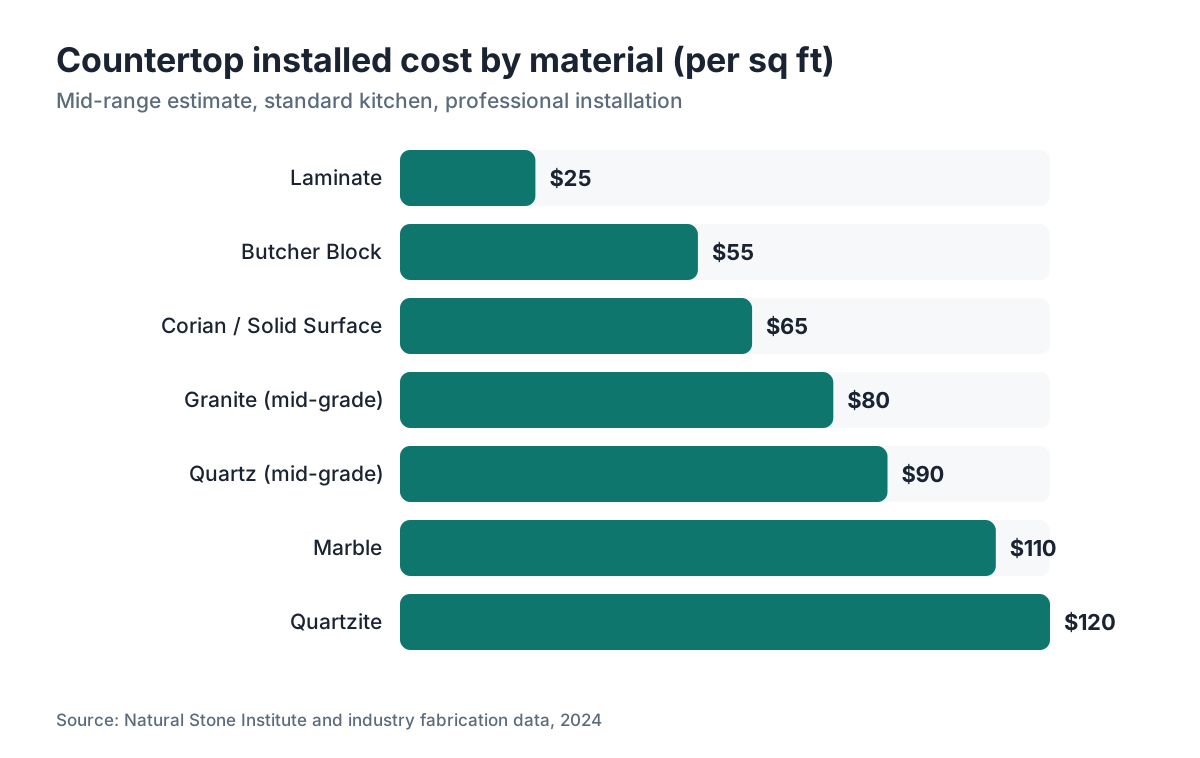
Granite and quartz are the two most popular countertop materials in the U.S. right now, and their installed prices overlap heavily. Quartz runs $50 to $150 per square foot installed, nearly identical to granite's mid-range. A typical quartz kitchen lands around $3,000 to $7,500, again close to granite [4].
Here's where they split. At the low end, Level 1 granite beats any engineered quartz because basic granite slab material is genuinely cheap. At the high end, exotic granites and quartzites push past premium quartz brands like Caesarstone or Cambria. For engineered stone pricing, the cambria countertops guide has specifics on that brand's installed costs.
| Material | Installed cost per sq ft | Notes |
|---|---|---|
| Laminate | $10 to $40 | Lowest durability, easiest DIY |
| Butcher block | $30 to $80 | Requires periodic oiling |
| Granite | $45 to $200 | Wide range by grade |
| Quartz | $50 to $150 | Engineered, no sealing needed |
| Marble | $60 to $200 | High maintenance |
| Quartzite | $65 to $200 | Harder than marble, similar look |
On a tighter budget, laminate countertops and formica countertops are real options that got much better over the last decade. For solid wood, butcher block countertops work well for sections away from the sink.
The kitchen countertops guide has a broader material comparison if you're still deciding.
What does a granite countertop installation include, step by step?
You're buying three separate services when you hire a fabricator: templating, fabrication, and installation. Knowing each step tells you what you're paying for and where things go wrong.
Templating is the first visit. A templater measures your cabinets precisely, either with physical cardboard or, more often now, a digital laser system, recording every angle, outlet notch, window sill depth, and appliance position. Accuracy gets baked in here. A bad template means a bad fit, full stop. Expect 45 minutes to 2 hours depending on kitchen size [5].
Fabrication happens at the shop over 3 to 7 business days in most markets. CNC machines rough-cut the slab from the digital template. Then fabricators refine the edges, polish the surface, and cut sink and cooktop openings. The stone stays at the shop until it's fully finished.
Installation is the last visit. A two-person crew arrives with the finished pieces, runs silicone adhesive along the cabinet tops, sets the stone, checks level, makes any minor on-site cuts, and caulks the seams. A standard kitchen install takes 3 to 6 hours. The counters are usually usable within 24 hours, once the adhesive cures.
For a fuller walk-through, see the countertop installation guide.
What questions should you ask before signing a granite countertop quote?
A good quote is specific. A vague one is an invitation to argue later. Ask every fabricator these before you sign.
What thickness is included? Standard residential granite is 3/4 inch (20mm, called 2cm) or 1-1/4 inch (30mm, called 3cm). Most shops default to 3cm, and it's the better choice for most kitchens. It's heavier but doesn't need a plywood sublayer. Some entry-level quotes sneak in 2cm.
Is the slab price locked or subject to change? If you're picking from a slab yard, the piece you choose should be held with a deposit. Prices shift and popular materials sell out fast.
What sealer is applied, and is it included? A quality penetrating sealer costs $30 to $80 retail. Most shops apply one coat before delivery. Some charge extra. Ask.
Who handles plumbing? Most fabricators exclude plumbing reconnection outright. You need to know that before demo day so you have a licensed plumber lined up. Most states require a licensed plumber to reconnect a sink drain or water lines [6].
What's the warranty? A reputable shop warrants fabrication defects, meaning cracking at cutout corners or seams that fail, for at least one year. Get it in writing.
If you run a shop and you're building quote templates, the quoting workflow in SlabWise handles exactly this kind of line-item transparency, which cuts down on disputes at install.
How do you measure countertop square footage to check your quote?
You don't need quarter-inch precision. A ballpark measurement is enough to catch a quote that charges you for more square footage than you have.
Measure the depth of your counters (usually 25 inches for base cabinets) and the length of each run. Multiply depth by length for each section, add them up, and divide by 144 to get square feet. That's it.
Fabricators add a waste factor, typically 10 to 15 percent, for offcuts, seaming, and positioning the veining correctly [5]. So your measured square footage times 1.1 to 1.15 is roughly what a quote should show.
If a quote shows a number well above your measurement plus 15 percent waste, ask the fabricator to walk you through the math. Most will, gladly. If they can't, that's a yellow flag.
For oddly shaped kitchens with lots of angles, fabricators sometimes quote by the slab instead of the square foot, especially on exotics where leftover stone is hard to reuse. That's normal on unusual layouts, not a red flag by itself.
Does granite need to be sealed, and what does that cost?
Granite is porous to varying degrees, and the answer depends on the stone. Dark, dense granites like Absolute Black are nearly impervious. Lighter ones like White Ice or Kashmir White soak up liquid and stain more readily without a sealer. The Natural Stone Institute recommends testing your specific granite by putting a few drops of water on the surface. If the stone darkens within 10 to 15 minutes, it needs sealing [7].
Most fabricators apply one coat of penetrating sealer before delivery, which is enough for many granites. That first sealing is either included in the installed price or runs $50 to $150 added on.
After that, you can reseal yourself with a quality impregnating sealer. Figure $15 to $50 for product and about 30 minutes of work. Annual resealing gets recommended a lot, but some dense granites go 3 to 5 years between coats with no problem [7].
The how to clean stone countertops guide covers day-to-day maintenance in detail.
What are the hidden costs of granite countertop installation?
The installed price per square foot tells most of the story. These line items are what catch people off guard.
Demolition of existing counters. Tearing out old tile, laminate, or even existing stone runs $300 to $800 depending on material and how hard it fights back. Some fabricators include demo. Most don't. Ask.
Plumbing disconnect and reconnect. Your sink plumbing comes out before templating and goes back in after install. A licensed plumber typically charges $150 to $350. Many states require a licensed pro for this work [6].
Appliance gaps and filler strips. If your new granite is a different thickness than the old counter, you may need filler strips or small modifications around a dishwasher or range. Usually minor. Sometimes a service call.
Sink upgrade. Switching from a drop-in to an undermount sink means precise granite support and a matching cutout. A new sink runs $100 to $600 depending on brand. Plenty of people take the chance to upgrade while the counters are off.
Backsplash. Standard quotes cover horizontal surfaces only. A matching granite backsplash gets priced separately, typically $15 to $40 per square foot installed depending on the approach.
Permits. Countertop replacement rarely needs a permit unless you're moving a gas line or making load-bearing changes. If it's part of a full kitchen remodel, check with your local building department [8].
How do you compare granite countertop bids fairly?
Three quotes is standard advice, and three quotes are worthless if they're pricing different things. Here's how to line them up.
Write a simple scope document before you call anyone. Put in your square footage, the specific slab you want (or a grade and color range), the edge profile, the cutout count, whether demo is included, and the thickness. Hand the same sheet to every fabricator.
When the quotes come back, check that each one breaks out material, fabrication, installation, and any extras. A single lump sum from a shop that won't itemize is worth a question. Sometimes it's fine. Sometimes it hides padding.
Price per square foot only helps if the square footages match. One shop quoting 48 sq ft and another quoting 55 for the same kitchen are measuring differently, probably counting overhang or backsplash differently.
Turnaround is a real cost. Some shops run 3 to 5 days from template to install. Busy shops in peak season stretch to 3 to 4 weeks. If your contractor is waiting on counters to finish, timeline hits your budget.
Read reviews for seam quality, delivery accuracy, and how the shop handled problems. A slab that cracks at install or a seam that gaps six months later is expensive to fix no matter who's technically at fault.
If you manage several quotes at once, tools like SlabWise standardize scope documents and line-item breakdowns so nothing slips through.
Is granite a good investment for resale value?
The real estate data here is messier than the renovation industry likes to admit. Remodeling magazine's Cost vs. Value Report is the most cited source, and its 2023 edition found a major kitchen remodel (counters included) recoups roughly 31 to 85 percent of cost depending on market and scale [9]. Mid-range projects recoup better than upscale ones in most markets.
What granite does reliably is present well to buyers. National Association of Realtors surveys consistently show stone counters among the features buyers notice and value [10]. That's not a dollar-for-dollar return. It does help a home sell faster with fewer inspection-driven price fights in most markets.
Here's the honest take. If you're remodeling mainly for resale, a Level 1 or Level 2 granite on solid cabinets photographs well and gets full buyer credit. Spending $12,000 on exotic Brazilian quartzite in a $280,000 house is over-improving, plain and simple. Pick a neutral granite that photographs well, spend what makes the kitchen good to live in, and skip the exotics unless you're staying long-term.
For comparison, marble countertops carry similar prestige appeal but higher maintenance cost, which some buyers count against you.
Frequently asked questions
How much do countertops cost in general?
Installed countertop cost ranges from about $10 per square foot for laminate to $200 or more for exotic stone. Granite and quartz both run $45 to $150 per square foot installed for most mid-range choices. A typical kitchen, 40 to 55 square feet, costs $2,000 to $7,000 installed depending on material and complexity. Labor and fabrication usually add $30 to $60 per square foot on top of raw material.
What is the average price for granite countertops installed in a typical kitchen?
For a mid-size kitchen of 40 to 55 square feet using a Level 2 to Level 3 granite, the installed price typically runs $2,800 to $6,000 total. That covers material, fabrication, one sink cutout, a standard edge, and basic installation. It does not include demo of old counters or plumbing disconnect, which add roughly $400 to $900 more.
How much does a granite countertop cost per square foot installed?
Granite countertops installed cost $45 to $200 per square foot all-in. Entry-level domestic granite runs $45 to $65 installed. Mid-range granite is $65 to $100. Premium and exotic slabs push $100 to $200 or higher. The per-square-foot number helps most when you compare quotes for the exact same material and scope.
What is the difference between granite and quartz installed cost?
They're close. Granite installed runs $45 to $200 per square foot. Quartz installed runs $50 to $150. At the low end, granite is cheaper because basic domestic slabs cost less than any engineered quartz. At the high end, premium exotic granites and quartzites exceed premium quartz. Quartz needs no sealing, which saves a little in ongoing maintenance.
Does installed price include removal of old countertops?
Usually not. Most fabricators price installation separately from demo. Removing old counters costs $300 to $800 depending on material and how they were attached. Tile counters are messier and pricier to pull than laminate. Always ask your fabricator explicitly whether demo is in the quote before you sign.
How long does granite countertop installation take?
Installation day itself takes 3 to 6 hours for a standard kitchen. The full process from first call to usable counters typically runs 2 to 4 weeks: a few days to schedule templating, 3 to 7 business days of fabrication, then a window for install. Busy shops in spring and summer can stretch to 4 to 6 weeks.
Can I install granite countertops myself to save money?
Technically yes, but it's genuinely risky. A full granite slab for a medium kitchen weighs 400 to 600 pounds. Cutting it takes a wet diamond blade saw and precise technique. A mistake at a seam or cutout can crack the stone and waste hundreds in material. Most people who try DIY granite on a full kitchen end up calling a fabricator to fix it. A remnant piece for a small bathroom vanity is a more reasonable DIY target.
How do I know if a granite countertop quote is reasonable?
Measure your own square footage and add 10 to 15 percent for waste. Multiply by the material cost per square foot for the granite grade you want, then add $30 to $60 per square foot for fabrication and install. If a quote sits 20 percent above that estimate, ask for itemization. If it's 20 percent below, ask what's excluded. Three competitive quotes on the same scope is the simplest reality check.
Does granite add resale value to a home?
It helps, but the return isn't dollar-for-dollar. Remodeling magazine's Cost vs. Value Report found mid-range kitchen remodels recoup roughly 50 to 85 percent of cost at resale in most markets. Granite photographs well and buyers value it, but over-improving with exotic slabs in a modest home rarely pays back. Pick a neutral, quality granite rather than the most expensive exotic.
How often does granite need to be sealed after installation?
It depends on the stone. Dense dark granites may need sealing once every 3 to 5 years. More porous light granites may need it yearly. The water test settles it: put a few drops on the surface and wait 10 to 15 minutes. If the stone darkens, it's time to reseal. Penetrating sealers cost $15 to $50 retail and take about 30 minutes to apply yourself.
What edge profile should I choose for granite countertops?
Eased or beveled edges are included in most base prices and look clean and modern. Bullnose is a step up and costs a little more. Ogee and dupont profiles are ornate and add $15 to $30 per linear foot over base. Waterfall mitered edges are dramatic but expensive. For most kitchens, an eased or slightly beveled edge holds up visually and costs nothing extra.
What thickness of granite should I choose?
3cm (roughly 1-1/4 inch) is standard for most residential kitchens and is included in most mid-range and up quotes. It's strong enough to skip a full plywood sublayer. 2cm slabs cost a little less but need a continuous substrate for support. For islands and floating counters, 3cm is strongly preferred. Confirm the thickness in your quote before you sign.
Are there extra costs for a kitchen island granite countertop?
Yes. Islands often need extra seaming because they're large, thicker slabs for visual weight, and sometimes waterfall edges on the sides. A basic island top adds $500 to $2,500 over standard counter pricing depending on size and edge choices. Seams on an island show more than seams against a wall, so placement matters and a good fabricator plans the seam location with you.
What should I look for in a granite fabricator?
Look for shops that use digital templating over cardboard. Ask to see recent work, specifically seam quality and edge consistency. Check reviews for delivery accuracy and how they handled problems. A one-year fabrication warranty is reasonable to expect. Membership in the Natural Stone Institute signals a shop takes professional standards seriously.
Sources
- U.S. Census Bureau, American Housing Survey: Data on kitchen renovation costs and project frequency in U.S. households
- Natural Stone Institute, Cost and Fabrication Reference: Fabrication add-ons including sink cutout pricing ($200 to $450) and edge profile upcharges
- Natural Stone Institute, Stone Grading and Pricing Overview: Granite grading levels and regional pricing variation by distribution hub proximity
- U.S. Bureau of Labor Statistics, Consumer Expenditure Survey: Average consumer spending on home improvement including countertop materials
- Natural Stone Institute, Fabrication Standards Manual: Waste factor standards (10 to 15%) and templating process description for stone fabrication
- National Conference of State Legislatures, Contractor Licensing Overview: Most states require licensed plumbers for sink plumbing disconnection and reconnection
- Natural Stone Institute, Care and Maintenance Guidelines: Water absorption test method for sealing need assessment; resealing frequency recommendations
- U.S. Department of Housing and Urban Development, Residential Building Codes: General guidance on when permits are required for kitchen renovation projects
- Remodeling Magazine, Cost vs. Value Report 2023: Mid-range kitchen remodel recoups roughly 31 to 85 percent of cost at resale depending on market
- National Association of Realtors, Remodeling Impact Report: Stone countertops are among the features buyers most frequently notice and value
Last updated 2026-07-10