TL;DR
- Granite ranks 6 to 7 on the Mohs hardness scale, resists heat and scratches better than most countertop materials, and routinely lasts the life of a house.
- Its real weaknesses are acid etching if left unsealed and cracking at unsupported edges.
- Sealed once a year, it is one of the most durable kitchen surfaces at any price.
How hard is granite compared to other countertop materials?
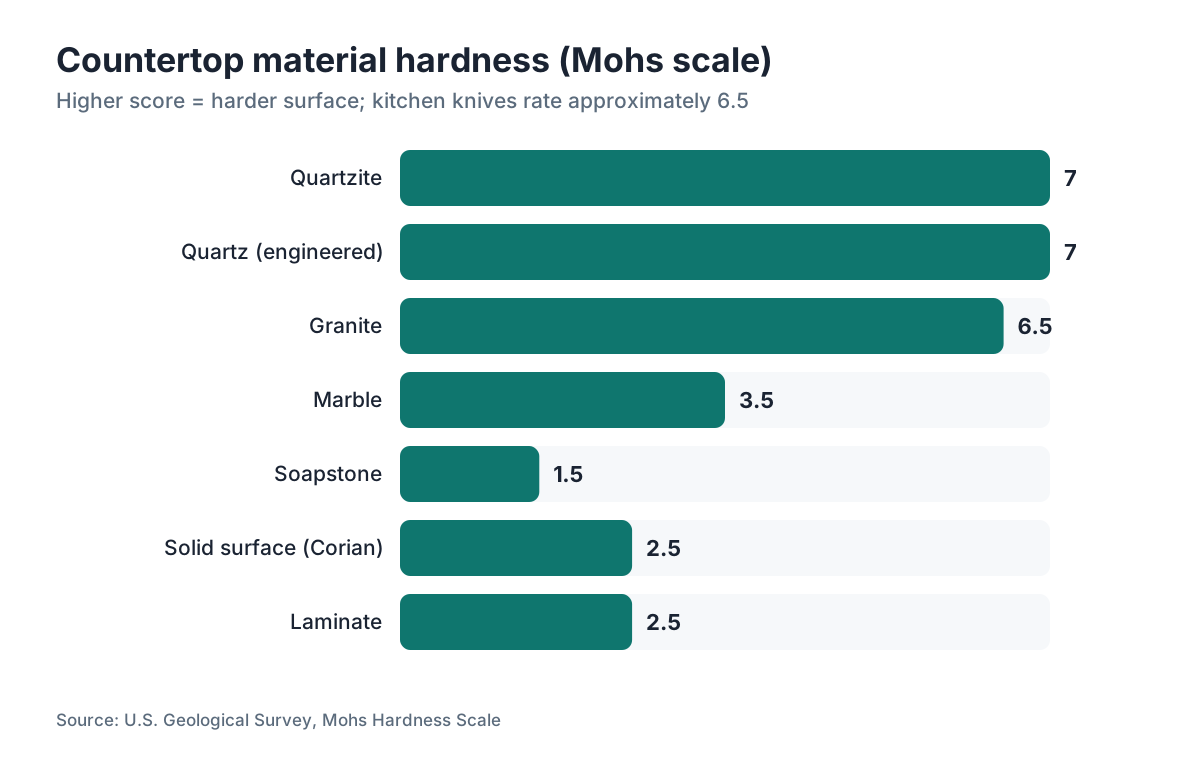
Granite sits at 6 to 7 on the Mohs hardness scale, the 1-to-10 mineral standard German mineralogist Friedrich Mohs published in 1812 [1]. For context: a steel knife blade runs about 6.5. Drag a sharp knife across softer granite and you might leave a faint mark, but the blade usually loses that fight, not the stone. Quartz countertops (engineered stone) register around 7, a hair harder on average than granite's middle range. Marble and limestone come in at 3 to 4, which is why a house key scratches them. Laminate and solid-surface acrylics sit below 3.
The Mohs scale is not linear. The jump from 3 to 6 is a far bigger hardness leap than the two numbers suggest. That gap is why marble shows knife marks that granite simply shrugs off.
Hardness is only one axis of durability. A material can be hard and still chip or crack under impact because it is brittle. Granite is crystalline and moderately brittle, so a dropped cast-iron pan hitting a thin edge can take a chip out. Thickness matters here. Standard 3 cm slabs (about 1.2 inches) resist impact far better than the older 2 cm material, which is why most fabricators quit offering 2 cm for kitchen tops more than a decade ago.
How does granite compare to quartz, marble, and other surfaces for durability?
This is the comparison homeowners actually need before signing a fabrication contract. Here is how the major materials stack up on the metrics that decide daily life with a countertop.
| Material | Mohs hardness | Heat resistance | Acid resistance | Scratch resistance | Typical lifespan |
|---|---|---|---|---|---|
| Granite | 6-7 | High (direct heat OK, some thermal shock risk) | Moderate (needs sealer) | High | 100+ years |
| Quartz (engineered) | ~7 | Low-moderate (resin discolors above ~150°C) | High | High | 25-50 years (estimate) |
| Marble | 3-4 | Moderate | Very low (etches from lemon juice) | Low | 50-100 years (with heavy patina) |
| Soapstone | 1-2 | High | High (naturally) | Very low | 100+ years |
| Butcher block | N/A (wood) | Low | Low | Low-moderate | 20-50 years with refinishing |
| Laminate | <3 | Low | Moderate | Low | 10-20 years |
| Solid surface (Corian-type) | ~2.5 | Low | Moderate | Low (but repairable) | 20-30 years |
Quartz's resin binder is its weak point. The polymer holding the crushed stone together can discolor and even delaminate under sustained heat. Set a 200°C cast-iron pan straight on quartz and you can cause damage that no polishing fixes [2]. Granite has no polymer phase, so it takes the same pan without discoloring. Rapid thermal cycling is a different story: a frozen bag pulled from the freezer onto a sun-heated slab creates stress that can crack any stone.
Marble is beautiful and structurally durable, but acid from citrus, vinegar, or wine etches its calcite crystals in minutes and leaves dull spots that need professional re-polishing. If you want that look without the anxiety, see how marble countertops stack up in detail.
Laminate countertops and Formica countertops cost a fraction of granite, but the surface layer is thin and gone for good once burned or deeply scored. Butcher block countertops bring warmth and sand back to new, though they want oiling every few months and hate standing water.
For a fabricator quoting a job, material choice drives template, fabrication time, and edge-profile difficulty in ways that compound fast. Granite's natural variation makes slab yield planning trickier than it sounds, which is where software like SlabWise helps shops avoid costly remnant waste when they nest cuts.
Does granite scratch, chip, or crack under normal kitchen use?
Normal kitchen use will not scratch polished granite. Steel knives, ceramic mugs, glass baking dishes, and aluminum pans all sit below or right at the hardness of granite's surface minerals. You will dull your knife long before you mark the stone. The one thing that does scratch granite is silicon carbide or diamond abrasive, found in some grinding compounds and sandpaper. Nothing in your utensil drawer comes close.
Chipping is another matter. Granite chips at corners and edges under point impact because the crystals fracture instead of flexing. The vulnerable spots are the front edge near the sink cutout, inside corners, and the lip of the overhang. A thick eased or bullnose edge holds up better than a sharp mitered one. Some fabricators add a small chamfer to otherwise sharp profiles specifically to cut chip risk during delivery and install.
Cracks in installed slabs almost always trace to one of three causes: not enough cabinet support under a long unsupported run, a stress fracture from the quarry that nobody caught before installation, or an impact during delivery. A slab set on a cabinet with a continuous perimeter frame and a center support across any span longer than about 24 inches will not crack from household loading. The stone is not going to split from a pot of boiling water, no matter what anyone tells you.
Repairs exist. Color-matched epoxy fills chips so well you have to know where to look. A full crack through a slab is harder and sometimes means replacing the piece.
Does granite need to be sealed, and how often?
Yes, most granite needs sealing. How much depends on the quarry and the mineral mix. The porosity range is wide. Some dense black granites like Absolute Black absorb almost nothing. Some lighter Brazilian beiges and golds are thirsty enough that red wine stains them in minutes without a sealer.
The field check is the water drop test. Put a quarter-sized drop on the surface, wait 10 to 15 minutes, then look. If the water darkens the stone underneath, it is soaking in and the slab needs sealing. Most fabricators seal once before or right after installation. After that, annual resealing is the common recommendation for kitchen use, though dense granites can hold a sealer two to three years [3].
Use an impregnating sealer, the type that penetrates below the surface instead of sitting on top. It does not change how the stone looks and does not wear off the way topical coatings do. Topical coatings can create a plastic sheen and peel over time. Skip them on polished granite.
Acid is the other threat. Even well-sealed granite can etch slightly from long contact with strong acid, though the reaction runs far slower and shallower than on marble. A lemon half left cut-side down for an hour is a bad idea. A quick splash of vinegar wiped right away does no lasting harm, because the sealer absorbs the brief contact before the acid reaches the stone.
For cleaning beyond sealing, the same rules that govern any natural stone apply. How to clean stone countertops covers the daily routine.
How does heat affect granite countertops?
Granite forms at roughly 650°C to 750°C deep in the Earth's crust [4]. A pan coming off a burner at 200°C is not a threat to the stone. You will not discolor, crack, or weaken granite by setting a hot pot directly on it.
The real risk is thermal shock, not sustained heat. Differential expansion stress needs a big, fast temperature swing across the slab, like a blowtorch flame on stone chilled by air conditioning. In household cooking that scenario is basically theoretical. Nobody drops a 300°C cast-iron onto a slab fresh from a freezer. For practical purposes, the thermal resistance of granite in a kitchen is unlimited.
One caveat worth raising: if your granite has an epoxy repair at a chip or crack, that filler has a much lower heat threshold than the stone and can soften or discolor under sustained direct heat. Keep hot pans off repaired spots.
Trivets still make sense, just not for the reason people think. The risk is dragging a cast-iron pan across a polished surface and scoring it with the rough cooking residue baked onto the pan's base, not the heat itself.
What are granite's actual weaknesses for kitchen countertops?
Granite has real weaknesses, and selling it as bulletproof does homeowners a disservice. Here is the honest list.
Porosity and staining come first. Unsealed or under-sealed granite soaks up oil, wine, and strongly colored liquids. Oil stains are the stubborn ones. They darken the stone and laugh at surface cleaning. A poultice (a paste of baking soda with acetone or hydrogen peroxide, depending on the stain) can pull oil out over 24 to 48 hours, but a good sealer prevents the whole problem.
Weight creates structural demands. A 3 cm slab weighs about 18 to 20 pounds per square foot [5]. A 30-square-foot granite island runs roughly 540 to 600 pounds. The cabinets have to be sound, and any sagging or unlevel run only gets worse over years under that load. Installing granite on worn-out base cabinets is a mistake you pay for later.
Edge fragility under point impact is the complaint fabricators hear most after install. The fix is a good edge profile, careful installation, and corner protectors during delivery.
Cost is not a durability weakness, but it becomes one sideways. Granite's higher upfront price sometimes pushes homeowners to skip professional installation, which creates bad support and handling damage. If you are buying granite, pay for professional countertop installation.
Natural variation is not a flaw so much as a fact: two slabs from the same quarry can behave very differently on porosity. Your fabricator should water-test each slab before sealing, not apply one blanket schedule to everything.
How long does granite actually last? What's the real lifespan?
Granite lasts about as long as the house, given a correct install and basic sealing. Nobody has good longitudinal data on this (there is no controlled study of countertop lifespans), but granite surfaces from the 1920s and 1930s are still working in old bank lobbies, courthouses, and kitchens across the country. The U.S. General Services Administration maintains historic federal buildings with original granite from the early 20th century that remain structurally sound [6].
The stone is not the limiting factor. The grout, the caulk at the backsplash joint, the sealer schedule, and the cabinetry underneath all give out first. Recaulk every three to five years, reseal every one to two years, and keep cabinet moisture in check, and a granite installation stays functional well past any owner's tenure.
For resale, listing data consistently shows granite as a positive feature, though the dollar premium swings by market. The National Association of Realtors tracks kitchen upgrades including countertop material in its remodeling research, and mid-range kitchen remodels with stone countertops show up as a cost-recovery positive [7].
Compare that to laminate at 10 to 20 years before the surface layer burns through or delaminates, or solid surface at 20 to 30 years. Granite's century-plus life, at roughly $40 to $100 per square foot installed for standard grades, works out to a lower cost per year than most alternatives.
Does granite have any health or safety concerns?
The radon question comes up constantly and deserves a straight answer. Granite is a natural rock carrying trace uranium, thorium, and radium, all of which decay into radon gas [8]. The EPA and the National Cancer Institute have both looked at whether granite countertops create a meaningful radon exposure.
The EPA's position is that radon from granite countertops is typically small next to radon coming into homes from soil and building materials, and unlikely to move overall indoor radon levels much [8]. The agency ties radon testing to soil and foundation conditions, not to what your counter is made of.
A 2008 report from Lawrence Berkeley National Laboratory measured radon and gamma radiation across a range of granite samples. It found that while granite does emit radon, emissions from countertops were in almost all cases negligible against background levels and well below any health threshold [9].
So test your home's radon if you live in a radon-risk area (EPA radon zone maps break this out by county), but do not choose a countertop out of radon fear. The slab is not a meaningful source.
Bacteria is the other worry. Porous surfaces can hold bacteria in tiny irregularities if you do not clean them. A study in Applied and Environmental Microbiology found that granite, like other porous surfaces, can retain bacteria in surface pits, but ordinary soap-and-water cleaning cuts bacterial loads to safe levels on every common countertop material [10]. Sealing lowers surface porosity and makes that cleaning more effective.
Is granite durable enough for bathroom countertops and outdoor use?
Granite works great in bathrooms. Lower traffic, less surface area, and gentler chemical exposure (no cooking acids, no searing pans) make it even easier to maintain than in a kitchen. You can often stretch the sealing schedule to every two to three years on a vanity.
Outdoors gets more complicated. Granite is freeze-thaw resistant in most climates because its porosity is low enough that water does not soak in deep and split it during freezing. Granite outdoor kitchens, fire pit surrounds, and exterior bars are common in warm and temperate regions. In hard-freeze climates like Minnesota, Maine, or Chicago, a slab with even minor natural fissures can crack over a winter if water works into a seam and freezes. Outdoor installs in those places need careful fissure inspection first and more aggressive sealing.
Sunlight does not degrade granite. UV will not fade most varieties, though some iron-rich stones can oxidize slightly over many years of direct exposure. That is a slow cosmetic shift, not a structural one.
For outdoor kitchens I lean granite over quartz. Quartz's resin binder is UV-sensitive and yellows or discolors outdoors within a few years, and granite beats any wood or laminate option by a wide margin.
How do fabricators assess and test granite slab quality before installation?
A good fabricator does more than eyeball color and pattern when picking slabs. Quality checking starts at the yard with a visual pass under raking light (a flashlight held at a low angle) to reveal fissures, pits, and fill repairs the supplier may have used to hide quarry damage. Filled fissures are not automatically a problem, but the homeowner should know they exist and the fabricator should know where they sit before templating.
The water absorption test from earlier is part of slab evaluation too. Dense, low-porosity slabs get a different sealer treatment than thirsty ones.
Thickness consistency matters for fabrication. A 3 cm slab should stay close to 3 cm across its whole face. Variation past about 2 to 3 mm creates fitting and leveling headaches at install that eat labor hours.
For shops juggling many slabs across many jobs, tracking which piece of which slab went to which customer, and how much remnant is left, is a real operational grind. That slab inventory and nesting work is exactly what SlabWise handles for fabrication shops, keeping remnant yield visible across the job queue.
Homeowners buying granite should ask to see the actual slab going into their job, more than a sample. Color and pattern swing hard within a single quarry run. A showroom tile sample and the slab that lands on your cabinets can look like different stones if you never approved the real one.
What maintenance does granite need to stay looking good for decades?
The honest maintenance list is short. Seal it, clean it with mild soap, and don't let acidic or oily stuff sit on it.
Sealing runs once a year for kitchen surfaces in active use, every two to three years for bathroom vanities and lower-traffic tops. Use an impregnating sealer rated for natural stone. Wipe it on with a clean cloth, let it absorb for the time on the label (usually 10 to 30 minutes), wipe off the excess, and let it cure a few hours before you use the surface. Do not let it dry to a haze on top, or you will be buffing hard to get the residue off.
Daily cleaning is warm water and a few drops of dish soap on a soft cloth. That handles everything. Dry the surface after to avoid hard-water spots if your water is mineral-heavy. Keep bleach, ammonia cleaners, and acidic cleaners (vinegar, citrus degreasers) off granite. They break down the sealer and dull the polish over time.
For stains that beat the sealer: oil responds to a baking soda and acetone poultice, and organic stains like coffee, wine, and food dye respond to a baking soda and hydrogen peroxide poultice. Spread the paste over the stain, cover it with plastic wrap taped at the edges, and leave it 24 to 48 hours. As it dries it pulls the stain up out of the stone.
Polishing is rarely needed. A polished top kept clean and sealed holds its sheen for years. If it dulls after a lot of wear, a stone polish product can bring it back. Deep polish loss from widespread acid damage needs a pro with diamond pads.
See how to clean stone countertops for the full protocol, and how to clean quartzite countertops if you are also dealing with quartzite (commonly confused with granite at the yard).
Is granite worth the cost compared to less expensive alternatives?
Granite installed usually runs $40 to $100 per square foot for standard commercial grades, with exotic or rare patterns climbing to $100 to $200 or more [11]. Quartz sits in a similar range. Marble tracks high-end granite. Laminate lands at $10 to $40 installed. Solid surface runs $35 to $65.
Run the durability-per-dollar math over the material's real lifespan and granite comes out ahead. Laminate at $20 per square foot installed that needs replacing in 15 years costs about $1.33 per square foot per year. Granite at $70 per square foot lasting 80 years costs $0.88 per square foot per year. That assumes no major damage to either, which tilts further toward granite: a laminate burn or delamination usually means full replacement, while a granite chip repair typically runs under $200 for a fabricator with color-matched epoxy.
There are cases where cheaper wins. Rental properties where nobody will ever reseal. Temporary kitchens. Budgets that genuinely can't cover professional installation, because improperly installed granite is not durable granite. A well-installed laminate countertop or solid Corian-type countertop beats badly installed granite every single time.
For a full kitchen countertops cost and material comparison, including engineered options like Cambria countertops, the tradeoffs shift with your use patterns, your kitchen's light, and honestly, how much you like cooking in a space that feels good to stand in.
Frequently asked questions
Will granite countertops crack on their own over time?
No. Granite does not crack from age, from normal kitchen thermal cycling, or from settling if the cabinet support is solid. Cracks almost always trace to inadequate support on a long unsupported run, a pre-existing quarry fissure nobody caught before installation, or a heavy impact during delivery or use. A properly installed slab on a sound cabinet base will not crack from everyday use over any reasonable span of years.
Can you cut directly on granite countertops?
Technically yes, the stone will not scratch from a steel knife. But you will wreck your knife edges fast, because cutting on a hard surface hammers repetitive shock into the blade geometry. Use a cutting board. Your knives last longer, and you avoid the small chance of surface grit from a pitted slab getting into food.
Does granite stain easily?
With a current sealer in place, granite resists most common kitchen spills well. Unsealed or under-sealed granite can absorb oil, wine, and dark liquids in minutes. Staining risk is highest with light-colored, high-porosity granites from some Brazilian and Indian quarries. Dense black or very dark granites are far more stain-resistant by nature. A simple water drop test tells you where your slab lands on the porosity spectrum.
How does granite hold up in high-traffic commercial kitchens?
Granite has held up in restaurant prep areas and hotel bars for decades. The main commercial challenge is keeping the sealer current under heavy cleaning-chemical exposure. Many commercial cleaners are alkaline or acidic and break down impregnating sealers faster than household dish soap does. A commercial kitchen running granite should plan to reseal two to four times a year rather than the annual schedule typical for homes.
Is quartzite the same as granite for durability purposes?
No, though the two get confused at slab yards constantly. Quartzite is a metamorphic rock rating 7 on the Mohs scale, slightly harder than most granite, and more acid-resistant because it lacks the feldspar granite carries. But many stones sold as quartzite are actually marble or a marble-quartzite mix that does etch. Ask your fabricator to run a simple acid spot test before you finalize the selection.
What edge profile is most durable for granite?
Eased, beveled, and bullnose profiles resist chips best because they remove the 90-degree corner that concentrates impact stress. Mitered edges look sharp but are the most vulnerable, since the thin miter edge is exposed. Ogee and other decorative profiles with tight curves can also be fragile at their most protruding points. For a busy kitchen with kids, a simple eased or 1/8-inch bevel is the best durability call.
Does sealing granite make it completely stain-proof?
No. A good impregnating sealer sharply slows absorption, buying you time to wipe up spills before they penetrate, but it is not an impermeable barrier. Long contact with oil, wine, or heavily pigmented liquids can still stain sealed granite if left for hours. Sealing gives you response time, not immunity. Think of it as a margin for error, not a guarantee.
Can granite countertops handle outdoor conditions year-round?
In most climates, yes. Granite's low porosity makes it far more freeze-thaw resistant than limestone or marble. In severe winter climates, inspect the slab carefully for natural fissures before an outdoor install, seal aggressively, and know that any filled repairs will be vulnerable to freeze-thaw cycling. UV does not degrade granite the way it degrades engineered quartz's resin binder, which makes granite the better outdoor pick of the two.
How do I know if my granite needs to be resealed?
Use the water drop test. Put a tablespoon of water on the surface and watch it for 10 to 15 minutes. If it beads and sits, the sealer is holding. If the water slowly darkens the stone beneath it as it soaks in, the sealer has worn and it is time to reseal. For kitchen surfaces, run this once a year or whenever the surface feels less water-resistant during normal cleaning.
Is black granite more durable than light-colored granite?
For stain resistance, generally yes. Dark granites, especially Absolute Black from India, tend to be denser and less porous than many lighter varieties. They absorb less water and oil and may need sealing less often. The tradeoff: dark granites show water spots, fingerprints, and cleaning residue more visibly, so they want more frequent wiping to look clean. Structural hardness is similar across colors; porosity is the meaningful difference.
Does granite add resale value to a home?
It tends to, especially in mid-range and upper-mid-range markets where buyers expect stone countertops. The National Association of Realtors' remodeling research consistently shows mid-range kitchen remodels, which typically include stone countertops, recovering 50 to 80 percent of their cost at resale depending on the market. Granite is still viewed as a premium feature in most U.S. markets, though its edge over quartz has narrowed as engineered stone went mainstream.
What's the difference between granite durability and quartzite durability?
Quartzite is harder (Mohs 7 versus granite's 6 to 7) and typically more acid-resistant, because it is almost pure quartz grains without the feldspar and mica granite carries. Both last effectively indefinitely when properly sealed. Quartzite's real-world drawback is mislabeling at distributors: many stones sold as quartzite are actually soft marbles that etch badly. Verify with an acid test before buying.
Sources
- U.S. Geological Survey, Mohs Hardness Scale: Granite ranks 6 to 7 on the Mohs hardness scale
- Natural Stone Institute, Care and Maintenance Guidelines: Engineered quartz's polymer resin binder can discolor and delaminate from sustained heat above approximately 150 degrees Celsius
- Natural Stone Institute, Fabrication and Installation Standards: Annual resealing is the common recommendation for kitchen granite; dense granites may hold a sealer for two to three years
- U.S. Geological Survey, Geology and Igneous Rocks: Granite forms at roughly 650 to 750 degrees Celsius deep in the Earth's crust
- Natural Stone Institute, Stone Reference Manual: Granite slabs at 3 cm thickness weigh approximately 18 to 20 pounds per square foot
- U.S. General Services Administration, Historic Buildings: GSA maintains historic federal buildings with original granite surfaces from the early 20th century that remain structurally sound
- National Association of Realtors, Remodeling Impact Report: Mid-range kitchen remodels including stone countertops show positive cost recovery at resale in NAR tracking
- U.S. Environmental Protection Agency, Radiation Protection: EPA states that radon levels from granite countertops are typically small compared to radon from soil and are unlikely to affect overall indoor radon levels significantly
- Lawrence Berkeley National Laboratory, Indoor Radon from Granite Countertops (2008): LBNL 2008 study found granite countertop radon emissions were in almost all cases negligible relative to background levels and far below any health threshold
- Applied and Environmental Microbiology (American Society for Microbiology): Standard cleaning with soap and water reduces bacterial loads to safe levels on all common countertop materials including granite
- Angi, Granite Countertops Cost Guide: Granite installed typically costs $40 to $100 per square foot for standard grades, with exotic varieties reaching $100 to $200 or more
Last updated 2026-07-09