TL;DR
- Granite costs $40, $100 per square foot installed and needs sealing every 1 to 3 years.
- Quartz costs $50, $120 installed and needs no sealing, but it can't take prolonged outdoor sun or high heat without damage.
- For most kitchens, quartz is lower maintenance.
- For a look you can't replicate, granite wins.
- Neither is clearly better.
- It depends on how you cook and clean.
What does granite actually cost, installed?
Granite prices swing wider than almost any other countertop material because you're buying a natural product that runs from commodity-grade to rare imported slabs. Budget roughly $40, $100 per square foot installed for a typical kitchen. That installed price covers the slab, fabrication (cutting, edge profiles, sink cutout), and setting [1]. Entry-level granite, often called "Level 1" or "builder grade," clusters near $40, $60 installed. Mid-range stones with more movement or rarer coloring sit around $60, $80. High-end exotics, think Brazilian quartzite sold under the granite label or rare blue bahia, push past $100 and sometimes well past $150 per square foot.
A 40-square-foot kitchen (a pretty typical layout with an island) comes out to $1,600, $4,000 at the low-to-mid range. That's a real number, not aspirational. Ripping out old countertops usually adds $100, $400 depending on material and your local labor market [1].
Fabrication complexity is the biggest variable. A straight run with one sink cutout costs a lot less to fabricate than an L-shape with a waterfall edge, a cooktop cutout, and a tight mitered corner. Every extra operation adds shop time. Shop time is where the bill climbs.
What does quartz cost, installed?
Engineered quartz, the kind made from ground quartz bound with polymer resin (the category includes brands like Silestone, Caesarstone, and Cambria), generally runs $50, $120 per square foot installed [2]. The floor price sits higher than entry granite because you're always paying for a manufactured, consistent product. The ceiling runs higher too, on the premium end, where thick slabs with complex veining are priced to compete with marble.
Branded products carry a markup. Caesarstone and Silestone typically land in the $60, $90 range installed. Cambria, which markets itself as the only American-made quartz brand of scale, often runs $80, $120 [3]. Generic or off-brand quartz from importers can dip toward $50, but quality control varies and slab thickness may come in thinner than the standard 3 cm.
One cost factor homeowners miss: quartz is sold in fixed slab sizes, usually around 55 x 120 inches [2]. A large kitchen may need multiple slabs, and matching the veining across a seam takes skilled fabrication. That adds labor cost. Granite has the same issue, but natural variation in granite is often less noticeable at a seam than an engineered vein pattern that doesn't quite line up.
How durable is granite compared to quartz?
Granite scores between 6 and 7 on the Mohs hardness scale, which means a standard kitchen knife (around 5.5 Mohs) won't scratch it, but a harder mineral could [4]. Quartz composite products test at roughly 7 Mohs, slightly harder on average [4]. For practical purposes, neither surface scratches easily under normal kitchen use. You'd have to drag a cast-iron skillet across the surface with real force to leave a mark on either one.
Heat resistance is where they split. Granite formed under enormous geological heat and handles thermal shock reasonably well. A hot pan set directly on granite won't typically crack or discolor the stone. Quartz is a different story. The polymer resin binding the quartz particles starts to discolor and can warp at sustained temperatures above roughly 300°F (150°C) [5]. Caesarstone's own care documentation advises against placing hot cookware directly on the surface. So if you slide pots off the burner onto the counter without thinking, granite forgives that habit. Quartz does not.
Impact resistance goes to quartz. The resin binder gives it a little flex. A granite slab is rigid natural stone, so it's more prone to cracking if something heavy drops on it or if the substrate settles unevenly. Corner chips show up more on granite than on quartz in my experience, though nobody has published a controlled study on this.
Outdoor and UV durability is the clearest split of all. The resin in quartz yellows under prolonged UV exposure [5]. Granite is fine outdoors. Planning an outdoor kitchen? Granite is the call. Quartz manufacturers explicitly exclude outdoor installations from warranty coverage.
Which one needs more maintenance?
Granite is porous. That's the core maintenance issue. As a natural stone with a crystalline structure, it lets liquids penetrate the surface over time if there's no protective seal. The standard recommendation is to seal granite every 1 to 3 years, depending on the stone's porosity and the sealer used [6]. Denser granites, like black absolute, need sealing less often. Lighter, more porous stones need it more. Test porosity yourself by dripping water on the surface. If it beads, the seal is good. If it soaks in, reseal.
Unsealed or poorly sealed granite can absorb cooking oils, wine, and citrus juice, leaving stains that require a poultice to draw out. Not catastrophic, but real work. Daily cleaning stays simple: mild dish soap and warm water, or a pH-neutral stone cleaner [6].
Quartz needs no sealing, ever. The resin surface is non-porous. You clean it the same way, mild soap and water. Harsh chemicals do damage the resin, though. Bleach-heavy cleaners, paint strippers, and highly alkaline solutions dull the finish over time [5]. Some homeowners think "non-porous" means indestructible, then they take a Magic Eraser to a glossy quartz surface and wonder why that spot went matte.
For a busy household that doesn't want to think about countertop upkeep, quartz is the easier call. For someone who doesn't mind a once-a-year sealing task and wants the uniqueness of natural stone, granite is perfectly manageable.
Considering other natural stones too? The cleaning logic carries over. See how to clean stone countertops for a broader look at pH-safe products and sealer timing.
Does granite or quartz hold up better to stains and bacteria?
The research on bacteria in kitchen surfaces is less definitive than stone marketing would have you believe. A study published in the journal Meat Science found that both granite and solid-surface materials harbored bacteria in micro-cracks and surface irregularities, and that cleaning method mattered more than surface material [7]. Nobody has done the controlled granite-vs-quartz bacterial study that would settle the argument cleanly.
Here's what we do know. Quartz's non-porous surface doesn't give bacteria a pore to hide in the way unsealed granite might. NSF International, which certifies food-contact surfaces, has certified some quartz products. If pathogen control matters to you for any reason, a properly cleaned quartz surface gives you fewer variables than an unsealed or aging-sealed granite [8].
Stain resistance in practice: quartz handles red wine, coffee, and tomato sauce better than unsealed granite does. Properly sealed granite comes close to quartz for everyday stains, but the sealer degrades and needs renewal. Quartz's resin can absorb pigment from concentrated dyes (think food coloring or turmeric) if left for hours, so it's not bulletproof either.
How do granite and quartz compare for resale value?
Neither material has a published, peer-reviewed return-on-investment figure specific to countertops. The numbers you see online, like "granite adds X percent to home value," come mostly from real estate surveys with small sample sizes and no controls for market, condition, or home tier. Treat them as marketing, not data.
What the National Association of Realtors survey data does show is that kitchen renovations rank highly for recouping costs at resale, and that stone countertops are consistently listed among the upgrades buyers notice [9]. Whether that's granite or quartz matters less than whether the material looks current and stays in good condition.
In luxury markets, book-matched natural stone slabs can genuinely set a property apart. In mid-range markets, buyers just want a clean, modern countertop that isn't laminate. Both granite and quartz clear that bar. If I had to pick for resale in a $400,000, $700,000 home, I'd match whatever the neighborhood comps show in kitchen listing photos. That's a better signal than any general study.
Can quartz or granite crack, and what does repair cost?
Both can crack. Granite cracks from impact (something heavy dropped), thermal shock (a frozen pan going straight next to a hot oven), or substrate failure (the cabinet settling unevenly over years). Quartz cracks from the same causes, though thermal shock from extreme heat is a more common culprit given the resin's sensitivity.
Repair costs vary enormously. A hairline crack in granite can often be filled with color-matched epoxy resin by a stone fabricator for $100, $300. A full crack through the slab usually means slab replacement, and you're back to material and fabrication costs. Quartz repair works the same in principle but harder in practice, because matching the engineered pattern precisely is difficult. A visible seam repair on quartz often looks worse than the same repair on natural granite, where variation is expected.
Chipped edges happen more on granite, especially at inside corners and near sink cutouts where the stone runs thin. An edge chip on granite can often be ground back and re-profiled for a few hundred dollars by a fabricator with the right tooling. Quartz chips are rarer but similarly repairable.
If you're a fabricator thinking about how to price repair work accurately alongside new installs, SlabWise includes repair line items in its quoting module so you don't have to eyeball those jobs differently from new countertop quotes.
Is quartz better for kitchens or is granite the smarter pick?
This is the question everyone actually wants answered, and the honest response comes down to one thing: how much direct heat lands on your countertops.
Cook heavily, always have hot pans migrating from stove to counter, don't want to remember trivets? Granite handles that better. Full stop. The heat tolerance of natural stone is a real functional advantage in a working kitchen.
If your kitchen is mostly prep and cleanup, not a lot of hot-pan moments, and you want zero sealing maintenance, quartz is the easier choice. The consistency of engineered stone also makes large kitchens with multiple slab runs look more uniform. For a white or light-colored design, quartz gives you more predictable tone matching than a natural stone.
For kitchen countertops in general, fabricators will tell you quartz now outsells granite in the U.S. residential market. The Marble Institute of America's industry data shows engineered stone taking a growing share of new kitchen installs since around 2015, though granite still dominates in certain regional markets and price points [10].
Granite is not an outdated choice. It's a different product with different properties. Anyone telling you granite is "old" is selling you something.
What are the environmental and health considerations?
Granite is a natural material quarried from the earth. Mining has environmental impacts: land disturbance, water use, diesel equipment. Transportation from Brazil or India (common origins for granite sold in the U.S.) adds a significant carbon footprint. On the other side, granite isn't manufactured with synthetic chemicals and has no off-gassing concerns once installed.
Quartz composite uses petroleum-based polymer resins as the binder, typically around 7 to 10% of the product by weight [2]. Making quartz is an industrial process with its own energy and emissions profile. Some manufacturers have pursued environmental certifications. Silestone has published sustainability reports. Caesarstone holds ISO 14001 environmental management certification [11].
The radon question comes up a lot with granite. Granite does contain trace naturally occurring radioactive minerals. The EPA has a dedicated page on this. Their position: while granite can emit low levels of radon, the levels measured in most granite countertops are not a significant source of indoor radon compared to soil gas entry through foundation cracks [12]. The EPA does not recommend avoiding granite countertops for radon reasons. If you have radon concerns, test your home's air, not your countertop.
For quartz, the occupational silica dust exposure during fabrication is a documented workplace health issue. Fabricators cutting dry quartz without proper respiratory protection risk silicosis. OSHA issued a specific hazard alert on this. It doesn't affect homeowners at all after installation, but it's a real danger for the workers who make the countertops [13].
How do installation and lead times compare?
The installation process runs nearly identical for both materials. A fabricator templates your countertops (either with physical sticks or digital templating), cuts the slabs to size, profiles the edges, and installs. Lead time from template to install runs 5 to 10 business days for granite and quartz alike, depending on the shop's queue and whether your slab is in stock [1].
Granite slabs come through stone distributors, and most metro areas have several distributors with slab yards you can visit. You pick the actual slab you want, which is part of the appeal of natural stone. Your countertop is literally one-of-a-kind.
Quartz comes through distributors and big-box stores (Home Depot and Lowe's both stock major brands). You're selecting a product code, not an individual slab, so there's less variation within a batch. Home Depot's countertop installation program uses local fabricators and typically quotes 3 to 5 weeks from measure to install, which accounts for their scheduling and material sourcing [14].
See countertop installation for a walkthrough of what installation day actually looks like and what to prep in your kitchen beforehand.
How do granite and quartz compare to other countertop materials?
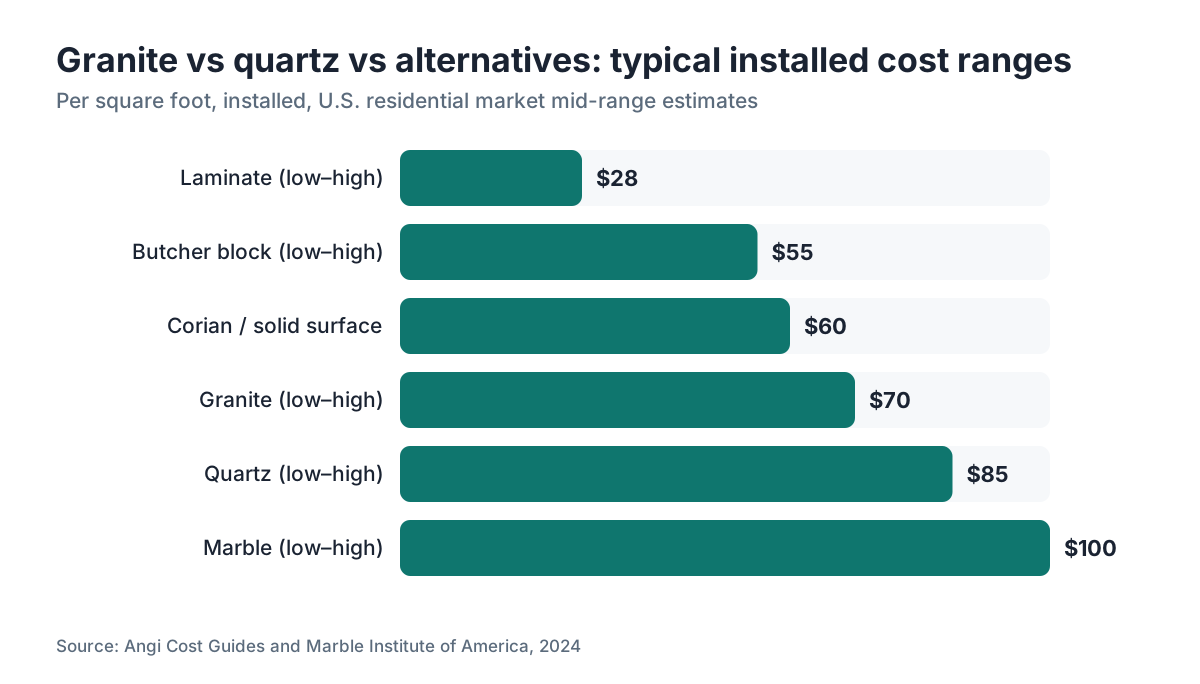
Still deciding? It helps to see where granite and quartz sit in the broader material landscape.
Marble countertops are softer (Mohs 3 to 4) and etch from acidic liquids. They're beautiful and high-maintenance. Not the right call for a busy kitchen unless you treat them like furniture.
Butcher block countertops cost $30, $80 per square foot installed and need regular oiling. They're warm-looking and knife-friendly but not heat-proof, and they take water damage if you neglect them.
Laminate countertops run $15, $40 installed and have improved a lot in appearance (many mimic stone convincingly), but they scratch and can't be refinished.
Corian countertops and similar solid-surface products run $40, $80 installed, sand out repairable, and hide their sink joints with no visible seam, but they're less heat-resistant than either granite or quartz.
For most homeowners choosing between stone options, the granite-vs-quartz decision is the right one to focus on. Both hold up for decades of use when properly installed.
Frequently asked questions
Is quartz more expensive than granite?
Quartz usually has a higher floor price, starting around $50 per square foot installed versus $40 for entry granite. But both materials overlap heavily in the mid-range. High-end granite exotics can top premium quartz prices. On average you'll pay a bit more for quartz, but the difference is often $5, $15 per square foot, not a dramatic gap.
Does quartz need to be sealed like granite does?
No. Quartz is engineered with a polymer resin that makes it non-porous. It never needs sealing. Granite is a natural porous stone and should be sealed every 1 to 3 years depending on the stone's density and the sealer used. If you want a surface with zero sealing upkeep, quartz wins outright.
Can you put a hot pan on quartz countertops?
You shouldn't. The polymer resin in quartz can discolor, warp, or crack from sustained heat above roughly 300°F. Most manufacturers, including Caesarstone, explicitly warn against direct hot pan contact. Granite handles heat much better since it formed under extreme geological heat. If you regularly slide pots from the burner to the counter, granite is safer.
Which is harder, granite or quartz?
Quartz composite typically rates around 7 on the Mohs hardness scale. Granite ranges from 6 to 7 depending on the specific stone. For practical purposes, neither scratches easily under normal kitchen use. A knife won't scratch either surface. Quartz has a slight edge in hardness on paper, but the real-world difference is minimal for home use.
Does granite emit radon and is it dangerous?
Granite contains trace naturally occurring radioactive minerals and can emit small amounts of radon. The EPA has reviewed this and does not recommend avoiding granite countertops on radon grounds. The contribution from countertops is typically far smaller than radon entering through soil and foundation. If you're concerned about radon, test your home's air with a certified test kit.
How long do granite and quartz countertops last?
Both materials last the lifetime of the house if properly installed and maintained. Granite that's sealed and protected from severe impact can last 50+ years. Quartz has a shorter track record since it caught on in the 1990s and 2000s, but there's no reason to expect it to fail within a normal homeownership span. The weak link is usually installation or substrate failure, not the material itself.
Which is better for resale value, granite or quartz?
There's no clean data separating granite from quartz for resale. Both beat laminate and outdated materials in buyer perception. The National Association of Realtors consistently ranks kitchen updates among the highest-impact renovations for resale. In practice, buyers want stone or stone-look surfaces in modern condition. Either granite or quartz in good shape satisfies that expectation.
Can quartz be used outdoors?
No. Quartz manufacturers explicitly exclude outdoor use from their warranties because UV exposure causes the polymer resin to yellow and degrade over time. Granite suits outdoor kitchens and holds up well to sun and weather. If you're building an outdoor kitchen or bar top, granite (or concrete, or porcelain) is the right call. Quartz belongs indoors only.
How do you clean quartz and granite day to day?
Both surfaces clean the same way: mild dish soap and warm water, or a pH-neutral stone cleaner. Avoid harsh chemicals on granite (they strip the sealer) and on quartz (bleach and highly alkaline cleaners degrade the resin over time). Don't use abrasive scrubbers on either. For granite, skip anything acidic that could etch the sealer or the stone surface.
What's the difference between quartz and quartzite?
Quartz countertops are engineered: ground quartz crystals mixed with polymer resin and formed into slabs. Quartzite is a natural metamorphic rock, harder than granite, that needs sealing more often than granite does. People confuse them because the names sound similar. If a showroom labels a slab as quartzite, verify it with an acid test. Some dealers mislabel softer stones.
Is a quartz or granite countertop better for white kitchens?
White or near-white quartz gives you very consistent tone across the counter and between multiple slabs, which is hard to hit with natural white granite. Natural white granites vary slab to slab and can carry warm or cool casts that don't match perfectly. If a uniform bright white is the goal, engineered quartz is easier to control. If you want movement and uniqueness, white granite like White Ice or Alaska White is beautiful but variable.
Does fabrication difficulty differ between granite and quartz?
Both materials get cut with similar CNC waterjet and bridge-saw equipment. Quartz is somewhat more consistent in density and less likely to have natural fissures that complicate cutting. Granite occasionally has natural cracks or weak spots a skilled fabricator has to work around. For complex edges or tight radius cutouts, the material behavior is similar. Shop labor rates are the same for both.
What thickness should I choose for granite or quartz?
The standard for both is 3 cm (about 1.25 inches). Some budget granite comes at 2 cm but requires a laminated edge or a plywood subtop for stability. For quartz, 3 cm is the practical standard; anything thinner is more prone to cracking at cutouts. Pay the small premium for 3 cm if given a choice. It looks better, feels more substantial, and installs more reliably.
Sources
- HomeAdvisor (Angi), Granite Countertops Cost Guide: Granite countertops cost $40, $100 per square foot installed; demolition adds $100, $400
- Marble Institute of America, Quartz Surfaces Overview: Engineered quartz is approximately 93% ground quartz and 7 to 10% polymer resin; standard slab size roughly 55 x 120 inches
- Cambria, Product and Pricing Overview: Cambria quartz countertops typically retail in the $80, $120 per square foot installed range
- USGS, Mohs Hardness Scale: Granite rates 6 to 7 on the Mohs scale; engineered quartz composites test near 7
- Caesarstone, Care and Maintenance Guidance: Caesarstone care guidance advises against direct hot cookware contact and against harsh or alkaline cleaners; resin can discolor above roughly 300°F and yellow under prolonged UV
- Marble Institute of America, Stone Care and Maintenance: Granite should be sealed every 1 to 3 years depending on porosity; daily cleaning requires pH-neutral cleaner or mild dish soap
- Meat Science journal, Bacterial transfer and kitchen surface study: Study found cleaning method mattered more than surface material type for bacterial presence on kitchen countertops
- NSF International, Food Safety and Equipment Certification: NSF certifies some quartz surfaces for food contact based on non-porous surface properties
- National Association of Realtors, Research and Statistics (Remodeling Impact Report): Kitchen renovations rank among the highest-impact remodels for cost recoupment at resale; stone countertops consistently noted by buyers
- Marble Institute of America, Annual Industry Statistics: Engineered stone has taken an increasing share of new U.S. residential kitchen countertop installs since approximately 2015
- Caesarstone, Sustainability and ISO Certification: Caesarstone holds ISO 14001 environmental management certification for manufacturing operations
- U.S. Environmental Protection Agency, Radiation Protection: Granite Countertops and Radiation: The EPA states granite countertops can emit low levels of radon but are not considered a significant source compared to soil gas; the EPA does not recommend avoiding granite countertops
- OSHA, Crystalline Silica Standard and Hazard Alert for Engineered Stone: OSHA issued a specific hazard alert on silica dust exposure risks for workers cutting engineered quartz countertops without proper respiratory protection
- The Home Depot, Countertop Installation Services: Home Depot's countertop installation program typically quotes 3 to 5 weeks from measure to install for quartz and granite products
Last updated 2026-07-09