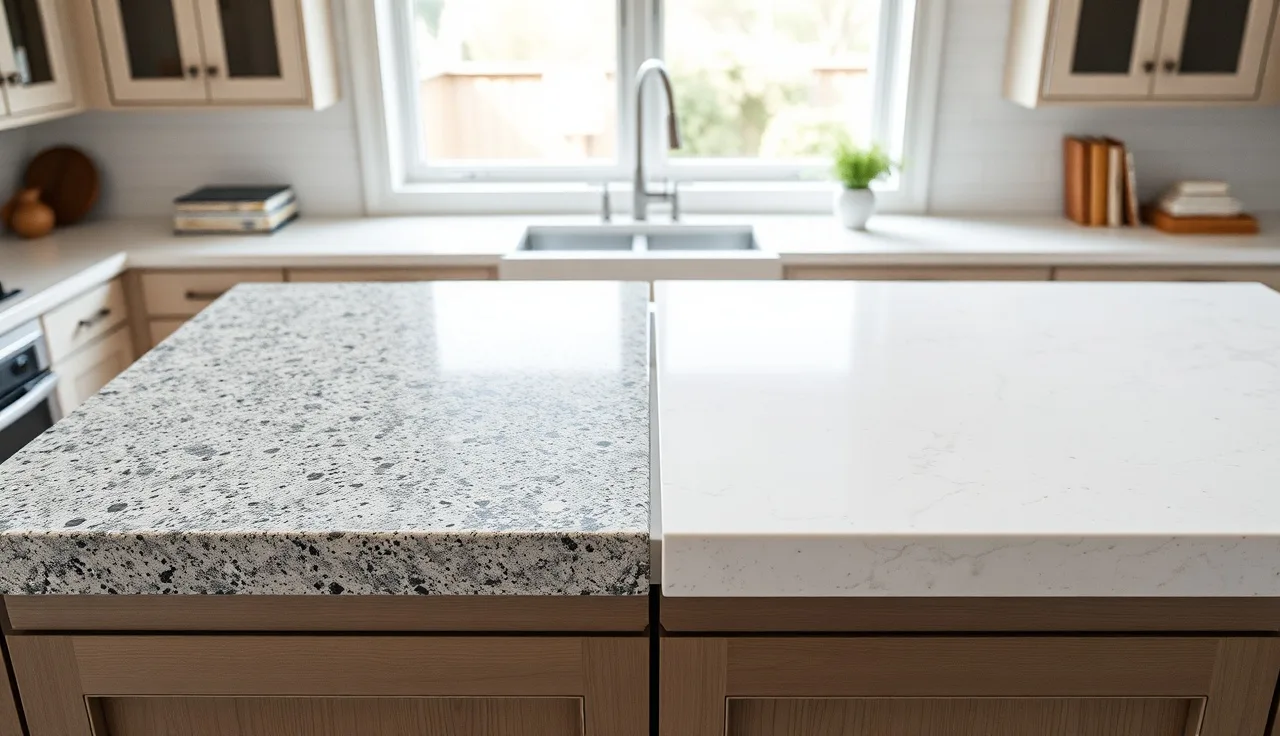
TL;DR
- Quartz engineered stone edges out granite on scratch resistance (Mohs 7 vs 6-7) and stain resistance because its resin binders seal the surface.
- Granite wins on heat tolerance and resale authenticity.
- Neither is indestructible.
- Your kitchen's actual abuse pattern, not abstract durability scores, should decide the choice.
What does 'durable' actually mean for a countertop?
Durability sounds like one thing. It's really five: scratch resistance, heat resistance, stain resistance, impact resistance, and long-term structural integrity. A material can ace two of those and fail a third. That's exactly where granite and quartz split, and why the endless "which is better" debate never lands.
The Mohs hardness scale rates minerals from 1 (talc) to 10 (diamond) by scratch resistance [1]. Granite is an igneous rock made mostly of quartz, feldspar, and mica, so different slabs test differently, usually landing between 6 and 7 on Mohs. Engineered quartz countertops are about 93% ground quartz particles (a 7 on Mohs) bound in polymer resin, and the finished product typically tests at 7 [2]. A one-point gap sounds trivial. At that range it means most kitchen knives (steel, roughly 5.5-6.5 Mohs) will scratch granite's softer feldspar pockets before they mark quartz.
Heat, stains, and cracks each follow completely different physics. Looking at all five properties together is the only honest way to answer this question.
Which is harder: granite or quartz countertops?
Engineered quartz wins on hardness, but the margin is smaller than most marketing implies.
Granite's hardness varies by slab because it's a natural composite. The quartz crystals in granite are a 7, but the feldspar (which makes up 50-60% of most granite) is a 6, and mica veins can be as soft as 2-3 [1]. A steel chef's knife dragged hard across a feldspar vein will eventually leave a mark. Day-to-day cutting board use won't do that fast, but fabricators who've seen countertops after a decade of hard use know it happens.
Engineered quartz is more homogeneous. The resin binders aren't harder than quartz, but they cushion micro-abrasions and fill the pore structure, so there are no soft mineral pockets to attack [2]. If scratch resistance is your single biggest worry, quartz is the more consistent choice.
One honest caveat. Most homeowners never scratch either surface badly enough to notice, because normal use doesn't involve dragging steel across stone over and over. Scratching only becomes a real-world problem for people who skip cutting boards entirely.
How do granite and quartz compare on heat resistance?
This is where granite wins clearly and where quartz has a real, documented weakness.
Granite formed at temperatures above 700°C deep in the earth [3]. A hot pan off the stove (typically 150-260°C for something you'd set down) does nothing to it. Set a cast iron skillet straight from the oven onto granite without a trivet and the stone itself won't care. The sealant on top can eventually degrade from repeated heat, but the stone underneath is fine.
Engineered quartz is a different story. The polymer resins that bind the quartz particles start to discolor, crack, or separate at temperatures above roughly 150°C (300°F) [4]. Sudden thermal shock, like a hot pan from a 230°C oven set directly on a cool quartz surface, can cause visible damage: discoloration, small cracks, or in bad cases, the surface layer lifting off. Breton, the Italian company whose technology underlies most quartz manufacturing, and the quartz brands themselves all recommend trivets.
If you cook seriously and tend to park pots directly on the counter, granite is the smarter pick. If you're disciplined about trivets, quartz's heat limit is mostly theoretical.
Which countertop stains less: granite or quartz?
Quartz wins this one, and the reason is structural.
Granite is porous, and the porosity swings hard by slab. A dense, dark absolute black granite may barely absorb anything, while a lighter granite with more feldspar can pull in red wine visibly in under ten minutes if it isn't sealed [5]. Sealing closes those pores temporarily. A quality penetrating sealer buys you one to three years of protection depending on use, traffic, and the product. Forget to reseal and stains get in.
Engineered quartz is non-porous. The resin binders fill every void, so there's no path for liquid to penetrate. Wine, coffee, tomato sauce, and most kitchen stains sit on top and wipe off. This is a genuine structural advantage, not a marketing claim [2]. The one exception: strong chemicals like paint strippers, high-concentration bleach, or certain solvents can attack the resin binders over time. So quartz shrugs off food and drink but stays chemically sensitive in a way granite is not.
For bathroom counters around cosmetics, nail polish remover, and hair dye, well-sealed granite may actually hold up better in daily life because it tolerates the chemical exposure without resin damage.
What about cracks and chips: which material holds up better?
Both materials chip if you hit them hard enough at an edge or corner. Neither bounces back from a direct impact the way laminate can.
Granite's natural fracture lines (called fissures, which are structural, versus cracks, which are damage) mean some slabs are more fragile than others. Thin granite sections, like a narrow strip between the sink cutout and the edge, can crack under stress during installation or from uneven cabinet support. An experienced fabricator can spot slabs with bad fissures before cutting, but homeowners buying granite usually don't know what to look for [6].
Engineered quartz behaves more predictably because the material is made to uniform specs. It has no natural fissures. It's still not impact-proof: a cast iron skillet dropped squarely on a quartz edge will chip it. Repaired chips in quartz often show more than repaired chips in granite, because quartz's patterning is harder to color-match exactly.
For kitchen countertops in a high-traffic home with kids, quartz's predictable structural behavior is a practical edge. For a kitchen where the main risk is uneven support or installation stress, granite's natural fissures need more vetting at selection time.
How do maintenance requirements compare over time?
This is the honest practical difference most homeowners feel every week.
Granite needs periodic sealing. Most fabricators recommend an annual seal, though the real interval depends on the stone's porosity and the sealer used. A simple water bead test tells you when: pour a few tablespoons of water on the surface, and if it soaks in rather than beads within 10-15 minutes, reseal [5]. Sealing takes 30-45 minutes and costs $10-30 for a DIY product, or $50-150 if you hire it out. Skip it and you risk permanent staining.
Quartz needs no sealing, ever. The routine is soap and water, or a dedicated stone cleaner. That's a real convenience win, especially for people who forget maintenance tasks or don't want to pay for them. For keeping any stone surface clean, our piece on how to clean stone countertops covers the general principles.
One underrated maintenance factor: quartz's non-porous surface doesn't harbor bacteria the way porous, unsealed granite can. A study from NSF International found the countertop surfaces with the highest bacteria counts in kitchen tests were consistently porous materials, though the study did not isolate granite specifically [7]. Non-porous quartz's hygiene advantage is real even if clean comparative numbers are rarely published.
Granite vs quartz: side-by-side durability comparison
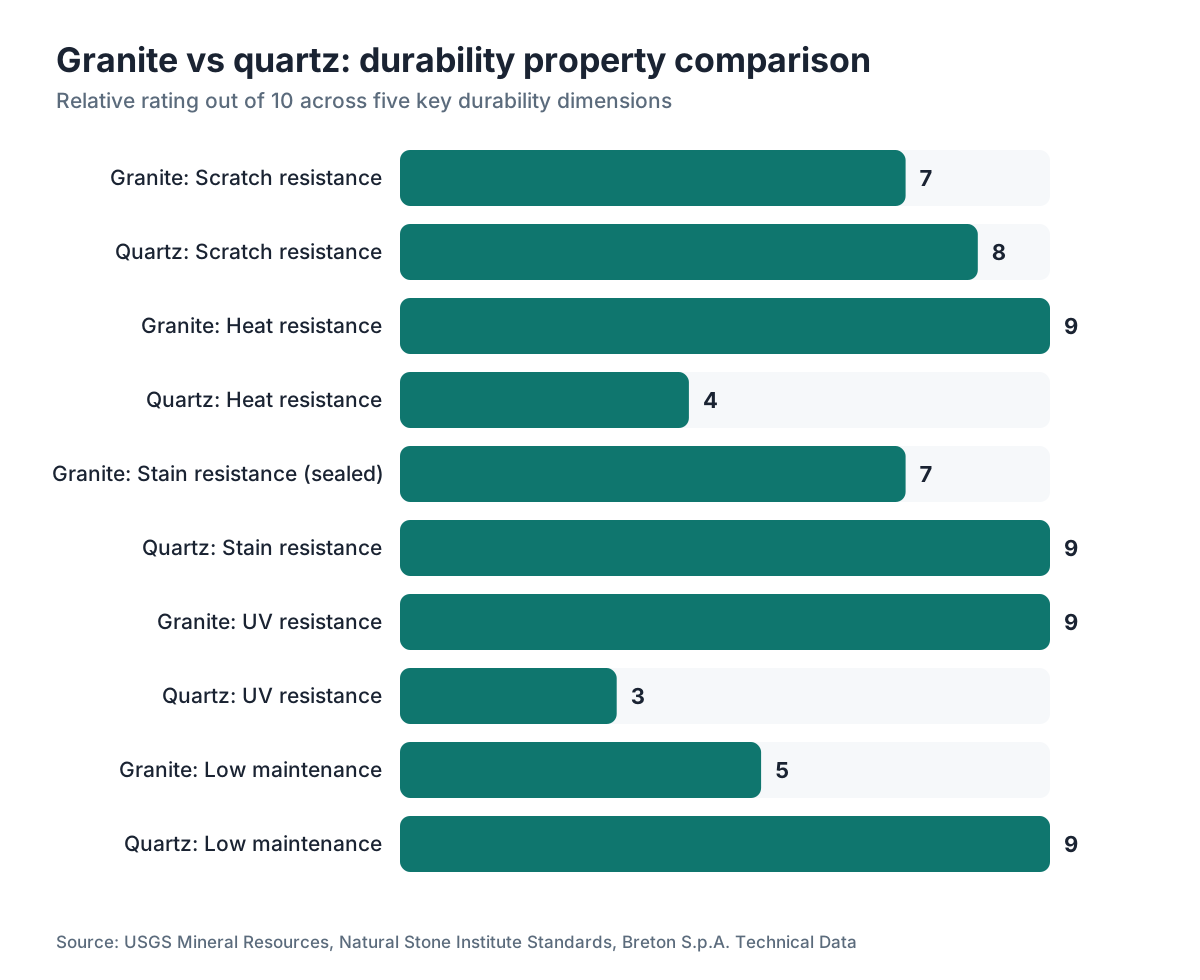
The table below compares the two materials across the five durability dimensions that matter in a real kitchen. Ratings are relative, not absolute.
| Property | Granite | Engineered Quartz |
|---|---|---|
| Scratch resistance (Mohs) | 6-7 (varies by slab) | ~7 (consistent) |
| Heat resistance | Excellent (700°C+ origin) | Poor above ~150°C |
| Stain resistance (unsealed) | Low to moderate | High |
| Stain resistance (sealed) | Moderate to high | High |
| Impact/chip resistance | Moderate (fissure risk) | Moderate (consistent) |
| Requires sealing | Yes, every 1-3 years | No |
| UV/fade resistance | Excellent | Poor (outdoor use) |
| Repairability | Good (color-matched epoxy) | Harder to match |
| Installed cost range (US) | $40-$200/sq ft [8] | $55-$200/sq ft [8] |
The cost overlap is real. Mid-range granite and mid-range quartz land in the same price band. Premium quartz from brands like Cambria can top the best granite. Budget granite slabs can undercut entry-level quartz. Price alone tells you nothing about durability.
For more on one side of this comparison, the full granite countertops guide goes deeper on slab selection, fissure identification, and sealer choices.
Does granite or quartz hold up better outdoors?
Granite. It's not close.
Engineered quartz contains polymer resins that UV light breaks down over time. Long sun exposure turns the resin yellow, fades it unevenly, or leaves it chalky. Most quartz manufacturers flatly void warranties for outdoor installations [4]. Building an outdoor kitchen or a bar top on a covered patio that catches afternoon sun? Quartz is the wrong material.
Granite handles outdoor conditions well. UV doesn't touch stone mineralogy. Freeze-thaw cycles can affect any porous stone, but a sealed granite in a moderately porous range holds up fine across most US climates, minus the extreme wet-freeze ones. For outdoor work, granite is the better choice between these two.
Which countertop material adds more resale value to a home?
Honest answer: the data here is thin, and what exists deserves real skepticism.
National Association of Realtors surveys consistently list stone countertops as a desired feature, and a 2022 NAR report found that kitchen renovations including stone countertops recovered 67% of their cost at resale on average [9]. But that figure bundles granite and quartz together and doesn't separate one from the other.
Real estate agents in practice often say granite reads as "natural stone" to buyers who care about authenticity, while quartz reads as low-maintenance, which pulls a different buyer. Neither is categorically better for resale; it depends heavily on your market and price point. In luxury markets, rare natural stone (marble, exotic granite) often signals more than engineered stone. In mid-market homes, quartz's durability story lands with practical buyers.
If resale is genuinely your main driver, ask a local agent what's selling in your specific neighborhood and price range. That beats a national average every time.
What do fabricators actually see after years of installations?
Fabrication shops see the before and the after. Countertops come back for repairs, show up in warranty claims, and get ripped out when they fail. Here's what the shop floor consistently shows (aggregated from fabrication industry discussions and trade publications, not invented anecdotes).
Quartz returns most often for heat damage from pans or slow cookers, chip damage at sink cutouts and edges, and discoloration from bleach or other harsh cleaners. Granite returns most for staining from oil or wine in unsealed or under-sealed slabs, and cracks at narrow sections (especially at sink cutouts in slabs with natural fissures).
Shops that run quoting software, including tools like SlabWise, track which materials generate callbacks and warranty claims. The pattern across shops is that quartz heat damage is a steady complaint category, while granite staining complaints line up strongly with jobs where the homeowner wasn't clearly told about sealing.
Here's the practical lesson. The material matters less than the match between its properties and the homeowner's actual habits. Granite in the hands of someone who never seals is a bad call. Quartz in a kitchen where pots live directly on the counter is a bad call.
So which should you actually choose?
Choose quartz if: you want the lowest maintenance possible, your kitchen sees lots of spills, you have kids who won't touch a trivet, or you're in a rental or investment property where simple upkeep matters.
Choose granite if: you cook seriously and set hot pans right on the counter, you want the counter on an outdoor kitchen or covered patio, you prefer a natural material, or you love that no two slabs are identical.
Don't choose either on price alone. The installed ranges overlap a lot, and the cheaper slab in either category is often the worse long-term value.
Comparing other materials entirely? Marble countertops are far softer (Mohs 3-4) and stain more readily than both. Butcher block countertops are warm and repairable but need more maintenance than either stone. Laminate countertops cost far less but don't match the thermal mass or longevity of stone. Cambria countertops are a quartz brand with strong warranty terms worth comparing if you go the quartz route.
For a fast, honest price estimate before calling a fabricator, SlabWise's instant quote tool at slabwise.com generates a realistic range from your dimensions, material choice, and edge profile in a few minutes.
How do you verify a granite slab's quality before buying?
Most homeowners visit a slab yard once, pick what looks good, and trust the fabricator to handle the rest. That works fine. Knowing a few things makes the choice better.
First, look for fissures. Natural fissures are linear breaks in the crystal structure, different from cracks (which are damage). Shine a flashlight at a low angle across the surface; fissures catch the light. Fissures aren't automatically disqualifying, but one running through a section that will be cut for a sink is a structural risk [6]. Tell your fabricator where the fissures are so they can work around them.
Second, run the water test on the actual slab. Pour a small amount of water on the surface. If it soaks in within a few minutes, the slab is highly porous and will need sealing more often. If it beads for 15+ minutes, the stone is denser and more naturally stain-resistant.
Third, ask about the slab's country of origin. This affects price and quality consistency. Brazilian, Indian, and Italian granites each have regional traits. It doesn't make one category better, but it's information worth having.
For quartz, slab quality is more standardized, so look at the warranty terms. Top brands like Cambria offer lifetime warranties; others offer 10-15 years. Warranty terms often tell you more about brand confidence than the marketing copy does.
Is quartzite a better choice than either granite or quartz?
Quartzite gets confused with quartz constantly, but they're completely different materials. Quartzite is a natural metamorphic rock (formed from sandstone under heat and pressure), not an engineered product. It sits at 7 on the Mohs scale, similar to engineered quartz, but it's natural stone with the look of marble and better durability than marble.
The catch: quartzite is porous and needs sealing like granite, some stone sold as "quartzite" is actually a dolomitic marble (softer, more acid-sensitive), and prices run higher than most granite or mid-range quartz. If you want natural stone with maximum hardness, quartzite is worth a look, but verify what you're buying with an acid test (a drop of lemon juice on an inconspicuous area, genuine quartzite won't etch). Full cleaning and care guidance is in the how to clean quartzite countertops article.
For the granite vs quartz question specifically, quartzite is a third option that doesn't settle the debate but offers a different set of trade-offs.
Frequently asked questions
Which is better, quartz or granite countertops?
Quartz is better for low maintenance, stain resistance, and consistent hardness. Granite is better for heat resistance, outdoor use, and authenticity of natural stone. Neither is objectively superior across all conditions. Quartz suits most modern kitchens with varied cooking habits; granite suits serious cooks who set hot pans on the counter and can commit to periodic sealing.
Does quartz scratch more easily than granite?
No. Engineered quartz tests at roughly Mohs 7 consistently, while granite varies between 6 and 7 depending on its feldspar content. The softer feldspar in granite can scratch more easily than the homogeneous quartz surface. In practice, both resist normal kitchen use well; the difference shows up under sustained heavy abrasion.
Can you put hot pans on quartz countertops?
You shouldn't. Engineered quartz resin binders can discolor, crack, or delaminate at temperatures above roughly 150°C (300°F). A hot pan fresh from a 230°C oven placed directly on quartz can cause visible permanent damage. Granite handles heat far better and won't be damaged by normal hot pans. Always use a trivet with quartz.
Does granite stain more easily than quartz?
Yes, unsealed granite stains more easily because it's porous. Oil, wine, and acidic liquids can penetrate and leave permanent marks if the stone isn't properly sealed. Quartz is non-porous, so those same liquids sit on the surface and wipe clean. Regular sealing (every 1-3 years) brings granite's stain resistance close to quartz, but it requires ongoing effort.
How long do granite and quartz countertops last?
Both materials last decades under normal conditions. Granite can last the lifetime of the house if sealed and maintained. Quartz warranties from major brands run 10 years to lifetime, but the resin component can degrade faster than stone under UV exposure or repeated heat stress. Properly maintained, either surface should easily outlast 20-30 years of kitchen use.
Which countertop is easier to maintain, granite or quartz?
Quartz is significantly easier to maintain. It requires no sealing, ever. Routine cleaning is soap and water. Granite requires periodic sealing (every one to three years depending on porosity), and if you skip it, staining risk climbs. For homeowners who want minimal maintenance obligations, quartz is the clear answer.
Does quartz or granite add more value to a home?
A 2022 NAR report found kitchen renovations with stone countertops recover about 67% of cost at resale on average, but it doesn't separate granite from quartz. In practice, both perform similarly for resale. Luxury markets may favor rare natural stone; mid-market buyers often prefer quartz's durability story. Ask a local real estate agent what buyers in your specific market and price range expect.
Which is more expensive: granite or quartz?
The price ranges overlap heavily. Both typically run $40 to $200 per square foot installed in the US. Budget granite slabs are cheaper than budget quartz at the low end. Premium quartz brands (like Cambria) can cost as much as or more than top-shelf exotic granite. Material cost alone is not a reliable signal of durability.
Can you use quartz countertops outdoors?
No. Quartz resin binders degrade under UV exposure, causing yellowing, fading, and chalking over time. Most quartz manufacturers explicitly void warranties for outdoor installations. Granite handles outdoor conditions well: UV doesn't affect stone mineralogy, and sealed granite holds up in most climates. For outdoor kitchens or covered patio bars, granite is the right choice between these two options.
Is granite or quartz more hygienic?
Quartz's non-porous surface gives it a hygiene advantage: bacteria and mold have no pores to settle in. Unsealed or poorly sealed granite can harbor bacteria in surface pores. A sealed granite's hygiene is closer to quartz, but quartz requires no maintenance to maintain that non-porous surface. For food prep areas, quartz's inherent non-porosity is a practical advantage.
Which countertop chips more easily, granite or quartz?
Both chip under sharp impact, especially at edges and cutouts. Granite slabs with natural fissures have specific vulnerable points that a fabricator should identify before cutting. Quartz is more structurally uniform and doesn't have fissures, making impact behavior more predictable. Chips in quartz are often harder to repair invisibly than chips in natural granite.
What is the main downside of quartz countertops?
Heat sensitivity is the biggest real-world downside. Polymer resins in quartz degrade at temperatures above roughly 150°C, and a hot pan from the oven can permanently discolor or crack the surface. UV degradation rules out outdoor use. Some chemical cleaners (bleach, paint stripper, acetone) also attack the resin binders in ways they wouldn't affect granite.
What is the main downside of granite countertops?
Porosity and the sealing obligation that comes with it. Granite must be sealed periodically (every one to three years depending on stone density) or it stains readily from oil, wine, and acidic spills. Slabs with heavy fissures can also crack at narrow sections during installation or under uneven support. Both risks are manageable with good fabricator communication and maintenance discipline.
Is quartzite the same as quartz countertops?
No. Quartzite is a natural metamorphic rock, while engineered quartz is a manufactured product of ground quartz particles and polymer resin. Quartzite is harder and more heat-tolerant than engineered quartz, but it's porous like granite and needs sealing. It's frequently confused with quartz in showrooms, so verify what you're buying with a simple acid test before purchasing.
Sources
- U.S. Geological Survey, Volcano Hazards Program: Granite forms from magma at temperatures exceeding 700°C, making it thermally stable at normal kitchen temperatures
- Silestone by Cosentino, Product Care and Maintenance Guide: Quartz manufacturer guidance warns against direct heat exposure above 150°C and recommends trivets; outdoor installations may void warranty due to UV degradation
- Natural Stone Institute, Care and Cleaning for Natural Stone Surfaces: Natural stone including granite should be sealed periodically; a water absorption test (beading within 15 minutes) indicates adequate seal protection
- Natural Stone Institute, Dimension Stone Design Manual: Natural fissures in granite slabs are structural features distinct from cracks; fissures in narrow sections near sink cutouts present cracking risk during fabrication
- NSF International, Household Germ Study: NSF kitchen hygiene testing found highest bacteria counts on porous countertop surfaces; non-porous surfaces were significantly easier to sanitize
- Angi, Countertop Installation Cost Guide: Installed granite countertops cost $40-$200 per square foot in the US; engineered quartz runs $55-$200 per square foot installed
- National Association of Realtors, 2022 Remodeling Impact Report: Kitchen renovations including stone countertops recovered approximately 67% of cost at resale on average in 2022
- U.S. Geological Survey, National Minerals Information Center: Feldspar constitutes 50-60% of most granite by volume and has a Mohs hardness of approximately 6
Last updated 2026-07-09