TL;DR
- Most granite chips fix at home for $40 to $100 with a color-matched two-part epoxy kit.
- Cracks are trickier.
- A hairline crack can stabilize with epoxy, but a crack through the full slab almost always needs a fabricator, and a shifted or moving crack often needs replacement.
- Reseal the repaired area every time.
- That part is not optional.
What kinds of damage can granite actually get?
Granite is hard, roughly 6 to 7 on the Mohs scale, but hard is not the same as indestructible. [1] The stone is brittle. Hit an edge with a cast-iron pan at a bad angle and you'll chip it. Set something heavy on an unsupported overhang and a crack starts from a stress point.
Damage falls into a few clear categories. Getting the category right is the single most important thing you do before you touch it.
Chips are missing material, usually at corners or edges where the stone is thinnest. They look bad but they're almost always fixable as a cosmetic job. Scratches are surface abrasions, and because granite is so hard, true scratches are rare. What most homeowners call a scratch is a metal mark from a pan or utensil that wipes off. Stains are a different problem and aren't structural at all. Cracks are the serious ones. A hairline crack through only the surface finish is one thing. A fissure running through the full thickness of the slab is another. A crack at a seam or cutout that moves under load is worse than both.
Fissures cause a lot of confusion, so they get their own paragraph. Natural fissures formed when the rock cooled millions of years ago. They're part of the stone, not damage, and they don't grow. A crack from impact or stress tends to run irregularly, has sharp edges, and may carry fine debris or a color that's different from the surrounding stone. Run your fingernail across it. Feel a step or a catch, and it's a crack. Feel nothing and see it follow the crystal pattern, and it's probably a natural fissure. [2]
How do you repair a granite countertop chip?
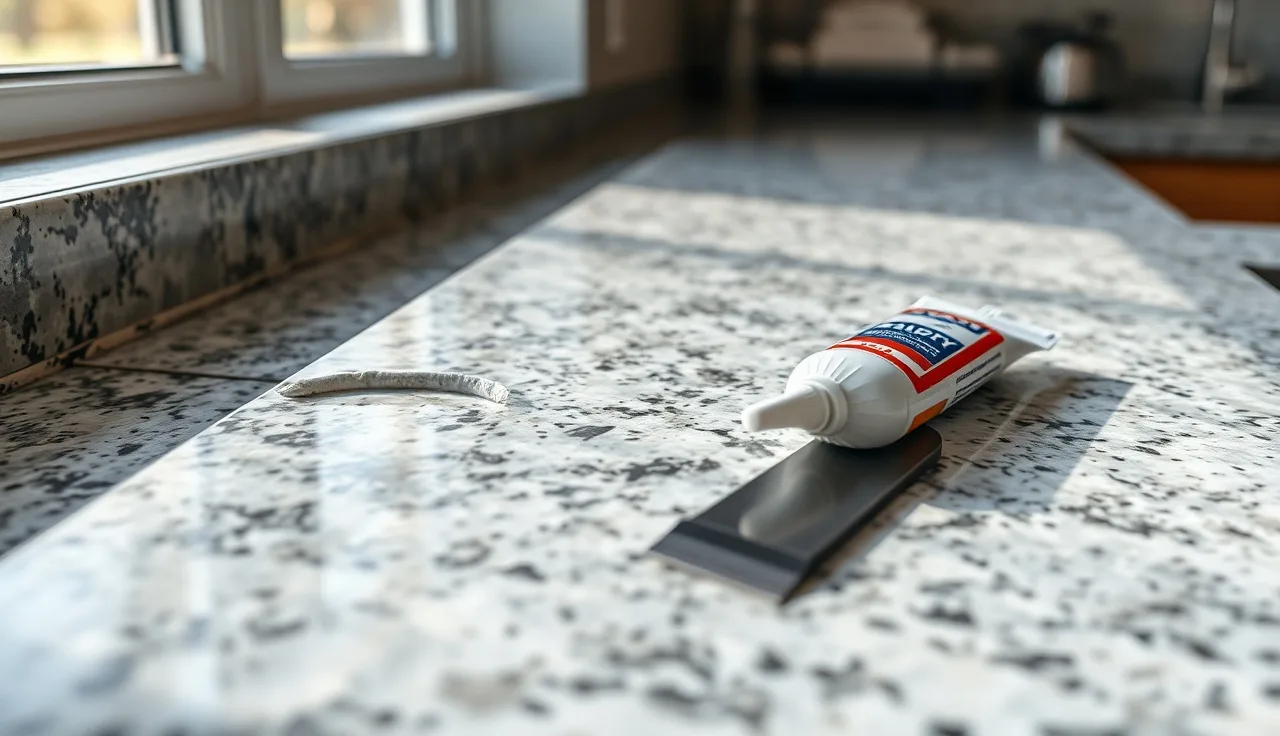
A granite chip is fixable, and most homeowners can do it in an afternoon. Here's the whole process, step by step.
Buy the right filler first. The standard for granite chip repair is a two-part polyester or epoxy adhesive tinted to match the stone. Akemi, Tenax, and Dural all make stone-specific repair adhesives that fabricators reach for. Big-box stores carry generic versions. Match your granite's background tone, not its pattern, because the filler won't copy the pattern and a close background reads as invisible from a normal distance.
Clean the chip before you mix anything. Blow out loose debris with a dry brush or compressed air. Wipe the area with acetone or denatured alcohol and let it dry all the way. Any moisture or grease left in the void kills adhesion.
Mix the epoxy to the manufacturer's ratio. Most two-part adhesives give you five to twenty minutes of working time, so mix only what you'll use in one shot. Overfill the chip a little. The filler shrinks slightly as it cures, and you want extra material to sand back rather than a divot to chase.
Once it cures (follow the manufacturer's time, usually one to four hours for a working cure), scrape the excess flush with a fresh single-edge razor blade. Keep the blade at a low angle so you don't scratch the surrounding stone. Then polish with progressively finer wet/dry sandpaper, starting around 400 grit and finishing at 1,500 or 2,000, and follow with a countertop polish. [3]
Edge chips use the same steps, but tape off the area with painter's tape to contain the filler and give yourself a clean edge to work up to.
Materials run $40 to $100 for a repair kit. The cost climbs on color matching. If your granite has heavy variation or a busy pattern, hand it to a fabricator, because they can tint the adhesive more precisely and they've done it hundreds of times. A professional chip repair runs $150 to $300 for one to three chips at the same visit, and up to $450 depending on location and complexity. [4]
How do you repair a cracked granite countertop?
Cracks are harder than chips, and the honest answer is that your options depend almost entirely on the type of crack you have.
A hairline surface crack, one that goes through the finish but not the full depth of the slab, can often be stabilized and made less visible with a low-viscosity epoxy. You clean the crack, work the epoxy in with a thin tool or by capillary action, let it cure, and sand flush. It'll still be faintly visible under certain light, but it won't grow and the surface stays sealed.
A through crack, one that runs completely through the slab, is a structural problem. You can inject epoxy and reinforce the underside with fiberglass mesh and more epoxy, which is exactly what fabricators do on slabs before they install them. The catch is access. This repair needs the underside, which usually means pulling the countertop. If the piece comes off without breaking, a fabricator can repair it on a bench and reinstall. If it's glued to the cabinets and boxed in by a backsplash, removal can turn one crack into three.
Cracks at cutouts are the most common structural failures because those are stress concentration points. Sink openings, cooktop holes, faucet holes. The stone is weakest there. A crack running from a sink corner at a 45-degree angle toward the front edge is a classic failure mode. [5] Professional repair here usually means epoxy injection, color-matched fill, and sometimes a hidden reinforcing rod or mesh on the underside. Expect $300 to $800, and up to $1,200 or more if the countertop has to come off the cabinets. [4]
If the crack has split the slab into pieces that have shifted, or if the crack moves when you push on it, no surface repair holds permanently. That section needs replacement.
One thing trips people up. Don't confuse a crack with a failing seam. Seams are the joints between two slabs, filled with color-matched epoxy at install. Over time that filler shrinks, yellows, or falls out. A failed seam looks like a crack but is really a gap between two separate pieces of stone. Redoing a seam is a different job, usually $150 to $350 from a fabricator, and it's about looks more than structure.
What does a professional granite repair actually cost?
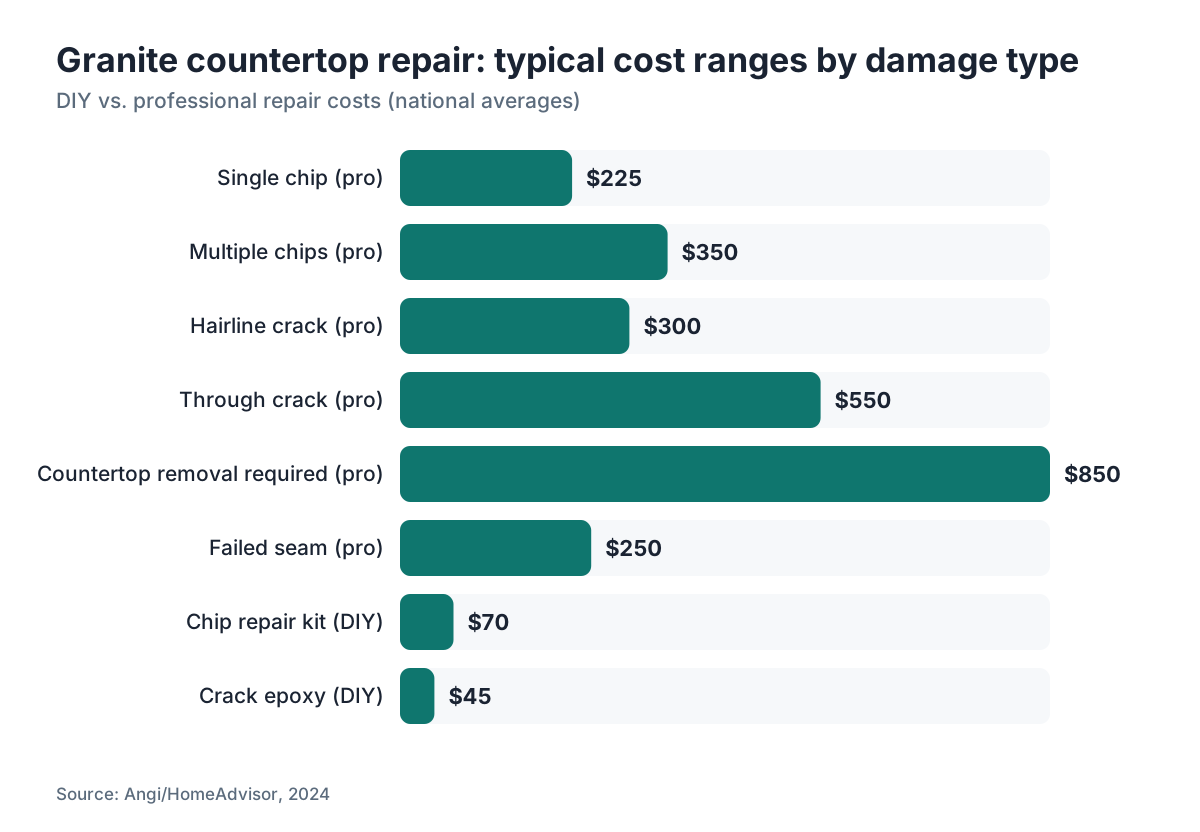
Professional granite repair runs $150 to $300 for a single chip and $300 to $800 for a crack, with the price driven by damage type, the number of spots, your location, and whether the fabricator has to come to you or you can bring a removable piece to the shop.
| Repair type | DIY cost | Professional cost |
|---|---|---|
| Single chip (edge or corner) | $40, $100 (kit) | $150, $300 |
| Multiple chips (2 to 5) | $40, $100 (same kit) | $250, $450 |
| Hairline surface crack | $30, $60 (epoxy) | $200, $400 |
| Through crack, accessible underside | Not recommended DIY | $300, $650 |
| Through crack, countertop must be removed | Not recommended DIY | $500, $1,200 |
| Failed seam | $50, $100 (kit) | $150, $350 |
| Deep scratch (honing required) | Not recommended DIY | $200, $500 |
These are national ranges. [4] High cost-of-living metros (San Francisco, New York, Seattle) run 30 to 50% higher. Rural areas can run lower, but you may also have fewer qualified stone fabricators within a reasonable drive.
Here's one move that saves real money. If you have several issues on the same countertop, get them done in one service call. Travel and setup is a big share of what you pay for.
Call a stone fabricator, not a general handyman. Look for shops that fabricate and install granite. They have the epoxies, the color-matching reps, and the polishing gear. A handyman with a tube of clear hardware-store epoxy is not the same thing, and the result shows it.
Can you seal granite after a repair, and do you need to?
Yes, and yes. Resealing after a repair is not optional, because sanding and polishing strip the sealer off the surrounding stone.
Granite is porous to varying degrees depending on its origin and mineral makeup. [6] The repair epoxy itself isn't porous, but the stone around it is, and any sanding or polishing you did will have taken off some or all of the existing sealer nearby. Skip the reseal and that area soaks up liquids, oils, and stains faster than the rest of the counter.
For a spot repair, you don't need to reseal the whole countertop. Clean the area, let it dry at least 24 hours after the repair is done, and apply a penetrating stone sealer to the repaired spot and about six inches around it. The Natural Stone Institute (formerly the Marble Institute of America) recommends a simple absorption test: put a few drops of water on the surface, and if it soaks in within three to four minutes, the stone needs sealer. [7] Let the sealer cure before you use the surface.
If the repair involved sanding a big area, or your countertop is overdue for sealing anyway, do the whole thing. A full seal is a few hours of work and $30 to $80 in materials. Small job.
For ongoing care of granite countertops, sealing frequency depends on density and use. Dense, dark granites may go three to five years between seals. Lighter, more porous stones may want it yearly. When you're not sure, run the water drop test.
When is it smarter to replace the slab than repair it?
Replace instead of repair when the repair cost approaches half the price of new countertops, when the crack has shifted the slab out of plane, or when the color is discontinued and a partial patch won't match. Repair wins when the damage is localized and the stone is otherwise sound.
Do the math on the 50% rule. Granite countertops typically cost $50 to $150 per square foot installed, depending on slab grade, edge profile, and region. [8] A $900 repair bill on a 30-square-foot kitchen that would cost $1,800 to replace in comparable granite is not obviously the better call, especially if the stone has other problems.
If the color or pattern is discontinued, matching a partial replacement piece gets very hard. In that case, repair is often the only way to keep the look you have.
If the slab has multiple cracks, or a crack that has pushed the two halves out of plane, repair rarely gives you a durable result. The underlying cause (usually inadequate support, settlement, or a point load) has to be fixed first, or the repair fails again.
For anyone mid-renovation and already pricing materials, kitchen countertops vary enormously by material, and what looks like a repair candidate today might be the right moment to swap the whole thing.
Fabricators running shop management and quoting software like SlabWise can price a partial slab replacement fast, which lets homeowners compare repair against replace side by side instead of guessing.
What tools and materials do you need for a DIY granite repair?
You don't need many tools. You do need the right ones. Here's the honest list.
For a chip repair: two-part stone epoxy or polyester adhesive (tinted to match), acetone or denatured alcohol for cleaning, a small mixing surface (cardboard or wax paper), a putty knife or small plastic spreader, painter's tape, a single-edge razor blade, and wet/dry sandpaper in 400, 800, 1,200, and 2,000 grit. Finish with a countertop polish or honing compound and a soft cloth.
For a crack repair: low-viscosity stone epoxy (it flows into the crack better than a thick adhesive), the same cleaning supplies, and access to the underside if the crack goes all the way through. Add fiberglass mesh tape and a thicker epoxy for the underside reinforcement if you go that route.
Color matching is the hard part. Stone adhesive tints sell separately and you mix them into the base adhesive. If you've never done it, buy a kit that comes pre-tinted in a range of colors instead of mixing from scratch. The Akemi Color Kit and Tenax Tefill Kit are two products fabricators actually use, and both are sold through stone supply distributors and some online retailers. [3]
One thing I'd skip: the clear silicone caulk trick that shows up on general home repair sites. Clear silicone in a chip looks fine for about six months, then yellows, skins over, and looks worse than the original damage. Use stone epoxy.
Same cleaning rules apply after the repair as for how to clean stone countertops: pH-neutral cleaners only, no bleach, no vinegar.
How do you find a qualified granite repair professional?
Hire a stone fabricator or a stone restoration specialist, not a general contractor or handyman. They have the right adhesives, the color-matching experience, and the polishing equipment that makes a repair disappear at normal viewing distance.
Start with the fabricator who installed your countertops, if you know who it was. They have records of your slab, maybe leftover material, and they know exactly what product went on the seams. If you don't know who installed it, call local countertop shops and ask specifically whether they do repair work. Not every fabricator takes repairs (the margin is thin and scheduling is a pain), but most know someone who does.
The Natural Stone Institute (formerly the Marble Institute of America) keeps a member directory at naturalstoneinstitute.org where you can search for stone professionals by location. [7] Members agree to a code of ethics, and many have finished training programs.
When you call, ask three things: do you color-match on-site, what adhesive products do you use, and do you have photos of similar repairs? A fabricator who uses professional-grade stone adhesives and matches color on-site gives a far better result than someone with a general-purpose clear epoxy.
Get at least two quotes. Repair pricing swings a lot between shops, and a quote that comes in way under the others often means less experienced work or cheaper materials.
Does homeowner's insurance or a home warranty cover granite countertop damage?
Usually no. Standard homeowner's insurance covers sudden, accidental damage, so a tree limb crashing through the ceiling onto your counter is likely covered, but a crack from normal use or installation stress almost never is. [9]
Home warranties are tighter still. Most contracts either exclude countertops outright or define them as a cosmetic item that isn't covered. Read your contract before you bother calling.
One exception is worth checking. If your countertops went in recently and a crack shows up within weeks or a few months, that may be a defect in the installation or the slab itself. Call the fabricator. Most reputable shops stand behind their work for at least a year and will look at a crack that appeared shortly after install.
If you financed the kitchen with a credit card that has purchase protection, check those terms too. Some cards carry 90-day or one-year purchase protection that might apply to a defective installation.
How do you prevent granite chips and cracks from happening again?
Some granite damage is just bad luck, a dropped skillet or an unlucky knock. A lot of it is preventable, and most of the prevention comes down to support under the stone and radiused corners at the cutouts.
Support matters more than most homeowners realize. Granite needs continuous support from the cabinets below. The fabrication standards most shops follow recommend no more than a 10-inch unsupported overhang for 3/4-inch granite and no more than 12 to 14 inches for 1-1/4-inch (3 cm) material. [5] Beyond that, steel corbels or hidden brackets are standard practice, not an upsell.
Cutout corners are stress concentration points. When a fabricator cuts the opening for a sink or cooktop, the inside corners should be radiused, not sharp 90-degree corners. A sharp corner is where cracks start. If your current countertop has square inside corners at the sink, know that it carries a higher risk.
Don't stand or sit on the countertop. It sounds obvious, but concentrated point loads on unsupported spans are a common cause of through cracks.
Edge profile affects chip resistance too. A bullnose or eased edge is thicker at the face and more forgiving of impacts than a knife-edge or a mitered waterfall edge. If you're planning a new countertop installation and want to cut chip risk, a thicker edge profile is worth the money.
Keep the stone sealed. A sealed countertop doesn't resist chips, but it resists the staining that makes a chip look worse and more obvious. See the sealing section above for how to test and hold your seal.
How does granite repair compare across different stone and countertop types?
Granite is one of the more repairable countertop materials. It's easier than marble, similar to quartzite, and harder than solid surface like Corian, which can be sanded fully smooth.
Marble countertops chip and scratch more easily because marble is softer (Mohs 3 to 4 against granite's 6 to 7) and more porous. [1] Epoxy repair works on marble too, but color matching is harder on white and gray stones where any variation jumps out.
Quartzite (not to be confused with engineered quartz) repairs about as well as granite. Engineered quartz products like Cambria countertops use a resin binder and usually get repaired with manufacturer-specific kits. Chips in engineered quartz can be harder to match because the pattern is manufactured uniformly, so any variation shows.
Laminate countertops and Formica countertops can't be repaired to invisibility. The pattern is printed on a thin surface layer, so any chip exposes the substrate underneath. Burn repair kits exist, but the results are usually obvious.
Corian countertops are solid surface material and the most repairable countertop type there is. Because the color and pattern run all the way through, a fabricator can sand out scratches and chips entirely and polish the surface back to factory condition.
Butcher block countertops sit in their own category. Cuts and gouges sand out and the surface refinishes. But they need ongoing maintenance that stone doesn't.
Repairability is a real factor in long-term ownership cost, so weigh it when you pick your next surface.
Frequently asked questions
Can I repair a granite countertop chip myself, or do I need a professional?
Most single chips, especially on edges or corners, are DIY-friendly using a color-matched two-part stone epoxy. The process takes a few hours and materials cost $40 to $100. Where DIY falls short is color matching. If your granite has complex patterning or you need an invisible result, a professional fabricator with tinting experience gets closer. A pro chip repair typically costs $150 to $300 per visit.
How to repair a cracked granite countertop at home
Hairline surface cracks stabilize with a low-viscosity stone epoxy: clean the crack thoroughly with acetone, work the epoxy in, let it cure, sand flush, and polish. Through cracks that run the full depth of the slab are not a reliable DIY repair because they need reinforcement on the underside. A surface-only fix on a through crack may look fine for a while but can reopen under normal use.
How to repair a granite countertop chip near the sink
Chips near sink cutouts are common because the stone is thinnest there and gets the most water exposure. The repair is the same as any chip: clean, fill with color-matched epoxy, cure, scrape flush, sand, and polish. Pay extra attention to sealing the repaired area afterward because it sits in a high-moisture zone. If the chip is at a corner of the cutout and a crack radiates from it, treat the crack first.
What epoxy should I use to repair granite?
Use a two-part polyester or epoxy stone adhesive, not silicone caulk and not general-purpose construction adhesive. Products like the Tenax Tefill Kit and Akemi Color Kit are what fabricators actually use. They come in colors and can be tinted. For filling cracks, choose a low-viscosity formula so it flows into the void. Clear silicone looks okay at first but yellows within months.
How much does it cost to repair a granite countertop?
A single chip repaired by a professional runs $150 to $300. Multiple chips at the same visit cost $250 to $450. A hairline crack repair is $200 to $400. A through crack costs $300 to $800, and more if the countertop has to be removed to reinforce the underside. DIY kits run $40 to $100 for chips and $30 to $60 for crack epoxy. Costs run 30 to 50% higher in major metros.
Can a cracked granite countertop be fixed without replacing it?
Yes, in most cases. Hairline surface cracks and cracks at seams get repaired with epoxy without replacement. Through cracks that haven't shifted the slab can be epoxy-injected and reinforced on the underside. Replacement becomes the better option when the crack has pushed the slab out of plane, when multiple cracks exist, or when repair cost approaches replacement cost and the counter has other problems.
How do I match the color of granite repair epoxy to my stone?
Buy a kit with multiple color pigments so you can mix to match. Test the mixed color on a tile or piece of cardboard and compare it in natural light before you apply anything. Match the background tone of the granite, not the veining or crystal pattern, because the filler can't copy that anyway. If the granite is rare or busy, a fabricator with color-matching experience will get closer than most homeowners can.
Will a repaired granite chip or crack be visible?
Honestly, a well-done repair is usually visible under raking light or close inspection. The goal is to make it unnoticeable at normal viewing distance under normal kitchen lighting, not to make it vanish. A professional repair on a good color match looks far better than the chip or crack itself. Edges and corners that see less direct light tend to hide repairs better than flat surface areas.
Do I need to reseal granite after a repair?
Yes. Sanding and polishing during the repair strip sealer off the surrounding stone. Apply a penetrating stone sealer to the repaired area and about six inches around it once the repair has cured and dried fully, at least 24 hours. Test absorption with a few water drops: if the water soaks in within three to four minutes, the stone needs sealer. The filler itself doesn't need sealing, but the surrounding stone does.
What causes granite countertops to crack?
Most granite cracks come from unsupported overhangs flexing under load, concentrated point loads (sitting or standing on the counter), stress at cutout corners for sinks and cooktops, impact from dropped heavy objects, and settlement or movement in the cabinets below. Natural fissures form when the rock cools; they look like cracks but don't grow and aren't defects. A crack that runs irregularly with sharp edges and a step you can feel is structural.
How long does a granite chip repair last?
A properly done epoxy chip repair can last ten years or more if you keep the area clean and reseal periodically. The filler is hard and chemically stable. What tends to make repairs show over time is the surrounding stone discoloring or the sealer wearing unevenly around the patch. Keeping the counter sealed and avoiding abrasive cleaners near the repair extends the visible life a lot.
Is granite easier or harder to repair than other countertop materials?
Granite is easier to repair than marble (softer and more porous), similar to quartzite, and harder than solid surface materials like Corian, which can be sanded fully smooth. Engineered quartz and laminate are generally harder to repair invisibly because their patterns are uniform or printed. Butcher block sands and refinishes. For long-term ownership, granite sits in a reasonably repairable middle ground.
Does homeowner's insurance cover a cracked granite countertop?
Rarely. Standard homeowner's insurance covers sudden, accidental damage but not cracks from normal use, installation stress, or gradual wear. If a specific accident (a falling object, a contractor's mistake) caused the crack, document it immediately and file a claim. Home warranties typically exclude countertops as cosmetic items. A crack that appears shortly after installation may be covered under the fabricator's workmanship warranty instead.
How do I know if my granite fissure is natural or a real crack?
Run your fingernail across it. A natural fissure is smooth and flush with the surface, follows the mineral crystal pattern, and has no step. A crack has a step or edge you can feel, tends to run more irregularly, may carry fine debris or a different color from the stone around it, and wasn't there at install. When in doubt, photograph it and take the photo to a stone fabricator for a second opinion.
Sources
- U.S. Geological Survey, Mineral Resources Program: Granite ranks approximately 6-7 on the Mohs hardness scale; marble ranks 3-4
- Natural Stone Institute, Technical Bulletins: Natural fissures in granite are inherent to the stone formation process, smooth to the touch, and distinct from structural cracks
- Tenax USA, Stone Repair Products: Tenax Tefill Kit is a color-matchable two-part adhesive used for granite chip and crack repair by fabricators
- HomeAdvisor (Angi), Granite Countertop Repair Cost Guide: Professional granite repair costs range from $150-$300 for chips and $300-$800 for cracks depending on type and location
- Marble Institute of America (Natural Stone Institute), Fabrication Standards: Unsupported granite overhangs beyond 10-12 inches and sharp cutout corners are primary causes of structural cracking in installed countertops
- U.S. Geological Survey, Mineral Resources Program: Granite porosity varies by mineral composition and origin; less porous than marble but still requires sealing in countertop applications
- Natural Stone Institute, Caring for Natural Stone Surfaces: The water drop absorption test (absorption within 3-4 minutes indicates need for sealer) is the standard field test recommended for determining when granite needs resealing
- National Kitchen and Bath Association (NKBA): Installed granite countertops typically cost $50-$150 per square foot depending on slab grade, edge profile, and region
- Insurance Information Institute: Standard homeowners insurance covers sudden accidental damage but excludes gradual wear, normal use damage, and cosmetic defects in most policies
- Natural Stone Institute, Member Directory and Certification Programs: The Natural Stone Institute maintains a searchable member directory for locating certified stone fabricators and restoration professionals
Last updated 2026-07-09