TL;DR
- Frymoyer Stone Fabrication & Supply is a regional stone fabricator and slab supplier in Bernville, Pennsylvania.
- Before you commit, learn how fabricators price work, what separates a good shop from a bad one, and which questions protect you when comparing quotes.
- Installed granite runs roughly $40 to $100 per square foot.
- This guide covers the rest.
What does a stone fabrication and supply company actually do?
A fabricator buys raw slabs, cuts them to your cabinet layout, cuts the sink and cooktop openings, profiles the edges, polishes the surfaces, and installs the finished tops. A company that also does supply, like Frymoyer, lets you source your own slab straight from their inventory instead of buying one sight-unseen through a distributor. That's the short version. The full picture is messier.
That supply side matters more than most homeowners realize. Granite, quartzite, marble, and similar natural stones are not uniform. Two slabs with the same name can look nothing alike. If you can walk a yard, pick your specific slab, tag it, and confirm the fabricator will cut from that piece, you get what you chose. If you can't, you're trusting somebody else's taste.
Fabrication shops fall into three types. A full-service shop does templating, fabrication, and installation under one roof. A broker outsources the cutting to a third party. A slab-only supplier sells material and leaves the cutting to you. A company that advertises both fabrication and supply implies the first model, but confirm it directly.
The machines a shop runs tell you a lot. CNC (computer-numeric-control) waterjet and bridge-saw equipment produces more consistent cuts than a manual saw. Most shops now template digitally with laser or structured-light devices, which cuts fit errors compared to paper templates. A shop that still hand-templates every job isn't automatically bad, but it's a reason to ask how they handle tight tolerances and what happens if a piece doesn't fit [1].
Where is Frymoyer Stone Fabrication & Supply located and who do they serve?
Frymoyer Stone Fabrication & Supply is based in Bernville, Pennsylvania, in Berks County [2]. The service area is mostly the greater Pennsylvania region, including surrounding counties in southeastern and south-central PA. Pricing a project in that area? Get a quote. Outside that range, lead time and delivery charges shift the math.
Shops in this part of Pennsylvania draw from the major stone distributors that keep warehouses in the Philadelphia and New Jersey corridor. That usually means decent selection across granite, quartz, marble, and quartzite. Whether Frymoyer's inventory matches your project depends on timing and what's moved through their supply chain lately.
If you're outside Berks County, the test is simple. Call, give them the rough project scope, and ask whether their delivery zone covers your address and what the trip charge runs. Most regional shops answer that in under two minutes.
How do stone fabricators price a countertop job?
Most fabricators quote by the square foot, and that number covers far more than cutting a rectangle. The base rate usually includes slab material, cutting, one standard edge profile (eased or beveled), and installation. What adds cost: premium edge profiles, sink cutouts, cooktop cutouts, mitered edges, backsplash fabrication, and oversize slabs that need special handling [3].
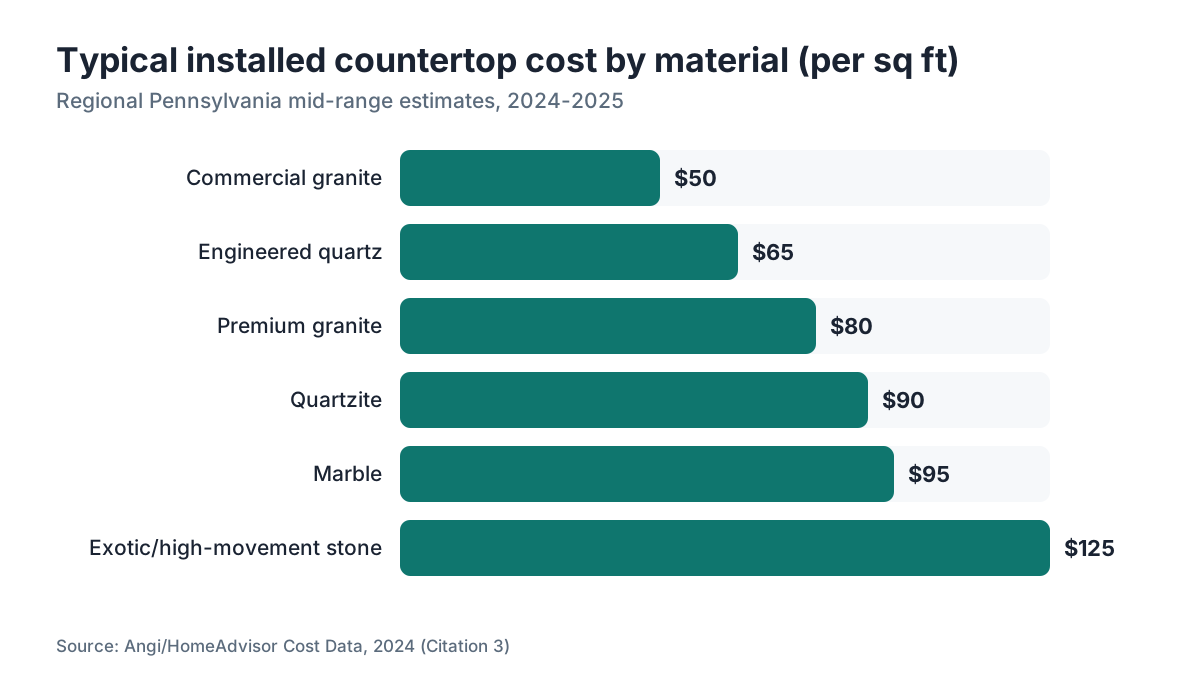
Installed granite runs roughly $40 to $100 per square foot depending on material grade and region, based on contractor cost data from Angi and similar aggregators [3]. Pennsylvania lands in the mid-range of that spread. Quartz runs comparable numbers. Quartzite and high-movement marbles run higher because the material costs more and the cutting takes more care to keep the veining lined up.
Here's where people get tripped up. The per-square-foot quote often uses the shop's own measurement convention, not a simple length times width on the finished top. Some shops bill the full rectangular bounding box of an L-shape. Others deduct for corners. Others charge a minimum square footage per piece. Before you set two quotes side by side, ask each shop how many square feet they're billing and what that number includes.
Sink cutouts usually run $50 to $150 each depending on sink type. Faucet holes are $20 to $40 each at most shops. Cooktop cutouts run $75 to $150 [3]. These add up fast on a full kitchen, so a quote that looks cheaper per square foot can end up more expensive once the line items pile on.
For granite countertops, the material grade (commercial, builder, premium, exotic) is the biggest swing. A 3-cm commercial granite from a common quarry might run $35 per square foot installed. An exotic slab with heavy movement and color can push past $120. Compare quotes on the same material or you're comparing nothing.
The cost table below gives a quick reference on price ranges by material type.
What materials does a full-service stone supplier typically stock?
A shop calling itself a stone fabrication and supply company should carry granite, engineered quartz, and marble at minimum. Most regional shops also stock quartzite, travertine, and soapstone. Higher-end shops add porcelain slabs and ultra-compact surfaces like Dekton or Neolith.
Granite is the volume workhorse. It's durable, heat-resistant, and the price range is wide enough to fit almost any budget. See our full guide on granite countertops for what to check when you're picking a slab.
Quartz (engineered stone, not natural quartzite) dominates new kitchen installs in a lot of markets because it needs no sealing and the surface is consistent slab to slab. Brands like Cambria countertops sell through authorized dealers, so if that's what you want, confirm the shop carries that brand or can source it.
Marble countertops are gorgeous and genuinely porous, which means they etch and stain more easily than granite or quartz. A shop that raises marble's maintenance concerns is being honest with you. A shop that stays quiet about them is not.
Quartzite (natural stone, not the engineered product) is a metamorphic rock harder than most granites and highly resistant to etching. People confuse it with marble because some slabs look similar. See how to clean quartzite countertops for what upkeep actually looks like.
Soapstone is a niche material some Pennsylvania shops carry. It feels soapy, it's non-porous, and it builds a natural patina. It needs oiling to even out the color as it ages. Full details are at how to clean soapstone countertops.
If a shop doesn't stock what you want, they can often broker a slab from a distributor and still do the fabrication. Ask. The answer is usually yes, with a longer lead time.
How do you evaluate a fabricator's quality before committing?
The clearest signal is finished work you can see with your own eyes. Ask to visit the shop or see a recent install nearby. A shop confident in its work usually says yes. One that hesitates probably has a reason.
Online reviews help, but they're uneven. A pattern of complaints about poor fit, chipped edges, or communication breakdowns means more than one or two bad reviews from difficult customers. Google and Facebook reviews are the most reliable. Yelp skews negative, because angry customers write more than happy ones.
Ask about their templating process specifically. Digital templating with a laser device like a Proliner or a structured-light system produces a template accurate to within about 1mm [1]. That accuracy earns its keep when your cabinets sit against an out-of-square wall. A shop that knows its tools and can explain the process is usually a shop that cares about the result.
Ask about stone thickness. Residential natural stone countertops are almost universally 3 cm (about 1.18 inches) thick today. 2 cm slabs are thinner, need a plywood substrate, and show up less in quality installs. If a shop quotes 2 cm for a residential kitchen without saying so, ask why.
Warranty terms matter. Most reputable fabricators offer a workmanship warranty on installation and fabrication defects, typically one year. Natural stone itself carries no material warranty, because it's a geological product and variability comes with it. Engineered quartz warranties vary by manufacturer and can be voided by the installer, so confirm the shop installs in a way that keeps the manufacturer coverage intact [4].
One more tell: quoting software that spits out itemized, line-by-line estimates instead of a single lump number. It means the shop worked through the job rather than pulling a number from memory. If you run a shop and want to sharpen your own quoting, tools like SlabWise generate detailed line-item quotes fast without building each estimate from scratch.
What should you ask a stone fabricator before signing a contract?
Seven questions do the real work here, in the order you should ask them. Ask all seven before you sign anything.
One: What's the total square footage you're quoting, and how do you calculate it? Get the number and the method. Check it against your own measurements.
Two: What edge profile is included, and what do upgrades cost? A simple eased or pencil edge usually comes standard. Ogee, mitered, or waterfall edges add cost. Know what you're getting.
Three: Who installs, your crew or a subcontractor? Shops that sub out installation have less control over the finished result. Not automatically bad, but you should know.
Four: What's the lead time from contract to install? Regional shops in 2024 and 2025 have ranged from two to six weeks depending on material availability and backlog. If a shop quotes under ten days for a full kitchen, ask how.
Five: What happens if the slab cracks during fabrication? This comes up more than shops admit, especially on materials with natural fissures. The industry standard is the shop eats the replacement cost and recuts. Get that in writing.
Six: Do I need to move appliances and plumbing before install? Most fabricators need the sink disconnected and the space clear. Some coordinate with a plumber, some won't. Knowing ahead prevents a wasted trip.
Seven: What are your payment terms? A deposit at signing (usually 50%) and the balance at installation is standard. Never pay 100% upfront.
These aren't trick questions. A good fabricator answers every one in the first conversation without stalling.
How does slab selection work when buying direct from a supply yard?
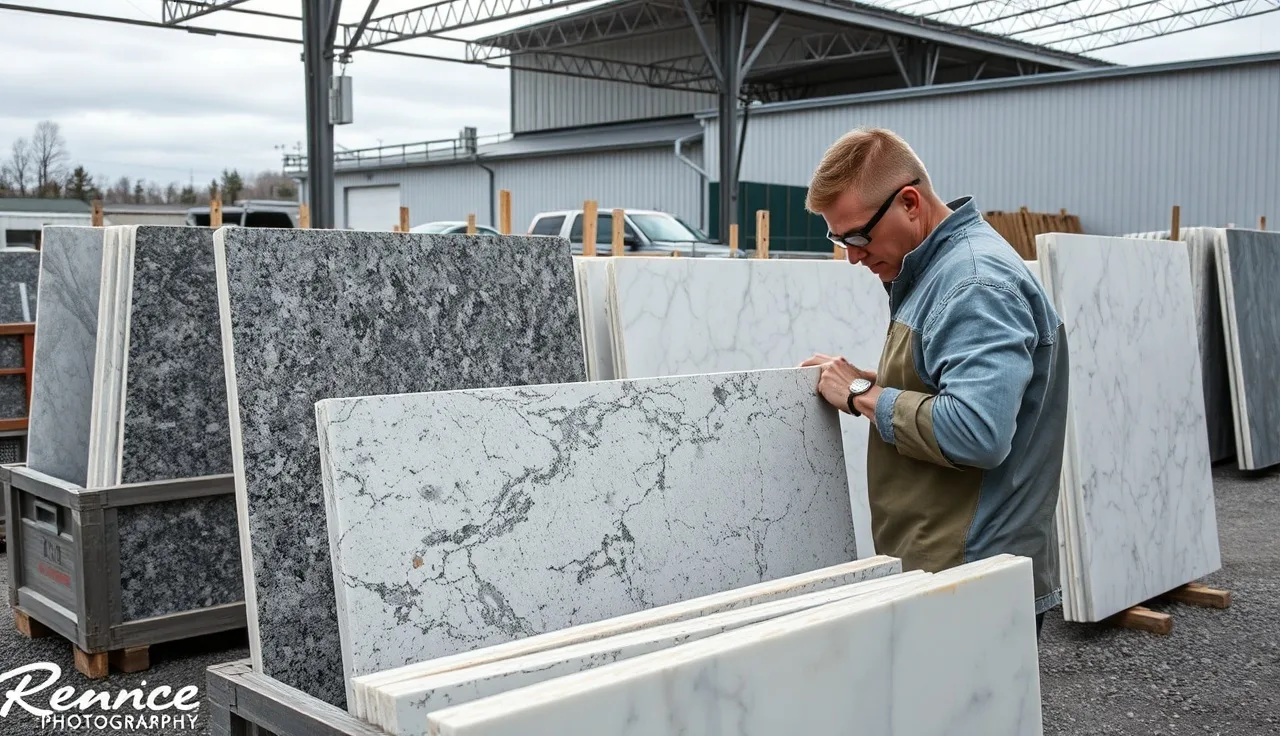
Buying a slab direct from a supply company, rather than letting the fabricator pick for you, is one of the smarter moves a homeowner can make. You walk the yard, see the actual slabs standing in the crates, and pick the exact piece you want. The fabricator cuts from that piece.
This matters most for natural stone with heavy movement, like a marble with bold veining or an exotic granite with dramatic color shifts. Two slabs with the same commercial name can look almost nothing alike. Picking in person kills that surprise.
Bring photos of your space when you walk a yard. Look at the slab in natural light if you can, more than under fluorescent warehouse tubes. Picture the slab lying flat, not standing up. Veining that looks beautiful vertical on a crate can turn disorienting on a horizontal counter, and the reverse happens too.
Confirm how many slabs your project needs. A standard slab runs about 55 to 65 square feet [5]. An average kitchen counter covers 40 to 60 square feet of surface, so one slab may be enough, but a larger kitchen or one with an island almost always takes two. If you need two, pull them from the same bundle (sequential slabs from the same block) for the best color and veining match.
For surface comparisons across budget levels, see our overviews of laminate countertops, formica countertops, and Corian countertops. Stone isn't the right answer for every budget or every kitchen, and a good fabricator tells you that straight.
What are typical lead times and how should you plan your project?
A realistic kitchen countertop timeline, first contact to installed tops, runs three to four weeks minimum. Initial consultation and quote: one to three days. Template appointment (after cabinets are level and plumbing rough-in is done): scheduled one to two weeks out at most shops. Fabrication after template: seven to fifteen business days for most regional shops [6]. Installation: one to three days after fabrication is finished.
Plan for five to six weeks if you want buffer. Shops that quote under two weeks total are either very lightly booked or cutting corners somewhere.
The template appointment is the bottleneck most homeowners never see coming. Cabinets have to be fully installed and level before the fabricator can template. If cabinet installation runs late, everything downstream slides. Build that contingency into your renovation schedule before demolition starts, not after.
Material lead time adds another variable. Want a specific exotic slab that has to come from a distributor? That's two to four extra weeks. Buying off existing yard inventory is faster. Ask what's in stock before you fall in love with something on the shop's website.
For installation details that apply no matter which shop you use, see our guide on countertop installation.
How does stone fabrication and supply work in Pennsylvania from a business and regulatory standpoint?
Pennsylvania does not require a specific state license for stone fabricators, but contractors doing residential home improvement work must register with the Pennsylvania Attorney General's Office under the Home Improvement Consumer Protection Act (HICPA), 73 P.S. § 517.1 et seq. [7]. The registration requires at least $50,000 in general liability insurance. Homeowners can verify registration through the PA Attorney General's contractor search [7].
The Pennsylvania Department of Labor and Industry oversees workers' compensation. Any shop with employees must carry coverage [8]. If a worker gets hurt on your property and the shop lacks coverage, the liability can fall on the homeowner in some situations. Ask for a certificate of insurance before any work starts.
Silica dust from cutting stone is a real occupational health hazard. OSHA sets the permissible exposure limit for respirable crystalline silica at 50 micrograms per cubic meter of air as an 8-hour time-weighted average [9]. Shops that cut dry or skip dust controls put their workers at risk and sit out of compliance. A shop with wet-cutting equipment and proper ventilation follows the rules. This is not a minor detail.
Sales tax applies to fabricated stone countertops as tangible personal property. Pennsylvania's rate is 6%, with some counties adding local tax (Philadelphia and Allegheny each add 2%) [10]. Confirm whether your fabricator's quote includes or excludes tax so you're comparing bids on equal footing.
What are the most common complaints about stone fabricators and how do you avoid them?
The complaints that repeat across consumer reviews and contractor dispute forums cluster around four problems. Know them before you sign.
First: seam placement. Natural stone usually needs at least one seam in a larger kitchen. Where it lands matters visually and structurally. Good shops discuss seam placement during quoting. Bad ones decide on install day. Ask before you sign.
Second: chipped edges. Most chipping happens at the sink or cooktop cutout, not out in the field of the slab. A dull blade or operator error usually causes it. A color-matched epoxy fill can repair it, but a clean cut beats a repair every time. Look at finished cutouts on any recent work the shop shows you.
Third: bad measurements. Digital templating has mostly solved this, but shops still occasionally cut a piece too short or forget a section. The question to ask: what's your policy when this happens? Do you recut at your cost, or do you expect me to split it? Get the answer in writing.
Fourth: slow communication after the contract is signed. Once the deposit clears, some shops go quiet. Ask upfront who your contact is for updates, how fast they return calls or texts, and how you'll be told when fabrication is done and install is scheduled.
None of these are specific to Frymoyer. They're the industry's recurring headaches. A shop that has thought through these scenarios and has clear policies almost always beats one that seems surprised by the question.
How do you maintain natural stone countertops after installation?
Most natural stone (granite, quartzite, marble) needs sealing at installation and periodic resealing depending on use. A water test tells you when resealing is due: put a few drops on the surface and wait 15 minutes. If the stone darkens where the water sat, the sealer has worn thin [11].
Granite and quartzite are easier to maintain than marble. Marble is calcium carbonate and etches on contact with acids, including wine, citrus juice, and most household cleaners. Choose marble and you commit to pH-neutral cleaners only. The etching isn't a seal failure. It's a chemical reaction with the stone itself, and no sealer fully stops it.
Engineered quartz asks the least of you. No sealing, no special cleaners, just pH-neutral soap and water. The tradeoff: quartz can fade or discolor under prolonged direct UV (a bay-window kitchen is a real risk) and it isn't heat-resistant the way granite is. Use trivets with quartz.
For detailed care instructions see how to clean stone countertops, plus the material-specific guides for quartzite and soapstone.
Mixing materials? Butcher block countertops and other elements in kitchen countertops each keep their own maintenance rhythm. A stone island with a butcher block perimeter is popular in Pennsylvania kitchens right now, and it looks good if you're willing to oil the wood on a regular schedule.
How do fabricators use software to quote and run jobs more efficiently?
Quoting a countertop job accurately is harder than it looks. You're estimating square footage from rough measurements, pricing multiple materials at different rates, adding line items for cutouts and edge profiles, accounting for slab waste (typically 15% to 25% on a residential kitchen, depending on layout [12]), and producing a customer-facing document clear enough to head off three follow-up calls.
Many smaller shops still run this in a spreadsheet or on paper, which works until it doesn't. A missed cutout charge or a waste number pulled from memory can quietly eat a job's margin. Larger shops have moved to dedicated quoting and shop-management software that calculates waste from a digital layout, generates line-item quotes automatically, and tracks the job from quote to install.
For fabricators weighing their own operations, SlabWise is built for countertop shops. It handles nesting (optimizing cuts from a slab to cut waste), quoting, and job tracking without forcing you into a full ERP system. If your shop still reconciles quotes in Excel, that demo is worth an hour.
The payoff isn't only internal. Shops that produce detailed, itemized quotes close more customers, because homeowners can see exactly what they're paying for instead of squinting at two lump-sum numbers and guessing which one is honest.
Frequently asked questions
Is Frymoyer Stone Fabrication & Supply still in business?
Based on public business records, Frymoyer Stone Fabrication & Supply operates out of Bernville, Pennsylvania. Business status can change, so the best confirmation is calling them directly or checking their current Google Business Profile listing. If you've had trouble reaching them, try the PA Attorney General's contractor registration search to see whether their registration is current.
What materials does Frymoyer carry?
Regional Pennsylvania fabricators like Frymoyer typically stock granite, quartz, marble, and quartzite. Availability shifts with distributor inventory. Call with your specific material and color before making a trip to the yard. If they don't have it in stock, ask whether they can source it from a regional distributor and what the added lead time looks like.
How much does a stone countertop from a regional Pennsylvania fabricator typically cost?
Installed granite runs roughly $40 to $100 per square foot depending on material grade. Quartz is similar. Exotic quartzite and high-movement marble can top $120 per square foot installed. An average kitchen with 50 square feet of counter surface typically costs $2,000 to $5,000 installed, not counting backsplash. Get at least three itemized quotes.
Do I need to be home during countertop templating and installation?
Yes to both, generally. Templating takes 30 to 90 minutes, and the technician needs access to all cabinets and may have questions about overhangs, cooktop specs, and sink type. Installation takes several hours and requires accessible water and power, a disconnected sink, and someone present to approve seam placement and sign off on the finished work.
What is the Home Improvement Consumer Protection Act and does it apply to countertop jobs?
Pennsylvania's Home Improvement Consumer Protection Act (HICPA), 73 P.S. § 517.1, requires contractors performing home improvement work over $500 to register with the PA Attorney General's Office and carry liability insurance. Countertop fabrication and installation qualifies as home improvement under the act. You can verify a contractor's registration at the PA Attorney General's official website.
How long does countertop fabrication take from template to install?
Most regional shops finish fabrication in seven to fifteen business days after the template appointment. Add the time to schedule the template (usually one to two weeks out) and you're looking at three to five weeks minimum from first contact to installed countertops. Exotic materials that have to be sourced from a distributor can add another two to four weeks.
Can I pick my own slab at a fabrication and supply company?
Yes, and you should if the shop allows it. Walking the yard and tagging your specific slab ensures you get the movement, color, and pattern you actually chose. This matters most for natural stone with heavy variation. Bring photos of your space and look at slabs in natural light. Pull sequential slabs from the same bundle if your project needs more than one.
What thickness should residential countertops be?
3 cm (about 1.18 inches) is the current standard for residential natural stone countertops. It's strong enough for most spans without a substrate and has a visible edge that looks substantial. 2 cm stone is thinner, needs a plywood backer, and shows up less in quality residential installs today. If a quote doesn't specify thickness, ask before you assume.
Does Pennsylvania charge sales tax on fabricated stone countertops?
Yes. Pennsylvania applies its 6% sales tax to fabricated stone countertops as tangible personal property. Philadelphia and Allegheny counties each add a 2% local tax on top of the state rate. Confirm whether the fabricator's quote includes or excludes tax before comparing bids, because a $500 tax difference on a $5,000 job is real money.
What is silica dust and why should I care which fabricator I hire?
Cutting stone generates respirable crystalline silica dust, which causes silicosis, an irreversible lung disease, with repeated exposure. OSHA sets a permissible exposure limit of 50 micrograms per cubic meter of air (8-hour average). Shops using wet-cutting equipment and proper ventilation are compliant. Shops cutting dry without controls are not. It affects workers, not homeowners at home, but it tells you how a shop operates.
What warranty should I expect from a stone fabricator?
Most reputable fabricators offer a one-year workmanship warranty covering fabrication and installation defects: poor fits, cracked edges, failed seams. Natural stone itself carries no manufacturer warranty because it's a geological material. Engineered quartz warranties come from the manufacturer and typically cover 10 to 15 years, but improper installation can void them, so confirm the shop's process preserves that coverage.
What's the difference between quartzite and quartz?
Quartzite is a natural metamorphic stone, harder than most granites, that often looks like marble. It needs sealing and isn't acid-proof, but it resists etching better than marble. Quartz (engineered stone) is roughly 90% ground quartz bound with resins and pigments. It needs no sealing, has a consistent pattern, and isn't heat-resistant. Suppliers sometimes mislabel quartzite as quartz, so ask for the geological origin if it matters to you.
How do I know if a fabricator is legitimate before I pay a deposit?
Verify their PA Home Improvement Contractor registration at the PA Attorney General's website. Ask for a certificate of general liability insurance and workers' compensation. Check Google reviews for patterns, not one-off outliers. Ask to see completed work in person or visit the shop. Any fabricator who pushes back on these basic requests is a shop to skip.
Sources
- Pennsylvania Department of State, Business Entity Search: Frymoyer Stone Fabrication & Supply is registered in Berks County, Pennsylvania.
- Angi (formerly HomeAdvisor), Cost to Install Granite Countertops: National average for granite countertop installation runs roughly $40 to $100 per square foot installed; sink cutouts typically $50 to $150, faucet holes $20 to $40, cooktop cutouts $75 to $150.
- Cambria, Limited Lifetime Warranty Terms: Engineered quartz warranties vary by manufacturer and can be voided by improper installation; homeowners should confirm the fabricator installs in a way that preserves manufacturer coverage.
- Natural Stone Institute, Stone Slab Standards: A standard stone slab is approximately 55 to 65 square feet; an average residential kitchen countertop runs 40 to 60 square feet of surface area.
- National Kitchen & Bath Association (NKBA), Project Timeline Guidelines: Fabrication turnaround after templating is typically seven to fifteen business days at most regional shops.
- Pennsylvania Office of Attorney General, Home Improvement Contractor Registration (HICPA): Pennsylvania's Home Improvement Consumer Protection Act (73 P.S. § 517.1) requires contractors doing residential home improvement work over $500 to register with the PA AG and carry at least $50,000 in general liability insurance.
- Pennsylvania Department of Labor and Industry, Workers' Compensation Requirements: Pennsylvania requires employers with employees to carry workers' compensation coverage; failure to do so can create liability exposure for homeowners if a worker is injured on their property.
- U.S. Occupational Safety and Health Administration, Respirable Crystalline Silica Standard (29 CFR 1910.1053): OSHA's permissible exposure limit for respirable crystalline silica is 50 micrograms per cubic meter of air as an 8-hour time-weighted average.
- Pennsylvania Department of Revenue, Sales and Use Tax: Pennsylvania's sales tax rate is 6%; Philadelphia and Allegheny counties each add a 2% local rate; fabricated stone countertops are taxable as tangible personal property.
- Natural Stone Institute, Care and Maintenance of Natural Stone: The water test (drops of water on stone surface, 15-minute wait) reveals when stone sealer has worn thin and resealing is needed.
- Natural Stone Institute, Fabrication Waste Guidelines: Typical slab waste on a residential kitchen countertop project is 15% to 25% depending on layout complexity.
Last updated 2026-07-09