TL;DR
- Faux marble countertops include laminate ($20, $45/sq ft installed), engineered quartz ($55, $130), large-format porcelain ($60, $130), and epoxy coatings ($3, $7/sq ft in materials).
- None of them needs sealing, and all of them copy marble's veining without marble's fuss.
- Quartz is the most popular.
- Porcelain is the hardest.
- Laminate is the cheapest.
- None is a perfect twin of real marble, but the best ones fool guests entirely.
What exactly is a faux marble countertop?
Faux marble means any countertop surface that looks like marble but isn't quarried stone. That covers more materials than most people expect: printed laminate sheets, engineered quartz with pigmented resin, large-format sintered porcelain, solid surface like Corian, and even epoxy poured right over an existing top.
The term gets used loosely, which causes confusion. A quartz slab from Silestone patterned after Calacatta Gold is technically engineered stone, but homeowners and kitchen designers call it faux marble every day. That's fine. What matters is that each material reaches the marble look through a completely different manufacturing process, and that difference drives everything: hardness, heat resistance, repairability, and price.
Real marble countertops are calcium carbonate. They etch from acids, stain from oils, and need sealing every six to twelve months [1]. Every faux option skips at least some of that. That's the core trade. You give up the exact depth and variation of natural stone, and you get a surface that's easier to live with.
For bathrooms especially, the low-maintenance angle is a big deal. Faux marble around a sink handles daily water, toothpaste, and makeup without the sealing anxiety that comes with real stone. We'll get into the bathroom specifics in their own section below.
What are the main types of faux marble countertop materials?
There are five real categories worth knowing. Each has a distinct look, feel, and price.
Laminate (printed) This is the original faux marble. A photographic paper layer printed with a marble pattern gets bonded under a melamine wear layer and glued to a particleboard or MDF core [11]. Formica, Wilsonart, and Dekton all make marble-pattern laminates. The printed image can look convincing at a glance, though up close the texture is flat instead of polished. Laminate is the cheapest option and the most vulnerable to moisture at seams and edges. See more on laminate countertops and Formica countertops for the full picture.
Engineered quartz Quartz countertops are roughly 90 to 93% ground quartz bound in polyester or epoxy resin, pigmented and patterned to copy marble veining [2]. The result is non-porous, stain-resistant, and consistent across the slab. Cambria, Silestone, and Caesarstone all offer Calacatta and Carrara-inspired collections. Read more about Cambria countertops if you want detail on one brand's process. Quartz is the most installed faux marble in kitchens today [9].
Porcelain / sintered stone Large-format porcelain slabs (Dekton, Neolith, Lapitec) get fired at extreme temperatures, which makes them harder than quartz, nearly impervious to UV, and heat-proof. The marble-look collections use high-resolution inkjet printing across the full face, sometimes with matching edge profiles. Porcelain runs as thin as 6mm or as thick as 20mm. It's the most chip-prone at edges if struck hard.
Solid surface Corian and similar acrylics get cast and thermoformed into marble-ish patterns. Scratches sand out, the joints glue up invisible, and the material forgives a lot. The look is the weakest of the group. Nobody mistakes solid surface for real stone. Corian countertops covers that material in detail.
Epoxy coatings Epoxy gets poured, swirled, or marbled right over an existing countertop, usually as a DIY refinish. It's cheap in materials but labor-heavy, and results vary widely. Durability is real but modest. Epoxy scratches and yellows faster than anything above it.
How much do faux marble countertops cost?
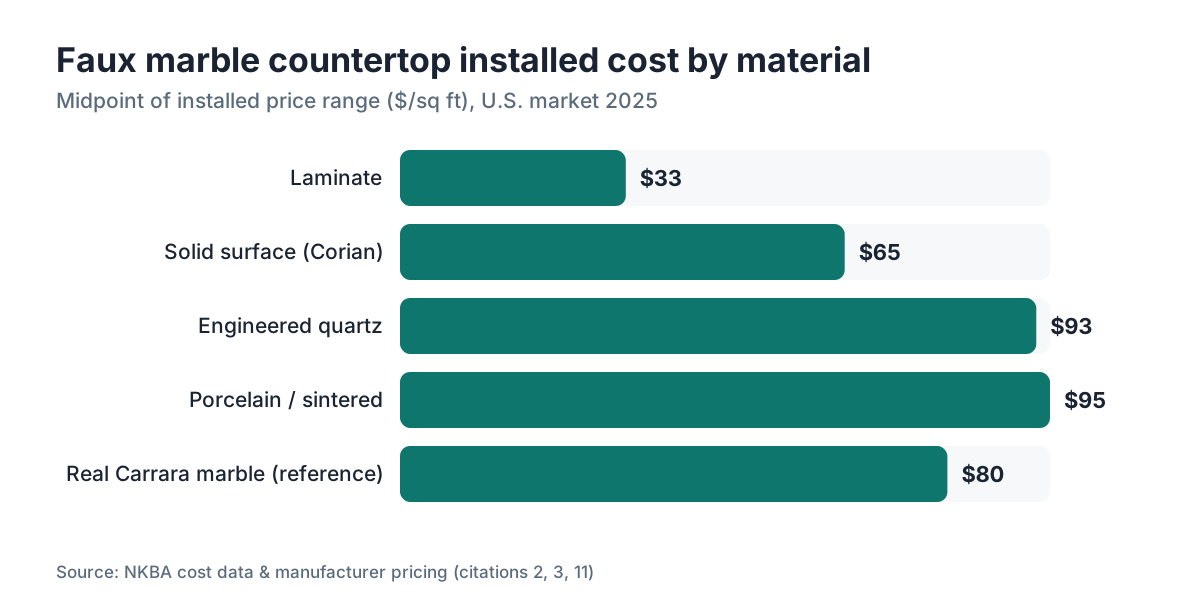
Installed prices (material plus labor, per square foot) vary enough to matter. The table below shows real market ranges as of 2025. Fabricator labor rates, region, edge profile, and sink cutouts all move the number, so treat these as honest midpoints, not quotes.
| Material | Installed range ($/sq ft) | Notes |
|---|---|---|
| Laminate | $20, $45 | Seams visible; DIY possible with skill |
| Solid surface (Corian) | $45, $85 | Integrated sinks available |
| Engineered quartz | $55, $130 | Most popular; wide brand range |
| Porcelain / sintered | $60, $130 | Harder to fabricate; edge work costs more |
| Epoxy coating (DIY) | $3, $7 (materials only) | Labor-intensive; skill-dependent result |
Real Carrara marble installed usually runs $60, $100/sq ft, and premium Italian marble (Calacatta, Statuario) runs $100, $200+ [3]. So mid-range quartz and porcelain land in the same ballpark as entry-level real marble. That's why the comparison matters.
Faux wins on cost in two places: the low end (laminate is genuinely much cheaper) and long-run maintenance. Marble sealing products cost $15, $40 per application and need reapplying once or twice a year. None of the faux materials ask for that [1].
Fabricators, take note. Engineered quartz is the most labor-efficient faux marble because it cuts and polishes like natural stone. Porcelain needs diamond tooling rated for it, slower feed rates, and a crew that knows the material, or edge chip rates climb fast. Shops that track their times often find porcelain jobs take 15 to 25% more fabrication time than equivalent quartz slabs, and that has to live in the quote.
How does faux marble quartz compare to real marble?
This is the question most homeowners are really asking. The honest answer has some nuance.
On hardness, quartz wins. Marble is a 3 to 4 on the Mohs scale; the quartz mineral is roughly 7 [4]. Quartz won't scratch from normal kitchen use. Marble might. On etching, marble loses badly. Any acidic food or cleaner, lemon juice, vinegar, wine, reacts with the calcium carbonate and leaves a dull spot. Quartz and porcelain don't etch at all.
On appearance, real marble still wins for depth. The veining in natural marble runs through the full thickness of the stone, and light bounces through it differently than it does through a resin-bound aggregate. Up close, in good natural light, trained eyes catch the difference. Most people, most of the time, cannot. High-end quartz and porcelain have gotten close enough that even stone fabricators do a double-take.
On heat, porcelain is the clear winner of the faux options. Set a hot pan straight on sintered porcelain and nothing happens [5]. Quartz resins can discolor or delaminate above about 300°F (150°C), so trivets matter [2]. Marble takes high heat but can crack under thermal shock.
On repairability, solid surface leads. Scratches sand out. Quartz and porcelain chips are hard to fix invisibly. Real marble can be honed to remove etches, which quartz cannot.
The case for real marble is aesthetics and a certain feel. The case for faux is practical: lower long-term maintenance, consistent appearance, and (at the laminate or mid-range quartz level) lower cost. For kitchen countertops that see daily acid exposure, faux marble is the pragmatic pick for most households.
Is faux marble a good choice for bathroom countertops?
Yes, and bathrooms might be the best application of all. Here's why.
Bathroom counters take far less mechanical abuse than kitchen counters. No heavy pots, no cutting, no real heat. What they get instead is constant water, toothpaste (slightly abrasive), cosmetics, and the occasional bleach cleaner. Marble bathrooms look gorgeous in magazine photos, but toothpaste carries mild abrasives, and the citric acid in mouthwash etches unsealed marble fast [1].
Engineered quartz in a bathroom skips all that. So does porcelain. Even laminate works on a vanity as long as the edges and seams get sealed well during install, because the water exposure is mostly topside splash, not full submersion.
Faux marble bathroom tops give you the high-contrast white-and-grey look, or the warm gold-veined Calacatta look, with no ongoing maintenance. For a rental or a busy family bathroom, that matters a lot.
One thing to watch: bathroom vanities often use integrated or undermount sinks. Laminate doesn't play well with undermounts because exposed particleboard edges swell. Solid surface, quartz, and porcelain all handle undermounts fine. If you want the clean undermount look with no visible edge, quartz or porcelain is the right call.
Cleaning a stone-look surface in a bathroom follows the same gentle rules: pH-neutral cleaner, no abrasive scrubbers. The guide on how to clean stone countertops is useful even for surfaces that aren't stone, because the wrong cleaners dull any polished finish.
What are the pros and cons of faux marble countertops?
No surface is perfect. Here's an honest accounting.
Pros
- No sealing for quartz, porcelain, or solid surface
- Acid and etch resistance (quartz, porcelain) that real marble can't match
- Consistent patterning across multiple slabs, which makes matching easier in large kitchens
- Lower entry cost at the laminate end of the spectrum
- Non-porous surfaces are hygienic: bacteria don't live in the surface the way they can in unsealed stone [6]
- Porcelain handles UV without fading, which makes it good for outdoor kitchens
Cons
- The aesthetic depth of real marble isn't fully replicated
- Laminate edges show the core material; post-formed edges limit the look
- Quartz resins can discolor from prolonged direct sun, so outdoor use isn't recommended [2]
- Porcelain edges chip more readily than stone if struck with something heavy
- Epoxy results swing hard by skill level and can yellow over time
- Resale perception: buyers who know stone will notice it isn't
My opinion. For a kitchen used daily by a family, quartz faux marble is the right choice for most people. The etch resistance alone earns it. For a low-budget project or a rental, laminate makes sense. For outdoor or high-heat areas, porcelain wins. Epoxy is a last resort for refinishing, never a first choice for new construction.
If you want real stone but lower maintenance than marble, look at granite countertops or quartzite. Granite doesn't etch, polishes much like marble, and costs about the same as mid-range quartz. It isn't faux marble, but it solves the maintenance problem without the engineered look.
How do you install faux marble countertops?
Installation varies by material, and the gap between them is large.
Laminate is the most DIY-friendly. Pre-formed laminate tops sell at big-box stores in standard lengths, and post-form edges (the rounded front edge) come pre-finished. Custom laminate with a square edge and marble print needs a shop to cut and bond the laminate, then you install the substrate. A full DIY is doable for someone with a jigsaw, a router, and patience.
Engineered quartz and porcelain are fabricator jobs. The slabs are heavy (quartz slabs run 18 to 22 lbs per square foot for 3cm material [7]), they need diamond blade wet saws for cutting, and they need a template to get sink cutouts right. Undermount sink clips and epoxy bonding are part of the work. Don't DIY this without actual stone fabrication gear.
Solid surface can be DIY-installed from pre-made vanity tops, or custom-fabricated and installed by a certified fabricator. The seams get glued and sanded invisible, which takes real skill.
Epoxy coating is a DIY process done in place. You clean and sand the existing top, mix and pour epoxy, work it with a heat gun or torch to create veining, let it cure, and topcoat. Tutorials make it look easy. In practice, runs, bubbles, and uneven color are common on a first try. Cure time is 24 to 72 hours before light use and up to 30 days for full hardness [8].
For any slab material, the template is the step that matters most. A bad template means gaps at walls and cutouts in the wrong place that you can't undo. Professional templating with a laser or digital tool pays for itself. See the countertop installation guide for the full process.
Fabricators using software like SlabWise can generate accurate material yield estimates from a digital template, which matters for pricey porcelain slabs where waste hurts.
How do you care for and clean faux marble countertops?
Good news: faux marble is easier to maintain than real marble. Bad news: it isn't zero maintenance, and the wrong cleaner still dulls a polished finish.
For quartz, the manufacturer guidance is consistent. Use a soft cloth and pH-neutral dish soap for daily cleaning. Skip bleach (repeated use can break down resin over time), skip abrasive powders, and skip anything with a pH above 10 or below 4 [2]. Stubborn grease comes off with a non-abrasive cream cleaner. Never use a Scotch-Brite pad or steel wool.
For porcelain, the surface is vitrified (essentially glass), so it shrugs off harsh cleaners better. Even so, stick to neutral pH cleaners on polished finishes, because aggressive acids and bases can attack the gloss layer over time [5].
For laminate, wipe spills fast. Laminate tolerates most household cleaners but hates standing water at seams. A cracked or lifted seam is the beginning of the end. Water reaches the particleboard core, and the swelling can't be reversed.
None of these surfaces need sealing, which is a real time and money saving over stone. An unsealed marble countertop soaks up a glass of red wine in minutes. Quartz won't absorb a drop.
For general guidance on keeping polished surfaces looking good, the article on how to clean stone countertops covers the pH-neutral fundamentals that apply across surface types.
Which faux marble countertop looks most like real marble?
High-end engineered quartz and large-format porcelain have converged on a look that's genuinely impressive. The answer shifts by brand and collection, so let me be specific.
For quartz, the most convincing marble looks as of 2025 come from collections that book-match veining across consecutive slabs and use a jumbo-format slab size (typically 130" x 65" or larger) so veining can cross the full counter without a seam. Cambria's Brittanicca series and Caesarstone's Calacatta Nuvo get cited often. The polished finish on top-tier quartz has a depth that budget laminates never touch.
For porcelain, Dekton by Cosentino and Neolith both print full-slab veining with high-resolution inkjet in multiple passes. The result can be nearly identical to marble at normal viewing distance. The tactile difference is real. Sintered porcelain feels slightly cooler and harder under your hand, but on a countertop most people don't notice.
Laminate, at the top end from Formica or Wilsonart, looks better than it did 15 years ago, but the flat texture gives it away in raking light. It's fine in a bathroom vanity where the scale is small and the lighting stays diffuse.
One honest caveat. Even the best faux marble doesn't fully replicate how real marble's translucency plays with light. In a sun-drenched kitchen with direct daylight, real and faux look different. In artificial light or diffuse daylight, the gap all but disappears.
Can you get faux marble countertops for outdoor kitchens?
Only porcelain. That's the short answer.
Engineered quartz uses polyester or epoxy resin as its binder, and that resin is vulnerable to UV. Most quartz manufacturers flat-out void the warranty for outdoor use [2]. Over time, outdoor quartz fades, yellows, or clouds from UV exposure.
Laminate degrades quickly in outdoor humidity and temperature swings. Solid surface warps from heat and isn't meant for outdoors.
Sintered porcelain is UV-stable, frost-resistant (above about 3cm thickness), and handles outdoor temperature swings without complaint [5]. Dekton and Neolith both market outdoor lines, and both offer marble-look collections. The material costs more than indoor surfaces, and fabrication needs the right tooling, but the durability is real.
Building an outdoor kitchen and want the marble look? Budget for porcelain and build it into the project from the start. Trying to save money with indoor quartz or laminate and then eating the rapid degradation isn't a good trade.
What should fabricators know about pricing and quoting faux marble jobs?
Faux marble spans a lot of fabrication complexity, and quoting every version the same way is a mistake.
Laminate is simple. Material cost is low, install is low-skill, margins are thin. If you're a stone shop, laminate isn't worth your time unless you run it as a package deal with a builder.
Engineered quartz is where most stone fabricators feel at home. The CNC and polishing gear you already own works on quartz. Marble-pattern quartz from premium brands carries higher material cost but cuts at the same speed and waste rate as any other quartz. Price it accordingly.
Porcelain is the expensive one to get wrong. The material is harder than quartz and more brittle at the edge. Edge profiles that take 4 passes on quartz may take 6 to 8 on porcelain to avoid chipping. Feed rates are slower. Diamond tooling wears faster. A shop that hasn't run porcelain before should make test cuts before pricing a customer job at quartz rates. Under-pricing a porcelain job by 15% is a classic first-timer mistake.
For any faux marble job with large slabs, material yield is the profitability variable that matters most. A 3cm Calacatta-pattern quartz slab at $18, $22 per square foot wholesale carries real waste cost. Nesting well (getting the most usable area out of each slab) moves profit directly. Fabricators who use SlabWise for quoting and nesting see the full yield calculation before the job starts, so nobody gets surprised by an extra slab on a tight job.
One general note: marble-look collections from premium quartz brands cost more per slab than solid-color or simple-pattern quartz from the same brand. Pass that material cost through accurately. Don't average it into your standard quartz price.
How long do faux marble countertops last?
Durability varies by material and use. Here's what honest warranties and real-world use suggest.
Engineered quartz from major brands (Caesarstone, Silestone, Cambria) carries a lifetime limited warranty for residential use, typically covering manufacturing defects rather than everyday chips or stains [10]. In practice, a well-installed quartz counter in a kitchen should run 20 to 30 years with no big degradation if you care for it correctly.
Porcelain is dimensionally stable and doesn't absorb stains, so surface degradation stays minimal. The risk is mechanical. A heavy impact on an edge can chip it, and that chip is hard to fix invisibly. Structurally, a correctly installed porcelain slab can last as long as the house.
Laminate wears out at the surface layer over time. Budget laminate in a high-use kitchen might show wear in 10 to 15 years. Higher-pressure laminate with a thicker wear layer lasts longer, and bathroom vanity laminate outlasts kitchen laminate because the abuse is lower.
Solid surface is theoretically repairable forever (sand out scratches, re-polish), so its lifespan rides on care more than on the material.
Epoxy coatings are the weakest. Expect 3 to 7 years before visible yellowing or surface wear in a kitchen, depending on use and UV exposure [8].
For context on how natural stone alternatives age, the guides on how to clean quartzite countertops and how to clean soapstone countertops show what long-term stone maintenance actually looks like.
Frequently asked questions
Is faux marble quartz cheaper than real marble?
At entry and mid-range levels, yes. Mid-grade engineered quartz runs $55, $90/sq ft installed, cheaper than premium Italian marble at $100, $200+ installed. Top-tier quartz from brands like Cambria overlaps with entry-level Carrara marble in price, though. The long-run savings from skipping sealing and possible etching repairs often tip the math further in quartz's favor.
Can you put hot pans on faux marble quartz countertops?
No. Quartz resin binders can discolor or delaminate above about 300°F. Quartz manufacturers tell you to always use trivets or heat pads. Sintered porcelain is the exception: it takes direct heat without damage. Laminate and solid surface also can't take hot pans. If heat resistance matters most, porcelain is the right faux marble material.
Does faux marble countertop add home value?
Quality faux marble, meaning quartz or porcelain, reads positively to buyers and appraisers because it signals durability and a current look. Laminate is generally seen as a dated material and may not add appraised value. Epoxy is unfamiliar to most appraisers. The NAR has not published specific data on faux-marble resale premiums, so exact ROI numbers aren't available from a reliable source [12].
How do you tell the difference between faux marble and real marble?
Raking light is the easiest test. Real marble has translucency and depth from its mineral structure; faux marble looks flatter. Check the edge too: real marble shows the stone's natural grain through the profile. Quartz shows the aggregate, and porcelain shows a printed edge tile or thin profile. Etching a hidden spot with lemon juice dulls real marble instantly but won't touch quartz or porcelain.
What is the most realistic looking faux marble countertop?
Large-format porcelain slabs (Dekton, Neolith) and top-tier engineered quartz (Cambria Brittanicca, Caesarstone Calacatta Nuvo) are the most convincing. Polished quartz in a book-matched layout is nearly indistinguishable from marble in diffuse light. Both beat laminate and epoxy, which show their character under close inspection.
Is faux marble countertop good for bathrooms?
Yes, bathrooms are one of the best applications for faux marble. The surfaces handle daily water and cosmetics without staining or etching. Quartz and porcelain need no sealing, which matters around sinks that see constant splashing. Laminate works on bathroom vanities as long as the edges get sealed well during install. Undermount sinks require quartz, porcelain, or solid surface, not laminate.
Can faux marble countertops be repaired if chipped or scratched?
Solid surface (Corian) is the most repairable: scratches sand out. Quartz and porcelain chips are hard to fix invisibly; color-matched epoxy fill is the standard patch, but it won't blend perfectly. Laminate takes laminate repair paste for small scratches. Epoxy coatings can be spot-poured and re-cured but often show a line at the repair boundary.
How do you clean faux marble countertops without damaging them?
Use pH-neutral dish soap and a soft microfiber cloth for daily cleaning on quartz and porcelain. Avoid bleach, abrasive powders, and any cleaner with a pH below 4 or above 10. For laminate, wipe spills immediately and don't let water sit at seams. None of the faux marble materials need sealing. Skip the Scotch-Brite pads; they leave fine scratches in polished surfaces.
What is the cheapest faux marble countertop option?
Laminate is the cheapest, at $20, $45 per square foot installed. For a DIY project, post-formed marble-pattern laminate from a big-box store costs as little as $15, $30 per linear foot for a standard 25-inch depth top. Epoxy coating is cheaper in materials ($3, $7/sq ft) but takes skill and time, and the results are less durable than even entry-level laminate over the long run.
Can faux marble countertops be used outdoors?
Only sintered porcelain is reliably suited for outdoor use. Engineered quartz has resin binders that degrade under UV, and most manufacturers void the warranty for outdoor installs. Laminate and solid surface also fail quickly outdoors. Dekton and Neolith both offer outdoor-rated marble-look porcelain collections, typically 2cm or thicker for structural support over outdoor framing.
What thickness should I choose for faux marble quartz countertops?
3cm (about 1.25 inches) is the standard thickness for kitchen countertops and is self-supporting across most spans. 2cm quartz needs a substrate and is less common in kitchens. For bathroom vanities, either 2cm or 3cm works. Porcelain comes as thin as 6mm for vertical surfaces, but kitchen tops should be at least 12mm and preferably 20mm for edge durability.
How long does it take to install faux marble countertops?
Template-to-installation time for quartz or porcelain runs 5 to 10 business days at most shops: 1 to 2 days for templating, 2 to 5 days for fabrication, then installation in a few hours per project. Laminate tops from stock go faster, sometimes same-week. Epoxy coatings need 24 to 72 hours of cure before light use, plus prep time. Full epoxy cure before heavy use is typically 30 days.
Does faux marble countertop require any special edge profiles?
No edge profile is required, but the right choice matters aesthetically. Quartz takes most standard profiles well: eased, beveled, ogee, or mitered. Porcelain is more limited because it chips at complex profiles; simple eased or 45-degree chamfer edges are safer. Laminate is limited to post-formed profiles or simple square edges with matching laminate tape or wood banding at the front.
What is the difference between quartz and porcelain faux marble countertops?
Quartz is ~90% ground quartz in resin; porcelain is fully sintered clay and minerals fired at high temperature. Porcelain is harder, heat-proof, and UV-stable but chips more easily at edges and costs more to fabricate. Quartz is easier to work with, comes in more profiles, and forgives a little more on edge durability. Both are non-porous and need no sealing. Porcelain wins outdoors; quartz is more practical indoors.
Sources
- University of Illinois Extension, stone and countertop care guidance: Marble is calcium carbonate, etches from acid contact, and requires sealing every 6 to 12 months to resist staining
- Caesarstone USA, Product Care & Warranty Documentation: Engineered quartz is ~93% ground quartz in resin, non-porous, sensitive to heat above ~300°F, and outdoor use voids the residential warranty
- National Kitchen and Bath Association (NKBA), cost and materials data: Installed marble countertop costs range from approximately $60, $100/sq ft for Carrara and $100, $200+ for premium Italian varieties
- U.S. Geological Survey, Mohs Hardness Scale reference: Marble rates 3 to 4 on the Mohs hardness scale; quartz mineral rates approximately 7
- Cosentino Group, Dekton Technical Data Sheet: Sintered porcelain (Dekton) is UV-stable, frost-resistant, and tolerates direct heat without surface damage
- NSF International, countertop materials and food safety guidance: Non-porous countertop surfaces do not harbor bacteria in the surface layer the way porous unsealed stone can
- Natural Stone Institute (formerly Marble Institute of America), Dimension Stone Design Manual: 3cm engineered quartz slabs typically weigh 18 to 22 lbs per square foot
- Rust-Oleum Corporation, countertop coating product data sheet: Epoxy countertop coatings reach light-use readiness in 24 to 72 hours and full cure in approximately 30 days
- U.S. Census Bureau, Survey of Construction and new residential data: Engineered quartz is among the most widely installed countertop materials in new U.S. kitchen construction
- Cambria USA, warranty and product specifications: Cambria offers a lifetime limited warranty for residential quartz countertop installations covering manufacturing defects
- Wilsonart, high-pressure laminate product guide: High-pressure laminate countertops are available in marble-pattern prints with a melamine wear layer bonded to particleboard or MDF core
- National Association of Realtors, Remodeling Impact Report: NAR remodeling impact data covers kitchen and bath countertop replacements but does not publish specific faux-marble resale premium figures
Last updated 2026-07-09