TL;DR
- Faux butcher block mimics wood grain without the oiling and babysitting.
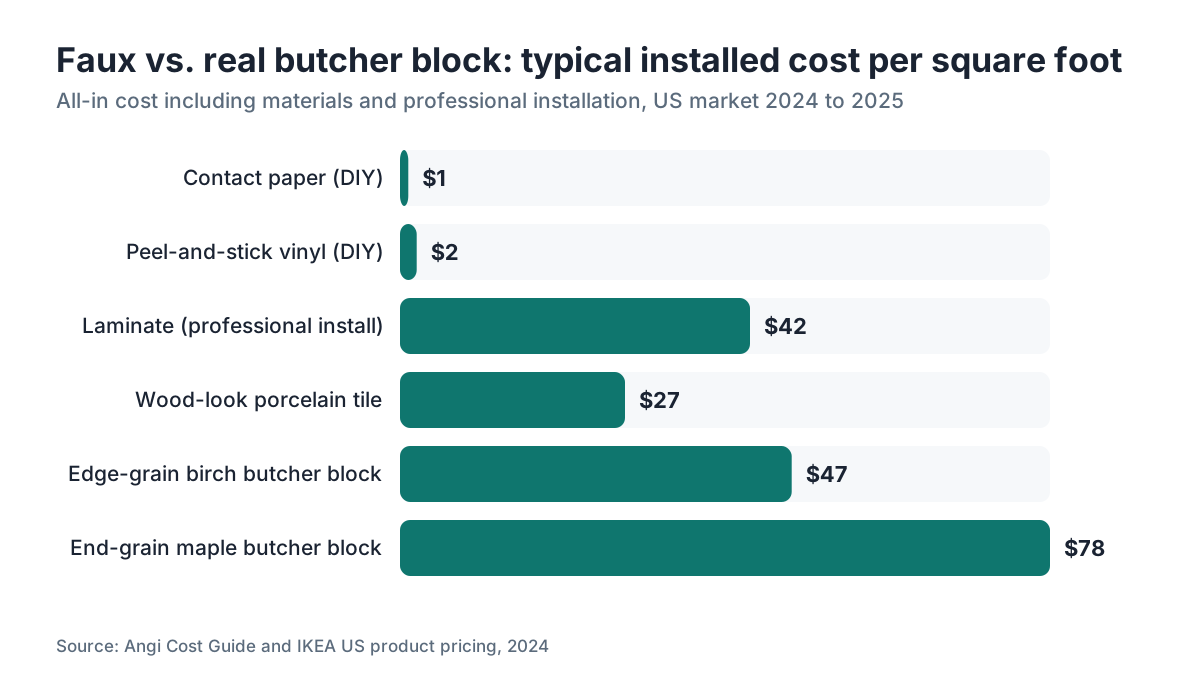
- Four options exist: contact paper (under $1/sq ft), peel-and-stick vinyl ($1, $3/sq ft), laminate ($30, $55/sq ft installed), and wood-look porcelain tile ($18, $35/sq ft installed).
- Laminate is the only one worth doing in a kitchen you actually cook in.
- Real birch butcher block runs $35, $60/sq ft installed.
What counts as a faux butcher block countertop?
A faux butcher block countertop is any surface that looks like end-grain or edge-grain wood but is made from something else. The category splits into four real options: high-pressure laminate with a wood-grain print, vinyl wrap applied over an existing substrate, peel-and-stick contact paper, and ceramic or porcelain tile printed with a wood pattern.
Laminate is the workhorse. Brands like Wilsonart and Formica print photographic wood grain onto a resin-impregnated paper core, then bond that to a high-density fiberboard (HDF) or particleboard substrate. It reads convincingly as butcher block from a standing distance and takes most kitchen abuse without complaint. [1]
Contact paper and vinyl wrap sit at the opposite end. They are surface treatments, not countertops. You stick them over whatever already exists, whether that is old laminate, MDF, or plywood. They cost almost nothing and photograph beautifully. In daily use they peel at edges, trap moisture, and bubble around the sink. Nobody who has lived with contact paper on a working counter calls it a success after 18 months.
Porcelain tile printed to look like wood is underrated. A 6x36 wood-look plank tile grouted tight reads as a light-colored wood countertop from across the room. It is harder than any real butcher block, shrugs off water completely, and costs $4, $12 per square foot for the tile alone. The grout lines are a cleaning annoyance. They are not a dealbreaker.
Real butcher block countertops start around $20, $40 per square foot for edge-grain maple or birch and run past $60 for thick end-grain slabs. Every faux option costs less upfront. Whether it costs less over ten years depends entirely on which one you pick.
How much does faux butcher block cost compared to the real thing?
The price gap between faux and real is real, but it closes faster than people expect once installation enters the math.
| Option | Material cost | Installed cost | Lifespan (realistic) |
|---|---|---|---|
| Contact paper | $0.20, $0.80/sq ft | $0.20, $0.80/sq ft (DIY only) | 6 to 18 months |
| Peel-and-stick vinyl | $1, $3/sq ft | $1, $3/sq ft (DIY only) | 1 to 3 years |
| Laminate sheet (Formica/Wilsonart) | $2, $5/sq ft | $30, $55/sq ft installed | 10 to 20 years |
| Wood-look porcelain tile | $4, $12/sq ft | $18, $35/sq ft installed | 20+ years |
| Edge-grain birch butcher block | $20, $40/sq ft | $35, $60/sq ft installed | 20 to 30+ years with maintenance |
| End-grain maple butcher block | $40, $80/sq ft | $60, $100/sq ft installed | 25 to 40+ years with maintenance |
Installation dominates the laminate number. The material is cheap, but a fabricator still cuts, edges, and templates the surface, and that labor runs $25, $45 per square foot in most US markets as of 2024 to 2025. [2] For a 40-square-foot kitchen, you might pay $1,200, $2,200 total for laminate versus $1,600, $3,500 for real birch.
Handy with a router and a laminate trimmer? Post-form laminate is a DIY job, and doing it yourself drops the installed cost to $200, $400 for a typical kitchen. Real butcher block installs DIY too, but it weighs a lot more and needs oiling before it ever meets water. [3]
One honest note on laminate countertops: the print quality is nothing like the early 2000s. Wilsonart's HD line and Formica's 180fx series use larger photographic prints that kill the obvious repeat pattern that used to give laminate away. If you last looked at laminate a decade ago, look again.
For fabricators pricing laminate jobs, SlabWise handles laminate quoting and nesting alongside stone, so you don't run a separate workflow for wood-look work.
Which faux butcher block option actually holds up in a real kitchen?
Contact paper does not hold up in a real kitchen. Grease, water at the sink, and heat from a pan destroy the adhesion within months. It is a rental staging trick or a short-term refresh, and that is the whole of it.
Peel-and-stick vinyl is a small step better. Thicker mil ratings (at least 6 mil) and textured surfaces grip longer, but the failure mode is identical: edge lift, then moisture underneath, then bubbling. If you need a surface for 12 to 24 months while you save for a real remodel, vinyl wrap is fine. Go in knowing it is temporary.
High-pressure laminate on a proper substrate is a legitimate kitchen surface. Research summarized by the Composite Panel Association finds that HDF-backed laminate resists staining and surface abrasion better than particleboard-backed versions. [12] The weak points are the edges and any seam. Water that gets under a laminate seam swells the substrate, and that damage is visible and permanent. Seal seams with silicone. Keep the sink edge caulked. Do not drop a cast iron pan on a laminate edge; the core chips.
Wood-look porcelain tile performs. It laughs off water, heat, and heavy impacts better than any wood product on the market. The trade-off is grout. A tight joint (1/16 inch or less, fully sealed) manages fine, but wider grout catches food and turns gray. Use a rectified porcelain plank and a color-matched grout. [11]
The real durability question is laminate versus real birch. Birch is a domestic hardwood with a Janka hardness around 1260 lbf. [4] It dents and scratches more than laminate, but those marks sand out. Laminate cannot be sanded, so its scratches are forever. On a surface you beat on daily, real wood is actually the more repairable material. People miss that constantly.
What are birch butcher block countertops, and how do they compare to faux?
Birch butcher block is real wood: yellow birch (Betula alleghaniensis) or occasionally silver birch, milled into strips and glued up edge-grain or end-grain. [4] It is one of the cheaper solid wood countertop options because birch grows all over the northeastern US and Canada and machines cleanly.
Edge-grain birch looks a lot like the laminate fakes from a standing distance. The grain runs lengthwise and shows a fine, fairly uniform pattern. End-grain birch shows the growth rings in a checkerboard and costs more because more wood goes into it.
Birch butcher block runs $20, $45 per square foot for the material at retailers like IKEA (their BADELUNDA and NUMERÄR lines use birch), specialty flooring outlets, and woodworkers. IKEA's countertop birch sells heavily in the US, partly because it comes pre-dimensioned for their cabinets and prices at roughly $25, $50 per linear foot depending on thickness. [5]
Real birch demands maintenance that faux never asks for. You oil it before installation (mineral oil, food-grade tung or linseed oil, or a product like Boos Board Cream), re-oil when it looks dry, and reseal around the sink on a schedule. Skip the oil entirely and birch cracks at the joints within a year or two in a dry house. Leave standing water on it and it warps. Contact paper and laminate carry neither of those demands.
For most homeowners the choice is not faux versus real in some abstract quality sense. It is this: am I willing to do seasonal maintenance for the warmth and repairability of real wood, or do I want a surface I clean with whatever is under the sink and never think about again? Laminate is the right answer for a lot of people. That is not a dig. It is just accurate.
Can you install faux butcher block over existing countertops?
Yes, with caveats. The substrate has to be flat, dry, and structurally sound. If your current counter has a big seam lip, water damage, or a wavy surface, none of the adhesive faux options will stick well.
Contact paper and peel-and-stick vinyl go directly over most existing laminate or solid surface counters. Clean the surface with isopropyl alcohol, let it dry, and apply with a squeegee to chase out bubbles. The sink cutout and exposed edges cause the most grief, so protect those transitions with a trim kit or wood-edge banding.
Sheet laminate glues directly over an existing laminate counter if the old surface is flat and well-adhered. The process uses contact cement: coat both surfaces, let them tack up, set the new laminate, then trim. This is a DIY-possible job that rewards patience and a router with a flush-trim bit. The National Kitchen and Bath Association advises against stacking more than one new laminate layer over existing laminate before the substrate thickness starts causing problems. [6]
Tile over existing counters needs a substrate that handles the added weight (roughly 3 to 7 lbs per square foot for tile plus mortar) and usually a cement backer board over the existing surface to give the mortar something to grip. Check that your cabinets can carry the combined load, especially in older construction.
Before you call a fabricator, it helps to understand the countertop installation process, so you know what to expect on templating, lead time, and how the sink gets cut.
What does faux butcher block look like compared to real wood grain?
This is where the options split hardest. Contact paper and cheap vinyl look like printed paper because they are printed paper. The grain repeats every 12 to 18 inches on most rolls, and once you clock the repeat, you cannot unclock it. The surface is flat to the touch.
Good laminate has come a long way. Wilsonart's HD line and Formica's 180fx series use high-resolution photographic prints with embossed texture that follows the grain. The repeat still exists but stretches out to 36 inches or more and hides well. Run your hand over a sample and you feel ridges and valleys that roughly track the printed grain. It does not feel like wood. It does not feel like plastic either.
Porcelain wood-look tile gets scary realistic. Italian makers like Florim, Marazzi, and Casalgrande Padana print full-surface digital images and add slight texture. A 6x36 plank in a warm birch tone is hard to tell from real wood in a kitchen photo. In person, the grout joints give it away, and the surface reads harder and colder than wood.
Real birch has warmth (literally, in surface temperature) and visual depth that no printed surface matches. The grain is three-dimensional because it is the actual structure of the material. Faux surfaces are flat images. For most kitchens that is fine. For a kitchen where the counter is the design statement, it is not the same thing.
Here is a fair way to put it. Faux butcher block is to real birch roughly what a good photograph of a landscape is to looking out the window. The photograph can be gorgeous. It is still a photograph.
How do you clean and maintain faux butcher block countertops?
It depends entirely on which type you have, so here is each one.
Contact paper and vinyl wrap: wipe with a barely damp cloth. No harsh cleaners, no scrub pads, no steam. A hot pan set directly on either material melts or bubbles it. Use trivets. Skip bleach-based cleaners, which attack the adhesive and speed up edge lift. Treat contact paper the way you would a sticker on a notebook.
Laminate countertops: clean with mild dish soap and warm water, rinse, dry. Laminate tolerates most household cleaners but hates abrasive pads and strong solvents like acetone and paint thinner. Never cut directly on it, because knife marks stay forever. The surface needs no oiling or sealing, but the seams and the joints at the backsplash and sink want fresh silicone caulk every 2 to 3 years to keep water out of the substrate. [7]
Wood-look tile: treat it like any porcelain tile. Grout is the maintenance item. Seal grout at installation and reseal annually in a heavy-use area. Diluted white vinegar is fine on the tile, but acidic cleaners etch unsanded grout over time, so a pH-neutral cleaner is the safer habit. [11]
If you end up with real birch, the routine is a different animal: no soaking, no standing water, regular oiling, and immediate treatment of any cut or scratch so moisture cannot get in. The how to clean stone countertops guide covers surface chemistry principles that apply to porous materials broadly, birch included, even though wood is not stone.
One rule crosses every faux option: the leading cause of early failure is water at the edges and seams. Whatever you buy, guard those transitions.
Is faux butcher block a good choice for a rental property or a flip?
Wood-grain laminate is one of the smartest choices for a rental. It costs $1,200, $2,500 installed for a typical kitchen, appeals to renters, takes hard use, and asks the landlord for nothing maintenance-wise. If a tenant wrecks it, replacement is cheap and simple next to stone or real wood.
Contact paper is a poor choice for a rental if you are the landlord. It will look rough inside 12 months and turn into a wear-and-tear argument at move-out. If you are a tenant doing a temporary refresh for your own enjoyment, that is your call.
On a flip, the math bends around your price point. A house selling at $250,000 or below gains from fresh laminate, because buyers at that level judge overall condition, not countertop pedigree. A house at $500,000 or above is different: those buyers notice the gap between laminate and stone or real wood, and laminate in an otherwise high-end kitchen reads as an inconsistency. Real butcher block tells a better story on a mid-range flip than any fake.
Wood-look tile lands in between. It reads as intentional and modern when done well (large plank format, minimal grout, warm tone). It reads as budget when done badly (small tiles, gray grout, mismatched hardware). Execution decides which one you get.
The National Association of Realtors 2023 Remodeling Impact Report tracks how kitchen upgrades recover cost at resale, and the short version is that recovery varies by material and by the home's price segment. [10] If you want more calibration on what buyers actually spend on kitchen countertops, the NKBA Kitchen and Bath Market Index reports average countertop spend by project type each quarter. [6]
What are the best laminate brands for a butcher block look?
Two brands dominate laminate in North America: Wilsonart and Formica. Both make several wood-grain patterns that read as butcher block.
Wilsonart's most-referenced butcher block patterns include 'Natural Maple' and 'Amber Birch' in the HD line. The HD finish adds a micro-texture that jumps the visual realism well past older smooth laminates. Wilsonart sheet is stocked by most building supply distributors and custom fabricators.
Formica's 180fx line runs several large-scale woodgrain options. The Natural Wood Expressions series has patterns that read convincingly as butcher block. Formica and Wilsonart sheet material costs roughly $2, $5 per square foot at distributor pricing. [1]
IKEA sells post-form laminate counters in wood-look patterns under the EKBACKEN line. These come pre-made in standard widths (25 inches and 39 inches) and sell by the linear foot, which makes them a real option for a standard layout. Material-only cost runs roughly $35, $75 per linear foot depending on thickness and pattern. [5]
For a fully custom fabricated laminate counter in any shape, a local shop buys sheet from a Wilsonart or Formica distributor and fabricates to your template. Labor, not material, drives that total. Getting competitive bids? Ask each fabricator which laminate line they stock. Some smaller shops carry one or two patterns and special-order the rest with a lead time.
Some fabricators also carry Trespa and Fundermax for commercial work, both of which make wood-look panels. They cost more but they are genuinely tough. Trespa gets used on lab surfaces and building facades. Overkill for most homes, worth knowing for a commercial kitchen or a very high-use residential space.
For fabricators building accurate laminate quotes, SlabWise tracks material cost and waste factor for laminate alongside stone, which matters when your sheets come in 4x8 or 5x12 and you need to nest several pieces.
What are the risks and downsides people don't mention enough?
Edge damage is the quiet killer of laminate faux butcher block. The printed layer is thin, and a hard hit at the edge (dropped pan, sliding appliance, a corner bump from a grocery bag) chips it and exposes the particleboard or HDF core. Once that core is bare, it drinks moisture and swells. Post-form laminate with a built-in edge profile resists this a little because the edge is integral, but it still chips.
Off-gassing is a real concern with some substrates. HDF and particleboard bonded with urea-formaldehyde resins emit formaldehyde. The EPA's Toxic Substances Control Act rules set limits for composite wood panels sold in the US. Under TSCA Title VI, the standard requires "0.05 ppm for hardwood plywood, 0.09 ppm for medium-density fiberboard, and 0.11 ppm for particleboard." [8] California's ATCM (CARB Phase 2) sets equivalent limits. [9] Look for CARB Phase 2 or TSCA Title VI compliant labeling when buying laminate counters, especially in enclosed spaces.
Contact paper can trap moisture against whatever sits underneath, which invites mold when that substrate is wood-based and the kitchen runs humid. The risk climbs if you apply contact paper over an existing laminate surface that already has small chips or edge damage.
Repairability is essentially zero for laminate and vinyl. A scratch on real birch sands out. A scratch on laminate stays until you replace the whole counter. That does not make laminate worse across the board, but it changes how carefully you have to treat the surface.
There is also a resale narrative issue. Real wood adds a story to a kitchen. Faux wood does not. Laminate has carried a budget connotation in home sales for decades, even now that modern laminate looks good. In a neighborhood where buyers expect stone or real wood, faux butcher block may not return its cost. granite countertops, marble countertops, and quartz (see Cambria countertops for one end of that market) all carry stronger resale stories in the upper-mid and high brackets.
What should you actually buy? An honest recommendation
Working with a tight budget and you need a real kitchen surface for a decade? Buy laminate from Wilsonart or Formica in a wood-grain pattern you like, fabricated by a local shop. Budget $1,500, $2,500 for a typical kitchen all-in. It performs, it looks good, and it asks nothing of you beyond keeping the seams caulked.
Love the butcher block look and planning to stay more than five years? Price real birch before you settle for faux. In a kitchen where you are already spending on cabinets and appliances, the difference is often $500, $1,500. Real birch is warmer, more repairable, and tells a better story. IKEA NUMERÄR birch counters are an honest value if your layout fits their standard widths and you will DIY the install. [5]
In a rental or doing a refresh under three years? Peel-and-stick vinyl in a 6-mil or heavier grade, with careful edge treatment. Expect it to look tired by the end of the run. Keep contact paper off any surface that sees real cooking.
Want the wood look, zero maintenance, and an open mind on a modern aesthetic? Go 6x36 wood-look porcelain tile, 1/16-inch grout joint, color-matched epoxy grout. It looks intentional, beats every real wood product around water, and lasts as long as you keep the house.
The one call that is hard to defend is any faux option on a high-end remodel where everything else reads premium. Faux butcher block in an $80,000 kitchen looks like an inconsistency most buyers catch. At that spend, use the real material.
For related surface comparisons worth reading: formica countertops and corian countertops both compete in the budget-to-mid range where faux butcher block lives.
Frequently asked questions
Does contact paper for countertops actually look like butcher block?
In photographs and bright light, yes. In person and in daily use, the flat texture and repeating grain give it away fast. The bigger problem is durability: grease, moisture, and heat from pans cause contact paper to bubble and peel within months. It works for a short-term staging refresh, not as a permanent surface you cook on.
How long does faux butcher block laminate last?
High-pressure laminate on a proper HDF substrate lasts 10 to 20 years with normal use. The surface itself does not wear out; what fails is the edge, the seams, or the area around the sink where water repeatedly contacts the substrate. Keep those areas caulked and you stretch the life considerably. Post-form laminate with an integrated edge holds up slightly better at the perimeter than glued flat sheet.
Can I put a hot pan directly on a faux butcher block countertop?
No. Laminate, vinyl wrap, and contact paper all damage above roughly 275 to 325 degrees F, which a pan off a burner easily beats. Even real butcher block should not take cast iron straight off the stove. Use trivets. Porcelain tile is the only faux butcher block option genuinely resistant to incidental heat from a hot pan.
What is the cheapest way to get a butcher block look in a kitchen?
Contact paper costs under $1 per square foot and goes on in an afternoon. It looks decent for 6 to 18 months under light use. If you want something still acceptable in five years, skip contact paper and buy an IKEA post-form laminate counter in a wood-grain finish. The material runs roughly $35, $75 per linear foot and the install is a manageable DIY project.
Is faux butcher block easier to maintain than real wood?
Yes, by a wide margin. Laminate and vinyl need only a damp cloth and mild soap. Real birch butcher block needs periodic oiling, immediate treatment of cuts and scratches to keep moisture out, and careful management around the sink. For a household that does not want to think about countertop maintenance, faux laminate is the right call.
Can you cut on a faux butcher block countertop?
Not on laminate or vinyl. Knife marks on laminate are permanent and will not sand out. On real butcher block, minor surface cuts are normal and sand and re-oil away. If you want the butcher block look and the ability to cut on it, you need real wood. A practical compromise is a large wood cutting board kept permanently on top of a laminate counter.
How do I install sheet laminate to look like butcher block?
Apply contact cement to both the substrate and the back of the laminate, let both surfaces tack up (about 20 to 30 minutes), set the laminate carefully (it bonds instantly on contact), then trim with a router and flush-trim bit. Finish the edge with iron-on banding or a matching laminate strip. It is a DIY-possible job, but practice on scrap before you touch the real counter.
Are there faux butcher block options that resist water better than real wood?
Yes. Wood-look porcelain tile is completely impervious to water, needs no sealing of the tile surface, and will not swell or warp. High-pressure laminate resists surface water better than real wood too, though its substrate is vulnerable at seams and edges. Real birch butcher block, left unsealed or poorly maintained around the sink, is actually the most water-vulnerable option in the whole comparison.
What is the difference between edge-grain and end-grain in faux butcher block?
Edge-grain shows wood strips running lengthwise, giving a straight or slightly wavy grain. End-grain shows the cut ends of strips in a checkerboard or mosaic. Most faux laminate and contact paper prints mimic edge-grain because it is simpler to print and more familiar. End-grain faux versions exist but are rarer. Real end-grain butcher block costs more and is the premium choice for cutting surfaces.
Does IKEA sell faux butcher block countertops, or only real wood?
IKEA sells both. Their NUMERÄR and BADELUNDA lines are real birch butcher block. Their EKBACKEN line includes post-form laminate in several finishes, some mimicking wood grain, though the current EKBACKEN lineup leans toward light concrete and marble looks more than butcher block. Product lines rotate seasonally, so check the IKEA website for what is available now.
Will faux butcher block countertops add value to a home?
Probably not in any measurable way, and possibly the opposite if the rest of the kitchen reads high-end. Laminate carries a budget perception that shapes buyer expectations at or above median price points. In a starter home or rental, fresh laminate adds value over damaged or dated surfaces. The material choice matters less than the condition and the overall coherence of the kitchen.
Can faux butcher block laminate be installed over tile?
Installing laminate directly over tile is difficult because the tile surface is uneven at the grout lines, and laminate needs a flat substrate or the texture telegraphs through. Better to screw down a sheet of 3/4-inch plywood over the tile to create a flat base, then apply laminate to that. Add the plywood thickness to your plan for how counter height meets the appliances and sink.
What thickness of countertop laminate looks best for a butcher block effect?
Standard countertop laminate sheet is about 1/16 inch thick (roughly 1.5mm for horizontal grade). The visual thickness of the counter comes from the substrate under it, typically 3/4 inch or 1.5 inches for a built-up edge. A thicker edge profile (1.5 inches or more) reads as more substantial and looks closer to a real thick butcher block slab than a thin edge does.
Sources
- Wilsonart International, Product Technical Data: Wilsonart HD and standard laminate sheet material costs and product specifications including surface texture and print resolution for wood-grain patterns.
- Angi, Countertop Installation Cost Guide: Average installed cost for laminate countertops nationally runs $30 to $55 per square foot including fabrication and installation labor.
- US Department of Energy, Energy Saver: DIY home improvement guidance; laminate and butcher block are common DIY-installable countertop materials for homeowners with basic tool skills.
- US Forest Service Forest Products Laboratory, Wood Handbook (FPL-GTR-282): Yellow birch (Betula alleghaniensis) Janka hardness approximately 1260 lbf; species grows abundantly in northeastern US and Canada.
- IKEA US, Kitchen Countertops: IKEA NUMERAR birch countertops and EKBACKEN laminate countertops pricing, dimensions, and material specifications.
- National Kitchen and Bath Association, Kitchen and Bath Market Index: NKBA tracks average countertop expenditure by project type; guidance on laminate overlay thickness over existing substrates.
- Formica Group, Care and Maintenance Guide for Laminate Surfaces: Formica laminate surfaces should be cleaned with mild soap and water; seams and joints should be re-caulked periodically; surface tolerates most household cleaners but not abrasive pads or strong solvents.
- US Environmental Protection Agency, Formaldehyde Emission Standards for Composite Wood Products (TSCA Title VI): TSCA Title VI sets formaldehyde emission limits of 0.05 ppm for hardwood plywood, 0.09 ppm for MDF, and 0.11 ppm for particleboard used in composite wood products including countertop substrates.
- California Air Resources Board, Composite Wood Products Regulation (ATCM): CARB Phase 2 sets formaldehyde emission limits for composite wood panels equivalent to TSCA Title VI federal standards.
- National Association of Realtors, 2023 Remodeling Impact Report: Kitchen remodels including countertop upgrades recover varying percentages of cost at resale depending on material and price segment of the home.
- Tile Council of North America, Handbook for Ceramic, Glass, and Stone Tile Installation: Rectified porcelain tile installed with minimum grout joints and epoxy grout performs well in countertop applications; grout sealing recommendations.
- Composite Panel Association, Product Standards for Composite Wood Panels: HDF-backed laminate resists staining and surface abrasion better than particleboard-backed versions; substrate quality affects laminate countertop durability.
Last updated 2026-07-10