TL;DR
- Fabricated natural stone, meaning slab or tile cut and finished in a shop, gets used in countertops, flooring, wall cladding, shower surrounds, fireplace surrounds, outdoor kitchens, and more.
- Granite, marble, quartzite, soapstone, limestone, travertine, and slate each have different hardness, porosity, and finish options that make them right or wrong for a given application.
- Matching stone to use is the whole job.
What does 'fabricated natural stone' actually mean?
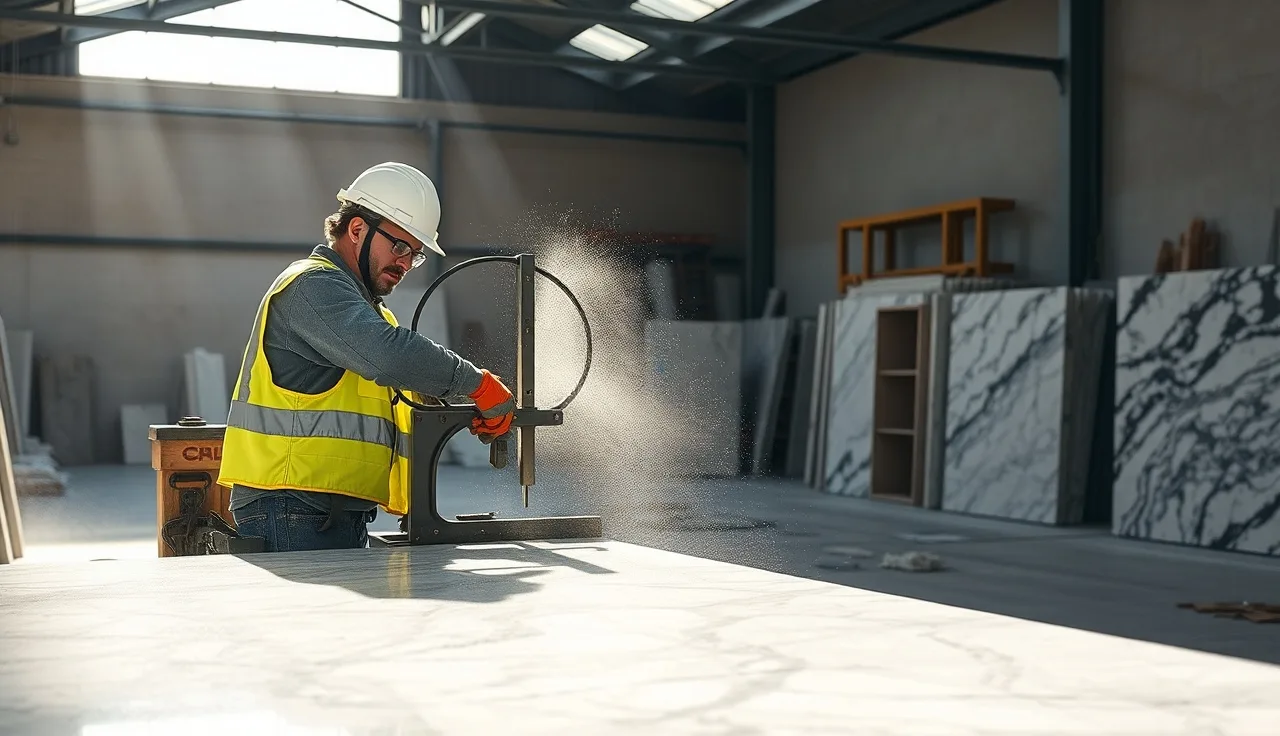
Fabricated natural stone is real quarried rock that a shop has cut to size, profiled on the edges, and finished with a surface treatment like polishing, honing, or brushing. The word fabricated just means processed. It is the opposite of a raw slab sitting in a yard. Once a fabricator is done, you have a countertop blank, a tile, a threshold, a window sill, or a cladding panel ready to install.
The fabrication method decides a lot about how the stone performs. A polished granite countertop and a flamed granite paver come from the same rock family but behave differently underfoot and under a hot pan. The surface treatment changes how porous the stone feels, how it reflects light, and how often it needs sealing.
Fabrication usually happens in one of three ways: CNC waterjet or saw cutting for precision shapes, hand profiling for ornate edge details, and grinding and polishing lines for surface finish. Most shops today run a bridge saw for straight cuts and a CNC router for curves and cutouts. Template-to-finished-slab turnaround at a typical shop runs five to ten business days, though that swings hard with shop volume [1].
Natural stone is a different animal from engineered quartz, sintered surfaces, or solid surface. It comes from a quarry, so every slab is unique. That uniqueness is a selling point and a sourcing headache both, because the slab you approve in the yard is the slab that has to work for your layout.
What are the most common applications for fabricated natural stone?
The list runs longer than most homeowners expect. The obvious use is kitchen countertops, but fabricated stone shows up in at least a dozen other places in a home and across commercial jobs too.
Kitchen countertops are the biggest single market for slab stone in the US. The Marble Institute of America (now part of the Natural Stone Institute) tracks this segment and has consistently found it represents roughly 40 to 50 percent of residential natural stone fabrication revenue [2]. Granite held the top spot for most of the 2000s and 2010s. Quartzite has been gaining share since around 2018.
Bathroom vanity tops and shower surrounds are the second big residential category. Stone is popular here because it handles moisture, but that popularity comes with a caveat: high-porosity stones like marble and limestone need diligent sealing in a wet shower or they stain and etch.
Fireplace surrounds and hearth pads are a classic stone application. Stone is non-combustible, which satisfies building codes, and it holds up to radiant heat that would warp or discolor other materials. Soapstone is especially good here because it absorbs and re-radiates heat evenly.
Flooring is a major commercial application and a growing residential one. Large-format tiles (24x24 and bigger) cut from granite, limestone, travertine, and slate go into foyers, great rooms, and commercial lobbies. Travertine floor tile ran hotel lobbies for decades.
Outdoor kitchens, pool coping, and exterior wall cladding are the growth edge right now. Fabricators who added outdoor capability in the early 2020s have seen strong demand. Not every stone works outdoors. Freeze-thaw cycles crack high-porosity stones, and UV exposure fades some sealer systems faster than expected.
Other uses include window sills, thresholds, stair treads, tabletops, bar tops, and decorative wall panels. Each is a smaller slice of the market. Together they add up.
Which natural stones are used for countertops and why?
Granite is still the workhorse. It scores 6 to 7 on the Mohs hardness scale, resists scratching better than most kitchen tools, and with annual sealing it takes daily cooking abuse without much complaint. The Natural Stone Institute notes that granite is one of the densest commercial countertop stones, which is why it resists staining better than marble at similar porosity levels [2]. See the full granite countertops guide for stone-specific maintenance and cost details.
Marble is softer (3 to 5 Mohs) and etches when acids like lemon juice or vinegar touch the polished surface. People choose it anyway because nothing else looks like it. If you want marble in a kitchen, hone the surface instead of polishing it. Etching is invisible on a matte finish. Marble countertops covers this tradeoff in depth.
Quartzite is the stone people confuse with quartz, the engineered product. Quartzite is metamorphic rock, usually harder than granite at 7 on the Mohs scale, with the veined look of marble and none of marble's acid sensitivity. The catch is that quartzite quality varies wildly by quarry. Some slabs sold as quartzite are actually a softer dolomite marble. Scratch the back of the slab with a metal key. If it gouges easily, it is probably not true quartzite.
Soapstone is soft (1 to 2 Mohs) and dents, but it is naturally non-porous, needs no sealer, and patinas beautifully over time. It is a real option for someone who wants a material that ages gracefully rather than staying pristine. The how to clean soapstone countertops guide explains the oiling routine that keeps soapstone looking intentional rather than neglected.
Limestone and slate show up occasionally in kitchens but suit lower-traffic areas better. Both are porous and softer than granite.
The table below sums up the key performance specs for the stones fabricators work with most.
| Stone | Mohs Hardness | Porosity | Acid Resistance | Needs Sealer? | Best Application |
|---|---|---|---|---|---|
| Granite | 6-7 | Low-medium | Good | Yes (annually) | Countertops, flooring |
| Marble | 3-5 | Medium | Poor | Yes (frequently) | Vanities, low-traffic counters |
| Quartzite | 7 | Low-medium | Good-excellent | Sometimes | Countertops, high-traffic |
| Soapstone | 1-2 | Very low | Excellent | No | Countertops, fireplace |
| Limestone | 3-4 | High | Poor | Yes (often) | Flooring, exterior cladding |
| Travertine | 3-4 | High (voids) | Poor | Yes | Flooring, bathroom tile |
| Slate | 2.5-4 | Low-medium | Fair | Optional | Flooring, roofing |
| Quartzitic Sandstone | 6-7 | Medium | Fair | Yes | Outdoor, coping |
How is fabricated stone used in flooring, cladding, and exterior applications?
Flooring is where tile-format fabrication takes over from slab fabrication. Most stone floors use tiles cut to 12x12, 18x18, or 24x24 inch formats, though large-format slabs installed as floor panels keep gaining ground in high-end residential work. Tile saw calibration matters more than people think. Tiles off by even a millimeter in thickness create lippage, an edge that sticks up and trips people or telegraphs grout lines unevenly.
Travertine floors need a decision upfront about the voids. Travertine has natural holes from gas bubbles in its formation. You can fill them with grout (filled travertine) or leave them open (unfilled). Unfilled looks more rustic and natural but collects dirt. Filled is easier to maintain.
Exterior cladding, or stone veneer panels cut from real quarried stone, is common on home facades, commercial building exteriors, and retaining walls. The key spec is thickness. Exterior panels typically run 3/4 inch to 1.5 inches thick. Thinner than that and freeze-thaw cycles can crack them. Thicker adds weight that requires engineering review for wall attachment [3].
Pool coping is the stone cap along the edge of a pool. It needs a non-slip surface finish (brushed or flamed, not polished) and has to handle constant water and chemical exposure. Travertine pool coping is by far the most common choice in warm climates because it stays cooler underfoot in direct sun than darker stones.
Outdoor kitchen countertops are a growing fabrication category. The same granite or quartzite used indoors works outdoors, but the fabricator should skip stones with visible iron content (they rust-streak when wet) and use an outdoor-rated penetrating sealer instead of a topical one. Topical sealers bubble and peel outdoors.
Slate earns a mention for flooring. It cleaves in layers, which gives it a textured, slip-resistant surface. That is why you see it on outdoor steps and entryways. It does not polish to a high gloss the way granite does, which limits its appeal indoors.
What does it cost to have natural stone fabricated and installed?
Cost gets complicated fast, because fabrication prices ride on stone type, slab cost, edge profile complexity, number of cutouts, and local labor rates. Here are the honest ranges fabricators and homeowners should know.
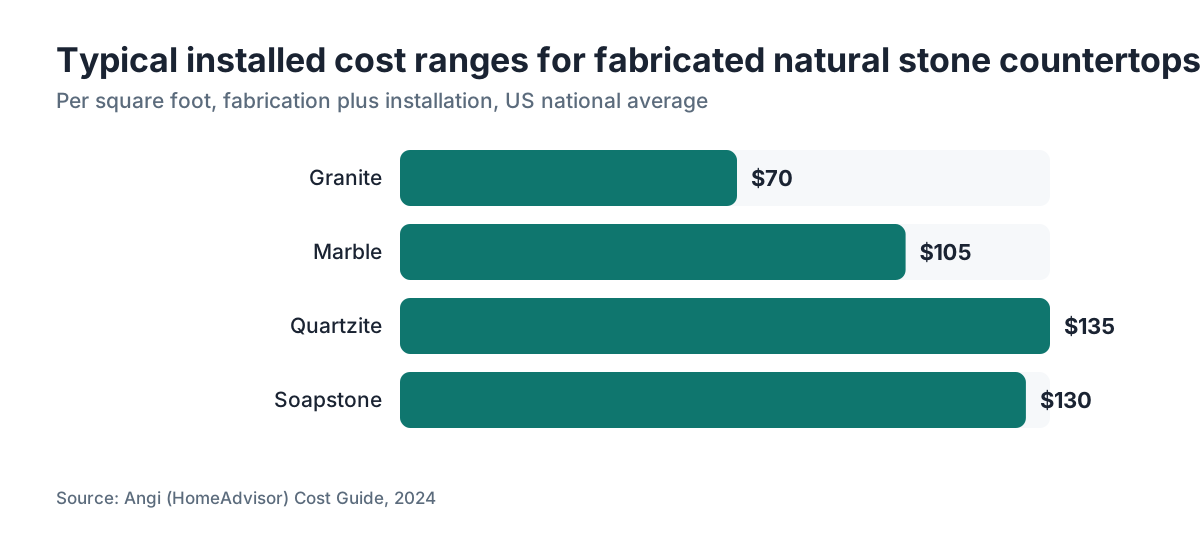
For countertop fabrication and installation combined (material plus labor), expect roughly $40 to $100 per square foot for granite, $60 to $150 for marble, $70 to $200 for quartzite (the wide range reflects how much quartzite quality varies), and $80 to $180 for soapstone [4]. These are 2024 US national estimates. Coastal metro markets run 20 to 40 percent higher.
Edge profiles add cost. A standard eased edge (squared with a slight bevel) usually comes in the base price. An ogee or waterfall edge can add $15 to $30 per linear foot. Mitered edges for thick-looking countertops add even more, because they require precise 45-degree cuts on two slabs that have to match in veining.
Sink cutouts typically run $100 to $200 each. Cooktop cutouts are similar. Seaming, which is joining two slabs, adds labor and takes skill. A good seam is nearly invisible. A bad one is obvious forever.
Floor installation for stone tile is usually quoted separately from material. Labor to set stone tile runs $8 to $20 per square foot depending on tile format, pattern complexity, and substrate condition. Large-format tile on an unlevel floor needs a self-leveling underlayment pour, which adds cost.
For fabricators pricing jobs, material cost is typically 40 to 60 percent of the total project price for slab work, with the rest covering labor, overhead, and margin. Shops with good quoting software price jobs faster and catch scope creep before it eats margin. SlabWise is built for exactly this, letting fabricators generate itemized quotes with material costs, edge profiles, and cutout charges in minutes rather than building spreadsheets from scratch.
The biggest hidden cost for homeowners is the gap between what you see in a showroom and what you actually get. Exotic quartzite or bookmatch marble commands a serious premium at the slab yard, sometimes $100 to $300 per slab over standard granite. That premium gets passed through.
How does the fabrication process work from slab to installed surface?
Understanding the fabrication process helps homeowners set realistic expectations and helps new fabricators see where the quality gates sit.
Step one is the template. After cabinets are installed and plumbing rough-in is done, a fabricator comes to the job site and templates the countertop layout. Modern templating uses a digital laser templater (like a Proliner) that captures exact dimensions, corner angles, and cutout locations. Older shops still use wood or cardboard strips. Digital templates transfer straight to CNC cutting files, which cuts error significantly [1].
Step two is slab selection and layout. The fabricator (or the homeowner, if they care about vein direction) lays the template over the slab at the yard and marks exactly where each piece gets cut. On a heavily veined stone, this step decides visual continuity. A fabricator who skips this conversation tends to eat callbacks.
Step three is cutting. The bridge saw makes the primary cuts. In a CNC shop, the router then handles curved cutouts, radius corners, and some edge profiles. Waterjet cutting handles complex shapes or decorative inlays. Waterjet is slow and expensive, so most shops reserve it for specialty work.
Step four is edge profiling. A CNC router or a hand-held router table shapes the edge. Edge work is one of the clearest ways to tell a good fabricator from a mediocre one. A poorly finished ogee profile has flat spots or swirl marks from the grinding wheels.
Step five is polishing. After shaping, the surface runs through a series of progressively finer diamond polishing pads. A full polish sequence might run 50, 100, 200, 400, 800, 1500, and 3000 grit. Stopping early leaves a honed or matte finish, which is a design choice, not a shortcut, as long as it is intentional.
Step six is sealing. Most stones get a penetrating impregnating sealer applied in the shop before delivery. It is much easier to do flat on a workbench than vertical on an installed piece. The sealer soaks into the pores and repels oil and water-based stains without changing the surface appearance much. See how to clean stone countertops for ongoing care after installation.
Step seven is delivery and installation. Slab countertops are heavy. A typical 3 cm granite slab weighs roughly 18 to 20 pounds per square foot [5]. A kitchen with 40 square feet of counter space is carrying 720 to 800 pounds of stone. The install crew handles rigging, adhesive setting, and final seam polishing on-site. Countertop installation details what to expect on that day.
How does fabricated natural stone compare to engineered and other countertop materials?
The comparison question comes up constantly, so it deserves a straight answer.
Engineered quartz (brands like Cambria, Silestone, Caesarstone) is 90 to 95 percent ground quartz aggregate bound with polymer resin. It is harder than most natural stones, non-porous, and needs no sealing. The tradeoff is that high heat discolors the resin and UV exposure yellows it outdoors. See the Cambria countertops guide for detail on one of the leading brands. Natural stone handles heat better and works outdoors. Engineered quartz handles stains better and is more consistent.
Laminate (Formica and its equivalents) costs $10 to $40 per square foot installed and has gotten dramatically better at photographic realism, but it cannot be repaired if it chips at an edge and it does not carry the same resale perception as stone. The laminate countertops and Formica countertops guides cover when laminate makes actual sense instead of being a budget compromise.
Solid surface (Corian and similar) is repairable, joins without a visible seam at sinks, and is easy to work with, but it scratches easily and lacks the depth of stone. Corian countertops is worth reading if you are comparing these for a bathroom project.
Butcher block is warm, renewable, and repairable, but it needs oiling and cannot live next to a wet sink without warping unless the species and finish are right. Butcher block countertops covers the species choices and maintenance.
The honest framing for a homeowner: natural stone has the highest ceiling and the widest floor, from cheap granite to exotic quartzite. It asks more care knowledge than engineered materials. It adds real resale value in most markets. If you are outfitting a rental or a high-use commercial space, the ease of engineered quartz often wins on total cost of ownership. If you are doing a primary kitchen you plan to live with for 15 years, natural stone is hard to beat on character and longevity.
What building codes and standards apply to stone fabrication and installation?
Building codes do not regulate stone fabrication directly the way they regulate electrical or plumbing. What they regulate are the structural requirements for what the stone sits on, the fire ratings for hearth applications, and in some jurisdictions, silica dust exposure during fabrication.
The silica dust issue is the most significant regulatory development in the stone trade in the last decade. Silicosis, a permanent and sometimes fatal lung disease, has been documented at elevated rates among stone fabricators who cut engineered quartz and some natural stones without adequate dust controls [6]. OSHA's silica rule for construction, 29 CFR 1926.1153, took effect in 2017 and requires fabricators to keep worker exposure to respirable crystalline silica below 50 micrograms per cubic meter as an 8-hour time-weighted average [7]. Wet cutting and vacuum extraction are the primary controls.
For fireplace hearths and surrounds, the International Residential Code (IRC) Section R1001 sets minimum hearth extension dimensions: the hearth must extend at least 16 inches in front of and 8 inches beyond each side of a fireplace opening less than 6 square feet [8]. Stone meets the non-combustible material requirement, but the fabricator should know the dimensions before cutting.
For exterior cladding and veneers, ASTM C1242 is the standard guide for the design, selection, and installation of exterior dimension stone [9]. It covers minimum thickness, anchorage, and movement joint requirements. A fabricator doing exterior work should have at least a working familiarity with this document.
Countertop overhangs without support follow physics and common sense more than code. A 3 cm slab can cantilever about 12 to 15 inches without corbel support before deflection and cracking risk climbs meaningfully. Beyond that, most fabricators require corbels or a hidden steel plate support, and that requirement is sound whether or not local code spells it out.
What are the most common problems with fabricated stone and how do you avoid them?
The problems that come back to bite homeowners and fabricators fall into a predictable set.
Etching is the chemical reaction between acid and calcium-based stones like marble, limestone, and travertine. It looks like a dull spot, and people often mistake it for a stain. You cannot wipe it off because it is surface damage, not a deposit. The fix is re-polishing, which a restoration pro can do. Avoidance means choosing a honed finish on marble in kitchens (etch marks vanish on matte) or picking a non-calcium stone if you cook acidically.
Seam visibility is the fabrication quality issue homeowners notice most. A seam is unavoidable when a countertop run exceeds slab size (most slabs are 55 to 65 inches wide). A skilled fabricator places seams away from sight lines, matches vein direction across the seam, and color-fills the epoxy to match the stone. A mediocre one does not. Ask to see seam photos from past jobs before you hire.
Cracking during installation happens when the substrate is uneven, the stone bridges a void, and then takes point load. The fix is proper cabinet leveling before templating. Cracks can also come from thermal shock (pouring boiling water into a cold stone undermount sink, for example), though that is rare with well-supported countertops.
Sealant failure shows up as water that soaks in rather than beading up. Most penetrating sealers last 3 to 10 years depending on stone porosity and traffic. A simple water test tells you where you stand: put a tablespoon of water on the stone. If it darkens right away and does not bead, seal it. If it beads for several minutes before absorbing, you are fine [10].
Color mismatch between slab lots is a sourcing problem. If you need more stone later for a repair or addition, the new slab from the same quarry may have shifted in color. Natural stone is a natural product. This is not a defect, but it means you should order 10 to 15 percent more than your square footage needs, especially for quarried materials with strong color character.
For quartzite specifically, the soft-stone-sold-as-quartzite problem is real. The how to clean quartzite countertops guide has a scratch test section that helps you verify what you actually have before committing to a slab.
How do fabricators price and quote natural stone jobs efficiently?
Quoting natural stone fabrication is harder than it looks from the outside. The price per square foot is just the start. Edge linear footage, number of cutouts, seam count, material waste factor, delivery distance, and install complexity all move the job economics.
The waste factor alone trips up new fabricators. A simple rectangular countertop might waste 15 to 20 percent of a slab. An L-shape with a diagonal seam and an island cutout might waste 35 to 50 percent. If your quote does not account for true material consumption, you price yourself into jobs that lose money.
Experienced shops build a pricing matrix that starts with a base rate per square foot by stone category, then adds line items for each edge linear foot by profile type, each cutout by type and complexity, each seam, and the template, delivery, and install labor. Review that matrix at least once a year, because slab-yard pricing moves with quarry output, shipping costs, and exchange rates (most exotic stone is imported).
Shops that still quote in spreadsheets or by gut feel leave money on the table or misquote complex jobs. This is exactly what software like SlabWise solves. A fabricator pulls up a job, enters measurements, picks stone and edge profiles, and has an accurate itemized quote in a few minutes, with material costs reflecting current slab pricing.
For homeowners comparing quotes: if two quotes look identical but one is 30 percent cheaper, the gap is usually in material grade, edge profile, or what is and is not included in installation. Ask each shop to itemize the quote so you can compare line by line. A quote that lumps everything into one price per square foot is hard to evaluate.
What maintenance does fabricated natural stone need over time?
Maintenance differs enough by stone type that there is no single answer. The broad principles hold steady, though.
Sealing is the main recurring task for porous stones. Granite typically needs a penetrating sealer reapplied every 1 to 3 years. Marble and limestone want it every 6 to 12 months in kitchen use. Quartzite varies by density. A dense quartzite may go 3 to 5 years. Soapstone needs no sealer but benefits from periodic mineral oil application to even out the patina. The Natural Stone Institute's care and maintenance guide is the best primary source for stone-specific schedules [10].
Daily cleaning is simpler than most people expect. pH-neutral dish soap and warm water works for all natural stones. What damages stone is regular use of all-purpose cleaners, vinegar solutions, bleach, or anything with citrus. These etch or slowly degrade the sealer on calcium-based stones.
Restoration is a real service category. A stone honing contractor can bring a severely etched or scratched marble surface back to original condition. This runs $5 to $15 per square foot depending on severity, far cheaper than replacement. For granite, chip repairs use color-matched epoxy fills that are nearly invisible when done well.
Commercial stone floors need more aggressive programs. Polished stone floors in high-traffic lobbies get diamond pad burnishing on a regular schedule to hold their shine, plus periodic deep cleaning and resealing. This is specialized work that building managers often contract to stone restoration companies rather than general janitorial services.
The point for any stone owner: maintaining natural stone properly over 20 years costs little compared to replacing a damaged surface. Most stone failures are preventable with basic knowledge.
Frequently asked questions
What is the most popular application for fabricated natural stone in homes?
Kitchen countertops. They represent roughly 40 to 50 percent of residential natural stone fabrication revenue in the US according to the Natural Stone Institute. Bathroom vanity tops and shower surrounds are the second most common use. Fireplace surrounds, flooring, and window sills follow. The kitchen dominates because homeowners see the countertop daily and it strongly influences resale perception.
Can natural stone be used outdoors?
Yes, with the right stone and the right sealer. Granite, quartzite, slate, and dense limestone handle outdoor use well. High-porosity stones like travertine and soft limestone crack in freeze-thaw climates if water penetrates and freezes inside the pores. Pool coping is almost always travertine in warm climates because it stays cooler underfoot. Use a penetrating outdoor-rated sealer rather than a topical film sealer, which peels outdoors.
What is the difference between quartzite and quartz countertops?
Quartzite is a natural metamorphic rock quarried from the ground. Quartz countertops are engineered: roughly 90 to 95 percent ground quartz mineral mixed with polymer resin and pigment, then formed in a factory. Quartzite is harder (about 7 Mohs), handles heat better, and varies from slab to slab. Engineered quartz is consistent, non-porous, and needs no sealing. The names are similar, which causes real confusion at showrooms.
How thick should a natural stone countertop be?
Most residential countertops are 3 cm (about 1.2 inches) thick. This is what most slab yards stock and what most fabricators price around. Some kitchens use 2 cm slabs (thinner, lighter, cheaper) with a built-up laminated edge to look thicker. Outdoor applications and commercial floors often go thicker for structural reasons. For bar tops with long overhangs, 3 cm is the minimum; anything beyond a 12 to 15 inch unsupported cantilever needs added support.
Does natural stone add resale value to a home?
Most real estate data suggests stone countertops positively influence buyer perception and sale price in mid-to-upper price ranges, but the exact return varies by market and material. A National Association of Realtors survey found kitchen renovations including stone countertops among the updates with strong resale impact, though full cost recovery is rarely 100 percent. In lower price-point markets, laminate or quartz may be sufficient to compete.
What natural stone is best for a fireplace surround?
Soapstone, slate, and granite are the top choices. Soapstone absorbs heat and releases it slowly, making it practical for wood-burning fireplaces. Slate and granite are non-combustible and handle radiant heat without cracking. Marble looks elegant but acid from soot can etch it over time. Avoid any stone with high resin content or heavy chemical treatment, since high heat can cause off-gassing or surface damage.
How long does stone fabrication take from template to installation?
Most shops complete the job in 5 to 10 business days from template to installation. Busy season (spring and fall remodeling peaks) can push that to two to three weeks. Exotic or special-order stone adds lead time for the slab itself to arrive from the yard or importer. Digital templating speeds up the cutting phase; shops using CNC with digital templates lose fewer days to measurement error and re-cuts.
Do I need a permit to have stone countertops installed?
In most US jurisdictions, replacing countertops does not require a permit. The exception is if the project includes moving plumbing, adding electrical circuits, or if the countertop is part of a larger kitchen remodel that crosses a permit threshold in your municipality. Fireplace hearth extensions may require a permit review in some areas because they relate to a fire-rated assembly. Always check with your local building department if you are unsure.
What is the OSHA silica rule and why does it matter for stone fabrication shops?
OSHA's silica standard for construction (29 CFR 1926.1153) limits worker exposure to respirable crystalline silica to 50 micrograms per cubic meter as an 8-hour time-weighted average. Stone shops cutting granite, quartzite, or engineered quartz generate silica dust that causes silicosis. Compliance requires wet cutting, vacuum extraction, or supplied-air respirators. Shops that ignore this face OSHA citations and, more importantly, harm their workers.
How much waste should I expect when fabricating natural stone?
Simple rectangular countertops waste roughly 15 to 20 percent of a slab. Complex L-shapes, islands, or projects that require matching veins across seams can waste 35 to 50 percent. This is why ordering 10 to 15 percent more square footage than your net countertop area is standard advice. Waste also depends on slab size relative to your layout; smaller slabs produce more offcut waste than full jumbo slabs.
Can fabricated stone be repaired if it chips or cracks?
Yes, in most cases. Chips in granite, marble, and quartzite can be filled with color-matched polyester or epoxy resin. A skilled restoration tech can make small chips nearly invisible. Cracks are harder. Hairline cracks can be stabilized with resin injection, but structural cracks (through the full thickness) usually mean the piece needs replacement. Soapstone is softer and dings more easily but can be sanded smooth, which no other stone can claim.
What stone finish options are available and which should I choose?
The main finishes are polished (high gloss, shows veining vividly, easy to wipe clean, shows fingerprints), honed (matte, hides scratches and etch marks better, slightly more porous feel), brushed or leathered (textured surface that hides smudges, good for darker stones), and flamed (very rough texture, used outdoors for slip resistance). For a kitchen with marble, honed is the practical choice. For granite, polished is most popular, but leather finishes have grown quickly.
What is bookmatch fabrication and when is it worth the cost?
Bookmatching means cutting two consecutive slabs from the same block and opening them like a book, so the veining mirrors across a central seam. The result is a symmetrical, dramatic vein pattern often used on kitchen islands, bathroom feature walls, or fireplace surrounds. It requires buying two matched slabs (more material cost), precise alignment during install, and careful seam placement. The visual effect can be stunning. It is worth the cost when the vein character is the whole point of the stone choice.
How do I compare quotes from different stone fabricators?
Ask each shop to itemize: material cost per square foot for the specific slab you selected, edge profile cost per linear foot, cutout charges, seam charges, template fee, delivery, and installation. A lump-sum price per square foot makes comparison impossible. Also check what stone thickness is quoted (2 cm versus 3 cm changes material weight and cost), and whether the quoted sealer application is included or extra. Reference checks on seam quality from past jobs are worth the time.
Sources
- Natural Stone Institute, Stone Fabrication Operations Guide: Digital laser templating reduces measurement error and typical fabrication turnaround runs 5 to 10 business days
- Natural Stone Institute, Industry Statistics and Market Data: Kitchen countertops represent roughly 40 to 50 percent of residential natural stone fabrication revenue; granite is among the densest commercial countertop stones
- ASTM International, ASTM C1242 Standard Guide for Selection, Design, and Installation of Exterior Dimension Stone Anchoring Systems: Exterior stone veneer panels typically require minimum thickness and anchorage specifications to handle structural and freeze-thaw loads
- HomeAdvisor (Angi), Stone Countertop Cost Guide 2024: Granite countertop fabrication and installation runs $40 to $100 per square foot; marble $60 to $150; quartzite $70 to $200; soapstone $80 to $180 nationally in 2024
- Natural Stone Institute, Technical Handbook for Stone Specifications: A 3 cm granite slab weighs approximately 18 to 20 pounds per square foot
- CDC / NIOSH, Silicosis Mortality Among Workers in the Stone Countertop Industry: Elevated rates of silicosis have been documented among stone fabricators who cut engineered quartz and some natural stones without adequate dust controls
- OSHA, 29 CFR 1926.1153 Respirable Crystalline Silica Standard for Construction: OSHA requires fabricators to maintain worker exposure to respirable crystalline silica below 50 micrograms per cubic meter as an 8-hour time-weighted average, effective 2017
- International Code Council, International Residential Code Section R1001, Masonry Fireplaces: IRC R1001 requires hearth extension of at least 16 inches in front and 8 inches to each side of a fireplace opening less than 6 square feet; stone satisfies the non-combustible material requirement
- ASTM International, ASTM C1242 Standard Guide for Design, Selection, and Installation of Exterior Dimension Stone: ASTM C1242 governs minimum thickness, anchorage, and movement joint requirements for exterior stone cladding
- Natural Stone Institute, Care and Maintenance of Natural Stone: A simple water bead test determines if a stone needs resealing; penetrating sealers for granite last 1 to 3 years; marble and limestone may need resealing every 6 to 12 months in kitchen use
- National Association of Realtors, Remodeling Impact Report: Kitchen renovations including stone countertops rank among updates with strong resale impact in NAR homeowner and realtor surveys
- US Geological Survey, Mineral Commodity Summaries: Stone (Dimension): USGS tracks dimension stone production and import data including granite, marble, limestone, sandstone, and slate in the US
Last updated 2026-07-10